Get in touch with Cenwan Machine Company


Folder gluer machine budget planning is the process of pricing four categories that carton and corrugated converters most often under-price: funding options, extra-cost features most buyers don’t see, calculating total costs for imported machines, and packaging all of it into one number for real packaging-industry operations. Updated July 2026.
Quick Specs: Folder Gluer Machine Budget Categories
| Equipment capital outlay (new) | $13,000 entry-level → $1M+ high-end configurations |
| Ancillary modules (packers, conveyors, glue systems) | $5,000–$65,000 collecting tables · up to $400,000–$600,000 full-auto packers |
| Financing starting rates (US, July 2026) | 5.99%–8.50%+ simple interest/APR (equipment business loans) |
| Landed-cost premium (imported machines) | Commonly 20%–60% above factory quote once freight, duty, and installation are added |
| 2026 Section 179 deduction ceiling (US) | $2,560,000 |
Beyond the Sticker Price: What a Folder Gluer Machine Budget Actually Includes
The process for folder gluer machine budgeting begins with a reality check: the price on a proposal will never be what you pay. Beyond capital costs of the machine itself are extra charges for support and packaging solutions, and operating and site expenses for startup and use – all factors that turn up in industry discussions about sourcing but which most purchasing departments limit their planning to the first. Omitting two-thirds of your overall budget leads to cost overruns even before the folder gluer has produced a single box.
This is less about buyer error and more about a structural misunderstanding. Manufacturers price equipment quotes with the folder gluer as the primary object of sale because that’s what they sell; items such as pack-out solutions and installation costs beyond the machine itself, as well as the cost of shipping and starting the equipment, fall to the buyer – particularly buyers who haven’t had to build a full-scope capital expenditure budget before. Consequently, list the three areas below on your equipment budget as soon as possible (using even approximate figures), so that your conversations with vendors are based on a full budget.
What Drives Your Bucket 1 Price Tier
Before financing, packaging machines or installation, mechanical characteristics are used to price a folder gluer; these include production speeds, the breadth of box types that can be processed, folding accuracy and rigidity, flexibility across various materials, changeover times, and after-sale service records of the vendor.
By understanding the cost implications of each feature, you can prevent purchasing more production capability than is required by the line – buying past your actual production needs inflates Bucket 1 without a matching gain in production efficiency or return on investment.
Box style range and complex folding are the first order of business; a straight-line corner folder for simple folding cartons costs far less than a machine built for six-corner folds or the more complex 4-corner box folder configurations, as the full folder gluer machine range comparison illustrates in its series breakdown. Speed and throughput demands will move you up or down the price scale within a specific box-style class. A high-speed automatic servo-drive model built to run at higher speeds for heavy production and fast format changeover will cost more than a lower-speed semi-automatic line geared for consistent, but lower, production volume. Precision, range of materials that can be fed, substrate thickness tolerance and setup/changeover time across different jobs are the specification points worth having every supplier quote on your specific needs, rather than a generic list. Be sure to ask whether the folding patterns and format settings are electronically adjustable from a touchscreen interface for ease of use, or whether a manual mechanical adjustment is required – a factor that can literally halve or double the setup time in a mixed format environment. Beyond the sticker price, operational ease, sensors on the compression section for quality checks, and vendor reliability, parts support, and technical service are important factors to discuss, which fit best into the “Bucket 1” conversation, not as afterthoughts.
A point to note on a closely related but separate classification: A simple folder gluer runs the mechanical process of folding and gluing on pre-printed, die-cut blanks, while a flexo folder gluer integrates both printing and that same folding process into a single machine; this isn’t simply a different option for the same equipment but a distinctly different category of machine altogether. Comparing different machines side by side matters here, because a full automatic line and a simple folder gluer solve different problems even when their sticker prices overlap. Customers running many types of substrate, different grades of paperboard and corrugation, or the most difficult corner-fold applications will want to verify any automatic folder gluer machine can adapt to their full spectrum of job mixes and actual operating speed. Without this assurance, they run the risk of a second purchase being required just a year later, effectively doubling the initial Bucket 1 investment.
Financing and Leasing Options for a Folder Gluer Machine Purchase
The majority of mid- to high-range folder gluer equipment isn’t paid for in cash. Instead, these investments are typically financed, just as all other significant capital equipment would be – whether through a traditional loan or lease-to-own structure. Most converters simply can’t afford to have six or seven figures of working capital sitting on a shelf, otherwise, there’s simply no cash to put toward raw materials, labor and to fulfill their other incoming orders.
Rates on equipment business loans as of July 2026 span roughly 5.99% to 8.50%+ simple interest or APR across major lenders, with the low end reserved for the strongest credit profiles and shorter terms and the high end applying to lower credit scores or higher-risk loan structures, according to Bankrate’s July 2026 comparison of equipment loans. For comparison of how amount and term affect pricing of equipment loans, see AgDirect’s published table of equipment loan rates, where it lists fixed rates in the 6.00%-6.50% range for equipment costing more than $250,000 on 2- to 7-year terms-which are comparable figures, regardless of whether they’re used to fund agricultural equipment or folder gluers-as the logic of loan underwriting-securing loan by depreciating industrial asset, financed over multiyear term-is the same.
✔ Financing / Leasing
- Preserves working capital for materials, payroll, and the next order
- Loan payments can be sized to match expected throughput gains
- Operating leases keep the machine off the balance sheet as a fixed asset
- Interest cost is often deductible; Section 179 can apply to financed purchases the same as cash purchases
⚠ Cash Purchase
- No interest cost over the life of the machine
- Full ownership and equity in the asset from day one, no lender covenants
- Ties up capital that can’t be redeployed if throughput assumptions don’t hold
- Six-to-seven-figure cash outlay is simply not available to many mid-size converters
Whether the purchase mechanism should be leasing or financing isn’t a question of right and wrong, but which one aligns with cash flow and planned ownership length. “The ‘cheaper’ method isn’t always the better method.
The monthly payments might be less with the lease option but the interest totals more over the lifetime of the equipment, which can result in more total money out of pocket compared to loan payments over the same lifetime period.” That advice was cited in Crestmont Capital’s lease versus buy analysis, and it rings true when compared to the following observation from a small-business forum discussion of financing acquisition.
“The actual financing could be the manufacturer or a bank, insurance company, credit union, etc. That would likely be the best rates you’ll get.”
r/SmallBusinessCanada, equipment leasing discussion thread
When buyers come with pre-approved financing, they tend to proceed through the process from purchase order to shipping date more smoothly, as capital issues have been addressed prior to specifying machine components.
The Hidden Line Items Most Folder Gluer Machine Buyers Forget to Budget
What’s a folder gluer cost?
It’s easy for most plant managers to answer with the machine cost only. What’s the total cost of the line, however, when everything else necessary for operation is factored in?
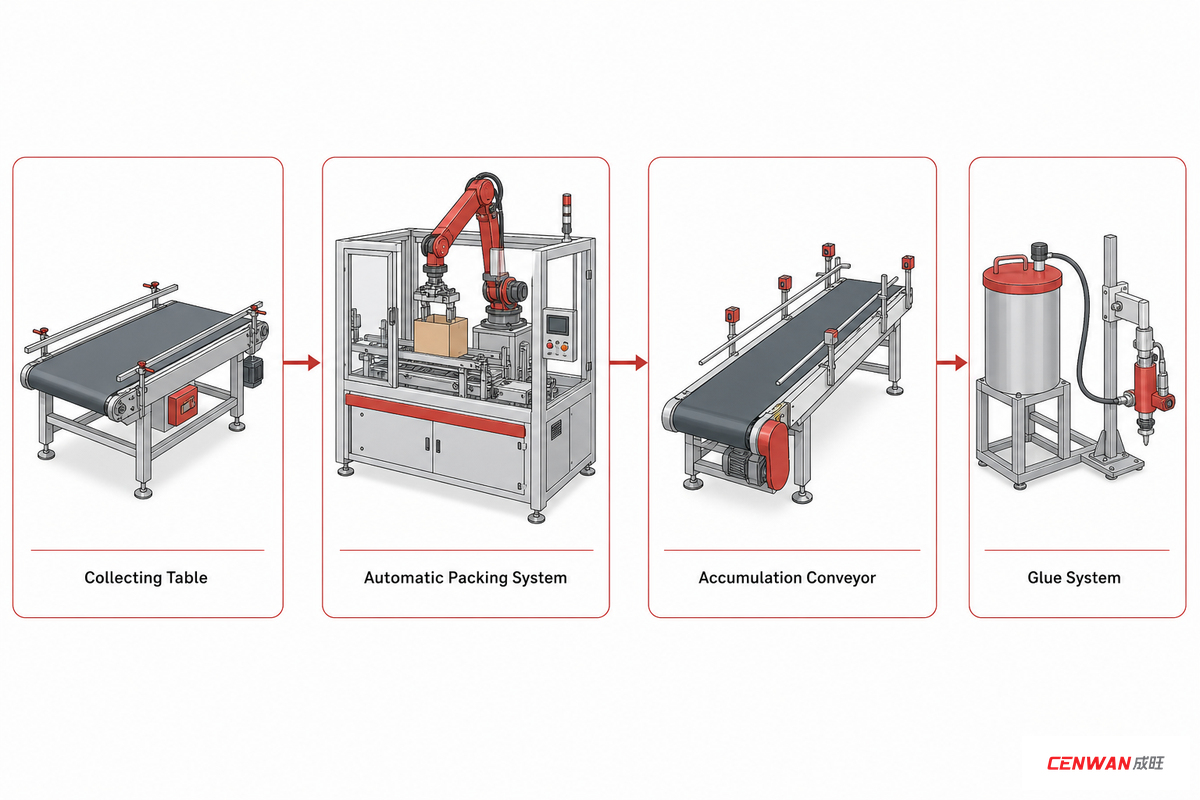
Typically, those numbers increase significantly when tables, automatic packing systems, accumulation conveyors, pre-feeders, and glue systems-ancillary components most frequently overlooked-are included in the initial cost estimates, based on industry sourcing discussions. Suppliers can customize most of these modules to your packaging needs, but customization is a Bucket 2 line item, not something that shows up free on the base folder gluer quote.
| Module | Typical Cost Band | Why It’s Missed |
|---|---|---|
| Collecting tables | $5,000–$65,000 | Treated as a “finishing detail,” priced last |
| Fully automatic packing systems | Up to $400,000–$600,000 | Buyers assume packing is a separate future purchase, not day-one scope |
| Accumulation conveyors / pre-feeders | Varies by line length and layout | Quoted by a different vendor than the folder gluer itself |
| Glue system upgrade | Varies by adhesive type and duty cycle | Assumed to be “included” when the base machine ships without one fully equipped |
Spare parts and consumables belong in the same conversation, even though each one is a smaller line item on its own – belts, glue nozzles, and format-specific tooling wear on a predictable cycle and should be budgeted as an annual reserve, backed by regular maintenance, rather than a mid-shift surprise. A documented maintenance routine is also the cheapest way to reduce downtime and reduce labor hours lost to unplanned troubleshooting – the whole point of automating the production line was to increase productivity, and unmanaged wear quietly erodes that gain. A documented routine also extends machine longevity, which matters most in high-mix production environments running long shifts. Vendor technical support and parts availability matter just as much as the machine itself once it’s turning out glued boxes on your floor; a line built to reduce manual intervention only pays off if support is there when a part wears out. Our own folder gluer parts guide and belts and rollers guide break down pricing by component class; the wear-cycle calculator converts those bands into the annual figure that belongs in this part of your budget, rather than a guess.
Freight, Installation, and Commissioning: The Landed-Cost Stack
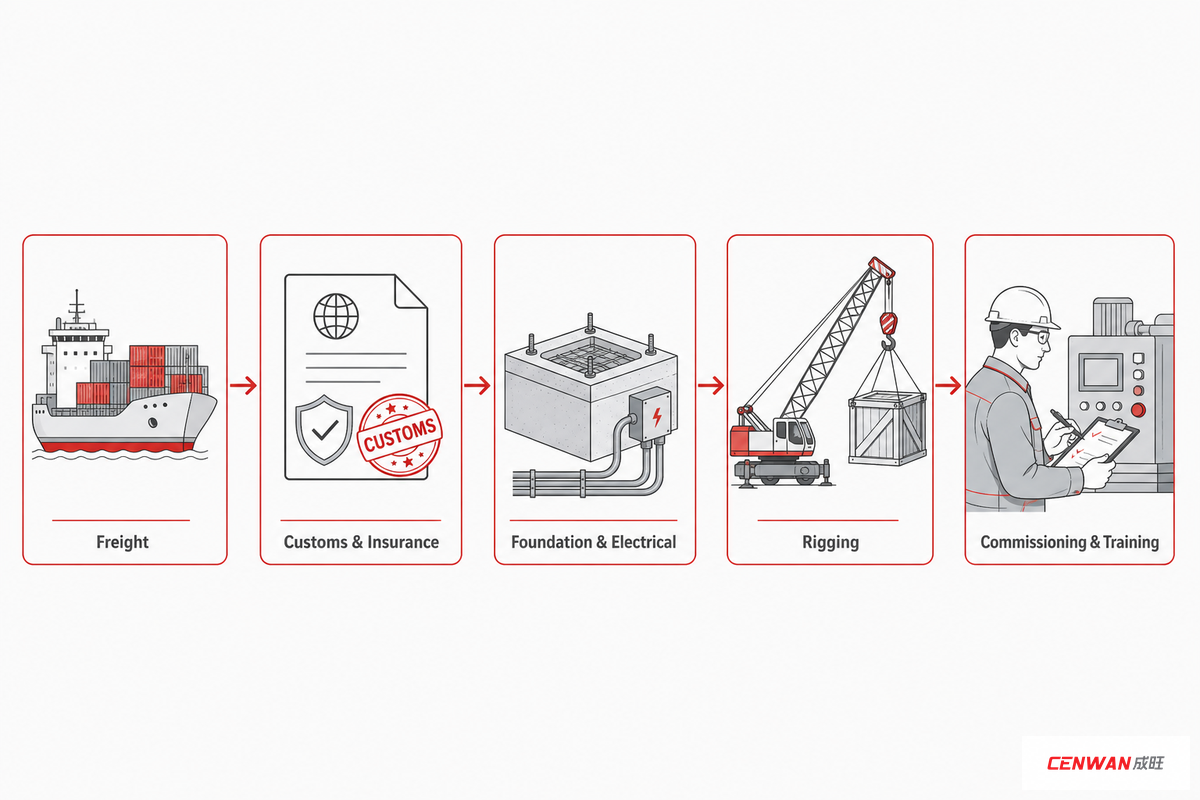
The cost difference between a factory-quoted folder gluer and what a machine on the floor is costing you, for an internationally sourced unit (most entry and mid-range machines fall into this category), isn’t just rounding error. Landing industrial machinery typically adds 20%-60% to the factory unit price, with the higher end reserved for more complex machines or when port-to-plant logistics require air freight for some components. We call this the Landed-Cost Stack, five elements to price before you sign the PO, not after the machine ship. That five-element breakdown isn’t a Cenwan invention – a U.S. Department of Energy equipment cost-estimation methodology confirms freight, insurance, duties, and commissioning as standard components of any industrial equipment’s true landed cost, not optional line items a buyer can assume away.
The Landed-Cost Stack
- Freight-While there may be rare occasions where air freight makes sense for truly critical items, the bulk of a folder gluer’s components are shipped via sea, as a rule of thumb; air can be several times the price of sea freight for a comparable size and weight shipment.
- Customs and Insurance-This can vary but expect to pay some duty based on declared value and appropriate tariff class, plus marine insurance to protect a fairly large investment (usually just a fraction of the total cost but still significant).
- Foundation and Electrical-These can be a bigger cost on some sites, especially for older facilities. Ensure you’ve a clean, flat site area and the necessary electrical service (power and pneumatic connections if needed) correctly sized and installed to avoid adding cost after installation.
- Rigging-You’re moving several tons, potentially. Most sites don’t have the necessary cranes and forklifts readily available for this part of the operation, especially when working in areas where space is limited.
- Commissioning and Training-The work isn’t done until the machine is up and running and is producing good work at or near rated speed. A portion of the cost should include machine setup, fine-tuning, and training of operators and maintenance personnel.
📐 Engineering Note
Automation tier drives much more than throughput – it drives footprint and electrical scope, which drive installation cost. Working width alone for a straight-line folder gluer ranges from around 650 mm wide to around 3,200 mm wide, and an integrated stacker-strapper attachment adds generally 2-4 m to the rear of the line. Confirm floor length, not just floor area, against your planned full line configuration – including any in-line stacker or strapper – prior to the foundation and electrical contractor providing a fixed quote, or the installation-cost line in your budget will be based on the machine alone rather than the finished line.
How the Used Folder Gluer Machine Market Changes Your Budget Math
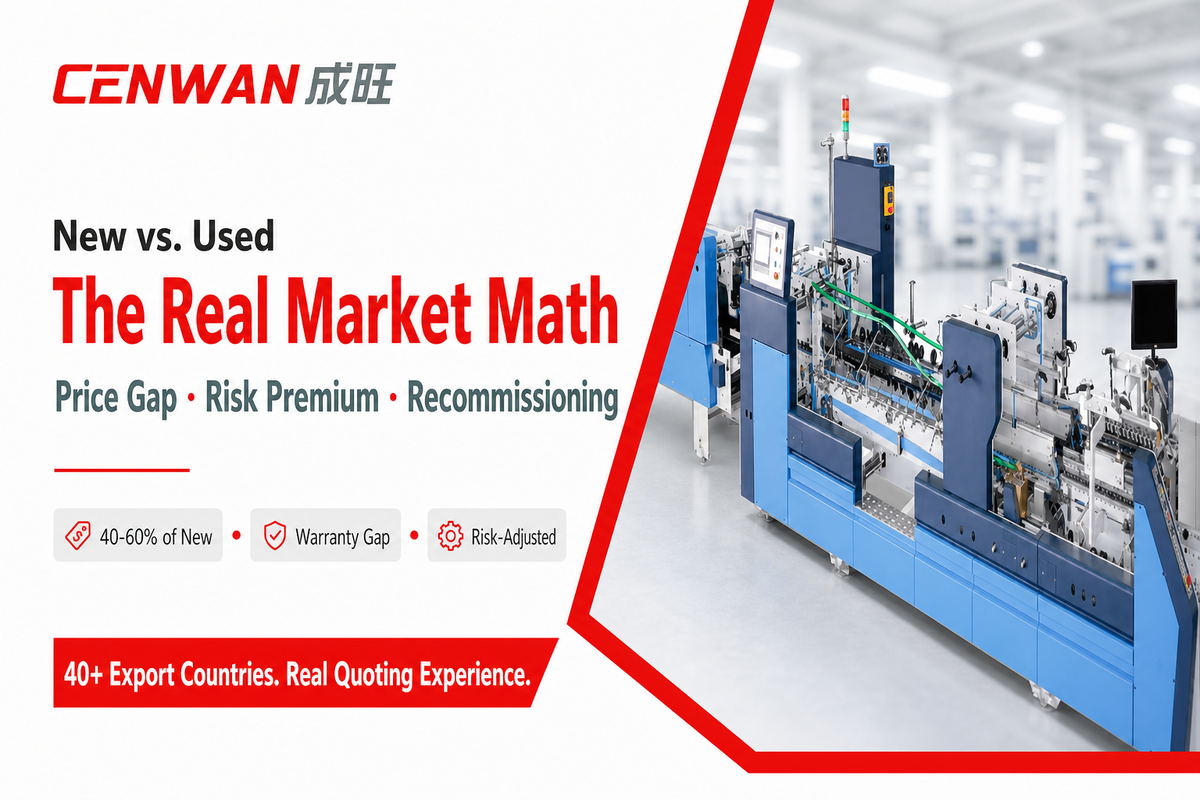
The used folder gluer market is active – hundreds of used machines sit on major industrial trade platforms at any given time, at roughly 40%-60% of new-machine list price for a comparable refurbished unit (per our own tracked new-versus-used secondary market data, linked below).
That price gap is real, but it isn’t the entire budget picture, and this is where used-market advice most often goes wrong: it stops at the sticker comparison rather than asking what the used machine adds back to the budget in risk.
Three items belong in the actual cost of a used machine to your budget that a new-machine quote doesn’t bear: a warranty gap (used equipment usually carries little or no manufacturer warranty, shifting failure risk to the buyer), a recommissioning cost (inspection, part replacement, and calibration prior to the machine being able to run production reliably), and a downtime risk premium (an unfamiliar machine with an unreported maintenance history is statistically more prone to suffer an early failure than a new one under warranty). None of these occur in the used-equipment listing price.
Key Factors for Risk-Adjusted Used-Machine Budgeting
- Request maintenance logs and recent production samples prior to budgeting the purchase price as final – a machine without documented history should be priced with a larger recommissioning reserve, not a smaller one.
- Add a recommissioning line item (inspection, likely part replacement, calibration) as a fixed percentage of purchase price rather than assuming zero.
- Budget for the warranty gap by calculating a first-year spare-parts allowance above what a new machine under warranty would require.
- Compare the used option against a second-line capacity requirement rather than a flagship line – the risk-adjusted calculation favors used equipment most clearly when it’s purchasing a backup or overflow line, not when it anchors a plant’s primary output.
Our own detailed breakdown of the new-versus-used secondary market addresses the price ranges and listing volumes in detail; the risk-adjustment framework above is what converts that price comparison into a budget decision.
How to Build Your Folder Gluer Machine Purchase Budget: A Step-by-Step Allocation Framework
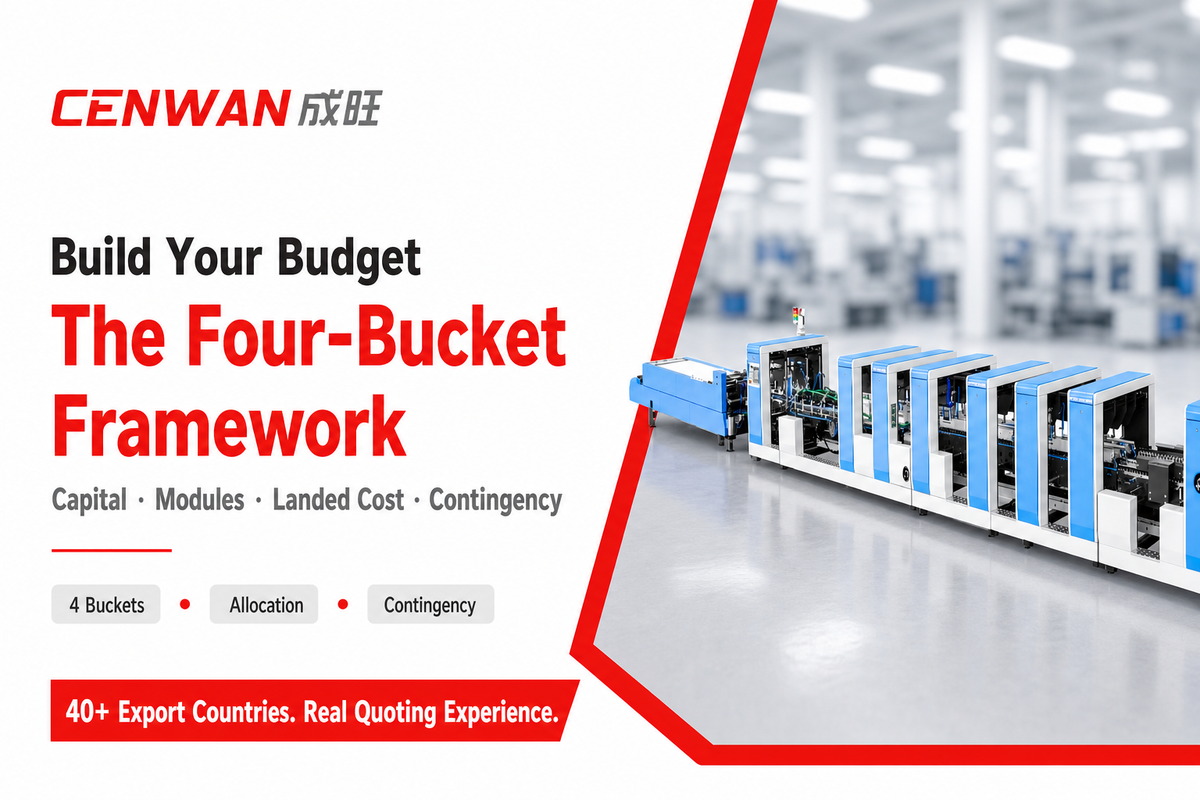
With those buckets set, the final piece is translating all those five-plus line items into one single number that a finance team (or bank loaning money for the investment) will base their decisions on – the true, end-result cost of the asset, not simply the sticker price. And it’s also more flexible; when a supplier estimate rolls back showing the machine at a different level of automation than we budgeted, we can adjust a single bucket’s cost without going back to redesign the whole thing. Our own TCO and budget-planning tools are built on this same four-bucket arrangement, which keeps those separate categories from dissolving into one, glossed-over line.
The Four-Bucket Purchase Budget Checklist
- Bucket 1 – Equipment Capital. This is the machine itself, at the same tier of automation as your box-style range and target throughput, not at the tier a vendor demo make most impressive.
- Bucket 2 – Ancillary Modules. Collecting tables, packing systems, conveyors, and glue systems, priced from Bucket 1’s actual line configuration, not assumed as “already included.”
- Bucket 3 – Landed & Install: this refers to all of the Landed-Cost Stack mentioned previously: freight, duty, insurance, foundation/electrical, rigging, commissioning and training; calculated as a percentage of Bucket 1, using the 20% to 60% rule of thumb range until you’ve a firm freight quote.
- Bucket 4 – Spare Parts and Contingency – Allocate an amount to account for first-year spare parts, and a percentage of contingency on anything the quote didn’t perfectly account for, like shipping, site work or a lengthier commissioning.
| Bucket / Category | Line-Item Type | Typical Cost Band | Timing / Notes |
|---|---|---|---|
| Bucket 1 – Equipment Capital | Entry-tier semi-automatic machine | From $13,000 | Base unit only, before any Bucket 2-4 additions |
| Bucket 1 – Equipment Capital | High-end automated configuration | $1M+ | Full automation, complex box styles, top-tier throughput |
| Bucket 2 – Ancillary Modules | Collecting tables | $5,000-$65,000 | Priced last; often wrongly assumed to be included |
| Bucket 2 – Ancillary Modules | Fully automatic packing systems | $400,000-$600,000 | Buyers often treat this as a separate future purchase |
| Bucket 3 – Landed & Install | Freight, duty, foundation, rigging, commissioning stack | 20%-60% of Bucket 1 | Internationally sourced machines; use as a rule of thumb until a firm freight quote lands |
| Bucket 4 – Spares & Contingency | Contingency reserve | Same 20%-60% band as Bucket 3 | Higher end for a new port partner, unfamiliar HS code, or new freight forwarder |
| Financing | Standard equipment business loan | 5.99%-8.50%+ simple interest/APR | July 2026 rates; varies with credit profile and term |
| Financing | Larger-ticket equipment loan (over $250,000) | 6.00%-6.50% fixed | 2- to 7-year terms; same underwriting logic as agricultural equipment financing |
| Used-Market Adjustment | Used machine vs. comparable new unit | 40%-60% of new-machine list price | Before adding recommissioning, warranty-gap, and downtime-risk premiums |
| Tax Treatment | 2026 Section 179 deduction ceiling (US) | $2,560,000 | Machine must clear customs and be placed in service by December 31 |
How much contingency should I add to a folder gluer machine budget?
There’s no single published industry best practice contingency for buying folder gluers, so view this as a target range-Buyers of domestic machinery who can produce clearly identified machine data can justify a smaller contingency, whereas buyers of imported equipment with uncertain freight and customs lead times can justify larger contingencies. That same 20%-60% Landed Cost Stack range doubles as a contingency band for Bucket 4.
Aim towards the higher end of that range if you’re dealing with a new port partner, an unfamiliar HS code designation, or an unfamiliar freight forwarder – all are more likely to cause you to revisit the budgetmid-way. Every first-time international purchase of machinery warrants an actual contingency line in the budget – and not just zero – since a smoothly executed international import still might uncover unforeseen costs like on-port storage during a customs delay, or last-minute prep for the machine at the site.
Run your own numbers through the 5-year TCO calculator or the tier budget mapper prior to placing a quote request, since both tools are built around this same four-bucket logic and their output maps directly onto the buckets above.
Buyers who go looking for a folder gluer machine budget planning pdf are usually after the same thing: a framework short enough to print and carry into a vendor conversation. Our Four-Bucket Checklist above does that job without a download – copy the four line items into your own spreadsheet and it becomes your working folder gluer machine budget planning cost sheet for every quote you compare. There is no single best folder gluer machine budget planning method that fits every converter, but the bucket that should carry the most weight in your version is whichever one your last purchase most badly underestimated.
2026 Industry Outlook: What’s Changing in Folder Gluer Machine Financing
Equipment-finance search demand isn’t flat across the year – our research shows that it peaks in Q3 and Q4, driven by the U.S. federal tax calendar rather than by any seasonal spike in production demand. That’s because Section 179 deduction amounts for tax years beginning in 2026 jump up to $2,560,000 from $2,500,000 for 2025, according to the IRS’s official 2025 Publication 946, allowing any qualifying capital equipment purchased and put into service before December 31st of that year to be expensed immediately, rather than depreciated. For equipment finance, that tax calendar mechanism translates directly to spikes in our search volume in September, November and December each year relative to lower volume periods during the rest of the year. The risk on the other side of that deadline is real: a machine that clears customs and installation even 1 day into January loses the current-year deduction entirely, and a shipping delay of even a few days in late December is enough to push a buyer past the cutoff and into a multi-year depreciation schedule instead.
If you’re thinking about procurement within the next 12 months, engaging in the equipment finance discussion now – instead of next January or February – provides sufficient time to finalize your funding, close on your purchase and place your equipment in service before the December 31st cutoff, maximizing your current year tax deduction instead of rolling it (and any corresponding depreciation schedule) into the next tax year. Indeed, according to the 2026 guide to financing packaging equipment, equipment finance remains among the top means by which purchasers of packaging systems maintain capital liquidity while meeting the year-end deduction target – an outcome that lines up closely with the Q3/Q4 trend line in our own equipment-financing search volume. Cenwan Machine resolves this timing risk directly for buyers across our 40+ countries: those who lock in financing and place their order by early Q4 are the ones who consistently clear customs, installation, and commissioning before the December 31st cutoff; buyers who start that conversation in December are the ones who miss it.
Frequently Asked Questions
Q: How much does it cost to budget for a folder gluer machine beyond the purchase price?
View Answer
When budgeting for the real costs of new packaging equipment, only one line item accounts for the list price of the machinery itself. Total cost, on the other hand, has consistently been reported across the industry in three categories: machinery capital, equipment ancillary to the packaging machinery such as automatic packers, accumulating conveyors, glue systems and collecting tables, and facility and operating expenses (floor space, electrical work, foundation and so on). Buyers who base budgets on machine list prices often underestimate their total requirement by a wide margin-a fuller, itemized breakdown is displayed above.
Q: Can I finance or lease a folder gluer machine instead of paying cash?
View Answer
Indeed. Folder gluers are almost always financed with other capital manufacturing equipment through an equipment lease, a lease-to-own purchase, or a loan; they are not purchased using cash. Financing is widely available; for instance, as of mid-July 2026, business loan rates on capital equipment across major lenders typically range from roughly 5.99% to 8.50%+ (simple interest or APR), varying with credit profile, expected usage, and term. Your cash position, how long you intend to hold the machine, and your tax status decide which financing arrangement fits best.
Q: What ancillary equipment budget should I plan for alongside a folder gluer machine?
Show Answer
Plan for collecting tables (roughly $5,000–$65,000), fully automatic packing systems (up to $400,000–$600,000 at the top end), accumulation conveyors and pre-feeders, and a glue system if the base machine doesn’t come fully equipped. These are the ancillary modules that industry sourcing on this topic most commonly flags as underestimated, and they can add tens of thousands of dollars — or considerably more at the automated end — on top of the machine itself. Confirm which modules you actually need before requesting quotes.
Q: Is a used folder gluer machine actually cheaper once you account for risk?
View Answer
Typically, but not automatically. Used machines list for about 40%-60% of new price, but that comparison leaves out the warranty difference, the recommissioning charge, and the downtime-risk premium for operating equipment with unknown service history. It’s usually the better budget play for a second-line capacity addition, where some downtime risk is acceptable; for a flagship line which is key to the plant’s output, the risk-adjusted equation often favors a new, warrantied machine. Ask for recent service logs and production samples before simply comparing prices.
Q: How to improve the efficiency of a folding gluer?
See Answer
Almost always by rectifying the deficiency in Bucket 2-not Bucket 1-the actual limiting bottleneck which caps total production irrespective of how fast the folder gluer actually runs.
Q: Is it difficult to operate a folder gluer machine?
View Answer
Not if there’s a qualified operator running it-which is exactly why Bucket 3 budgets for formal training, rather than assuming on-the-fly skill acquisition.
Why We Write This
In our case, most of the questions our engineers field after we send a quotation aren’t even about the machine itself, but about all the things that surround it, such as the financial terms, shipping schedules and on-site installation prerequisites. We prepared this guide, because these were the same questions we always receive post-quote, but they should all be resolved prior to it.
Our costs are based on our own quotation and installation experience from over 40 export markets and compared with public sources on financing and importation costs, not simply taken from any vendor’s marketing page.
Reviewed by the Cenwan Machine technical team — folder gluer manufacturing and export quoting experience across 40+ countries since 2014.
References & Sources
- 2025 Publication 946, Section 179 Deduction Limits — Internal Revenue Service
- 5 Methods for Capital Budgeting — Norwich University
- Process Equipment Cost Estimation, Final Report — U.S. Department of Energy, Office of Scientific and Technical Information
- Best Equipment Business Loans, July 2026 — Bankrate
- Equipment Loan Interest Rates — AgDirect
- Guide to Financing Packaging Equipment (2026) — Paxiom
Related Articles
- Automatic Folder Gluer Machine: 2026 Buyer’s Guide, pricing tiers, used market, and ROI in detail
- High Speed Folder Gluer: Speed, ROI & How to Choose, throughput vs. capital tradeoffs
- Automatic Packaging Line: 2026 Buyer’s Guide & Costs, full-line budget context
- Corrugated Box Gluing Machine: Glue, Bond & Cost, a second angle on capital vs. running cost