Get in touch with Cenwan Machine Company



A automatic 4/6 corner folder gluer machine folds and glues cartons of four or six bonding points around their perimeter one the carton patterns handling by these machines are those used in cosmetic compacts, pharmaceutical outer boxes, e-commerce shipper boxes, food cartons, and reinforced retail packaging. This guide explains the fact that machine works, the box patterns on diagram, the components inside the machine, how to read a vendor datasheet so a buyer is not mislead by structural-speed figures, how to decide between cold emulsion / hot melt / PUR adhesive systems, and how to smooth out setup and maintenance into a 10-year usage plan. Our aim is a working buyers’ framework – not manufacturer-specific.
Quick Specs
| Box patterns supported | Straight-line, lock-bottom, crash lock bottom, double-wall, 4-corner, 6-corner, mini box |
| Typical structural speed | 300 to 700 m/min (vendor headline figure) |
| Real 4/6-corner backfolding speed | 180 to 300 m/min (the actual ceiling on corner cartons) |
| Box width range | Typically 80 mm to 1,650 mm depending on model |
| Material | Cardboard up to 800 gsm and 3 to 5-layer corrugated paper (E, F, B, A, AB flute) |
| Power | 15 to 28 kW total connected load |
| Compressed air | 6 bar at roughly 10 m³/h consumption |
| Reference standards | EN ISO 12100 (machine safety), EN 415-1 (packaging machinery), EU Machinery Directive 2006/42/EC |
How a 4/6 Corner Folder Gluer Machine Works
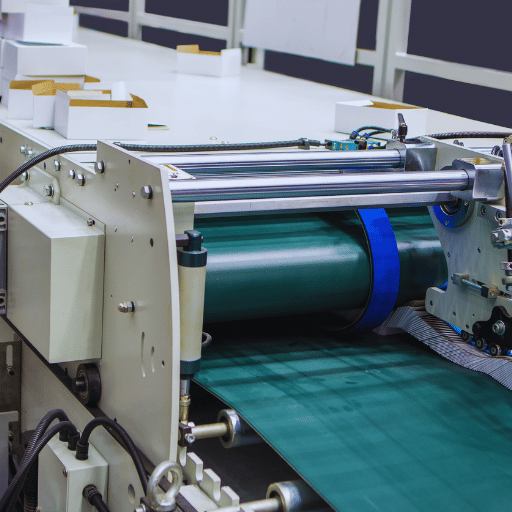
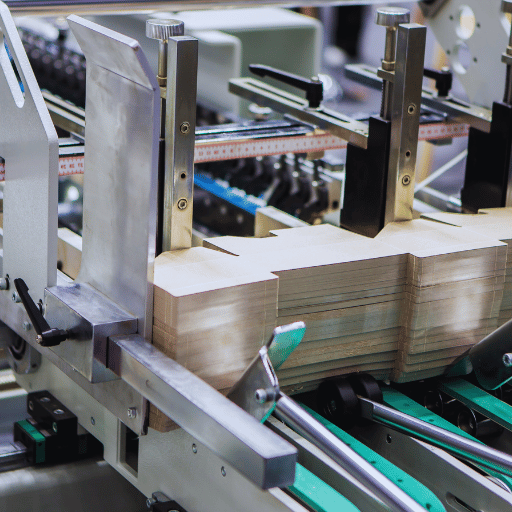
The machine moves the predetermined die-cut and printed flat sheet, which already has the correct fold lines creased in, through five forward-progressing stations. Each blank sheet begins as a sheet of cardboard or corrugated paper with creased fold lines and slot cuts formed into it. The folder gluer takes it and converts that flat sheet into an open 3dimensional carton by applying folding flaps inward at precise angles and gluing ports together so they remain held in that position.
These five stations are a feeder, a pre-folding segment, a main folding section, a gluing station, and a pressing-and-stacking section. A feeder draws each blank sheet into the machine one at a time through vacuum suction and/or belt grippers, and at identical speeds. Pre-folding sections crease and age the first and third fold lines to open them outward at angles between 180 and 165 degrees to ease the box opening process afterward. Main folding segments advance the blank through the second and fourth fold lines using bend belts that accelerate and decelerate along their length, precisely skewing and aligning the carton as it advances. A gluing station deposits adhesive at bonding points, so the final fold brings the seam into contact, closing the carton.
What distinguishes a 4/6 corner folder gluer from a straight-line folder gluer is the addition of a backfolding component which folds the two front panels back, and the two side panels inwards. On a 4-corner carton the device makes four such folds, on a 6-corner it makes six, and the corners receive its own glue glue beads. After the final fold the carton enters a compression conveyor, where upper and lower belts press the bonded surface together until the glue dries. A photoelectric eyes then erops the carton into a stacker.
Box Patterns a 4/6 Corner Folder Gluer Can Produce
Compared to the straight-line 4/6 corner folder gluer handler, the key feature of a recent 4/6 corner folder gluer machine is an added backfolding device which angles the two side panels to 135 degrees. 4-corner cartons get four such backfolding confronts. After the glove holds the carton’s edge, it receives a glue bead, then the whole carton is put through a press roller so it is ready for indexing into other production equipment.
| Box pattern | Typical industry use | Mechanical complexity |
|---|---|---|
| Straight-line | Pharmaceutical outer cartons, stationery, tuck-end retail boxes | Lowest — single seam, fastest production |
| Lock-bottom | Heavier consumer products, household goods | Medium — bottom flaps interlock without glue |
| Crash lock bottom | E-commerce shippers, food takeaway boxes | High — pre-folded bottom snaps open under tension |
| Double-wall (double-side) | Fragile cosmetics, pharmaceutical sample kits | High — two layers of cardboard fold simultaneously |
| 4-corner | Cosmetic compacts, gift boxes, premium retail | High — four reinforced corners glued simultaneously |
| 6-corner | Pharmaceutical sample boxes, premium electronics, food display trays | Highest — six reinforced corners; longest makeready |
| Mini box | Single-dose pharmaceutical, premium chocolate, sachet packaging | Medium — narrow blanks below 120 mm need specialized feeders |
The top specifications of a new servo driven modern flexo-folder-gluer capable of running carton patterns are 350 strokes per minute. Versatility in supporting the seven expected production patterns on one machine the cost of even a sole-purpose straight-line gluer, is what guarantees the capital investment for a single MDMD like the automatic folder gluer when demand derives from the pharma side and the cosmetic side in support.
Components Inside a 4/6 Corner Folder Gluer Machine
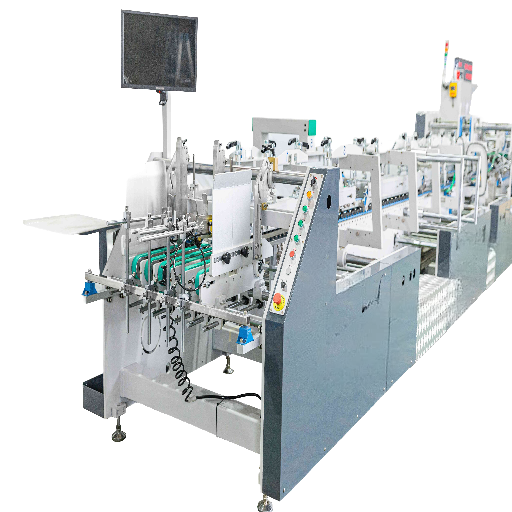
The machine can be broken down into 9 major sub-systems, each fulfilling a specific purpose and each offering a range of adjustments. Knowing what each piece is responsible for and what those responsibilities entail is the difference between an effective operator and an operator who always has to call his vendor for the next recipe change.
| Component | Function |
|---|---|
| Feeder section | Vacuum suction or gripper belt picks blanks one at a time from a stack of around 400 mm height. Includes vibrators and multiple feeding gates for blank separation. |
| Auto-calibration unit | Two sets of guide plates with adjustable tilt belts correct any parallelism error before the carton hits the folding rails. |
| Pre-fold knives and belts | First fold knife creases the first fold line to 180 degrees. Belt-driven pre-folder partially folds the third line to roughly 165 degrees so the box opens cleanly downstream. |
| Main folding rails and bend belts | Bend belts whose speed varies along their length keep the carton skewed correctly through the second and fourth fold lines. |
| Backfolding device (4/6 corner unit) | Servo-driven specialty unit that folds the side panels inward at 90 or 135 degrees to form four or six reinforced corners. Performance ceiling of the entire machine. |
| Gluing system | Lower glue tank with disc or wheel applicators for straight seams, plus three or four electronic guns for spray application on irregular corners. AICC documents HHS 4-gun glue systems as the industry standard for high-speed servo-driven units. |
| Compression (pressing) section | Upper and lower belts press the glued seams together until adhesive sets. Independent drive on upper and lower allows length adjustment per carton size. |
| Photoelectric counter and ejector | Counts cartons exiting the press and triggers a pneumatic ejector to redirect defective cartons to a reject chute. |
| Stacker / collecting table | Independent carrier system stacks finished cartons in adjustable counts for downstream packing. |
📐 Engineering Note
The servo-driven backfolding is the single most important element to 4/6-corner precision. A photoelectric position sensor reads each blank’s leading edge and the servo motor adjusts corner-arm position as each blank passes by. Pneumatic backfolders simply cannot match servo accuracy once machinery speed passes about 150 m/min – which is why all rapidly-paced 4/6-corner machinery specifies servo control on the backfolding portion even if all other sections are pneumatic.
How to Read a 4/6 Corner Folder Gluer Datasheet
Every vendor doles out a datasheet, and most procurement specialists believe the headline figures at face value. There are two headline figures that are systematically sensationalized – and a buyer wise to the deception is not billed for a capacity he won’t see from his assembly line.
The structural-speed-versus-backfolding-speed gap
A datasheet showing “max speed 700 m/min” is actually transmitting structural belt speed in straight-line mode, not 4/6-corner transfer. Real maximum on 4/6-corner throughput will be governed by the backfolding assembly, which is mechanically deterred, regardless of how fast the assembly line runs. The SCM SQ Series datasheet makes the disparity crystal clear: 700 m/min structural max, and 300 m/min maximum backfold – which demonstrates that real 4/6-corner output will be approximately 43 percent of the published maximum. Other published on… machinery often run servo limited at 180 m/min on corner work, regardless of structural max.
| Datasheet line | What buyers think it means | What it actually means |
|---|---|---|
| Max speed 400 to 700 m/min | All carton patterns run at this speed | Straight-line mode only; backfolding speed is half this number |
| Max box blank width | All carton patterns can run up to this width | 4-corner and 6-corner widths are usually narrower than the headline max — check the box-pattern-specific table |
| B-flute (horizontal) corrugated | Any B-flute corrugate is supported | Horizontal grain only — vertical-grain B-flute may stall the feeder |
| Power 25 kW | Required electrical supply rating | Total connected load — actual draw is roughly 60 to 70 percent under normal duty |
| Cardboard up to 800 gsm | Any 800 gsm board can run | 800 gsm at the upper limit; tested working range is typically 200 to 600 gsm |
| Net weight 6,000 to 11,500 kg | Just a shipping figure | Indirect rigidity indicator — lighter machines vibrate more above 200 m/min |
When compiling three vendor datasheets, each vendor must be asked to supply the specific box-pattern throughput-table, not the structural maximum. One who supply structural throughput only and publish it means he is the one to scrutinize most.
Adhesive Choice: Cold Emulsion, Hot Melt, or PUR

The glue system imposed on a folder gluer is as important as the folding system. This same machinery can run any of three chemistries – cold emulsion (PVA based dispersions), hot melt (EVA polymer) or PUR (polyurethane reactive) and each demands a distinctive recyclability, set time, machinery cost and equipment profile.
| Criterion | Cold emulsion (PVA) | Hot melt (EVA) | PUR (polyurethane reactive) |
|---|---|---|---|
| Application temperature | Ambient (20 to 30 °C) | 160 to 180 °C | 120 to 150 °C |
| Set time | Slow (water must absorb / evaporate) | Fast (seconds — cools and re-solidifies) | Roughly 2 minutes (chemical cure) |
| Bond on UV-coated or laminated stock | Poor — water cannot soak in | Poor — cannot adhere to smooth surfaces | Excellent — chemical bonding holds on smooth substrates |
| Equipment cost | Lowest — disc applicator or simple wheel | Mid — heated guns and tank | Highest — purged moisture-cure guns plus dedicated tanks |
| Adhesive cost per kg | Lowest | Mid | Highest (typically 2 to 3 times hot melt) |
| Recyclability of finished carton | Best — water-based, fully repulpable | Good — most fibers recover, some hot-melt residue | Mixed — chemical bond complicates fiber recovery |
Based on Baumer hhs’s PUR Applications in folding-Carton Production technical paper, hot melts do not aspirate onto smooth UV-laminated surfaces, and dispersion (cold) adhesives are of no use because the water cannot be absorbed. Only PUR chemistry guarantees reliable adhesion onto these substrates. (Decision guide: cold emulsion for high volume, uncoated cartons where a slow set is acceptable; hot melt for high-throughlooked, general application; PUR for laminated, UV-laminated or food-safe cartons where on-adhesion isn’t optional.
Selection Criteria: How to Choose a 4/6 Corner Folder Gluer
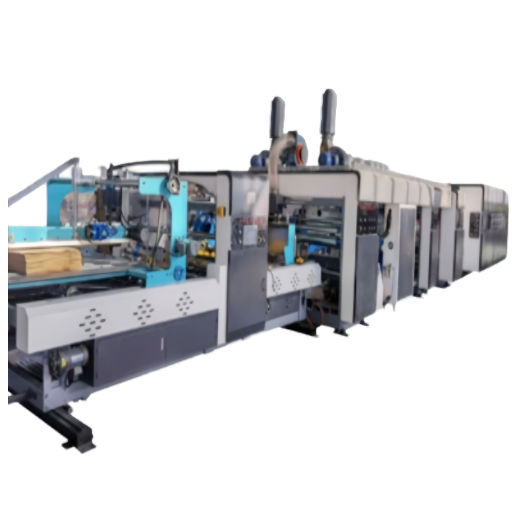
Procurement teams typically discriminate automatic folder gluer on price alone. That misses the 7 choices which determine the long run total cost over a 10-year time frame. Use the policy checklist below when evaluating a 4/6 corner folder gluer machine against vendor quotes.
7-Criteria Selection Framework
- Volume goal – boxes per shift or internally set per year. Under approximately 5 million cartons per annum, an entry servo-driven 650 mm machine will do. Over 20 million, specify 1,250 to 1,650 mm wide-format tier.
- Box type – distinct count of carton SKUs for the machine. High-mix, more-than-15-SKU/week rotation plants need a one-click recipe changeover, single-SKU plants do not need to pay for one.
- Box width range – minimum and maximum box width for each pattern type; always check 4-corner—and 6-corner-specific widths (which are often narrower than the straight-line maximum).
- Material range – cardboard only, corrugated only, or both. Wide-gap settings—and the higher-powered feeders for mixed-material plants—are expensive.
- Auto-dose-automation level – manual recipes versus automatically-loaded QR-code or one-click servo. Automation quickly pays back in high changeover plants.
- Plant size – most 4/6 corner folder gluer machines require length of 14 to 17 meters, plus a clear operator-access zone on the operator side. Confirm on your floor plan before approval.
- Forward end of life support – commitment to spare-parts inventory, terms for on-site engineer deployment, life versus warranty coverage. Half the capital initial cost, half the lifetime cost, comprises service delivery.
Once the seven criteria have been scored, selection comes down to two or three vendors that meet your plant realities. For purchasing groups summing 4/6 corner folder gluer machine specifications against this framework, the bullet items that should be at forefront are box pattern-specific makeready speed, 4-corner/straight-line width range, adhesive system (cold / hot melt / PUR-in-waiting) and service installer visit requirements. All four even-handedly published by the vendors prove easier to compare than speed published alone.
Automatic folder gluer industry has settled into three regional intakes. Europe’s premium cluster (long delivery, high capital cost) is dominated by Bobst and Heidelberg. Value mid-tier (Taiwan and china) cluster, with Cenwan CW-W PCW—and similar tier of Chinese and Taiwanese regional vendors covers the bracket of mid-priced builders. The North American distribution market includes companies such as SCM (through best graphics) and others from AICC membership. Balance comparison tends to be one quote from each of the clusters.
Setup, Operation, and Maintenance
A 4/6 corner folder gluer machine runs in three duty modes: steady production, recipe changeover, and scheduled maintenance. Of these, the first accounts for approximately 70% of operational time; the second accounts for approximately 20% on a wider-mix manufacturing concern; and the third accounts for approximately 10%. Plants that neglect this preventative schedule suffer its consequences twice—one time during unexpected downtime, and one time due to premature wear of costly servo and bearing parts.
Recipe-changeover time
Contemporary units powered by servo reach documented repeat-pattern makeready of in about 10 minutes when the operator is changing between recipes stored in memory. A new 6-corner configuration – especially with a fresh blank size – can take 30 minutes on a first pass to confirm. Established recipe libraries and one-click recall squeeze the time even more on machinery with QR-code recognition. Plants running more than 15 SkU adjustments weekly, justify this quick payback; plants not running so often won’t.
| Frequency | Maintenance task |
|---|---|
| Daily (end of shift) | Drain and clean the lower glue tank; wipe glue residue from disc applicators and gun nozzles; inspect feeder belts for paper-dust buildup |
| Weekly | Check upper- and lower-belt tension; inspect bend-belt wear; clear photoelectric sensors of paper dust; verify feeder vibrator amplitude |
| Monthly | Lubricate transmission bearings; inspect tie rods and spacers; check air pressure regulator at 6 bar; calibrate counter-ejector timing |
| Quarterly / annual | Recalibrate servo backfolding device; inspect main folding rails for groove wear; replace worn belts; verify CE / EN ISO 12100 safety-circuit functionality |
Common operational faults
3 failure modes combine to produce >80% of all unscheduled downtime. Foreign trim debris/jams – (corrugated and trim, loose paper or torn flap pieces left in the feeder). This is documented by Packaging Portal as being so sensitive that even a singlethin corrugated piece can cause a jam and consequently machine downtime often including pan malfunctioning and warm-up that could have been avoided by cleaning the feeder and checking the sizes before stacking, Tip. To avoid this possible flat Failure mode, the user should line up the feeder feature with the clamp partially open and then check the feeder station previous and present indicator lights after the clamp is closed. Cold emulsion drying clogging in the disc applicator during long shutdowns – (glue). This is fixed with daily tank drainage at end of shift. Calibration drift in the auto-cal unit caused by paper-dust accumulation on guide-plate bearings – (alignment drift). This is fixed weekly by sensor cleanliness inspection and cleaning.
📐 Engineering Note
Buyers designing PM schedules usually plan to reserve 3-5% of capital cost each year, for parts and engineer time. For machine info relevant to your production schedules, see the summarized 4/6 corner folder gluer machine spec sheet. Capturing the above schedule in a maintenance log supplies the audit trail future regulators require for CE-certfied machines in regulated industries, as per EU machinery Directive 2006/42/EC.
Industry Outlook (2026): Servo, IIoT, and Sustainable Adhesives
3six trends drive 4/6 corner folder gluer specs through 2026+. Firstly, the carton folding gluing machine industryis forecasted to achieve approximately 7.9% CAGR from 2026 to 2033+. The global packaging machinery market overall reaches roughly 71 billion US dollars by 2026 at 5.8 percent annual growth. Capital expenditure on folder-gluer is driven by both currents.
Secondly, the 4/6 Jupatuh Tarez industry looks to adopt IIoT and predictive maintenance as basic technology. Based on SUN Automation Co-.’s 2026 corrugated manufacturing trends report, the three highest themes that will be supported by automation, IIoT-enabled predictive maintenance, operator support, and workforce training/retention are the three highest themes that market operators plan to adopt in 2026. Its wise for buyers to require RFQ offerings withIIoT-capable controllers, remote diagnostic pathways, and tabloid operatorist instructions.
Thirdly, sustainability favorites adhesives. Specifically, cold emulsion (water-controlled) and appropriately-engineered PUR systems will displace some hot-melt solutions, in high-recyclability (food & pharma) end-of-life applications. Buyers should account for EU 2006/42/EC machineriesafe-to-work-off-purchase-and-manufacture and emerging sustainability specs in their 2026 specifications, expecting such field specs to contain CE-marking, EN ISO 12100 risk assessment, EN 415-1 pallets safety plan, REACH 2011/65/EU, and IIoT readiness as a bundle.
4-Corner vs 6-Corner vs Crash-Lock: Which Box Needs Multipoint Gluing?
A 4/6 corner folder gluer is justified when the carton needs multiple timed glue points and folding actions that a straight-line machine cannot complete. Use the box structure, not the carton name alone, to choose the mechanism.
| Box structure | Typical use | Machine requirement |
|---|---|---|
| 4-corner carton | Trays, food packs and shallow display boxes with four glued corner flaps. | Timed multipoint gluing plus corner-folding devices; accurate blank registration is critical. |
| 6-corner carton | Deeper trays and specialty retail packs with six corner connections. | More turning and folding actions, additional glue points and longer setup validation. |
| Crash-lock bottom | Cartons that erect quickly because the bottom locks automatically. | Bottom-folding hooks and controlled glue placement; a dedicated crash-lock setup may be more efficient. |
| Straight-line carton | Simple side-seam folding cartons. | Usually does not need a 4/6-corner system; avoid paying for unused complexity. |
Send the dieline and three physical blanks when requesting a quote. Then check the 4/6 corner folder gluer specifications against the minimum panel size and glue-point count.
Frequently Asked Questions
Q: What is the difference between a 4 corner and 6 corner box?
View Answer
A 4-corner box has four reinforced corners formed by folding side panels inward at 90 to 135 degrees, glued at four bonding points. A 6-corner box has six such corners, requiring two additional folding-and-gluing operations. The 6-corner pattern produces stronger reinforcement for taller cartons or heavier contents, but adds roughly 20 minutes to typical machine makeready time and runs at a lower speed because the backfolding device performs more operations per cycle.
Q: What box sizes can a 4/6 corner folder gluer machine handle?
View Answer
Box width range – depends on the model of boxmker. Entry-level models accommodate 80 to 650mm blank width. Mid-level models accommodate 140 to 1,250mm. Wide-format models accommodate 290 to 1,650mm. Note that the 4-corner and 6-corner widths are generally narrower than the straight-line max – on a 1,650mm-class boxmker, they are generally 470 to 1,450mm. See the vendor datasheet for box-pattern-specific table.
Q: What speed should I expect from a 4/6 corner folder gluer machine?
View Answer
Vendor datasheets record a structural maximum of 300 to 700 metres per minute, but the actual ceiling on 4-corner or 6-corner cartons is 180 to 300 metres per minute (true speed). That minimum number is the mechanical limitation of the servo backfolding device, which does the corner folds. When evaluating quotes, always ask for the box-pattern-specific speed table – never the structural max alone.
Q: Hot melt or cold glue — which is better for 4/6 corner boxes?
View Answer
Cold emulsion (PVA dispersion) is cheapest and most recyclable, but has slow set time. Hot melt (EVA) sets in seconds and supports high throughput, but is not capable of bonding UV-coated or laminated surfaces. PUR (polyurethane reactive) is the most expensive, but is the only adhesive chemistry that bonds reliably to smooth coated stock and food-grade cartons. So the choice depends on the type of substrate and the run length, not on the cost.
Q: How long does it take to switch between box styles on a 4/6 corner folder gluer?
View Answer
Switching between previously-stored recipes on a servo-driven boxmker typically takes 10 minutes. First-pass setup of a new 6-corner pattern with unfamiliar blank dimensions takes up to 30 minutes. Plants that switch recipes more than 15 times per week pay back the automation premium for QR-code or one-click recall systems; plants with fewer changes do not.
About this guide
This buyers guide to 4/6 corner folder gluer machines compiles best practice and specification data from published vendor datasheets, the AICC packaging industry association, the SUN Automation 2026 corrugated report, and Baumer hhs’s PUR adhesive technical paper. Compliance references are current to EN ISO 12100, EN 415-1, and EU machinery Directive 2006/42/EC.
References & Sources
- AICC NOW: Global Boxmachine – servo-driven Flexo folder gluers – Independent Packaging Association (AICC)
- PUR Applications in folding-carton Production – Baumer hhs technical paper
- 2026 Trends in corrugated Manufacturing – SUN Automation Group
- SCM SQ Series folder gluer Datasheet (700 m/min structural / 300 m/min backfold) – Best Graphics
- EU Machinery Directive 2006/42/EC – European Union
- EN ISO 12100 – Safety of machinery – International Organization for Standardization
- Avoiding Jams and Gluing Defects on Flexo-Folder-gluers – The Packaging Portal
- Traditional Hot Melt vs. PUR Polyurethane Hot Melt Adhesives – hotmelt.com industry guide