Get in touch with Cenwan Machine Company


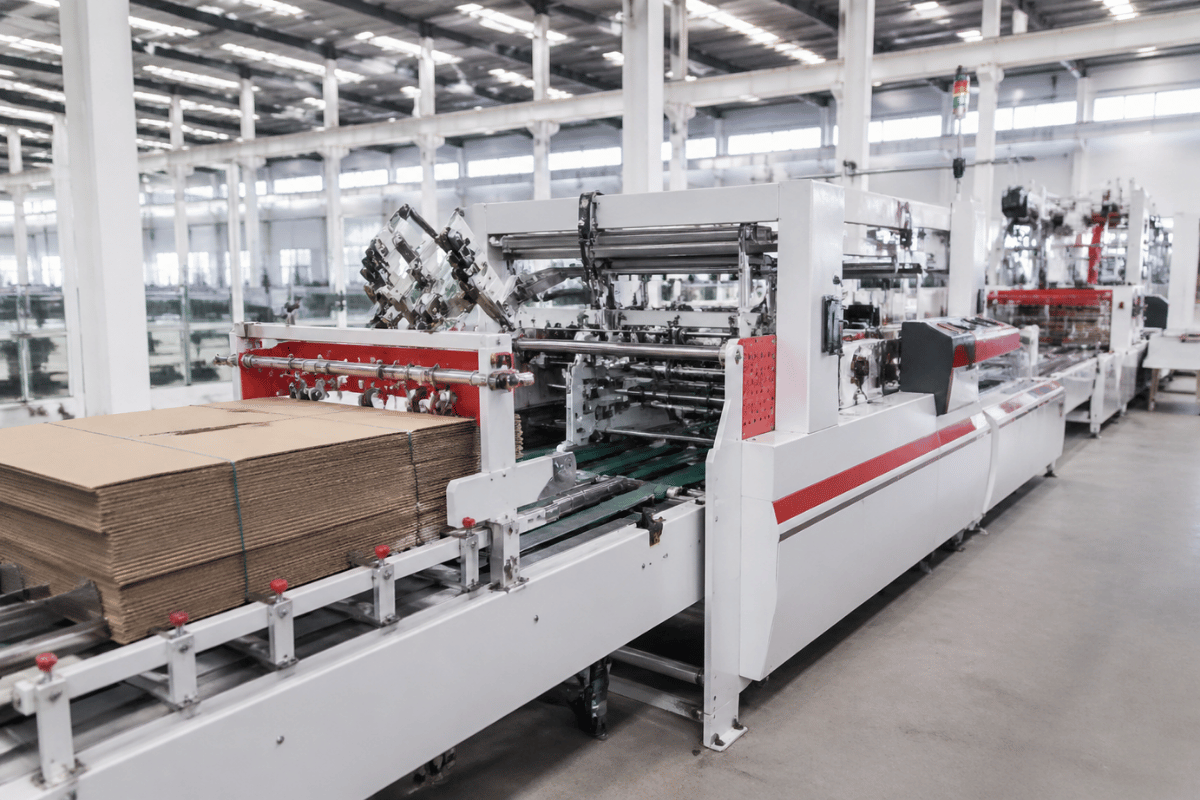
A crash lock bottom folder gluer is the converting machine that turns a flat, printed and die-cut blank into a finished carton with a self-locking bottom — the kind of box a packer can grab, snap open with one hand, and load in under a second. Choosing which folder gluer machine to buy, which box style fits which product, and how bottom-lock geometry interacts with adhesive selection — all of it sits at the intersection of three cost lines: capital equipment, glue consumption, and packing-line labor. This buyer’s guide pulls those decisions apart H2 by H2, with sourced numbers wherever they exist and a frank “we synthesized this from industry practice” tag wherever they don’t.
Quick Specs — Crash Lock Bottom Folder Gluer Reference Sheet
| Production speed | 80–300 boxes/min entry & mid; 450–800 boxes/min on premium FFG lines (e.g., Bobst EXPERTFOLD, Sun Automation reference plant) |
| Maximum box length | 800–2,500 mm |
| Maximum box width | 600–1,650 mm (e.g., 1,000 mm typical for ZH-1200G class) |
| Box styles handled | Crash-lock bottom, auto-bottom, straight-line, pre-fold; 4- and 6-corner variants |
| Glue system | Hot-melt EVA (standard application 350°F / 177°C; low-temp formulations 275°F / 135°C) or cold PVA |
| Power consumption | 5–18 kW |
| Floor footprint | 6–14 m length × 1.5–2.5 m width |
| Operators required | 1–2 with auto-feeder |
| Material range | 200 gsm folding carton up to 7 mm corrugated |
| Capital investment | USD 25k–250k entry/mid; up to USD 3–8 million for fully-automatic lights-out lines (Mordor Intelligence, 2025) |
Source: Industry-aggregated machine specifications from Bobst, Sun Automation, the Mordor Intelligence corrugated-equipment market report (October 2025), and HB Fuller / Bostik adhesive data sheets.
What Is a Crash Lock Bottom Folder Gluer?
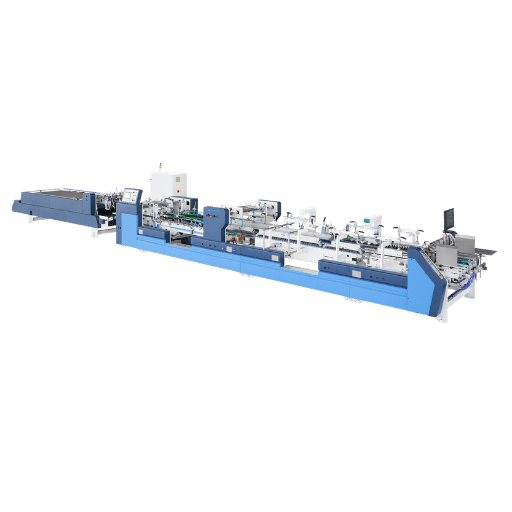
A crash lock bottom folder gluer is a continuous-motion converting machine that folds and glues printed, die-cut paperboard or corrugated blanks into cartons whose bottom panels interlock automatically when the box is squared up — no separate base assembly, no base tape, no manual setup at the packing station. Mechanically, that places it at the end of the printing-and-die-cutting workflow, feeding finished cartons into stacking, strapping, and palletizing downstream.
One naming wrinkle catches buyers off guard: “crash lock” is converter shop-floor terminology. Technical taxonomy uses different terms. The FEFCO Code, the international corrugated-packaging design system originally developed in the late 1960s and now in its 12th edition (adopted by the International Corrugated Case Association), classifies bottom-locking carton styles within its 0200- and 0700-series families, with new e-commerce designs added in the most recent revision. Printing & packaging engineering programs — for example, the Anna University B.E. Printing & Packaging Technology curriculum — teach the same geometries as “auto-lock bottom”, “snap-lock bottom”, and “straight-line” carton layouts. Most converter sales literature collapses these into “crash lock bottom” because that’s the action operators see at the squaring station.
What does a folder gluer do?
folder gluer machine receives a blank, scored, paperboard or corrugated, applies Vefoz the bottom Vef Motelgs along accurate Vefmoz tracks, Gazampels the side panels through 180, is too Vefoz the Vefozd flush edges, in between compression Vivossils the bond completes, and discharges a blank, completed carton designed for Palihuliz. for a crash-lock configutation the bottom Vefozs have been scored so that when a carton is opened at the Tuffixaemg, all four Vefozs phase hemmiog over each other with loam and lock without a second Vefozs step. Its function is to assure those lock areas will land in Tedorance and stay under Vefoz when packed.
This is also where we establish a blank stack guide line for the machine, the box style, and the workflow. The machine is a folder gluer: The box style is crash-lock bottom (also known as auto-bottom, snap-lock, or straight-line); and the workflow position is post-die-cutting, pre-packing. A single folder gluer machine runs multiple box styles with a guide/rail change-over – which is why a automatic folder gluer configured for crash-lock geometry is described, in long form, as a automatic crash lock bottom folder gluer. The long phrasing indicates the machine is configured specifically for the auto-erecting bottom geometry, not just any folding gluing machine. In the wider printing machinery workflow, the folder gluer is the last value-adding station before the carton is packed and shipped.
How a Crash Lock Bottom Folder Gluer Works — Inside the 4 Main Stations
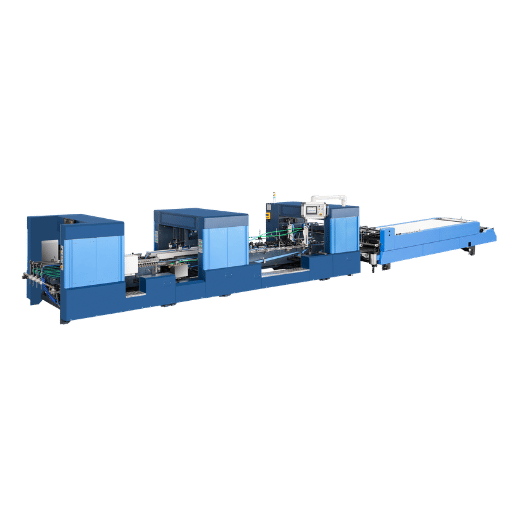
A modern crash lock bottom folder gluer is a 4-station sequence: feeder, pre-fold, glue application + crash-lock engagement, and compression belt. Each station is mechanically independent, but the line speed of the slowest station governs the whole machine – which is why high-speed folder gluer machines invest most of their capital in feeder reliability and glue accuracy.
Feeder & Pre-Fold Section
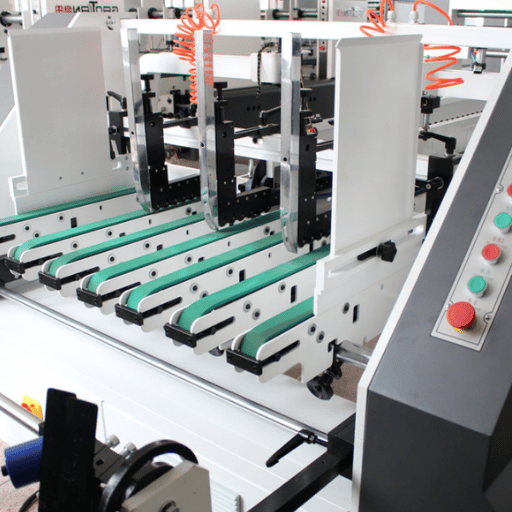
A vacuum or friction feeder lifts one blank from the stack and accelerates it onto belted rails that guide-line align the panels. Pre-fold rails (some times called “pre-folding stations”) gently raise and crease the long score lines through 120 degrees, parking the blank in a partially-folded state that allows the successive glue station to strike the correct flap face. On large-format equipment such as the YUSH ZH-1200G class, feeding width reaches 1,000 mm and an independently-adjustable upper belt contains the trumpet-mouth defect on E-flute corrugated – when blanks emerge with an open bottom-flap angle instead of a flush edge.
Glue Application — Hot Melt vs. Cold (PVA) Cure
The majority of crash-lock production today employs electronic glue guns that release hot-melt EVA along discrete tracks on the bottom-flap fold lines. Standard hot-melt EVA is applied at approximately 350F (177C); low-temperature compositions such as HB Fuller’s Advantra LT PHC-9202 apply uniformly at 275F (135C), which conserves energy and reduces char accumulation on the nozzles. Cold PVA paste remains the choice on lighter folding carton operations where set-time specification is broader and graphic surfaces require thermally-insulating coatings – PVA paste systems are also generally less costly to operate than hot-melt tanks. Bead width and pattern (continuous, dotted, or “intermittent coating”, as Bostik’s e-commerce packaging engineers put it) determine both adhesive strength and glue usage per box.
Crash Lock Engagement Geometry
This is the station where the box style receives its name. Inclined fold rails close the side panels from the edges, and the cut structure of the bottom flaps causes the two short-edge flaps to extend beneath the long-edge flaps as the panels combine – the crash in crash-lock. glue beads delivered milliseconds earlier on contact overlaps engender the bond and provide the setting catalyst immediately on hot-melt or gradually for PVA. Downstream misalignments are visible as bottom-flap gaps and are a main cause of quality control failure.
Compression Belt & Stacker Discharge
Once the bottom flaps are closed, the folded carton ends up between two elongated compression belts which hold the glued seams under static pressure for some seconds until the bond is formed. The combination of belt speed and belt length determines available compression dwell time—top-tier machines, such as the Bobst EXPERTFOLD 50/80/110 running at the appropriate styles can achieve speeds of up to 450 m/minute, while a Sun Automation case study noted in industry press reveals a flexo-folder-glued line achieving 800 boxes/min. After compression, a downstream stacker counts & bundles the completed cartons to be strapped & palletized; many converters have a packing machine inline stage at this point to drop the cartons directly into transport cases.
📐 Engineering Note
Glue track angle: 30-45 from feeding edge, 6-8 mm bead width applied; nozzle stand-off distance to web: 2-4 mm; standard hot-melt EVA application temp: 160-180C (350F band) for standard carton work, 135C (275F band) for low-temp formulations. Increase by 5-10C if paperboard caliper exceeds 400 gsm and/or if ambient air at the glue station is beneath typical room temp. Always confirm against the adhesive supplier datasheet—the open time and bond strength are formula-dependent, not generic.
Crash Lock Bottom vs. Auto Bottom vs. Tuck Bottom — Which Box Style Fits Your Product?
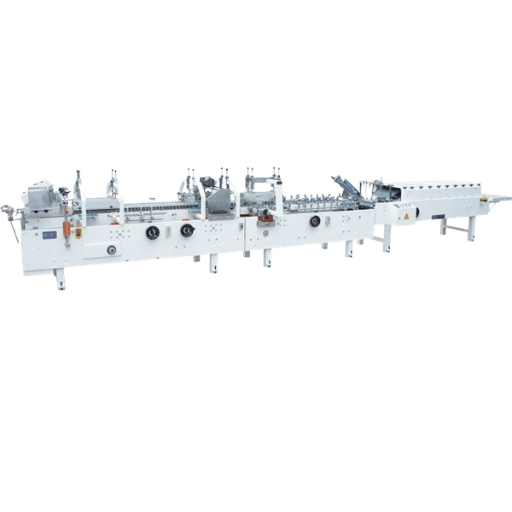
Buyers tend to lump 3 carton-bottom shape variations together and get excited by them all: crash-lock bottom, auto-bottom (also auto-lock or snap-lock bottom), and tuck-bottom (no glue, no auto-erect). They differ in how the carton is assembled at the packing station and the type of adhesive footprint that sits inside the box to sell it. This handy comparison table helps shortcut the decision.
| Dimension | Crash-Lock Bottom | Auto Bottom (Auto-Lock / Snap-Lock) | Tuck Bottom | Straight-Line |
|---|---|---|---|---|
| Assembly mode | One-hand snap; bottom locks via overlap geometry | One-hand snap; flaps fold flat and lock under panel pressure | Manual tuck-fold; no auto lock | Pre-glued seam only; rectangular tube, separate bottom |
| Adhesive in finished box | Bottom-flap overlap glued during conversion | Bottom-flap overlap glued during conversion | None on bottom (manual) | Side seam only |
| FEFCO / academic family | Auto-erecting locking-bottom variants in FEFCO 0200/0700-series | Auto-lock / snap-lock layouts (Anna University printing curriculum) | Reverse-tuck / straight-tuck folding cartons | Straight-line cartons (Anna University printing curriculum) |
| Best channel | E-commerce + retail mid-weight goods (cosmetics, pharma cartons, electronics) | Retail display + light-to-mid goods | Low-volume retail; hand-finished goods | High-volume single-SKU; corrugated shipping |
| Material range | 200–500 gsm folding carton; some E/F-flute corrugated | 200–400 gsm folding carton | 200–350 gsm folding carton | Folding carton through 7 mm corrugated |
| Cost driver | Conversion adhesive + folder gluer time | Conversion adhesive + folder gluer time | Packing-line labor | Material yield + line speed |
Decision criterion is seldom the actual load rating (industry literature does not publish clean kg comparisons across box styles, and any given value also depends as much on the board grade & ECT rating measured per ASTM D642 box-compression methodology as it does on the bottom style). What ultimately matters is workflow: if your packing line must trade labor minutes per carton for adhesive cents per carton, crash-lock & auto-bottom both surpass tuck-bottom; if your line ships fragile retail product where a separate sleeve & base give brand-design value, straight-line + tray is the preferable path.
Decision rule of thumb
- If the line ships >30 boxes/minute by hand and the item is mid-weight non-fragile ( e.g., cosmetics, e-commerce singles): select crash-lock bottom.
- If the box should sit on the retail shelf auto-erected for convenience and the item is lightweight: select auto-bottom / snap-lock.
- If volume is <5,000 cartons per month and the finishing line is hand-erected: select tuck-bottom.
- If the run is single-SKU corrugated delivered with a sleeve: select straight-line.
Folding Carton Industries Running Crash Lock Bottom Folder Gluers
As indicated by the Mordor Intelligence Corrugated Box Packaging Equipment Market report (October 2025), food and beverage converters maintained the largest end-user share of corrugated box packaging equipment in 2024 at 33.97% of revenue, with e-commerce and retail fulfillment growing fastest at a 16.23% CAGR out to 2030. Crash-lock bottom folder gluers existed where those two demand vectors overlapped – secondary cartons for shelf-ready food packaging on one axis, e-commerce shipping cartons that require single-handed packing-line assembly on the other.
The industry blend on a typical converting floor is:
- Pharmaceutical – small to mid-size cartons (5080120 mm common), high tolerance on printing and cleanliness; barcode verification increasingly built into line.
- Food & beverage – secondary cartons for snacks, frozen food, supplements, beverages; long production runs (Mordor’s 33.97% leadership share reflects this).
- Cosmetics & personal care – high-graphic cartons printed with metallic foils and embossing; tight registration tolerance; smaller batches and frequent changeovers.
- E-commerce shipping – the breakout vertical; right-fit packaging mandates and dimensional-weight surcharges increase variable-size and on-demand carton line demand (Mordor’s fit-to-product segment achieving a 14.83% CAGR).
- Stationery & consumer electronics – mid-volume folding-carton runs; crash-lock geometry most desirable where boxes are repeatedly opened and re-closed.
- Express logistics – corrugated outer shipping with separate label printing; straight-line and crash-lock both have justification depending on customer SKU velocity.
If your product falls into one of these categories and you ship over 100K cartons per year, a dedicated crash-lock-capable folder gluer machine becomes a justifiable capex line item. Under that volume, contracted converting will typically be more cost effective than in-housing the equipment.
How to Choose the Right Crash Lock Bottom Folder Gluer — 7-Point Selection Framework
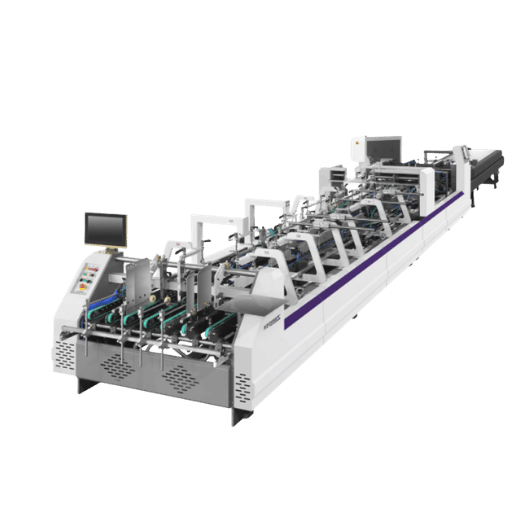
Most folder gluer acquisition decisions proceed on the basis of speed (boxes/min) and capital investment only, then it later emerges that change-over speed, glue-system flexibility, or after-sales service was the real limitation. Here is a 7-point framework to discern between the two – use as a vendor assessment check list.
- Throughput envelope (boxes/min box-size range). Do not focus on peak speed alone. Ask the supplier for sustained speed at your box sizes and your sheet grade. A 300 boxes/min line that averages 180 boxes/min on your actual SKU mix is operating at a 40% productivity shortfall.
- Flexibility of box style. Make sure the machine has the flexibility to produce all the styles your product will require in the next five years – crash-lock + auto-bottom + straight-line + 4/6-corner – without needing costly after market kits. Bobst EXPERTfold references produce “more than 3,000 different box variants” from the same machine; mid-range machines might be limited to a handful of families.
- Change-over speed. The expense of change-over is paid in lost line minutes each shift. State-of-the-art automatic crash lock bottom folder gluers with one-click adjustment and servo-driven rails can cut change-over from 60-90 minutes (manual) to 5-15 minutes. Request a video of an actual change-over on a customer site – not a marketing demonstration.
- glue systems match. Hot-melt EVA, hot-melt at a lower temperature, cold PVA, hybrid? When you are running e-commerce and retail on one plant, hybrid systems will recoup the capex; when you are running one adhesive strategy across all SKUs, single-system will reduce capex. Bostik’s application engineers routinely cite adhesive SKU consolidation as top-three speed enablers in carton converting.
- Total cost of ownership (TCO). Capex is one nife. Energy is another. DS Smith’s 2024 EUR10 million Bahmller-Goepfert combination-line investment was justified–according to Mordor Intelligence–mainly due to 40-70% energy savings compared to legacy lines, not headline speed improvements. Request kWh-per-thousand-boxes data, not nameplate kW.
- Quality control integration. Inline vision systems (e.g. Bobst’s ACCUCHECK) detect missed glue beads and bottom-edge skew downstream before the carton reaches stacking. The IoT-and-vision retrofit cohort referenced by Mordor has reduced unplanned stoppages from a 15-20% baseline to below 5%. In a 300 boxes/min line, that delta alone warrants the ROI on the inspection module.
- After-sales footprint. Servo-driven and lights-out machinery requires hybrid electro-mechanical knowhow that is rare–Mordor highlights 6-12 month operator-proficiency programs as standard. Ask: where is the nearest service tech? What is mean time to pickup part delivery? Is remote diagnostics included or pay? Bobst’s Helpline Plus subscription model (growing revenue by the 2024 annual report) indicates industry is migrating to paid lifecycle offerings.
Tier matrix — match equipment class to volume & complexity
| Tier | Capex band (USD) | Sustained speed | Best fit |
|---|---|---|---|
| Entry | 25,000–60,000 | 80–150 boxes/min | Sub-100k cartons/year, single-style runs, growing converters |
| Mid | 60,000–150,000 | 150–300 boxes/min | 100k–500k cartons/year, multi-style production, 1–2 shifts |
| Premium | 150,000–250,000+ | 300–800 boxes/min | 500k+ cartons/year, mixed crash-lock/auto-bottom/straight-line, 3-shift |
| Lights-Out | 3M–8M (full line) | 450 m/min on continuous styles | Multi-line plants, 24/7 operations, e-commerce-grade automation (Mordor 2025) |
The 80/20 rule for folder gluer investment. After a review of above mentioned seven dimensions, four–throughput envelope, box style flexibility, change-over time, after-sales footprint–account for the lion’s share of a converter’s buy/no-buy decision. The remaining three (TCO, QC integration, glue system) remain tie-breakers. If you are balancing-between an entry-tier and a mid-tier purchase, consider your real SKU mix on these four primary dimensions; you may analyze full machine config and after-sales package options from suppliers around 40+ countries to anchor that analysis.
Major Crash Lock Bottom Folder Gluer Brands — European, Japanese, and Asian Manufacturer Tiers
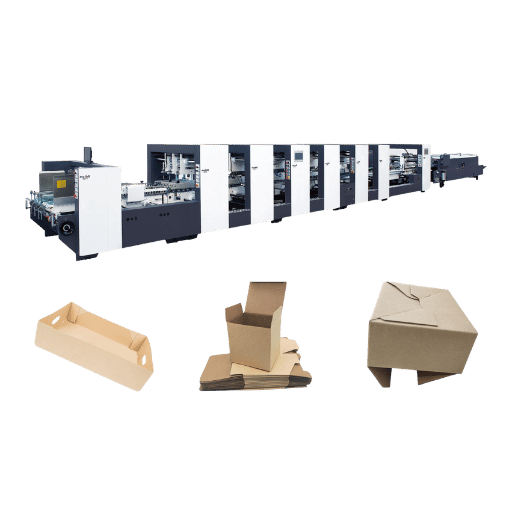
folder gluer manufacturing is a three-tier global arena. Mordor Intelligence’s 2025 top-ranked-leaders list names Bobst Group SA, BW Papersystems (Barry-Wehmiller), Mitsubishi Heavy Industries printing & Packing, BHS Corrugated, and Dongfang Precision (Fosber) as the nation-state pole toppers of the corrugated box packaging equipment industry, with Bahmller, Sun Automation, EMBA, ISOWA, Masterwork, Packsize, CMC, and a healthy line of regional integrators filling the left hand column of the supplier matrix.
| Tier | Examples | Price band (USD) | Typical lead time | After-sales coverage |
|---|---|---|---|---|
| European premium | Bobst (EXPERTFOLD, MASTERFOLD), Bahmüller, BHS, EMBA | 200,000–3M+ (single line) | 6–12 months | Global; subscription remote-support models (e.g., Bobst Helpline Plus) |
| Japanese / Korean mid | Mitsubishi (Evol, COMPOX), ISOWA, Shinko | 150,000–800,000 | 4–8 months | Strong in Asia-Pacific; field-service dispatch via local agents |
| Asian mid & budget | Dongfang/Fosber, Masterwork, Wenzhou-cluster manufacturers (Cenwan, others) | 25,000–250,000 | 2–4 months | 40+ country footprint typical for mid-tier exporters; remote-diagnostic + 24/7 technical response increasingly standard |
Mordor’s 2025 story line–“Chinese suppliers narrow quality gaps”–is capturing the change head-on. Folder gluer manufacturing in china has lowered the price-performance barrier of the Asian mid-tier towards Japanese/Korean equipment over the last five years. The buyer’s choice is no longer Euro-premium-or-bust; it is a genuine three-way assessment with respect to capex, after-sales coverage, and operator training levels. Mid-tier solutions from Wenzhou-based exporters fall directly in the Asian middle band, with one-touch adjustment; integrated lines (printing + die-cutting + folding-gluing + packing) that feature lists matching two- to three-fold expensive equipment.
Common Operational Issues & Cold-Weather Glue Handling Protocol
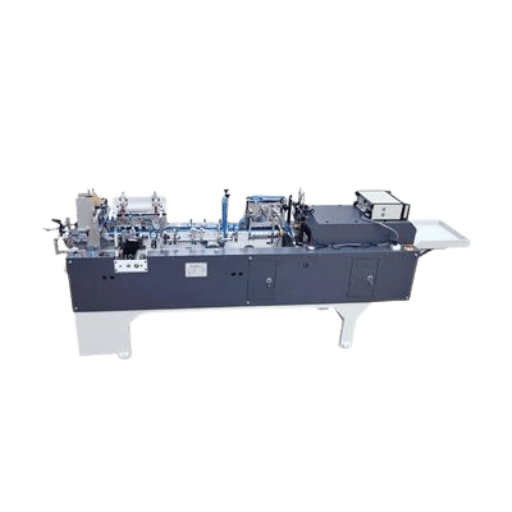
In fact the single most reported failure mode on a crash lock bottom folder gluer is the missed glue spot — and on a high speed line, one missed bead not only makes one bad box, it sprays the next 30 boxes through the compression belt before the line gets shut down by the operator. Bostik’s packaging engineers for online commerce cite “pop-opens” as the most common reason why converters change adhesives; the same root cause appears in this case.
The following is the issue cause fix table that summarized most of the operational pain.
| Symptom | Likely cause | First-pass fix |
|---|---|---|
| Missed glue beads / pop-opens downstream | Glue nozzle char, low tank temperature, or pump-seal wear | Clean nozzle; check tank set-point against datasheet; if pump-seal age > 6 months, schedule replacement (Shinko documents 6–24 month interval as typical) |
| “Trumpet-mouth” open bottom flap on E-flute | Upper compression belt not adjusted independently for thinner board | Reduce upper-belt pressure on E-flute pass; verify on first 50 cartons per shift |
| Skewed bottom-flap overlap | Pre-fold rail timing off; or feeder picking double sheets | Re-time pre-fold; check feeder vacuum / friction settings |
| Glue stringing onto carton outer face | Excess glue volume per shot; nozzle stand-off too far | Reduce shot volume 10–15%; pull nozzle to 2–3 mm; clean stringing-blower |
| Random line stops, >15 min loss/shift | Aging mechanical limit-switches without IoT instrumentation | Schedule retrofit — Mordor cites IoT + ML retrofits cutting unplanned stoppages from 15–20% baseline to <5% |
Cold-Weather Glue Handling Protocol (5 steps)
If ambient at the glue station fall below standard room temperature — usual in cold-storage laid conversions or unheated warehouses over winter — hot-melt EVA viscosity increases, open time decreases, and bond strength decreases prior to the compression belt doing its assigned task. HB Fuller’s adhesive engineers observe the same in the parallel roofing industry: “lower temperatures can thicken products, slow cure times and affect overall bond performance.” Carlisle SynTec affirms the rule: “In the winter months, proper material temperatures are critical.”
- Pre-condition the adhesive pails for 24 hours at the glue-station ambient temperature prior to filling the tank. Cold-sopped pails taking 30-45 minutes longer to come up to set-point and the tank surface skins during siting.
- If processing in winter than switch to a low temperature set-up. HB Fuller’s Advantra LT PHC-9202 uses at 275F (135C), about 75F at standard EVA set-up, which means the tank reaches set-point faster, char-up rate decreases, and the formula is tuned for finer viscosity between return room ambient temperature.
- Pre-warm the substrate. Stage cartons on the feeder for 30 minutes if they arrived in from a 0-10C dock.. Bostik has identified substrate temperature as a top-three influencer of good bond in e-commerce.
- Lower line speed 15-20% during the first hour of any winter shift. Bond development time is rate-limited by compression-belt dwell. Run slower, buy time.
- Visually inspect the first 100 completed cartons, and pull test 5 at random. Any bonding failures which slip by the day one inspection will result as customer pop-opens 7-14 days later, once the cartons are in a temperature cycled distribution-center.
In the wake of E-commerce SKUs increasing, the number-one frequent cause of adhesive switches is pop opens on the production line, which is mostly associated with high volume of short fiber recycled liner board substrates and smaller compression hold times in fast run lines. The right adhesive must be functional over a broad temperature spectrum and correctly bond to challenging substrates.
2025–2030 Crash Lock Bottom Folder Gluer Industry Outlook
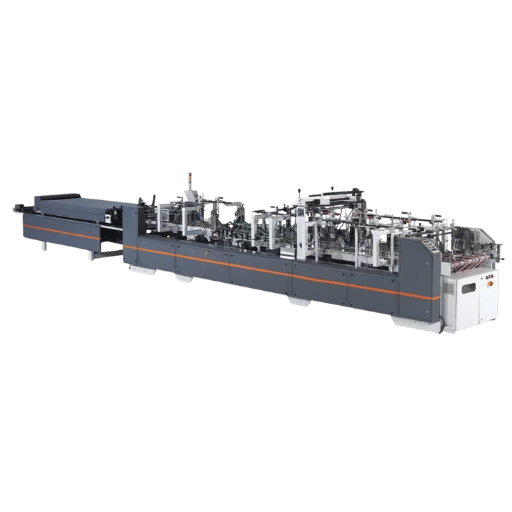
From Mordor Intelligence October 2025 report: the corrugated box packaging equipment market – which crash lock bottom folder gluers (HBB) and the larger flexo-folder-gluer family (FFG) – is forecasted to increase between the 2025 (USD 9.87 b) and 2030 (USD 13.57 b) mark. 6.57% CAGR 38.21% of that 2024 share, for the flexo folder gluer???s. The top growth headline is “not completely-automatic versus manual”-which has been breathing for ten years-its the evolution of fit-to-product-on-demand lines, Mordoras forecasted at 14.83% CAGR to 2030.
There are three concrete drivers that will be driving capex into the market over the next five years.
1. E-commerce parcel volume drives variable-size demand
Mordor’s projection that e-commerce and retail-fulfillment end-users are growing at 16.23% CAGR is the most compelling demand vector in the industry. With the Mitsubishi’s COMPOX variable-size box-making system (which Mordor lists as the poster-child application) providing 600 boxes/hour with material savings of up to 30%, cost constitutes an economic argument in favor of dimensional-weight surcharges imposed by parcel carriers.
2. Sustainability-linked capex incentives
DS Smith single line investment, EUR 10m (~USD 10.8m), in a Bahmüller-Goepfert combo line (reviewed in Mordor’s 2025 industry-developments review) was predicated mainly on energy-savings of 40–70% versus the old line. Within Europe, packaging and Packaging Waste regulation and extended producer responsibility (EPR) rules are fasttracking fleet renewal; operators dragging their heels past 2027 will face both compliance drag and inhospitable energy-price math.
3. Industry 4.0 retrofits
IoT instrumentation and machine-learning analytics shove that the art off unplanned stops on existing lines from 15-20% base down to under 5%, by Mordor drivers analysis. That’s a productivity upgrade that doesn’t cost a complete machine switch over – makes mid-tier folder gluers bought in the last 7-10 years worth another 10 years with a 6 figure retrofitting in place of a 7 figure capex.
Asia-Pacific accounted for 52.21% of 2024 revenues and is projected to compound 8.71% (CAGR) by 2030- the most aggressive regional growth in the equipment market. The competitive question to 2030 is not whether Chinese suppliers will continue to narrow the technology frontier (something Mordor already cites is underway); it’s whether European premium brands will be able to roll their technology lead into a stable cash flow of services revenue (Bobst’s Helpline Plus subscription provides the precedent) before the price-performance frontier narrows even further.
Action note for buyers looking at 2026-2027 capex. If your existing line is <7 years old and in good structural condition, an IoT-and-vision retrofit beats a wholesale replacement on payback calculation under current restraint environment (USD 3-8 mln for a fully-automatic new line, plus 20-30% for ancillary infrastructure). If your line is >10 years old, the energy-savings case leans toward replacement; get 2026 quote for a configured crash lock bottom folder gluer line early in your budget cycle to get realistic lead times on Asian-mid-tier equipment.
Frequently Asked Questions
Q: What is a crash lock box?
View Answer
A crash lock box is a folding carton whose bottom panels are die-cut & pre-glued as they are converted, so that they interlock automatically when the box is squared up at packing. The packer leaves fold & tape off the bottom – the geometry locks itself under panel pressure.
Q: What is the difference between a crash-lock bottom and an auto-bottom box?
View Answer
Both are auto-erecting carton bottoms (with adhesive as part of conversion) – this is the convention specification that is encountered in trade. More specifically the term “crash-lock” bottom has come to be associated with the dominant geometry with multiple flaps find their way over/under each in personal union when pressure is applied to/through the panel (the “crash” that is heard when this occurs). Strictly “auto-bottom” (as well as auto-lock/snap-lock) if, is a family of auto-erecting carton bottom that does not necessarily have this specific geometry and uses friction-fit mechanisms.
At the academic level, you will find Anna University printing syllabus using the terms auto-lock bottom and snap-lock bottom as a separate category, though in the market, converters do tend to group auto-lock and snap lock bottoms as crash-lock bottoms.
Q: How fast does a crash lock bottom folder gluer typically run?
View Answer
Standard crash-lock geometry is 80-300 boxes/min for entry-/mid-tier machines. High-speed FFG lines in premium styles such as Bobst EXPERTFOLD run up to 450 m/min. Reference plant for flexo-folder-gluer in industry trade press: 800 boxes/min. Running speed sustainability with your style platform is typically 60-80% of the nameplate peak.
Q: Can a crash lock bottom folder gluer process corrugated cardboard?
View Answer
Most mid-/premium-tier folder gluer machines handle E- and F-flute as corrugated and foldering carton on top of with guide change for the thicker caliper. Many heavy double-wall corrugated to 7 mm are outside the crash-lock line comfort zone and better run through dedicated corrugated-box folder gluing machine equipped with wider compression section.
Q: What box dimensions can a crash lock bottom folder gluer handle?
View Answer
Typical dimension envelope on a mid-tier machine: maximum length 800-2,500 mm, maximum width 600-1650 mm. Minimum box size is usually 8060 mm depending on feeder design. Larger envelopes for example a ZH-1200G class (1,000 mm feeder width) handle both retail cartons and corrugated shipping outer case in a single line.
Q: How long does a folder gluer machine last?
View Answer
Mechanical service life of a well taken care of folder gluer machine: routinely 15-25 years. A Shinko machinery displays typical 6-24 month glue-pump seal replacement interval, depending on chosen adhesive and cycle time. Compression belts, feeder vacuum cups, limit switches follow next as rated wear components. Most convert equipment out for energy reasons or automation lag, not due to mechanical fatigue.
Q: Is a crash lock bottom folder gluer suitable for small-batch production?
View Answer
Above roughly 100,000 carton/year across all SKUs, contracted converting can often outperform equipment on payback calculations. For lower volumes an entry-tier folder gluer machine, features with 15 minute or less change-over time, handle small batches and multi-style projects without forcing accounts into twomid-tier capex buckets. Change-over time is the practical constraint on number of SKUs for small batch utilization, not nameplate throughput.
Q: Why does glue performance drop in cold weather, and how is it managed?
View Answer
At a bit above room temperature, hot-melt EVA shears, open time is drastically reduced, and the failure can occur before compression belt dwell has been completed – in that case pop-opens seen days later in shipment. Control with the Cold-Weather glue Handling Protocol earlier in this document: pre-condition pails 24 hours, change to a low-temperature formulation (such as HB Fuller Advantra LT PHC-9202 applied at 275F / 135C), pre-heat substrate at feeder, reduce line speed 15-20% during cold-shifted starts, and examine first 100 finished cartons.
Planning a crash lock bottom folder gluer purchase?
Concordant machine builds brand new folder gluer machines and integrated lines for convertors in over 40 countries – entry level configurations through to premium, with one-touch adjustment and 24/7 global technical support.
About This Crash-Lock Folder Gluer Analysis
This buyer’s guide unites public industry data – Mordor Intelligence’s October 2025 corrugated box packaging equipment market report, FEFCO’s 12th-edition design code, and adhesive engineering resources from HB Fuller, Bostik, and Carlisle – with operational synthesis from carton converting practice. Where competitor product pages listed market figures we could not verify against Tier-2 research (such as the outlier 15% folder-gluer CAGR claim circulating on syndicated aggregator sites), we instead relied on Mordor’s 6.57% CAGR figure. Reviewed by the Cenwan Machine engineering team — 10+ years exporting folder gluer machines across 40+ countries.
References & Sources
- FEFCO Code (12th edition) — European Federation of Corrugated Board Manufacturers, adopted by ICCA
- B.E. Printing & Packaging Technology Curriculum — Anna University, College of Engineering Guindy
- Corrugated Box Packaging Equipment Market Size & Share Analysis (2025–2030) — Mordor Intelligence, October 2025
- Corrugated Boxes Market Size & Share Industry Report 2033 — Grand View Research
- ASTM D642 Box Compression Test methodology overview — Powell Systems engineering reference
- HB Fuller Advantra LT PHC-9202 Low-Temperature Hot Melt Adhesive datasheet — H.B. Fuller / hotmelt.com
- 3 Ways to Improve Ecommerce Package Fulfillment with the Right Adhesives — Bostik (Arkema)
- Winter Tips for Using Adhesives — Cold-Weather Application Notes — H.B. Fuller Glue Talk Blog
- Cold Weather’s Effect on Flexible FAST Dual Tank Adhesives — Carlisle SynTec TecTopics
- EXPERTFOLD 50 / 80 / 110 Folder-Gluer specifications — Bobst Group
- Corrugated Today, July/August 2021 — preventive-maintenance case study, 800 boxes/min FFG reference — Sun Automation Group
Related Articles
- —Additional crash-lock and folder-gluer technical manuals – soon as the Cenwan machine engineering blog grows.