Entre em contato com Cenwan Machine Company


Atualizado em junho de 2026 · Avaliado pela equipe técnica da Cenwan Machine
Um linha embalagem automática é um termo que esconde duas compras de capital completamente diferentes Para alguns compradores significa o sistema de fim de linha que preenche, sela e paletiza produtos acabados Para conversores de papelão significa a linha de produção que fabrica as caixas vazias em primeiro lugar Escolher o errado desperdiça meses de avaliação, então este guia começa separando os dois, em seguida, vai fundo no lado da produção de papelão, onde a maioria dos conselhos publicados fica em silêncio.
Resposta curta. Uma linha de embalagem automática é um conjunto integrado de máquinas que executa uma sequência de embalagem com manuseio manual mínimo A frase abrange duas famílias: a linha de embalagem de produtos de fim de linha (erguimento, embalagem, vedação, paletização de produtos acabados) e a linha de produção da caixa 150 m/min. Cenwan constrói o segundo.
Especificações rápidas, linha de embalagem automática (produção de papelão)
| Duas categorias | Embalagem de produto de fim de linha vs linha de produção de papelão (caixa) |
| Velocidade da linha da caixa | 1500 m/min (dependente da configuração) |
| Limite de integração | ~800.000 caixas/dia (autônomo → integrado) |
| Banda investimento | ~USD $40K (autônomo) para $500K+ (linha totalmente integrada) |
| Mudança servo de um toque | Menos de 6 vs 150 segundos manual de 5 minutos |
| Padrões de segurança básicos | CE/Regulamento de Máquinas da UE 2023/1230, EN 415-1, ISO 9001, OSHA dos EUA 1910.212 |
💡 Pontos chave
- A categoria, e não o orçamento, é o maior erro de compra: as embalagens de fim de linha e as linhas de produção de papelão são extremos opostos da cadeia de suprimentos.
- Uma máquina mais rápida não aumenta automaticamente a produção, o equilíbrio da linha, as transferências e a mudança decidem o rendimento real.
- Cerca de 800.000 caixas/dia, a questão muda do preço para a arquitetura: colador de pasta independente ou linha integrada.
- A partir de janeiro de 2027, as máquinas vendidas na UE devem atender ao Regulamento de Máquinas 2023/1230, que substitui a Diretiva 2006/42/CE.
O que é uma linha de embalagem automática? O teste de dois significados
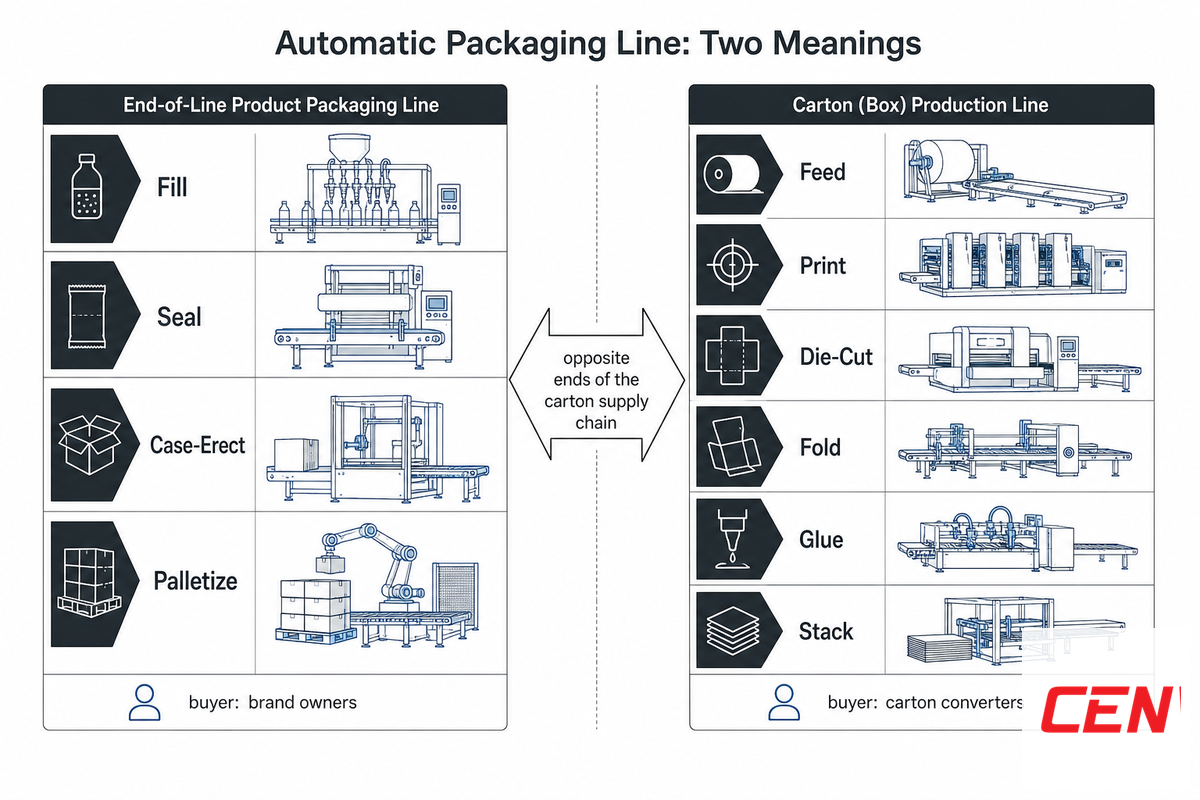
Uma linha de embalagem automática é um conjunto integrado de máquinas que realiza uma sequência de embalagem, manipulação, formação, enchimento, vedação, rotulagem, com intervenção manual mínima O problema é que a mesma frase de pesquisa retorna duas indústrias Execute o Teste de Dois Significados antes de selecionar qualquer fornecedor: pergunte se você está fazendo as malas produtos em caixas, ou fazendo o caixas próprias.
Essa mesma consulta surge à automação da linha de embalagem, a uma linha de embalagem integrada e a sistemas de embalagem automatizados, todo o significado de fim de linha, ao lado de um sistema de embalagem automática que preenche e sela produtos acabados; este guia é para o outro significado, a linha que faz as caixas.
Os principais fabricantes de equipamentos desenham a mesma linha Os gluers de pastas de produção de caixas dobráveis da Heidelberg listam a mesma linha de 300 m/min e, em seguida, listam seu Diana Packer de fim de linha separadamente em 30.00020.00 caixas por hora, duas classes, uma página A imprensa especializada é igualmente explícita: Packaging World e Packaging Strategies descrevem a coladora de pastas flexográficas como uma máquina box-making isso produz uma telha contínua de caixas dobradas e coladas, a montante de qualquer enchimento de produto. Errar na divisão é um problema caro: um comprador que encomenda a família errada corre o risco de meses de capital paralisado, porque um papelão e um colador de pastas não compartilham ferramentas, controles ou operadores, o Cenwan entrega apenas o lado da fabricação de caixas, por isso confirma a intenção do comprador em relação aos tipos de máquinas classificados pela ISO antes de citar.
| Pergunta | Linha de embalagem de produtos de fim de linha | Linha de produção da caixa (caixa) |
|---|---|---|
| O que faz | Produtos acabados embalados, selados e paletizados | Caixas vazias dobradas e coladas |
| Quem compra | Proprietários de marcas, 3 PLs, centros de atendimento | Conversores de caixa, plantas de caixa, impressoras |
| Exemplos estações | Eretor de caixa, empacotador de caixa, controlador de peso, paletizador | Alimentador, impressora, cortador de dados, colador de pastas, empilhador |
| Métrica de rendimento | Pacotes por minuto | Caixas por hora /velocidade da linha (m/min) |
| Cenwan constrói isso? | Não há um fornecedor de papelão/fornecedor de linha | Sim, linhas de papelão integradas e de papelão |
Qual é a diferença entre uma linha de embalagem automática e uma máquina de encadernação automática?
Uma linha de embalagem automática e uma máquina de encadernação automática ficam em extremos opostos da vida útil da caixa Uma linha de produção de caixas pega uma placa impressa plana e a transforma em caixas vazias dobradas, coladas e empilhadas; uma máquina de encadernação automática, ou caixa de fim de linha, ergue, preenche e fecha essas caixas em torno de um produto acabado Venda caixas para outras pessoas e você deseja uma linha de pasta-coladora; embale as mercadorias em caixas e você deseja uma caixa.
✔ Qual é você? Se sua saída é caixas, leia em & n o resto deste guia é o guia do comprador da caixa-produção Se sua saída produto embalado, os seis estágios abaixo ainda orientam você, mas sua lista restrita é de caixas e paletizadores, não de coladores de pastas.
O Mapa Linha Embalagem 6 Estágios
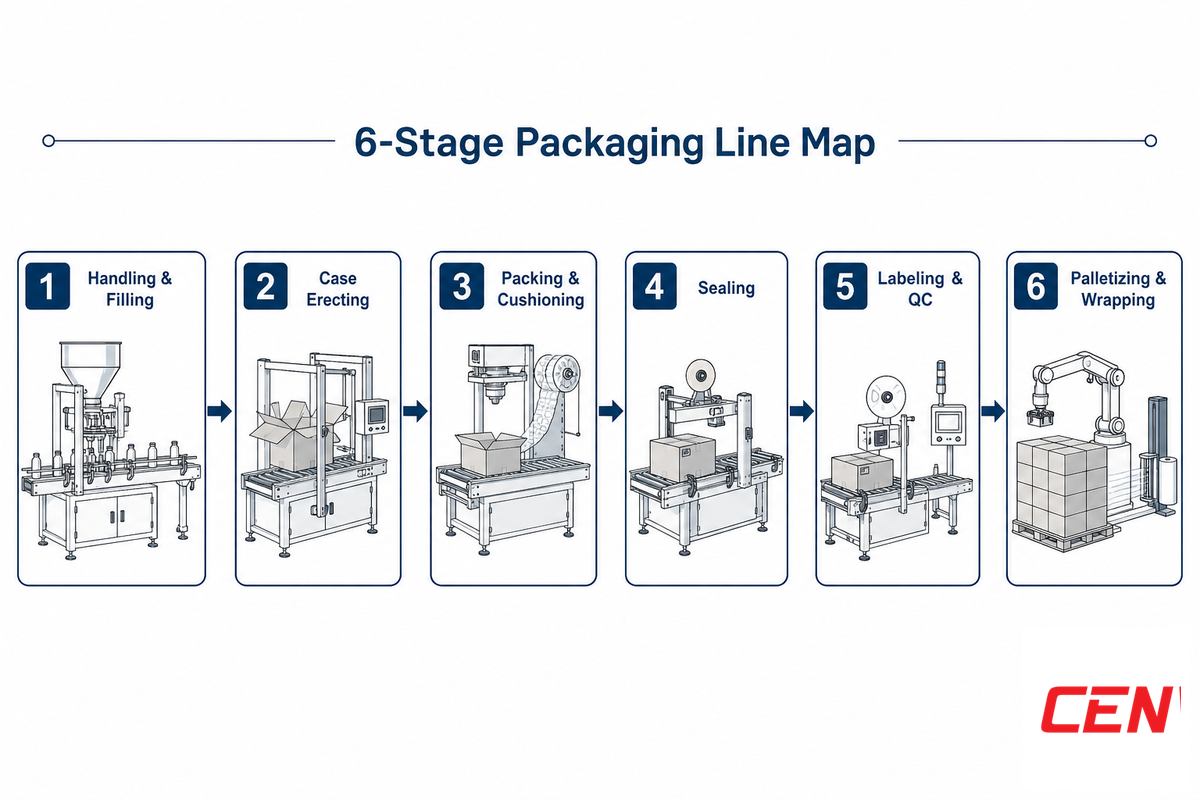
Seja qual for o lado em que você estiver, uma linha de embalagem automática é uma sequência de estações, cada uma tampada pela velocidade da mais lenta Do lado do produto, um sistema de embalagem automatizado executa todo o processo de embalagem, desde a formação da caixa até o carregamento de um palete acabado, com pouca entrada do operador Mapa de linha de embalagem em 6 estágios abaixo está a sequência de embalagem automatizada de fim de linha (o significado que os guias públicos descrevem); abaixo dela está o equivalente de produção de caixas, para que você possa combinar seu próprio fluxo de produto com o conjunto de máquinas certo.
| Estágio | O que a estação faz | Máquina típica |
|---|---|---|
| 1. manuseio e enchimento | Doses ou coloca o produto em embalagens primárias | Pesador multihead, enchimento, pick-and-place robótico |
| 2. montagem do caso | Formulários e caixas de vedação inferior em espaços em branco planos | Eretor de caso |
| 3. embalagem e amortecimento | Carrega o produto, adiciona preenchimento vazio, dimensiona a caixa à direita | Embalador de caixas, sistema de preenchimento vazio |
| 4. Vedação | Fecha a parte superior e inferior com fita adesiva ou hot-melt | Selador caso |
| 5. rotulagem & verificação | Aplica códigos; verifica peso, selo, código de barras | Imprimir-e-aplicar, checkweigher, sistema de visão |
| 6. Paletização | Pilhas e envoltórios de caixas acabadas para trânsito | Paletizador, invólucro elástico |
Em a linha de produção da caixa, o fluxo análogo é alimentar → imprimir (flexo ou lito) → cortar e vincar → dobrar → colar → empilhar e agrupar As referências da indústria descrevem a própria seção do dobrador-colador como alimentação, pré-quebrar, dobrar, colar, transferir e entregar Os nomes das estações diferem, mas a disciplina é idêntica: a linha corre no ritmo de sua transferência mais fraca.
Como a frase cobre ambos os significados, um rápido passeio pela família de fim de linha ajuda os compradores a se colocarem O equipamento de embalagem de fim de linha abrange uma única máquina de embalagem ou sistema de ensacamento até células de embalagem totalmente automatizadas que encadeiam os eretores, um selador, os checkweighers em linha e a paletização em um fluxo As soluções de embalagem semiautomáticas ficam entre a embalagem manual e uma linha totalmente automática, e a maioria dos sistemas automatizados se conecta ao software de gerenciamento de armazém para que a linha de embalagem automatizada seja executada a partir de dados de ordem ativa O campo mais amplo de máquinas de embalagem cobre muitos tipos de embalagem, desde o flow-wrap até a paletização, e toda solução de automação de embalagem existe para encerrar e proteger o produto.
Os benefícios explicam por que as operações de atendimento automatizam A embalagem totalmente automatizada eleva a proteção do produto e a qualidade e consistência da embalagem, ao mesmo tempo em que corta o desperdício de material e os danos ao produto por trás dos produtos danificados e devolvidos; o dimensionamento correto sob demanda e os custos dimensionais de acabamento de preenchimento vazio e os custos de frete As linhas automatizadas ligadas ao transportador aumentam o rendimento e a produtividade mais alta, proporcionam uma redução mensurável nos custos trabalhistas, reduzem os custos trabalhistas e as tarefas repetitivas e melhoram a eficiência e a qualidade do produto, ao mesmo tempo que aliviam a tensão ergonômica e as lesões no local de trabalho que o trabalho manual carrega A aceleração do processo de embalagem aumenta a eficiência sem adicionar pessoas.
Para um comprador de atendimento, os requisitos de embalagem se resumem ao manuseio do produto em um catálogo de alto SKU e volume sazonal: uma tabela de embalagem e tecnologia de embalagem que flexionam com as características do produto, manutenção preventiva para manter o tempo de atividade e braços robóticos para itens estranhos que não cairão ordenadamente em um saco ou bandeja Essa decisão pesa o investimento inicial contra o retorno do investimento, a velocidade de atendimento do pedido, os custos operacionais e a pegada da embalagem do armazém, o aumento da produtividade, o aumento da taxa de transferência e a maneira como a automação pode aumentar a eficiência sem novo número de funcionários.
O controle de qualidade é importante em ambas as extremidades. Um estudo de ergonomia revisado por pares no Jornal Internacional de Pesquisa Ambiental e Saúde Pública descobriu que a introdução de um a máquina de embalagem automática moveu a tensão do operador de risco intermediário para baixo em três métodos de avaliação independentes, um lembrete de que a automação também é uma decisão de segurança, não apenas uma decisão de rendimento.
Configurações da linha de produção de caixas: Gluer de pasta integrado versus independente
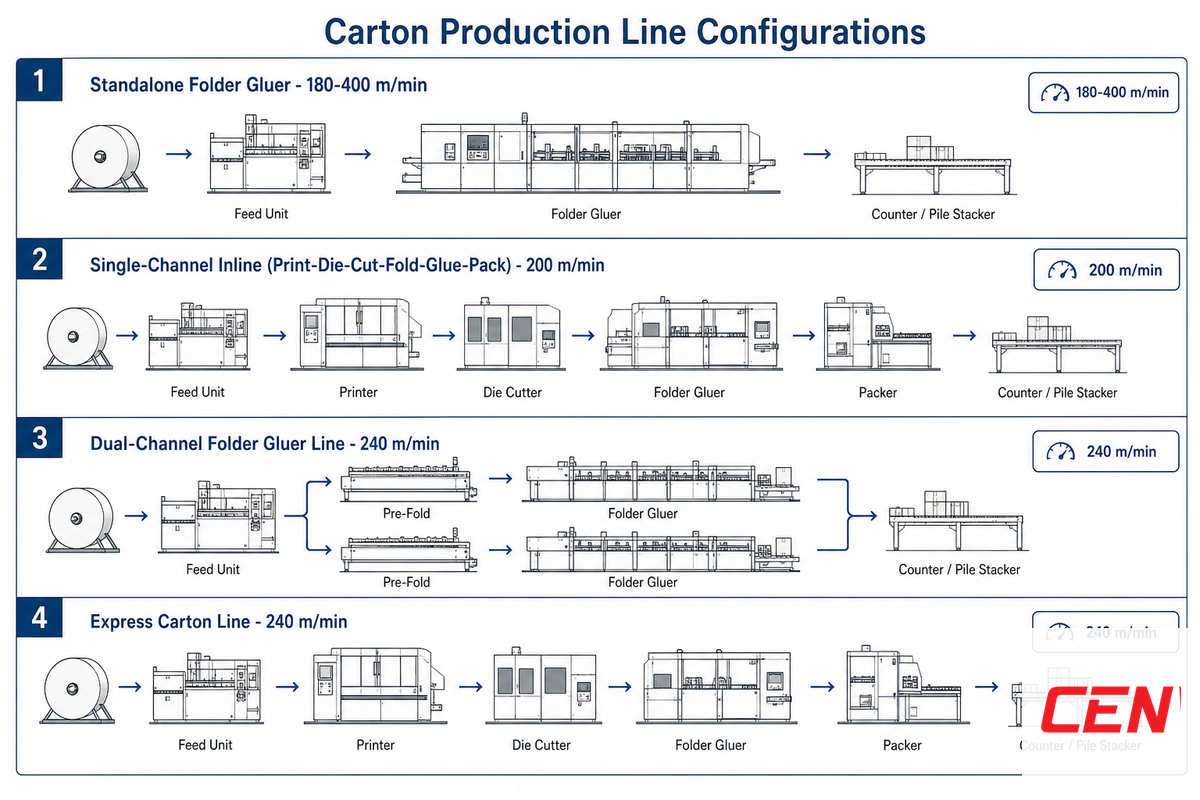
Uma linha de produção de caixas funciona como um fluxo contínuo, alimentação, impressão, corte e vinco, colagem dobrável e embalagem em uma única célula, ou como máquinas independentes, uma planta é alimentada manualmente. Abaixo de cerca de 800.000 caixas por dia, um autônomo máquina de alta velocidade da colagem da pasta normalmente faz o trabalho Acima dele, as transferências entre estágios tornam-se o gargalo, e um linha de embalagem automática integrada começa a pagar por si mesmo.
| Configuração | Velocidade | Capacidade/melhor ajuste |
|---|---|---|
| Coladora de pastas autônoma | 1800 m/min | <800 K caixas/dia, mistura estreita estilo caixa |
| Canal único em (impressão em matriz de impressão - Fold underfold thundle) | 200 m/min | Plantas que precisam de impressão em linha para embalagem, estilos mistos de FEFCO |
| Linha de colador de pasta de canal duplo | 240 m/min combinados | Caixas de 1,3 M/dia @ tamanho postal 13#; picos de comércio eletrônico |
| Linha de produção expressa da caixa | canal duplo de 240 m/min | Conversores postais/de encomendas ao nível do hub, 2 M+ caixas/dia |
A configuração é apenas metade da especificação, o estilo de caixa que você executa decide qual pasta-gluer sua linha realmente precisa Esta próxima tabela agrupa estilos de caixa FEFCO comuns por tipo mecânico e mapeia cada um para a máquina correspondente, a dimensão que a maioria dos guias do comprador deixa de fora inteiramente.
| Estilo caixa (FEFCO) | Tipo | Configuração correspondente de pasta-gluer |
|---|---|---|
| Caixa com fenda normal (0201) | Linha reta | Coladora de pastas padrão em linha reta |
| Bloqueio de colisão/fundo automático (0215) | Fechadura inferior | Coladora de pasta de fundo |
| Bandeja de 4 cantos (0422) | Multi-canto | Coladora de pastas de canto 4/6 |
| Caixa de exibição de 6 cantos | Multi-canto | Coladora de pastas de canto 4/6 |
| Caixa ondulada de parede dupla | Serviço pesado | Máquina colagem caixa ondulada |
| Estéreo premium/caixa de presente | Multi-eixo | Coladora de pastas de caixa estéreo |
| Caixa pequena (<150 mm) | Caixa pequena | Coladora de pastas de caixa pequena |
| Cartão postal 13# 7# parcel | Expresso | Linha de caixa expressa/de canal duplo |
| Execução mista com impressão em linha | Inline | Imprimir + cortar + dobrar + cola + linha de embalagem |
Essas faixas de velocidade não são exclusivas de uma marca A Heidelberg publica coladores de produção de caixas de 300 a 450 m/min, e os analistas de mercado observam que as linhas de coladores de pastas totalmente automatizadas correm acima de 400 m/min, otimizadas para troca de um toque O que importa para um comprador é combinar a métrica com a máquina: uma coladora de pastas é medida em caixas por hora e velocidade da linha, não a figura de pacotes por minuto que os guias de fim de linha citam.
Matemática de rendimento e mudança: a quebra da lacuna de rendimento
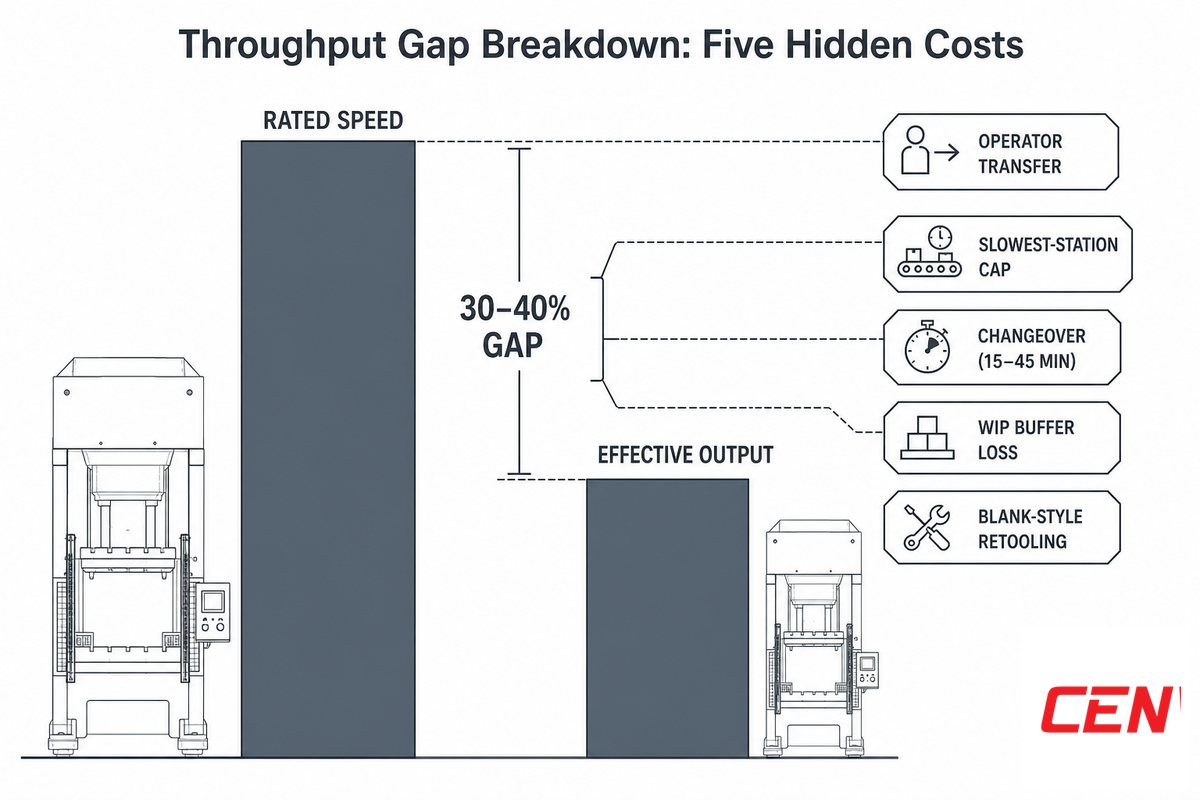
Aqui está a parte contra-intuitiva que a maioria das folhas de especificações pula: uma velocidade nominal mais alta nem sempre produz mais caixas, e a suposição comum de que a máquina mais rápida ganha o dia geralmente é para trás Como os integradores de embalagens colocam, o verdadeiro problema raramente é que a máquina é muito lenta, é que a linha não está mais equilibrada para o volume Quebra de lacuna de taxa de transferência nomeia os cinco lugares onde uma linha de papelão perde silenciosamente 30040% de sua saída nominal.
“Em uma linha pasta-gluer, a paralisação que custa uma alta temporada quase nunca é a estação mais rápida, é a transferência desequilibrada entre dois módulos que nenhuma folha de especificações mostra.”
| Custo oculto | Por que a saída cai |
|---|---|
| Transferência operador | As peças em bruto móveis entre máquinas independentes adicionam tempo ocioso em cada transferência |
| Tampa da estação mais lenta | A velocidade da linha é igual ao módulo mais lento, não à especificação mais rápida |
| Mudança | As mudanças manuais de tamanho levam 1545 minutos; servo um toque leva menos de 60 segundos |
| Perda de buffer em processo | Alimenta mal e rejeita resíduos de cartão, a maior parcela do custo da caixa |
| Reequipamento em branco | As máquinas não servo precisam de uma nova configuração para cada novo estilo de caixa encomendado |
. Nota de Engenharia (o próprio número de mudança).
Pegue uma planta funcionando 8 mudanças de ordem por turno Troca manual a 30 minutos cada queima 240 minutos, 4 horas de uma corrida de 20 horas, cerca de 201TP3 T de capacidade diária, ido antes de um único mal-alimentado Troque para uma linha servo de um toque em menos de 60 segundos por mudança e as mesmas 8 mudanças custam cerca de 8 minutos no total Conecte suas próprias trocas por turno e minutos por mudança: a lacuna entre esses dois números é geralmente uma alavanca maior do que comprar uma máquina mais rápida.
É também por isso que um conversor deve ler cuidadosamente uma cláusula de velocidade nominal versus efetiva. Isso decisão entre uma linha integrada e máquinas autônomas ativa esses cinco custos, não o título m/min.
O que custa uma linha de embalagem automática: níveis de investimento e ROI
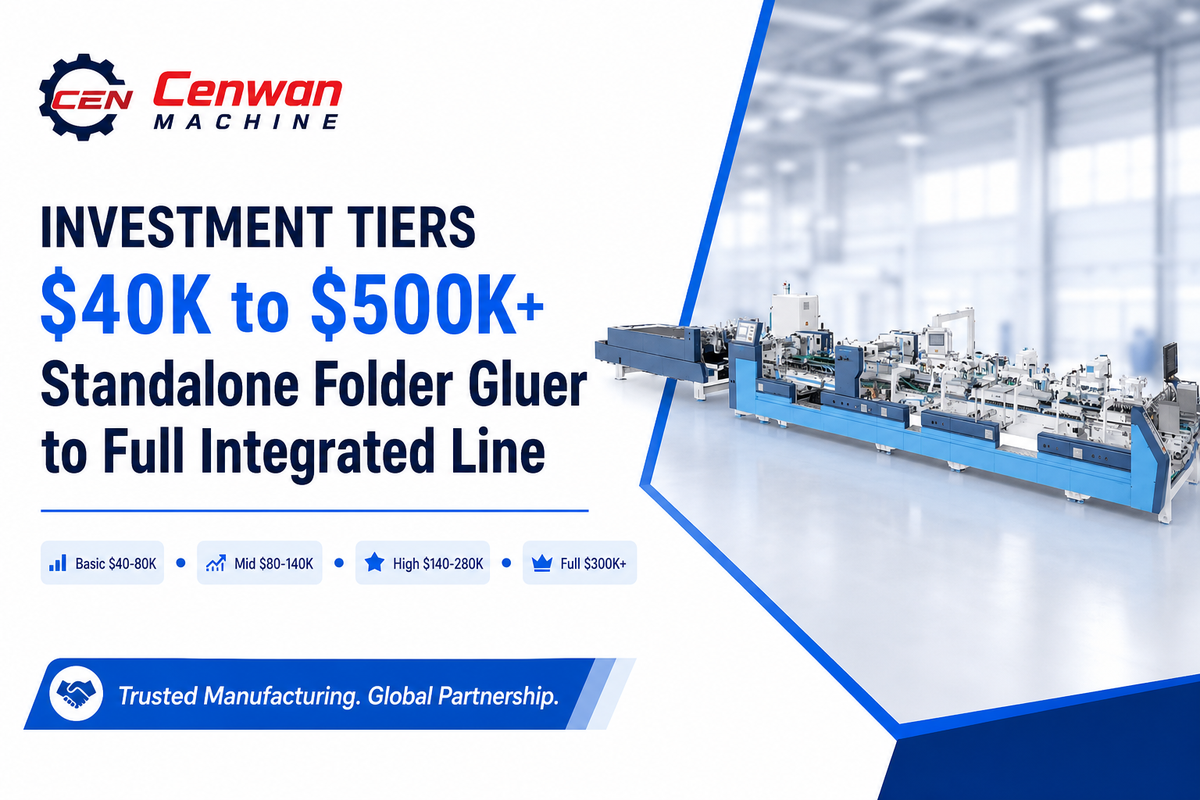
Uma linha de embalagem automática para produção de caixas varia de cerca de US$ $40.000 para um colador de pastas independente a $500.000-plus para uma linha totalmente integrada, e a maioria dos conversores pousa nas camadas $80.000,000 de médio a alto preço rastreia profundidade de automação, velocidade de linha e faixa estilo caixa, não apenas velocidade manchete.
Quanto custa uma linha de embalagem automática?
Os complementos de embalagem de fim de linha custam diferentemente novamente, um empacotador de pasta-gluer roda aproximadamente $7.000 a $600.000+ pelo escopo da automação, enquanto os analistas de mercado observam que as máquinas de especificação superior atingiram US$ 1,5 milhão no extremo Trate o custo da linha de embalagem automática abaixo como um envelope orçamentário e, em seguida, confirme com uma cotação com escopo.
| Camada | Banda | O que compra |
|---|---|---|
| Básico | $40K$80K | Coladora de pasta autônoma, planta de volume médio de produto único |
| Meio | $80K$140 | Único-canal em linha ou 400 m/min autônomo de alta velocidade |
| Alto padrão | 1TP140K1T4T4T280 | Linha de canal duplo, postal 13#7 day#, ~1.3 M caixas/ |
| Integrado completo | 1TP300K1T4T4T60 | Flexo + die-cut + dual-channel + embalagem, rollouts OEM |
Os retornos raramente vêm apenas da velocidade A suborçamentação é o problema comum de custo: uma planta que compra apenas com o preço do adesivo arrisca um 301TP3 T através do déficit, porque a linha não-servo mais barata carrega o maior custo de troca e sucata, então Cenwan uma figura instalada, com escopo FOB e uma linha marcada CE que corresponde à proposta A integração corta o número de funcionários do operador na linha de caixa de quatro para um ou dois por turno, e a economia de mudança acima normalmente paga uma opção de servo em bem menos de dois anos para plantas executando muitas mudanças de tamanho Os benchmarks independentes no lado do final da linha apontam da mesma maneira: a maioria das operações de médio a alto volume relata ROI dentro de 1224 meses Os dados de preços aqui datados de 2026 e dependentes de FOB, portanto, trate-o como uma banda de planejamento e modele a economia de mão de obra e mudança em relação ao seu próprio padrão de mudança com o padrão de mudança mapeador de orçamento de nível de linha de embalagem automática.
Linha Integrada vs Autônoma: O Limiar de Integração de 800.000 Caixas
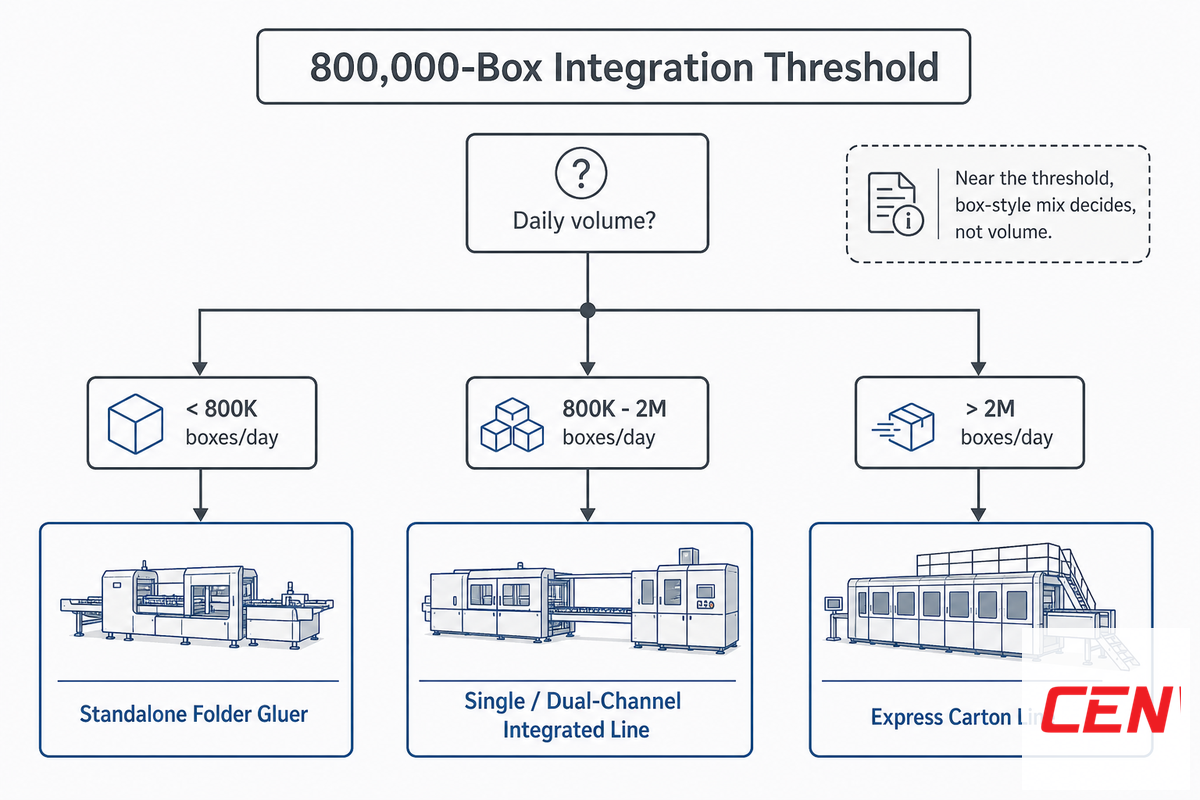
Os conversores podem levar uma regra de decisão para uma reunião de fornecedores: a Limite de integração de 800.000 caixas, o cruzamento do portfólio da Cenwan da experiência de implantação em vez de uma lei universal Abaixo de cerca de 800.000 caixas/dia, um colador de pasta independente geralmente é a compra certa; de cerca de 800.000 a 2 milhões, uma linha integrada de canal único ou duplo ganha; acima de 2 milhões, uma linha de caixa expressa é a ferramenta Seu próprio crossover se move com mix de estilo de caixa e custo de mão de obra, então perto do limite o fator decisivo muda de volume para quantos estilos você executa, quanto mais estilos, mais cedo a integração e a mudança de servo ganham seu sustento.
Mas o limiar é um ponto de partida, não um veredicto Como observa um editor de equipamentos industriais, a melhor escolha nem sempre é a mais automatizada; é a que se encaixa no mix de produtos, na situação de trabalho e na capacidade de manutenção da fábrica Uma planta de produto único com operadores qualificados e um orçamento de manutenção apertado pode superar uma célula integrada semi-usada.
| Perfil do comprador | Volume diário | Configuração recomendada |
|---|---|---|
| Conversor regional, mistura estreita | <600K/dia | Máquina de dobragem & de colagem autônoma da caixa |
| Planta de alto volume, sem impressão em linha | 600 mil toneladas 1,5 milhões/dia | Coladora de pasta de alta velocidade a 400 m/min |
| E-commerce/postal, multiplicadores de pico | 800 KK2M/dia | Linha de colador de pasta de canal duplo |
| Pharma/alimento/3 C misto, impressão em linha | 1MM/dia | Imprimir + cortar + dobrar + cola + linha de embalagem |
| Fornecedor de encomendas ao nível do hub | 2M+/dia | Linha de produção expressa da caixa |
Se seus números estiverem em um limite, passe-os pelo ferramenta de recomendação de linha de embalagem automática antes de comprometer capital.
Antes de comprar: lista de verificação de aceitação de linha de 7 pontos
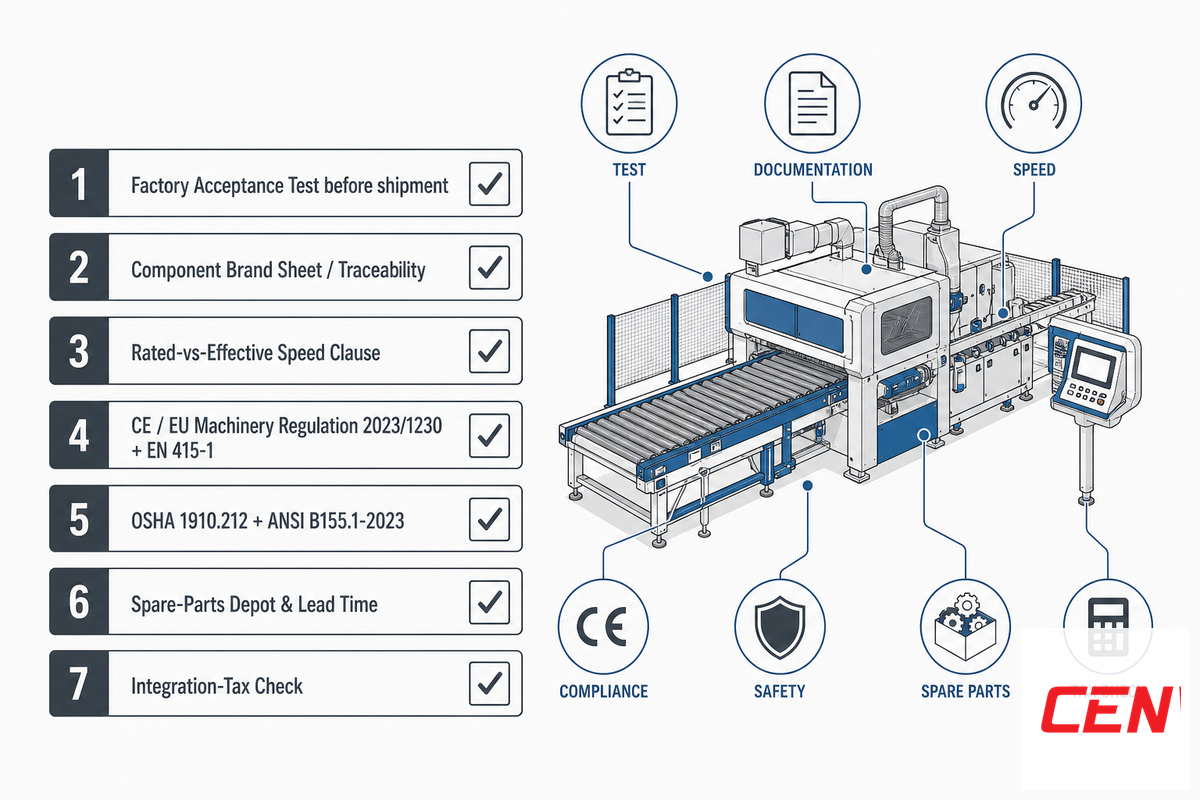
O equipamento de caixa de capital é uma compra propensa a erros, os profissionais trocam abertamente histórias de linhas mal especificadas e coladores envelhecidos que arrastam um novo packer para baixo A Lista de verificação de aceitação de linha de 7 pontos (pronta para FAT) separa uma linha que atingiu sua velocidade nominal daquela que para no terceiro ano.
- ✔ Teste de aceitação de fábrica (FAT) antes da expedição, veja a linha executar sua caixa na velocidade nominal, não uma demonstração em branco.
- ✔ Folha de marca de componente, PLC, servoacionamentos, rolamentos e pneumática listados pelo fabricante e número da peça para rastreabilidade.
- ✔ Uma cláusula escrita de velocidade nominal versus efetiva, com a suposição de tempo de atividade declarada.
- ✔ Conformidade com a UE: CE ao abrigo do Regulamento de Máquinas 2023/1230 (obrigatório a partir de janeiro de 2027), com avaliação de risco EN 415-1 e EN ISO 12100.
- ✔ Conformidade com os EUA: proteção de máquina para OSHA 29 CFR 1910.212 e a atual edição de segurança de máquinas de embalagem ANSI/PMMI B155.1-2023.
- ✔ Depósito de peças de reposição e prazo de entrega documentado para os mercados que você atende.
- ✔ A verificação fiscal de integração: as compilações mais completas de vários fornecedores geralmente adicionam semanas de engenharia de interface e ainda subexecutam o rendimento nominal, onde uma única célula pré-testada não.
. Engineering Note (Nota de Engenharia) leia o padrão de segurança como comprador, não como advogado.
Nos Estados Unidos, OSHA 29 CFR 1910.212 faz o empregadornão só o construtor de máquinas, responsável pela guarda dos pontos de aperto e do acesso ao transportador Na UE, Regulamento (UE) 2023/1230 substitui a Diretiva de Máquinas de longa data e se torna obrigatória em janeiro de 2027 Confirme qual estrutura seu mercado de destino usa antes de assinar, a adaptação de proteções após a entrega é o caminho caro.
Perspectivas da indústria: o que está impulsionando a automação de linha de papelão em 2026
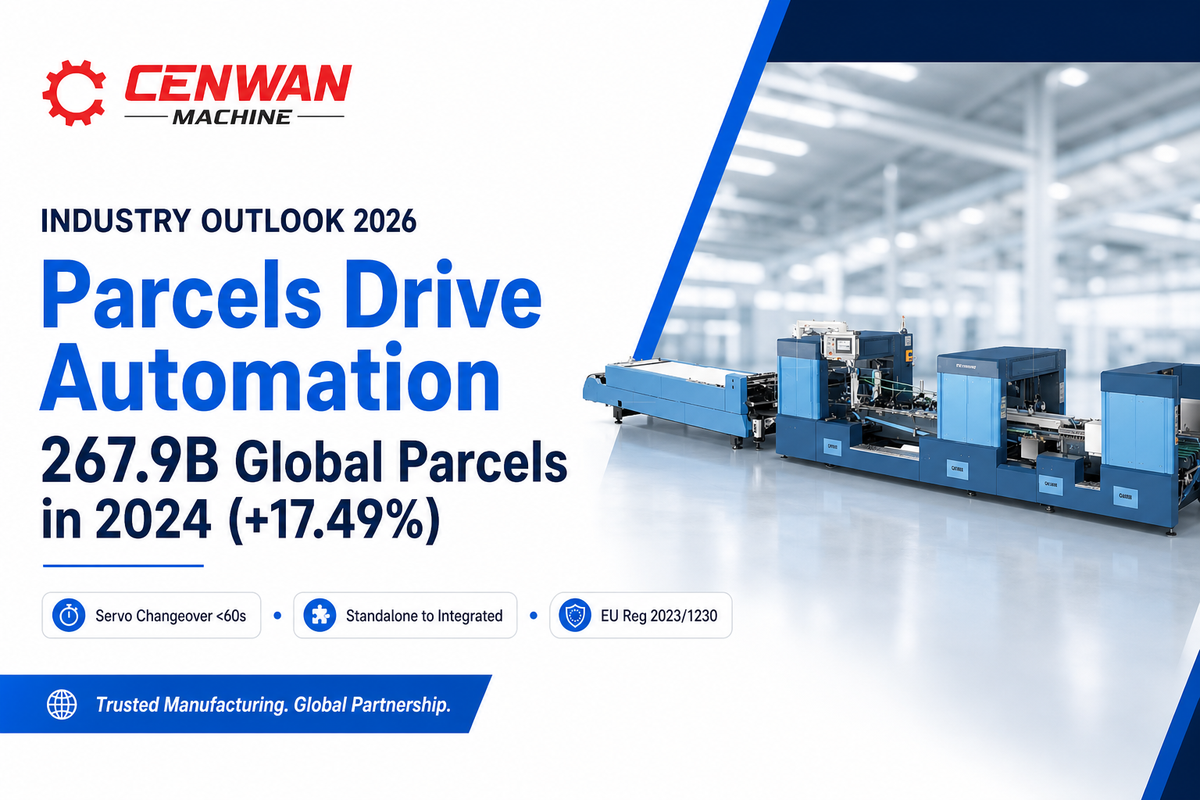
O que impulsiona a automação da linha de papelão não é um mercado, são encomendas De acordo com o Global Express Development Report 2025 do State Post Bureau, o volume global atingiu 267,9 bilhões de itens em 2024, um aumento de 17,49% com a China lidando com 175 bilhões de peças, e o relatório projeta que o mundo passe 300 bilhões em 2025, enquanto Correio Estatal da China Registrou 216,5 bilhões de itens domésticos em 2025. essa inundação empurra os conversores de duas maneiras ao mesmo tempo: de coladores de pastas autônomos em direção a linhas integradas, e de mudanças manuais de tamanho em direção à troca servo de um toque, de modo que os gargalos de transferência e troca sejam apagados antes de uma saída de limites de pico de temporada Para um comprador que planeja uma linha de 2026, a ação é concreta, audite quantas mudanças seu turno mais movimentado é executado hoje, porque esse número, não a velocidade nominal, decide se você limpa o pico do próximo ano Cenwan vê o mesmo padrão em conversores de caixa de comércio eletrônico, alimentos e produtos farmacêuticos: as plantas que lutam através de um pico são aquelas cujo gargalo de transferência e troca nunca foi projetado, se elas executam uma linha de embalagem automática para caixas de alimentos ou encomendas postais Nas implantações de Cenwan em conversores de comércio eletrônico, alimentos e produtos farmacêuticos, as linhas que limpam o pico são verificadas pela FAT e a mudança de fábrica ISO 901 porque a remessa foi superada pelo mecanismo antes.
As previsões de mercado se alinham com a leitura, apenas em termos direcionais: analistas do setor projetam que o mercado de embalagem-automação cresça cerca de 8% por ano (uma estimativa o coloca perto de US$ 84 bilhões em 2026), e o segmento de máquinas de colador de pastas em cerca de 6,8% anualmente. Esses números são úteis como contexto, não como motivo de compra, o motivo de compra é a curva de encomendas e a matemática da mudança no seu próprio andar.
Layout automático da linha de embalagem e lista de verificação de retrofit
Uma linha que se encaixa no processo no papel ainda pode falhar na fábrica porque o fluxo de material, utilitários ou espaço de embalagem foram ignorados Congele o layout somente depois que essas restrições forem medidas no chão.
| Ponto de verificação de layout | Medir antes do projeto | Falha comum se for perdida |
|---|---|---|
| Fluxo material | Entrada em branco, buffers de trabalho em processo, saída de caixa acabada e cruzamentos de empilhadeiras. | Os operadores criam desvios manuais que apagam o benefício da automação. |
| Estação gargalo | Boas unidades por hora na impressão, corte e vinco, dobramento/colagem e embalagem. | A máquina mais rápida espera atrás da estação mais lenta. |
| Utilitários | Potência, ar comprimido, extração, fornecimento de adesivo e gotas de rede. | Mudanças tardias na utilidade aumentam o tempo e o custo de comissionamento. |
| Troca de espaço | Acesso em torno de alimentadores, unidades de cola, transportadores dobráveis e painéis de serviço. | A manutenção e a configuração do trabalho tornam-se mais lentas ou inseguras. |
| Controles de retrofit | Interfaces de sinal, sincronização de velocidade de linha, lógica de rejeição e cadeia de parada de emergência. | As máquinas funcionam individualmente, mas não podem operar como uma linha controlada. |
Usar o recomendação automática da linha de embalagem para definir uma configuração inicial, valide o layout com fluxo real do produto e acesso de mudança.
Perguntas frequentes
Q: Quão rápido é uma linha de embalagem automática, em produção real?
Ver Resposta
As linhas de produção de caixas executam aproximadamente 15. linhas de pasta dependendo da configuração de 00 m/min, e os principais fabricantes publicam coladores de até 450 m/min. A saída efetiva é sempre menor que o valor nominal porque a linha funciona na velocidade de sua estação mais lenta e perde tempo para transferências e trocas Trate o número da folha de especificações como um teto e peça uma cláusula nominal versus efetiva apoiada por um teste de aceitação de fábrica.
Q: Uma linha de embalagem automática vale a pena sob 800.000 caixas por dia?
Ver Resposta
Normalmente, um colador de pasta independente é o melhor valor abaixo de cerca de 800.000 caixas/dia, especialmente com uma mistura estreita estilo caixa. Uma exceção é o trabalho pesado de troca: se você executar muitas mudanças de tamanho por turno, a economia servo de um toque pode justificar uma linha mais automatizada bem antes do limite de volume. Decida sobre mix estilo caixa e frequência de troca, não apenas volume.
Q: Quais são as desvantagens da embalagem automática?
Ver Resposta
As principais desvantagens são o custo de capital, o espaço físico e a dependência do tempo de atividade: uma linha integrada que interrompe todo o fluxo, de modo que um único congestionamento pode ocioso em toda a célula, em vez de uma estação Os compradores também subestimam rotineiramente o treinamento do operador, a prática de mudança, a logística de peças de reposição (spare-parts). os custos operacionais que decidem se a linha permanece produtiva após o terceiro ano.
Q: Uma linha da caixa segura tanto a caixa dobrável quanto as caixas onduladas?
Ver Resposta
Alguns podem. uma máquina dobrável e de colagem da caixa do full-servo lida com a placa dobrável-carton em torno de 20000 g, quando as linhas corrugadas-capazes correrem as flautas comuns de E/F/C/B/AB.
P: Que certificações uma linha de embalagem automática deve transportar para importação?
Ver Resposta
Para a UE: Marcação CE sob o Regulamento de Máquinas 2023/1230, EN 415-1, EN ISO 12100 e RoHS. Para a América do Norte, alinhe-se com a proteção OSHA 1910.212 e a inspeção de pré-embarque ANSI/PMMI B155.1-2023. Uma inspeção de pré-embarque de terceiros, mediante solicitação, suaviza o desembaraço aduaneiro.
Q: Qual é a diferença entre uma linha de embalagem e um sistema de fim de linha?
Ver Resposta
Um sistema de fim de linha é um tipo de linha de embalagem (peça) que embala produtos acabados em caixas de transporte (erguimento, embalagem, vedação, paletização).Uma linha de produção de caixas é a linha upstream que faz com que essas caixas vazias sejam chamadas de linha de embalagem automática, e é exatamente por isso que o Teste de Dois Significados é importante.
Escopo de uma linha de produção de caixas?
Diga-nos o seu volume diário, estilos de caixa e mercados de destino, e nós os mapearemos para uma máquina autônoma ou uma linha integrada, com uma cotação de escopo, não um folheto.
Sobre Este Guia do Comprador
Este guia é escrito para conversores de caixas pesando uma compra de linha de pasta-gluer, e ele deliberadamente encaminha os compradores de embalagens de produtos de fim de linha para a categoria certa, em vez disso, as velocidades de configuração, os números de capacidade e os níveis de investimento refletem as linhas de caixas de pasta-gluer e integradas da Cenwan implantadas em mais de 40 países desde 2014; os dados de mercado e padrões são citados de fontes públicas Revisados pela equipe técnica da Cenwan Machine.
Referências e fontes
- 29 CFR 1910.212, Requisitos Gerais para Todas as MáquinasAdministração de Segurança e Saúde Ocupacional dos EUA
- Regulamento (UE) 2023/1230 relativo a máquinas (que revoga a Diretiva 2006/42/CE)Jornal Oficial da União Europeia
- Redução ergonômica de riscos de máquinas de embalagem automática (IJERPH 2022)Biblioteca Nacional de Medicina dos EUA (PMC)
- ANSI/PMMI B155.1-2023 Segurança de Máquinas de Embalagem e ProcessamentoInstituto Nacional Americano de Padrões
- Relatório de Desenvolvimento Global Express 2025 (volume global de encomendas 267,9 bilhões, 2024)Centro de Desenvolvimento e Pesquisa do State Post Bureau
- US 8.033.975 B2, Unidade dobrável e método de dobramento de folha de papelão onduladoEscritório de Marcas e Patentes dos EUA
- Estatísticas da indústria postal da China de 2025 (216,5 bilhões de itens)Conselho de Estado da República Popular da China
- US 2011/0268551 A1, Contra ejetor de máquina para fazer caixas de folhas de papelãoEscritório de Marcas e Patentes dos EUA
- Automação de Embalagens Previsão de mercado (~81TP3 T CAGR)Fortune Business Insights (estimativa de analistas do setor)
Artigos Relacionados
- Máquinas automáticas de coladores de pastas explicadas, tipos, componentes e custos
- Como cortar o tempo de troca de pedidos em uma máquina de colador de pastas
- O que é uma coladora de pastas em linha reta? verificações de processo e produtividade
- guia, largura, cola e velocidade da máquina de colador de pasta de caixa pequena de 2026