Get in touch with Cenwan Machine Company


Updated June 2026 · Reviewed by the Cenwan Machine technical team
An automatic packaging line is one term that hides two completely different capital purchases. For some buyers it means the end-of-line system that fills, seals, and palletizes finished products. For carton converters it means the production line that manufactures the empty boxes in the first place. Picking the wrong one wastes months of evaluation, so this guide start by separating the two, then goes deep on the carton-production side, where most published advice goes silent. For the separate task of securing finished pallet loads, compare industrial strapping and stretch film from UD Packaging against the load dimensions and handling conditions specified for your line.
Short answer. An automatic packaging line is an integrated set of machines that runs a packaging sequence with minimal manual handling. The phrase covers two families: an end-of-line product packaging line (erecting, packing, sealing, palletizing finished goods) and a carton production line — the folder-gluer line that converts printed board into folded, glued, stacked empty cartons, running 150–450 m/min. Cenwan builds the second.
Quick Specs, Automatic Packaging Line (Carton Production)
| Two categories | End-of-line product packaging vs carton (box) production line |
| Carton line speed | 150–400 m/min (configuration-dependent) |
| Integration threshold | ~800,000 boxes/day (standalone → integrated) |
| Investment band | ~USD $40K (standalone) to $500K+ (full integrated line) |
| Servo one-touch changeover | Under 60 seconds vs 15–45 minutes manual |
| Core safety standards | CE / EU Machinery Regulation 2023/1230, EN 415-1, ISO 9001, US OSHA 1910.212 |
💡 Key points
- Category, not budget, is the biggest buying error: end-of-line packaging and carton production lines are opposite ends of the supply chain.
- A faster machine doesn’t automatically raise output, line balance, transfers, and changeover decide real throughput.
- Around 800,000 boxes/day, the question shifts from price to architecture: standalone folder gluer or integrated line.
- From January 2027, machines sold into the EU must meet Machinery Regulation 2023/1230, which replaces Directive 2006/42/EC.
What Is an Automatic Packaging Line? The Two-Meaning Test
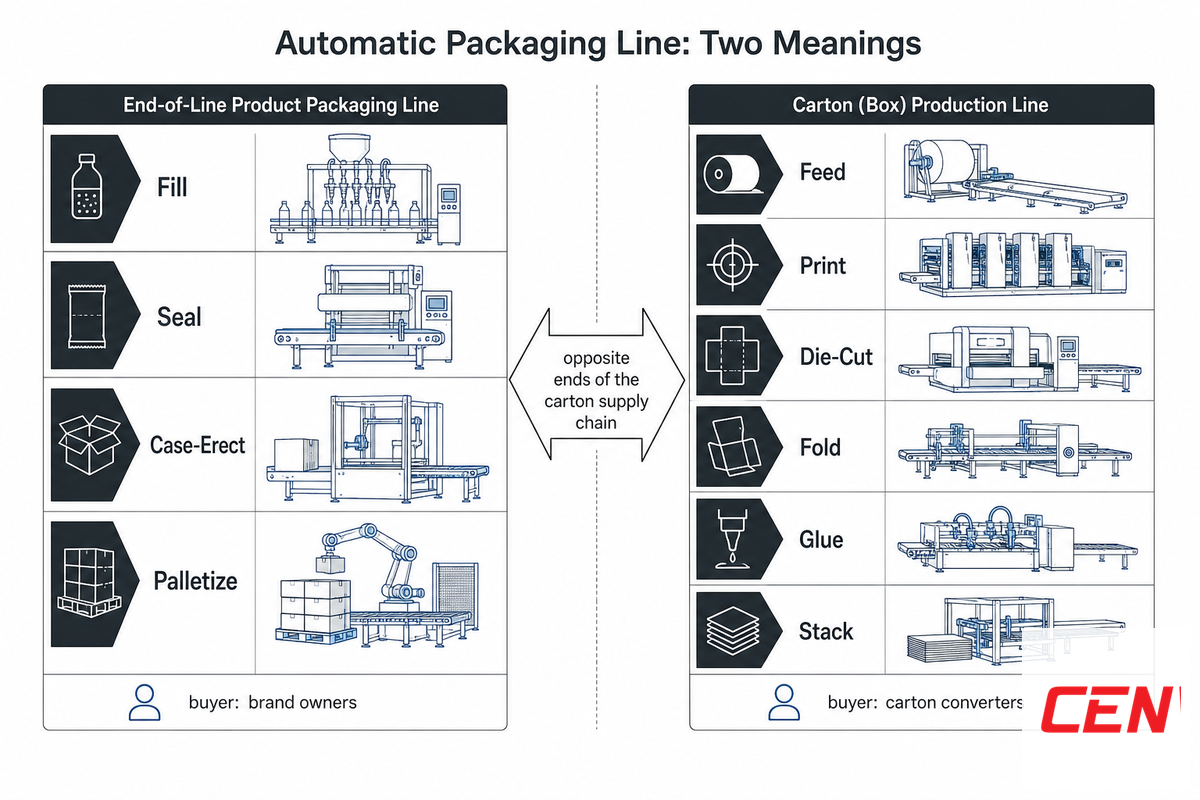
An automatic packaging line is an integrated set of machines that performs a packaging sequence, handling, forming, filling, sealing, labeling, with minimal manual intervention. Trouble is, the same search phrase returns two industries. Run the Two-Meaning Test before you shortlist any vendor: ask whether you’re packing products into boxes, or making the boxes themselves. In bakery and snack projects, the food processing machinery from UDTECH catalogue provides examples of the upstream production equipment; wrapping the finished food and manufacturing its empty cartons remain separate equipment scopes.
That same query surfaces packaging line automation, an integrated packaging line, and automated packaging systems, all the end-of-line meaning, next to an automatic packaging system that fills and seals finished goods; this guide is for the other meaning, the line that make the boxes.
Major equipment makers draw the same line. Heidelberg’s folding-carton catalogue lists box-production folder gluers at 300–450 m/min, then lists its end-of-line Diana Packer separately at 30,000–220,000 cartons per hour, two machine classes, one page. Trade press is just as explicit: Packaging World and Packaging Strategies describe the flexo folder gluer as a box-making machine that outputs a continuous shingle of folded, glued cartons, upstream of any product filling. Getting the split wrong is an expensive problem: a buyer who orders the wrong family risks months of stalled capital, because a cartoner and a folder gluer share no tooling, controls, or operators, Cenwan delivers only the carton-making side, so it confirms a buyer’s intent against ISO-classified machine types before quoting.
| Question | End-of-line product packaging line | Carton (box) production line |
|---|---|---|
| What it makes | Packed, sealed, palletized finished goods | Empty folded-and-glued cartons |
| Who buys it | Brand owners, 3PLs, fulfilment centers | Carton converters, box plants, printers |
| Example stations | Case erector, case packer, checkweigher, palletizer | Feeder, printer, die-cutter, folder gluer, stacker |
| Throughput metric | Packages per minute | Boxes per hour / line speed (m/min) |
| Cenwan builds this? | No — evaluate a cartoner / end-of-line vendor | Yes — folder-gluer and integrated carton lines |
What is the difference between an automatic packaging line and an automatic cartoning machine?
An automatic packaging line and an automatic cartoning machine sit at opposite ends of the carton’s life. A carton production line takes flat printed board and turns it into folded, glued, stacked empty cartons; an automatic cartoning machine, or end-of-line cartoner, erects, fills, and closes those cartons around a finished product. Sell cartons to others and you want a folder-gluer line; pack goods into cartons and you want a cartoner.
✔ Which are you? If your output is boxes, read on — the rest of this guide is the carton-production buyer’s guide. If your output is packed product, the six stages below still orient you, but your shortlist is cartoners and palletizers, not folder gluers.
The 6-Stage Packaging Line Map
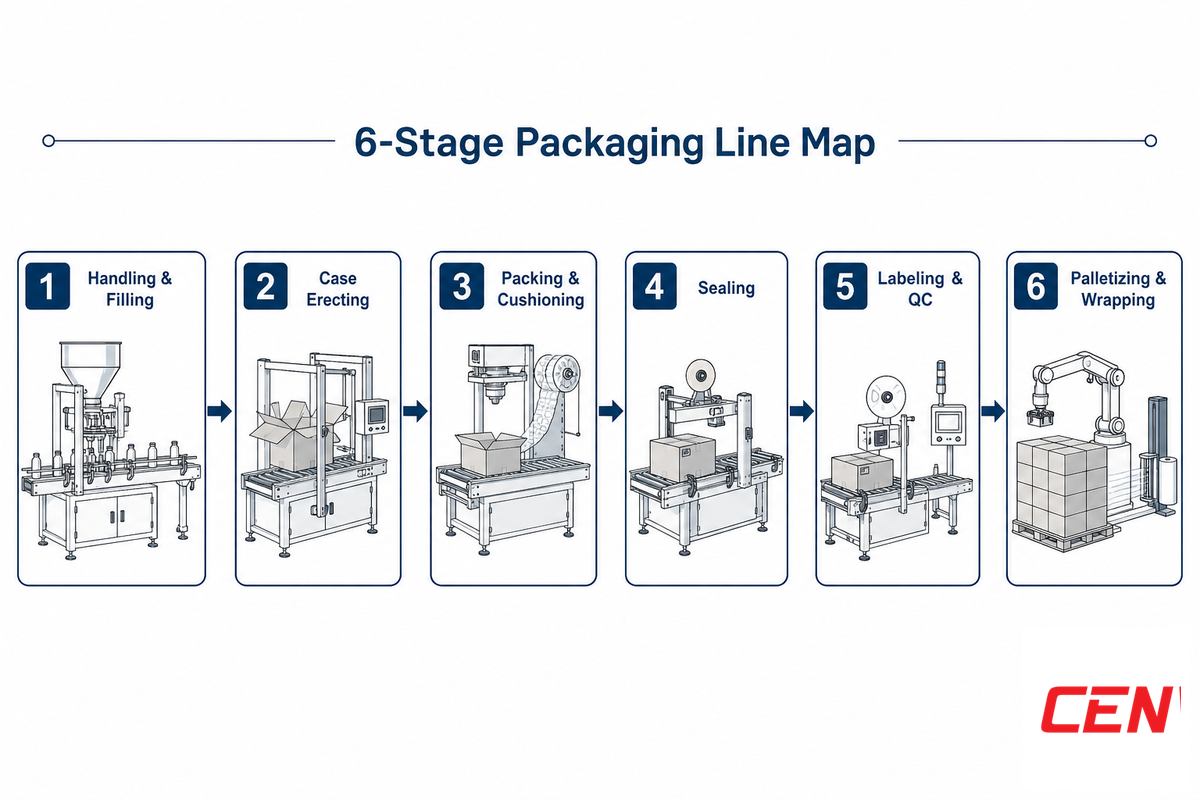
Whichever side you’re on, an automatic packaging line is a sequence of stations, each capped by the speed of the slowest one. On the product side, an automated packaging system runs the whole packaging process, from forming the box to loading a finished pallet, with little operator input. The 6-Stage Packaging Line Map below is that end-of-line automated packaging sequence (the meaning the public guides describe); beneath it’s the carton-production equivalent, so you can match your own product flow to the right machine set.
| Stage | What the station does | Typical machine |
|---|---|---|
| 1. Handling & filling | Doses or places product into primary packaging | Multihead weigher, filler, robotic pick-and-place |
| 2. Case erecting | Forms and bottom-seals cartons from flat blanks | Case erector |
| 3. Packing & cushioning | Loads product, adds void fill, right-sizes the box | Case packer, void-fill system |
| 4. Sealing | Closes top and bottom with tape or hot-melt | Case sealer |
| 5. Labeling & verification | Applies codes; checks weight, seal, barcode | Print-and-apply, checkweigher, vision system |
| 6. Palletizing | Stacks and wraps finished cases for transit | Palletizer, stretch wrapper |
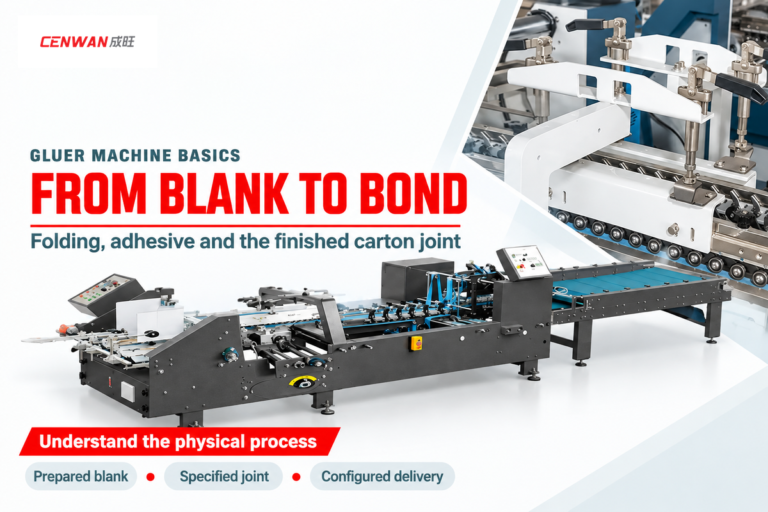
On a carton production line, the analogous flow is feeding → printing (flexo or litho) → die-cutting and creasing → folding → gluing → stacking and bundling. Industry references describe the folder-gluer section itself as feeding, pre-breaking, folding, gluing, transfer, and delivery. Station names differ, but the discipline is identical: the line run at the pace of its weakest transfer.
Because the phrase cover both meanings, a quick tour of the end-of-line family helps buyers place themselves. End-of-line packaging equipment spans a single packing machine or bagging system up to fully automated packaging cells that chain case erectors, a sealer, in-line checkweighers, and palletizing into one flow. Semi-automated packaging solutions sit between manual packing and a fully automatic line, and most automated systems link to warehouse management software so the automated packaging line runs from live order data. The wider field of packaging machinery covers many types of packaging, from flow-wrap to palletizing, and every packaging automation solution exists to enclose and protect the product.
Benefits explain why fulfillment operations automate. Fully automated packaging lifts product protection and packaging quality and consistency while cutting material waste and the product damage behind returned, damaged products. On-demand right-sizing and void fill trim dimensional weight and freight costs. Conveyor-linked automated lines raise throughput and higher productivity, deliver a measurable reduction in labor costs, and reduce labor costs and repetitive tasks. They also improve efficiency and product quality while easing the ergonomic strain and workplace injuries that manual labor carries. Speeding the packing process boosts efficiency without adding people.
For a fulfillment buyer, packaging requirements come down to product handling across a high-SKU, seasonal-volume catalog. That means a packing table and packing technology that flex with product characteristics, preventative maintenance to hold uptime, and robotic arms for awkward items that won’t drop neatly into a bag or tray. That decision weighs initial investment against return on investment, order fulfillment speed, operational costs, and the warehouse packaging footprint, the increase in productivity, the increases throughput, and the way automation can increase efficiency without new headcount.
Quality control matters at both ends. A peer-reviewed ergonomics study in the International Journal of Environmental Research and Public Health found that introducing an automatic packaging machine moved operator strain from intermediate to low risk across three independent assessment methods, a reminder that automation is also a safety decision, not only a throughput one.
Carton Production Line Configurations: Integrated vs Standalone Folder Gluer
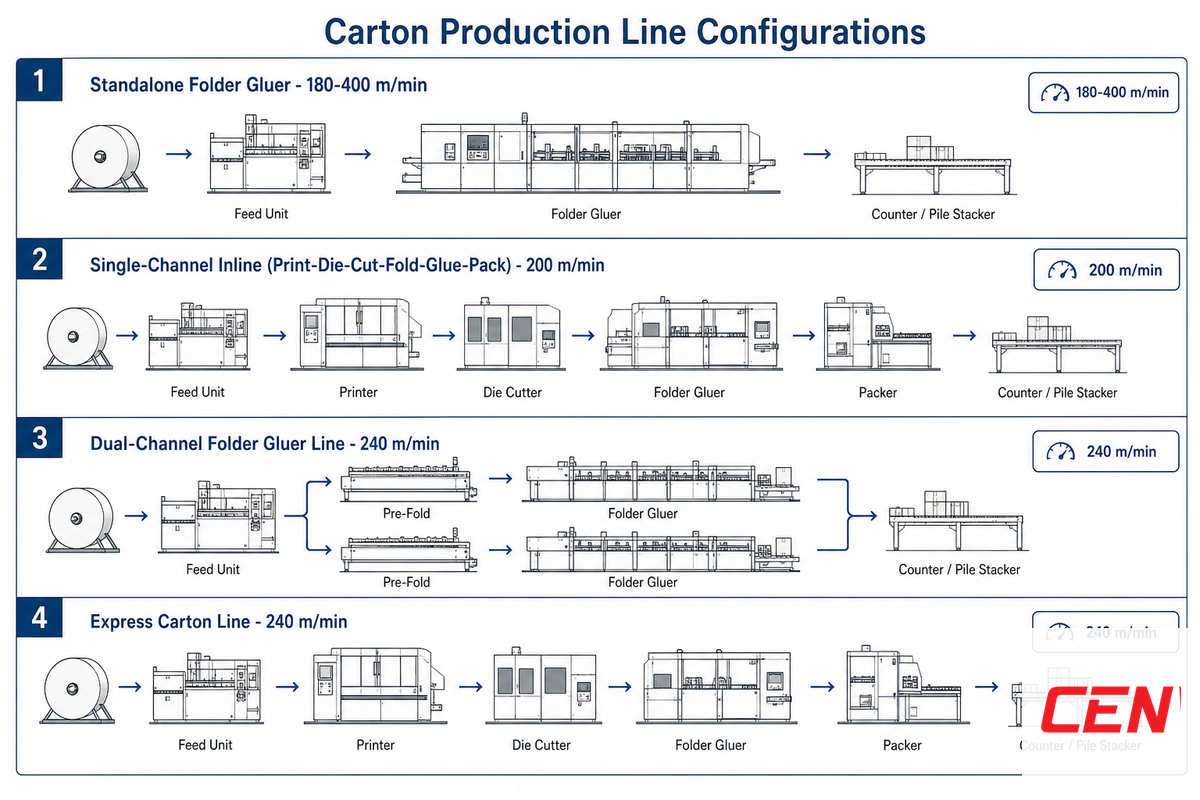
A carton production line either runs as one continuous flow, feeding, printing, die-cutting, folding-gluing, and packing in a single cell, or as standalone machines a plant feed by hand. Below roughly 800,000 boxes a day, a standalone high-speed folder gluer machine usually does the job. Above it, the inter-stage transfers become the bottleneck, and an integrated automatic packaging line starts to pay for itself.
| Configuration | Speed | Capacity / best-fit |
|---|---|---|
| Standalone folder gluer | 180–400 m/min | <800K boxes/day, narrow box-style mix |
| Single-channel inline (print–die-cut–fold–glue–pack) | 200 m/min | Plants needing inline print-to-pack, mixed FEFCO styles |
| Dual-channel folder gluer line | 240 m/min combined | 1.3M boxes/day @ postal size 13#; e-commerce peaks |
| Express carton production line | 240 m/min dual-channel | Hub-level postal/parcel converters, 2M+ boxes/day |
Configuration is only half the spec, the box style you run decides which folder-gluer your line actually needs. This next table clusters common FEFCO box styles by mechanical type and maps each to the matching machine, the dimension most buyer guides leave out entirely.
| Box style (FEFCO) | Type | Matching folder-gluer configuration |
|---|---|---|
| Regular slotted carton (0201) | Straight-line | Standard straight-line folder gluer |
| Crash-lock / auto-bottom (0215) | Lock-bottom | Lock-bottom folder gluer |
| 4-corner tray (0422) | Multi-corner | 4/6-corner folder gluer |
| 6-corner display box | Multi-corner | 4/6-corner folder gluer |
| Double-wall corrugated case | Heavy-duty | Corrugated box gluing machine |
| Premium stereo / gift box | Multi-axis | Stereo box folder gluer |
| Small carton (<150 mm) | Small-box | Small-box folder gluer |
| Postal 13#–7# parcel carton | Express | Dual-channel / express carton line |
| Mixed run with inline print | Inline | Print + die-cut + fold + glue + pack line |
These speed bands aren’t unique to one brand. Heidelberg publishes box-production gluers from 300 to 450 m/min, and market analysts note that fully automated folder-gluer lines run above 400 m/min, optimized for one-touch changeover. What matters for a buyer is matching the metric to the machine: a folder gluer is measured in boxes per hour and line speed, not the packages-per-minute figure that end-of-line guides quote.
Throughput & Changeover Math: The Throughput Gap Breakdown
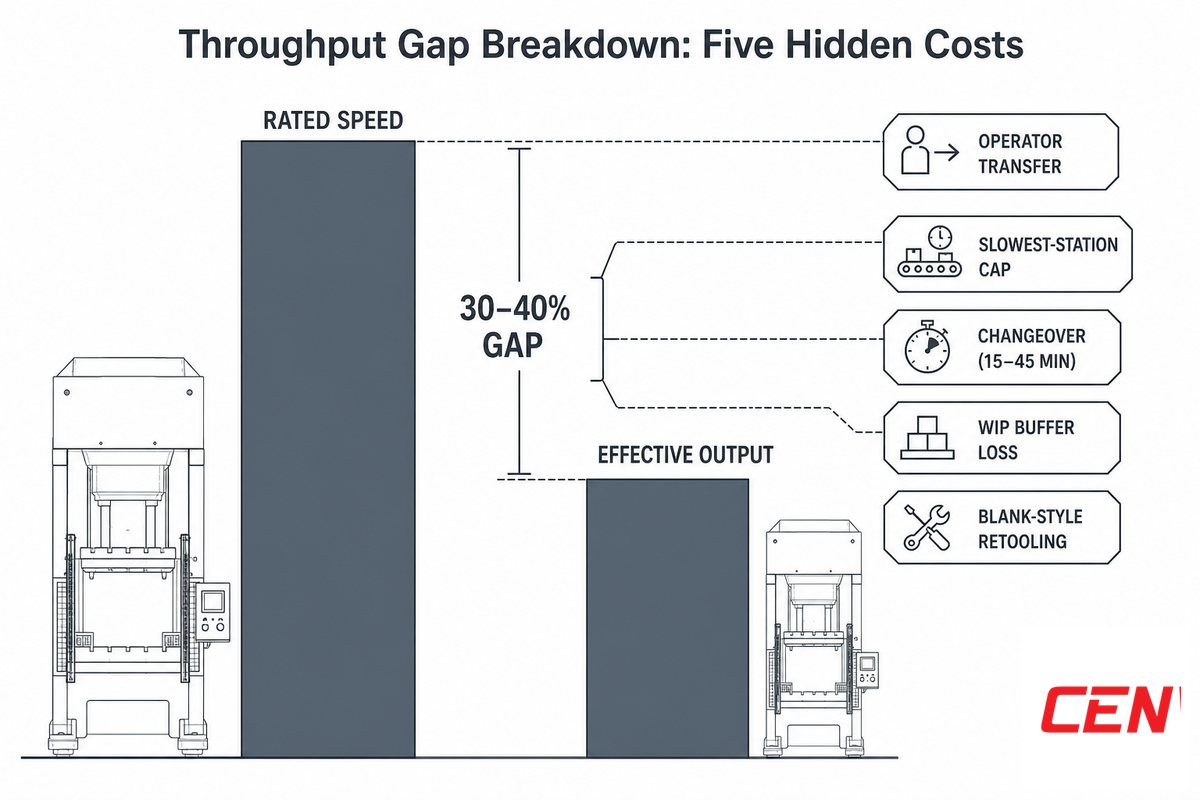
Here’s the counterintuitive part most spec sheets skip: a higher rated speed doesn’t always produce more cartons, and the common assumption that the fastest machine win the day is often backwards. As packaging integrators put it, the real problem is rarely that the machine is too slow, it’s that the line is no longer balanced for the volume. The Throughput Gap Breakdown names the five places a carton line quietly loses 30–40% of its rated output.
“On a folder-gluer line, the stoppage that costs you a peak season is almost never the fastest station, it is the unbalanced transfer between two modules that no spec sheet shows.”
| Hidden cost | Why output drops |
|---|---|
| Operator transfer | Hand-moving blanks between standalone machines adds idle time at every handoff |
| Slowest-station cap | Line speed equals the slowest module, not the fastest spec |
| Changeover | Manual size changes take 15–45 minutes; servo one-touch takes under 60 seconds |
| In-process buffer loss | Misfeeds and rejects waste board, the largest share of carton cost |
| Blank-style retooling | Non-servo machines need new setup for every new box style ordered |
📐 Engineering Note — work the changeover number yourself.
Take a plant running 8 order changes per shift. Manual changeover at 30 minutes each burns 240 minutes, 4 hours of a 20-hour run, about 20% of daily capacity, gone before a single misfeed. Swap to a servo one-touch line at under 60 seconds per change and the same 8 changes cost about 8 minutes total. Plug in your own changeovers-per-shift and minutes-per-change: the gap between those two numbers is usually a larger lever than buying a faster machine.
This is also why a converter should read a rated-versus-effective speed clause carefully. That decision between an integrated line and standalone machines turns on these five costs, not the headline m/min.
What an Automatic Packaging Line Costs: Investment Tiers & ROI
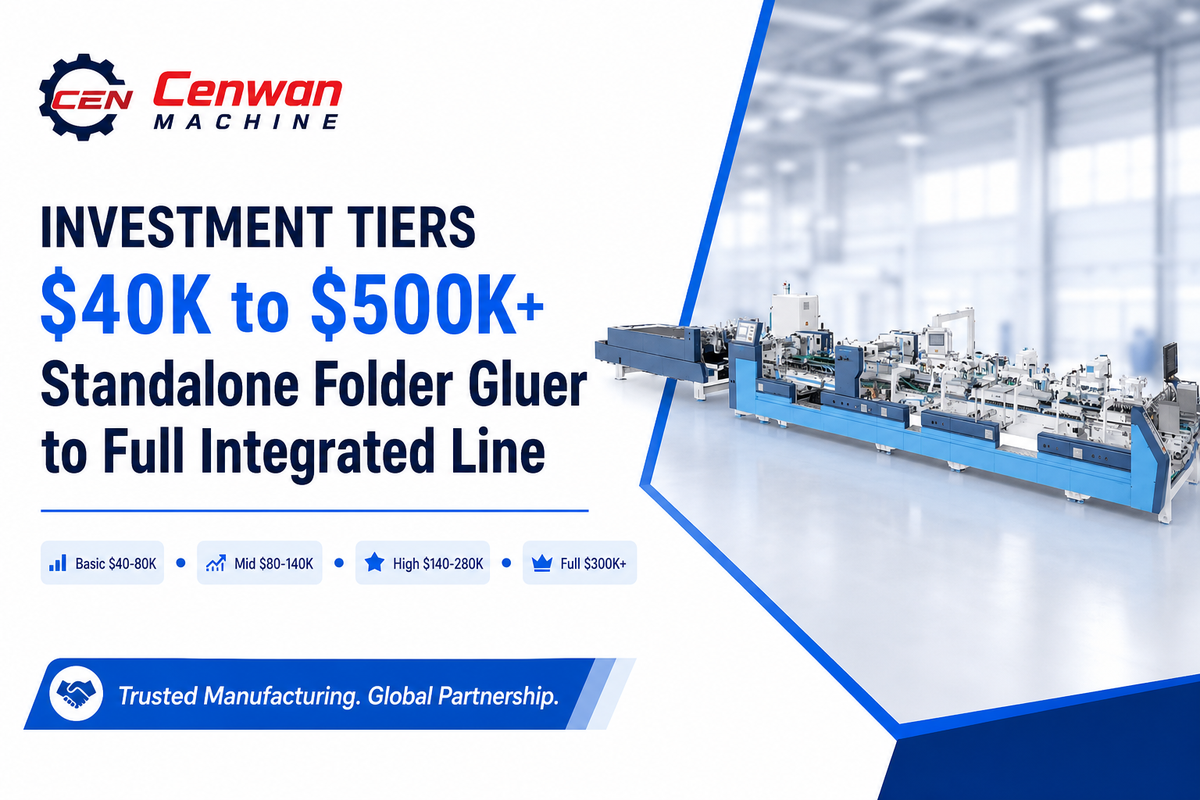
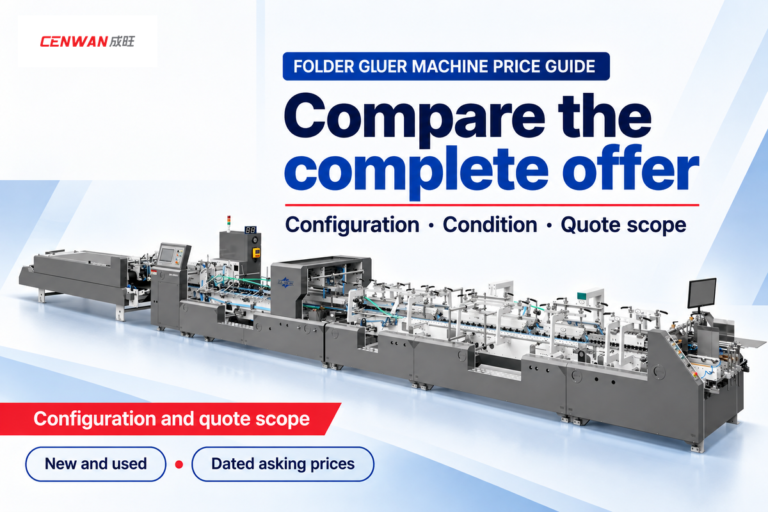
An automatic packaging line for carton production runs from about USD $40,000 for a standalone folder gluer to $500,000-plus for a full integrated line, and most converters land in the $80,000–$280,000 mid-to-high tiers. Price tracks automation depth, line speed, and box-style range, not headline speed alone.
How much does an automatic packaging line cost?
End-of-line packing add-ons price differently again, a folder-gluer packer runs roughly $7,000 to $600,000+ by automation scope, while market analysts note used, top-specification machines have reached USD 1.5 million at the far end. Treat the automatic packaging line cost below as a budget envelope, then confirm with a scoped quote.
| Tier | Band | What it buys |
|---|---|---|
| Basic | $40K–$80K | Standalone folder gluer, single-product mid-volume plant |
| Mid | $80K–$140K | Single-channel inline or 400 m/min high-speed standalone |
| High-end | $140K–$280K | Dual-channel line, postal 13#–7#, ~1.3M boxes/day |
| Full integrated | $300K–$600K+ | Flexo + die-cut + dual-channel + packing, OEM rollouts |
Returns rarely come from speed alone. Underbudgeting is the common cost problem: a plant that buys on sticker price alone risks a 30–40% throughput shortfall, because the cheapest non-servo line carries the highest changeover and scrap cost, so Cenwan provides an installed, FOB-scoped figure and a CE-marked line that matches the proposal. Integration cuts operator headcount on the carton line from four to one or two per shift, and the changeover savings above typically pay back a servo option in well under two years for plants running many size changes. Independent benchmarks on the end-of-line side point the same way: most medium-to-high-volume operations report ROI within 12–24 months. Price data here’s dated 2026 and FOB-dependent, so treat it as a planning band, and model the labor and changeover savings against your own shift pattern with the automatic packaging line tier budget mapper.
Integrated Line vs Standalone: The 800,000-Box Integration Threshold
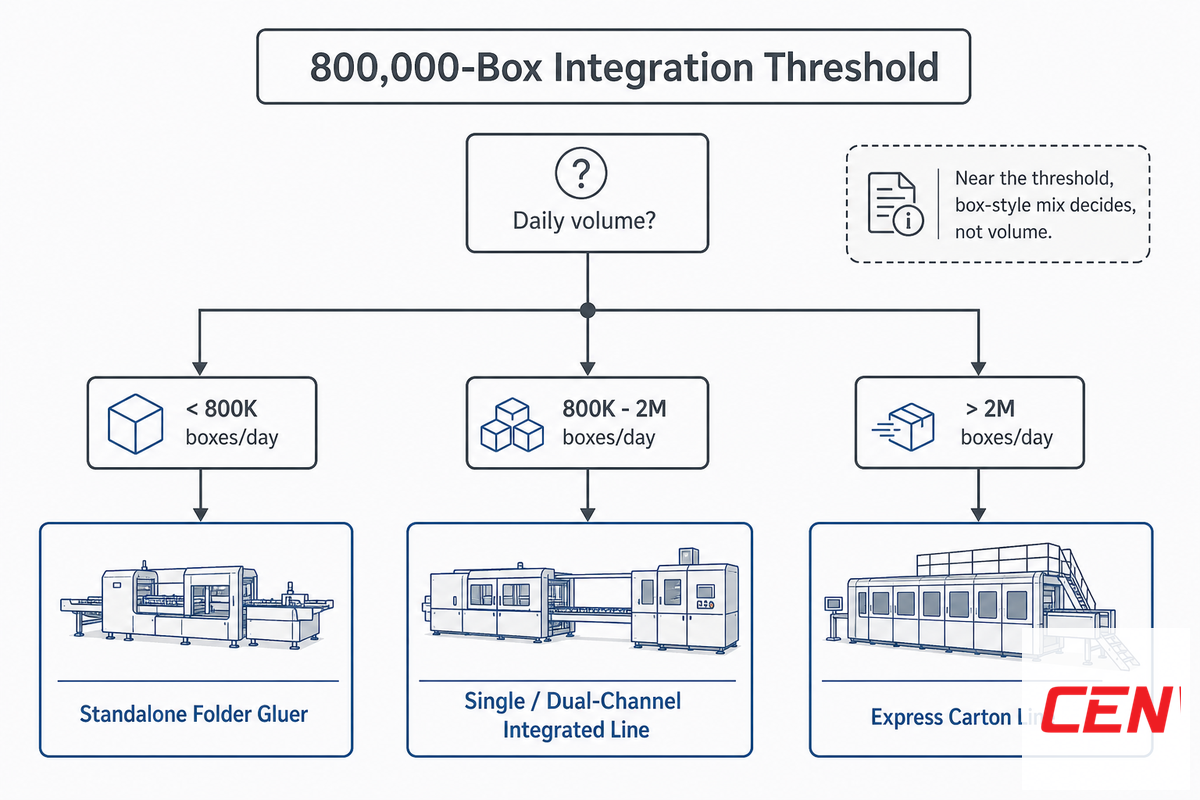
Converters can carry one decision rule into a vendor meeting: the 800,000-Box Integration Threshold, Cenwan’s portfolio crossover from deployment experience rather than a universal law. Below roughly 800,000 boxes/day a standalone folder gluer is usually the right buy; from about 800,000 to 2 million a single- or dual-channel integrated line wins; above 2 million an express carton line is the tool. Your own crossover moves with box-style mix and labor cost, so near the threshold the deciding factor flips from volume to how many styles you run, the more styles, the sooner integration and servo changeover earn their keep.
But the threshold is a starting point, not a verdict. As one industrial-equipment editor notes, the best choice isn’t always the most automated one; it’s the one that fit the factory’s product mix, labor situation, and maintenance capability. A single-product plant with skilled operators and a tight maintenance budget can out-earn a half-used integrated cell.
| Buyer profile | Daily volume | Recommended setup |
|---|---|---|
| Regional converter, narrow mix | <600K/day | Standalone box folding & gluing machine |
| High-volume plant, no inline print | 600K–1.5M/day | High-speed folder gluer at 400 m/min |
| E-commerce/postal, peak multipliers | 800K–2M/day | Dual-channel folder gluer line |
| Mixed pharma/food/3C, inline print | 1M–3M/day | Print + die-cut + fold + glue + pack line |
| Hub-level parcel supplier | 2M+/day | Express carton production line |
If your numbers sit on a boundary, run them through the automatic packaging line recommender tool before committing capital.
Before You Buy: The 7-Point Line Acceptance Checklist
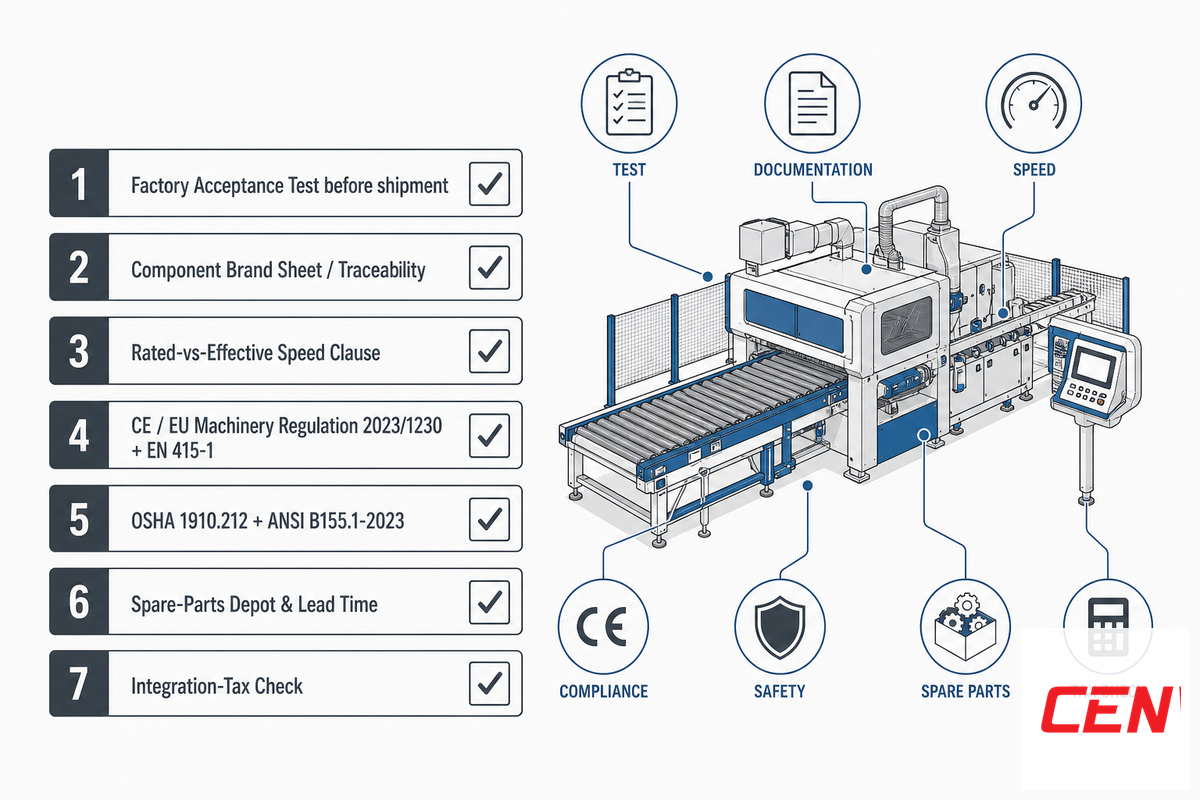
Capital carton equipment is an error-prone purchase, practitioners openly trade stories of mis-specified lines and aging gluers that drag a new packer down. A 7-Point Line Acceptance Checklist (FAT-Ready) separates a line that hit its rated speed from one that stalls in year three.
- ✔ Factory acceptance test (FAT) before shipment, see the line run your box at rated speed, not a demo blank.
- ✔ Component brand sheet, PLC, servo drives, bearings, and pneumatics listed by maker and part number for traceability.
- ✔ A written rated-versus-effective speed clause, with the uptime assumption stated.
- ✔ EU compliance: CE under Machinery Regulation 2023/1230 (mandatory from January 2027), with EN 415-1 and EN ISO 12100 risk assessment.
- ✔ US compliance: machine guarding to OSHA 29 CFR 1910.212 and the current ANSI/PMMI B155.1-2023 packaging-machinery safety edition.
- ✔ Spare-parts depot and documented lead time for the markets you serve.
- ✔ The integration tax check: best-of-breed builds from several vendors often add weeks of interface engineering and still under-run rated throughput, where a single pre-tested cell doesn’t.
📐 Engineering Note — read the safety standard as a buyer, not a lawyer.
In the United States, OSHA 29 CFR 1910.212 makes the employernot only the machine builder, responsible for guarding pinch points and conveyor access. In the EU, Regulation (EU) 2023/1230 replaces the long-standing Machinery Directive and becomes mandatory in January 2027. Confirm which framework your destination market uses before you sign, retrofitting guards after delivery is the expensive path.
Industry Outlook: What’s Driving Carton-Line Automation in 2026
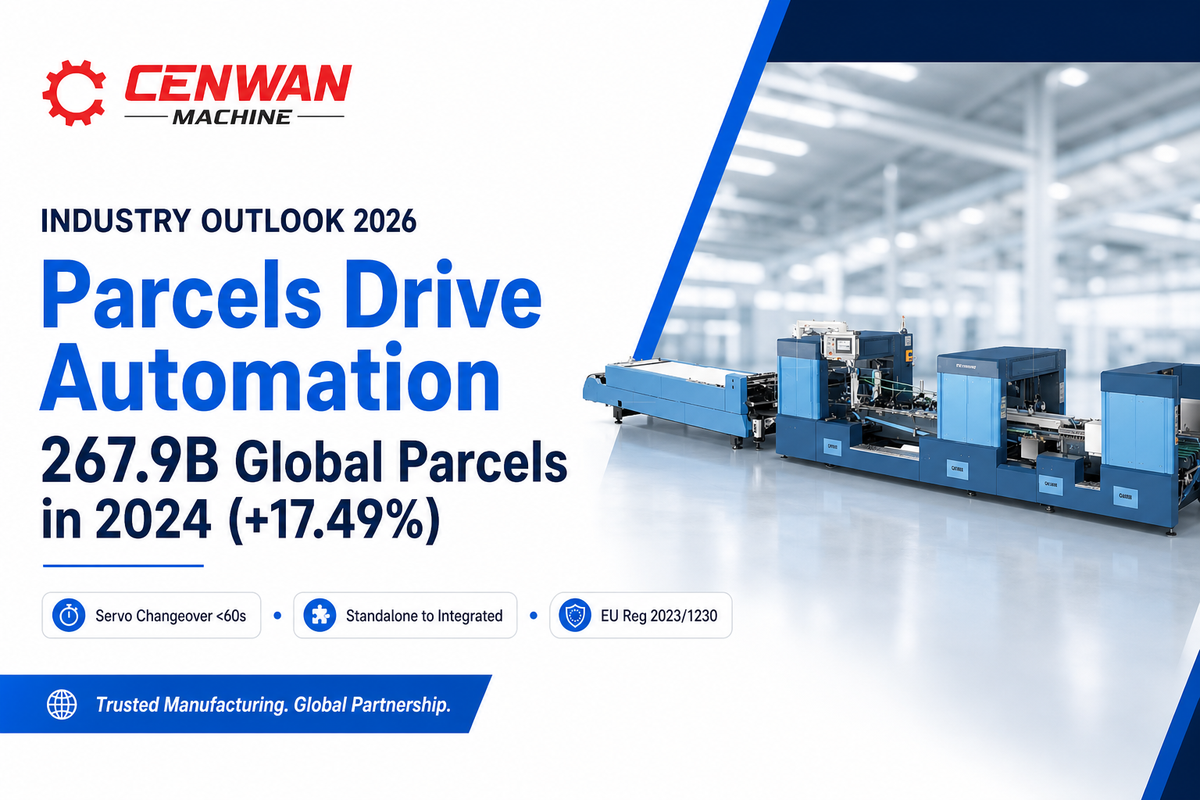
What drives carton-line automation is not a market chart, it is parcels. According to the State Post Bureau’s Global Express Development Report 2025, global parcel volume reached 267.9 billion items in 2024, up 17.49% — with China handling 175.08 billion pieces, and the report projects the world to pass 300 billion in 2025, while China’s State Post Bureau logged 216.5 billion domestic items in 2025. That flood pushes converters two ways at once: from standalone folder gluers toward integrated lines, and from manual size changes toward servo one-touch changeover, so that the transfer and changeover bottlenecks are erased before a peak season caps output. For a buyer planning a 2026 line, the action is concrete, audit how many changeovers your busiest shift runs today, because that number, not the rated speed, decides whether you clear next year’s peak. Cenwan sees the same pattern across e-commerce, food, and pharma carton converters: the plants that struggle through a peak are the ones whose transfer-and-changeover bottleneck was never engineered out, whether they run an automatic packaging line for food cartons or postal parcels. In Cenwan’s deployments across e-commerce, food, and pharma converters, the lines that clear peak are FAT-verified and ISO 9001-built, because the changeover bottleneck was engineered out at the factory before shipment.
Market forecasts line up with that read, in directional terms only: industry analysts project the packaging-automation market growing at roughly 8% per year (one estimate puts it near USD 84 billion in 2026), and the folder-gluer machine segment at about 6.8% annually. Those figures are useful as context, not as a buying reason, the buying reason is the parcel curve and the changeover math on your own floor.
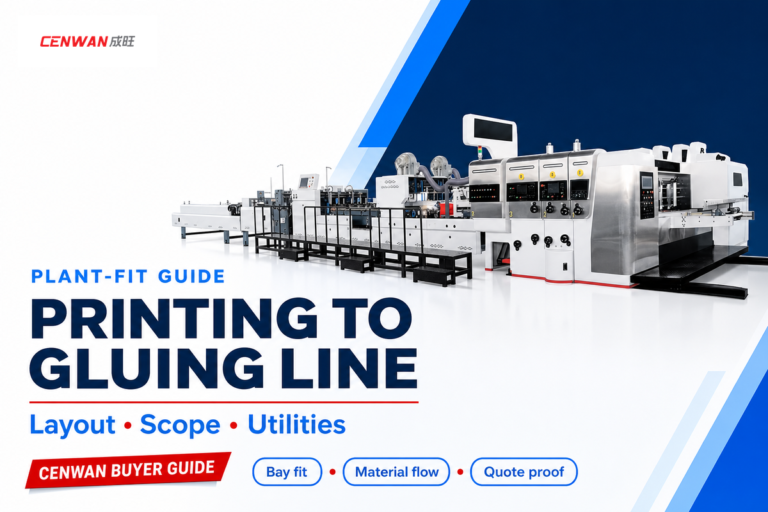
Automatic Packaging Line Layout and Retrofit Checklist
A line that fits the process on paper can still fail in the factory because material flow, utilities or pack-out space were ignored. Freeze the layout only after these constraints have been measured on the floor.
| Layout checkpoint | Measure before design | Common failure if missed |
|---|---|---|
| Material flow | Blank entry, work-in-process buffers, finished-carton exit and forklift crossings. | Operators create manual detours that erase the automation benefit. |
| Bottleneck station | Good units per hour at printing, die cutting, folding/gluing and packing. | The fastest machine waits behind the slowest station. |
| Utilities | Power, compressed air, extraction, adhesive supply and network drops. | Late utility changes increase commissioning time and cost. |
| Changeover space | Access around feeders, glue units, folding carriers and service panels. | Maintenance and job setup become slower or unsafe. |
| Retrofit controls | Signal interfaces, line speed synchronization, rejection logic and emergency-stop chain. | Machines run individually but cannot operate as one controlled line. |
Use the automatic packaging line recommender to define a starting configuration, then validate the layout with actual product flow and changeover access.
Frequently Asked Questions
Q: How fast is an automatic packaging line, in real production?
View Answer
Carton production lines run roughly 150–400 m/min depending on configuration, and major makers publish folder gluers up to 450 m/min. Effective output is always lower than the rated figure because the line runs at the speed of its slowest station and loses time to transfers and changeovers. Treat the spec-sheet number as a ceiling, and ask for a rated-versus-effective clause backed by a factory acceptance test.
Q: Is an automatic packaging line worth it under 800,000 boxes per day?
View Answer
Usually a standalone folder gluer is the better value below about 800,000 boxes/day, especially with a narrow box-style mix. One exception is changeover-heavy work: if you run many size changes per shift, the servo one-touch saving can justify a more automated line well before the volume threshold. Decide on box-style mix and changeover frequency, not volume alone.
Q: What are the disadvantages of automatic packing?
View Answer
The main drawbacks are capital cost, floor space, and uptime dependence: an integrated line that stops halts the entire flow, so a single jam can idle the whole cell rather than one station. Buyers also routinely under-estimate operator training, changeover practice, and spare-parts logistics — the running costs that decide whether the line stays productive past year three.
Q: Does a carton line handle both folding carton and corrugated boxes?
View Answer
Some can. A full-servo box folding and gluing machine handles folding-carton board around 200–800 g, while corrugated-capable lines run common E/F/C/B/AB flutes.
Q: What certifications should an automatic packaging line carry for import?
View Answer
For the EU: CE marking under Machinery Regulation 2023/1230, EN 415-1, EN ISO 12100, and RoHS. For North America, align with OSHA 1910.212 guarding and ANSI/PMMI B155.1-2023. A third-party pre-shipment inspection on request smooths customs clearance.
Q: What is the difference between a packaging line and an end-of-line system?
View Answer
An end-of-line system is one type of packaging line — the part that packs finished products into shipping cartons (erecting, packing, sealing, palletizing). A carton production line is the upstream line that makes those empty cartons. Both get called an automatic packaging line, which is exactly why the Two-Meaning Test matters.
Scoping a carton production line?
Tell us your daily volume, box styles, and destination markets, and we’ll map them to a standalone machine or an integrated line, with a scoped quote, not a brochure.
About This Buyer’s Guide
This guide is written for carton converters weighing a folder-gluer line purchase, and it deliberately routes end-of-line product-packaging buyers to the right category instead. Configuration speeds, capacity figures, and investment tiers reflect Cenwan’s folder-gluer and integrated carton lines deployed across 40+ countries since 2014; market and standards data are cited from public sources. Reviewed by the Cenwan Machine technical team.
References & Sources
- 29 CFR 1910.212, General Requirements for All MachinesU.S. Occupational Safety and Health Administration
- Regulation (EU) 2023/1230 on machinery (repealing Directive 2006/42/EC)Official Journal of the European Union
- Ergonomic risk reduction from automatic packaging machinery (IJERPH 2022)U.S. National Library of Medicine (PMC)
- ANSI/PMMI B155.1-2023 Packaging and Processing Machinery SafetyAmerican National Standards Institute
- Global Express Development Report 2025 (global parcel volume 267.9 billion, 2024)State Post Bureau Development & Research Center
- US 8,033,975 B2, Folding unit and method of folding corrugated cardboard sheetU.S. Patent & Trademark Office
- China postal industry 2025 statistics (216.5 billion items)State Council of the People’s Republic of China
- US 2011/0268551 A1, Counter ejector of cardboard sheet box-making machineU.S. Patent & Trademark Office
- Packaging Automation Market forecast (~8% CAGR)Fortune Business Insights (industry analyst estimate)