Póngase en contacto con Cenwan Machine Company



Actualizado en junio de 2026 · Revisado por el equipo técnico de Cenwan Machine.
Una plegadora-encoladora para cajas 3D es la máquina que fabrica las cajas tridimensionales para cosmética, regalo y joyería que se encuentran en los estantes de las tiendas prémium. Si está pasando de los estuches plegables planos a envases 3D con aspecto rígido, esta es la categoría de maquinaria que pliega y encola esas cajas de varios paneles a velocidad de producción. Su funcionamiento difiere del de una plegadora-encoladora lineal convencional, y esas diferencias determinan si las cajas salen listas para el envío o se agrietan por el hendido.
En resumen: una plegadora-encoladora para cajas 3D es una máquina especializada que pliega y encola planchas troqueladas de cartón para convertirlas en cajas tridimensionales terminadas: estuches de varios paneles para cosmética, regalo, electrónica y joyería que una plegadora-encoladora lineal convencional no puede formar. Procesa cartón de aproximadamente 200–400 g/m² mediante un recorrido de plegado multieje y ocupa un espacio intermedio entre las plegadoras-encoladoras para cajas plegables convencionales y las máquinas para cajas rígidas montadas.
Datos técnicos rápidos: plegadora-encoladora para cajas estéreo (clase de máquina)
| Categoría de máquina | Plegadora-encoladora especializada 3D/multieje |
| Rango de cartón | ~200–400 g/m² (el rango que la define) |
| Tipos de caja | Cajas 3D para cosmética, regalo, joyería y productos electrónicos para la venta al por menor |
| Velocidad habitual de línea | ~120–180 m/min (sin carga) |
| Plegado | Multieje (p. ej., 180° + 160° + 180° + bisagra de fondo automático) |
| Producción frente al trabajo manual | ~30–60× una línea de encolado manual |
¿Qué es una plegadora-encoladora para cajas estéreo? (caja estéreo frente a caja estándar y caja rígida)

La forma más rápida de entender qué es una plegadora-encoladora para cajas 3D es aclarar un problema de nomenclatura que el sector rara vez aborda directamente. «Caja estéreo» es un término comercial y de exportación, no una categoría industrial normalizada. Describe una caja tridimensional de cartón con varios paneles —como un estuche de cosmética con tapa abatible, una caja para té o un estuche de presentación para joyería— con más pliegues y una geometría más compleja que una caja de envío sencilla, pero fabricada con cartón plegable y no con cartón gris grueso.
En otras palabras, las cajas estéreo siguen siendo cajas de cartón o cartoncillo, solo que plegadas en más dimensiones que una caja con solapas convencional.
Esta última distinción es importante para los compradores, porque una «caja rígida» y una «caja plegable» son productos realmente distintos. Según la terminología del Paperboard Packaging Council para las cajas rígidas, una caja rígida auténtica (de montaje) está hecha de cartón gris recubierto con papel y utiliza un cartón más grueso que una caja plegable; las guías del sector sitúan el grosor del cartón para cajas rígidas en torno a cuatro o cinco veces el del material de las cajas plegables. Estas cajas se montan en máquinas específicas para cajas rígidas, no en plegadoras-encoladoras. La plegadora-encoladora para cajas estéreo ocupa el segmento intermedio: fabrica cajas de cartón con las estructuras más complejas antes de llegar a una caja rígida forrada.
| Atributo | Estuche plegable 3D/«estéreo» | Caja plegable lineal convencional | Caja rígida montada auténtica |
|---|---|---|---|
| Cartón | Cartón de 200–400 g/m² | Cartón de 80–600 g/m² | Cartón gris de 800–2.000 g/m² + forro |
| Pliegues | Multieje, con varios paneles | Un solo hendido recto | Forrada, no plegada |
| Máquina utilizada | Plegadora-encoladora estéreo / para aplicaciones especiales | Plegadora-encoladora lineal | Máquina para cajas rígidas montadas |
| Uso habitual | Cosmética, regalo, joyería y electrónica | Cajas de envío y para venta al por menor | Cajas rígidas de lujo y relojes |
En resumen: si trabaja con cartón plegable de hasta unos 400 g/m² y su caja tiene varios paneles que se unen en ángulos pronunciados, necesita una plegadora-encoladora para cajas estéreo, no una encoladora de cajas convencional ni todavía una línea para cajas rígidas. La plegadora-encoladora para cajas estéreo de Cenwan (CW-T-650) está diseñada precisamente para este segmento.
Cómo funciona una plegadora-encoladora para cajas estéreo: 5 estaciones de la trayectoria de plegado multieje
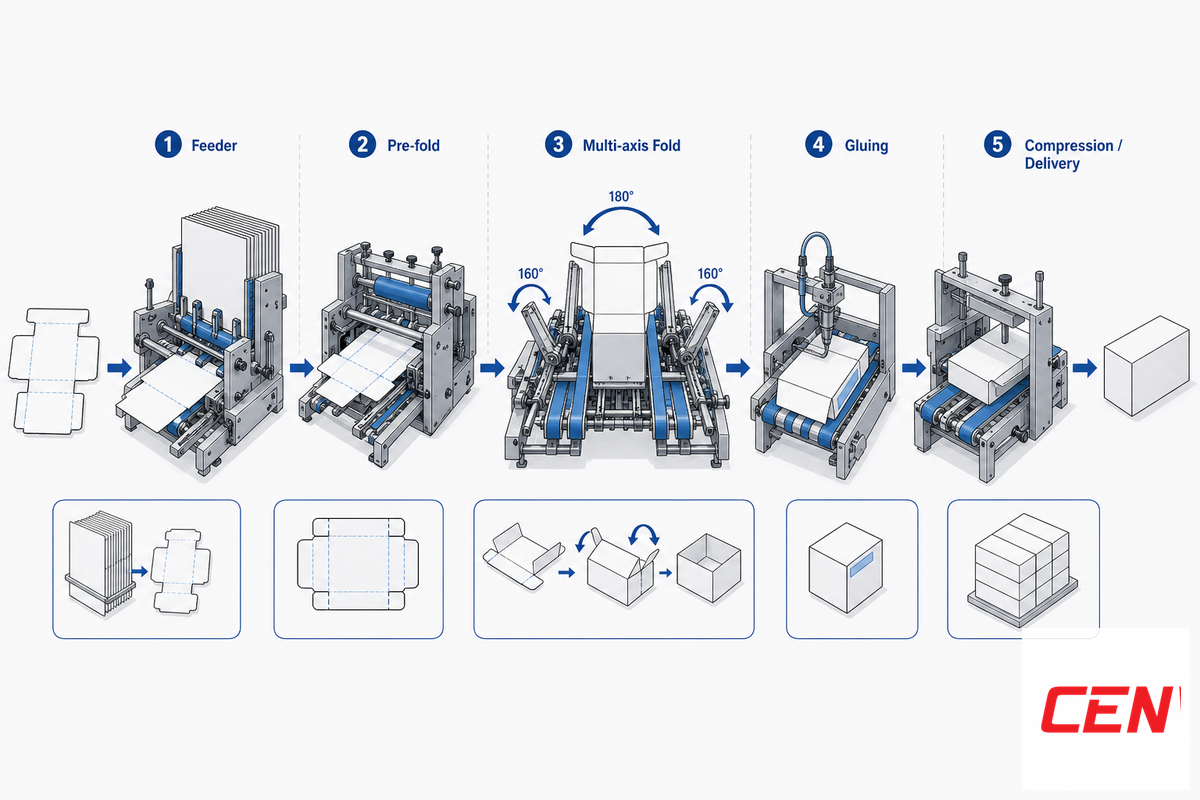
Todas las máquinas plegadoras-encoladoras reciben una plancha plana troquelada y la hacen pasar por una serie de estaciones para obtener una caja terminada. Una plegadora-encoladora para cajas estéreo se diferencia de una plegadora-encoladora de cajas convencional porque cuenta con una trayectoria de plegado multieje de 5 estaciones: incorpora varios pliegues en distintos ejes, en lugar de una sola línea de plegado de 180, para formar la caja antes del encolado.
| Estación | Función | Por qué resulta más difícil en una caja 3D |
|---|---|---|
| 1. Alimentador | Separa las planchas troqueladas y las alimenta de una en una | El cartón más pesado, de 200–400 g, requiere alimentación mediante servomotor y un vibrador para mantener la alineación |
| 2. Plegado previo | Marca suavemente los hendidos para que los paneles se plieguen correctamente | Hay más líneas de plegado, cada una con un radio de curvatura distinto |
| 3. Plegado multieje | Las bandas laterales y los puentes de plegado forman la estructura 3D | Dos pliegues laterales de 180° + un plegado previo de 160° + una bisagra de fondo automático en una misma plancha |
| 4. Encolado | Aplica cola fría o adhesivo termofusible en las pestañas | Las líneas de adhesivo deben alcanzar paneles que llegan desde distintos ángulos |
| 5. Compresión/salida | Presiona las uniones encoladas y apila las cajas terminadas | La unión debe quedar firme mientras la caja conserva su geometría 3D |
Para visualizar la estructura y el principio de funcionamiento, siga una plancha troquelada por los principales componentes de la máquina. En la sección de alimentación, un alimentador servoaccionado utiliza correas para manejar el cartón más pesado y separar las planchas de una en una. En el preplegado, se suavizan las líneas de plegado para que la unidad de plegado doble cada panel sin romper el cartón. A continuación, la sección principal de plegado conduce la plancha por un proceso de plegado preciso en más de un eje a alta velocidad, donde la geometría de plegado determina la forma final de la caja. La sección de encolado aplica adhesivo a la pestaña y la sección de compresión presiona las zonas encoladas para que las cajas mantengan su forma hasta llegar a la apiladora. Todas las plegadoras-encoladoras de cajas comparten esta estructura; una máquina estéreo simplemente añade un segundo conjunto de ejes de plegado.
¿En qué consiste el proceso de plegado y encolado, paso a paso?
El proceso de plegado y encolado comienza con una plancha plana con los hendidos hechos. Los paneles se pliegan para formar la caja, se aplica adhesivo a la pestaña de encolado y se presiona la unión para que el adhesivo fragüe. El plegado previo es, con diferencia, el aspecto que más subestiman los compradores. Un hendido ya no es una simple línea: es una sección del cartón debilitada deliberadamente para que la flexión resultante del panel actúe como una bisagra.
El estudio sobre hendido y plegado de cartón de NC State University y la investigación sobre la delaminación durante el hendido del cartón demuestran que primero hay que hacer los hendidos para lograr un pliegue sin grietas. En una caja 3D, la zona de hendido debe estar perfectamente alineada en cada eje; de lo contrario, la caja se agrietará en puntos donde debería plegarse.
«Ajustamos el modelo CW-T específicamente para cajas rígidas 3D porque las plegadoras-encoladoras de uso general fallan de forma sistemática en el segundo pliegue lateral cuando el cartón supera los 300 gramos. El recorrido de bandas de plegado servoaccionado es lo que mantiene la recuperación del hendido dentro de una tolerancia de 0,3 mm incluso a 150 m/min».
9 formatos de caja que produce una plegadora-encoladora para cajas estéreo
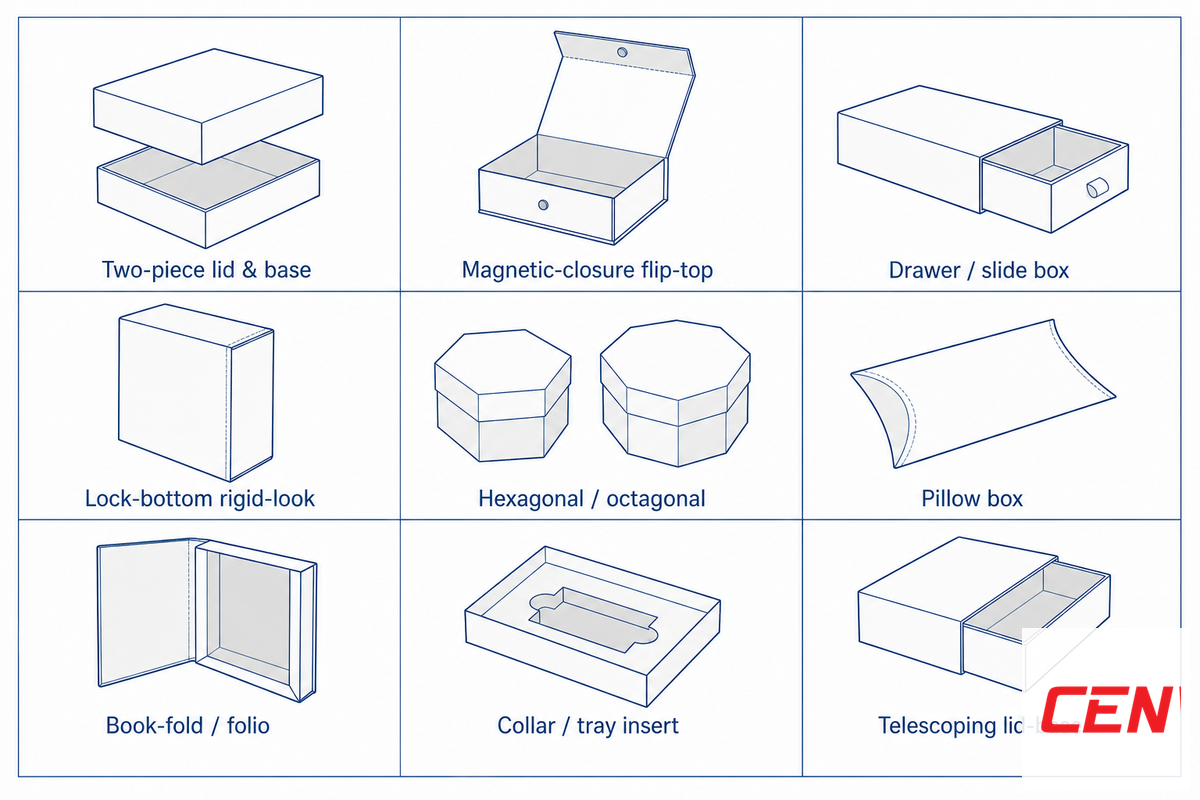
No todas las cajas de aspecto elaborado requieren una plegadora-encoladora para cajas estéreo, ni todas las cajas que se pueden fabricar son adecuadas para una plegadora-encoladora lineal. La familia de cajas estéreo de estilo 9 que aparece a continuación relaciona los tipos estándar de cartón 3D con la necesidad real de un recorrido multieje, para que pueda ajustar su cartera de productos a la máquina adecuada al solicitar presupuesto. Las estructuras con varios paneles —como el diseño de cuatro paneles y una pestaña de encolado descrito en esta patente de plegadora-encoladora— son precisamente lo que automatiza el recorrido multieje.
| Tipo/formato de caja | Descripción | ¿Plegadora-encoladora estéreo? | Producto habitual |
|---|---|---|---|
| Tapa y base de dos piezas | Tapa telescópica sobre una base tipo bandeja | Sí | Estuches para tratamientos de cuidado de la piel |
| Tapa abatible con cierre magnético | Tapa con bisagra y solapas imantadas | Sí | Cosmética prémium |
| Caja con cajón/deslizante | Bandeja interior que se desliza dentro de una funda | Sí | Joyería y electrónica |
| Aspecto rígido con fondo automático | Caja con fondo automático de cartón grueso | Sí | Regalos y productos de confitería |
| Hexagonal/octogonal | Cuerpo con varios lados y varios hendidos | Sí | Velas y cajas para té |
| Caja almohada | Caja plegable con extremos curvos | Sí | Regalos pequeños y accesorios |
| Caja tipo libro/portafolio | Apertura con bisagra como un libro | Sí | Kits de muestras y presentaciones |
| Collarín/bandeja interior | Estructura interior que sujeta el producto | A menudo | Productos electrónicos para la venta al por menor |
| Estuche plegable lineal con solapas | Caja sencilla con un solo hendido | No: basta una plegadora-encoladora convencional | Cajas convencionales para venta al por menor |
Mensaje clave: cuantos más ejes incluya la secuencia de plegado y más grueso sea el cartón, más dificultades tendrá una plegadora-encoladora lineal convencional. La fila inferior marca la diferencia: una caja sencilla con solapas puede procesarse en una plegadora-encoladora lineal; para el resto resulta útil el recorrido multieje.
Por qué fallan las plegadoras-encoladoras convencionales con las cajas 3D: 3 modos de fallo
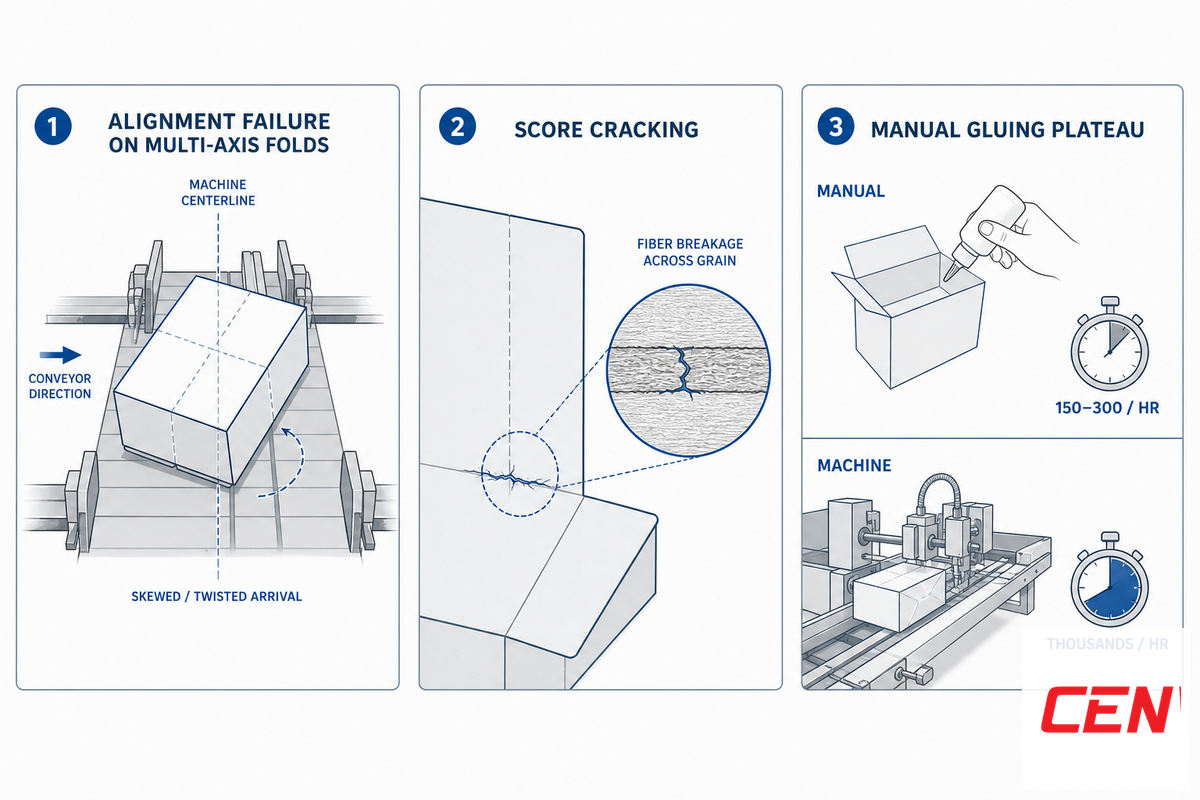
A menudo, los equipos intentan procesar un trabajo 3D en la plegadora-encoladora lineal que ya tienen. El resultado son los 3 fallos habituales: tres modos de fallo previsibles que consumen silenciosamente horas de producción y material desperdiciado antes de que el operario pueda diagnosticar la causa raíz real en un trabajo para una plegadora-encoladora de cajas 3D.
⚠️ Fallo 1: desalineación en los pliegues multieje
Una plegadora-encoladora lineal está diseñada para un hendido de 180°. Una caja 3D necesita dos pliegues laterales de 180°, un plegado previo de unos 160° y una bisagra de fondo automático, con distintos radios de curvatura en una misma plancha. Sin un control independiente de cada banda de plegado, los paneles llegan torcidos y la caja se deforma.
⚠️ Fallo 2: desajuste del gramaje del cartón y grietas en los hendidos
Las plegadoras-encoladoras universales suelen ajustarse para procesar cartón de 80-600 g, lo que sacrifica el estrecho margen de precisión que necesita el cartón de 200 400 g con aspecto rígido para funcionar como una caja de papel. Los datos de acabado del sector en US indican que el hendido a contrafibra delamina el cartón en líneas largas, y que el cartón seco y con poca humedad se tensa y se agrieta en el hendido en lugar de plegarse limpiamente. Si el hendido queda a la vista en una caja cosmética, el producto se rechaza.
⚠️ Fallo 3: límite de producción del encolado manual
La alternativa es plegar y encolar las cajas 3D a mano. Según las cifras del sector, el montaje manual por operarios cualificados alcanza aproximadamente 150–300 cajas por hora. Entre los defectos manuales más habituales que señalan los profesionales están el despegado de las uniones por una adhesión débil y la desalineación en forma de cola de pez. Una plegadora-encoladora automática para cajas 3D supera ese límite por un orden de magnitud.
📐 Nota de ingeniería: el hendido hace de bisagra
En una caja estéreo, el segundo pliegue lateral y el cuarto pliegue deben formar una bisagra integrada de 180° sin delaminación. En la mayoría de los casos, los adhesivos rara vez fallan como suponen muchos impresores. La causa principal de las grietas en las cajas prémium casi nunca es el adhesivo; suele ser la geometría del hendido. Dado que el hendido es, en realidad, una delaminación intencionada y controlada —el mecanismo de fallo caracterizado en la investigación sobre el hendido de cartón laminado— que permite la rotación del papel, el ajuste de la máquina debe adaptarse al calibre y a la dirección de la fibra del cartón; después, pliega dentro de lo que se conoce como ventana de recuperación (por ejemplo, Cenwan especifica una recuperación del hendido de alrededor de 0,3 mm en su plegadora-encoladora CW-T-650 a 150m/min). Si la geometría del hendido es incorrecta, ningún adhesivo podrá mantener la caja unida.
Caja estéreo frente a encoladora lineal y máquina para cajas rígidas, y la ventana para cartón de 200-400 g
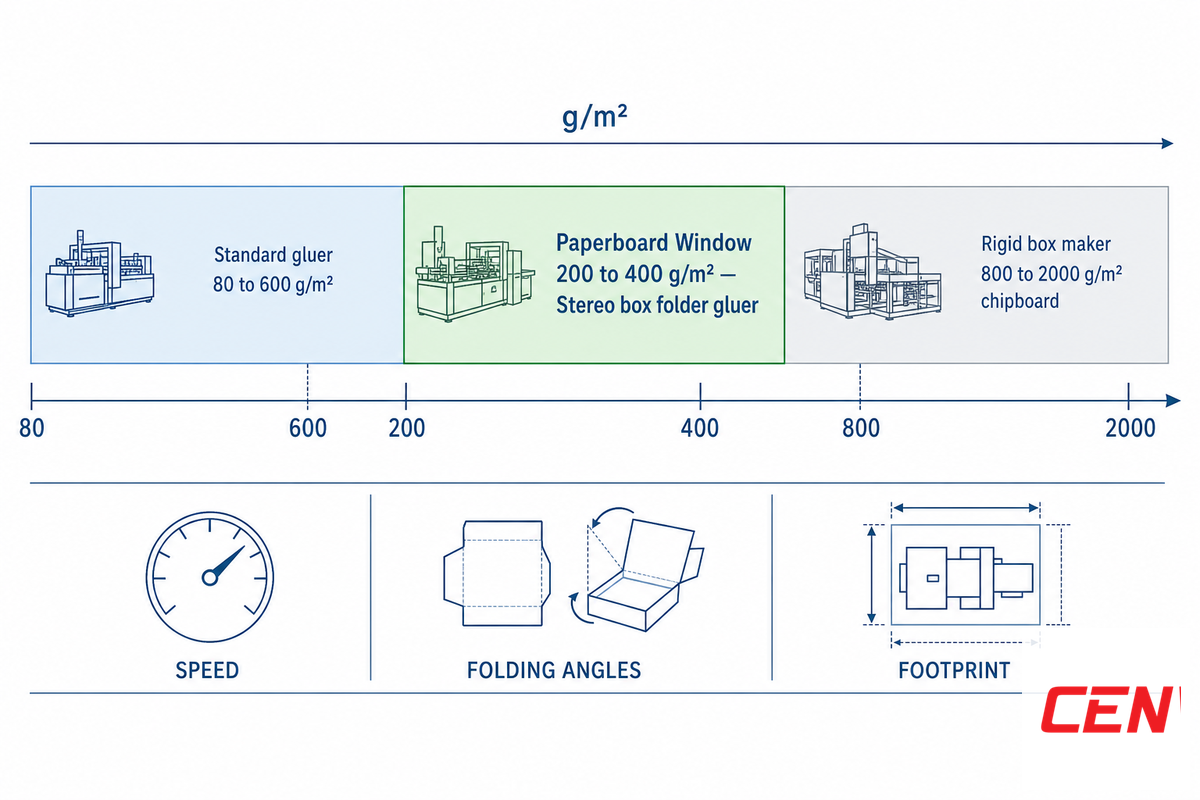
La forma más clara de hacerse una idea de la capacidad de una máquina de este segmento es consultar el intervalo de cartón de 200-400 g. Este intervalo debe considerarse el rango específico de material de trabajo para máquinas configuradas para estilos de aspecto rígido; en la práctica, esta especificación es un criterio decisivo, no una regla universal para clasificar los sustratos de papel (que, por lo general, se definen a partir de unos 250 gsm). El gramaje del cartón, medido en gramos por metro cuadrado según la norma ISO 536 de la industria papelera, es precisamente lo que distingue las plegadoras-encoladoras para cajas estéreo de las convencionales. Si trabaja con menos de 250 gsm, cualquier plegadora-encoladora convencional será adecuada; si supera aproximadamente los 600 gsm en cartón gris, necesitará maquinaria para cajas rígidas, no una plegadora-encoladora.
| Parámetro | Estéreo / aplicaciones especiales | Plegadora-encoladora lineal | Máquina para cajas rígidas |
|---|---|---|---|
| Rango de cartón | 200–400 g/m² | 80–600 g/m² | Cartón gris de 800–2.000 g |
| Ángulos de plegado | Multieje (180°+160°+180°) | Un único pliegue de 180° | Solo forrado (sin plegado) |
| Tipos de caja | Estéreo + lineal + fondo automático | Lineal + fondo automático | Solo cajas rígidas montadas |
| Espacio ocupado (longitud) | ~5,8 m | 11–16 m | 8–12 m |
| Operarios por turno | 1 | 1–2 | 2–3 |
| Inversión (US$) | Media ($18K–55K) | Alta ($80K–250K) | Muy alta ($120K–400K) |
En los distintos catálogos de maquinaria de plegado y encolado, las categorías se difuminan y pueden confundir a los compradores potenciales. Nombres y definiciones como plegadora-encoladora para cajas 3D, plegadora-encoladora de cajas, máquina de plegado y encolado y plegadora-encoladora de alta velocidad pueden aplicarse a equipos similares, pero claramente distintos. Una plegadora-encoladora convencional para cajas o una plegadora-encoladora compacta de nivel básico puede no tener un recorrido multieje. Más allá del lenguaje comercial o de la marca, hay tres especificaciones importantes que conviene comparar: el rango de sustrato (o cartón) de la máquina, el tamaño del alimentador de alta resistencia para la caja grande que se va a producir y las guías laterales ajustables e independientes que mantienen el registro durante la puesta a punto.
¿Puede una plegadora-encoladora de cajas estéreo procesar cartón ondulado?
No. Las plegadoras-encoladoras de cajas estéreo están diseñadas específicamente para plegar y encolar cartón, como cartoncillo para cajas o cartón para envases, con un gramaje aproximado de 200-400 gsm; no están diseñadas en absoluto para cajas de cartón ondulado ni para otros gramajes de cartón ondulado, que pertenecen a una categoría de máquinas plegadoras-encoladoras completamente distinta.
Una caja de cartón ondulado requiere una plegadora-encoladora para cartón ondulado, una plegadora-encoladora flexográfica u otra máquina especializada para manejar canales de distintos tamaños, como E/F/C/B. Estos equipos ofrecen características de adhesión que evitan la separación y reducen el desgaste de las bandas. Si su planta necesita procesar ambas categorías de sustrato, debe considerarlas como categorías de máquina distintas que requieren equipos separados.
✔ Ventajas
- Fabrica cajas 3D multieje que una plegadora-encoladora lineal no puede producir
- Formato compacto de ~5,8 m; un operario
- Control del hendido ajustado para el rango de 200–400 g
⚠ Limitaciones
- No apta para cartón ondulado
- No apta para cajas rígidas montadas de cartón gris auténtico (>600 g)
- Idónea para tiradas especializadas pequeñas y medianas, no para tiradas enormes de una sola referencia
Cómo elegir el tipo de caja según el sector: cosmética, regalo, electrónica y joyería

Los cuatro principales tipos de aplicación son los motivos más habituales para comprar estas máquinas. Cada uno se asocia con un gramaje de cartón y un tamaño de caja que determinan requisitos específicos de maquinaria. Los perfiles siguientes muestran configuraciones de producción habituales para cajas con aspecto rígido en estos segmentos de mercado; los gramajes se indican en g/m² según el método de gramaje ISO 536.
| Sector | Caja habitual | Cartón | Volumen de la tirada |
|---|---|---|---|
| Cosmética | ~150×50×30 mm, tapa abatible/deslizante | 250–300 g | 5,000–30,000 |
| Regalos y chocolate | ~200×150×80 mm, caja para té/confitería | 300–350 g | con fuerte concentración en el Q4 |
| Electrónica de consumo | ~180×120×40 mm, caja para accesorios | 250–350 g | Volumen medio |
| Joyería | ~100×80×30 mm, tapa abatible | 300–400 g | 500–5,000 |
Las cifras ofrecen una lección de planificación. Los trabajos de cosmética y regalo se disparan en Q4, y una marca que en primavera produce 8.000 cajas por semana puede llegar a multiplicar ese volumen por tres o cuatro en una promoción de regalos de Q4; de ahí que quienes compran cajas para regalos en Q4 prioricen los cambios rápidos. Las tiradas de cajas para joyería son más pequeñas y suelen situarse en el extremo superior del rango de peso del cartón (300 a 400 g), donde la precisión del hendido es el requisito #1 por el efecto negativo que cualquier arruga leve o exceso de hendido tiene en los bordes interiores visibles de una caja de regalo prémium. Por el contrario, a quien compra cajas para electrónica de consumo le interesa sobre todo que la esquina de la caja de exposición tenga el acabado más definido posible. Una clase de máquina y cuatro prioridades distintas de especificación explican por qué adaptar la máquina a su aplicación concreta —y no solo a su categoría de producto más amplia— garantiza una calidad constante en toda la gama de embalajes.
Cuánto cuesta una plegadora-encoladora para cajas estéreo: 3 niveles de inversión y ROI frente al trabajo manual
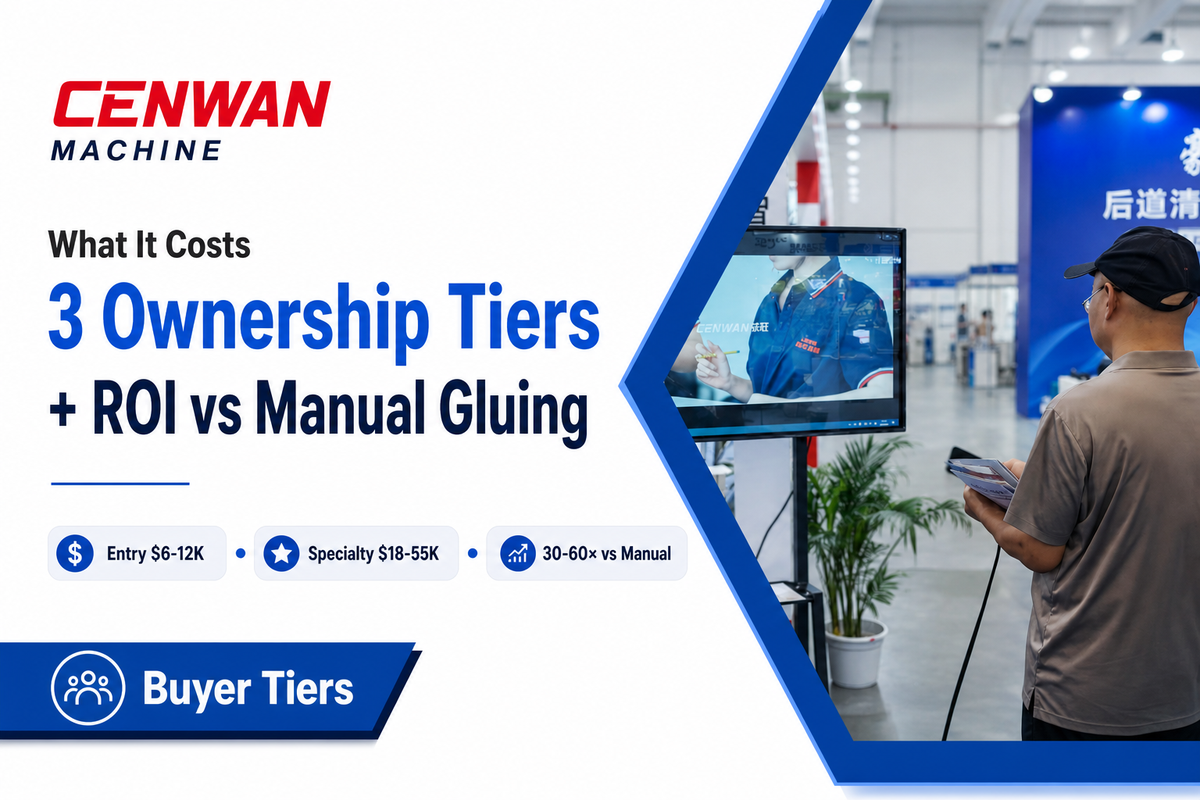
El precio de las plegadoras-encoladoras varía mucho en el mercado de maquinaria de embalaje, así que conviene plantearse la compra desde tres niveles de inversión, en lugar de fijarse en un solo precio. Las encoladoras de nivel básico, las máquinas especializadas de gama media y los modelos insignia fabrican los mismos productos terminados —los envases que se envían a las marcas—, pero lo hacen de formas distintas.
Las cifras siguientes son estimaciones generales para cada categoría de máquina y solo tienen fines ilustrativos. Son rangos de precios indicados por proveedores para equipos nuevos vendidos en 2026; no deben considerarse un presupuesto directo, un índice ni una lista de precios publicada. El precio real de cada máquina puede variar considerablemente en función de la configuración y las opciones, así como de la región.
Tres niveles de inversión: elija el que se ajuste a su volumen y combinación de productos
- Nivel básico: ($6 to $12K) – Las plegadoras-encoladoras compactas chinas pertenecen a este nivel. Los precios publicados en sitios de proveedores suelen rondar los $6.377–7.500. Pueden procesar cartón de hasta unos 500 g, pero no cuentan con el conformado multieje necesario para la compleja geometría de las cajas 3D de las gamas superiores. Son más adecuadas para cajas sencillas y pequeñas.
- Especializado: ($18K to $55K) – Esta es la categoría principal de plegadoras-encoladoras para cajas 3D. Aquí sube el precio para obtener las ventajas del plegado multieje, una mayor anchura de alimentación, accionamiento servo y acceso a una red de servicio técnico y repuestos.
- Gama alta: ($80K+) – Líneas especializadas con sede en Europa que superan las 20.000 unidades por hora, destinadas únicamente a fabricantes de gran volumen que producen millones de unidades de una sola referencia.
¿Cómo se compara la productividad de una plegadora-encoladora para cajas 3D con el encolado manual de cajas tridimensionales?
Una plegadora-encoladora para cajas 3D suele sustituir el montaje manual y multiplicar la producción por 30–60×, según indican los fabricantes: un operario con formación pliega y encola solo unas 150–300 cajas 3D por hora, mientras que una máquina automática produce varios miles de cajas terminadas por hora en un solo turno.
Este ejemplo práctico le permite hacer el cálculo con sus propios datos: un taller que fabrica a mano 8.000 cajas cosméticas a la semana, a un ritmo de ~200 cajas por hora y operario, dedica unas 40 horas de trabajo semanales. Con las mismas planchas troqueladas en una máquina especializada que produce incluso a un ritmo conservador de 6.000 cajas/hora, un operario termina el trabajo en menos de dos horas. Con un coste laboral total de $18/hora, las ~38 horas que se ahorran cada semana equivalen a unos $684, aproximadamente $33.000 al año. Frente al coste de una máquina especializada, de $18K–55K, ese ahorro apunta a un plazo de amortización de entre 14–22 meses, según suelen indicar los fabricantes, sin contar la reducción de rechazos en los hendidos prémium. Haga el mismo cálculo con su volumen usando la calculadora del ROI de una plegadora-encoladora de cajas estéreo.
El ROI depende de varios factores propios de cada centro de producción, como el tipo de plancha troquelada y la experiencia de los operarios. Utilice estos valores para hacer sus cálculos; no constituyen una oferta de precio.
Perspectivas del sector: repunte de la demanda en Q4, productos prémium y cambio hacia el cartón
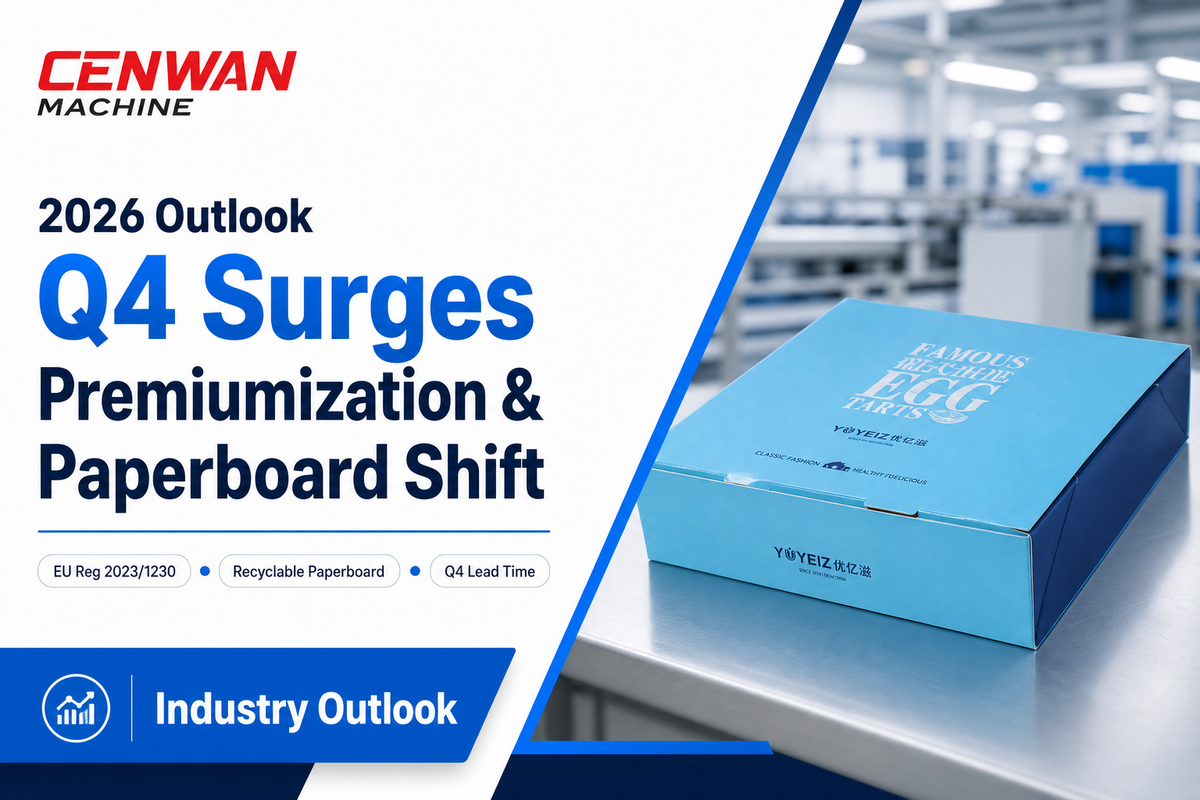
Conviene planificar el momento de compra de una plegadora-encoladora de cajas estéreo teniendo en cuenta dos factores que quizá no ocupen los titulares sobre el tamaño del mercado. El primero es la normativa gubernamental. La antigua Directiva de máquinas 2006/42/EC está siendo sustituida por el nuevo Reglamento de máquinas (EU) 2023/1230, cuya entrada en vigor está prevista para enero de 2027. Si para entonces su máquina va a cruzar la frontera de la UE y aún no se ha previsto adaptar el equipo al nuevo reglamento, en lugar de limitarse a cumplir la antigua directiva, hable ahora mismo con su proveedor y asegúrese de que lo acordado quede reflejado en el pedido.
El segundo factor tiene que ver con la demanda y los cambios estructurales del mercado. Las marcas están dejando atrás el plástico grueso y el cartón compacto para pasar al cartón reciclable y a acabados de gama alta, con los que pueden conservar una imagen prémium y evitar el plástico… precisamente el tipo de material que, por casualidad, se encuentra en el cartón de 200-400 g que procesa una plegadora-encoladora de cajas estéreo. A esto se suma la marcada estacionalidad del sector: por ejemplo, las búsquedas en US de cajas rígidas para regalo pasan de unas 590 al mes a aproximadamente 3.600 en octubre. Por tanto, si quiere reservar la producción del cuarto trimestre, debe tener en cuenta el plazo de entrega. La fabricación de una máquina de calidad personalizada lleva entre 6 y 10 semanas, así que habría que encargarla como muy tarde en agosto para atender el pico del Q4. En los pedidos de exportación, tenga en cuenta las normas ISPM 15 para embalajes de madera al preparar el embalaje y confirme que las protecciones de la máquina en el punto de operación, en la zona de alimentación, plegado y compresión, cumplen las especificaciones del lugar de instalación. Por último, desde el punto de vista del proveedor, un estándar adecuado que conviene buscar es un sistema de calidad ISO 9001.
(Como contexto de mercado: los analistas sitúan el mercado de cajas rígidas de lujo cerca de los US$4,6 billion en 2026 (Future Market Insights), y las cajas plegables y rígidas representan en conjunto el 41 % del embalaje de lujo total (Mordor Intelligence). Para ponerlo en perspectiva, este no es el único factor que debe tener en cuenta al invertir.)
Preguntas frecuentes
¿Qué diferencia una plegadora-encoladora de cajas estéreo de una plegadora-encoladora estándar?
Ver respuesta
Una plegadora-encoladora para cajas 3D incorpora una trayectoria de plegado con varios ejes —normalmente, dos pliegues laterales de 180°, un pretroquelado de unos 160° y una bisagra de fondo automático— que una plegadora-encoladora para cajas lineales estándar no puede ejecutar sin una adaptación mecánica. El alimentador y las bandas de plegado cuentan con servomotores independientes para procesar el cartón más grueso de 200–400 g que requieren las cajas 3D de cosméticos, regalo y joyería y lograr que los hendidos recuperen su forma correctamente.
¿Qué gramaje de cartón (GSM) puede procesar una plegadora-encoladora de cajas estéreo?
Ver respuesta
La producción sostenida se sitúa entre unos 200 y 400 g/m² de cartón plegable, medido según la norma ISO 536 para el gramaje. En ocasiones es posible procesar tiradas cortas con material algo más pesado, pero por encima de unos 600 g se entra en el ámbito del cartón gris, que requiere una máquina para cajas rígidas de montaje y no una plegadora-encoladora. El intervalo de 200–400 g es el límite práctico que define esta categoría de máquinas.
¿Cuánto cuesta una plegadora-encoladora de cajas estéreo?
Ver respuesta
En 2026, las plegadoras-encoladoras especializadas para cajas estéreo suelen situarse en un rango aproximado de US$18.000–55.000, por encima de las máquinas mini básicas (unos $6.000–12.000) y muy por debajo de las líneas europeas de gama alta ($80.000–400.000+). El precio depende de la anchura de alimentación, las opciones de servomotores y las guías de plegado personalizadas. Por tanto, este rango sirve como referencia para planificar, no como presupuesto; solicite un precio para una configuración concreta adaptada a sus formatos de caja.
¿Accionamiento por servomotor o por engranajes: cuál es mejor para plegar cajas 3D?
Ver respuesta
El accionamiento por servomotor ofrece mejores resultados en trabajos 3D, porque el control independiente de cada banda de plegado mantiene alineados los paneles con varios ejes y agiliza los cambios de formato.
¿Cuántos operarios necesita una plegadora-encoladora de cajas estéreo?
Ver respuesta
La mayoría de las máquinas especializadas funciona con un solo operario por turno, frente a los dos o tres que requiere una línea manual con una producción similar.
¿Qué es un apilador para plegadoras-encoladoras y necesita uno una encoladora para cajas estéreo?
Ver respuesta
El apilador es la sección de salida que comprime las uniones encoladas y agrupa las cajas terminadas en lotes ordenados. En una plegadora-encoladora para cajas 3D es un elemento esencial, porque el adhesivo debe fijarse mientras la caja mantiene su forma tridimensional. Si la sección de salida es demasiado pequeña, es frecuente que las uniones se abran después del embalaje.
¿Puede una plegadora-encoladora de cajas estéreo procesar también cajas lineales y de fondo automático?
Ver respuesta
Sí. Como incorpora una trayectoria de plegado con varios ejes, una plegadora-encoladora para cajas 3D también puede producir cajas lineales más sencillas y cajas con fondo automático, lo que ofrece flexibilidad para una línea con distintos productos. A la inversa no funciona: una máquina solo para cajas lineales no puede formar las cajas 3D con varios paneles para las que está diseñada una plegadora-encoladora para cajas 3D. Por eso, la máquina especializada ofrece más posibilidades.
¿Está eligiendo la mejor plegadora-encoladora para una línea de cajas 3D de cosméticos, regalo o joyería y quiere adaptar la trayectoria de plegado con varios ejes a sus formatos de caja?
Consulte la plegadora-encoladora de cajas estéreo CW-T-650 →Sobre esta guía
Esta guía se basa en la experiencia de Cenwan en la fabricación de plegadoras-encoladoras y en la CW-T-650 para envases de cosméticos, regalo y joyería, exportada a más de 40 mercados. También se han contrastado estudios sobre el hendido del cartón y normas del sector del embalaje para fundamentar la distinción entre cajas rígidas y cajas plegables, en lugar de presentarla como un argumento comercial. Revisada por el equipo técnico de Cenwan Machine.
Referencias y fuentes
- Terminología del sector de las cajas rígidasPaperboard Packaging Council
- Hendido y plegado (BioResources)NC State University
- Sobre la influencia de la delaminación en el hendido del cartón laminadoU.S. National Library of Medicine (PubMed)
- ISO 536, Papel y cartón: determinación del gramajeInternational Organization for Standardization
- ISO 9001:2015, Sistemas de gestión de la calidadInternational Organization for Standardization
- Directiva de máquinas 2006/42/CEEUR-Lex, European Union
- Protección de máquinas: descripción generalU.S. Occupational Safety and Health Administration
- ISPM 15, Reglamentación del embalaje de madera utilizado en el comercio internacionalInternational Plant Protection Convention
Artículos relacionados
- ¿Qué es una plegadora-encoladora para cajas lineales?proceso, fondo automático y producción
- Guía de plegadoras-encoladoras para cajas pequeñasancho, cola y velocidad
- Plegadora-encoladora para cajas de cuatro y seis puntos 4/6guía completa
- Tipos de plegadoras-encoladoras automáticastipos, componentes y costes
- Guía de plegadoras-encoladorascómo elegir
- Plegadora-encoladora automáticaguía del comprador de 2026