Póngase en contacto con Cenwan Machine Company

CE + ISO 9001:2015
Línea plegadora-encoladora de doble canal
Línea de producción plegadora-encoladora de doble canal — Cenwan: troquelado, encolado y embalaje integrados
Línea plegadora-encoladora de doble canal diseñada para plantas de cajas de cartón para mensajería urgente de comercio electrónico: troquelado en línea al inicio, dos carriles de encolado paralelos en el centro, recepción en escama de pez y enfardado semiautomático al final. En una sola pasada, desde la plancha de cartón hasta el palé embalado, con una producción máxima de 1,3 millones de cajas al día en tamaño #13. Está diseñada para absorber los picos del 6.18, el Día de los Solteros y el Black Friday sin tener que repartir los pedidos entre varias máquinas.
Solicite un presupuesto de capacidad de la línea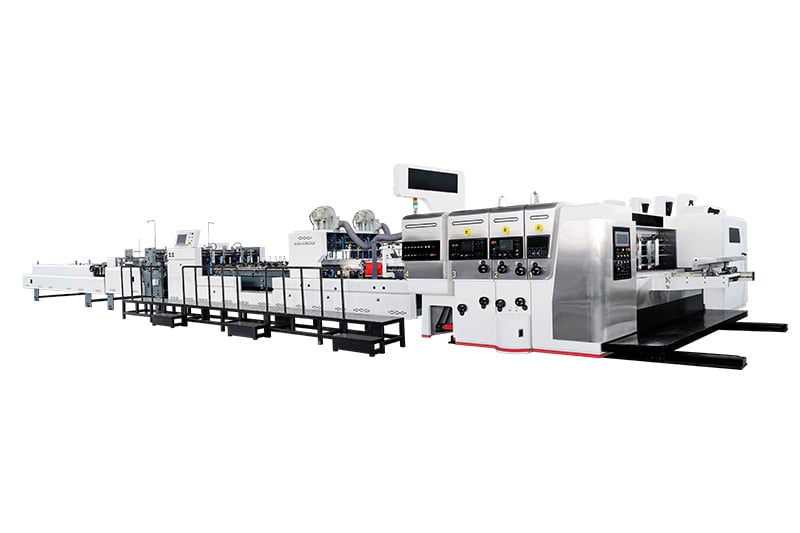
1.3M cajas/día
en tamaño #13
en tamaño #13
Más de 40 países
con instalaciones
con instalaciones
Más de 10 años
de experiencia en ingeniería
de experiencia en ingeniería
De por vida
suministro de repuestos
suministro de repuestos
Cuellos de botella en líneas de un solo carril durante los picos del comercio electrónico: por qué una plegadora-encoladora no supera las 600k cajas al día
Una línea de producción plegadora-encoladora es una cadena de estaciones de transformación del papel que convierte planchas planas de cartón ondulado en cajas plegadas, encoladas y apiladas en una sola tirada continua. La línea de doble canal de Cenwan incorpora un troquel en línea al inicio y una enfardadora semiautomática al final, de modo que una sola línea cubre todo el flujo de trabajo de las cajas de mensajería urgente que la mayoría de las plantas realizan con tres máquinas distintas.
Este problema se repite cada junio y noviembre. El Día de los Solteros de 2023 generó un gasto de $132,6 mil millones solo en Alibaba y JD.com, y el 6.18 se ha convertido en la celebración equivalente de mitad de año en China. Los compradores del sector de la logística urgente necesitan un suministro de cajas estable cuando el volumen diario de pedidos se multiplica por tres o cuatro; precisamente entonces, las plegadoras-encoladoras de un solo carril se quedan sin capacidad.
Una plegadora-encoladora automática de un solo carril suele funcionar a 100–150 m/min de forma sostenida con cajas pequeñas para mensajería urgente, lo que equivale aproximadamente a 500.000–650.000 cajas por jornada de 20 horas en tamaño 13#. Las plantas que intentan aumentar la producción añadiendo turnos alcanzan el límite de los costes laborales; las que añaden máquinas individuales en paralelo se topan con límites de espacio y de plantilla. La configuración de doble canal de Cenwan resuelve este problema sin duplicar ni el espacio ocupado ni el personal: dos carriles comparten un alimentador, un troquel, una enfardadora y un equipo de operarios, con dos bandas de encolado servoaccionadas y sincronizadas que funcionan en paralelo.
Para la mayoría de las operaciones de cajas para mensajería urgente, la pregunta no es «¿podemos ir más rápido con una sola máquina?», sino «¿podemos duplicar la capacidad efectiva sin duplicar el coste de funcionamiento de una segunda línea?». Esta página responde a esa decisión de compra.
Resumen de la solución: por qué una línea de doble canal supera a dos máquinas individuales
Producción:
Los dos carriles paralelos encolan a 240 m/min en conjunto. Las plegadoras-encoladoras de un solo carril suelen alcanzar un máximo de unas 600.000 cajas al día; la línea Cenwan produce 1.3M al día con cajas de mensajería urgente de tamaño #13.
Flujo de trabajo en una sola pasada:
Alimentación → Troquelado → Plegado → Encolado → Transporte y prensado → Recepción en escama de pez → Placa de alineación → Cinta transportadora → Enfardado semiautomático: sin transferencias intermedias ni traspasos manuales entre estaciones.
Amplia gama de formatos
cubre los tamaños 7 a 13 de las cajas para mensajería urgente de China sin necesidad de reajustes; ancho de fabricación de cajas de 450–750 mm.
Espacio ocupado:
Dimensiones totales de la línea: 17,5 × 4 × 1,8 m; ocupa unos 70 m² de suelo, sin contar los pasillos de mantenimiento. Estas dimensiones se publican por adelantado para que los responsables de planta puedan planificar la distribución del taller antes de solicitar un presupuesto.
Con el respaldo del servicio de Cenwan
en más de 40 países: ISO 9001:2015, marcado CE, garantía gratuita de 12 meses y suministro de repuestos de por vida.
Línea integrada de doble canal Cenwan: troquelado → plegado → encolado → apilado → embalaje en una sola pasada
Esta línea se basa en dos canales de encolado servoaccionados y sincronizados que comparten una estación de troquelado aguas arriba y una estación de embalaje aguas abajo. Cada canal se ocupa de su propia alimentación de papel, aplicación de cola, plegado, transporte y apilado; una placa patentada de convergencia de doble canal alinea ambas pilas antes de que lleguen a la cinta transportadora y a la enfardadora. Así, un solo equipo de operarios y el espacio de un único taller cubren el trabajo que, de otro modo, requeriría dos plegadoras-encoladoras de un solo carril, además de un troquel independiente y una máquina de embalaje aparte.
Parámetros técnicos
Sección de troquelado
Cartón compatibleCartón ondulado E, N y F
Ancho interior mecánico2000 mm
ControladorInterfaz PLC
Velocidad máxima de troquelado180 pcs/min
Ancho máximo de alimentación1700 × 1200 mm
Alimentación de papelVentilador de alta presión
Sección plegadora-encoladora
Cartón compatibleCartón ondulado E, N y F
Gramaje máximo800 g
Velocidad máxima de encolado240 m/min (en conjunto)
Ancho de fabricación de cajas450–750 mm
Tipo de adhesivoAdhesivo de tipo soluto / cola fría
Potencia / presión de aire20 KW / 6 Pa
Configuración de la línea completa
Dimensiones (largo × ancho × alto)17,5 × 4 × 1,8 m
Peso total16 T
* El mecanismo de bloqueo maestro garantiza la precisión del control de velocidad. El diseño modular protege al comprador: cada estación puede aislarse por separado.
Cada estación de la línea está construida como un módulo independiente, con acceso propio para el mantenimiento, separación controlada eléctricamente y enclavamientos neumáticos entre unidades adyacentes. Esta modularidad responde a la preocupación más habitual de los compradores de una línea integrada: «si una estación se avería, ¿se para toda la producción?». La respuesta es no: las estaciones pueden aislarse, abrirse y revisarse por separado.

Sección de alimentación
Separación de unidades controlada eléctricamente, con alarma acústica durante el funcionamiento. Un ventilador centrífugo de alta presión facilita la alimentación por succión, con el caudal de aire ajustado a la curvatura del cartón. Parada al alcanzar la cantidad de producción programada, con señal de alarma automática.
Sección de plegado y encolado
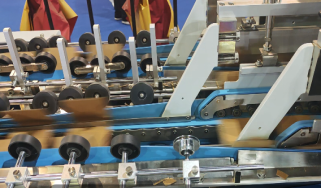
Un dispositivo de eliminación de residuos situado antes del aplicador de cola mantiene limpio el papel. Ambos canales pliegan y encolan simultáneamente el cartón troquelado, con bandas servoaccionadas independientes a izquierda y derecha que pueden funcionar a distintas velocidades para garantizar la escuadra de las cajas. La banda superior activa suaviza el paso de las cajas.
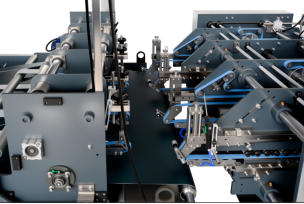
Transporte y prensado
La alimentación de papel independiente en cada canal garantiza un traspaso fluido de las cajas. Cada canal cuenta con su propio sistema de pulverización para el recuento preciso de los lotes. El cabezal apilador con desplazamiento transversal facilita el cambio de pedido en las cajas de tapa plana.

Recepción en escama de pez
La banda de prensado superior ejerce menos presión sobre la recepción, lo que evita que las cajas encoladas se peguen antes de tiempo. El diseño de banda estrecha mantiene visible la zona de recepción para que el operario pueda intervenir rápidamente. La retracción independiente de la banda superior se adapta al tamaño de las cajas para alinear las pilas con precisión.
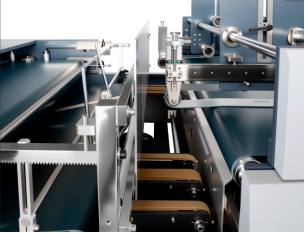
Placa de alineación (patentada)
El sistema exclusivo de transferencia por convergencia y relé de doble canal de Cenwan mantiene constante la altura de las pilas en ambos canales. El control servo independiente de la transferencia de la placa apiladora evita los atascos que se producen en las líneas con un único controlador cuando los dos canales funcionan a velocidades efectivas ligeramente distintas.

Transporte y enfardado
Una banda independiente de esponja suave protege las cajas terminadas durante el transporte. La velocidad de la cinta transportadora se ajusta automáticamente a la velocidad de rotación de la máquina principal mediante un controlador fotoeléctrico, con opción de ajuste manual. La enfardadora semiautomática al final de la línea completa el flujo desde el cartón hasta el palé.
Doble canal, un solo carril o equipos modulares de primera categoría: comparación de producción, espacio y TCO
Al evaluar una inversión en una línea de producción, los compradores suelen comparar tres opciones: mantener una plegadora-encoladora de un solo carril y añadir turnos, instalar dos máquinas de un solo carril en paralelo o adquirir una línea integrada de doble canal. Las diferencias no se limitan a la producción: también afectan al espacio en planta, al número de operarios, al tiempo de integración y al coste total de propiedad a cinco años.
Los análisis del sector confirman que las líneas totalmente integradas tienen un coste inicial más alto y plazos de entrega más largos que los conjuntos de equipos combinados, pero reducen los costes laborales y la complejidad de integración durante la vida útil de los equipos. El «coste oculto de integración» de conectar equipos de varios proveedores —ingeniería de interfaces, sincronización de varios PLC y coordinación de proveedores durante la puesta en marcha— rara vez aparece en el presupuesto inicial, pero suele hacerse evidente durante el primer año de funcionamiento.
Un solo carril / línea recta |
Dos máquinas en paralelo |
Línea integrada Cenwan |
|
|---|---|---|---|
| Producción máxima (caja de tamaño 13#) | ~500–650k cajas/día | ~1,0–1.3M cajas/día (2 líneas) | ~1.3M cajas/día (1 línea integrada) |
| Velocidad máxima de encolado | 120 m/min por canal | 120 m/min × 2 = 240 m/min en total | 240 m/min en conjunto, doble canal |
| Espacio ocupado en planta | ~35 m² | ~70–80 m² (dos células independientes) | ~70 m² (una célula integrada) |
| Operarios por turno | 2–3 | 4–6 | 3 |
| Troquel al inicio de la línea | Máquina independiente, transferencia manual | Independiente para cada línea, 2 transferencias | En línea, sin transferencias |
| Enfardado al final de la línea | Enfardadora semiautomática independiente | 2 enfardadoras independientes o un cuello de botella compartido | Enfardadora semiautomática integrada |
| Número de proveedores | 3–4 (troquel, encoladora, máquina de embalaje y controles) | 4–6 (marcas duplicadas) | 1 (solución llave en mano de Cenwan) |
| Tiempo de puesta en marcha de la integración | 2–4 semanas | 4–8 semanas (el doble de coordinación) | ~1 semana in situ (línea probada previamente) |
| Coste de funcionamiento a 5 años | ~€100–120/h de mano de obra + suministros | ~€180–220/h (más operarios) | ~€110–140/h (un equipo, una conexión de servicios) |
| Flexibilidad de capacidad | Añadir solo turnos | Añadir líneas (más CAPEX) | Usar un canal en temporada baja y ambos en temporada alta |
Cuándo conviene cada opción:
La configuración de un solo carril es adecuada para plantas con menos de 400k cajas al día, una demanda estable y sin grandes variaciones estacionales. Dos máquinas de un solo carril en paralelo son adecuadas cuando la planta produce dos tipos de cajas completamente distintos al mismo tiempo y puede asumir los costes generales duplicados. La línea integrada de doble canal de Cenwan es la solución cuando el volumen diario supera las 800k cajas y los pedidos muestran claros picos estacionales, como ocurre en la mayoría de los proveedores chinos de cajas para mensajería urgente de comercio electrónico y en un número creciente de empresas extranjeras de embalaje para logística de terceros.
Producción para el cliente: 1.3M cajas/día en tamaño #13: capacidad para los picos del comercio electrónico
La cifra de producción destacada —1,3 millones de cajas al día en tamaño 13#— es lo que hace viable la línea de doble canal Cenwan durante los picos del comercio electrónico. Corresponde a un funcionamiento continuo de 20 horas a una velocidad efectiva de encolado de 240 m/min con doble canal. El tamaño 13# (13 × 8 × 4,5 cm) es la caja para mensajería urgente más habitual en el mercado chino de paquetería nacional y transfronteriza.
Esta capacidad es importante porque solo el Día de los Solteros de 2023 generó transacciones por valor de $132,6 mil millones en Alibaba y JD.com, y el volumen de paquetes en los días posteriores a la celebración llegó a triplicar o cuadruplicar la media semanal habitual. Las líneas capaces de absorber picos de 4× sin repartir los pedidos entre varias máquinas ni mantener inventarios para 30 días son las que mejoran la rentabilidad por unidad del suministro de cajas para mensajería urgente.
«La placa de convergencia con servos independientes no se ha atascado en ninguna de las pruebas previas al envío que hemos realizado desde que fijamos la versión de producción. Los diseños convencionales con cinta transportadora compartida se atascaban aproximadamente una vez cada dos horas».
Quién utiliza hoy las líneas de doble canal Cenwan
La base actual de clientes incluye empresas de embalaje para logística urgente, plantas de embalaje secundario farmacéutico, fabricantes de cajas de cartón para alimentación, plantas de cajas para cosmética que necesitan cambios rápidos de formato y empresas de embalaje de electrónica 3C que producen pedidos mixtos de tiradas cortas. Con una red de servicio en más de 40 países, los compradores de Europa, el Sudeste Asiático, Oriente Medio y Norteamérica pueden contar con ingenieros de fábrica para la instalación y el servicio técnico.
Resumen del coste total de propiedad a 5 años
€500k
Ahorro
Reducción de los costes operativos
La configuración integrada de doble canal alcanza una producción equivalente a €110–140/hora, frente a €200–240/hora en líneas individuales en paralelo, y ahorra 3–4 operarios por turno.
Frente al funcionamiento de dos plegadoras-encoladoras de un solo carril en paralelo, más un troquel y una máquina de embalaje independientes, la configuración integrada de doble canal elimina dos puntos de transferencia manual y comparte un conjunto de conexiones de servicios.
El resumen del TCO se basa en un coste de referencia de €100–120/h por plegadora-encoladora de un solo carril, aplicado a 5.000 horas de funcionamiento al año durante 5 años. El ahorro real depende de los turnos y de los salarios locales.
Gama de cajas para mensajería urgente (tamaños 7 a 13): flexibilidad de formato sin reajustes
Las empresas de embalaje para logística urgente utilizan una gama reducida pero precisa de tamaños de cajas, definida por la norma china predominante para paquetes urgentes. Esta línea Cenwan cubre los tamaños 7 a 13 de la serie estándar de cajas para mensajería urgente dentro de un mismo intervalo de funcionamiento continuo, lo que permite cambiar de tamaño modificando un parámetro, sin reajustes mecánicos. A continuación se publican todas las dimensiones de referencia para que los compradores puedan comprobar si la línea es compatible con sus SKU concretas antes de solicitar un presupuesto.
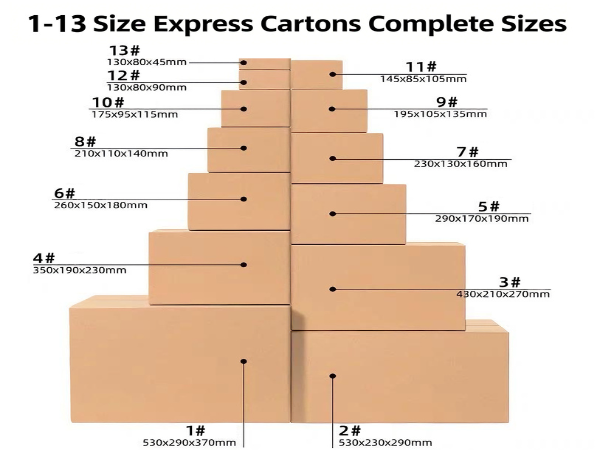
Tamaños estándar de cajas para mensajería urgente en China
13#
13 × 8 × 4,5 cmAplicación: Joyas pequeñas, accesorios, memorias USB
Cobertura: Sí: tamaño de producción máxima (1.3M/día)
12#
13 × 8 × 9 cmAplicación: Muestras de cosméticos, dispositivos electrónicos pequeños
Cobertura: Sí
11#
14,5 × 8,5 × 10,5 cmAplicación: Accesorios para teléfonos, libros pequeños
Cobertura: Sí
10#
17,5 × 9,5 × 11,5 cmAplicación: Paquete pequeño estándar de mensajería urgente
Cobertura: Sí
9#
19,5 × 10,5 × 13,5 cmAplicación: Prendas dobladas, cajas de regalo para cosméticos
Cobertura: Sí
8#
21 × 11 × 14 cmAplicación: Prendas de vestir, artículos para el hogar
Cobertura: Sí
7#
23 × 13 × 16 cmAplicación: Paquete mediano de mensajería urgente
Cobertura: Sí: se aproxima al ancho máximo de caja
6#
26 × 15 × 18 cmAplicación: Artículos grandes para el hogar
Cobertura: De referencia: fuera del intervalo principal
5#
29 × 17 × 19 cmAplicación: Prendas de vestir en grandes cantidades, utensilios de cocina
Cobertura: De referencia: fuera del intervalo principal
4# – 1#
35×19×23 → 53×29×37Aplicación: Cajas de envío para grandes volúmenes
Cobertura: Consulte la plegadora-encoladora para cajas de cuatro y seis puntos
Certificaciones, normas y trazabilidad de componentes
Normas internacionales
- Marcado CE
- ISO 9001:2015
- EN ISO 12100:2010
- EN 415-1:2014
- RoHS 2011/65/EU
- Declaración CE de conformidad
Las inversiones CAPEX en líneas de producción del tramo de $200.000+ conllevan requisitos de conformidad y trazabilidad de componentes que no se aplican a la compra de una sola máquina. La línea de doble canal Cenwan está certificada y documentada para facilitar el cumplimiento de los requisitos de importación en la UE, Norteamérica, el Sudeste Asiático y Oriente Medio, las cuatro regiones que representan la mayoría de los más de 40 países a los que presta servicio actualmente.
Directivas y evaluación de riesgos
El marcado CE de la línea cubre la Directiva de máquinas 2006/42/EC (seguridad mecánica, incluido el análisis de riesgos de la placa de convergencia de doble canal), la Directiva EMC 2014/30/EU (compatibilidad electromagnética de los servomotores) y RoHS, relativa a las sustancias restringidas en los componentes eléctricos. EN ISO 12100:2010 proporciona el marco de evaluación de riesgos de tipo A, mientras que EN 415-1:2014 y EN 415-10:2014 cubren los requisitos de seguridad específicos de la maquinaria de embalaje que distinguen la evaluación CE de una línea de la evaluación de una sola máquina.
Protocolo de producción y trazabilidad
La trazabilidad de los componentes se proporciona mediante una lista detallada de marcas que se entrega con cada presupuesto: el controlador PLC importado, los servomotores, los rodamientos, las válvulas neumáticas y los contactores eléctricos se identifican por fabricante y número de pieza, no mediante categorías genéricas. El proceso de montaje de rodamientos por diferencia de temperatura de Cenwan —aplicado a todos los rodamientos de transmisión de la línea— queda documentado en el registro de pruebas de producción para que los compradores puedan verificarlo durante la inspección previa al envío o en una FAT realizada por terceros (prueba de aceptación en fábrica).
Guía de compra: precios, planificación del espacio, plazo de entrega e instalación
La mayoría de los proveedores de líneas plegadoras-encoladoras no comunican sus precios hasta que el comprador rellena un formulario de contacto. Cenwan publica por adelantado un intervalo de precios orientativo y las dimensiones de espacio necesarias, porque los responsables de planta necesitan ambos datos para avanzar con una propuesta interna de inversión CAPEX más allá de la primera selección de proveedores.
Intervalo de precios
Una línea integrada de doble canal básica cuesta entre USD 180.000–220.000, según la configuración del troquel en línea, el tamaño de la enfardadora y la región eléctrica (220 V frente a 380 V trifásica). La incorporación del paquete opcional de ajuste de máquina con un solo toque (automatización de parámetros mediante el sistema de servos completo y escaneo de pedidos con código QR) sitúa el precio de la línea entre 240.000–270.000. El dispositivo patentado de placa de convergencia de doble canal está incluido en la línea básica y no es una opción aparte. Los presupuestos específicos se calculan según la combinación de tamaños de caja del comprador, el suministro eléctrico disponible y el país de instalación.
Planificación del espacio
La línea ocupa 17,5 × 4 × 1,8 m (largo × ancho × alto). El equipo de instalación de Cenwan recomienda prever una zona de aproximadamente 22 × 6 m (~130 m²) para dejar espacio para las pilas de papel antes de la alimentación, los palés después de la enfardadora y un pasillo de servicio de al menos 0,8 m a cada lado de la línea. Los talleres con una altura libre inferior a 2,5 m o una desviación de planitud del suelo superior a 5 mm en un tramo de 4 m necesitarán trabajos de preparación antes de la instalación. Cada presupuesto incluye las dimensiones de la línea y un plano recomendado de distribución del taller.
Plazo de entrega
El plazo de fabricación estándar es de 30 días desde la confirmación del pedido hasta la entrega en condiciones ex works en Wenzhou. El plazo y el alcance de la configuración son flexibles: los compradores que necesiten una entrega acelerada para instalar la línea antes de la temporada alta pueden solicitar una producción urgente al pedir presupuesto. El transporte marítimo a la mayoría de los destinos añade 25–45 días, según el puerto. La instalación in situ requiere de 5–7 días para la puesta en marcha y la formación habituales de los operarios. El plazo total desde el pedido de compra hasta la primera tirada suele ser de 2–3 meses.
Instalación
Cenwan envía ingenieros de fábrica a las instalaciones para montar la línea y formar a los operarios. La tarifa diaria de los ingenieros es de 150$/día; el comprador asume los gastos de asistencia para la solicitud de visado, los billetes de avión de ida y vuelta, el alojamiento y las comidas. La formación incluye las rutinas diarias de los operarios, el proceso de cambio de formato, la resolución básica de problemas y la entrega de la documentación de repuestos. Desde ahora y durante toda la vida útil de la línea, el precio incluye asistencia remota para resolver problemas mediante llamadas telefónicas programadas con los ingenieros de Cenwan.
Garantía y servicio posventa
La línea incluye una garantía gratuita de 12 meses a partir de la fecha de entrega, que cubre los componentes eléctricos del armario de control y las bandas de marcas importadas. Una vez vencida la garantía, se ofrece mantenimiento de por vida y suministro de repuestos de por vida; los repuestos y el transporte se facturan al precio de mercado vigente. Las modificaciones de la estructura, la configuración o las funciones de la máquina sin el consentimiento escrito de Cenwan anulan la cobertura de la garantía. Las condiciones de pago suelen ser T/T, con un depósito del 30 % al confirmar el pedido y el 70 % antes del envío; también se aceptan L/C y tarjeta de crédito.
Herramientas para planificar la producción y las instalaciones
Calculadora de capacidad de la línea de doble canal
Calcule la producción diaria y anual de cajas de cartón de la línea plegadora-encoladora de doble canal Cenwan según su patrón de trabajo. Las cifras son realistas para cajas de envío urgente de los tamaños 7–13, con la velocidad combinada especificada de 240 m/min en doble canal.
Iniciar calculadoraPlanificador del espacio de taller — línea de doble canal Cenwan
Visualice el espacio de taller necesario para instalar la línea integrada de doble canal Cenwan. Incluye las dimensiones de la línea, la zona de preparación de pilas de cartón aguas arriba, el área para palés aguas abajo y los pasillos de servicio recomendados.
Abrir planificador de espacioPreguntas frecuentes: qué preguntan los compradores antes de invertir en una línea completa
La línea de doble canal es una línea de producción integrada completa: troquelado en línea, encolado en dos carriles, recepción tipo escama de pez y enfardado semiautomático. Está diseñada para producir grandes volúmenes de cajas de envío urgente de los tamaños 7 a 13 con patrones de plegado convencionales. En cambio, la plegadora-encoladora para cajas de cuatro y seis puntos es una máquina especializada para cajas con fondo automático y cuatro o seis esquinas preplegadas, utilizadas en cosmética, farmacia y embalaje prémium para comercios. Las plantas que atienden la logística urgente del comercio electrónico suelen comprar la línea de doble canal; las que fabrican cajas de marca para comercios suelen comprar la máquina para cajas de cuatro y seis puntos. Muchas plantas compran ambas para disponer de capacidades complementarias.
Una plegadora-encoladora es la máquina de una planta de cajas de cartón que recibe planchas troqueladas impresas y planas, las pliega por las líneas de hendido, aplica adhesivo en los bordes de unión y produce la caja plegable terminada, lista para enviarse al propietario de la marca que la llenará. En una línea totalmente integrada como la configuración de doble canal Cenwan, el módulo de plegado y encolado va precedido de una troqueladora en línea (por lo que la línea admite pliegos impresos sin troquelar en lugar de planchas ya troqueladas) y seguido de una empaquetadora (para enfardar las cajas de salida y dejarlas listas para paletizar sin manipulación manual).
Las plegadoras-encoladoras flexográficas incorporan una unidad de impresión flexográfica en línea en la entrada, de modo que la línea imprime, ranura, troquela, pliega y encola cajas de cartón ondulado en una sola tirada continua. La línea de doble canal Cenwan, tal como está configurada, incluye estaciones de troquelado, plegado, encolado y embalaje, pero no incluye impresión flexográfica. Las plantas que necesitan impresión en línea suelen combinar la línea plegadora-encoladora de doble canal con una impresora flexográfica independiente aguas arriba, o especifican una ampliación con impresora flexográfica al solicitar el presupuesto.
La configuración básica cuesta entre USD 180.000–220.000 en condiciones EXW en Wenzhou. Si se añade el paquete opcional de ajuste con un solo toque y lectura de pedidos mediante códigos QR, el precio de la línea se sitúa entre 240.000–270.000. La configuración concreta depende de la combinación de tamaños de caja, la región de suministro eléctrico y las estaciones adicionales, como la impresión flexográfica o el enfardado totalmente automático. Normalmente se envía el presupuesto en un plazo de 48 horas desde la recepción del cuestionario del comprador sobre las especificaciones de las cajas y los turnos de trabajo.
La plantilla estándar es de tres operarios por turno: uno en la entrada de alimentación, otro supervisando las secciones de encolado y recepción, y otro en la cinta transportadora y la enfardadora. Las plantas que utilizan la línea 20 horas al día en dos turnos necesitan un equipo rotativo de seis operarios y un técnico de mantenimiento por turno, compartido con otros equipos de la planta.
En las configuraciones manuales de plegado y encolado, los operarios manipulan el material en casi todas las etapas: alimentación, aplicación de adhesivo, plegado, apilado y enfardado. Además, la velocidad efectiva es baja. Las líneas semiautomáticas automatizan el encolado y el plegado, pero dejan la alimentación y el enfardado a cargo de los operarios. Las líneas totalmente automáticas, como la configuración de doble canal Cenwan, automatizan todo el proceso, desde la alimentación asistida por succión hasta el enfardado; los operarios supervisan la línea en lugar de manipular el material. La estación de enfardado de una línea Cenwan se describe como semiautomática porque el embalaje final del palé sigue siendo manual, aunque el flujo del cartón hasta la pila está totalmente automatizado.
El rango de trabajo principal de esta línea abarca las cajas para envíos urgentes de China de los tamaños 7 a 13 (13 × 8 × 4,5 cm hasta 23 × 13 × 16 cm). Se puede configurar para tamaños mayores, hasta el tamaño 4# (35 × 19 × 23 cm), pero es necesario ajustar los parámetros fuera de la biblioteca de preajustes estándar. Esta línea no es adecuada para cajas de tamaño superior al 4# ni para estructuras especiales con cierre de esquina. Esas plantas deberían valorar la plegadora-encoladora para cajas de cuatro y seis puntos Cenwan o solicitar una configuración personalizada de plegadora-encoladora.
Cenwan ofrece visitas de inspección antes de las temporadas punta, en mayo (antes del 6.18) y en octubre (antes del Día de los Solteros y el Black Friday), a las plantas que tienen un contrato de servicio vigente. En esas visitas se sustituyen de forma preventiva los componentes críticos sujetos a desgaste para evitar averías en plena temporada punta. El comprador debe tener repuestos para los componentes sometidos a un desgaste intenso —correas, boquillas de encolado y sensores fotoeléctricos—, según la lista de repuestos entregada con la línea. Hay asistencia remota para resolver problemas por vídeo las 24 horas del día, los 7 días de la semana, durante los tres periodos punta.
El plazo de fabricación estándar es de 30 días desde la confirmación del depósito hasta la entrega en condiciones EXW. El transporte marítimo añade 25–45 días, según el puerto de destino. La instalación in situ dura 5–7 días e incluye la formación de los operarios. El tiempo total desde el pedido de compra hasta la primera tirada de producción suele ser de 2–3 meses. Durante el plazo de fabricación, se coordinan con el equipo de logística del comprador los visados, el alojamiento y las comidas del técnico de fábrica desplazado.

![Piezas para plegadoras-encoladoras: componentes, desgaste y sustitución [2026]](https://cenwanpack.com/wp-content/uploads/2026/05/0-1-150x150.png)