Get in touch with Cenwan Machine Company

CE + ISO 9001:2015
Dual Channel Folder Gluer Line
Dual Channel Folder Gluer Production Line — Cenwan Integrated Die-Cut + Gluer + Packer
Dual channel folder gluer line built for the e-commerce express carton plant: inline die-cutting at the front, two parallel gluing lanes in the middle, fish-scale receiving and semi-automatic baling at the back. One pass from cardboard sheet to packed pallet, with peak throughput reaching 1.3 million boxes per day at size #13 — designed to absorb 6.18, Singles’ Day, and Black Friday surges without splitting orders across multiple machines.
Get Line Capacity Quote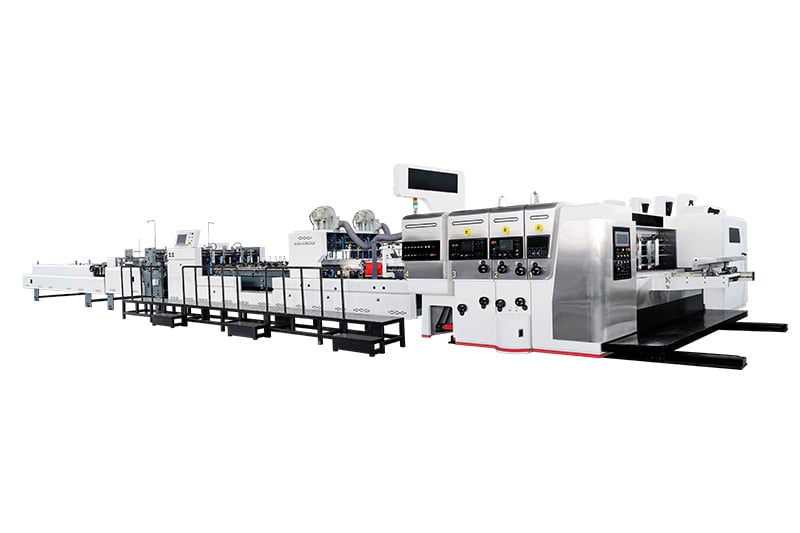
1.3M boxes/day
at size #13
at size #13
40+ countries
deployed
deployed
10+ years
engineering
engineering
Lifetime
spare parts
spare parts
Single-Lane Bottlenecks During E-Commerce Peaks — Why One Folder Gluer Caps Out at 600k Boxes/Day
A folder gluer production line is a chain of paper-converting stations that turn flat corrugated sheets into folded, glued, and stacked cartons in one continuous run. The Cenwan dual-channel line adds an inline die-cutter at the front and a semi-automatic baler at the back, so a single line covers the full express-carton workflow that most plants run as three separate machines.
This pain shows up every June and November. Singles’ Day 2023 generated $132.6 billion in spend on Alibaba and JD.com alone, and 6.18 has grown into China’s mid-year sister festival. Express logistics buyers need carton supply that holds steady when daily order volume jumps three to four times normal — and that is exactly when single-lane folder gluers run out of headroom.
A typical single-lane automatic folder gluer runs at 100–150 m/min sustained for tiny express cartons, which translates to roughly 500,000–650,000 boxes per 20-hour day on size 13#. Plants that try to scale by adding shifts hit labor-cost ceilings; plants that try to scale by adding parallel single machines hit floor-space and operator-headcount ceilings. Cenwan’s dual-channel layout solves this without doubling either footprint or staff: two lanes share one feeder, one die-cutter, one baler, and one operator team, with two synchronized servo gluing belts running in parallel.
For most express-carton operations, the question is not “can we go faster on one machine” but “can we double effective capacity without doubling the cost of running a second line.” That is the buying decision the rest of this page answers.
Solution Summary — Why a Dual-Channel Line Beats Two Single Machines
Throughput:
Two parallel lanes glue at 240 m/min combined — single-lane folder gluers typically peak around 600,000 boxes/day, the Cenwan line absorbs 1.3M/day at express size #13
One-pass workflow:
Feeding → Die-Cutting → Folding → Gluing → Conveying & Pressing → Fish-Scale Receiving → Aligning Plate → Conveyor → Semi-Auto Baling — no intermediate transfers, no manual handoffs between stations
Flexible format range
across China express carton sizes 7 to 13, covered without reconfiguration; box making width 450–750 mm
Footprint:
17.5 × 4 × 1.8 m total line dimensions, ~70 m² floor occupation excluding maintenance walkways — published upfront so plant engineers can plan workshop layout before quote
Backed by Cenwan service
across 40+ countries: ISO 9001:2015, CE marked, 12-month free warranty plus lifetime spare parts supply
Cenwan Dual-Channel Integrated Line — Die-Cutting → Folding → Gluing → Stacking → Packing in One Pass
This line is built around two synchronized servo gluing channels that share one upstream die-cutting station and one downstream packing station. Each channel handles its own paper feed, glue application, folding, conveying, and stacking; a patented dual-channel converging plate aligns both stacks before they reach the conveyor and baler. The result is one operator team and one workshop footprint covering work that would otherwise require two single-lane folder gluers plus a separate die-cutter and a separate packer.
Technical Parameters
Die Cutting Part
Applicable paperE, N, F corrugated board
Mechanical inner width2000 mm
ControllerPLC interface
Max cutting speed180 pcs/min
Max feeding width1700 × 1200 mm
Paper feedingHigh-pressure fan
Folder Gluer Part
Applicable paperE, N, F corrugated board
Max thickness800 g
Max gluing speed240 m/min (combined)
Box making width450–750 mm
Glue typeSolute-type / cold glue
Power / Air pressure20 KW / 6 Pa
Whole Line Setup
Dimensions (L×W×H)17.5 × 4 × 1.8 m
Total weight16 T
* Master locking mechanism ensures speed regulation stays accurate. Modularity protects buyers: stations can be isolated individually.
Each station inside the line is built as a self-contained module with its own service access, its own electrically-controlled separation, and pneumatic interlocks between adjacent units. This modularity is what protects buyers from the most common worry about an integrated line — “if one station goes down, do I lose the entire production.” The answer is no: stations can be isolated, opened, and serviced individually.

Feeding Section
Electrically-controlled unit separation with audible alarm during operation. High-pressure centrifugal fan provides suction-assisted feeding, with air volume tuned to cardboard curvature. Planned production quantity stop with automatic alarm signal.
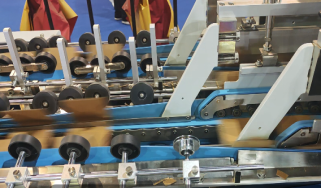
Folding Gluing Section
Waste removal device before the glue applicator keeps paper clean. Both channels glue and fold die-cut cardboard simultaneously, with independent left/right servo belts that can run at different speeds for precise box squareness. Active upper belt smooths carton transit.
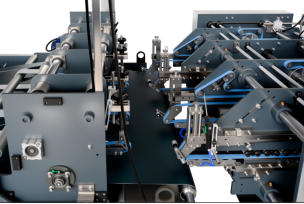
Conveying & Pressing
Dual-channel independent paper feeding ensures smooth carton handover. Each channel has its own counting spray for accurate batch tallies. Transverse-movement paper stack head simplifies order changeover for flat-top boxes.

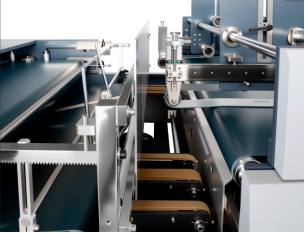
Fish-Scale Receiving
Upper pressing belt produces lighter receiving pressure, preventing glued cartons from sticking together prematurely. Narrow belt design keeps the receiving zone visible for fast operator intervention. Independent upper-belt retraction adjusts to carton size for neat stack alignment.
Aligning Plate (Patented)
Cenwan’s exclusive dual-channel converging relay transfer ensures stack height stays consistent across both channels. Independent servo control of stacking-plate transfer prevents the clogging that single-controller lines experience when the two channels run at slightly different effective speeds.

Conveyor & Baling
Independent soft-sponge belt protects finished cartons during conveying. Conveyor speed auto-adjusts to the main machine’s rotational speed via photoelectric controller, with manual override available. Semi-automatic baler at the line tail completes the cardboard-to-pallet flow.
Dual-Channel vs Single-Lane vs Best-of-Breed Modular — Throughput, Footprint & TCO Comparison
Buyers evaluating a line-level investment usually weigh three approaches: stay with a single-lane folder gluer and add shifts, stack two single-lane machines side by side, or buy a fully integrated dual-channel line. The differences are not just throughput — differences show up in floor space, operator headcount, integration time, and five-year total cost of ownership.
Industry analyses confirm that fully integrated lines carry higher upfront cost and longer lead times than mix-and-match assemblies, but reduce labor cost and integration complexity over the equipment lifetime. The hidden “integration tax” of stitching together best-of-breed equipment from multiple vendors — interface engineering, multi-PLC synchronization, vendor coordination during commissioning — is rarely surfaced in the original quote, but consistently shows up during the first year of operation.
Single-Lane / Straight-Line |
Two Stacked Machines |
Cenwan Integrated Line |
|
|---|---|---|---|
| Peak throughput (size 13# carton) | ~500–650k boxes/day | ~1.0–1.3M boxes/day (2 lines) | ~1.3M boxes/day (1 integrated line) |
| Max gluing speed | 120 m/min single channel | 120 m/min × 2 = 240 m/min total | 240 m/min combined dual-channel |
| Floor footprint | ~35 m² | ~70–80 m² (two separate cells) | ~70 m² (single integrated cell) |
| Operators per shift | 2–3 | 4–6 | 3 |
| Front-end die-cutter | Separate machine, manual transfer | Separate per line, 2 transfers | Inline, no transfer |
| End-of-line baling | Separate semi-auto baler | 2 separate balers or shared bottleneck | Integrated semi-auto baler |
| Vendor count | 3–4 (cutter, gluer, packer, controls) | 4–6 (duplicated brands) | 1 (Cenwan turnkey) |
| Integration commissioning time | 2–4 weeks | 4–8 weeks (twice the coordination) | ~1 week on-site (pre-tested as a line) |
| 5-year operating cost | ~€100–120/hr labor + utilities | ~€180–220/hr (more operators) | ~€110–140/hr (single team, single utility tap) |
| Capacity flexibility | Add shifts only | Add lines (more CAPEX) | Run one channel for low season, both for peak |
Where each choice still wins:
Single-lane is right for plants under 400k boxes/day with stable demand and no peak-season swing. Two stacked single-lane machines are right when a plant runs two completely different box types in parallel and can absorb the duplicated overhead. Cenwan’s dual-channel integrated line is the answer when daily volume crosses 800k boxes and the order pattern shows clear peak-season multipliers — which describes most Chinese e-commerce express-carton suppliers and a growing share of overseas third-party logistics packagers.
Customer Output: 1.3M Cartons/Day at Size #13 — E-Commerce Peak Capacity
That headline capacity number — 1.3 million boxes per day at size 13# carton — is what makes the Cenwan dual-channel line viable for e-commerce peak season. It represents continuous 20-hour operation at the dual-channel 240 m/min effective gluing speed, with size 13# (13 × 8 × 4.5 cm) being the most common express-logistics carton in the Chinese domestic and cross-border parcel market.
This capacity matters because Singles’ Day 2023 alone moved $132.6 billion in transactions across Alibaba and JD.com, with parcel volume in the days following the festival running three to four times normal weekly baseline. Lines that can absorb 4× peak without splitting orders across multiple machines or running 30-day inventory buffers are what changes the unit economics of express-carton supply.
“Our independent-servo converging plate has not jammed in any pre-ship test we have run since locking in the production version. Conventional shared-conveyor designs jammed roughly once every two hours.”
Who runs Cenwan dual-channel lines today
Today’s deployed customer base spans express logistics packagers, pharmaceutical secondary packaging plants, food carton converters, cosmetics carton plants needing fast format change, and 3C electronics packagers running mixed-size short-run orders. With a 40+ country service network, line buyers in Europe, Southeast Asia, the Middle East, and North America have access to factory engineers for installation and service.
5-Year Total Cost of Ownership Snapshot
€500k
Savings
Operating Cost Reduction
Integrated dual-channel layout achieves equivalent throughput at €110–140/hour compared to €200–240/hour for parallel single lines, saving 3–4 operators per shift.
Compared to running two parallel single-lane folder gluers plus a separate die-cutter and a separate packer, the integrated dual-channel layout eliminates two manual transfer points and shares one set of utility connections.
TCO snapshot uses baseline of €100–120/hr per single-lane gluer, applied to 5,000 operating hours/year × 5 years. Actual savings depend on shift pattern and local wage.
Express Carton Range (Sizes 7 to 13) — Format Flexibility Without Reconfiguration
Express logistics packagers run a narrow but exact set of carton sizes determined by the dominant Chinese express-parcel size standard. This Cenwan line covers sizes 7 through 13 of the standard express carton series in one continuous operating envelope — meaning a plant can switch between sizes with a parameter change rather than a mechanical reconfiguration. Complete reference dimensions are published below so buyers can match specific SKUs against the line’s capability before requesting a quote.
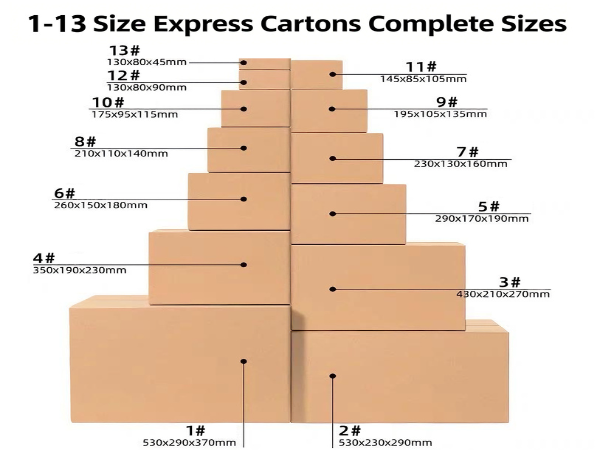
China Express Carton Standard Sizes
13#
13 × 8 × 4.5 cmApplication: Small jewelry, accessories, USB drives
Coverage: Yes — peak throughput size (1.3M/day)
12#
13 × 8 × 9 cmApplication: Cosmetic samples, small electronics
Coverage: Yes
11#
14.5 × 8.5 × 10.5 cmApplication: Phone accessories, small books
Coverage: Yes
10#
17.5 × 9.5 × 11.5 cmApplication: Standard express small parcel
Coverage: Yes
9#
19.5 × 10.5 × 13.5 cmApplication: Apparel folded, cosmetics gift box
Coverage: Yes
8#
21 × 11 × 14 cmApplication: Apparel, household goods
Coverage: Yes
7#
23 × 13 × 16 cmApplication: Mid-size express parcel
Coverage: Yes — max box width approached
6#
26 × 15 × 18 cmApplication: Large household goods
Coverage: Reference — outside primary envelope
5#
29 × 17 × 19 cmApplication: Bulk apparel, kitchenware
Coverage: Reference — outside primary envelope
4# – 1#
35×19×23 → 53×29×37Application: Bulk shipping cartons
Coverage: See 4/6 corner folder gluer
Certifications, Standards & Component Traceability
Global Standards
- CE Marked
- ISO 9001:2015
- EN ISO 12100:2010
- EN 415-1:2014
- RoHS 2011/65/EU
- EC Declaration of Conformity
Line-level CAPEX investments at the $200,000+ tier carry compliance and component-traceability requirements that single-machine procurement does not. The Cenwan dual-channel line is certified and documented to support import compliance into the EU, North America, Southeast Asia, and the Middle East — the four regions making up most of the 40+ countries currently served.
Directives & Risk Assessment
Line CE marking covers the Machinery Directive 2006/42/EC (mechanical safety, including dual-channel converging plate hazard analysis), the EMC Directive 2014/30/EU (servo drive electromagnetic compatibility), and RoHS for restricted substances in electrical components. EN ISO 12100:2010 provides the type-A risk assessment framework, and EN 415-1:2014 plus EN 415-10:2014 cover the packaging-machinery-specific safety requirements that distinguish a line-level CE assessment from a single-machine assessment.
Production & Traceability Protocol
Component-level traceability is delivered by an itemized brand sheet released with each quote: imported PLC controller, servo drives, bearings, pneumatic valves, and electrical contactors are specified by manufacturer and part number rather than as generic categories. Cenwan’s temperature-differential bearing assembly process — applied to all transmission bearings across the line — is documented in the production-test record so buyers can verify it during pre-shipment inspection or third-party FAT (factory acceptance testing).
Procurement Guide — Price Range, Footprint Planning, Lead Time, Installation
Most folder-gluer line vendors hold pricing back until a buyer fills out a contact form. Cenwan publishes a working price band and a footprint envelope upfront because plant engineers need both numbers to advance an internal CAPEX proposal beyond the initial vendor-shortlist stage.
Price band
A base dual-channel integrated line sits in the USD 180,000–220,000 range, depending on configuration of the inline die-cutter, baler size, and electrical region (220 V vs 380 V three-phase). Adding the optional One-Touch Machine Adjustment package (full-servo parameter automation plus QR-code order scanning) brings the line into the 240,000–270,000 range. Adding the dual-channel converging-plate patent device is included in the base line; it is not a separate option. Specific quotes are configured against the buyer’s box size mix, available power supply, and installation country.
Footprint planning
This line itself occupies 17.5 × 4 × 1.8 m (L × W × H). Cenwan’s installation team recommends planning for a total bay of approximately 22 × 6 m (~130 m²) to allow for upstream paper-stack staging on the feed side, downstream pallet staging on the baler side, and a service walkway of at least 0.8 m on each side of the line. Workshops with floor-to-ceiling clearance below 2.5 m or floor flatness deviation greater than 5 mm over a 4 m span will need preparation work before installation. Line dimensions and a recommended workshop layout drawing are released with every quote.
Lead time
Standard production lead time is 30 days from confirmed order to ex-works Wenzhou. Lead time and configuration scope remain flexible — buyers needing accelerated delivery for a peak-season install can request expedited production at quote stage. Sea freight to most destinations adds 25–45 days depending on port. On-site installation runs 5–7 days for a typical commissioning and operator training cycle. Total time from purchase order to first production run is normally 2–3 months.
Installation
Cenwan send factory engineers to the site for installation and training of operators. Engineer day rate is 150$/day; buyer pays for visa application assistance, round-trip airfare, lodging and meals. Training includes operator daily-routine procedures, format-change process, basic troubleshooting and a hand-over of spare parts documentation. From now until the lifetime of the line, remote troubleshooting via scheduled telephone calls with the Cenwan engineers is included in the price.
Warranty and after-sales
This line carries a 12-month free warranty from the delivery date, covering electrical components in the control cabinet and imported-brand belts. Out-of-warranty support is delivered as lifetime maintenance plus lifetime spare-parts supply; spare parts and freight are billed at then-current market price. Modifications to machine structure, configuration, or function without written Cenwan consent terminate warranty coverage. Payment terms are typically T/T with 30% deposit on order confirmation and 70% before shipment, with L/C and credit-card options available.
Line Output & Facility Planning Tools
Dual-Channel Line Capacity Calculator
Estimate daily and annual carton output for the Cenwan dual-channel folder gluer line based on your operating pattern. Numbers are realistic for the express size 7–13 envelope at the line’s specified 240 m/min combined dual-channel speed.
Launch Calculator ToolWorkshop Footprint Planner — Cenwan Dual-Channel Line
Visualize the workshop bay needed to install the Cenwan dual-channel integrated line. Includes line dimensions, upstream paper-stack staging, downstream pallet area, and recommended service walkways.
Open Footprint PlannerFAQ — What Buyers Ask Before Investing in a Full Line
The dual-channel line is a complete integrated production line — inline die-cutting, dual-lane gluing, fish-scale receiving, and semi-automatic baling — built for high-volume express-carton sizes 7 to 13 with conventional folding patterns. By contrast, the 4/6 corner folder gluer machine is a single specialty machine for crash-lock-bottom cartons with four or six pre-folded corners, used in cosmetics, pharma, and premium retail packaging. Plants serving e-commerce express logistics typically buy the dual-channel line; plants making branded retail boxes typically buy the 4/6 corner machine; many plants buy both as complementary capacity.
A folder gluer is the machine in a carton plant that takes flat printed and die-cut cardboard blanks, folds them along the scored lines, applies adhesive at the joining edges, and produces the finished collapsible carton ready to ship to the brand owner who will fill it. In a fully integrated line like the Cenwan dual-channel layout, the folder gluer module is preceded by an inline die-cutter (so the line accepts plain printed sheets rather than pre-cut blanks) and followed by a packer (so output cartons are baled and pallet-ready without manual handling).
Flexo folder gluers add an inline flexographic printing unit at the front, so the line prints, slots, die-cuts, folds, and glues corrugated boxes in one continuous run. The Cenwan dual-channel line as configured includes the die-cutting, folding, gluing, and packing stations but does not include flexo printing — plants needing inline printing typically pair the dual-channel folder gluer line with a separate upstream flexo printer, or specify a flexo-printer extension during the quote configuration.
The base configuration sits in USD 180,000–220,000 ex-works Wenzhou. Adding the optional one-touch adjustment package with QR-code order scanning brings the line into the 240,000–270,000 range. Specific configuration depends on box size mix, power-supply region, and any add-on stations such as flexo printing or fully automatic baling. Quotes are normally returned within 48 hours of receiving the buyer’s box-spec and shift-pattern questionnaire.
Three operators per shift is the standard headcount: one at the feeder end, one supervising the gluing and receiving sections, and one at the conveyor and baler. Plants running the line 20 hours per day across two operating shifts plan for a six-person rotating operator team plus one shift maintenance technician shared with other plant equipment.
Manual folder-gluer setups depend on operator handling at almost every stage — feeding, glue spreading, folding, stacking, baling — and run at low effective speeds. Semi-automatic lines automate the gluing and folding but leave feeding and baling as operator tasks. Fully-automatic lines like the Cenwan dual-channel layout automate the full sequence from suction-assisted feeding through baling; operators supervise rather than handle. A Cenwan line’s baling station is described as semi-automatic because final pallet wrapping remains a manual step, but the cardboard-to-stack flow is fully automated.
This line’s primary operating envelope covers China express carton sizes 7 to 13 (13 × 8 × 4.5 cm up to 23 × 13 × 16 cm). Larger sizes up to size 4# (35 × 19 × 23 cm) can be configured but require parameter adjustments outside the standard preset library. Cartons larger than size 4#, or specialty corner-lock structures, are not the right fit for this line — those plants should evaluate the Cenwan 4/6 corner folder gluer machine or specify a custom folder gluer configuration.
Cenwan offers pre-peak inspection visits in May (before 6.18) and October (before Singles’ Day and Black Friday) for plants under active service contract, with critical wear-part replacement done preemptively to avoid mid-peak failure. Spare parts for high-wear components — belts, gluing nozzles, photoelectric sensors — are pre-stocked on the buyer side based on the spare-parts list released with the line. Remote video troubleshooting is available 24/7 during the three peak windows.
Standard production lead time is 30 days from confirmed deposit to ex-works. Sea freight adds 25–45 days depending on destination port. On-site installation runs 5–7 days including operator training. Total elapsed time from purchase order to first production run is typically 2–3 months. Visa support, accommodation, and meal arrangements for the dispatched factory engineer are coordinated with the buyer’s logistics team during the production lead time.