
Get in touch with Cenwan Machine Company



A folder gluer is a machine that folds and glues carton blanks into finished boxes. Choosing between a straight-line vs lock-bottom vs 4/6-corner folder gluer comes down to one physical fact: every folder gluer machine is limited by what its folding station is built to do. Even before you get into speed sheets and price quotes, the most fundamental question defining which folder gluer machine to buy for your line is quite simply: what box style do you run, and does your line need more than one? This guide compares straight-line, lock-bottom (crash-lock bottom) and 4/6-corner folder gluers on the three critical metrics of any machine comparison that get left out in simple cost and speed comparisons – total cost of ownership (TCO), changeover economics, and format flexibility – and will give you a framework to start evaluating folder gluer machines and make more informed comparisons before you reach out to a sales representative. Simply put, picking the right folder gluer machine to fit the job it’s meant to run is often the more cost-effective route to a rapid ROI than buying more versatile packaging solutions for your folding carton application – and the real benefits of folder gluers and the production efficiency they add show up when their folding and shaping capability matches what the line actually runs, not when it doesn’t.
Quick Specs: Box Style → Folder Gluer Fit Snapshot
| Straight-line carton | Single glued seam, lowest mechanical complexity, widest speed range |
| Lock-bottom / crash-lock | Interlocking base folds, no glue on the bottom seam, pops open under tension |
| 4-corner / 6-corner | Servo-driven backfolding device required, highest mechanical complexity, longest makeready |
| Multi-style option | A single machine (e.g. Cenwan CW-W-1250PCW) can run all three on one line — see “When You Need More Than One Box Style” below |
Box Style Basics: The Types of Folder Gluer Machines and What They Make

You may see this problem described in different ways throughout the packaging industry, but it’s the same issue we’ve discussed countless times across packaging and the packaging machinery market; some customers will describe boxes or cartons simply as “boxes,” while others will use the word “cartons” and a good percentage will just state their packaging needs in plain English. Regardless of terminology, any supplier in the packaging machinery sector quoting on different products, each with different box quality standards and production requirements, will require specific information about your box style, not just a generic description of a simple box or the product category, in order to correctly specify a suitable machine.
You can’t say “carton” to a folder gluer manufacturer and expect to receive accurate guidance. While the European Federation of Corrugated Board Manufacturers (FEFCO) code system identifies and defines 4-digit codes for various types of corrugated packaging (the most common box design used for straight-line folder gluers, 0201, being an example), this system is based solely on corrugated box design and has limited direct overlap with the established naming conventions for folding-carton designs (the type of pharma, cosmetic and food packaging a straight-line machine will commonly produce). Therefore, don’t assume the FEFCO codes used on corrugated specifications translate perfectly onto folding carton blank drawings. Ask your supplier which system they’re using.
| Box style | What it looks like | Typical use case |
|---|---|---|
| Straight-line | One glued side seam, folds in a single direction | Pharma cartons, cosmetic boxes, sleeves, food cartons |
| Lock-bottom / crash-lock | Pre-folded interlocking base, no bottom glue | E-commerce shippers, fast-food and takeaway boxes |
| 4-corner | Four reinforced glued corners via backfolding | Cosmetic compacts, gift boxes, premium retail |
| 6-corner | Six reinforced corners, longest makeready | Pharma sample boxes, premium electronics, food display trays |
| Corrugated (FEFCO-coded) | Flute-based board, folding and gluing machine for corrugated box production | Shipping cases, bulk packaging |
Regardless of what you call the final package – “boxes” or “cartons,” etc – each of the simpler corrugated boxes or folding-carton designs listed in the FEFCO code structure is an evolution from a standard corrugated box or folding carton blank which would pass through a production line, with the specific FEFCO or folding-carton code indicating which box design it represents to a machinery manufacturer.
Takeaway: Don’t ask a folder gluer supplier “I need a folder gluer.” You can be far more effective by saying “I need a straight-line machine for 200-400 gsm pharma carton.”
Don’t discount this advice. Any supplier bidding against your general description of “corrugated box” will have to guess your flute type, blank width and folding pattern-three separate variables that all determine the appropriate folder gluer class for your line. Sending the correct box-style name along with a blank drawing and finished carton photo will enable your packaging machine supplier to efficiently develop an accurate quote in a single round of communications rather than needing three to four exchanges.
Straight-Line vs Lock-Bottom vs 4/6-Corner: Core Mechanical Differences

What is the difference between a folder gluer and a straight-line folder gluer?
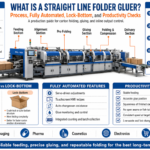
Straight-line folder gluers belong to a subset of all folder gluer classes: they crease a blank along a single axis and glue one seam, making this class the least complex and fastest to run. Lock-bottom and 4/6-corner folders add a backfolding station, something a straight-line gluer doesn’t have — and that’s the real “difference”: mechanical, not speed.
A straight-line gluer can’t form a locked bottom or reinforced corner, no matter how fast its folding belts are; a straight-line can’t achieve the necessary number of backfolds.
Within any of these three classes of folder gluers, the process is fundamentally the same: die-cutting sets up fold lines and slots on a blank, a feeding system pulls blanks from the stack, a folding section creases them, and a gluing station joins a seam to finish the blank into a finished product before it goes to the stacker. Paper feeding and folding automation replaced what used to be manual gluing and manual box assembly on an assembly line, without changing the underlying production process. What differentiates box styles for a folding gluer is simply how many creases a machine needs to produce on a blank; a straight-line needs one, whereas a complex box design will require multiple backfolds in succession without dropping production speed.
| Dimension | Straight-line | Lock-bottom | 4/6-corner |
|---|---|---|---|
| Fold/glue points | 1 side seam | Interlocking base, 0 bottom glue points | 4 or 6 corner glue points |
| Backfolding device needed | No | Yes (base-forming) | Yes (servo-driven, corner-forming) |
| Published structural speed | Up to ~400 m/min on this class of machine | Typically lower than straight-line, no bottom-glue step | 300-700 m/min headline figure |
| Actual box-style throughput ceiling | Close to structural speed | Bounded by base-locking mechanism, not glue drying | 180-300 m/min real — the backfolding device is the ceiling, not the structural drive |
📐 Engineering Note
A folder gluer datasheet that touts a “700 m/min maximum” rating on a 4/6-corner folder gluer will usually be talking about its main folding belts. A reliable manufacturer datasheet from the competitive landscape-SCM’s SQ Series, referenced by Cenwan’s 4/6-corner guide-will show the main belts’ rated speed as 700 m/min and a more modest, structurally accurate, “maximum 300 m/min backfold,” roughly 43% of the main belt rating because backfolding is structurally limited and relies on servo speed (again, no straight-line folding belt speeds the backfolding belts up or down). This is just one documented instance; be aware that this 43% is a starting point to question rather than a universal number. Always ask for a box-pattern specific speed table. Electrical draw scales with the same pattern: straight-line lines commonly run 15-22 kW total connected load, while 4/6-corner backfolding equipment often needs 15-28 kW — a real line-item on your facility’s power budget, not just a footnote. Separately, safety is an issue in all three machine types. The ANSI/PMMI B155.1-2023 “Safety Requirements for Packaging and Processing Machinery” applies to all machines “making… paperboard cartons or corrugated cases”, including folder gluers, and both backfolders and glue heads are pinch points where safety standards apply.
Total Cost of Ownership Across the Three Styles

Sticker price is only one part of the equation in acquiring a folder gluer. According to one industry report for comparable machinery-a combination folder-gluer-case-packer system-the price ranges from CAD $7,000 up to CAD $600,000+, depending on the level of automation involved. A stand-alone folder gluer typically falls somewhere within the lower-to-middle part of that price range, but the wide variation underscores why the initial purchase price means very little until you can narrow it down for your particular application.
Where straight-line usually costs less
- No backfolding device to buy or maintain
- Fewer trained-technician hours per changeover
- Simpler glue system (one seam vs. multiple corner points)
Where 4/6-corner cost hides beyond the machine price
- Servo backfolding maintenance and periodic recalibration
- Longer first-pass makeready on new patterns (up to 30 minutes)
- More glue guns/applicators to service (3-4 electronic guns is typical for corner work)
Capex-only comparisons also ignore what happens when the box leaves the folder gluer. ASTM D4169, the standard shipping-container performance test method, addresses the finished package in the context of distribution hazards such as drops, compression and vibration. Choosing a box style that makes you money on the machine side but then flunks the distribution test simply swaps that saved money into damage claims and rework – a legitimate total-cost item even if it’s not one that ever appears on a machine quote.
Labor is the other line that’s absent from a machine-price comparison. Single-seam glue systems on a straight-line machine require less training to keep running than a 4/6-corner line’s array of corner-glue applicators. (By way of reference, Industry comparisons between manual and fully automated folder gluers report output that differs by roughly an order of magnitude: thousands of boxes per hour on a manually fed line versus tens of thousands per hour on fully automated ones.) This same gradient in labor intensifies again at a smaller scale when you transition between straight-line and 4/6-corner equipment within the automated range; the additional glue points necessitate more sensor calibration, more frequent wear-part inspection, and more training hours for a new employee to operate the line unsupervised. This all contributes to labor costs and the bottom line – just not the machine-price line.
Condition-based cost guidance
- ✔Single box style, long runs → straight-line, lowest total cost per box at volume
- ✔Shipping/e-commerce with drop-test exposure → lock-bottom, factor distribution testing into the comparison, not just machine price
- ✔Premium/reinforced packaging, willing to pay for corner strength → 4/6-corner, budget for servo maintenance as a recurring cost line
Changeover Time and Recipe-Switching Economics

Changeover time scales with box-style complexity, not with the speed of the machine’s main drive. Switching between previously saved recipes on 4/6-corner equipment may take around 10 minutes once the operator pulls up a saved job; a completely new 6-corner pattern and unfamiliar blank dimensions could take up to 30 minutes the first time through to ensure the machine is correctly set. On a straight-line machine with servo-assisted setup, a similar changeover can take a fraction of that time because there’s no backfolding device to realign.
SMED (Single-Minute Exchange of Dies) – a lean-manufacturing approach for reducing changeover times to single-digit minutes – provides a good way to think about this: Packaging lines running 5 to 15 changeovers per shift will lose significantly more production time to setups than a plant running one long production job a week, so the value of rapid changeover will scale more closely to how often you actually switch box styles than how many boxes you produce in a day. If your plant largely runs one box style for multiple days, there’s limited value to high-speed changeovers.
The Cenwan Servo Changeover Calculator will let you evaluate this trade-off based on your own shift count and SKU mix, not an industry-average figure.
Changeover time is a further multiplication to the labor issues in the last paragraph. A crew that already requires more training to produce a 4/6 corner line with a half-dozen glue points is the same crew you’re now asking to run an efficient 30-minute first-pass changeover – pair a challenging box style to the frequent changeovers and those two costs don’t just add, they compound. If your SKU count is actually large and it’s getting larger, that pair deserves an explicit conversation with a supplier rather than just a new faster machine.
Adhesive and Glue System Fit by Box Style

How do I know which folder gluer machine is suitable for my business?
Begin with the box style and substrate, not the machine catalog. Straight-line and lock-bottom cartons on uncoated paper stock typically work well on either a cold emulsion or hot-melt system; 4/6-corner applications on laminated or UV-coated board usually require a PUR adhesive (applied at 120-150°C, versus 160-180°C for hot melt), since most cold and hot-melt systems can’t stick to a smooth, coated stock.
This gluing process starts from flat sheets of paper on the folding carton side, or sheets of paper or cardboard rated by flute on the corrugated side; cold glue remains the standard choice for straight-line cartons on uncoated paper board, since it provides efficiency and precision with no increased costs or complexity in the overall process.
Our full comparison on cold emulsion versus hot melt versus PUR-and the corresponding trade-offs with set time, equipment costs, and recyclability-can be found in the Cenwan 4/6-corner folder gluer guide; for that reason, this section will focus solely on the box-style filter and won’t repeat the broader discussion.
Another filter box style alone won’t tell you: If you are running food and beverage or pharmaceutical cartons, your choice of adhesives is determined by compliance not simply a better bonding capability. 21 CFR 175.105, “Adhesives” is the regulation for FDA and provides the food-contact clearance for adhesives based on specific adhesive chemistries. This limitation holds true irrespective of the style of carton. Before ordering the adhesive that “bonds best,” be certain to discuss its FDA clearance and obtain official Food Contact Statement documentation from the adhesive supplier – don’t rely on the technical adhesive specifications, they are rated separately from their food contact compliance.
A Decision Framework: The Box-Style Tradeoff Triangle

Cost, changeover time, and format versatility all work at cross purposes and an approach that optimizes only on one axis nearly always ends up with a machine that’s ill suited to a facility’s real SKU mix. The Box-Style Tradeoff Triangle offers all three at once instead of an “apples vs. oranges” comparison:
The Box-Style Tradeoff Triangle
- Cost vertex — lowest machine capex and maintenance belongs to straight-line; highest belongs to 4/6-corner servo backfolding
- Changeover-speed vertex — fastest recipe switching is servo-driven straight-line; slowest first-pass setup is a new 6-corner pattern
- Format-flexibility vertex — a dedicated straight-line unit scores lowest here; a multi-style configuration scores highest, at a cost premium
No one machine hits all three corners simultaneously. Any plant pulling hard towards ‘lowest cost’ and ‘fastest changeover’ and “runs every box style” is calling a machine that can’t exist at any single price point – the honest answer is to prioritize the two vertices that matter most for your SKU mix, and make the third a tradeoff you accept.
Working the framework with your own numbers
Score your own line 1-3 on each vertex (1=not a priority, 3=critical) prior to calling a supplier — the servo changeover savings calculator can help quantify the changeover-speed vertex with your own numbers — and the resulting pattern should immediately tell you which class of machine to start the conversation with:
- ✔Cost = 3, Changeover-speed = 2, Flexibility = 1 → single-purpose straight-line, budget-driven, one dominant box style
- ✔Cost = 1, Changeover-speed = 2, Flexibility = 3 → a multi-style configuration like the CW-W-1250PCW is worth the capex premium, since format flexibility is scored as critical
- ✔Cost = 2, Changeover-speed = 3, Flexibility = 1 → servo-driven straight-line or lock-bottom, prioritizing fast recipe switching within one box style family over running every style on one line
Any plant scoring all three at a ‘3’ isn’t describing a machine – it’s describing a wishlist. Use the scoring exercise to force the trade-off decision before a salesperson makes it for you at a worse price; the real decision is about versatility versus productivity, not ‘best’ versus ‘wrong’.
When You Need More Than One Box Style

The ability to run two or three box styles doesn’t necessitate purchasing two or three machines. Cenwan’s CW-W-1250PCW, for instance, is configured to run straight-line, lock-bottom, 4-corner, and 6-corner cartons on a single line — verifiable on Cenwan’s published box-style compatibility matrix, rather than some generic ‘multi-purpose’ line item on a specification sheet.
This is hardly unique to one manufacturer; Vega’s Altair folder-gluer is another established machine that runs both straight-line and crash-lock bottom configurations, thus confirming that multi-style machines are a recognized industry equipment class, not just some vendor’s overblown sales tactic – good to know as you consider the real configuration options rather than dismissing it as oversell.
Stereo boxes and more-challenging corrugated require dedicated machines. Cenwan’s CW-T-650 stereo-box unit is another example of a separate product line from their multi-style configuration. Check a specific machine model’s published box-style and material-compatibility chart (e.g. Cenwan’s Box Style Compatibility Matrix) before assuming a universal run capability; avoid just accepting ‘runs everything’ claims at face value.
| Cenwan model class | Straight | Lock-bottom | 4-corner | 6-corner | Stereo | Max speed | Material |
|---|---|---|---|---|---|---|---|
| CW-G Series (High-Speed) | ✓ | opt | opt | — | — | 400 m/min | 200–800 g paperboard |
| CW-M Series (Medium-Speed) | ✓ | opt | opt | — | — | 400 m/min | 200–800 g paperboard |
| CW-T-650 (Stereo Box) | — | — | — | — | ✓ | 150 m/min | 200–400 g paperboard |
| CW-W-1250AC (Two-fold) | ✓ | — | — | — | — | 180 m/min | E/F/C/B/AB flute |
| CW-W-1250AC-S (Intelligent) | ✓ | opt | — | — | — | 200 m/min | E/F/C/B/AB flute |
| CW-W-1250PC (Lock Bottom) | ✓ | ✓ | — | — | — | 180 m/min | E/F/C/B/AB flute |
| CW-W-1250PCW (4 & 6 Corner) | ✓ | ✓ | ✓ | ✓ | — | 180 m/min | E/F/C/B/AB flute |
| CW-G-AC Series (Heavy-duty) | ✓ | — | — | — | — | 400 m/min | 200–800 g paperboard |
| Dual-Channel Integrated Line | ✓ | — | — | — | — | 240 m/min | E/N/F flute, 13#–7# postal |
✓ = standard capability | opt = optional configuration | — = not supported. CW-W-1250PCW is the only class in this lineup covering all four non-stereo box styles at once, which is the specific model referenced earlier in this section.
Industry Outlook: Why Box-Style Flexibility Is Becoming Part of the Spec Conversation

Market-context only as of July 2026: the folder gluer machine market is expected to expand from approximately $678.4MM in 2025 toward $1.30BN by 2035, and the 2026 vendor commentary points to AI-assisted changeover support, energy-efficient drives, and waste-reduction as the live themes suppliers are building toward. Meanwhile, one industry analyst estimate of the larger packaging-machinery retrofit-and-upgrade sector follows a steeper growth curve (roughly 7.14% CAGR) versus a separate estimate of packaging-machinery buy-and-install activity overall (roughly 5.2% CAGR) the two reports scope their machine categories differently, so this is a loose directional indicator at best, not a like-for-like apples-to-apples comparison, and it doesn’t allow us to draw a specific conclusion about the proportion of shoppers requesting multi-box-like quotes on one line. We’re providing these figures for context, not as evidence of a specific buying behavior we’re unable to independently confirm.
One final data point, held to the same diligence standard: a single keyword-suggestion snapshot for the broad phrase “box style” (which isn’t specific to folder-gluer but can include unrelated search intent) showed a year-over-year increase of approximately 52 percent as of mid-2026. We’re citing that as a loose, single-snapshot indication, not evidence that folder-gluer buyers specifically are searching more often – it’s directionally consistent with the “name your box style accurately” guidance in the first section of this guide, nothing more. The operational implication for 2026 capital planning: ask any qualifying provider whether their existing line can be configured or retrofitted to accept a second box style before you go with a single-purpose machine, even if you currently only produce one style – given the retrofit-sector expansion rate outrunning new-equipment purchases, that flexibility is less costly to include upfront than to retrofit later.
FAQ
Q: Are folder gluers suitable for small production runs?
View Answer
Yes, but the economics shift with volume. Servo-driven automatic folder gluers pay back fastest on repeatable, higher-volume runs, while very small or one-off box-style batches are often cheaper to run on a semi-automatic machine or through a converter’s own short-run line. The break-even point depends more on changeover frequency and SKU count than on raw daily volume alone.
Q: Can folder gluer machines handle recycled board stock or specialty substrates?
View Answer
Most folder gluers handle a defined paperboard and corrugated flute range (commonly E/F/C/B/AB flute and roughly 200-800 gsm paperboard), and recycled-content board generally runs fine within that range. Specialty substrates — laminated, UV-coated, or unusually heavy stock — change glue-system requirements more than they change the folding mechanism itself, so confirm adhesive compatibility before assuming a substrate will run.
Q: Do folder gluer machines require a lot of maintenance?
View Answer
Routine maintenance is closer to daily housekeeping than heavy servicing: draining and cleaning glue tanks and applicators at shift end, checking belt tension and photoelectric sensors weekly, and lubricating transmission bearings monthly are typical tasks. The servo-driven backfolding assembly used on lock-bottom and 4/6-corner machines needs periodic recalibration, which straight-line machines without that assembly don’t require.
Q: What is the typical lead time for folder gluer machines?
View Answer
Lead time varies by manufacturer, configuration complexity, and whether the machine is a stock configuration or a custom build — ask your supplier for a firm quote tied to your specific box-style and options list rather than relying on a generic industry-wide figure.
Q: Who benefits from using folder gluer machines?
View Answer
Carton and corrugated converters, contract packagers, and in-house packaging lines for food, pharma, cosmetic, and e-commerce brands.
Q: Is a flexo folder gluer the same as the machines in this guide?
View Answer
No. A flexo folder gluer is a different equipment category — an inline printing machine that combines flexo printing, slotting, die-cutting, and folding-gluing in one high-speed pass for corrugated production, closer to a separate corner of packaging and printing technology than to the sheet-fed straight-line, lock-bottom, and 4/6-corner machines this guide compares. Cenwan’s current line does not include flexo folder gluers or other inline folder gluers; if your production needs specifically call for combined flexo printing and box-forming, ask your supplier about that separate machine class.
Q: Can one folder gluer machine make all box styles?
View Answer
Not universally, but some configurations get close. Cenwan’s CW-W-1250PCW, for example, is built to run straight-line, lock-bottom, 4-corner, and 6-corner cartons on one line — a real multi-style configuration, not a marketing claim, confirmed on Cenwan’s own published box-style compatibility matrix. Stereo boxes and heavier corrugated-specific work still typically need a dedicated machine such as the CW-T-650 stereo-box unit, so before assuming full universality, check a specific model’s published box-style and material compatibility table rather than a generic “multi-purpose” claim in a spec sheet.
Related Articles and Tools
- Straight Line Folder Gluer Guide — complete process data, readiness rank, and buying considerations for straight-line models
- 4/6 Corner Folder Gluer Guide — component features, chemistry comparison, and datasheet reference points
- Crash Lock Bottom Folder Gluer Guide — lock-bottom structure and TCO transparency
- Straight-Line vs 4/6-Corner Folder Gluer Picker — interactive for model recommendation corresponding to your box-style mix
- Box Style Compatibility Matrix — link box types to Cenwan model options
- New Cenwan vs Used Bobst vs Alibaba Mini — brand and condition comparison for straight-line models
References & Sources
- FEFCO Code — European Federation of Corrugated Board Manufacturers
- ANSI/PMMI B155.1-2023 — Safety Requirements for Packaging and Processing Machinery
- 21 CFR 175.105, Adhesives — U.S. Food and Drug Administration, Electronic Code of Federal Regulations
- ASTM D4169 — Standard Practice for Performance Testing of Shipping Containers and Systems
- Folder Gluer Machine Market Size, 2026-2035 Forecast — Global Market Insights
About This Analysis
This box-style decision framework draws on Cenwan’s own published multi-style machine specifications alongside independent standards (FEFCO, ANSI/PMMI, FDA, ASTM) rather than repeating the automation-level comparisons already published by other manufacturers. Where cost and market figures are industry-reported ranges rather than machine-specific quotes, we’ve said so directly instead of presenting them as precise. Reviewed by the Cenwan Machine technical team.
![Folder Gluer Parts: Components, Wear & Replacement [2026]](https://cenwanpack.com/wp-content/uploads/2026/05/0-1-150x150.png)