Get in touch with Cenwan Machine Company

Flexo Folder Gluer Machine: Setup, Training, and Buyer Specs for Corrugated Plants

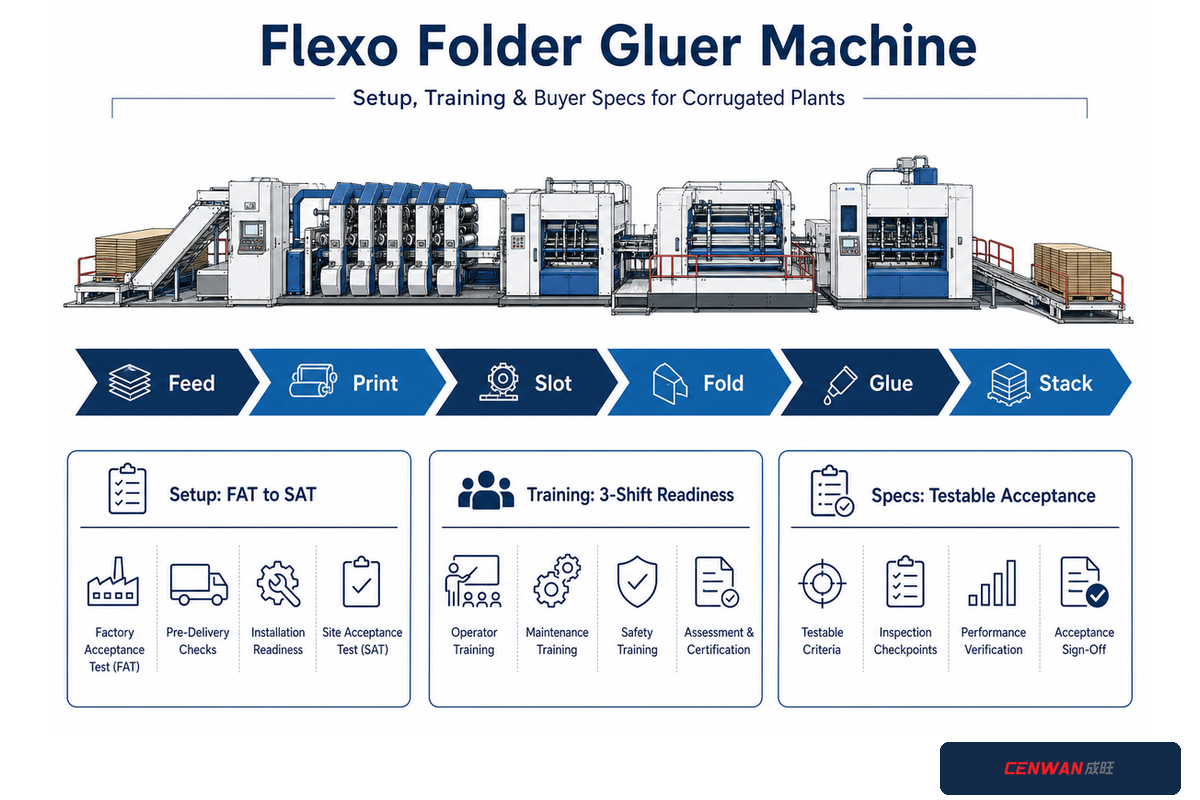
A flexo folder gluer machine is an inline converting system that feeds corrugated sheets, prints them, slots or die-cuts them, then folds, glues, counts, and delivers finished boxes in one production line. Successful purchasing isn’t simply a hunt for the highest catalog speed. It requires a signed match among box mix, plant utilities, operator capability, sample acceptance, and service support.
Updated July 2026
Direct answer
Specify the real jobs first: board, blank size, box style, colors, print target, slot or die-cut work, fold and glue quality, shift pattern, utilities, and delivery format. Then make the supplier prove that signed configuration through project-specific factory and site acceptance tests.
Quick specifications to collect before requesting a quote
| Products | Blank length and width, board grades, flute profiles, box styles, coatings, warp range, and monthly mix |
| Print and convert | Color count, coverage, register target, slot or die-cut scope, crease, fold, glue method, and delivery format |
| Plant | Footprint, access route, electrical supply, compressed air, extraction, network, environment, and line interfaces |
| People | Shift count, operator and maintenance roles, training language, teach-back tests, and escalation owners |
| Acceptance | Representative jobs, measurement methods, sustained-run period, document pack, defects, retest rules, and sign-off authority |
TL;DR
- Treat the line as a chain: feeder, flexographic printing, slotting or die cutter, fold, adhesive, and delivery.
- Don’t accept one maximum speed as proof of saleable output across a mixed-job shift.
- Separate factory acceptance from site acceptance and define the test plan before the purchase order.
- Train operators, quality staff, maintenance technicians, and supervisors to their own responsibilities.
- Use sample jobs and measurable pass/fail fields to compare new and used equipment on the same basis.
What Does a Flexo Folder Gluer Machine Do in One Pass?
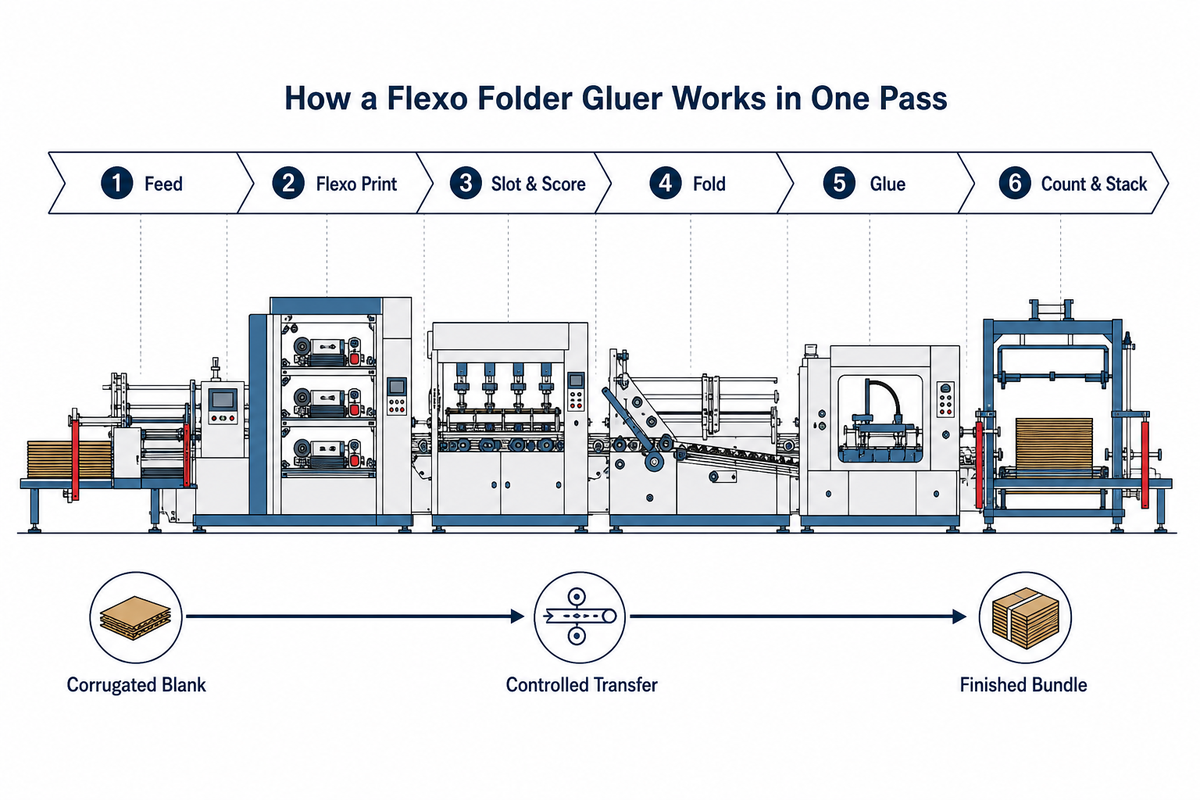
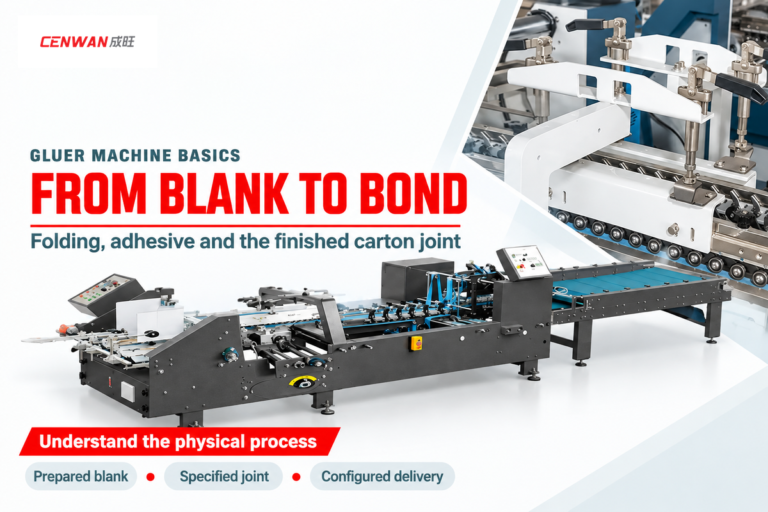
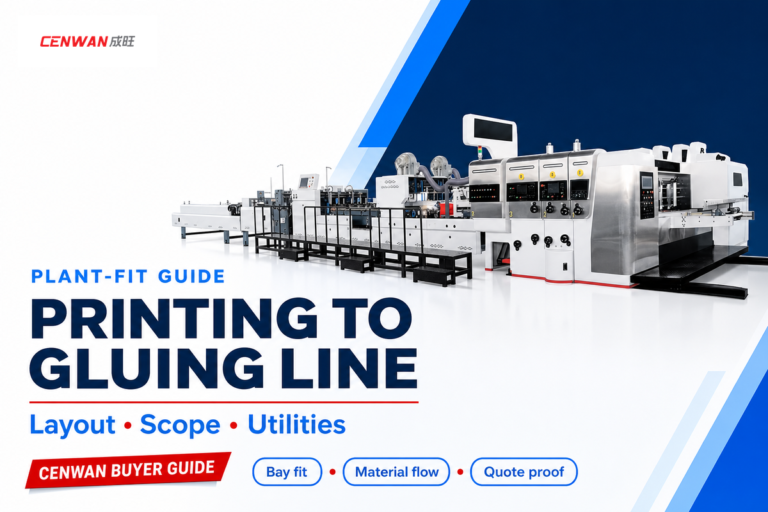
Often shortened to FFG inside a corrugated plant, this machine combines converting sections that may otherwise require separate machinery and material handling. Each cardboard or corrugated blank enters through the feeder. Flexo printing units apply the image. A creaser-slotter or die-cutting section forms the precise geometry. Folding rails align the panels, adhesive is applied to the glue lap, and the delivery section counts or bundles the boxes.
The intended result is a printed corrugated box completed in a single pass, with the blank controlled from feeder to conveyor belt.
Exact sequences depend on configuration. Depending on the project, the line may include multiple print colors, vacuum transfer, rotary die cutting, servo-controlled adjustments, inspection, counter ejecting, bundling, or connection to downstream palletizing. TAPPI’s Box Plant Basics course description identifies the same core sections: feeder, printing, creaser-slotter, die-cutter, glue-lap, folding-rail, and delivery.
- Feed: separate and register the corrugated blank without skew or double-feed.
- Print: transfer ink with the specified colors, coverage, and register.
- Convert: crease, slotting, or die-cut the blank to the approved geometry.
- Fold and glue: control panel position, glue application, compression, and bond formation.
- Deliver: count, eject, bundle, or transfer accepted boxes without creating a downstream bottleneck.
If you’re still comparing basic folder-gluer categories, start with the folder gluer machine guide. For an inline printing and converting project, keep the process map above beside the quote: every added section changes setup, guarding, utilities, training, spare parts, and acceptance.
What Must Be Ready Before the Machine Arrives?
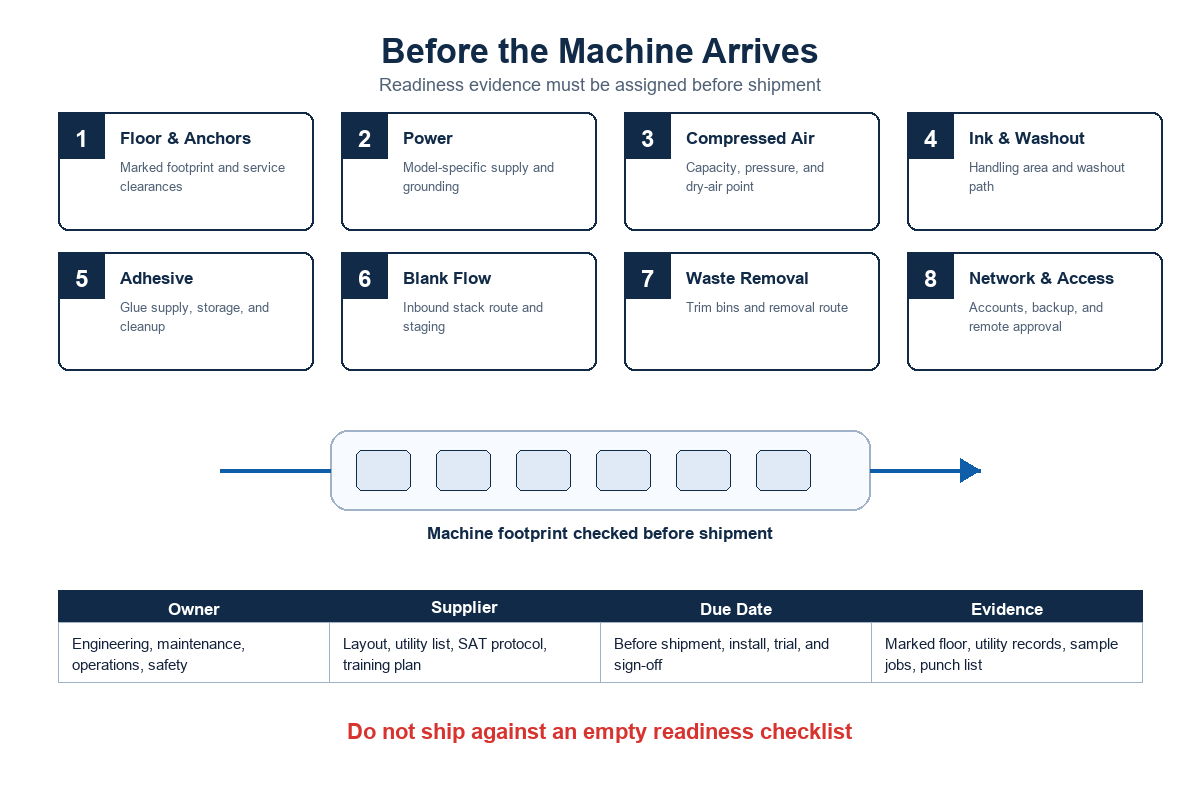
Installation problems are often decided before the truck reaches the plant. Readiness evidence must show more than a free rectangle on a floor plan. It should define how the machine enters the building, where modules are staged, how technicians work safely around it, where utilities terminate, and how wet ink, adhesive, trim, finished boxes, and people move through the area.
Don’t copy a foundation detail, voltage, air pressure, or extraction value from another model. Obtain the signed layout and utility schedule for the exact machine. Cenwan’s public pages, for example, show different requirements across standalone and integrated configurations. This printing, die-cutting, folding and gluing line isn’t interchangeable with a standalone folder gluer.
8-Field FFG Commissioning Baseline
| Field | Buyer evidence before shipment | Release check |
|---|---|---|
| Layout | Signed footprint, service clearances, operator stations, guarding envelope | Measured and marked on the plant floor |
| Access | Door, aisle, crane or forklift route, lifting points, staging sequence | Route survey approved by plant and installer |
| Utilities | Model-specific electrical, air, extraction, grounding, and connection schedule | Capacity and termination records complete |
| Environment | Temperature, humidity, lighting, dust, noise, ink and adhesive handling assumptions | Site conditions recorded for acceptance runs |
| Interfaces | Upstream flow, bundler or palletizer, data exchange, emergency-stop boundaries | Interface owner and test method assigned |
| Materials | Approved board, ink, plates, tooling, adhesive, and difficult sample jobs | Lots labeled and conditioned for the test |
| People | Installation lead, safety lead, operators, quality, maintenance, interpreter | Shift coverage and authority confirmed |
| Acceptance | Test plan, measurements, defects, retest rules, document pack, signatories | Open points have owners and due dates |
Noise belongs in this baseline as a measured exposure question, not as a universal machine label. In the United States, 29 CFR 1910.95 requires monitoring when employee exposure may equal or exceed an eight-hour time-weighted average of 85 dBA. In practice, procurement should agree where and when measurements will be taken under production conditions, then let the plant’s applicable program determine controls and training.
How Should Installation and Commissioning Be Accepted?
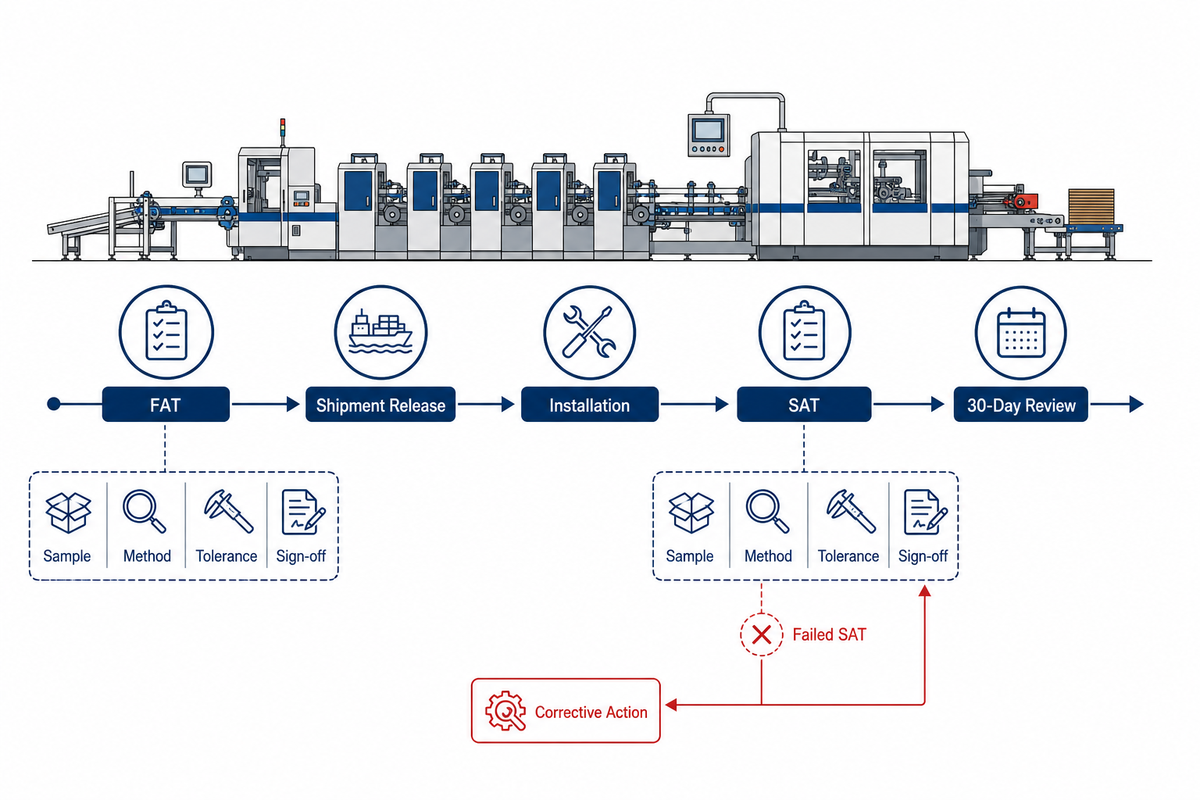
“The machine runs” isn’t an acceptance criterion. Commissioning should move through installation verification, dry cycles, guarded operation, recipe and job loading, material trials, quality checks, sustained production, training proof, and document handover. Keep unresolved items on a signed punch list rather than burying them in chat messages.
IEC 62381:2024 provides a useful structure: factory acceptance, factory integration, site acceptance, and site integration are distinct activities, and the checklist and test plan are project specific. It does not prescribe one universal FFG test. Buyer and supplier must write the relevant evidence into the contract.
Spec-to-Sample Acceptance Ledger
| Ledger field | What to record |
|---|---|
| Job identity | Drawing, blank dimensions, board grade/flute, style, colors, plate, tooling, ink, and adhesive |
| Signed configuration | Installed modules, controls version, options, delivery equipment, and interfaces |
| Conditions | Board condition, temperature/humidity where relevant, line state, and operator |
| Target and method | Stable speed, register, slotting/die-cut, fold, glue, count, waste, sampling method, and instrument |
| Observed result | Measured value, sample count, rejects by reason, stops, restart outcome, and sustained-run duration |
| Disposition | Pass, conditional pass, or fail; corrective owner, due date, retest job, and buyer signatory |
Use at least three representative jobs: the smallest normal blank, the largest normal blank, and the most demanding combination of print, slotting or die-cut, fold, glue, and delivery. Add any job family that creates a real business risk. ASTM’s D5639/D5639M-25 scope page supports the broader principle that corrugated requirements should use test methods recognized by buyer and seller and attributes selected for the intended operation.
Print acceptance also needs a stated aim and measurement method. Where it fits the job and customer requirement, ISO 12647-6:2020 provides process-control information for flexo package printing, including corrugated-board applications. Contracts still need the actual color, register, sampling, substrate, and acceptance values.
After handover, schedule a stabilization review using live production records. Scheduling it at 30 days is a useful project choice, not a universal standard. One transferable lesson from the U.S. Department of Energy’s lifecycle commissioning guidance is that testing, documentation, operator training, and continuing review shouldn’t collapse into one installation-day event.
Engineering note: acceptance evidence needs a signed sample job, stated test condition, measurement method, observed result, defect disposition, and accountable owner. A catalog value without that chain is a screening input, not a passed test.
Acceptance rule
If a result cannot be linked to a signed job, method, condition, sample, and owner, it is a demonstration—not auditable acceptance evidence.
What Training Should Every Shift Receive?
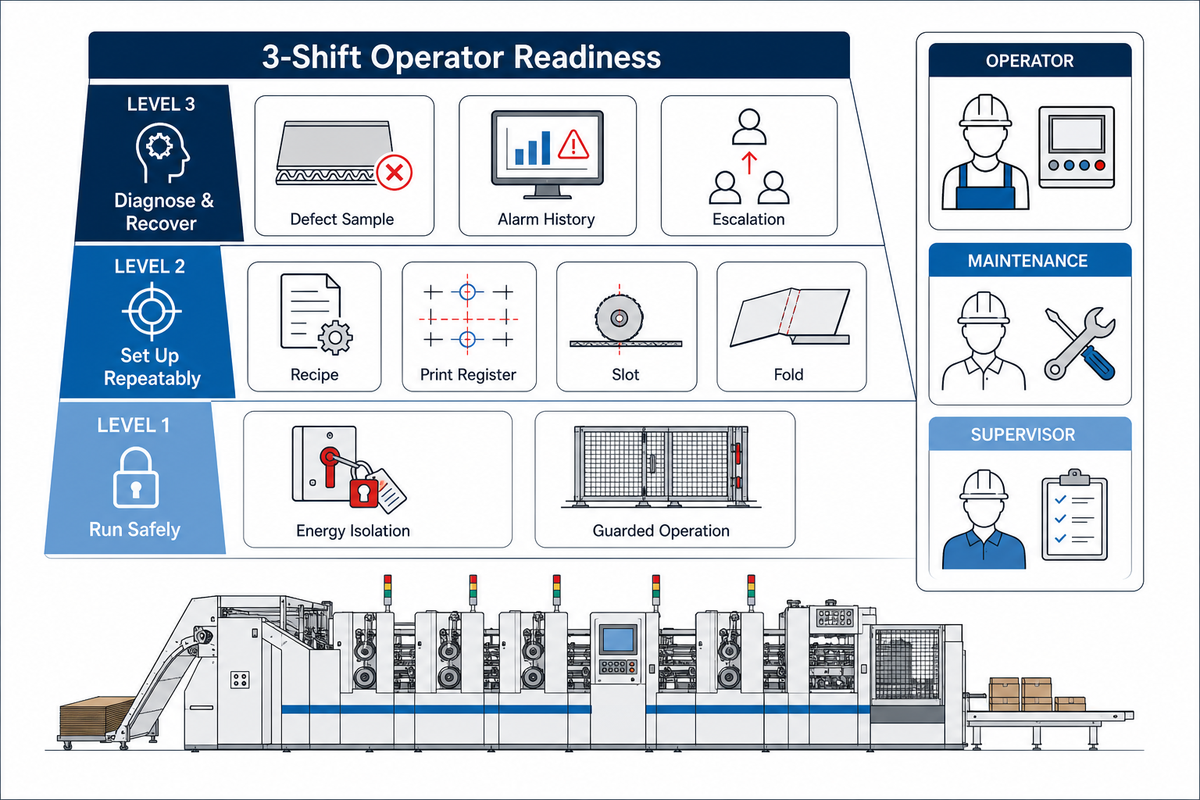
Training completion should mean demonstrated competence, not attendance. Operators need to identify the sections, hazards, normal controls, quality checks, controlled-stop recovery, and escalation boundaries. Quality staff need the sampling and defect rules. Maintenance staff need diagnostic, isolation, and authorized intervention procedures. Supervisors need production, waste, and retraining triggers.
In a 2024 signed article, independent folder-gluer trainer Jeff Wilcox reports that setup wasn’t always repeatable from shift to shift and challenges the idea that automation removes operator skill. That observation is consistent with the buyer’s real risk: even a user-friendly interface can shorten some adjustments, but it can’t guarantee that each crew reads board behavior, adhesive condition, print register, fold accuracy, or a developing mechanical problem in the same way.
3-Shift Operator Readiness Ladder
| Level | Required demonstration | Evidence |
|---|---|---|
| 1. Explain | Trace the process, identify hazards, controls, inspection points, and who may perform each intervention | Teach-back checklist signed by trainer and trainee |
| 2. Run with supervision | Set a known job, verify materials, make approved adjustments, inspect output, and close the job record | Completed recipe and quality sheet with trainer observations |
| 3. Run independently | Change over, prove first-off quality, recover a controlled stop, identify a defect trend, and escalate correctly | Independent run record for each shift and role |
Cenwan publishes a five-day on-site operator-training statement for one related box folding and gluing machine. Treat that as a contract starting point for the applicable model, not proof that every team is competent after five days. Specify trainee count, shifts, language, materials, exercises, trainer availability, and the pass criteria above.
Hazardous-energy training is role specific. 29 CFR 1910.147 distinguishes authorized, affected, and other employees and requires retraining after relevant assignment, machine, process, or procedure changes, or when deficiencies are found. An OSHA accident report involving an FFG describes a hand-crush injury between rollers during setup when the machine hadn’t been de-energized. Each plant’s applicable energy-control program must govern setup, cleaning, unjamming, and maintenance boundaries.
Require
- Role-based training and independent demonstrations
- One verified setup on every working shift
- Documented retraining triggers and escalation limits
- Controlled-stop recovery without bypassing safeguards
Do not accept
- Attendance alone as competence evidence
- One expert operator covering every shift informally
- Production pressure as permission to enter a hazard zone
- A generic manual with no model or software revision
Which Buyer Specifications Must Be Signed?
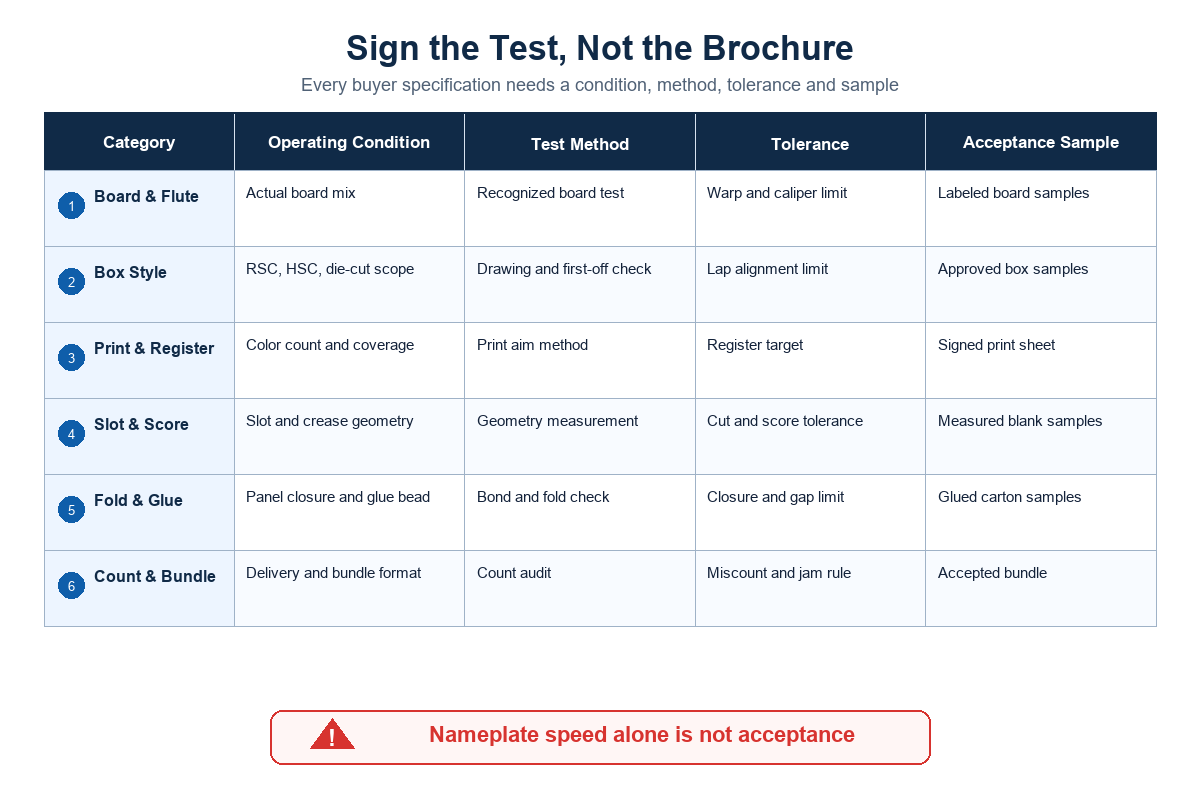
Serious requests for quotation use a controlled dataset, not “send price for a high-speed automatic folder gluer.” Give every supplier the same board and box matrix. Require each response to identify what’s standard, optional, excluded, assumed, or still subject to sample testing. Record the precision required for register, converting geometry, panel alignment, and delivery count.
Cenwan’s public product-family pages illustrate why the configuration must be signed. Across different listed machines, published ranges span roughly 180–400 m/min, 130–1,650 mm working width, 13.5–25.5 kW, and one to three trained operators per shift. Those figures are manufacturer-published context across several models, not one guaranteed envelope. Compare the applicable corrugated folder gluer configurations and obtain a model-specific sheet.
| Model specification category | Fields that belong in the signed schedule |
|---|---|
| Blank and board | Minimum, normal, and maximum dimensions; grade; flute; caliper; coating; warp; recycled content; supplier variation |
| Box family | RSC, HSC, die-cut styles, special folds, adhesive-lap alignment, and monthly order distribution |
| Printing | Color count, coverage, line and solid work, plates, anilox plan, ink system, drying, register, and inspection |
| Converting | Crease, slotting, die cutter, trim, fold geometry, adhesive type including hot-melt where specified, adhesive verification, compression, and delivery |
| Production | Shift pattern, job mix, order changes, target accepted output by sample job, waste categories, and downtime records |
| Controls | Recipes, servo axes, user roles, backups, audit trail, remote access, interfaces, spare licenses, and software support |
| Safety and compliance | Guarding, interlocks, energy isolation, emergency-stop interfaces, declarations, risk documents, and jurisdiction |
| Plant and service | Utilities, footprint, installation, commissioning, training, manuals, drawings, spares, response time, and parts path |
| Acceptance | Factory and site tests, sample jobs, methods, instruments, sustained run, defects, retest, documentation, and sign-off |
Public model ranges are a screening aid, not a merged guarantee
| Public model family | Manufacturer-published context | Buyer verification |
|---|---|---|
| WPA / FFG series | 200–260 m/min; up to 350 sheets/min | Test the signed width, board, print, fold, adhesive, and delivery combination |
| CW-M / CW-G / CW-W family | 180–400 m/min; 130–1,650 mm; 13.5–25.5 kW | Identify the exact model and which published endpoint applies |
| CW-W AC family | 200 m/min; 290–1,650 mm; 22 kW | Confirm board and box scope, utilities, and operator count |
| CW-IL single / dual | 200–240 m/min; 20–22 kW; 6 bar; 14.2–17.5 m line length | Confirm installed modules, interface scope, and actual footprint |
| Dual-channel line | 240 m/min combined; 450–750 mm; 17.5 × 4 × 1.8 m; 20 kW | Verify the channel mix, staffing, delivery, and combined-output test |
Connected-control handover
If the equipment includes remote support, plant-network connectivity, recipe transfer, or software-managed safety functions, add a connected-control schedule. IEC 62443-2-1:2024 specifies security-program requirements for owners and operators of industrial automation and control systems. Procurement should therefore define named accounts, role permissions, remote-access approval, log retention, backup and restore proof, update ownership, incident contacts, and what happens when supplier support ends.
For equipment placed in the European Union, the applicable conformity work must also consider the actual legal scope. Regulation (EU) 2023/1230 addresses corruption of safety-critical control software or data and foreseeable malicious attempts affecting safety. This is jurisdiction-specific; it isn’t a claim that every FFG worldwide follows the same legal pathway.
Why Nameplate Speed Is Not Saleable Output
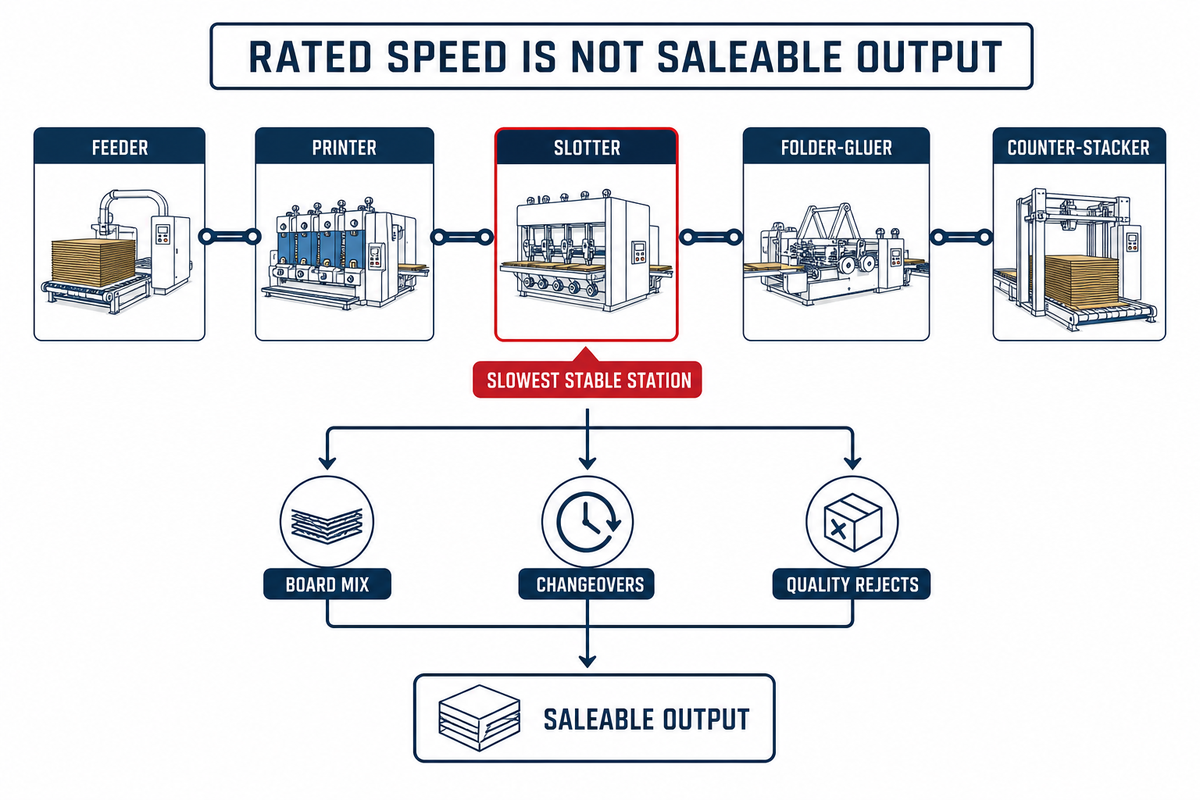
Nameplate production speed describes a machine capability under stated or unstated conditions. Saleable output is what the plant accepts after setup, stops, order changes, material variation, inspection, waste, and downstream handling. Productivity should therefore be measured as accepted boxes by job and shift. Higher feeder speed can’t compensate for ink that hasn’t set, unstable registration, a die-cut load, poor panel closure alignment, inconsistent adhesive, or a bundler that can’t clear the delivery.
Hidden Bottleneck Chain: Print → Slotting → Panel closure → Adhesive → Bundle
| Link | Decision-bearing evidence | Typical loss to classify |
|---|---|---|
| Feed/print | Blank stability, feed register, ink transfer, drying, print register, inspection result | Misfeed, skew, print defect, stop for ink or plate work |
| Slotting/die-cut | Geometry, crease, slotting alignment, cut quality, trim removal, tooling load | Crush, tear, blocked trim, tooling change, speed reduction |
| Panel closure/adhesive | Panel alignment, belt and rail alignment, adhesive presence, bond, compression time | Fish-tailing, gap variation, adhesive miss, squeeze-out, open joint |
| Delivery | Count accuracy, stack condition, bundle transfer, downstream accumulation | Jam, poor stack, count correction, conveyor or bundler stop |
Calculate accepted boxes by job and by shift from observed records rather than applying an invented efficiency percentage. Separate planned changeover, material wait, quality hold, mechanical stop, electrical stop, cleaning, and downstream blockage. This exposes whether the next investment should be another high-speed section, better job preparation, a different delivery system, or more consistent training.
An FTA purchasing article on five considerations for a folder-gluer purchase makes the same practical point: product mix and existing constraints can undermine an investment, while a correctly matched line can replace several older assets in a specific plant context. For integrated flow, review how the FFG will connect to an automatic packaging line instead of sizing it in isolation.
How Do Board, Box, Print, and Adhesive Requirements Change the Configuration?
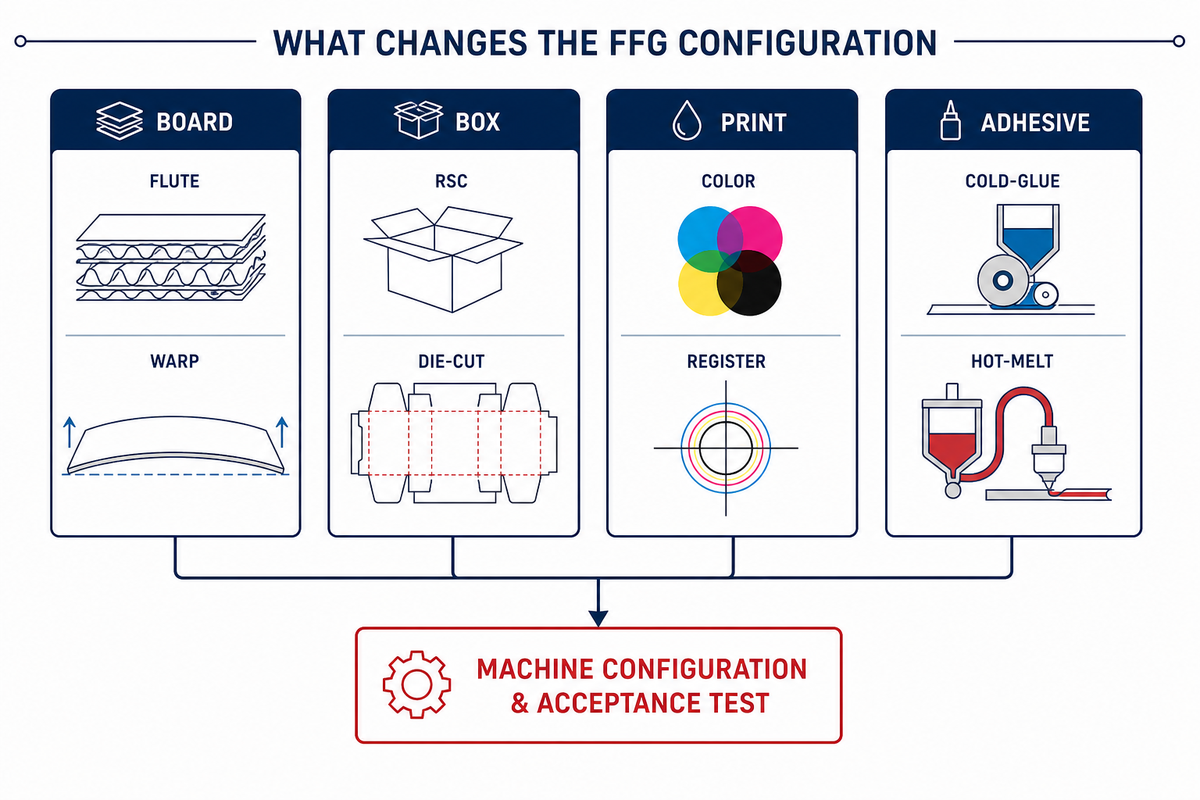
Two plants asking for the same working width may need different machines. Board stiffness and warp affect feeding. Flute and caliper affect creasing, folding, and crush risk. Heavy print coverage changes ink transfer and drying. Die-cut work adds tooling and trim demands. Box geometry changes rail, belt, adhesive-lap, compression, and delivery behavior.
Build a sample-job matrix that contains business volume and technical difficulty. A practical set includes the smallest and largest normal blanks, the widest and narrowest adhesive lap, light and heavy print coverage, the most demanding register, the most difficult slotting or die-cut geometry, a warped or coated board within the plant’s allowed range, and a high-volume repeat job.
Don’t let one easy demonstration carton stand in for this matrix. Mark which jobs require optional sections, special tooling, different adhesive, lower stable speed, or a separate offline process. If the factory can’t test the buyer’s exact board or consumables, agree on the substitute and repeat the risk-bearing test at the site.
For a different product family such as stereo cartons, compare the workflow with the stereo box folder gluer guide. For a high-speed straight-line application, use the folder gluer throughput estimator only as a planning aid; the signed sample-run ledger remains the acceptance evidence.
New vs Used Flexo Folder Gluer: What Evidence Changes?
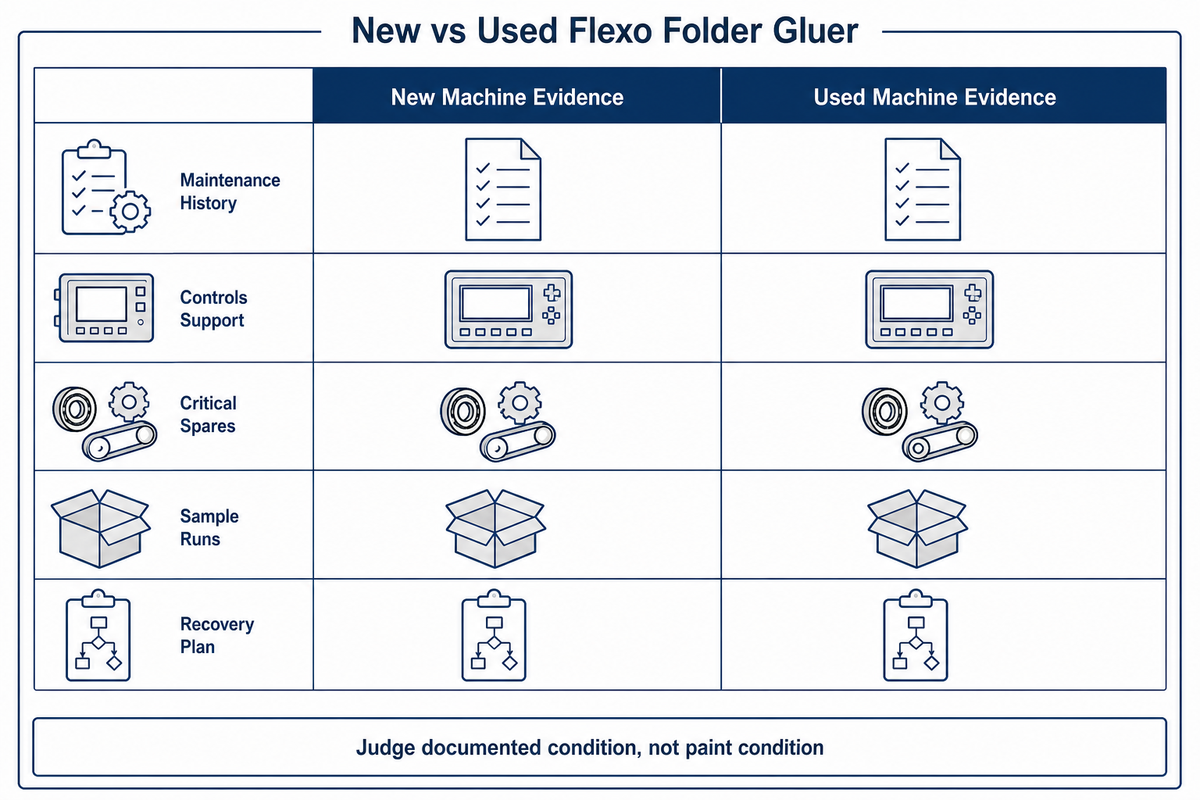
Used flexo folder gluers can be commercially sensible, but price and catalog identity are weak evidence. Confirm the installed configuration by serial numbers, plates, controls, software, modules, and options. Ask for production history where available, maintenance and retrofit records, safety-circuit status, electrical drawings, manuals, passwords and backups that can legally be transferred, and a supported spare-parts path.
| Evidence | New machine | Used machine |
|---|---|---|
| Identity | Purchase configuration and current bill of materials | As-found configuration, serial/year, retrofit and removed-option history |
| Condition | Factory inspection and baseline measurements | Anilox/print, bearings, gears, rollers, belts, rails, die-cut, adhesive, guards, and wiring |
| Controls | Supported hardware/software, licenses, accounts, backup and restore test | Obsolescence, transferable licenses, source/backups, passwords, remote-support viability |
| Acceptance | Factory and site tests against purchase specification | As-found inspection plus witnessed sample runs, relocation effects, and post-install retest |
For either choice, require the same representative sample jobs and measurable acceptance fields. Used lines need more condition and controls evidence; new lines need stronger proof that the promised configuration exists and performs. Ask how folder gluer parts and service support will work after warranty and after current control components reach end of support.
What Should Go in the RFQ and Acceptance Contract?
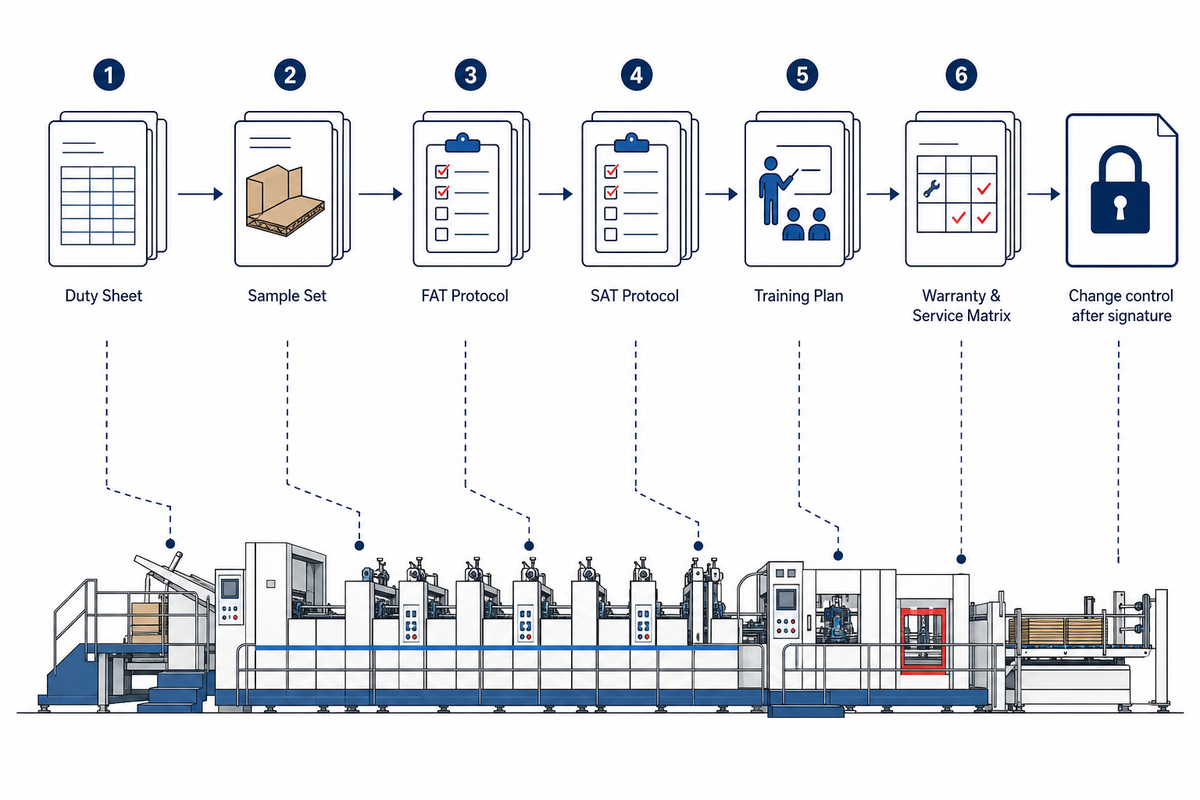
Final request-for-quotation documents should make supplier responses comparable and make acceptance enforceable. Attach the product matrix, readiness baseline, sample jobs, training ladder, controls schedule, spares list, service obligations, and factory/site test plan. Name the person authorized to sign each result.
Spec-to-Sample RFQ Pack
- Signed blank, board, box-style, print, slotting/die-cut, panel closure, adhesive, and delivery matrix
- Model, modules, controls, options, utilities, footprint, interfaces, and exclusions
- Representative jobs with materials, targets, methods, samples, sustained-run period, and reject rules
- Factory acceptance, factory integration, site acceptance, and site integration scope where applicable
- Role-based training by shift, teach-back, independent runs, retraining triggers, and language support
- Manuals, electrical/pneumatic drawings, software and recipe backups, licenses, account transfer, and revision list
- Recommended commissioning spares, two-year operating spares, consumables, lead times, and obsolescence notice
- Warranty start point, service response, remote-access rules, escalation contacts, and open-item retest process
Ask suppliers to price the base machine, options, tooling, freight, unloading, installation, commissioning, training, spares, travel, and service separately. Don’t compare headline machine prices when one quotation excludes the modules and evidence needed to run the buyer’s jobs.
When the dataset is ready, send the sample-job specification with drawings and production mix. A supplier can then propose a configuration and identify what must be validated rather than guessing from a generic product name.
Frequently Asked Questions
What does a flexo folder gluer do?
A flexo folder gluer feeds corrugated sheets, prints them with flexo units, then slots or die-cuts, folds, applies adhesive, and delivers counted or bundled boxes in one inline process. Configuration changes the number of colors, die-cut scope, controls, inspection, and delivery sections.
Buyers should also confirm the board grades, smallest and largest normal blanks, box styles, adhesive-lap alignment, tooling, plate and ink system, recipe controls, and downstream handling. A useful acceptance run follows a signed sample from feeder to bundle and records every quality result, stop, reject reason, and owner instead of judging the machine from one easy demonstration carton.
What is a folder gluer operator?
A folder gluer operator prepares jobs, verifies materials and recipes, sets approved positions, checks print, slotting, panel closure, and adhesive quality, responds to controlled stops, records defects, and escalates maintenance or safety issues. Competence should be proved by an independent setup and sample run, with hazardous-energy responsibilities aligned to OSHA 29 CFR 1910.147 where U.S. rules apply. The role isn’t maintenance authorization: task boundaries, lockout permissions, quality release authority, and escalation routes should be written and trained.
How much does a flexo folder gluer machine cost?
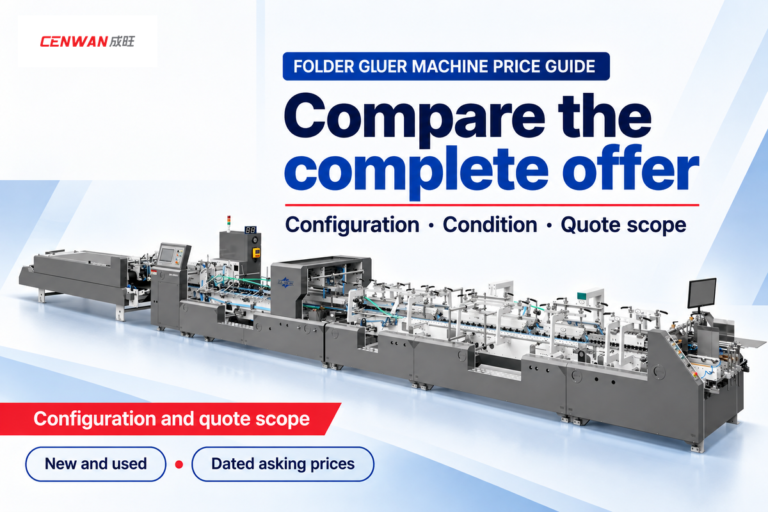
There’s no responsible universal price. Width, color count, printing and die-cutting sections, automation, delivery equipment, controls, freight, installation, training, spares, and acceptance scope all change the quotation. Compare suppliers with one common configuration and sample-job pack, and ask each bidder to price options and exclusions separately.
How long should operator training take?
Duration should follow machine scope, shift count, language, and operator baseline. A published number of days is only a starting point. Completion should require each role and shift to prove setup, quality checks, controlled recovery, safe escalation, and documentation on agreed jobs.
What should be tested before final acceptance?
Test representative jobs, not only an easy blank. Record board and environmental conditions, configuration, setup, stable speed, print and register, slotting or die-cut result, panel closure accuracy, adhesive bond, delivery/counting, defects, safety checks, controlled stops, and the sustained-run period defined in the contract.
References & Sources
- TAPPI, Box Plant Basics: Flexo Folder Gluers
- Flexo Technical Association, Five Components to Consider in a Folder-Gluer Purchase
- ASTM D5639/D5639M-25 scope page
- IEC 62381:2024 scope page
- ISO 12647-6:2020 scope page
- OSHA 29 CFR 1910.147, Control of Hazardous Energy
- OSHA 29 CFR 1910.95, Occupational Noise Exposure
- IEC 62443-2-1:2024 scope page
- Regulation (EU) 2023/1230
- U.S. Department of Energy, Commissioning for Federal Buildings
Manufacturer Background
Cenwan Machine is a Wenzhou, China-based manufacturer of folder gluer machines, corrugated box gluing equipment, and integrated packaging lines. For more than 10 years, we have supported carton and corrugated packaging manufacturers in 40+ countries with equipment selection, custom configuration, installation support, spare parts, and after-sales service.
Our blog content is written to help packaging buyers, plant managers, and procurement teams understand folder gluer technology, box style compatibility, production capacity, ROI, maintenance, and supplier selection before requesting a quote.
- 10+ years of folder gluer engineering experience
- Factory base in Ruian, Wenzhou, Zhejiang, China
- Folder gluer machines, corrugated folder gluers, and automatic packaging lines
- CE / ISO 9001 manufacturing and quality references
- Remote diagnostics, spare parts support, and 24/7 technical response
- Equipment and service experience across 40+ countries
Brand
Cenwan Machine
Company
Zhejiang Chengwang Intelligent Packaging Equipment
Business Type
B2B Machinery Manufacturer
Factory Base
Ruian, Wenzhou, Zhejiang, China
Email
sales2@cenwanmachine.com
Phone / WhatsApp
+86 139 0664 6788