Get in touch with Cenwan Machine Company


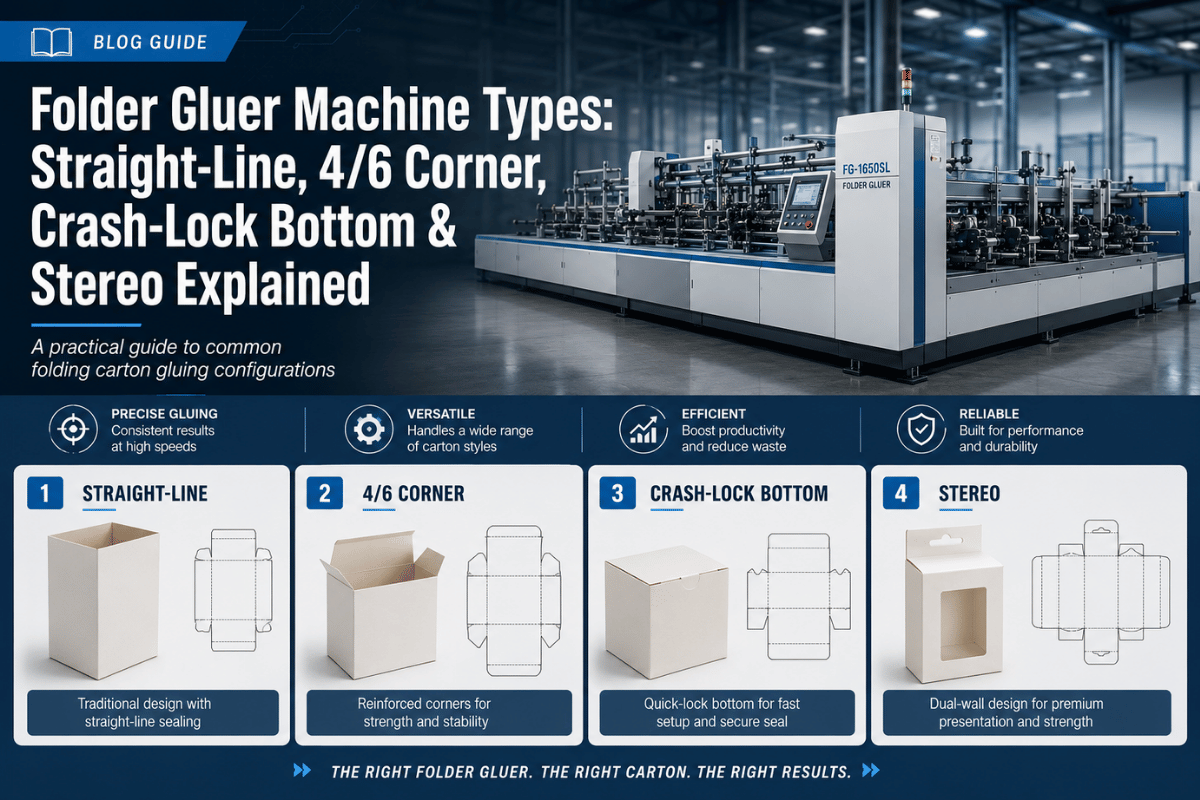
The four main folder gluer machine typesstraight-line, 4/6-corner, crash-lock bottom, and stereo (specialty) — aren’t interchangeable. Each one folds and glues a different family of box styles, runs at a different speed, and carries a different price tag. Pick the wrong configuration and you either overpay for capability you never use, or buy a machine that can’t run the carton your customer ordered. This guide breaks down every type, the box styles each one produce, and how to match a machine to your actual work.
Quick Specs: Folder Gluer Machines at a Glance
| What it does | Folds and glues flat, die-cut carton blanks into finished boxes |
| Input / Output | Printed, die-cut & creased blank → folded, glued, flat-packed carton |
| Main types | Straight-line · 4/6-corner · Crash-lock bottom · Stereo / specialty |
| Typical speed | Simple cartons up to ~250–300 m/min; corrugated lines ~150–200 m/min |
| Substrates | Folding carton (paperboard), corrugated board, micro-flute |
| Gluing | Cold glue (PVA) or hot-melt (EVA); some lines run both |
| Operators | Usually one per machine; ~2 hours to set up a new job |
What Is a Folder Gluer Machine?
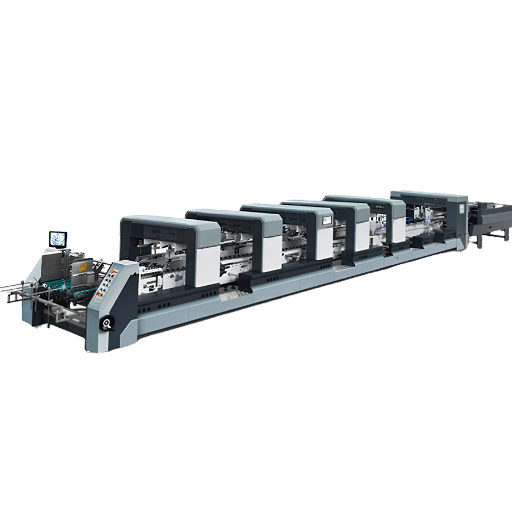
At its core, a folder gluer machine takes a stream of flat, die-cut box blanks and turns each one into a finished carton by folding the panels and applying adhesive. It’s the last station on a packaging line, after printing and die-cutting, and it replaces the slow, inconsistent manual gluing process once done by hand. That single job, repeated thousands of times an hour, is why a folder gluer exists.
Here’s why the type matters. This machine doesn’t “make boxes” in the abstract; it makes a specific set of box styles determined by how its folding and gluing sections are arranged. Simple machines can only fold along one straight seam. More capable folder gluer machines add corner-gluing and pre-folding sections so it can build trays, locking bottoms, and multi-panel cartons. So the question is never “which brand is best” — it’s “which configuration matches the boxes I sell.”
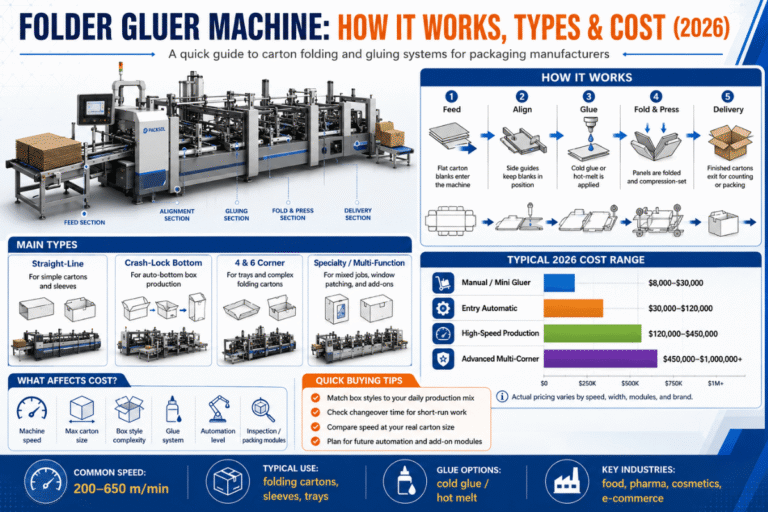
Mechanically, every folder gluer move a blank through five sections in sequence:
- Feedingthe feeder pull die-cut, creased blanks one at a time into the machine.
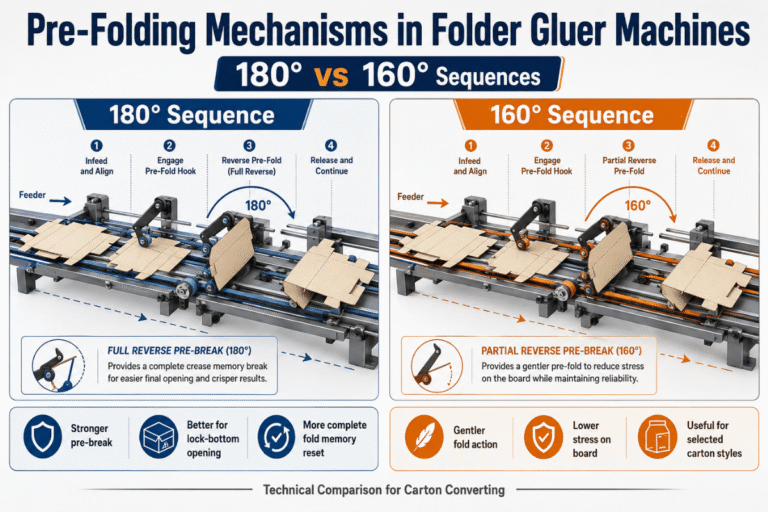
- Pre-foldingflaps are broken along their creases (180°) so they fold cleanly later.
- Foldinghooks and guides fold the panels into the final box shape.
- Transferboxes are carried forward, and any mis-folded blanks are ejected.
- Deliverythe compression section presses the glued seam so the adhesive hold.
💡 Key takeaway
Every folder gluer runs the same five-section flow. The “type” simply describes which folding-gluing sections are fitted — and therefore which box styles the machine can build.
The 4 Main Folder Gluer Machine Types at a Glance
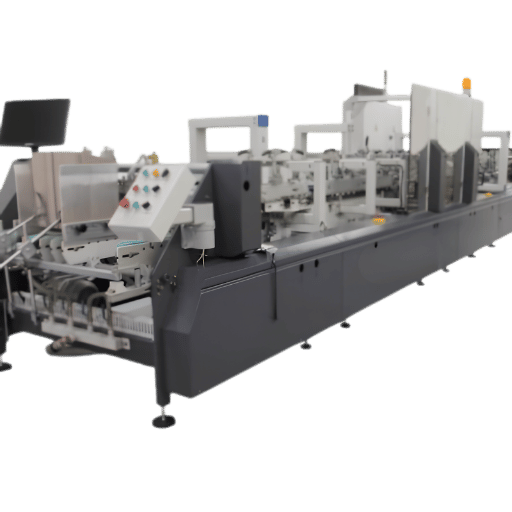
Before the deep dives, here’s the one table most buyers actually need. It maps each of the four folder gluer machine types to the box styles it produces, a typical speed band, and the kind of operation it suits. Pick the box style first; the machine type picks itself.
| Type | Box styles it makes | Typical speed | Best for |
|---|---|---|---|
| Straight-line | RSC cartons, simple tuck boxes, sleeves, envelopes (single straight seam) | Up to ~250–300 m/min | High-volume, simple cartons |
| 4/6-corner | Trays, display boxes, four- and six-corner cartons (glue at multiple corners) | ~120–200 m/min | Retail, food, cosmetics trays |
| Crash-lock bottom | Auto-bottom mailers / shippers that snap square (FEFCO 0215-type) | ~100–180 m/min | E-commerce, ship-flat boxes |
| Stereo / specialty | Mixed and complex styles in one machine (straight-line + corner + lock-bottom) | Varies by job | Converters with diverse, short runs |
Speed bands are typical ranges compiled across industry machine specifications; actual output depends on board grade, box size, and glue system. Speed always drops as box complexity rises.
Straight-Line Folder Gluers
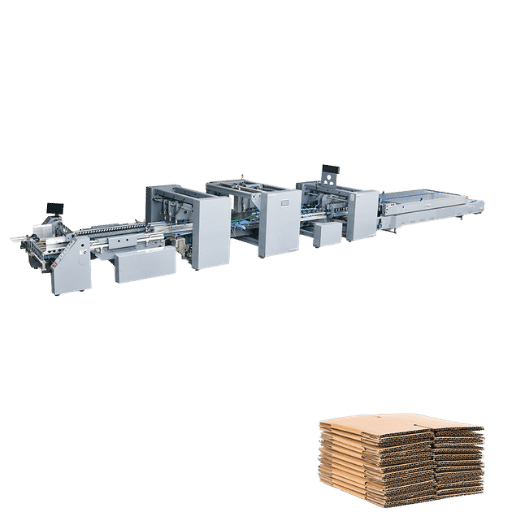
Straight-line folder gluers are the simplest configuration: the blank folds along a single straight seam, glue is applied to one joint, and the box is compressed and ejected. Because there’s only one fold to control, this is the fastest type, high-speed models run simple cartons at up to roughly 250–300 m/min. It’s also the lowest cost per box.
Why does simplicity translate into speed? With a single glue line and no corner sections, there are fewer variables to keep in register, so the machine can run faster without folds drifting out of alignment. That means a straight-line machine is the throughput champion for standard work, regular slotted containers (the FEFCO 0201 code), plain tuck cartons, sleeves, and envelopes. If most of your orders are simple rectangular boxes, this is usually the right starting point.
⚠️ Common misconception
“Straight-line” gets dismissed as entry-level. It is not. For plain cartons it out-runs every other type — the limitation is range, not quality. The moment a job needs a locking bottom or a tray corner, though, a straight-line machine simply cannot fold it.
When a straight-line machine reach the edge of its range, the next step is a configuration that adds corner gluing. See our straight-line folder gluer page for box-size and speed details.
4-Corner and 6-Corner Folder Gluers
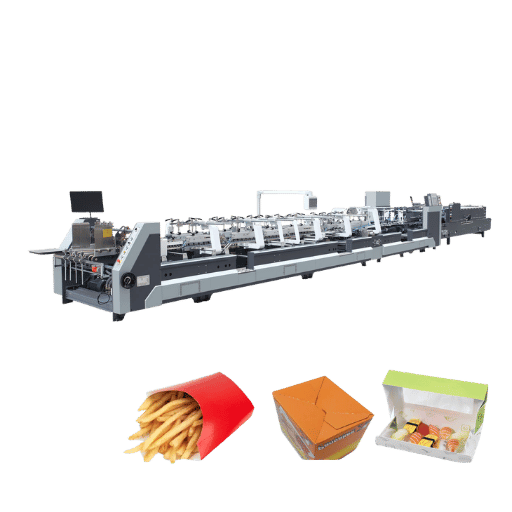
Four- and six-corner folder gluers handle cartons that are glued at multiple corners rather than along one seam, the trays, display boxes, and reinforced cartons common in food, cosmetics, and retail. A 4-corner box has glue tabs at four corners; a 6-corner adds two more for extra rigidity and a deeper wall. To build them, the machine carries extra pre-folding and corner-gluing sections that a straight-line machine doesn’t have.
Here’s the engineering reason it costs more and runs slower: each corner must receive glue and fold square at exactly the right instant while the blank is moving. More glue points mean more things to keep in register, so a 4/6-corner machine usually runs around 120–200 m/min, fast, but below straight-line speed. Buyers get a stronger, better-looking box that stands up on a shelf.
📐 Engineering Note
Corner-gluer accuracy lives or dies on the side-guide and glue-timing settings. A glue line that starts a few millimetres early contaminates the visible panel; one that ends late strings adhesive into the transfer section and jams the stack. For 4/6-corner work, verify glue-wheel timing against the corner crease on the first blanks of every run before committing the order.
A converter running cosmetics trays put it simply: a six-corner display box that arrives slightly skewed gets rejected at the brand’s incoming inspection, so the few extra seconds of setup on a 4-corner and 6-corner folder gluer pays back in avoided returns.
Crash-Lock Bottom (Auto-Bottom) Folder Gluers
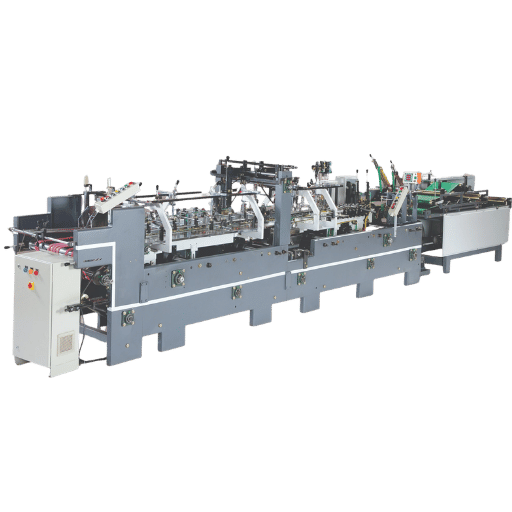
Crash-lock bottom folder gluers make boxes with a self-locking base, the kind that ship flat and snaps into a square, ready-to-fill carton when you push the sides together. No tape, no manual bottom assembly. In the FEFCO system this maps to 0215-style lock-bottom cartons, and it has become the default for e-commerce and fast-pack lines where assembly speed at the far end matter as much as production speed.
Most of the trick is in the pre-folding. The machine pre-breaks and glues the interlocking bottom flaps so they collapse flat for shipping yet spring square under hand pressure. Get the pre-fold wrong and the bottom either won’t pop open or won’t lock, which is why crash-lock machines carry the same corner-folding sections as a 4/6-corner type, plus tuned lock-bottom tooling. Skip that and the box fail at the customer’s packing bench, not on your floor.
Picture a small e-commerce brand that switched from taped RSCs to crash-lock mailers. Their pack-out crew stopped taping bottoms by hand, and line throughput at the fulfilment table climbed because each box went from flat to filled in one motion. That carton cost a little more per unit; the labour saved on every order more than covered it. That trade, slightly higher box cost for far faster assembly, is the whole reason the auto-bottom exists. Details on box sizes and board grades are on our crash-lock bottom folder gluer page.
Stereo and Specialty Folder Gluers
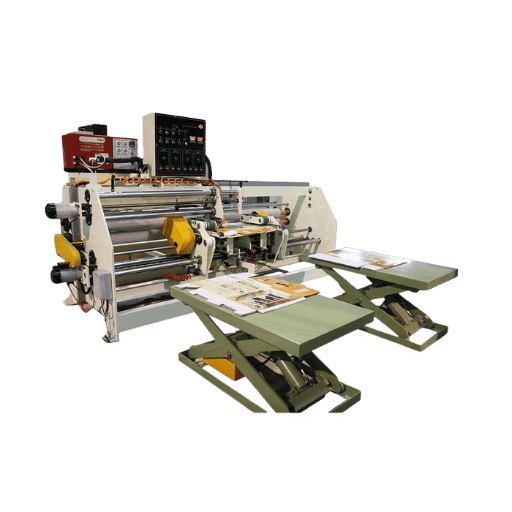
“Stereo folder gluer” is a term you’ll see often from Asian machine builders, and it confuses a lot of Western buyers, so here’s the plain translation. A stereo folder gluer is a multi-function machine that combines straight-line, 4/6-corner, and crash-lock sections in one frame, so a single machine can switch between simple cartons, trays, and lock-bottom boxes. In North American and European catalogues the same machine is usually called a “multi-purpose” or “specialty” folder gluer. Same capability, different name.
Why would you buy one? Because a converter that run many different box styles in short batches can’t justify a separate machine for each. A stereo machine trades a little top-end speed for breadth: it folds the widest range of styles, including irregular and complex cartons, on one line. The cost is higher than any single-purpose type, and the setup is more involved, but for a job shop juggling RSCs on Monday, cosmetic trays on Tuesday, and crash-lock mailers on Wednesday, one versatile line beat three idle specialists.
“The number that decides a stereo purchase is not top speed, it is changeover time. A shop running ten box styles a week loses more hours to setup than to slow running, so one-click adjustment that drops a changeover from forty minutes to a few matters more than another fifty metres per minute.”
If your mix is genuinely diverse, look at the stereo box folder gluer range; if you run mostly one style at high volume, a dedicated type will out-run it every time.
Glue Systems: Cold Glue, Hot-Melt, and RF
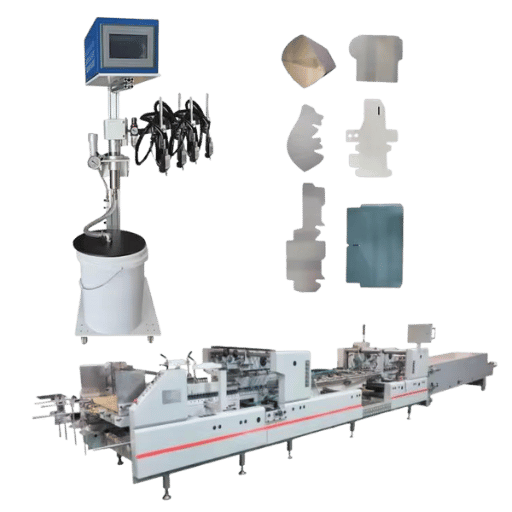
The folder gluer type decides the folds; the glue system decides whether the seam actually hold. Choosing the adhesive is mostly a substrate decision, and getting it wrong is one of the most common, and most avoidable, setup failures on a line.
| Glue type | Best for | Set speed | Watch out for |
|---|---|---|---|
| Cold glue (PVA) | Uncoated paperboard & corrugated; flat, clean finish | Slower — needs compression time | Will not grip coated / laminated stock |
| Hot-melt (EVA) | Coated, UV-varnished, laminated stock; high speed | Fast — bonds in a second or two | Higher temp; needs clean nozzles |
| RF / specialty | Niche dielectric and laminate applications | Varies | Specialised, less common on cartons |
The rule of thumb: if the surface to be glued is plain paper or board, cold glue gives a flat, economical bond. The moment the joint lands on a coated, varnished, or laminated panel, common on premium retail cartons, cold glue beads up and the box pops open. That’s where hot-melt earns its keep, gripping slick surfaces fast enough to keep a high-speed folder gluer running. Field experience is blunt here: most “the glue failed” complaints are really “the wrong glue for that surface.”
Automatic vs Semi-Automatic and Inline Flexo Folder Gluers
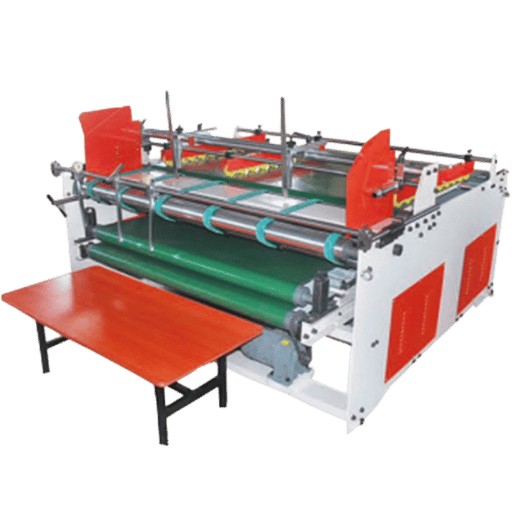
Cutting across all four types is a second decision: how automated should the machine be? Semi-automatic folder gluers suit low volumes, large or odd-shaped boxes, and shops where an operator can manage feeding by hand. An automatic folder gluer adds powered carriers, job-memory recall, and faster changeover, worth it when you run high volumes or many repeat jobs.
What is the standard speed of a high-speed inline folder gluer?
For folding-carton work, high-speed automatic machines commonly run simple cartons up to roughly 250–300 m/min, with the fastest straight-line models quoted even higher. For corrugated, an inline flexo folder gluer (FFG) — which prints, slots, die-cuts, folds, and glues corrugated board in one continuous pass, typically runs around 150–200 m/min because the heavier board and combined operations cap the rate. Real output is always lower than the headline number once you factor in box size, board grade, and setup, so treat quoted top speeds as a ceiling, not an average.
✔ Automatic advantages
- Stored job recall cuts setup waste on repeat runs
- Faster, more accurate changeovers between styles
- One operator can hold higher, steadier output
- Less reliance on scarce, highly skilled setters
⚠ Automatic limitations
- Higher purchase price and maintenance demand
- Overkill for low volumes or one-off jobs
- More electronics to service and keep calibrated
- Operators still need training on the control system
If most of your work is corrugated shippers, the integration question often points toward a corrugated box gluing machine built around board handling rather than a paperboard-first design.
How to Choose the Right Folder Gluer Type
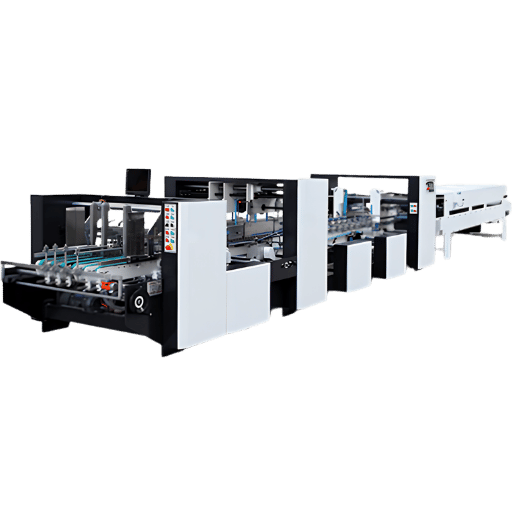
Choosing the right folder gluer comes down to three questions, answered in order: what box styles do you run, what substrate, and at what volume? Get those straight and the type follows.
How do I choose the right folder gluer machine?
Start with the box, not the brochure. List the styles you actually sell today and expect to sell in two years, then match them to the table below. One veteran point worth heeding: machines built for corrugated C-flute won’t efficiently run thin folding cartons, and vice versa, the substrate narrows your shortlist before speed or price ever enters the conversation.
| If your work is mostly… | Substrate | Choose | Because |
|---|---|---|---|
| Plain rectangular cartons, high volume | Paperboard | Straight-line | Fastest, lowest cost per box |
| Trays, display & reinforced boxes | Paperboard | 4/6-corner | Builds multi-corner shelf-ready cartons |
| Ship-flat e-commerce mailers | Board / micro-flute | Crash-lock bottom | Auto-bottom speeds far-end assembly |
| Many styles, short runs | Mixed | Stereo / specialty | One line covers the whole mix |
| Corrugated shippers, high volume | Corrugated | Inline flexo (FFG) | Print-to-glue in one continuous pass |
Then layer in budget. Industry pricing has long run from around US$200,000 for a small, simple machine to well over US$1,000,000 for a large, complex line, with one widely cited buyer’s guide putting the range at roughly US$150,000 to US$1,000,000+ in Canadian-dollar terms. (Figures compiled from industry buyer’s guides published 2019 and updated 2025; they may not reflect current quotes, request a current price for your spec.) The number track automation level and box complexity more than brand. Finally, weigh the operator question: skilled setters are getting harder to hire, so machines with stored-job recall and one-click changeover quietly de-risk your staffing.
Industry Outlook: What’s Changing in 2026

Demand for folded-and-glued cartons is growing, not shrinking. Folding carton packaging is projected to rise from about USD 220.9 billion in 2026 to roughly USD 290.9 billion by 2031, a compound growth rate near 6%. Two forces are driving it, and both shape which folder gluer type to buy next.
First, sustainability is pushing brands from plastic to paper. Corrugated and carton board are now among the most recycled materials in the waste stream, the U.S. EPA puts the recycling rate for old corrugated boxes at 96.5 percentand that recyclability is part of why paper-based packaging keeps taking share. More carton demand means more pressure on fold-and-glue capacity.
Second, e-commerce keeps fragmenting runs. Brands want more box styles in smaller batches, which rewards machines that change over fast rather than ones that only run fast, a shift that puts production efficiency ahead of raw top speed. Expect continued investment in one-click setup, stored-job automation, and inline glue and registration checks that catch a bad box before it reaches the stack. If you’re specifying a line for 2026, weight changeover time and automation at least as heavily as top speed, that’s where the labour and waste savings now live.
Folder Gluer Machine Types by Box Style
Start with the carton structure, then compare working width and automation. This prevents a high-speed specification from hiding a box-style mismatch.
| Machine type | Primary box styles | Best-fit buying signal |
|---|---|---|
| Straight-line | Side-seam folding cartons and simple sleeves. | High repeat volume with limited folding complexity. |
| Crash-lock bottom | Auto-bottom cartons that erect quickly at packing. | Bottom-hook range and accurate glue timing. |
| 4/6-corner | Trays, food packs and multipoint-glued specialty cartons. | Multiple timed glue points and corner devices. |
| Stereo/specialty | Rigid or complex premium cartons with special forming requirements. | Sample validation and application-specific tooling. |
If the plant runs several structures, calculate the share of each style and the changeovers per shift before choosing a universal or dedicated line.
Frequently Asked Questions
Q: What box styles can a folder gluer machine produce?
View Answer
It depends on the type. Straight-line machines make RSCs, tuck boxes, and sleeves; corner machines add trays and display boxes; crash-lock machines add auto-bottom mailers; stereo machines cover most styles on one line.
Q: What’s the difference between top-feeding and bottom-feeding folder gluers?
View Answer
These terms describe how blanks are pulled from the feeder stack. Bottom-feeders draw the lowest blank, letting operators top up the stack without stopping the run — handy for long jobs. Top-feeders take from the top and can suit certain warped or specialty stocks. For most carton work the feed type matters less than the folding sections fitted downstream.
Q: How does an inline folder gluer integrate with other carton machines?
View Answer
On a corrugated line, an inline flexo folder gluer combines printing, slotting, die-cutting, folding, and gluing into one continuous pass, then feeds a counter-ejector and bundler. On a folding-carton line, it sits after the printer and die-cutter and ahead of the packing equipment, so blanks flow straight from die-cut to flat-packed boxes. Integration is mostly about matching speeds: a folder gluer running faster than the packer downstream just builds a pile, which is why converters add a stacker or counter-ejector to buffer the flow between stations.
Q: What industries use folder gluer machines?
View Answer
Almost any sector that ships product in printed cartons: food and beverage, pharmaceuticals, cosmetics, electronics, e-commerce, express logistics, and general retail. Pharma and cosmetics lean on corner precision; e-commerce drives crash-lock volume.
Q: Is a folder gluer machine suitable for beginners?
View Answer
Yes, especially semi-automatic and automatic models with stored-job recall, which lower the skill barrier for setup. A new operator can usually run repeat jobs after basic training, though complex 4/6-corner and lock-bottom setups still reward experience. One operator per machine is the norm, with roughly two hours to dial in a new job.
Q: Can one folder gluer handle both corrugated and folding carton?
View Answer
Some machines run both on a limited basis, but not efficiently. Substrate is the real divide: the feed, fold, and compression sections are tuned to one board thickness, so a machine built for corrugated C-flute struggles with thin 12-point folding cartons, and a paperboard-first machine cannot handle heavy board well. Stretching one line across both ends usually means slower speeds and more rejects on whichever job it was not built for. If you genuinely run both at volume, plan for a specialty machine or separate lines.
Not sure which folder gluer type fits your boxes?
Send Cenwan Machine your carton style, substrate, and run-rate target. Our engineers respond within one business day with a configuration and a quote.
About This Guide
Cenwan Machine builds straight-line, corner, crash-lock, and stereo folder gluers, plus integrated packaging machinery lines for partners in more than 40 countries. The speed bands and cost ranges here are compiled from published industry specifications and buyer’s guides rather than a single catalogue; where the data is dated or varies by machine, we say so. Our aim is to help you match a folder gluer type to your real box mix, even if the right answer is a configuration we don’t sell.
References & Sources
- Containers and Packaging: Product-Specific DataU.S. Environmental Protection Agency
- FEFCO Code (International Fibreboard Case Code)European Federation of Corrugated Board Manufacturers
- Folding CartonWikipedia
- Corrugated FiberboardWikipedia
- FlexographyWikipedia
- Folding Carton Packaging Market Size & Growth TrendsGlobal Market Insights