Get in touch with Cenwan Machine Company


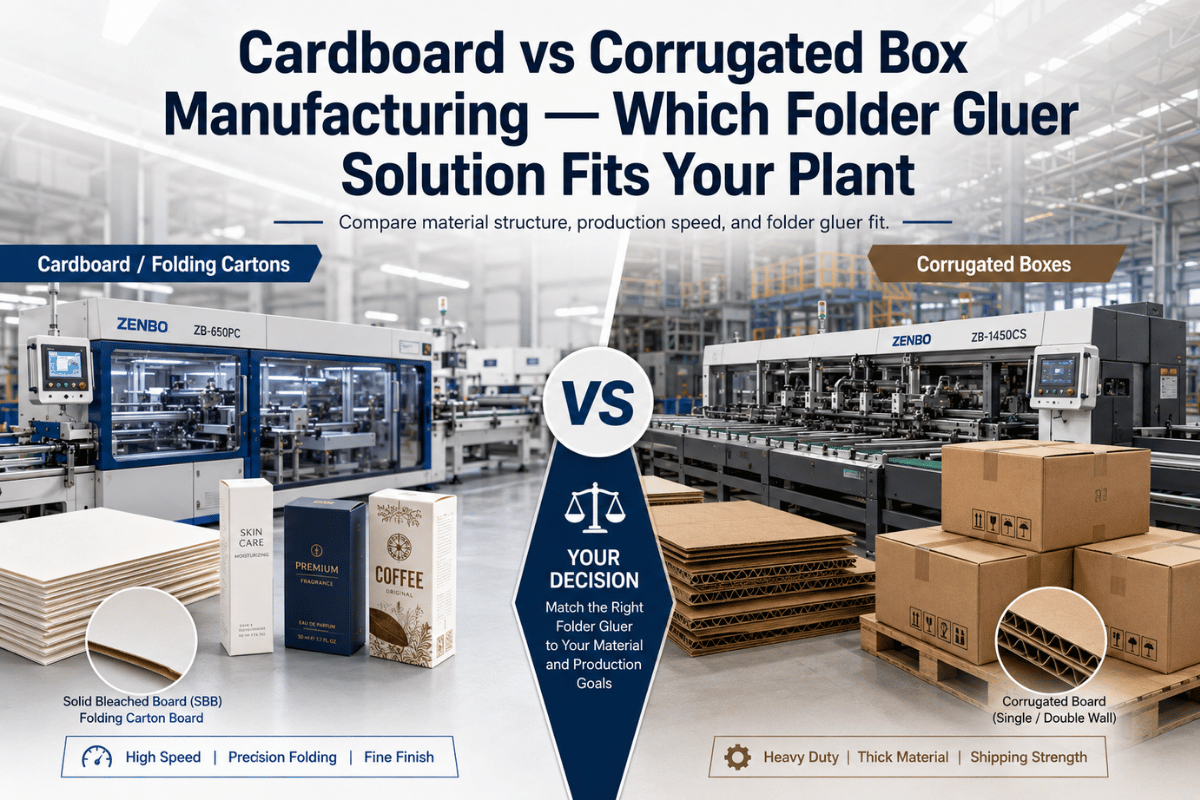
Cardboard vs. corrugated is arguably one of the most incorrectly-used comparisons in packaging, and it costs the production floor. People throw the two terms around interchangeably, but cardboard and corrugated aren’t the same. They aren’t manufactured the same way and, most guides forget this, they usually require a different folder gluer. Understanding the differences matters on the floor, because the difference between corrugated and cardboard, and the difference between cardboard cartons and heavier shippers, decides which machine runs the job. This article details these materials, explains their production and aligns those material decisions to the right machinery.
Cardboard vs Corrugated at a Glance
| Structure | Cardboard: one solid layer of thick paperboard. Corrugated: a fluted medium sandwiched between two liners (3+ layers). |
| Typical caliper | Paperboard ~0.3–0.8 mm (0.012–0.030″); single-wall corrugated ~3–5 mm depending on flute. |
| Strength basis | Cardboard: flat rigidity for display. Corrugated: stacking and crush strength (e.g., 32 ECT single-wall). |
| Best use | Cardboard: cereal boxes, cosmetic cartons, inserts. Corrugated: shipping boxes, e-commerce, heavy or fragile items. |
| Recyclability | Both recyclable; corrugated boxes recycled at 96.5% in the U.S. (EPA, 2018). |
| Typical machine | Cardboard cartons: straight-line folder gluer. Corrugated boxes: flexo / corrugated folder gluer. |
Cardboard vs Corrugated: What Each Material Actually Is

Simply put, cardboard is a single piece of Thick-Paperboard or paper-pulp sheet; whereas corrugated (properly known as corrugated fiberboard) is an engineered assembly. While casual conversation and community posts blur these lines, in packaging circles they’re distinctly different and fulfill distinct responsibilities. Typically, a layperson referring to ‘cardboard’ actually means paperboard – a thick, single layer of papermaking materials; your favorite cereal box comes to mind.
Corrugated board’s construction is its distinction; a single sheet of PaperBoard can’t perform this role. The wavy, corrugated core of fiberboard creates air pockets that do the heavy lifting when you pack fragile or heavy goods. Acting like minuscule columns, this unique construction offer incredible structural integrity; essential for both physical protection during transport, and support for multiple box layers in a stacked retail environment. This design contributes to their impressive crushing and stacking strength. Unlike paperboard, their construction does far more to protect items, preventing them from breaking upon impact or excessive pressure. In practical terms, that built-in package cushioning acts as a shock absorber for electronics and other delicate goods, holding up through freight transport, warehouse logistics, and the jostling inside a shared shipping container.
⚠️ Important
So, if a buyer states they need a “cardboard box” to ship a package valued over 15kg, they require corrugated board! Community forums are often abuzz with stories of improperly-used paperboard failing during transit, leaving consumers with damaged orders. Selecting the right material in packaging isn’t a point of pretension, it is a critical step in quality assurance and packaging functionality.
What’s the bottom line? Next time you’re determining your packaging needs, never ask for a cardboard box – always question it. Instead ask; “Does the box need to support items being shipped and handled, or will it simply be placed on a retail shelf?” The answer will guide you toward the appropriate board material, the correct grade and, subsequently, the right machinery for folding and gluing, ultimately helping prevent operational bottlenecks in your plant!
A Side-by-Side Comparison of the Two Materials

Corrugated and paperboard are both composed of Paper and are very lightweight when compared to plastic or metal products. Both are considered sustainable by today’s eco-conscious standards and can be printed with the most advanced printing technologies. Because each starts from renewable paper pulp, they are widely regarded as environmentally friendly and support biodegradation at end of life, and the right grade also helps preserve product shelf life on the way to the store. However, there’s a noticeable and very important distinction between how the corrugated process and the cardboard production process differs, in regard to not only the structure but the protective properties as well. See how these specific features measure up against each other below. In order to properly differentiate between cardboard vs. corrugated packaging, it all comes down to the structure, what they can stand up to, and the kinds of products they were made to hold and ship. In simplest terms, to distinguish between cardboard and a typical shipping box, think one thick layer; between corrugated and a typical flat sheet, think corrugated core.
| Dimension | Cardboard (paperboard) | Corrugated fiberboard |
|---|---|---|
| Layers | 1 solid layer | 3 (single-wall), 5 (double-wall), 7 (triple-wall) |
| Caliper | ~0.3–0.8 mm | ~3–5 mm (single-wall), 6–7 mm (double-wall) |
| Protection | Minimal; often needs bubble wrap or void fill | Built-in cushioning from the fluted medium |
| Print quality | Excellent (smooth surface, offset/litho) | Good (flexo direct, or litho-laminate for retail) |
| Cost per unit | Lower material cost | Higher — more material and a more involved process |
| Best fit | Retail cartons, displays, inserts, fragile-light items | Shipping, e-commerce, stacking, fragile-heavy items |
✔ Corrugated advantages
- Stacking and crush strength for transit
- Cushions shock, moisture swings, and rough handling
- Scales from single- to triple-wall for heavy loads
⚠ Corrugated limitations
- Higher material and conversion cost
- Bulkier to store flat than paperboard
- Direct-print finish trails a smooth folding carton
Inside Corrugated: Flutes, Walls, and Board Grades
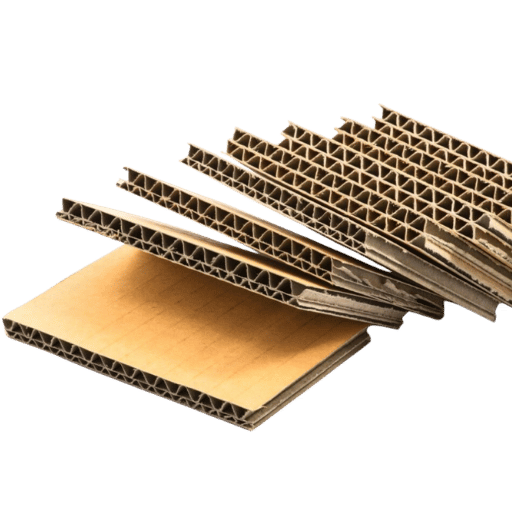
When comparing cardboard and corrugated Packaging, think the flute’s contribution to both structure and packaging. This ridged element that lies between the liner papers give corrugated much of its strength and its loadbearing-capacities. Board thickness and compression are influenced significantly by flute size; your selection of flute largely impacts the packaging process in addition to the structural integrity that the material will afford packaging! Flute choice sits at the heart of corrugated box design, shaping everything from print quality to stacking strength.
| Flute | Approx. caliper | Typical use |
|---|---|---|
| A | ~4.7 mm (3/16″) | Maximum cushioning and stacking; fragile or heavy goods |
| C | ~3.6–4.0 mm (11/64″) | The most common shipping flute; good all-round box |
| B | ~2.5–3.2 mm (1/8″) | Crush resistance for canned goods; better flat-surface print |
| E | ~1.5 mm (1/16″) | Thin retail boxes and litho-laminate; near-folding-carton look |
| F | ~0.8–1.0 mm (1/32″) | Small cosmetic and high-end retail packaging |
| BC / EB | ~6–7 mm | Double-wall — two flutes combined for export and heavy loads |
A 0.5mm difference is pretty normal in flute caliper between converters – take the above figures with a grain of salt (they’re only working estimates); the industry standard caliper targets are maintained by the Fibre Box Association. Two ways of assessing strength: Edge Crush Test (ECT), which will tell you how much will stack without crushing, and Mullen Burst, an older measure of puncture resistance. Typical general-duty box board is single-wall C-flute at 32ECT (approx 200# Mullen).
Is a Pizza Box Corrugated Cardboard?
Yes – and likely so. A take-out pizza box is corrugated board, not flat, unless you’re buying from the really low-budget end and it’s an all-paper ‘tray’. Corrugated adds bulk to both stack height and some thermal/steam resistance as well. Confirm this by looking at the cut edge of the board itself. Corrugated looks like three plies of material (outer liner, medium, inner liner) and you see that wavy layer. Flatboard only has two plies.
📐 Engineering Note
32 ECT C-flute would be your first thought for a single-wall e-commerce box that should run under 30 pounds gross. You’ll need BC double-wall when shipping anything in excess of that, or you plan to stack the boxes more than two high in your shipping pallet structure. If ordering custom cartons, be specific and require testing of your received material in accordance with TAPPI T811; your carton specifications should list “32ECT” not “heavy duty”. The restraint around a finished carton stack is a separate selection: compare carton and pallet strapping from UD Packaging against the pack weight and box compression limits rather than using banding to compensate for inadequate board strength.
How Each Box Is Manufactured: From Sheet to Finished Carton
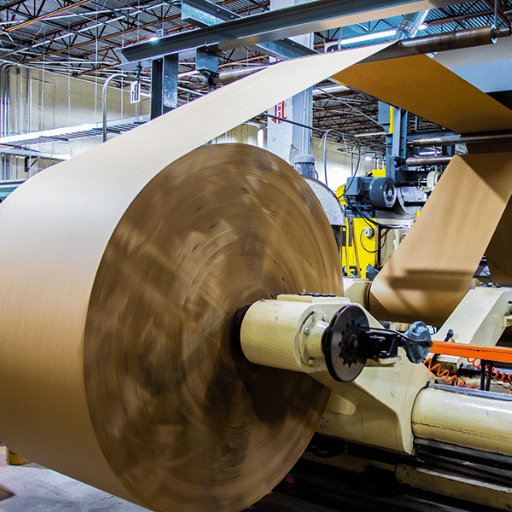
I’m going to expand on some things that you’ll often find missing from the “corrugated vs cardboard” type guides. Understanding that there are different manufacturing routes taken for each board stock, we get a better sense of why one is cheaper, and how the two materials come to be processed on entirely different lines before they hit the last, critical step – where they converge again – the fold and glue process.
Folding carton (cardboard) route:
- Paperboard arrives as sheets or reels of single-layer stock.
- Offset or litho printing lays down high-resolution graphics.
- The layout of your die is made. Your flat stock is die cut & creased in one motion to create your net (or flattened carton blank).
- Your folded & glued carton then exits the machine. Your typical box folding gluer can run many styles of packaging, but the simplest are running a straight-line folder gluer.
Corrugated route:
- Your corrugator uses starch paste to laminate the outerliner, medium & innerliner together with heat and pressure creating sheet board.
- The resulting sheets of sheetboard is then scored, turned 90 degrees and cut down into your flattened carton blanks.
- Flexo printing and die-cutting add graphics and shape.
- Your folded & glued carton then exits the machine. Here again, your box folding & gluing equipment runs many different types, however your corrugating folder gluer is geared toward sheet board, many in a flexo and corrugating folder style gluer combination.
This added step of manufacturing, the sheet board fabrication in the corrugator, contributes to corrugated having a higher cost factor than a single board folded carton of similar dimensions. What’s the big takeaway from all this? No matter the materials used to create a flat packaging design, the conversion of flat stock into a finished carton occurs at the folding & gluing phase. This process is the #1 throughput concern in the packaging plant, even if many plant managers worry first & foremost about the print and die cutting aspects.
‘People spend the most time with die cutting and print. If it leaves the print station and die line it goes into a box and doesn’t cause a jam unless the boxmaker set the gluer poorly.’ ‘If they don’t do the right thing with it there, it gets stuck there,’ noted Dave Loez-Santi. ‘It will bog that whole machine down; a well-tuned gluer, you can practically feed a jumbled assortment and it will run them’ through.
Where the Folder Gluer Fits, and Why Material Changes the Machine
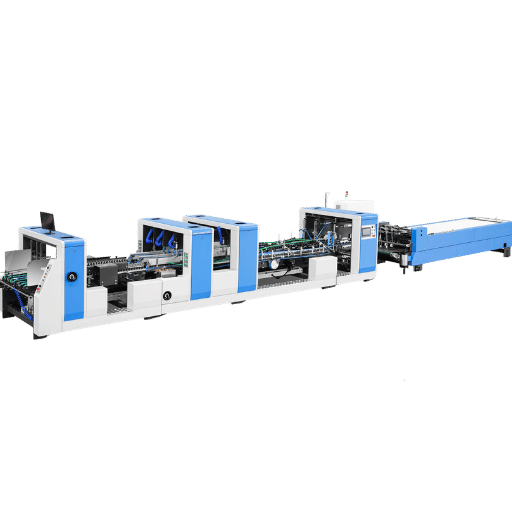
The folder gluer is the machine that transforms that flat sheet you designed into a finished carton-glued, ready to be filled. Sounds simple, but the reality of the thick, multilayered material changes the basic physics of what it takes to fold, crease and seal a package. That’s why plants that run both types rarely use a single piece of equipment, even for the most basic carton. Material, more than anything else, determines which machine you use to make the box.
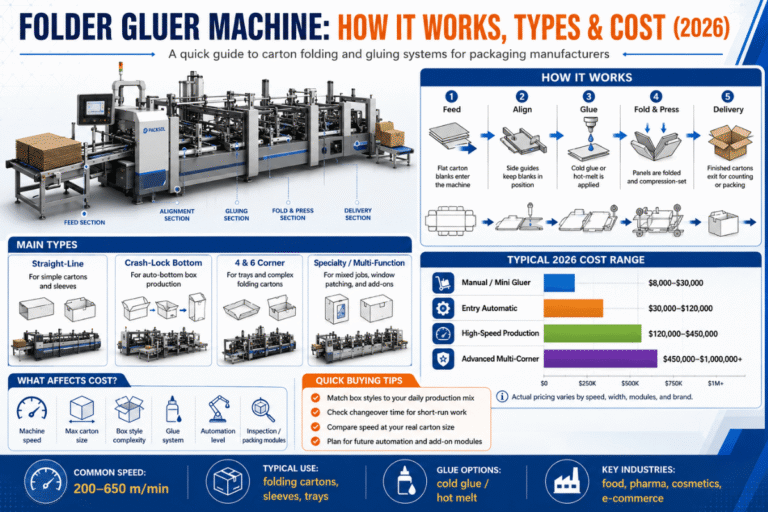
Straight-line folder gluers address simple straight-seam jobs – folding cartons, plain regular slotted cartons – at high speed. As box style gets complex, you move to a crash-lock bottom folder gluer or a 4- and 6-corner folder gluer for lock-bottom mailers and multi-panel displays. When only considering corrugated, a corrugated folder gluer is built with thick, crushable board in mind.
But why is material so important? 3 reasons. 1. Caliper: The same 0.5-mm carton that glues fine on a simple straight-line machine will crush corrugations and weaken performance if blindly placed on a 4-mm C-flute blank on any gluer. 2. Glue: High coverage starch/PVA adhesives for bridging a corrugated surface differ greatly from fine bead glues used for clean, precise application on coated folding carton substrates. 3. Speed and Registration:Thin, lightweight carton stock can easily achieve tight register while running fast, whereas heavier board needs stabilization for a more consistent (though slower) speed.
What Is the Difference Between a Folding Carton and a Corrugated Carton?
A folding carton uses single-layer board-think cosmetic, retail supplement boxes-folded and glued with precise straight-line accuracy for direct consumer display. The corrugated carton relies on fluted medium, structurally reinforced by liner board, and built for resilience in the shipping and stacking environment; this generally means running on a corrugated folder gluer or a flexographic folder gluer.While the terms are sometimes confused in casual conversation, they represent distinct packaging applications with entirely different specifications for their materials, machines, glues and performance speed parameters. Product shipped to consumers prefers a corrugated carton for its durability.
Our collective experience operating folder gluer machines in over 40 countries indicates that shops processing both board types benefit most from truly “one-click” product format changeovers – as we found real costs in mixed board operations often reside not within running operations, but in the extensive time required to change over production from one product run to the next. An automatic folder gluer offering simplified, rapid format adjustment can significantly reduce the burden of constant retraining for senior operators responsible for such changes.
Matching Box Style to Material and Machine: The Material, Machine Fit Test
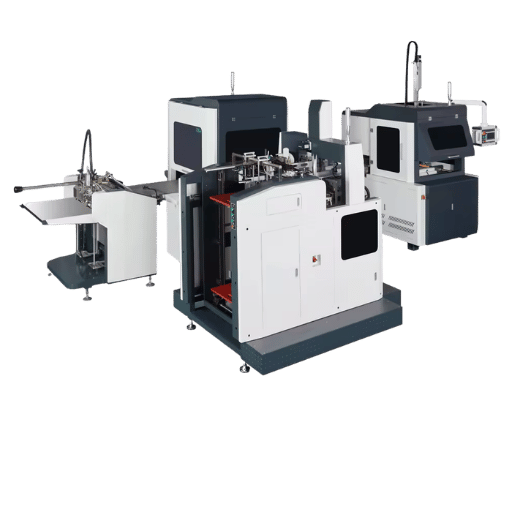
Instead of having to commit specifications to memory, consider simply answering 3 questions, which will guide you to the ideal configuration. Call this the Material-Machine Fit Test. (1) Should the packaging serve to ship or will it be sold directly for display at retail? (2) What kind of box do you intend to create? Is it straightforward straight-seamed product, or a more complex lock bottom structure or even a multi-cornered design? (3) What’s your production volume and your order complexity and frequency? With those in hand, the choice of materials and appropriate equipment machines become clear, thanks to the matching below.
| Scenario | Material | Folder gluer fit |
|---|---|---|
| Retail cosmetic carton, premium print | Paperboard (or E/F-flute) | Straight-line folder gluer |
| E-commerce shipper, medium weight | C-flute single-wall corrugated | Corrugated / flexo folder gluer |
| Lock-bottom mailer or takeaway box | B/E-flute corrugated | Crash-lock bottom folder gluer |
| Multi-panel display or six-corner tray | Corrugated | 4- and 6-corner folder gluer |
| Heavy export crate, stacked pallets | Double-wall (BC) corrugated | High-speed folder gluer + crash-lock |
| Rigid gift / 3D specialty box | Mixed board | Stereo box folder gluer |
Take a footwear brand that swapped its paperboard shoebox for E-flute corrugated for direct-to-consumer fulfillment. Its previous retail box looked swell on a shelf but showed up at its destination, dented by rough handling during transit. By switching to E-flute, they achieved the same great print quality plus the required physical fortitude – and routed the work to their corrugated gluer, not the carton gluer. Next, they upped the ante with custom corrugated packaging, adding die cuts and branding, which pushed the job onto machines ready to maintain registration over challenging folds, a problem familiar across the packaging industry as product packaging migrates toward customization. If you’re undecided on where your favorite box style falls, our box-style compatibility matrix maps common boxes against suitable machines.
Cost, Strength, and Sustainability: Choosing the Right Material

Now that machine and structure are resolved, there are only three levers left to play – cost, strength and sustainability – each favoring different materials, and none universally better than the others. The correct package material will be determined by the interplay of those three – combined with your product and your shipping operation.
Cost Packaging cost per unit on the other hand Paperboard is cheapest due to a single layer design that bypasses the need to go through the corrugator. Corrugated is inherently more costly to produce, and those costs increase as soon as you start custom die cuts, large sizes and small volumes. The low unit price is false however, if packaging damage due to failure to transport correctly leads to product damage, replacement, and customer refunds which can far outweigh the few cents that you may save on the box itself. It becomes a total cost picture considering shipping and customer experience when viewing packaging in light of shipping and handling.
Strength In this regard, the higher material cost is justified. the fluted medium adds additional strength and stacking ability and cushioning for contents where paperboard will fail.fragile items or items which will carry a great amount of weight go into a corrugated box.Paperboard relies on the rigidity to offer presentation, not protection.
96.5%
Corrugated box recycling rate, U.S. 2018 (EPA)
69–74%
Cardboard recovered/recycled, 2024 (AF&PA, new method)
Sustainability Many Buyers were misled with the headlines concerning this subject matter, and while in reality the packaging may have only measurably suffered; as Corrugated has been one of the best recycled material in the U.S.-a 96.5% recycled in 2018 according to the EPA for corrugated boxes-in 2023 the American Forest & Paper Association altered their calculation model. Their methodology adjustment led to a 69%-74% rate of material recovery for 2024 from cardboard and a 93.6% from the ‘traditional’ measurement model in 2022 which would have placed it at a comparable number.
These shifts don’t signify a collapse in recycling as measurement methodologies changed rather than the physical state of the material.Both are the most recycled material.
Quick decision guide
- ships, potentially rough handling, can be stacked (heavy weight products). C-flute or heavier.
- Ships via Retail Shelf light products. E-flute or heavier paperboard, printed.
- Premium look, then shipped (product protection) E-fluterugated with premium graphics.
- Heavy or export, multi-stack pallets → double-wall corrugated.
Common Mistakes When Choosing Between Cardboard and Corrugated
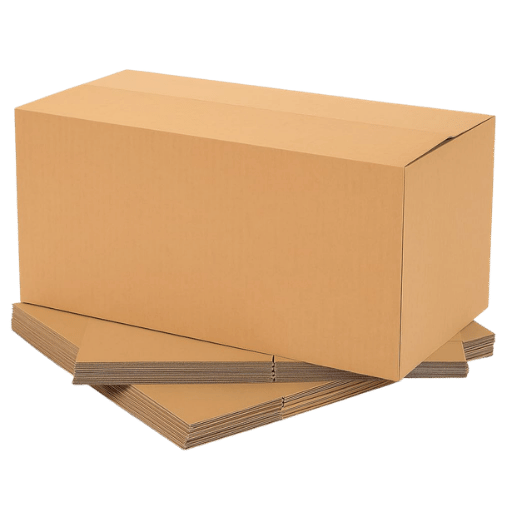
We’re repeatedly seeing mistakes made on the buy side as well as the producing end that can usually be attributed to lumping cardboard and corrugated into a single type of package.
- ✔
Shipping in paperboard. Using a display-grade carton for heavy or transit orders. Packaging communities are full of crushed-parcel complaints that all start here. - ✔
Under-speccing the flute. Choosing E-flute for its looks when the load needs C- or double-wall, then blaming the courier for damage. - ✔
Running the wrong machine for the material. Forcing thick corrugated through a carton-tuned gluer crushes flutes; running thin board on a corrugated setup wastes speed and registration. - ✔
Ignoring changeover time. Buying for top run speed while a mixed-order shop bleeds hours on manual setup between jobs.
Industry Outlook: Automation, Right-Sizing, and What’s Changing in 2026

Box manufacturing doesn’t sit still, and there are a few shifts worth considering when developing next year’s plans for your plant equipment.
E-commerce will never stop changing what’s needed. With the continued increase of e-commerce, you can be assured that volume continues to swing toward appropriate sizes for the right-sized, fiber- and freight-reducing thinner E-flute corrugated; and year-over-year data indicates demand for corrugated box manufacturing facilities tends to jump month-to-month, a sign that flexible lines can provide greater advantages.
The hot topic here: automation. If it makes setup easier (like automatic quick die-changeover devices, direct-to-box inline print-fold-glue for flexo folder-gluers) and saves labor in the rear (like automatic case packing systems), assume it’s going to transition from the cutting edge to a standard requirement. In a mixed paperboard and corrugated box environment, this focus will be on reduced setup time (especially when you factor in a high number of short runs) rather than maximum top speeds.
Reporting sustainability performance will be subject to scrutiny. The changes made to AF&PA’s recycling methodology for 2023 and 2024 indicate this is a wider movement beyond recycling volumes to comparable accuracy with consistent use of recovered content and retailers’ requirements for right-sizing packaging.
💡 Action for 2026
Check up on your orders by reviewing for one month your order size variation and the speed at which you change over machine set-ups. When you have many small runs, favor a fast-changing format (with duel-material capability) over higher top speed for folder gluers in the real plant – that will likely justify the cost.
Bottom line
To choose the right packaging, start with the product and the journey, not the price sheet. Paperboard cartons suit lightweight retail product packaging; corrugated earns its keep when shipping costs and damage rates are on the line. Match the right packaging to the box, then match the box to the folder gluer that runs it cleanly. Get those two decisions aligned and your packaging solutions stop fighting your production schedule.
Which Folder Gluer Does Each Board and Box Style Need?
Material is only the first filter. The final machine choice comes from the combination of board structure, blank size, fold sequence and glue points.
| Board and box style | Recommended machine class | Decision note |
|---|---|---|
| Paperboard straight-line carton | Straight-line folder gluer. | Prioritize clean scoring, glue-lap control and rapid changeover. |
| Paperboard crash-lock carton | Crash-lock bottom folder gluer. | Bottom hooks and glue timing matter more than headline speed. |
| Paperboard 4/6-corner tray | 4/6-corner folder gluer. | Requires multipoint gluing and corner-folding devices. |
| Corrugated regular or die-cut case | Corrugated folder gluer or box folding-and-gluing machine. | Check flute thickness, crush risk and compression dwell. |
Review the full folder gluer machine range for paperboard and the corrugated folder gluer range for corrugated applications.
Frequently Asked Questions
What do you call cardboard that is not corrugated?
View Answer
For instance, this comes in handy when making cereal boxes, certain inner boxes/inserts and cosmetic product cartons and is characterized by a thick solid layer of paper board, as is the gray-colored recycled version sometimes referred to as chipboard.
How can you tell if cardboard is corrugated?
View Answer
Simply look at the edge of the cut box: you have a corrugated corrugated structure with a thin wavy middle between a two-sided paper and paperboard if no wave is apparent.
Are corrugated boxes stronger than regular cardboard?
View Answer
For more of an answer, we refer you back to our “Corrugated or Paperboard.” Yes, by quite a bit, if you have a standard one, due to its rigidity and shock-absorption strength to maintain shape and integrity through shipping. Corrugates, though it has a greater per- pound cost, generally results in overall, cost savings after you calculate replacements from products shipped poorly.
Is corrugated cardboard recyclable?
View Answer
In the United States, old corrugated is among the country’s most readily recycled materials, with an EPA rate that topped 96.5 percent in 2018 (this rate depends on methodology. Though it will ebb and flow).
Which costs less, corrugated or cardboard boxes?
View Answer
Given that only one layer of paperboard (vs. two) is typically needed to produce its packaging, its cost will naturally go down per piece, especially as you compare customized dies and longer runs. Corrugated, while it generally starts more expensive on a per-piece basis, will actually turn out to be cheaper overall for shipment if products frequently arrive damaged, cracked or returned because they were shipped with less support.
Can one folder gluer run both cardboard cartons and corrugated boxes?
View Answer
That is largely determined by thickness in the box you will produce; your specified material range is based on the max calipers required for the jobs running on a particular machine, so a shop with a broad array of boxes needs a series of specialized machines. This requires you to consult a manufacturer’s specifications to ensure your expected box ranges align. However, you can obtain a dual-material folder gluer that will accommodate both thick corrugated as well as paper board but there will be compromise in the thickness it is able to run. In instances of a mixed range of boxes, it is typical to have both a general line gluer and a corrugated box folder gluer. The first step is determining what the minimum and maximum box dimensions for your jobs is as you need to know the maximum for the specific gluer for these calculations to make sens. Our model selector can help shortlist machines by board range.
Use this tool to specify both the shape of your box and to obtain optimal speeds and configurations for that case style.
Rather check the solutions first? Use the box-style compatibility matrix or see our integrated line solutions.
How We Approached This Comparison
Cenwan Machine manufactures folder gluer and box gluing machine, such as corrugated, stereo boxes as well as paper board boxes, for the more than 40 packaging plants in many countries worldwide.
This article is from the machine perspective of paper board vs corrugated cardboard matter – when the difference of the material becomes a practical issue and impacts decisions on feeding speed, adhesive spread, and changeover times on the packaging line. Below, material strengths and recycling statistics are based on publically available resources by EPA and industry associations, properly cited.
References & Sources
- Paper and Paperboard: Material-Specific Data – U.S. Environmental Protection Agency
- 2024 U.S. Paper Recycling Rates – American Forest & Paper Association (AF&PA)
- Corrugated Board Specifications & Caliper Standards – Fibre Box Association
- Recyclability of Paper and Paperboard (WP-23-03, 2023) – NCASI
- Edge Crush Test (T811) and Mullen Burst (T807) standards – TAPPI
Related Articles
- Automatic folder gluer machines explained – types, components, and costs
- What’s a straight-line folder gluer? Process and productivity
- Small box folder gluer machine guide – width, glue, and speed
- Automatic pasting machine – 2026 buyer’s guide
- Corrugated box gluing machine – specifications and configurations