Get in touch with Cenwan Machine Company


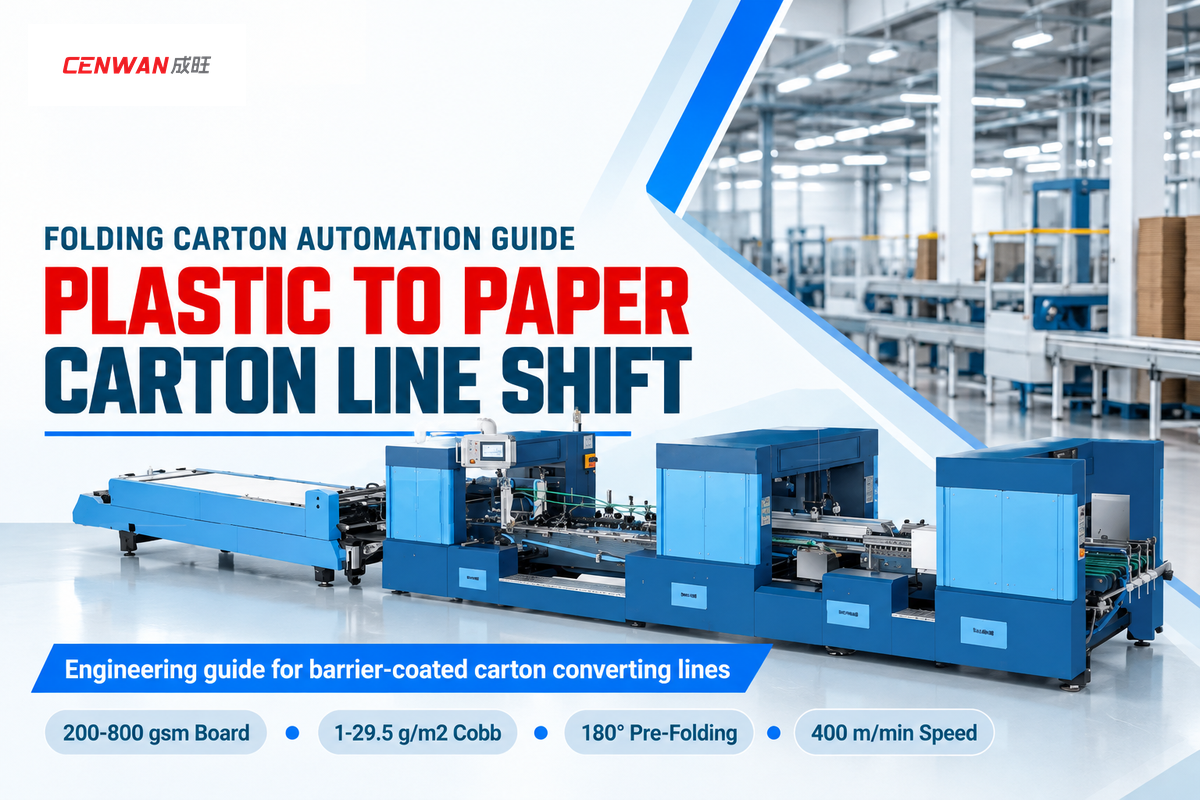
Global plastic to paper packaging transition is forcing converting plants to revamp how they design, fold and glue retail cartons. Brand owners want to cut plastic waste and replace single-use trays, clamshells, and film multipacks with fiberboard. While it may appear similar to material swaps, running barrier coated board on existing fold-and-glue equipment is far more challenging. Dispersion coatings negatively impact the absorption of water based adhesives. Heavier fiberboard grades also increase crease springback and shipping weight compared with lightweight polymer films. Life-cycle environmental gains depend on controlling food waste, transport load, and municipal recycling. Aligning substrate selection, adhesive chemistry with 180-degree pre-folding and compression is key to maintain high line speeds.
Updated October 2026 | Technical Review by Cenwan Machine Converting Engineering Team
Key Engineering Takeaways for Converting Plants
- Regulatory timeline: European Union Regulation (EU) 2025/40 entered into force on February 11, 2025. Its general rules will apply from August 12, 2026, to all packaging materials.
- Global paper packaging reached USD 448.9 Billion in 2025 and USD 461.8 Billion in 2026. Folding boxes hold a 45.2% category share, according to the IMARC Group market report.
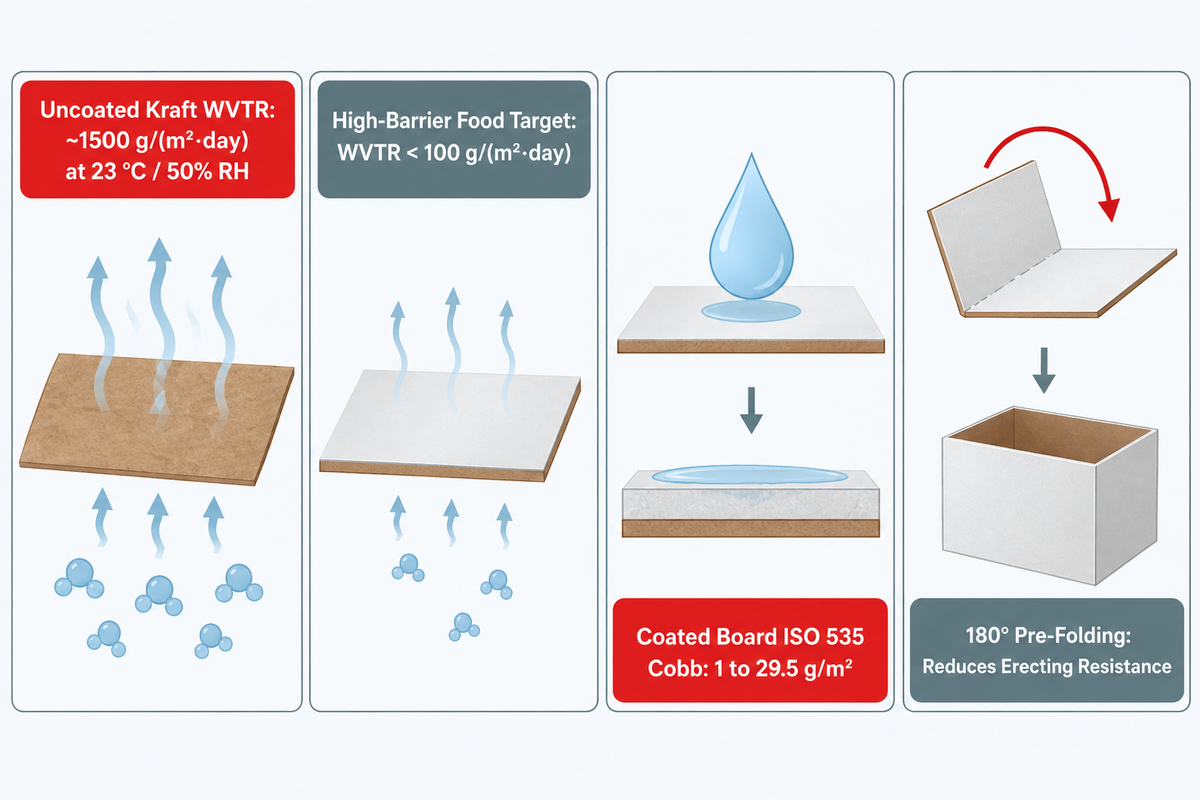
- The 2026 ScienceDirect barrier coating review reports uncoated Kraft paper at 23 °C and 50% RH has a WVTR around 1500 g/(m²·day). High-performance food packaging applications often require a WVTR below 100 g/(m²·day), depending on product sensitivity and shelf life.
- Adhesive selection errors, pressure imbalances, and speed oversights account for 70% of folding carton gluing defects according to Sinosun’s folder-gluer defect report.
- High-speed folder-gluers like the Cenwan CW-G can glue 200 to 800 gsm board, as well as E/F/N microflute, at speeds up to 400 m/min.
Folding carton plants must integrate four different variables when switching from plastic to paper packaging. Converters must coordinate the match of paperboard basis weight (200 to 700 gsm on CW-W or 200 to 800 gsm on CW-G) to load structures and mill datasheets. Waterborne dispersion barrier coatings are paired with proper adhesives. Lines also control crease springback through score geometry and pre-folding, and add multi-corner tooling where tray geometry requires it.
Why the Plastic-to-Paper Packaging Shift Re-Engineers Folding Carton Production
From plastic packaging to paperboard, production processes and machine physics change. Forming three-dimensional plastic containers requires one thermoforming cycle. Replacing those containers on a flat-blank converting line requires multi-panel die-cut cartons, multi-corner folding hooks, barrier coatings, and tighter compression control.
Regulatory rules and retail commitments drive this material transition across the global packaging industry. In the EU, the Packaging and Packaging Waste Regulation (Regulation (EU) 2025/40) came into force on 11 February 2025. Its general provisions will apply from 12 August 2026, as confirmed by the UK Government EU PPWR exporter guide. Importantly, Regulation (EU) 2025/40 covers all packaging materials, not only plastic. In the EU PPWR, PFAS limits for food contact packaging will apply from 12 August 2026. Recyclability grading requirements for each regulated packaging company and format are scheduled from 2030.
Market data reflects the scale of this converting demand. According to the IMARC Group paper packaging market report, global paper packaging grew from USD 448.9 Billion in 2025 to USD 461.8 Billion in 2026. The sector is projected to reach USD 552.0 Billion by 2034 at a 2.25% compound annual growth rate. Within that existing global market, folding boxes and cases represent the largest product segment at 45.2%. A separate Grand View Research industry analysis values the 2025 paper packaging market at USD 416.1 Billion. It projects USD 611.7 Billion by 2033 as consumer demand for fiber packaging solutions accelerates.
The UNEP Life Cycle Initiative food packaging report notes that life-cycle assessments must evaluate the package together with the food product it protects. Additionally, the transport weight of heavier fiberboard blanks must also be assessed. Because a large proportion of plastic produced globally is used in short-lived food containers, poorly designed barriers can create a new food-waste problem. When brands switch from plastic to paper without proper barrier development, food spoilage and higher shipping weight can outweigh material savings. Responsible converters also confirm that virgin wood fibers come from sustainable forestry practices. Forest certification supports responsible forest management through sourcing requirements, biodiversity protection, and auditing. For chains of custody, there are credible standards that promote responsible forest management and/or help alleviate deforestation and protect old growth forests. Using certified pulp (paper) that households can recycle in municipal streams helps reduce dependence on fossil fuel. A paper-based disposable product can reduce life-cycle carbon emissions linked to climate change when fiber production, coating, shipping weight, and product protection together yield a lower footprint. Actual collection and recycling of packages is required to keep garbage out of landfills.
What mechanical and moisture-barrier trade-offs arise when switching from plastic to paper packaging?
Replacing plastic with paperboard requires barrier coatings to control gas permeability and water absorption. At the same time, heavier boards increase crease springback, shipping weight, and folding control demands. As documented in a 2026 ScienceDirect barrier coating benchmark study, uncoated Kraft paper at 23 °C and 50% relative humidity (RH) exhibits a water vapor transmission rate (WVTR) around 1500 g/(m²·day). Its oxygen transmission rate (OTR) exceeds 5000 cm³/(m²·day) under the same 23 °C and 50% RH test conditions. The ScienceDirect benchmark review reports that high-performance food packaging applications often require a WVTR below 100 g/(m²·day) and an OTR below 100 cm³/(m²·day). Exact barrier targets vary with food sensitivity, shelf life, package surface area, and respiration needs for fresh produce. For the same material at a fixed temperature, a larger water-vapour pressure difference generally increases WVTR. High humidity can also increase OTR in moisture-sensitive barriers by plasticising the barrier layer.
Closing that barrier gap needs functional coatings or laminations that change the behavior of folder-gluers. A commercial paper vs. plastic food packaging comparison observes that multilayer or windowed paperboard cartons cost more to convert than plain boxes. For each added barrier layer, tolerances for creasing and gluing change.
| Performance Parameter | Rigid / Flexible Plastic (PET, PP, PE) | Uncoated Kraft / Cartonboard | Dispersion-Coated Paperboard | Folder-Gluer Line Impact |
|---|---|---|---|---|
| WVTR | Low moisture vapor permeability | Approximately 1500 g/(m²·day) at 23 °C / 50% RH (2026 review) | Below 100 g/(m²·day) is a cited food target; a separate dispersion study reported 240 g/(m²·day) | Compare results only at matching test conditions; assess glue-water uptake separately |
| Oxygen Transmission | At comparable thickness, PET generally provides a stronger oxygen barrier than uncoated PE or PP | > 5000 cm³/(m²·day) at 23 °C / 50% RH (2026 review) | Often < 100 cm³/(m²·day) in high-barrier food benchmarks (varies by product sensitivity) | Continuous barrier layers improve performance, while crease cracks can compromise it |
| Water Absorptiveness | ISO 535 measures water absorption by paper and board | Higher water uptake than coated grades at equal exposure time | The 2026 barrier review reports coated-paperboard Cobb values of 1 to 29.5 g/m² | Water-based dispersion glue needs a path for water removal; hot melt sets by cooling; adhesion requires wetting the coating |
| 3D Corner Formation | Molded one-piece cavity | Die-cut straight-line flaps | 4-corner / 6-corner webbed or deep-drawn trays | Multi-corner folded trays use back-folding hooks and timed glue nozzles |
| Crease Memory & Springback | Set by thermoforming mold cooling | Paperboard fibers can spring back after folding | Elevated bending stiffness in heavy caliper grades | Holmen Iggesund describes 180° pre-folding as a way to reduce erecting resistance |
| Ambient Humidity Sensitivity | Negligible moisture uptake | Cellulose absorbs and releases moisture | Drying reduces paperboard foldability | Crease geometry, fiber direction, and interlaminar delamination also affect folding and cracking |
| Feeder Surface Friction | Not fed on carton gluers | Traction governed by belt compound and normal force | Slick barrier topcoats can alter feeder friction | Vacuum assistance increases contact force when coated blanks slip |
| Recycling Routes & Assessment | Plastics are sorted by polymer | EN 643 classifies recovered paper and board grades | The 2025 4evergreen protocol evaluates fibre-based packaging for conventional, deinking, and specialised mills | The assessment covers the board, coating, and adhesive together |
Plastic Format to Paperboard Mapping: Selecting SBS, FBB, CUK, WLC, and Microflute Grades
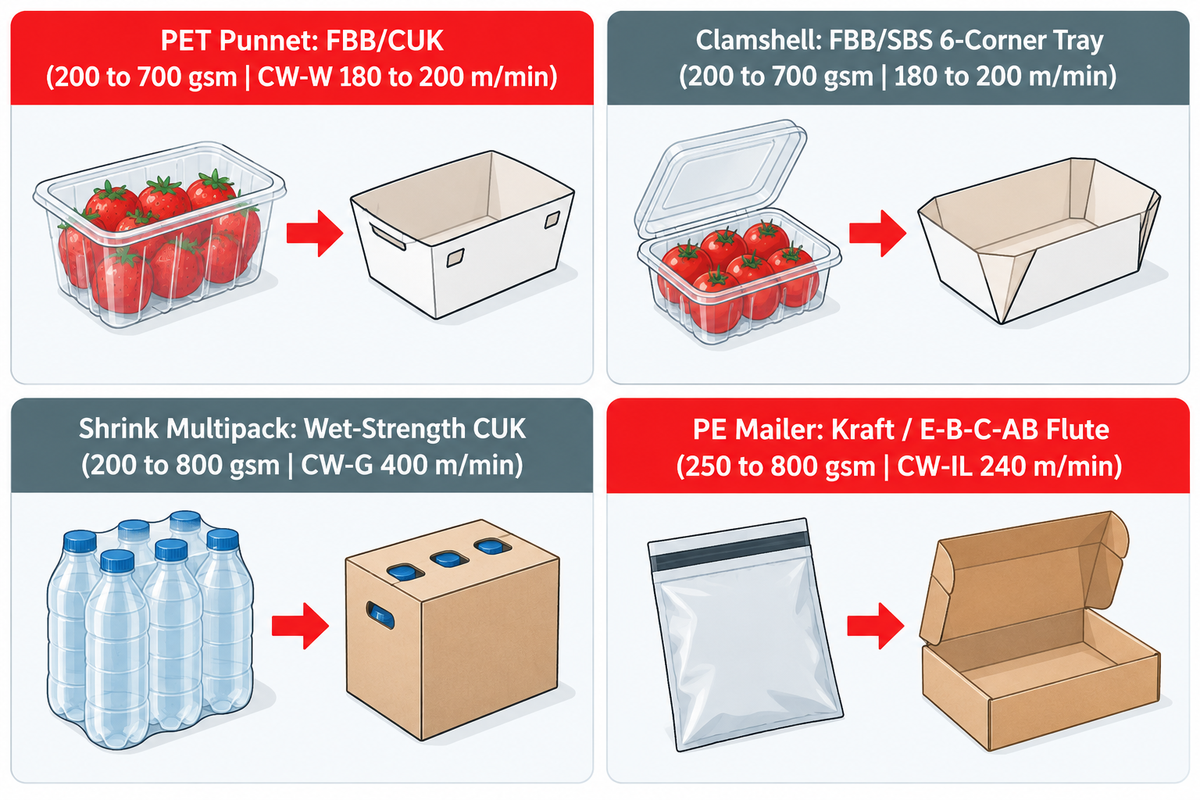
The first step in successful plastic replacement is matching the mechanical duty of the original polymer container with the verified basis-weight range of the paperboard, and ensuring that the converting machine can fulfill the task. Converters use The Substrate-to-Speed Transition Matrix (SSTM) to map thermoformed trays, clamshells, and shrink wraps to cartonboard (200 to 700 gsm on CW-W or 200 to 800 gsm on CW-G) and E/F/N microflute corrugated fiberboard.
Not every plastic package converts into a die-cut folding carton. For shallow three-dimensional trays, some manufacturers use molded pulp or 3D deep drawing of paperboard with segmented blank holders. However, when brands need high-graphic retail branding, flat-blank shipping efficiency, and rapid SKU changeovers, die-cut folding cartons and multi-corner paperboard trays dominate high-volume production. Trade press such as Packaging Strategies and Packaging World have reported how converters replace plastic punnets, shrink collars, and blister packs with engineered cartonboard.
Material suppliers develop barrier coating technology specifically for these converting lines. Individual paper mills request different combinations of grades across Solid Bleached Sulfate (SBS), Folding Boxboard (FBB), Coated Unbleached Kraft (CUK), and White Lined Chipboard (WLC). As such, converters request food-contact and barrier datasheets from the mill, like Stora Enso’s barrier-coated paperboard range. Engineers then ensure the basis weight and flute caliper of the chosen material match the folder-gluer’s mechanical rating (200 to 700 gsm on CW-W or 200 to 800 gsm on CW-G).
How should converters choose between SBS, FBB, CUK, and E/F/N microflute when replacing rigid plastic trays?
Choose SBS or FBB for smooth printing surfaces, CUK for high tear resistance, and E/F/N microflute corrugated fiberboard for higher stacking compression and structural stiffness. Verify the folder-gluer’s rated caliper window and basis weight against the paper mill’s datasheet. Test stacking load, wet-strength exposure, and barrier requirements (e.g., moisture/grease), and adjust belt speed for test specimens.
Below is The Substrate-to-Speed Transition Matrix (SSTM), which maps eight common plastic-replacement packaging formats to target paperboard families and verified Cenwan folder-gluer machine ranges.
| Replaced Plastic Format Type | Candidate Paperboard Family (Verify Mill Datasheet) | Machine Basis Weight / Flute Window | Replacement Carton Style | Folder-Gluer Tooling & Rated Machine Window |
|---|---|---|---|---|
| PET Produce Punnet | FBB or CUK with moisture barrier | 200 to 700 gsm (CW-W window) | Multi-corner folded tray or deep-drawn tray | Back-folding hooks; CW-W rated 180 to 200 m/min |
| Hinged Clamshell Container | Dispersion-coated FBB or SBS | 200 to 700 gsm (CW-W window) | 6-corner hinged-lid food tray | 6-corner timed hooks (CW-W rated 180 to 200 m/min) |
| LDPE Shrink Multipack Film | Wet-strength CUK virgin kraft | 200 to 800 gsm (CW-G window) | Wrap-around carrier or top-clip carton | 180° pre-folder (CW-G rated up to 400 m/min) |
| Thermoformed Frozen Meal Tray | Double-dispersion coated SBS / FBB | 200 to 700 gsm (CW-W window) | Web-corner gusseted tray | Compatible cold/hot glue and pneumatic compression |
| PVC Retail Blister Shell | SBS or FBB cartonboard | 200 to 800 gsm (CW-G window) | Double-wall frame-view straight-line box | Straight-line folding up to 400 m/min on CW-G |
| Rigid Plastic Jar Outer Pack | WLC or E/F microflute | 200 to 700 gsm board; E/F flute | Crash-lock (auto-bottom) carton | Crash-lock bottom hooks (180 to 200 m/min on CW-W) |
| Molded EPS Structural Insert | E, F, or N microflute corrugated board | 200 to 800 gsm board; E/F/N flute | Multi-cell partition and folded insert | Wide-clearance carrier frame and partition tooling |
| Polyethylene E-Commerce Mailer | Unbleached Kraft board or E/B/C/AB flute | 250 to 800 gsm board (CW-IL window) | Peel-and-seal tear-strip mailer folder | Integrated line up to 240 m/min on CW-IL |
Barrier Coating vs. Glueability: Aqueous Dispersion Boards, Dyne Levels, and Adhesive Selection
Replacing polyethylene film lamination with waterborne dispersion coatings changes how adhesive bonds form on a folder-gluer. Coated paperboards with low water absorptiveness (such as the 1 to 29.5 g/m² ISO 535:2023 Cobb range in the 2026 ScienceDirect review) can slow water removal from water-based adhesives. For reliable high-speed bonding, one can use compatible adhesive formulation, coat-free glue flaps, or surface treatments.
Historically, converters produced water-resistant and grease-resistant cartons by extrusion-laminating polyethylene (PE) onto paperboard. Food wraps contain silicone parchment paper, as well as sheets of wax-coated paper and grease-resistant paper (not to be confused with industrial grease (lubricant)). Dry and chilled folding cartons are shifting towards mono-material fiber designs, unlike aseptic processing brick cartons that use layers of aluminum-polyethylene. In paper recycling, the harmonized European recyclability laboratory test method by Cepi and the 4evergreen Recyclability Evaluation Protocol (January 31, 2025) establish baseline laboratory tests. These benchmarks support the 4evergreen initiative to achieve a 90% fiber-based packaging recycling rate in Europe by 2030.
Engineers must differentiate between raw-material trading standards and package testing protocols. The European standard EN 643:2014 sets standards for grades of recycled paper and board. It also sets limits for tolerable levels of non-paper components in refuse and paper mill trade. By contrast, the 2025 4evergreen protocol evaluates whether a finished package—board, barrier coating, and adhesive—repulps cleanly in conventional, deinking, or specialized mills. A 2022 peer-reviewed MDPI Coatings study on waterborne dispersion coatings showed that double-coated paper board achieved a WVTR of 240 g/(m²•day) at 23 °C in the presence of high humidity. After a brief immersion and rinsing treatment in a dilute solution of sodium hydroxide, double-layer coating still remained on the board. Therefore, converters must test the complete bonded carton rather than assuming any aqueous coating label guarantees conventional mill compatibility.
How do aqueous dispersion barrier coatings compare with PE lamination for folder-gluer adhesive bonding?
Both PE lamination and aqueous dispersion coatings limit water absorption into the board, slowing the water-wicking setting mechanism of standard water-based PVA cold glues. PaperIndex Academy’s technical guide on ISO 535 Cobb values notes the Cobb60 test evaluates water absorption by measuring the mass of water (g/m²) in 60 seconds. Standard ISO 535:2023 (and TAPPI T 441 om-24) measures water absorptiveness rather than air porosity. Coated paperboards reviewed in the 2026 ScienceDirect review span Cobb values between 1 and 29.5 g/m². Barrier coatings reduce water uptake on the glue contact face. This leads to a loss of rapid capillary drainage into the cellulose network and longer setting times compared to uncoated board. To account for this, the operator needs to adjust the open time and cure time of the adhesive to match the times stated on the datasheet.
As discussed in SBL Machinery’s analysis of folding and gluing failures, standard water-based glue used on PE-coated or waterproof-coated surfaces can fail when the barrier blocks penetration. A report on folding-carton gluing defects, authored by Sinosun, states that 70% of folding carton gluing defects are due to improper choice of glue, pressure imbalance, and speed problems. Lanco Adhesives’ best-practice guide for folding cartons states that if the adhesive open time is too long, stiff flaps can spring open after the compression belt. On the other hand, if the adhesive open time is too short, premature skinning can occur, and bonding won’t occur.
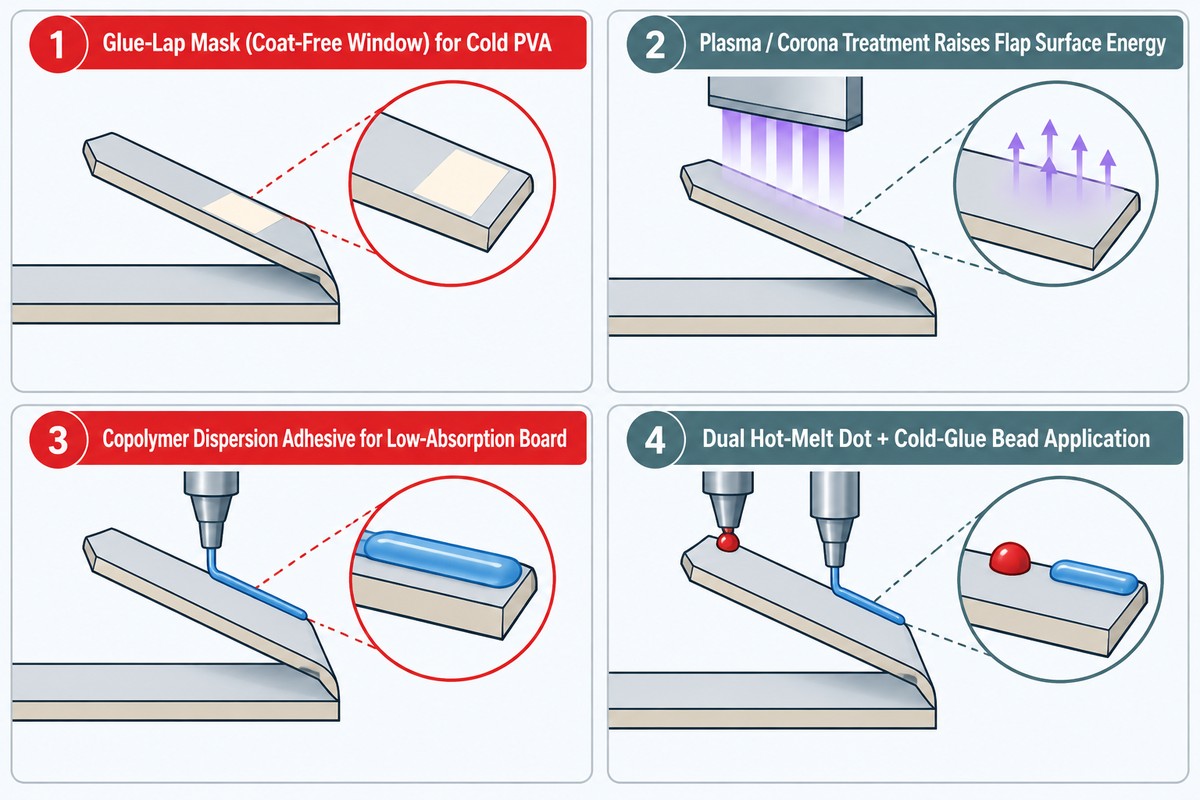
To prevent pop-opens on barrier-coated paperboard, there are four engineering controls converting plants can employ:
- Glue-lap mask (coat-free window): Leave the glue flap uncoated during gravure or flexo barrier application, so that cold PVA emulsion adhesive can bond to bare cellulose fibers.
- Plasma/corona surface treatment raises the surface energy of the coated glue flap to aid adhesive wetting.
- Formulated dispersion adhesives replace standard PVA with copolymer emulsions engineered to wet and bond to low-absorption barrier surfaces.
- Dual hot-melt and cold-glue application uses a fast-setting metallocene polyolefin or EVA hot-melt dot for early holding strength as it cools. An adjacent compatible cold-glue bead, then, dries to create the ultimate bond.
Crease Springback, 180-Degree Pre-Folding, and Score Cracking Control on High-Speed Lines
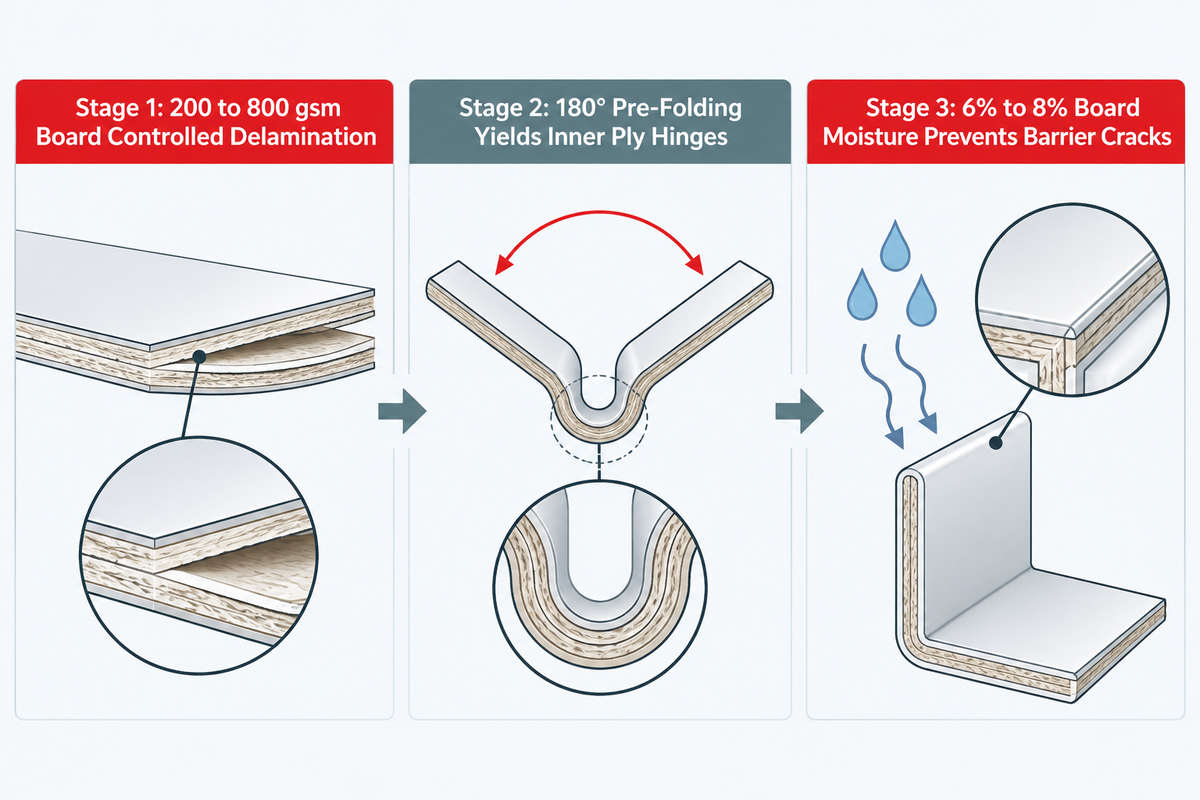
Heavy virgin kraft and dispersion-coated cartonboards exhibit elastic fiber recovery that resists automated folding. Creasing geometry, controlled interlaminar delamination, board moisture and fiber direction affect crease springback and score cracking.
180-degree pre-folding, described by Holmen Iggesund, is said to overcome erecting resistance on filling lines.
For a 200 to 800 gsm paperboard carton replacing a rigid plastic tray, bending performance is a function of material stiffness, board thickness, fiber direction, and carton geometry. There’s reviewed research on converting coated packaging materials by NC State BioResources that shows that brittle barrier layers can become micro-cracked due to mis-matched score geometry. Creasing stresses can depend on folding depth and also can be a function of Machine-Direction versus Cross-Direction (MD/CD) of fibers. Finite element studies on creasing of paperboard suggest that to achieve a perfectly clean fold, the delamination of the layers must happen in a controlled manner. Score performance also can depend on how deep the score is.
Why is full 180-degree pre-folding mandatory when running heavy plastic-replacement paperboard?
Pre-folding breaks the virgin crease stiffness before the carton reaches the final gluing and closing section. Holmen Iggesund’s Paperboard Manual on creasability and foldability explains that low crease bending resistance guarantees low springback. Pre-folding the blank to 180 degrees also reduces erecting resistance on downstream filling lines. On a high-speed folder-gluer, pre-folding the primary score lines to 180° according to the carton dieline yields the inner ply hinges before final closing.
Practitioners on r/Packaging say that without crease delamination and pre-breaking, folded paperboard boxes spring back along the base glue joints. In r/Packaging Design discussions on complex multi-panel cartons, converters also add relief scores and timed folding hooks to heavy flaps to help eliminate twist. Finally, a Michigan State University packaging study on folding boxboard scores confirmed that score stiffness is affected by the width of the scoring rule, the depth of the scoring, and 6% to 8% moisture in the board. Over-drying the board can also increase cracking along the barrier coat.
Folder-Gluer Subsystem Upgrades: Vacuum Feeding, Squaring, Multi-Corner Tooling, and Compression Dwell
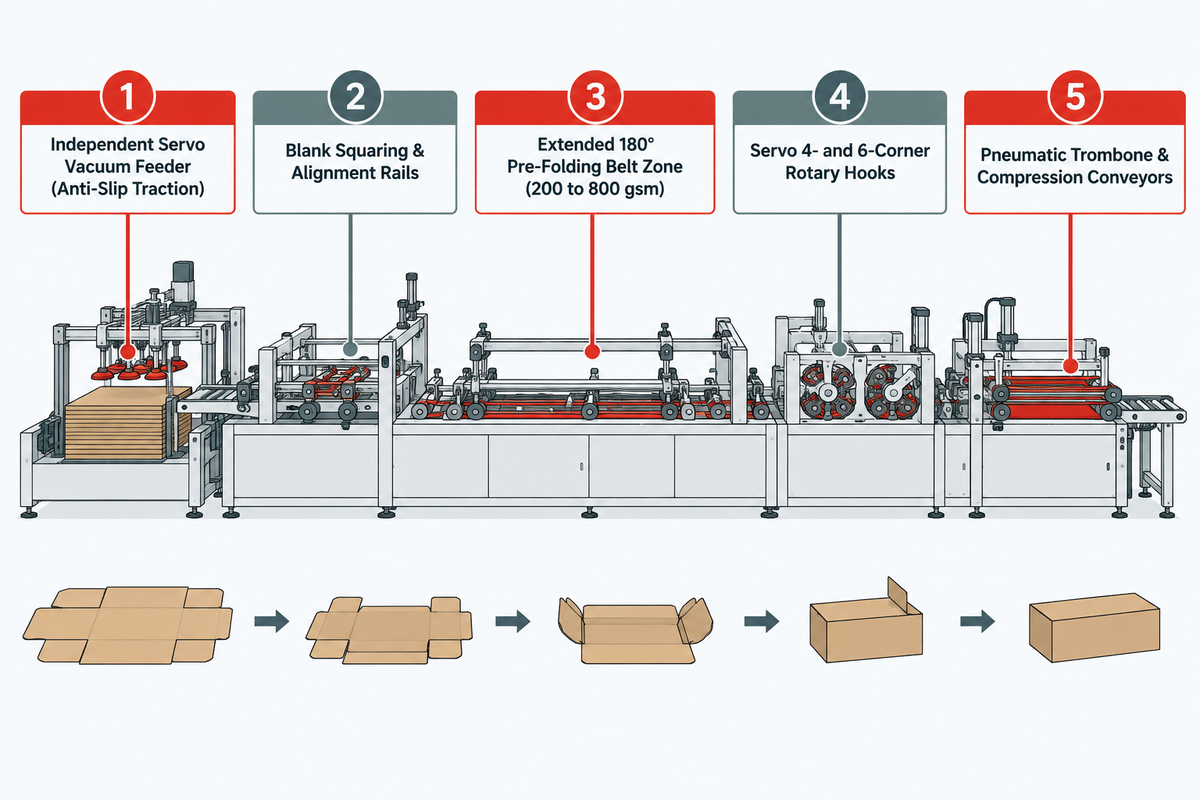
Barrier-coated blanks and multi-corner trays need hardware upgrades when current feeding, folding, adhesive application or compression capacity is insufficient after process adjustments. Key mechanical modules are vacuum-assisted feeding, register-squaring rails, electronic 4- and 6-corner rotary hooks, dual glue applicators and pneumatic compression and dwell control.
Modern folder-gluers use stabilization techniques to help transport rigid carton blanks at high speeds. European patent EP1593482A2 (Folding and feeding station in a folder-gluer) discloses special feeding and folding transport planes for rigid or semi-rigid paperboard containers (CPC classification B31B50/00). In addition, US Patent US8926485B2 describes synchronized individual station controls and inline monitoring to maintain carton blanks square during changes in speed.
What folder-gluer feeder, squaring, and compression upgrades are needed to run barrier-coated paperboard at high speed?
When upgrading a line to run plastic-replacement SKUs at speeds of 180-200 m/min (on CW-W) or up to 400 m/min (on CW-G), the following five mechanical subsystems should be inspected across the high-speed folder gluer machine range:
- Independent servo vacuum feeder: Vacuum assistance on the feeder increases contact force and improves traction for coated blanks that tend to slip on the belts. Slippage can occur with any feeding system, if the required feeding force is greater than the available friction.
- Blank squaring and alignment rails align multi-corner food trays and hexagonal containers before the die-cut blank enters the pre-folding belts.
- Extended 180° pre-folding belt transition zones gradually fold primary scores to decrease the risk of outer-ply cracking on 200 to 800 gsm boards.
- Servo-synchronized 4- and 6-corner rotary hooks fold rear gussets cleanly on multi-corner tray styles, as detailed in our 4- and 6-corner folder gluer guide.
- Pneumatic trombone and compression conveyors regulate belt holding pressure evenly while dispersion adhesives set across variable shingle heights.
For E, F, or N microflute converting with solid cartonboard, carrier frames, and upper belt clearances must accommodate microflute corrugated caliper, as detailed in our corrugated folder gluer guide.
Standalone Folder-Gluer Retrofits vs. Integrated Automatic Packaging Lines for Paperized SKUs
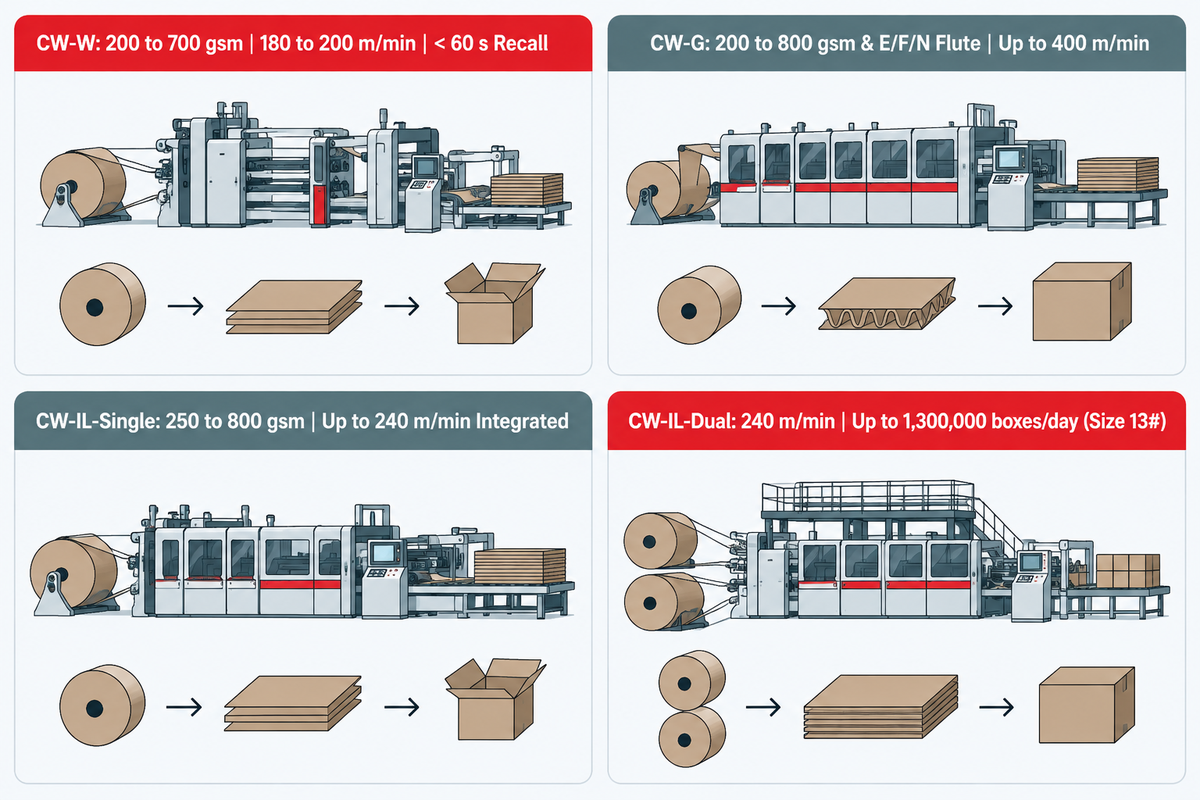
Plants apply the 4-Gate Folding Carton Paperization Audit to choose between retrofitting a standalone folder-gluer and deploying an integrated automatic packaging line. Upgrades to standalone equipment featuring under 60 second servo changeovers are suitable for multi-SKU short runs. Dual-channel integrated lines maximize throughput up to 1,300,000 boxes/day for high-volume paperized cartons.
Flexible paper-wrapping machines (such as Sitma Machinery mailers) serve flat pouches, whereas rigid retail packaging requires die-cut folding carton machinery. Founded in 2011 in Wenzhou, Zhejiang, Zhejiang Chengwang Intelligent Packaging Equipment (Cenwan Machine) manufactures standalone folder-gluers and turnkey automatic packaging line systems. The CW-IL-Dual dual-channel folder-gluer line complies with Machinery Directive 2006/42/EC and EN 415-1:2014.
How should carton plants evaluate standalone folder-gluers versus integrated automatic packaging lines when scaling paper packaging?
Plants should opt for a standalone folder-gluer for frequent multi-SKU short runs and a dual channel integrated line for high volume paperized food and e-commerce cartons. Integrated lines connect upstream die-cut blank feeding with high-speed folding, gluing, counting, and case strapping up to 1,300,000 boxes/day at size 13#. Apply the 4-Gate Folding Carton Paperization Audit prior to capital expenditure.
- Gate 1 (Structural Format & Board Grade Equivalence): Match each SKU to the specific machine. CW-W lists 200 to 700 gsm board and E/F flute, while CW-G lists 200 to 800 gsm board and E/F/N flute.
- Gate 2 (Dispersion Barrier Coating vs Repulpability Grade) differentiates glueability from repulpability. Surface treatments may support adhesion, and the 2025 4evergreen evaluation explores the board, coating, and adhesive structure.
- How frequently crews change box styles is analyzed in Gate 3. Motors Servo carriers with under-60-second recall on the CW-W (180 to 200 m/min) cut downtime on multi-SKU runs.
- Gate 4 (Upstream & Downstream Line Integration) analyzes standalone manual packing versus the integration of pre-feeders and high-speed gluing and strapping within a CW-IL running up to 240 m/min with 1 to 2 operators.
| Converting System / Station | Board & Flute Range | Rated Speed / Output | Order Changeover | Primary Paperization Use Case & Reference CAPEX |
|---|---|---|---|---|
| Cenwan CW-W Box Folding & Gluing Machine | 200 to 700 gsm board; E/F flute | 180 to 200 m/min | < 60 s motorized servo recall | Frequent SKU changeovers, crash-lock & 4/6-corner runs (USD 40,000–80,000 FOB) |
| Cenwan CW-G High-Speed Folder Gluer | 200 to 800 gsm board; E/F/N flute | Up to 400 m/min belt speed | Manual / semi-auto carrier setup | Long-run beverage carriers, heavy kraft sleeves, retail cartons (USD 35,000–75,000 FOB) |
| Cenwan CW-IL-Single Packaging Line | 250 to 800 gsm board; E/B/C/AB flute | Up to 240 m/min integrated | Automated recipe sync | Single-channel automated folding, gluing, counting, and strapping (USD 80,000–160,000 FOB) |
| Cenwan CW-IL-Dual Packaging Line | 250 to 800 gsm board; E/B/C/AB flute | 240 m/min (up to 1,300,000 boxes/day at size 13#) | Dual-channel recipe sync | High-volume e-commerce mailers & food cartons with 1–2 operators (USD 140,000–280,000 FOB) |
| Inline Plasma / Corona Pretreatment Unit | Dispersion, PE, or varnished flaps | Synchronized with CW-G up to 400 m/min | Zero mechanical changeover | Raises glue-flap surface energy for cold-glue wetting |
| Dual Cold-Glue + Hot-Melt Extrusion System | Coated barrier board with low water uptake | High-frequency nozzle switching | Digital pattern recall | Uses hot-melt dot for early holding strength while cold glue dries |
| 4/6-Corner Electronic Rotary Hook Module | 200 to 700 gsm FBB / SBS / CUK | 180 to 200 m/min on CW-W | Servo phase adjustment | Folds multi-corner trays replacing plastic clamshells and punnets |
| Optical Glue Inspection & Pneumatic Ejector | All coated & uncoated carton grades | Single-blank rejection up to 400 m/min (CW-G) | Saved with job recipe | Detects missing or shifted glue beads and ejects faulty blanks before packing |
Quality Control, Fiber-Tear Verification, and Plant Readiness Checklist for Plastic-to-Paper Conversions
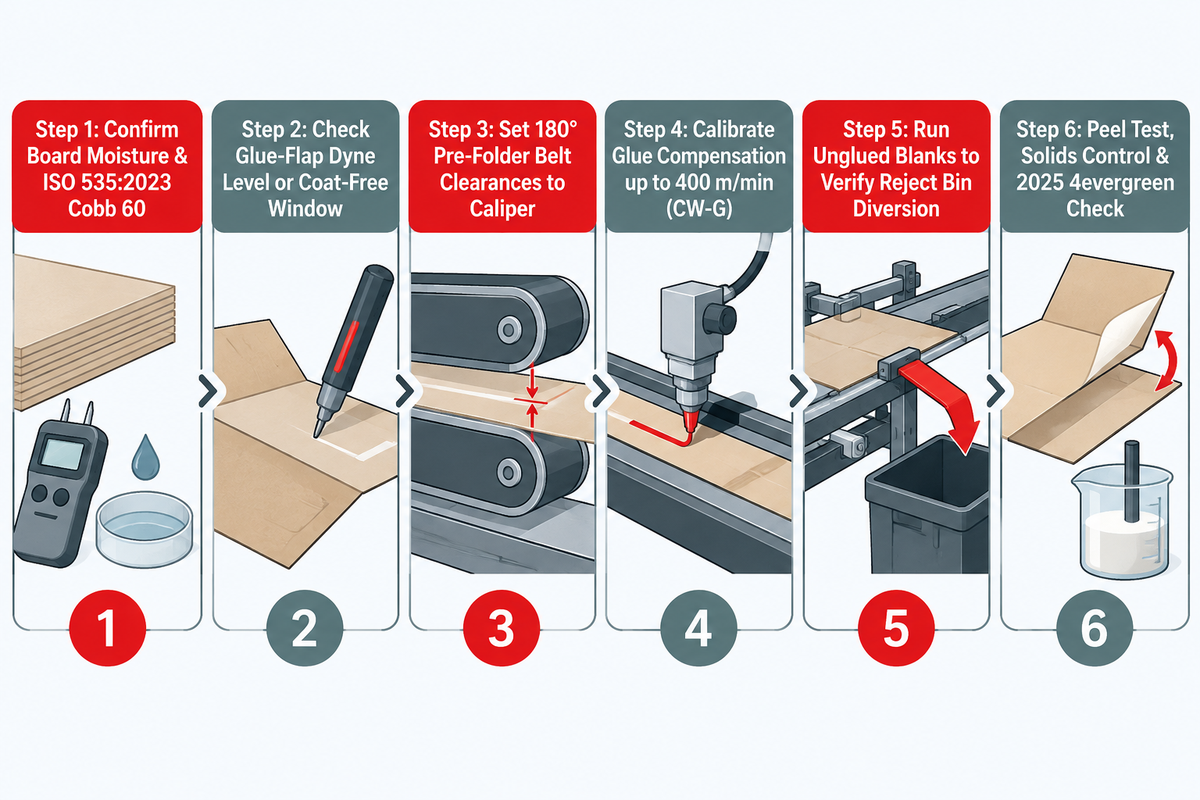
High speed barrier paperboard production requires closed-loop glue inspection and conditioned bond testing. For cold-chain cartons, the integrity of the barrier coating and adhesive joint needs to be assessed during freezer storage and the transition to ambient conditions. Quality teams perform tests to assess joint strength and the ability to withstand a sustained load to open the joint prior to batch release.
Dispersion-coated board can’t be assessed by a visual inspection at the delivery belt. The adhesive joint can pop open later in cold storage, especially if the adhesive only bonds to the topcoat.
How do inline glue-inspection cameras and fiber-tear tests prevent cold-chain carton pop-opens?
Inline infrared or optical glue sensors monitor bead presence, position, and width on blanks on high-speed folder-gluer machines. When the controller detects a missing bead or skew, a high-speed pneumatic ejector removes that single blank before it enters the compression stack. Simultaneously, conditioned cartons are removed for destructive peel tests. Bond qualification tests are performed to assess the joint and support the integrated process. Fiber tear and delamination of the coating identify the point of failure.
Use this pre-production readiness checklist before starting a plastic-to-paper carton run:
- Confirm board moisture and ISO 535:2023 Cobb 60 batch certificate against paper mill datasheet and load feeder accordingly.
- Check glue-flap dyne level after plasma treatment or ensure coat-free glue lap window registration to allow cold glue to wet the substrate.
- Set 180° pre-folder belt clearances to exactly match blank caliper to avoid crushing micro flutes or cracking barrier coats.
- Calibrate encoder glue-pattern compensation across setup speed and rated speed (up to 400 m/min on Cenwan CW-G) to maintain bead placement. Control glue quantity, nozzle shutoff, adhesive rheology and compression to control tailing and squeeze out.
- Run unglued blanks through the system at rated speed to inspect diversion of defects into the reject bin.
- Bond performance is assessed through peel tests. Gluing consistency is monitored through adhesive solids control. The 2025 4evergreen protocol assesses the recyclability of packaging, and EN 643 specifies grades for recovered papers. For spare belts, nozzles, or retrofit support, contact our folder gluer parts and service specialists.
Frequently Asked Questions About Plastic-to-Paper Packaging and Folding Carton Automation
Can existing straight-line folder-gluers run water-based dispersion barrier paperboard without hardware modifications?
Existing straight-line folder-gluers can run dispersion-coated blanks when feeding, folding, and compression capacity are sufficient and glue flaps use compatible adhesives or coat-free windows.
There are three process variables that determine whether hardware upgrades are necessary when converters run aqueous dispersion barrier board at elevated belt speeds. First, if slick barrier topcoats slip against worn feeder belts, vacuum-assisted feed belts increase contact traction. Second, a low Cobb value on the glue-contact face indicates limited water uptake. In this case, the plant can implement inline plasma treatment or use a copolymer dispersion adhesive. Third, heavier board springback may require a hot-melt tacking gun or extended pneumatic compression dwell to prevent pop-opens.
Why do paperboard cartons replacing plastic clamshells require 4-corner or 6-corner folder-gluer modules?
Thermoformed plastic clamshells rely on molded sidewalls, which flat paperboard replicates through multi-corner gusseted or webbed tray folds.
A straight-line folder-gluer folds parallel creases only along the transport direction. Paperboard replacements for plastic produce punnets include multi-corner folded cartons and deep-drawn trays. Hinged takeout cartons can use 6-corner folded designs, where the barrier layer and corner seals provide leakage resistant closure. Folding rear diagonal gussets on multi-corner trays (at transport speeds of 180-200m/min on the Cenwan CW-W) uses back-folding hooks and timed glue nozzles. A squaring section then aligns corners of the trays for tray denesters.
What is the difference between PE-laminated paperboard and dispersion-coated board in recycling and gluing?
Dispersion-coated paperboard uses a waterborne barrier coating, whereas PE lamination adds a plastic film layer; repulpability depends on the complete package and the receiving mill process.
Extrusion-laminated polyethylene (PE) bonds a continuous plastic film layer to the paperboard surface. The PE film can hinder wetting and fiber release and remain as a non-fiber reject during pulping. Meanwhile, EN 643 classifies recovered-paper feedstock and specifies allowances for non-paper components. Dispersion-coated paperboard forms a barrier as the waterborne coating dries. In the cited 2022 MDPI Coatings research, double-coated paperboard achieved a WVTR of 240 g/(m²·day) at 23 °C under high humidity, and a brief alkaline immersion-and-rinsing test still left double-layer coating residue. For commercial cartons, the 2025 4evergreen protocol evaluates the complete bonded structure.
How does paperboard moisture content affect score cracking during high-speed folding?
Conditioned board moisture supports foldability; over-drying increases cracking risk during 180-degree pre-folding.
According to a Michigan State University study, score stiffness is a result of scoring rule width, penetration depth, and 6% to 8% board moisture, as well as fiber orientation.
When should a converter choose microflute (E, F, or N flute) over solid folding boxboard when replacing plastic?
Choose E, F, or N microflute board when replacing rigid plastic inserts that require high stacking strength.
Fragile electronics, glass cosmetics, and heavier shipments use E, F, or N microflute (converted up to 800 gsm on Cenwan folder-gluers) for vertical stacking compression.
Upgrade Your Folding Carton Line for Plastic-to-Paper Packaging Runs
Send our converting engineers your target plastic-replacement dieline, paperboard grade (200 to 800 gsm or E/F/N microflute), barrier coating Cobb specification, and daily output target.
References & Sources
- New EU rules on packaging enter into application (Regulation (EU) 2025/40), European Commission Directorate-General for Environment, 2025–2026.
- EU PPWR, Packaging and Packaging Waste Regulation Guide, UK Government Department for Business and Trade, 2025.
- 4evergreen Published Updated Recyclability Evaluation Protocol, 4evergreen Alliance, January 31, 2025.
- Cepi Publishes Update to European Recyclability Laboratory Test Method, Confederation of European Paper Industries (Cepi), 2025.
- Benchmarking barrier coatings for paper packaging: From biopolymers and nanomaterials to bionanocomposites, Progress in Organic Coatings (ScienceDirect), 2026.
- About Gas Barrier Performance and Recyclability of Waterborne Dispersion Coatings on Paperboard, MDPI Coatings, 12(12), 1841.
- Converting and its effects on barrier properties of coated packaging materials: A Review, NC State University BioResources.
- Paperboard Manual: Creasability and Foldability, Holmen Iggesund Technical Reference.
- The stiffness of folding boxboard scores as a function of scoring rule, makeready, depth of penetration, and moisture content, Michigan State University Libraries ETD.
- Single-use supermarket food packaging and its alternatives: Recommendations from Life Cycle Assessments, UNEP Life Cycle Initiative, 2023.
- Paper Packaging Market Size, Share & Growth Report, 2026–2034, IMARC Group, 2026.
- EP1593482A2: Folding and feeding station in a folder-gluer, European Patent Office / Google Patents.
- US8926485B2: Folder gluer and method for controlling individual stations, United States Patent and Trademark Office / Google Patents.