Get in touch with Cenwan Machine Company


Updated October 2026. Reviewed by the CENWAN technical team.
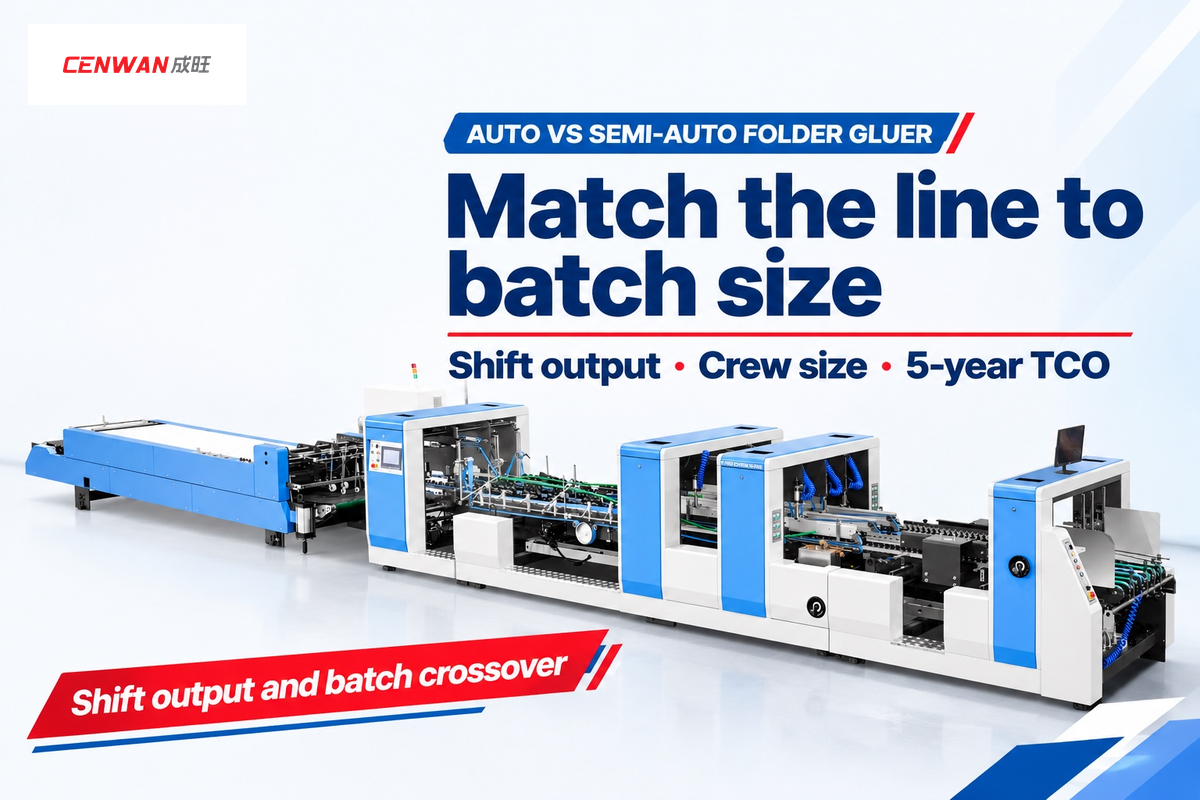
An Auto vs Semi-Auto Folder Gluer comparison evaluates how feeding, pre-folding, gluing, and compression stations are mechanized. An automatic folder gluer machine feeds, folds, glues, and compresses carton box blanks continuously. High-speed models reach maximum belt speeds of 300 to 400 meters per minute depending on configuration. Specific hardware such as 180-degree pre-folding, multi-gun adhesive systems, and pneumatic compression depends on the selected model and carton style. A semi-automatic folder gluer mechanizes adhesive application and pressing. Operators still feed sheets, fold flaps, or stack bundles manually, producing around 8,000 to 12,000 finished cartons per 8-hour shift (Sinosun). Matching box folding automation to high-volume production or short-run flexibility drives efficient packaging, production efficiency, and overall efficiency in the packaging industry. In the global packaging world, evaluating industry reports, recent reports, or any recent market report still comes back to aligning an auto folder gluer machine with actual carton production batch sizes.
Direct Comparison Summary: When the running-time savings of an automatic box gluing machine outweigh the additional setup time, a batch is completed in less time than with a semi-automatic machine. Setup times on semi-automatic machines involve short manual adjustments compared to longer initial multi-station setup on manual-carrier automatic lines unless presets cut repeat-job time (Ouye). While short-run guides flag average orders below 3,000 to 5,000 cartons for semi-auto, our two worked straight-line time examples yield crossover quantities of 488 and 1,543 cartons. Long repeat runs favor automatic equipment when multi-year labor cost savings justify the investment. Short runs, frequent daily changeovers and jumbo two-piece corrugated blanks favor semi-automatic equipment.
Quick Decision Snapshot: Auto vs Semi-Auto Folder Gluer
| Machine Class & Comparison Tier | Semi-Automatic Folder Gluer | Fully Automatic Folder Gluer |
|---|---|---|
| Active Running Rate (While Producing) | 2,000–4,000 boxes/hr (excludes setup and stops) | 8,000–20,000 boxes/hr standard (up to 300–400 m/min max belt speed) |
| Net Shift Output (8-Hour Shift) | 8,000–12,000 cartons/shift (1,000–1,500 boxes/hr shift average) | 60,000–100,000+ cartons/shift (7,500–12,500+ boxes/hr shift average) |
| Crew Size per Line | 4–8 operators/shift (covering feed and manual pre-folding/bundling) | 1 lead operator + 1 outfeed packer (with automated collection/bundling) |
| Typical Setup Changeover | Short manual rail and glue roller adjustment | Longer manual straight-line / crash-lock setup (5–15 min servo recall) |
| Time vs Economic Crossover Basis | Finishes sooner below the batch time-crossover threshold | Finishes sooner above Q*; costs less when labor savings exceed CapEx gap |
| Supported Box Styles | Straight-line (FEFCO 0201) and two-piece cartons; complex boxes need manual steps | Straight-line, crash-lock bottom (0711), 4-corner, and 6-corner cartons |
| Substrate & Flute Window | Single-wall and warped AB/BC double-wall corrugated sheets | 200–800 gsm solid board and N, F, E, B, C, AB corrugated flutes |
| CENWAN Model Width Window | Not a semi-automatic gluing machine (every model is fully automatic) | 130–650 mm (CW-G-650) up to 290–1,450 mm (CW-W-1450PCW) |
| Published Machine Footprint & Power | Compact frame; verify exact length and kW rating on model datasheet | 14.4–16.4 m length, 6,400–7,800 kg weight, 21.5–25.5 kW (CW-G series) |
| Equipment Price & Payback Basis | Varies by blank width and feeder drive (request a quotation) | Varies by station modules and servo options (request a quotation) |
Auto vs Semi-Auto Folder Gluer at a Glance: 4-Station Automation Boundary Matrix
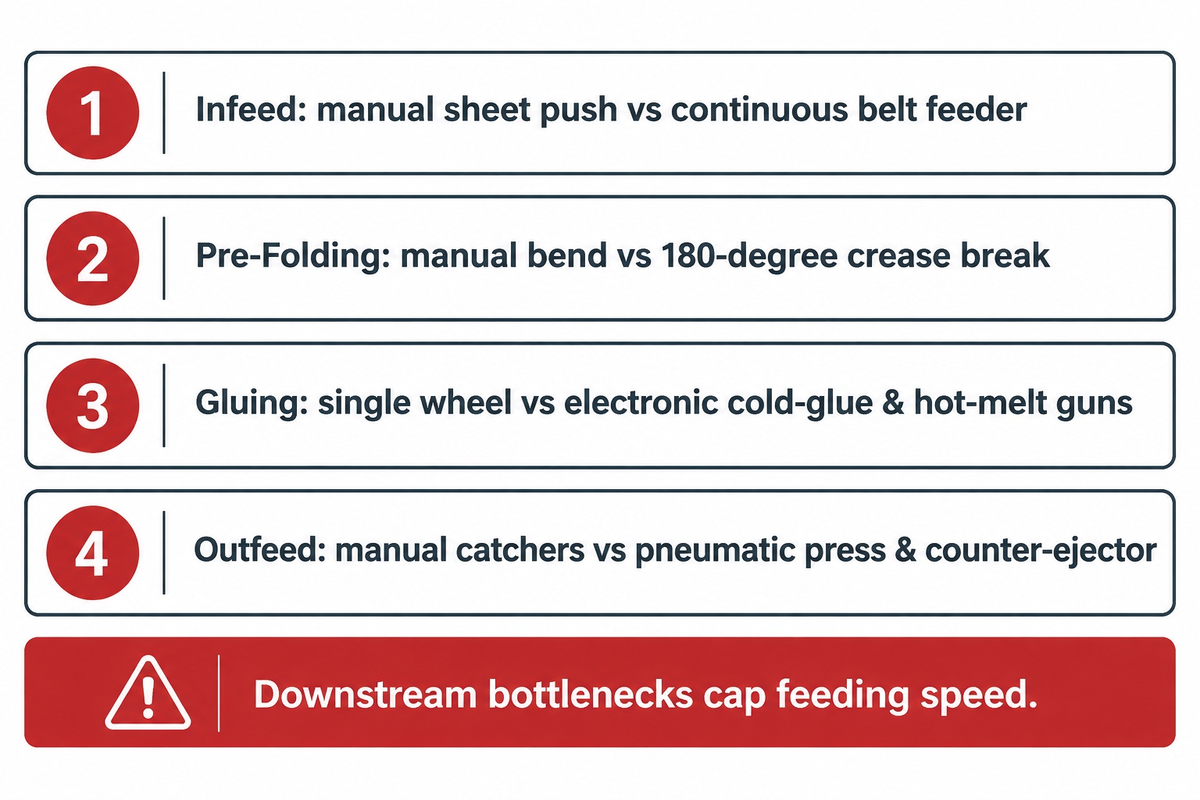
An automatic folder gluer automates feeding, folding, gluing, and compression in a continuous chassis. High-speed carton models reach belt speeds of several hundred meters per minute (Pulp & Paper Technology), up to 400 meters per minute on CENWAN CW-G models. Machine-specific hardware such as 180-degree pre-folding, multi-gun gluing, and pneumatic compression varies with the selected configuration. A semi-automatic folder gluer mechanizes adhesive application and pressing. Sheet feeding, flap folding, or bundle collection, however, is left under operator control.
Buyers usually get confused by the naming practice of suppliers, who give the name “semi-automatic” to three different machine classes. One subtype is a table top or belt-fed paste roller in which workers manually fold every carton box. The second subtype is a corrugated gluer that feeds single-wall sheets and relies on manual collection. The third subtype is a two-piece gluer for large double wall boxes. Even when comparing top brands with smart technology, buyers should map each quote against our 4-Station Automation Boundary Matrix.
Standalone carton and corrugated folder gluers also vary from inline flexo folder gluers (FFGs). An inline FFG integrates flexographic printing, slotting, folding and gluing in a continuous corrugated box line. A rotary die-cutting unit may also be incorporated. Standalone folder gluers accept pre-printed, die-cut blanks from a flatbed cutting machine located upstream. Representative mechanisms for prefeeding and orienting corrugated board stacks are illustrated in US Patent 8,418,834 B2. Pulp & Paper Technology provides technical insights on folder gluer machinery for folding pre-creased blanks into a flat-collapsed carton.
| Station | Semi-Auto Manual-Fold Gluer | Semi-Auto Belt Corrugated Gluer | Fully Automatic Folder Gluer (CENWAN CW Series) |
|---|---|---|---|
| 1. Infeed & Alignment | Operator pushes single sheets into glue roller by hand | Manual stack loading; intermittent belt or vacuum-assisted feed | Continuous friction or vacuum-assisted feeder belts with alignment gauge |
| 2. Pre-Folding & Crease Break | None; operator bends score lines manually | Folds two main score lines flat (~180 degrees); no pre-folder section | 180-degree first crease and 135-to-180-degree third crease pre-folding (model dependent) |
| 3. Gluing & Crash-Lock Assembly | Single cold-glue wheel or hot-melt applicator | Glue wheel or cold-glue nozzle for side seam | Lower cold-glue wheel or electronic cold-glue and hot-melt guns |
| 4. Compression & Outfeed | Compression provided by a separate press or belt section | Pressing belt section; catchers count and bundle by hand | Transfer and pneumatic compression sections with batch counter-ejector |
When evaluating automatic folder gluer machine configurations, determine the capacity of every station on the quotation sheet. Automatic feeding will create a bottleneck downstream at folding, compression, or outfeed when capacity is less than the feeding rate.
Belt Speed vs Net Shift Output: Why m/min Ratings Diverge from Actual Boxes per Hour
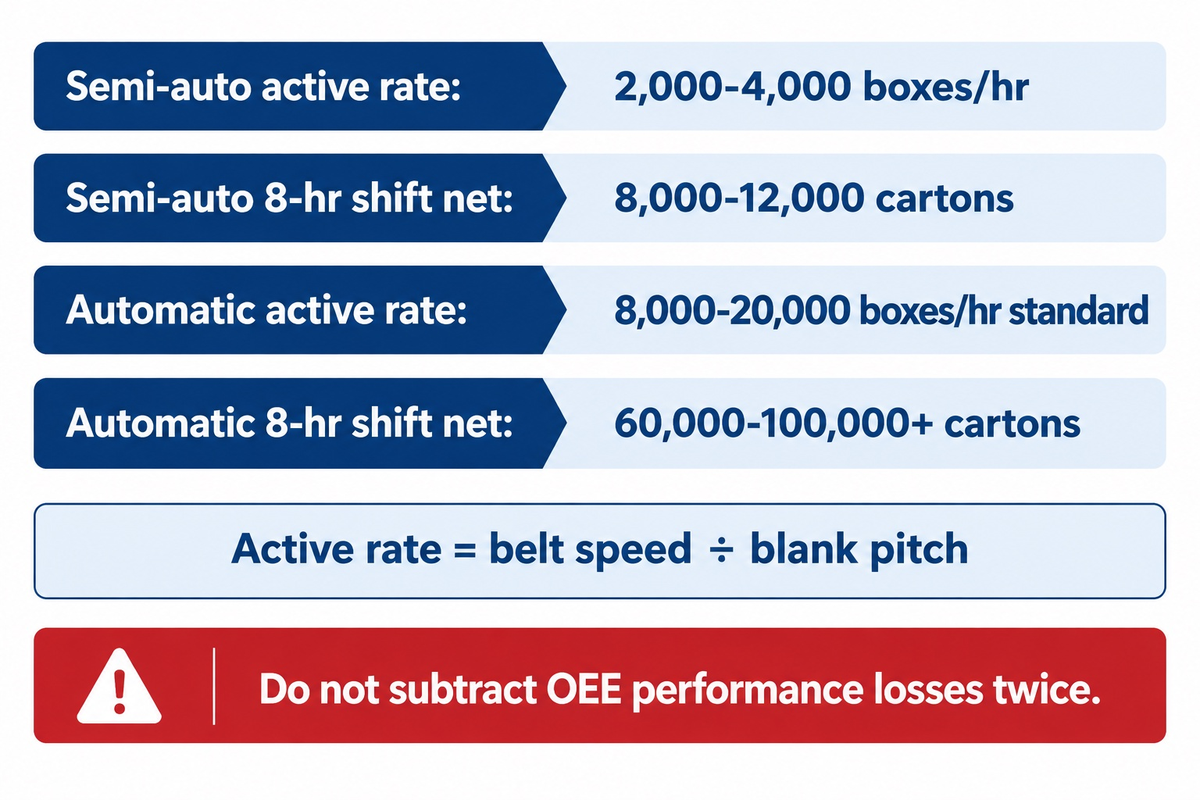
Semi-automatic folder gluers run at an active running rate of 2,000 to 4,000 boxes per hour while producing (Ouye). Post changeovers and stops, net shift totals are 8,000 to 12,000 cartons per 8-hour shift (Sinosun). This equates to a shift average output of 1,000 to 1,500 cartons per hour. Fully automatic folder gluers can actively run at rates of 8,000 to 20,000 boxes per hour on standard jobs (Ouye), and higher on small folding cartons. With automated outfeed, continuous lines produce three to four times semi-automatic output (FoldingGluing) and plan around 100,000 cartons per day.
Ratings in meters per minute (m/min) measure belt velocity rather than finished box production. Matching production speed to production needs on your production line protects both output quality and operational efficiency. To convert belt velocity into active running rate, divide belt speed by the blank pitch (open carton length plus feed gap between sheets). Because blank pitch increases with carton length, shorter folding cartons achieve higher hourly piece counts than long corrugated blanks at the same belt speed (Pulp & Paper Technology).
For an 8-hour shift, net good output equals the ideal hourly rate multiplied by 8 hours and Overall Equipment Effectiveness (OEE). However, if actual running rate is used instead, multiply that rate by the actual running hours and the quality rate. Do not subtract performance losses twice. According to supplier comparisons from FoldingGluing, manual feeding caps operators at a speed of 30 to 40 sheets per minute. Fatigue, stack replenishment, and setup stops generally result in semi-automatic output of 8,000 to 12,000 cartons in an 8-hour shift (Sinosun).
| Machine Class & Carton Format | Nameplate Speed | Active Running Rate (Excl. Setup) | Net 8-Hour Shift Output (Incl. Stops) |
|---|---|---|---|
| Semi-Auto Manual-Fold (Corrugated RSC) | Up to 70 m/min | 25–35 boxes/min (1,500–2,100/hr) | 8,000–10,000 cartons/shift (1,000–1,250/hr avg) |
| Semi-Auto Belt-Fed Gluer (Medium Box) | Up to 120 m/min | 35–58 boxes/min (2,100–3,500/hr) | 8,000–12,000 cartons/shift (1,000–1,500/hr avg) |
| Automatic Crash-Lock Mode (0711 Carton) | Up to 250 m/min | 200–350 boxes/min (12,000–21,000/hr) | 60,000–85,000 cartons/shift (7,500–10,625/hr avg) |
| Automatic Straight-Line Mode (Small Carton) | 300–400 m/min | 400–600 boxes/min (24,000–35,000+/hr) | 85,000–100,000+ cartons/shift (10,625–12,500+/hr avg) |
How Do Automatic Gluing Machine Results Compare With Manual Tables on Hard Data?
An automatic gluing machine can produce 8,000 to 20,000 finished cartons per hour on standard runs (Ouye), or three to four times semi-automatic output (FoldingGluing). It uses 1 lead operator and 1 outfeed packer when automated collection and packing equipment handles the output. Manual gluing tables yield 300 to 800 cartons per hour per worker. Semi-automatic units run at 8,000 to 12,000 cartons per 8-hour shift with 4 to 8 workers when feed, fold assist, and off-line bundling are included (Sinosun).
For packed pallets, high running speed requires adequate outfeed. Manual inspections, bundle stacking, and hand transfer at outfeed limit line output for small cartons per hour (ME-Industry). Assumptions about high line output require automated bundling or additional outfeed. When downstream packing capacity is less than that of the folder gluer, operators adjust the line speed to match. Interruptions in upstream corrugated stack prefeeding (US Patent 8,418,834 B2) or blank feeding on high-speed folder gluer models also impact line output.
Crew Size, Ergonomics, and Annual Labor Cost per 1,000 Cartons
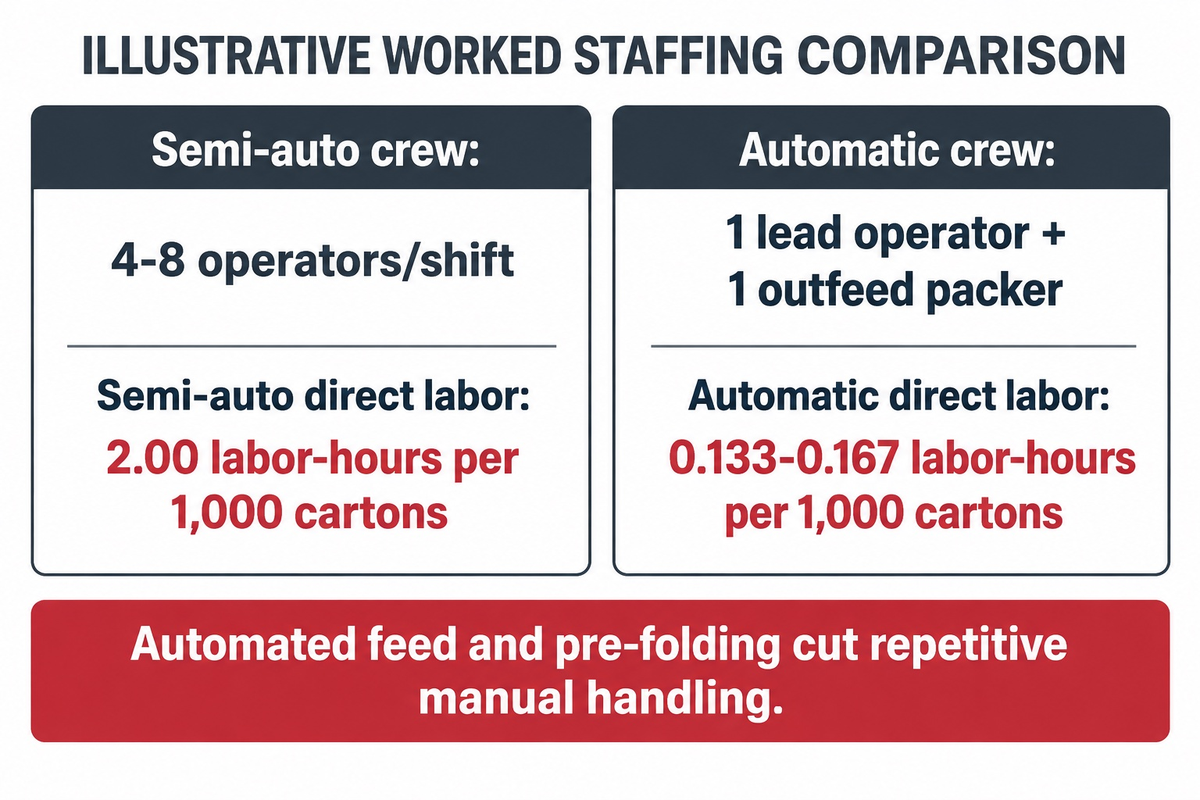
A semi-automatic folder gluer typically requires 4 to 8 operators per shift (covering feed, manual pre-folding, glue watch, and off-line bundling) to feed blanks, fold flaps, square joints, and bundle boxes (Sinosun). Under Table 4’s staffing and output assumptions, a fully automatic folder gluer uses 1 lead operator and 1 outfeed packer with automated bundling. That staffing change reduces direct labor from 2.00 to approximately 0.133 labor-hours per 1,000 cartons.
On a semi-automatic line, manual labor pace limits machine throughput. One feeder lifts die-cut stacks, two folders bend flaps to the glue wheel, and one to three catchers count and tie bundles. Implementing an automatic folder gluer would provide more floor staffing flexibility, boost productivity, and improve efficiency and precision through easy operation.
Ergonomic fatigue also limits manual shift output. Repetitive hand folding, awkward postures, and twisting the torso are workplace risk factors for musculoskeletal disorders, according to the U.S. Occupational Safety and Health Administration. By contrast, ISO/DIS 3153 (ISO Catalog 79507) addresses posture assessment only for seated industrial workers in whole-body vibration environments rather than standing gluer crews. The automated feeder and pre-folding stations reduce repetitive manual handling. Interlocked guards still need to be maintained on the gluer during the cleanup and jam clearing process.
“In the workplace, the number and severity of MSDs resulting from physical overexertion, and their associated costs, can be substantially reduced by applying ergonomic principles.”
| Staffing & Productivity Metric | Semi-Auto Line (4-Person Crew) | Automatic Line (2-Person Crew + Auto Bundling) |
|---|---|---|
| Active Operators per Shift | 4 workers (1 feeder, 2 folders, 1 bundler; up to 6–8 on complex jobs) | 2 workers (1 lead operator, 1 outfeed packer with auto-bundling) |
| Two-Shift Active Headcount (4,000 hrs/yr) | 8 station workers across 2 shifts | 4 station workers across 2 shifts |
| Assumed Net Output per Hour | 2,000 cartons/hour | 12,000 to 15,000 cartons/hour |
| Direct Labor-Hours per 1,000 Cartons | 2.00 labor-hours per 1,000 cartons (4 / 2,000 × 1,000) | 0.167 labor-hours (at 12,000/hr) to 0.133 labor-hours (at 15,000/hr) |
| Direct Labor Cost per 1,000 Cartons | 2.00 × local loaded hourly wage rate | 0.133 to 0.167 × local loaded hourly wage rate |
Our guide on folder gluer operator staffing and workflow provides role descriptions and shift handoff checklists.
Changeover Time and the Batch-Crossover Time Equation for Short vs Long Runs
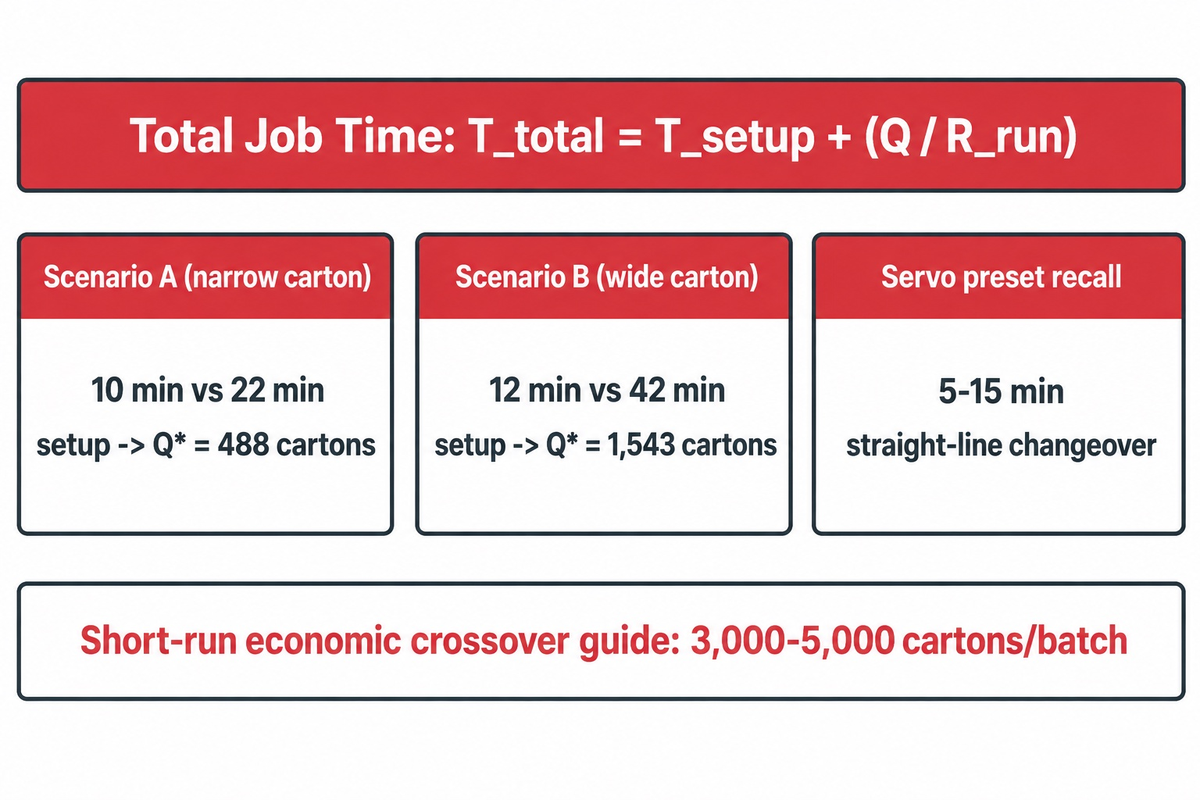
A semi-automatic folder gluer sets up through short manual adjustments (Ouye). By contrast, a manual-rail automatic folder gluer requires longer multi-station setup for straight-line cartons and crash-lock boxes unless servo presets cut repeat setup time. While short-run cost guides flag average orders below 3,000 to 5,000 cartons per batch for semi-automatic machines, our two specific worked examples below yield single-batch time crossovers of 488 and 1,543 cartons.
Short-run converters often ponder if small batches warrant a full automatic machine. Ease of operation during rail adjustments helps save costs on fragmented schedules. Buyers, however, have to distinguish time crossover from economic crossover. Time crossover pertains to which machine completes a batch in the shortest wall-clock time. Economic crossover pertains to which machine results in the greater savings over the life of the equipment, taking into account the setup, labor and equipment costs. To determine the lot size where the total job minutes are equal, use the Batch-Crossover Time Equation.
Batch-Crossover Time Equation (Active Running Rate Basis):
Total Job Time: Ttotal = Tsetup + (Q / Rrun)
Crossover Batch Quantity: Q* = (Tsetup,auto − Tsetup,semi) / [ (1 / Rrun,semi) − (1 / Rrun,auto) ]
Where Tsetup is the time for a setup and first article trial (minutes), and Rrun is the active running rate (boxes/minute) during steady production (excluding setup stops).
Consider two illustrative worked shop-floor examples of straight-line carton style extending qualitative changeover concepts in Ouye’s short-run analysis:
- In Scenario A for a narrow straight-line carton, semi-auto setup is 10 min at 35 boxes/min (2,100/hr). Manual-carrier automatic setup is 22 min at 250 boxes/min (15,000/hr). The 12-minute setup gap and 0.02457 min/box inverse speed difference yield a time crossover of Q* = 12 / 0.02457 ≈ 488 cartons.
- In Scenario B for a wide straight-line carton requiring full carrier and pre-fold rail repositioning, automatic setup is 42 min at 180 boxes/min (10,800/hr) versus 12 min at 40 boxes/min (2,400/hr) on semi-auto for the identical straight-line box. That 30-minute setup gap yields a time crossover of Q* = 30 / (1/40 − 1/180) ≈ 1,543 cartons. Should a plant compare a crash-lock carton across both routes, the semi-automatic side is comparable only when all manual pre-folding and spot-gluing steps, labor, setup time, and reduced manual throughput are incorporated in the semi-automatic total.
Actuators transversely positioning belt pairs on individual processing stations, as described in US Patent 8,926,485 B2 (Heidelberger Druckmaschinen AG), reduce manual rail adjustment effort. In combination with stored servo preset recall, full-servo systems can reduce straight-line job changeovers to the 5 to 15 minute range.
| Order Batch Size (Q) | Semi-Auto (12 min setup, 40 pcs/min) | Standard Auto (42 min setup, 180 pcs/min) | Servo-Memory Auto (15 min setup, 220 pcs/min) |
|---|---|---|---|
| 500 cartons | 24.5 minutes total | 44.8 minutes total | 17.3 minutes total (Fastest) |
| 1,500 cartons | 49.5 minutes total | 50.3 minutes total (Near 1,543 Crossover) | 21.8 minutes total |
| 3,000 cartons | 87.0 minutes total | 58.7 minutes total | 28.6 minutes total |
| 5,000 cartons | 137.0 minutes total | 69.8 minutes total | 37.7 minutes total |
| 25,000 cartons | 637.0 minutes (10.6 hours) | 180.9 minutes (3.0 hours) | 128.6 minutes (2.1 hours) |
When Does an Automatic Box Gluing Machine Beat Manual Processes?
An automatic box gluing machine completes a batch sooner than a semi-automatic machine when running-time savings exceed the additional setup time, and lowers ownership cost when labor savings offset the additional investment.
While manual-carrier automatic lines finish single straight-line batches sooner once running-time savings offset setup, short-run cost guides place economic crossover around the 3,000 to 5,000 cartons per batch window. On micro-runs without motorized carrier recall, setup adjustments consume most of the saved running time (Ouye). Continuous feeding and automated counting release 2 to 4 operators per shift for long, repeat runs.
Paperboard GSM and Corrugated Flute Windows: Folding Carton vs Heavy Corrugated
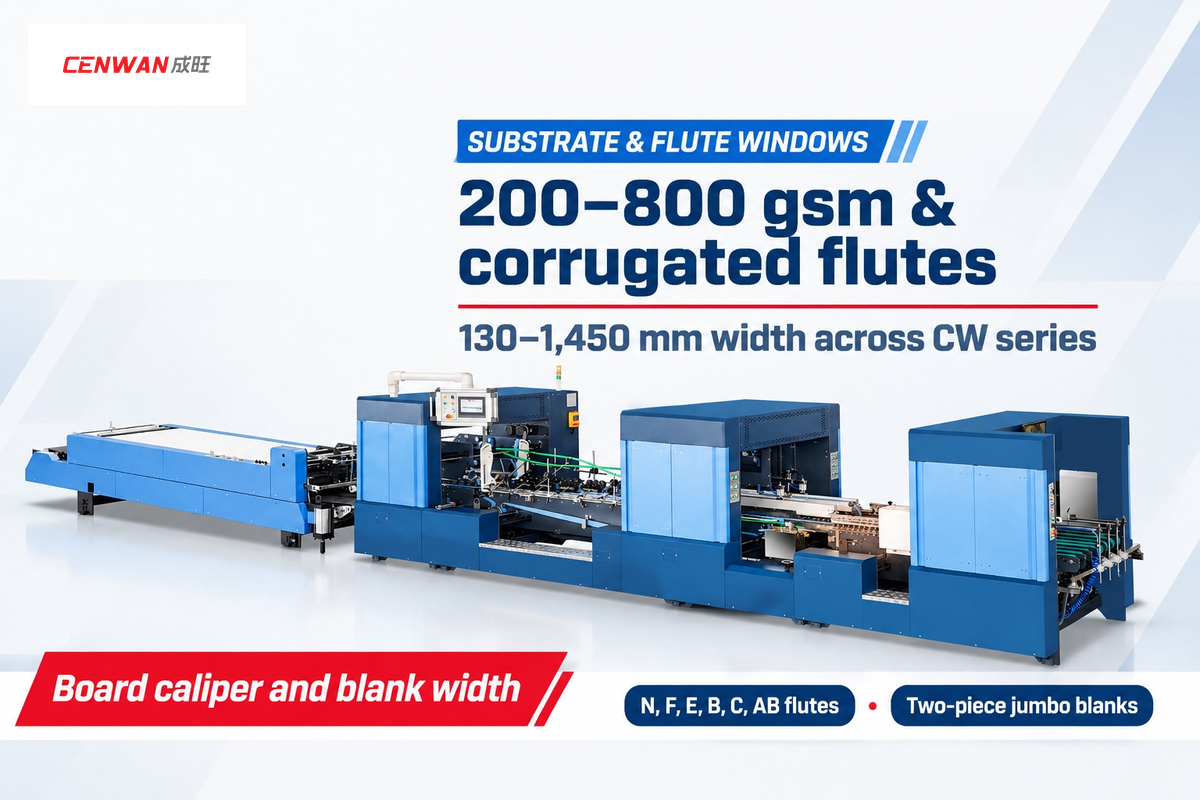
High-speed automatic folder gluers process 200 to 800 gsm solid paperboard and N, F, E, B, C, and AB corrugated flutes. Blank widths span 130 mm to 1,450 mm across the CENWAN CW series. Wide format 2 piece semi-automatic or specialty jumbo gluers are used when oversized 2 piece corrugated blanks exceed single sheet feeder limits.
When evaluating various materials, open blank width and flute caliper are key features to consider. Folding carton plants running 200 to 600 gsm solid board use friction feeders with adjustable gate knives. Corrugated folder gluers can use friction or vacuum assisted feeders for corrugated cardboard. Appropriate feeder clearance and contact pressure help safeguard E, B, C, and AB flutes during feeding when plants specify specialty folder-gluer features (TAPPI proceedings).
Manufacturer-supplied specifications for the CENWAN machine lineup and comparative semi-automatic tiers illustrate how substrate and width windows scale across 10 equipment classes:
| Model / Machine Class & Tier | Published Blank Width Window | Primary Substrate & Flute Range | Typical Packaging Applications |
|---|---|---|---|
| Tier 1: Manual Gluing Table / Paste Roller | Unrestricted manual sheet handling | Single-wall and double-wall corrugated sheets | Sample runs, prototype cartons, micro-batches |
| Tier 2: Semi-Auto Table-Top Folding Gluer | Model-dependent narrow to medium width | Heavy paperboard and E/B/C single-wall flute | Short-run straight-line RSC shipping boxes |
| Tier 3: Semi-Auto Belt-Fed Corrugated Gluer | Medium to wide single-sheet corrugated | E, B, C, and AB double-wall corrugated board | Standard slotted containers (FEFCO 0201) |
| Tier 4: Semi-Auto Two-Piece Jumbo Gluer | Dual-sheet oversized blank configurations | Warped AB/BC double-wall corrugated board | Appliance cartons, furniture boxes, two-piece containers |
| Tier 5: CENWAN CW-G-650 (High-Speed Auto) | 130–650 mm | 200–800 gsm paperboard (cardboard up to 800 gsm) | Pharmaceutical, cosmetic, and small folding cartons |
| Tier 6: CENWAN CW-G-880 (High-Speed Auto) | 140–880 mm | 200–800 gsm paperboard (cardboard up to 800 gsm) | Food cartons, e-commerce mailers, retail boxes |
| Tier 7: CENWAN CW-G-1100 (High-Speed Auto) | 140–1,100 mm | 200–800 gsm paperboard (cardboard up to 800 gsm) | Beverage carriers, medium corrugated crash-lock cases |
| Tier 8: CENWAN CW-W-1250AC-S (Auto Servo Straight-Line) | From 290 up to 1,250 mm | Cardboard up to 800 g and E, F, C, B, AB single/double-wall corrugated board | Wide-format multi-SKU straight-line cartons |
| Tier 9: CENWAN CW-W-1450PCW (4/6-Corner Auto) | 290–1,450 mm | Heavy paperboard and E/B/C/AB corrugated board | Large multi-corner trays, produce boxes, display cartons |
| Tier 10: Inline Flexo Folder Gluer (FFG Line) | Integrated printer-slotter width envelope | E, B, C, and AB corrugated shipping board | High-volume printed regular slotted shipping cases |
To identify feeder types to match flute caliper and blank geometry, view our corrugated folder gluer series.
Box Style Capability: Straight-Line, Crash-Lock Bottom, and 4/6-Corner Cartons
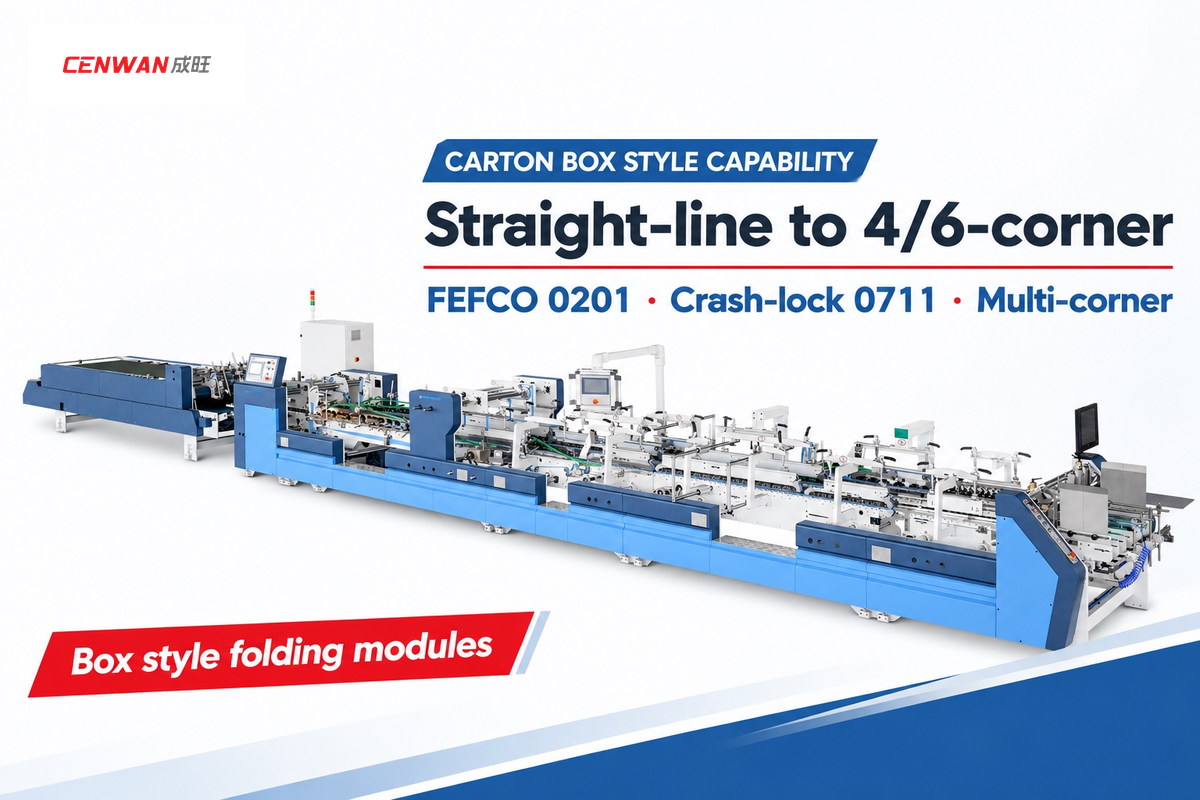
Basic single-seam semi-automatic gluers handle straight-line and two-piece cartons; crash-lock and multi-corner cartons require additional folding and gluing operations, performed manually or by dedicated mechanisms. Automated crash-lock production uses bottom-folding and gluing mechanisms, while automated 4-corner and 6-corner tray production uses corner-folding mechanisms. Side-crease pre-folding helps in preparing cartons for downstream erection.
International buyers of packaging specify carton geometry using the FEFCO Code (12th Edition). A standard slotted container (FEFCO 0201) is made by folding the blank flat approximately 180 degrees on two score lines, so that the manufacturer’s joint can be glued. Both semi-automatic and automatic machines deliver efficient and precise closure on 0201 boxes.
Complex structural styles introduce two mechanical operations that basic single-seam semi-automatic gluers do not automate inline:
- When folding cartons feed into an automatic downstream cartoning line, side creases benefit from pre-breaking. Depending on the geometry of cartons, pre-folding stations slightly pre-fold the first and third panel crease lines so blanks open cleanly (Pulp & Paper Technology), up to 180 degrees on CENWAN automatic pre-folders.
- Automated production of FEFCO 0711 crash-lock bottoms folds bottom tabs with hooks, applies bottom adhesive, and closes side seams in a single pass. For 4-corner and 6-corner trays, motorized untimed electronic back-folding hooks on 4/6-corner folder gluer machines fold trailing corner flaps in phase with each blank.
| Box Style (FEFCO / ECMA Class) | Folding & Pre-Fold Geometry | Basic Single-Seam Semi-Auto | Automatic Multi-Section Gluer |
|---|---|---|---|
| Straight-Line / RSC (FEFCO 0201) | Folded flat (~180° along two score lines) | Yes (Primary single-seam application) | Yes (Up to 300–400 m/min max belt speed) |
| Crash-Lock Bottom (FEFCO 0701 / 0711) | Bottom tab hook fold; pre-folding angle varies by carton design | Requires offline manual pre-fold and spot gluing | Yes, with dedicated crash-lock folding and gluing module |
| Multi-Panel Inner-Partition Structures | Design-specific multi-panel crease breaking | Requires assessment of manual folding steps and tooling | Yes, with suitable specialized folding ploughs |
| 4-Corner & 6-Corner Trays | Front and back corner flap folding | Requires manual corner folding or dedicated fixture | Yes, with mechanical or servo back-folding hooks (CW-W-1450PCW) |
| Oversized Two-Piece AB Boxes | Dual-sheet alignment and manufacturer’s joint fold | Yes, on dedicated two-piece semi-auto gluer | Requires specialized jumbo two-piece line |
Why Choose a Semi Automatic Folder Gluer Machine for Your Business?
Use a semi automatic folder gluer machine when your plant converts oversized two-piece corrugated containers or warped double-wall AB-flute boxes. This machine is also appropriate for short batches below 3,000 to 5,000 cartons where quick manual set-up and low up-front cost of equipment outweigh the benefits of automation (Ouye).
For automated production of retail lock-bottom cartons or e-commerce auto-bottom mailers, a crash-lock bottom folder gluer uses bottom-folding tooling and adhesive application matched to the blank’s glue-flap layout.
Glue Application Systems, Fishtailing Control, and Scrap Rate Reduction
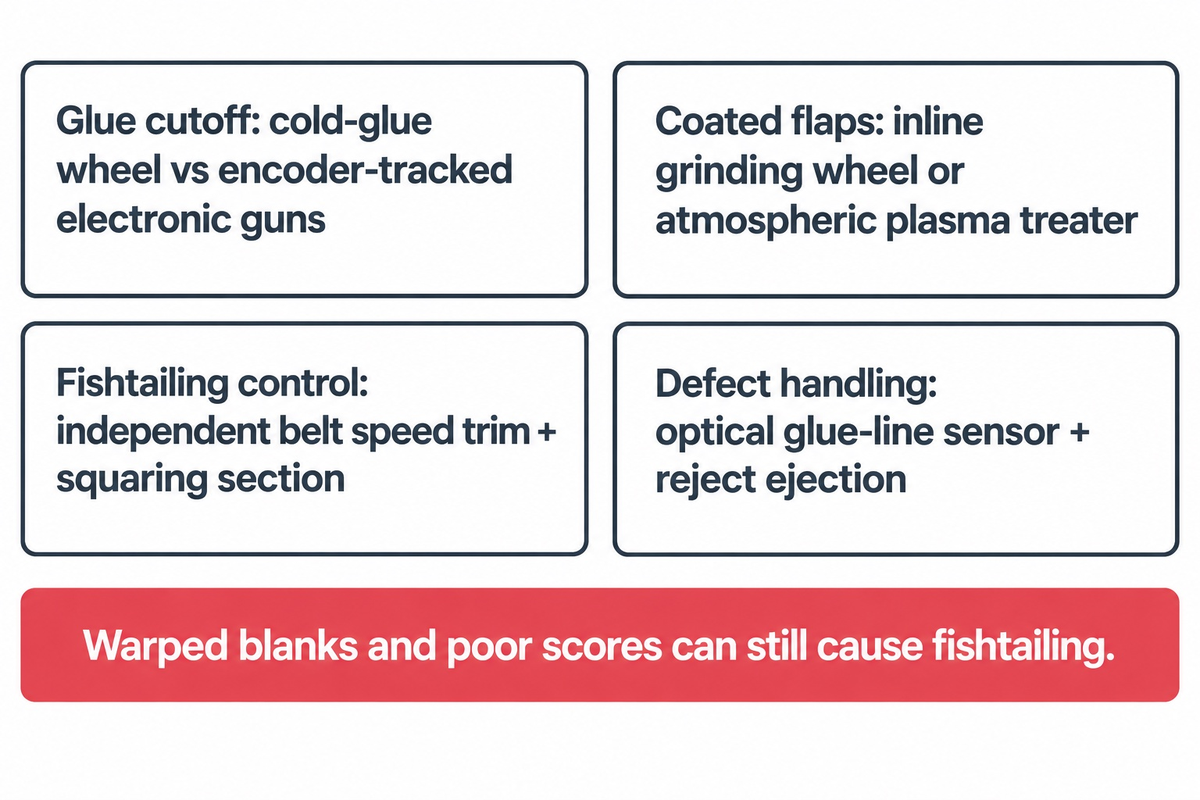
With cold-glue wheels or electronic guns, automatic folder gluers can apply adhesive evenly. Balanced carrier-belt tension and squaring equipment help control panel alignment. This minimizes corrugated fishtailing skew.
In converting plants, the gluing process determines whether cartons hold square corners during pallet stacking. The four primary causes of rework for the folder gluer are gluing seam failure, box dimensional skew, folding defects, and production line jams. These failure modes and corrugated fishtailing are described in SBL troubleshooting notes and Suba upgrade analyses.
Fishtailing occurs when the left and right panels of a corrugated box travel through folding belts at uneven velocities or fold along shallow scores. Basic semi-automatic gluers rely on operators pushing the folded blank against a side guide before compression. Automatic corrugated folder gluers can combine feeder alignment, independent belt speeds, and a squaring device to minimize fishtailing before compression. Warped blanks and poor scores can still cause fishtailing.
| Quality Control Dimension | Semi-Automatic Folder Gluer | Fully Automatic Folder Gluer (With Optional Modules) |
|---|---|---|
| Primary Glue Applicator | Mechanical stainless-steel cold-glue wheel (single seam) | Lower cold-glue wheel or electronic cold-glue and hot-melt guns |
| Glue Volume & Cutoff Control | Manual scraper blade gap adjustment | Encoder-tracked intermittent bead pattern matched to belt speed |
| UV-Varnish / Laminated Flap Prep | Typically external or manual abrasion | Optional inline glue-lap grinding wheel or atmospheric plasma treater |
| Fishtailing & Skew Correction | Manual hand squaring against side guide | Independent folding-belt speed trim and squaring section |
| Defective Carton Handling | Visual sorting by outfeed catchers | Optional optical glue-line sensor and reject ejection |
When converting UV-varnished or film-laminated cartons, water-based PVA cold glue struggles to penetrate non-porous coatings. In these cases, the glue flap can be treated with plasma or ground to improve adhesion. A hot-melt adhesive can become brittle and allow a joint to open in a cold environment. Our folder gluer glue system selection guide describes options for choosing the appropriate wheels, nozzles and surface treaters for a given board mix.
Equipment Price Tiers, 5-Year Total Cost of Ownership, and Payback Period
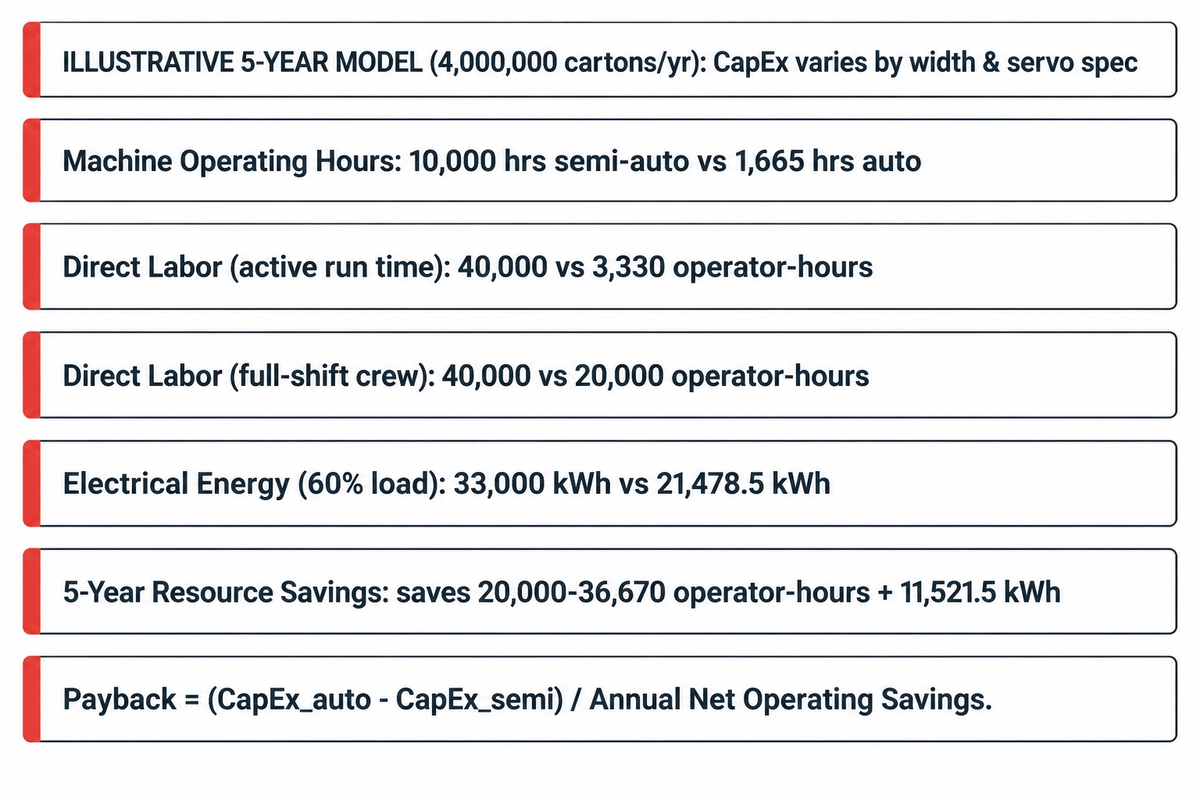
Standalone semi-automatic and automatic folder gluer prices vary by maximum blank width, station configuration, and servo automation. Buyers should request a formal quotation matched to their carton drawings. Over a five-year horizon, total cost of ownership and return on investment are governed by cumulative operator labor-hours, electrical energy consumption, adhesive scrap, and preventive maintenance.
Comparing machine quotes without taking into account operating hours distorts capital budgeting. Direct crew hours, electric draw, maintenance, and setup waste shape every multi-year cost analysis for ownership of a machine (Ouye; Pulp & Paper Technology). Proper daily care can reduce maintenance and frequent maintenance stops. CENWAN lists connected nameplate power for these automatic models at 21.5 to 25.5 kW. Breaker sizing depends on the supply voltage, the rated current, and the starting characteristics of the machine. This energy model assumes an average running load of 60 percent of connected load.
Worked 5-Year Total Cost of Ownership (TCO) Resource Model (Equal 4,000,000 Cartons/Year Output)
Worked-Table Input: Alongside our volume upgrade guide and cost-benefit frameworks, this illustrative model forecasts a volume of 4,000,000 cartons per year (20,000,000 over 5 years). At 2,000 cartons/hour net, the semi-automatic line runs 2,000 operating hours/year (10,000 machine-hours over 5 years) with 4 operators. At 12,000 cartons/hour net, the automatic line completes 4,000,000 cartons in approximately 333 operating hours/year (rounded to whole hours, or 1,665 machine-hours over 5 years) with 2 operators and automated bundling. For capacity context, hitting 12,000,000 cartons/year at 2,000 cartons/hour would require 6,000 machine-hours annually across three 2,000-hour shifts.
| 5-Year TCO Component (Equal 4,000,000 Cartons/Yr) | Semi-Auto Line (2,000 Hrs/Yr, 4 Crew) | Automatic Line (333 Hrs/Yr, 2 Crew) |
|---|---|---|
| 1. Equipment CapEx (FOB + Commissioning) | Varies by width and feeder spec (request quotation) | Varies by station modules and servo spec (request quotation) |
| 2. 5-Year Machine Operating Hours | 10,000 machine-hours (2,000 hrs/yr) | 1,665 machine-hours (333 hrs/yr; leaves 1,667 spare hrs/yr) |
| 3. 5-Year Direct Labor (Allocated by Active Run Time) | 40,000 operator-hours (4 workers × 10,000 hrs) | 3,330 operator-hours (2 workers × 1,665 hrs; saves 36,670 hrs) |
| 4. 5-Year Direct Labor (If Dedicated Full-Shift Crew) | 40,000 operator-hours (4 full-shift workers) | 20,000 operator-hours (2 full-shift workers; saves 20,000 hrs) |
| 5. 5-Year Electrical Energy (60 percent Assumed Load) | 33,000 kWh (5.5 kW assumed → 3.3 kW × 10,000 hrs) | 21,478.5 kWh (21.5 kW CW-G-650 → 12.9 kW × 1,665 hrs) |
| 5-Year Resource Savings (Automatic vs Semi-Auto) | Baseline | Saves 20,000–36,670 operator-hours + 11,521.5 kWh |
| Incremental Payback Equation | Baseline | (CapEx_auto − CapEx_semi) / Annual Net Operating Savings |
To approximate your plant’s payback with our labor-savings payback calculator, multiply your loaded hourly wage by the annual saved operator hours (4,000 hours/year for a dedicated shift crew, or 7,334 hours/year if operators are reassigned). Add annual electricity savings (2,304.3 kWh/year × local kWh tariff) and scrap savings, and subtract increased wear-part maintenance. Finally, divide the quoted equipment capital expense (CapEx) difference by this annual saved amount.
What should manufacturers prioritize when budgeting for auto folder gluer investments?
When determining budgets for auto folder gluer investments, manufacturers should look at five-year operator labor-hour savings, crash-lock and pre-folding tooling, and motorized changeovers for short runs. In addition, automated outfeed bundling and three-phase electrical preparation should be included in investment decisions instead of comparing the prices of bare machines.
Request itemized quotations for cold-glue spray guns, hot-melt applicators, spare feeder belts, and operator training, so competing proposals share an equivalent technical boundary.
How to Choose: The 4-Gate Plant Upgrade Filter and Hybrid Line Pairing
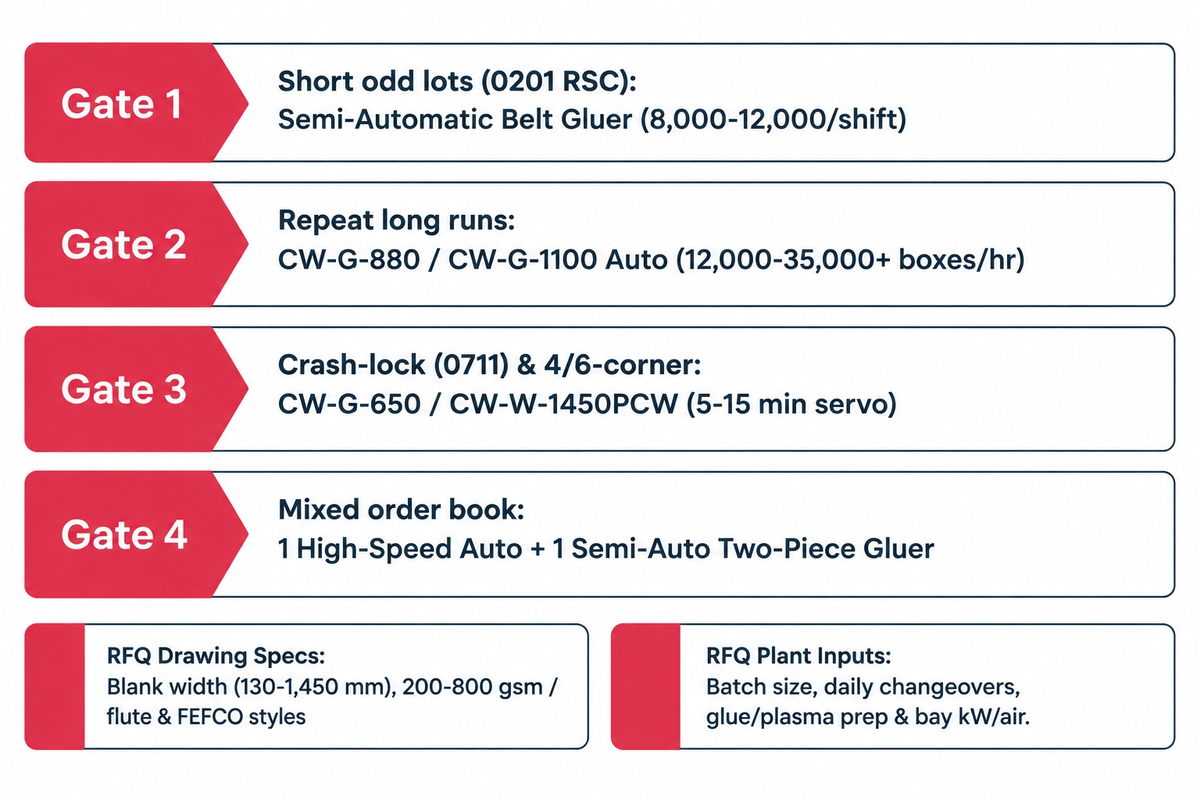
Long repeat runs favor automatic folder gluer equipment when labor and running-time savings justify the investment (Suba). Short runs, frequent daily changeovers, and jumbo two-piece blanks can favor semi-automatic equipment. Crash-lock cartons can also be produced with manual folding and gluing, though high-volume auto-bottom orders benefit from dedicated crash-lock automation.
An upgrade to automatic folder gluer equipment does not mean retiring a semi-automatic machine. As converter discussions on PrintPlanet’s packaging forum, phased upgrade roadmaps (Ouye; Suba), and TAPPI specialty gluer notes show, box plants often use a Hybrid Line Pairing. High-speed automatic folder gluer equipment is used for repeat straight-line and crash-lock orders. Meanwhile, a semi-automatic unit absorbs small rush jobs and oversized double-wall cartons.
| Decision Gate & Plant Profile | Recommended Configuration | Engineering Rationale | Boundary & Trade-Off |
|---|---|---|---|
| Gate 1: Short Odd Lots Below Batch Crossover (0201 RSC) | Semi-Automatic Belt Folder Gluer | Short manual setup and lower initial investment suit short runs | Basic single-seam unit produces 8,000–12,000 boxes per 8-hour shift |
| Gate 2: Repeat Long Runs Above Batch & Economic Crossover | Fully Automatic High-Speed Folder Gluer (CENWAN CW-G-880 / 1100) | Reduces crew from 4–6 workers to 2 (with auto-bundling) at 12,000–35,000+ boxes/hr | CW-G-880 and CW-G-1100 have 16.4 m machine length and 25.5 kW connected power |
| Gate 3: Automated Crash-Lock (0711) or 4/6-Corner Production | Automatic Crash-Lock / Multi-Corner Folder Gluer (CW-G-650 / CW-W-1450PCW) | Folding and gluing mechanisms matched to carton geometry, with mechanical or servo folding devices | Requires longer initial setup (or 5–15 min with servo recall) and trained operators |
| Gate 4: Mixed Order Book (Repeat Standard Runs + Jumbo 2-Piece / Rush Lots) | Hybrid Pairing: 1 High-Speed Auto Line + 1 Semi-Auto Two-Piece Gluer | Protects automatic line uptime by routing disruptive odd lots and 2-piece blanks to semi-auto | Requires floor space for both lines and cross-trained operators |
Buyer RFQ Technical Specification Checklist (Send With Your Drawings)
- Specify your minimum and maximum open blank width and length, such as 130–650 mm vs 290–1,450 mm.
- List your solid paperboard gsm range (200–800 gsm) and corrugated flutes (N, F, E, B, C, or AB double-wall).
- Break down your FEFCO or ECMA box styles across straight-line (0201), crash-lock bottom (0701/0711), 4-corner, 6-corner, and two-piece cartons.
- Give your average batch quantity per SKU, minimum short-run lot size, and daily changeover count.
- Confirm your requirements for adhesives and surface treatments for lower cold-glue wheels, electronic guns, and inline grinders or plasma units.
- Identify your available bay length, floor load, three-phase voltage and kW, and compressed air.
Integration and Utility Requirements: Floor Length, kW Load, Air Supply, and Downstream Strapping
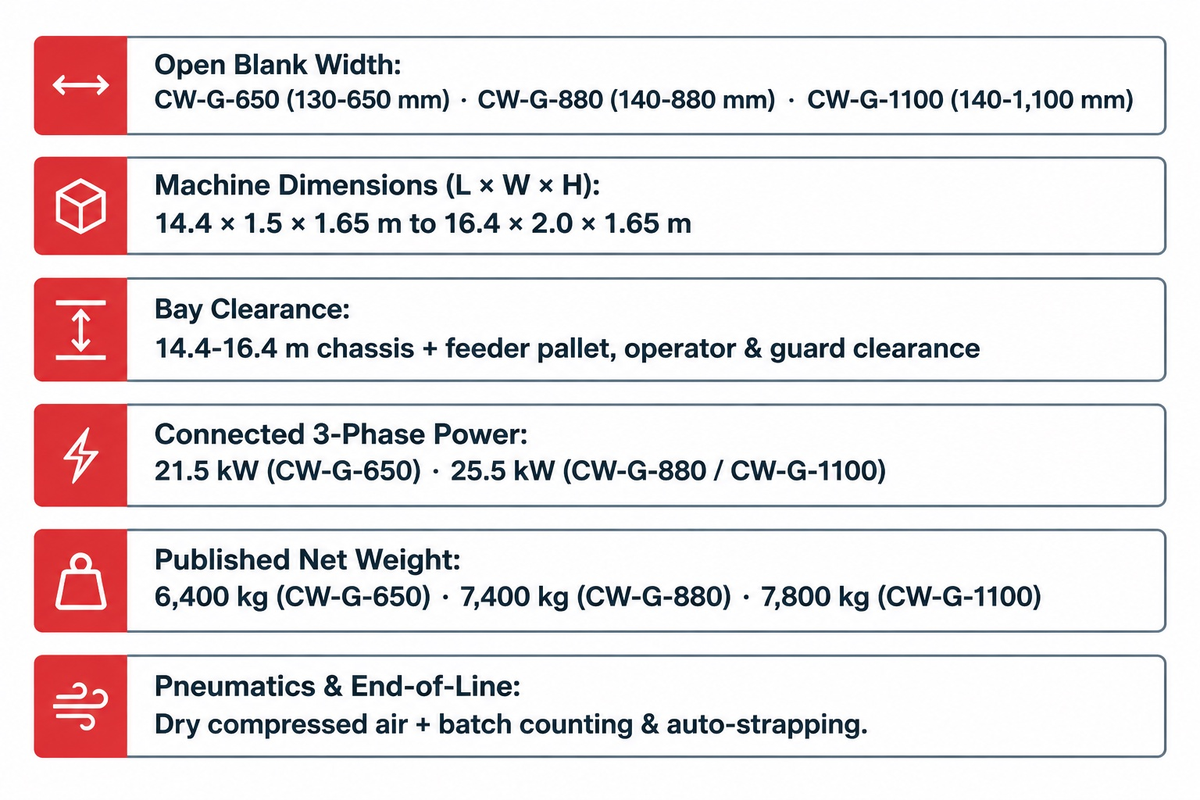
CENWAN lists machine lengths of 14.4 to 16.4 meters, net machine weights of 6,400 to 7,800 kg, and connected three-phase power ratings of 21.5 to 25.5 kW across the CW-G-650, CW-G-880, and CW-G-1100 models. Floor-loading calculations account for installed machine weight, support-point layout, and dynamic operating loads.
Facility readiness must first be confirmed before ordering new tech for your converting department. Single-station semi-automatic units take up less floor space than multi-station automatic lines. Always confirm machine dimensions and connected kW against the supplier’s machine datasheet. A multi-station automatic crash-lock folder gluer typically includes feeding, pre-folding, crash-lock folding, main folding, transfer, and compression sections. Check building column spacing, transformer capacity and safety guard clearances before purchasing.
| Utility & Footprint Parameter | Typical Semi-Auto Gluer | CENWAN CW-G-650 | CENWAN CW-G-880 | CENWAN CW-G-1100 |
|---|---|---|---|---|
| Open Blank Width Range | Model-dependent single or two-piece width | 130–650 mm | 140–880 mm | 140–1,100 mm |
| Published Machine Dimensions (L × W × H) | Compact frame (verify on model datasheet) | 14.4 × 1.5 × 1.65 m | 16.4 × 1.7 × 1.65 m | 16.4 × 2.0 × 1.65 m |
| Bay Clearance Planning | Machine length + feeder and pallet access | 14.4 m chassis + operator and pallet clearance | 16.4 m chassis + operator and pallet clearance | 16.4 m chassis + operator and pallet clearance |
| Connected Electrical Power (3-Phase) | Verify kW rating on model datasheet | 21.5 kW | 25.5 kW | 25.5 kW |
| Published Net Machine Weight | Verify net weight on model datasheet | 6,400 kg | 7,400 kg | 7,800 kg |
| Compressed Air Supply (Pneumatics) | Required only if fitted with pneumatic press | Dry compressed air for pneumatic press and kicker | Dry compressed air for pneumatic press and kicker | Dry compressed air for pneumatic press and kicker |
Match the pace of your downstream packaging equipment to the outfeed of your gluer. Upgrading the folder gluer without adding batch counting, squaring, and auto-strapping shifts the bottleneck to the delivery conveyor (ME-Industry). Consider CENWAN’s integrated automatic packaging line solutions to automate packaging processes including integration with counting, strapping and case packing.
Frequently Asked Questions
Q: Can an automatic folder gluer and a semi-automatic folder gluer be used together in the same plant?
Yes, using both machines in a plant is a standard practice among converting facilities.
A high-speed automatic folder gluer can handle repeated straight-line and crash-lock batches beyond the setup crossover threshold. A semi-automatic unit can be used to handle small rush orders, irregular die-cuts and large two piece corrugated containers, without interruptions to the main line, and without the need for lengthy rail change-overs on the main line automatic unit.
Q: What is the minimum paperboard GSM and corrugated flute thickness an automatic folder gluer can run?
CENWAN CW-G series high-speed automatic folder gluers process folding paperboards from 200 to 800 gsm with a blank width of 130 to 1,100 mm.
CENWAN CW-W servo models also run E, F, C, and B single-wall corrugated flutes and AB double-wall board plus cardboard up to 800 g when feeder gates, carrier belts, and compression rollers are adjusted to the board caliper.
Q: How should operators manage feeder belt and compression belt wear on high-speed lines?
High-friction rubber feeder belts wear out faster than compression or folding belts because of the abrasive action of the dust and acceleration shear of the linerboard during continuous feeding.
Operators can improve the service life of belts by vacuuming paper dust at shift changes, cleaning the residue of PVA cold-glue with warm water, and balancing the right-to-left carrier belt tension.
Q: Do semi-automatic folder gluers support hot-melt adhesive systems for coated cartons?
Base semi-automatic gluers use a cold-glue wheel, but stand-alone hot-melt guns and in-line edge grinders can be used for coated boards.
Q: What specific automation features and maintenance designs minimize downtime on automatic folder gluers?
Centralized lubrication, quick-release feeder belts, and sealed glue pots are among the key automation features.
Motorized carrier positioning with PLC diagnostics also speeds up shift changeovers when evaluating packaging machinery manufacturers institute member equipment.
Q: How much floor length is required to install a high-speed automatic folder gluer?
A standalone automatic folder gluer in the CENWAN CW-G-650 to CW-G-1100 series measures 14.4 to 16.4 meters in net machine length.
Plants must add surrounding floor clearance for feeder pallet access, operator walkways, and downstream strapping equipment.
Editorial Disclosure & Engineering Scope
CENWAN manufactures high-speed automatic folder gluers, corrugated crash-lock gluers, and 4/6-corner converting lines for packaging plants worldwide. Machine dimensions, blank widths, net weights, and connected kW ratings for the CW-G-650, CW-G-880, CW-G-1100, CW-W-1250AC-S, and CW-W-1450PCW models are published CENWAN specifications. Shift outputs, batch-crossover equations and 5-year TCO resource tables synthesize public supplier benchmarks and explicit worked-example assumptions. Actual plant results vary with blank geometry, board caliper, operator skill and local utility rates. Reviewed by the CENWAN technical team.
References & Sources
- Ergonomics — Solutions to Control Hazards & Musculoskeletal Disorders — U.S. Occupational Safety and Health Administration (OSHA).
- US Patent 8,926,485 B2: Folder gluer and method for controlling individual processing stations inside a folder gluer — Heidelberger Druckmaschinen AG / USPTO, 2015.
- US Patent 8,418,834 B2: Prefeeding corrugated boards to box finishing machines — Sun Automation Inc / USPTO, 2013.
- TAPPI Corrugated Containers Conference Proceedings (COR9301: Specialty Folder-Gluers) — Technical Association of the Pulp and Paper Industry (TAPPI).
- ISO/DIS 3153 (Catalog 79507): Mechanical vibration — Posture in whole-body vibration environments — International Organization for Standardization (ISO).
- International Fibreboard Case Code (FEFCO Code, 12th Edition: Series 0201 & 0701/0711) — European Federation of Corrugated Board Manufacturers (FEFCO).
- Folder Gluer Machines in Paper Packaging: Station Architecture and Pre-Folding — Pulp & Paper Technology.
- Automatic Folder Gluer vs. Semi-Auto: When to Make the Switch — Sinosun Packaging Machinery.
- When to Upgrade from a Semi-Automatic to an Automatic Folder Gluer — FoldingGluing.
- Semi-Auto Gluer vs. Fully Automatic Folder Gluer: Cost-Benefit Analysis for Short-Run Packaging — Ouye Carton Machine.
- 4 Common Folder Gluer Failures and How to Fix Them — SBL Machinery.
- Semi- vs. Fully Automated Folding Gluing Machine Comparison — SBL Machinery.
- Reasons to Upgrade to an Automatic Folder Gluer Machine — Suba Solutions.
- When Folder Gluer Lines Need Automation Upgrades for Faster Output — ME-Industry.