Get in touch with Cenwan Machine Company


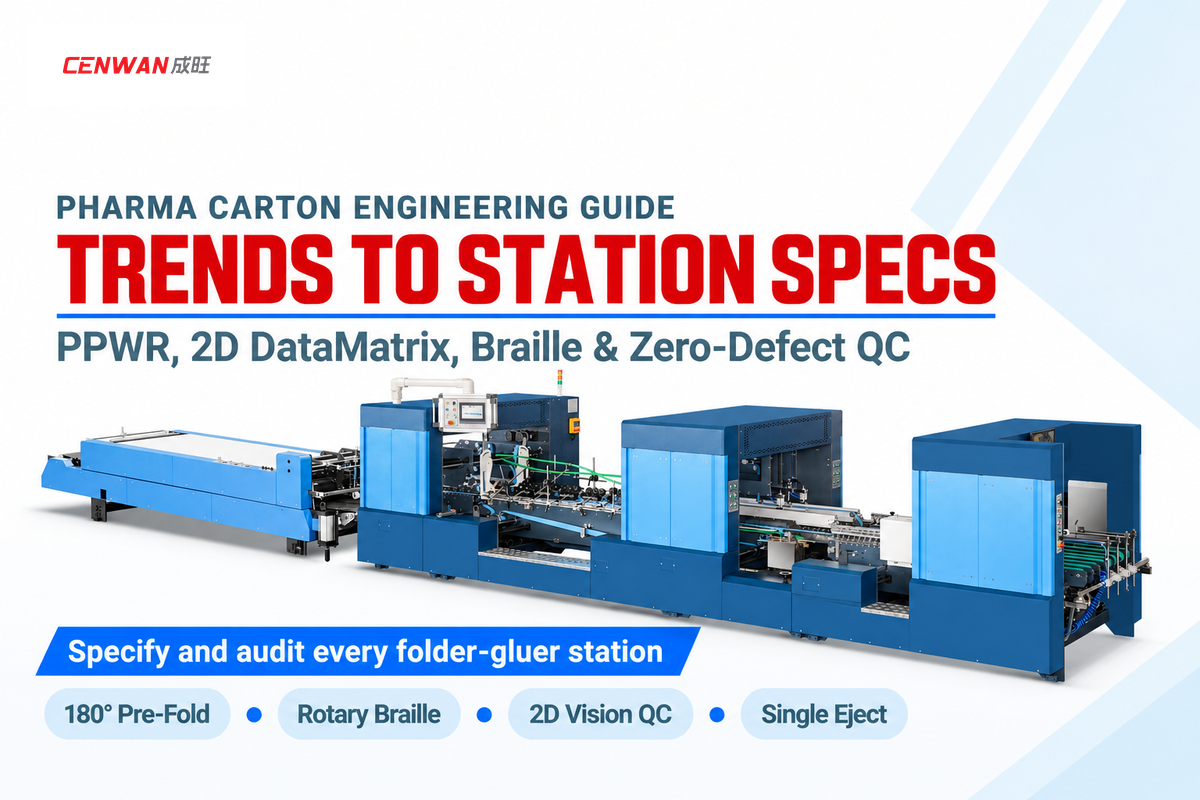
2026 Pharmaceutical carton production trends show packaging design shifts related to converter equipment. Drug brands are adopting recyclable mono-material paperboard alongside Regulation (EU) 2025/40 (PPWR) recyclability rules, which preserve targeted medicinal exemptions. Unit-level 2D serialization per the U.S. DSCSA and EU FMD is also managed. DSCSA enforcement and EU FMD rules, optional or pilot QR e-leaflets, fiber-tear closures, tactile Braille, and cold-chain partitions. Statutory regulatory requirements, customer quality agreements and market trends impact folder gluer configurations. Across the line, dedicated stations maintain blank alignment and pre-break specified creases, such as 180 degrees on Crease 1 and Crease 3 for automated cartoners. Customer requirements specify embossing of Marburg Medium Braille to a 0.20 mm target dot height, and flat transport for ISO/IEC 15415 Grade C (1.5) barcode grading. Optional modules on the folding carton converting machinery add single-carton ejection and UV glue monitoring.
Updated October 2026
Engineering guide scope and commercial handoff
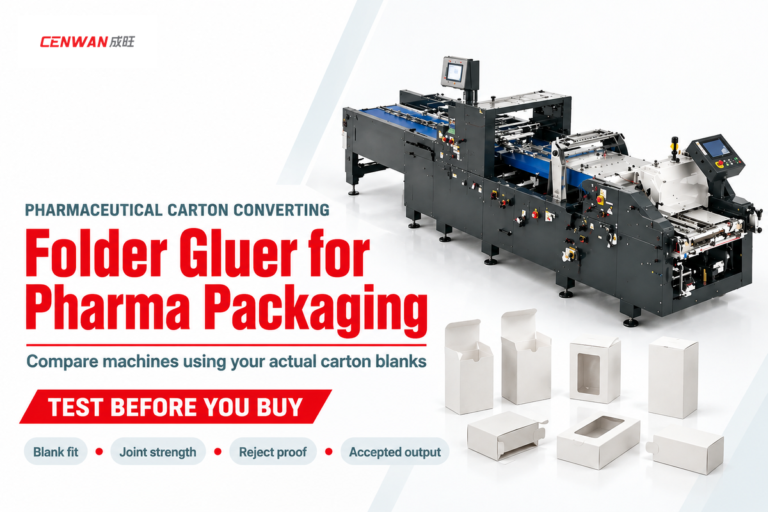
This technical guide examines how 2025 and 2026 regulatory and drug-format shifts govern feeder, pre-folding, coding, gluing, inspection, and Factory Acceptance Testing (FAT) on medicinal carton lines. For commercial machine specifications, model comparisons, and equipment quotations, visit our automatic folder gluer machine solutions page.
Pharmaceutical carton production trends in 2026 include recyclable paperboard designs, serialization for applicable medicines, tamper-evident closures, medicinal-packaging Braille, and inline inspection. Converters support these specifications in the production process through calibrated score pre-breaking and stable blank transport beneath printing and vision heads. Job-specific options include UV glue monitoring and encoder-tracked single-carton ejection.
- Separate statutory drug-packaging pre-use line clearance from converter runtime sensor and ejection engineering.
- Respect targeted medicinal exemptions under Regulation (EU) 2025/40 while preparing for recyclable materials in secondary trays.
- Distinguish ISO/IEC 15415 barcode print grading from GS1 serialization data-content verification.
- Validate crease pre-folding, 0.20 mm Braille dot uniformity, and single-carton fault rejection on actual board during FAT.
What Regulatory and Market Trends Are Reshaping Pharmaceutical Carton Production in 2026?
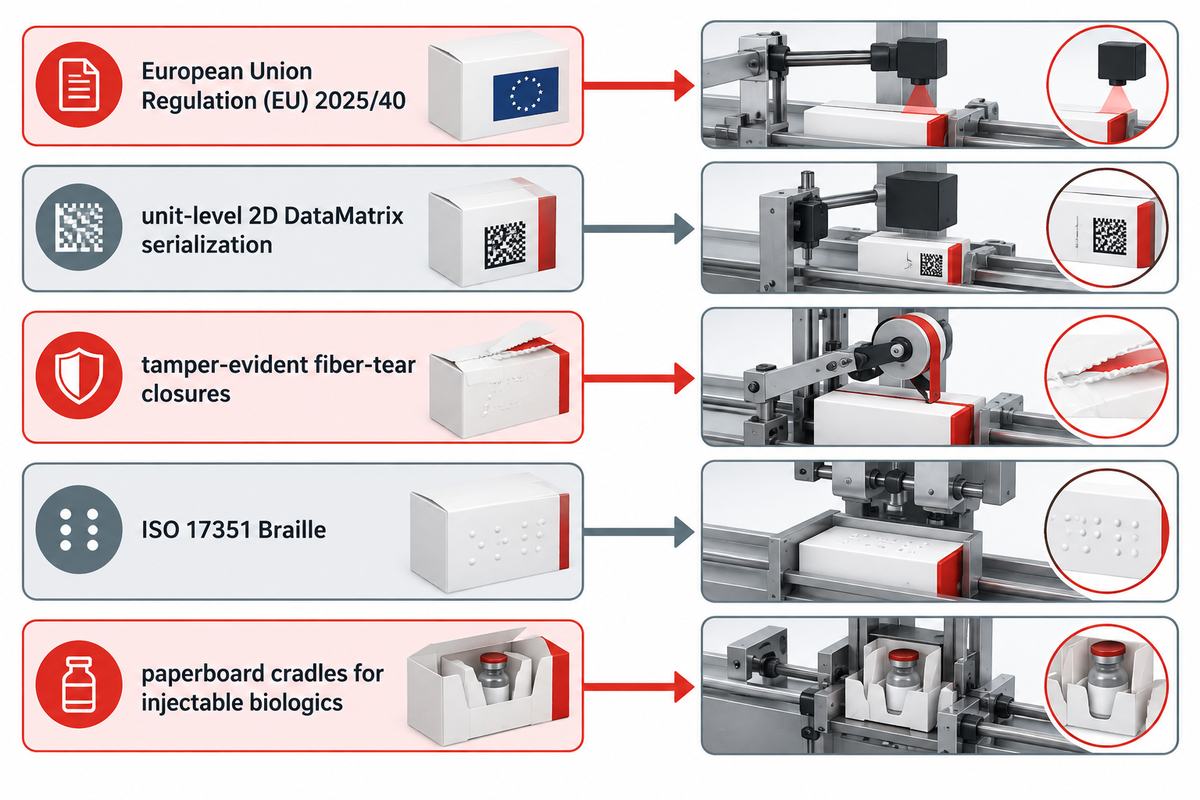
Five regulatory and market trends reshape pharmaceutical carton production in 2026. These include European Union Regulation (EU) 2025/40 on packaging waste (with targeted medicinal exemptions) and unit-level 2D DataMatrix serialization under phased U.S. DSCSA and EU FMD rules. Converters also address tamper-evident fiber-tear closures, ISO 17351 Braille, optional or pilot QR e-leaflets, and paperboard cradles for injectable biologics.
According to PMMI’s 2026 industry report, 78% of drug manufacturers are already in the process of implementing sustainable packaging changes to meet their corporate sustainability targets. The same report projects the global packaging machinery to expand at a 7.8% compound annual growth rate (CAGR) through 2028. Market analysis from Towards Packaging values the wider pharmaceutical packaging global market at USD 148.65 billion in 2025. Under that market outlook, global revenue is projected to reach USD 354.69 billion by 2035 across the forecast period, following baseline expansion tracked since 2022.
Rising healthcare investments and broader access to healthcare are speeding up growth in the region for both Asia-Pacific and Latin America. A higher prevalence of chronic conditions and rising drug approvals drive increasing demand for unit-dose medicine packs. However, most market size and market growth studies blend primary containers with secondary paperboard boxes. They combine key companies such as Amcor plc and Schott AG that supply vials, flexible packaging, pouch formats, aluminum foil blister packaging, and prefilled syringes along with carton converters.
Inside the pharmaceutical industry, secondary carton manufacturers must address a distinct engineering reality. Pharmaceutical companies expect every secondary packaging solution to protect product shelf life, support patient adherence, and run cleanly on high-speed cartoners. Industry overviews from Smurfit Westrock highlight eco-friendly materials, patient-centric design, and smart packaging across the supply chain. Converter plant engineers translate these sustainable packaging solutions into specifications for folder gluer stations as opposed to broad consumer goods descriptions. The Trend-to-Station Requirement Matrix and Zero-Defect Pharma Line-Clearance Gate synthesize EU PPWR (Regulation 2025/40), 21 CFR 211.130, ISO 17351 Braille, and OEM folder-gluer engineering into two original, multi-role converter decision tools.
Trend-to-Station Requirement Matrix
The Trend-to-Station Requirement Matrix maps ten current regulatory and drug format drivers to their governing scope, impact on a folder gluer station, and inline verification checks.
| Production Trend or Mandate | Regulatory or Market Scope | Folder Gluer Station Affected | Inline Control or Verification Check |
|---|---|---|---|
| Recyclable secondary packaging & voluntary mono-material paperboard shifts | Brand sustainability goals & Regulation (EU) 2025/40 (PPWR) recyclability rules (targeted medicinal exemptions apply, with no blanket mono-material mandate) | Feeder gate & pre-folding station | Calibrated gate gap and crease pre-breaking without coating cracks |
| Paperboard blister packs and vial partitions | Voluntary brand replacement of non-exempt PVC/PET secondary trays | Straight-line divider folding or conditional 4/6-corner rotary hooks | Synchronized folding hooks when multi-panel internal retention cradles are specified |
| Unit-level 2D DataMatrix serialization | U.S. DSCSA & EU FMD (Delegated Regulation 2016/161) | Transport belt & coding table | Stable blank registration and ISO/IEC 15415 print grade check (minimum Grade C / 1.5) |
| Digital e-leaflets (ePI) & multi-SKU splits | EMA ePI pilot & Swissmedic HCP QR framework (Dec 2025) | Servo axes & recipe management HMI | Motorized carrier recall and documented physical line-clearance verification |
| Tamper-evident glued carton ends | Visible fiber tear on opening, as described by CCL Healthcare | End-flap geometry and die-cut tear features compatible with downstream cartoner sealing | Adhesive-to-board bonding that produces visible opening damage |
| Tactile Braille on medicinal cartons | ISO 17351 & Marburg Medium specification (1.3 mm to 1.6 mm base, 2.5 mm dot spacing, 6.0 mm cell spacing, 0.20 mm target dot height) | Rotary Braille embossing unit (when embossed inline) | Male/female tool registration up to 200 m/min without dot crushing under compression |
| Small-format vial and ampoule boxes | High-potency unit-dose and clinical trial presentations | Narrow-belt feeder & pre-fold carriers | Minimum open-blank width verification on actual production dielines |
| Cold-chain biologics & biosimilars cartons | Refrigerated cold-chain vs. ambient storage per drug stability labeling | Dispersion cold-glue (PVA) & hot-melt nozzles | Adhesive bond and fiber-tear verification across customer-specified conditioning protocols |
| cGMP mix-up prevention & line clearance | 21 CFR 211.130(e) drug-packaging rules & converter quality agreements | Pre-use physical inspection & optional inline pharmacode | Documented pre-run clearance plus job-specified pharmacode and UV glue scanning |
| Zero-defect single-carton fault removal | Converter quality agreements for medicinal cartons | Optional high-speed ejection gate before compression | Encoder-tracked single-blank ejection with reject-bin photo-eye confirmation |
Regulatory boundaries require careful engineering attention. Under EUR-Lex’s summary of Regulation (EU) 2025/40, the Packaging and Packaging Waste Regulation entered into force on 11 February 2025. It applies generally from 12 August 2026 and sets 2030 and 2035 recyclability targets. PPWR provides targeted exemptions from recyclability requirements for immediate medicinal packaging and outer medicinal packaging necessary to preserve product quality. PPWR doesn’t mandate a single material for all drug boxes. Even so, many brands are voluntarily shifting non-exempt secondary trays and cartons toward recyclable mono-material paperboard while preserving barrier protection for sensitive pharmaceutical products.
How Do PPWR and Mono-Material Paperboard Shifts Affect Carton Blank Stiffness and Creasing?
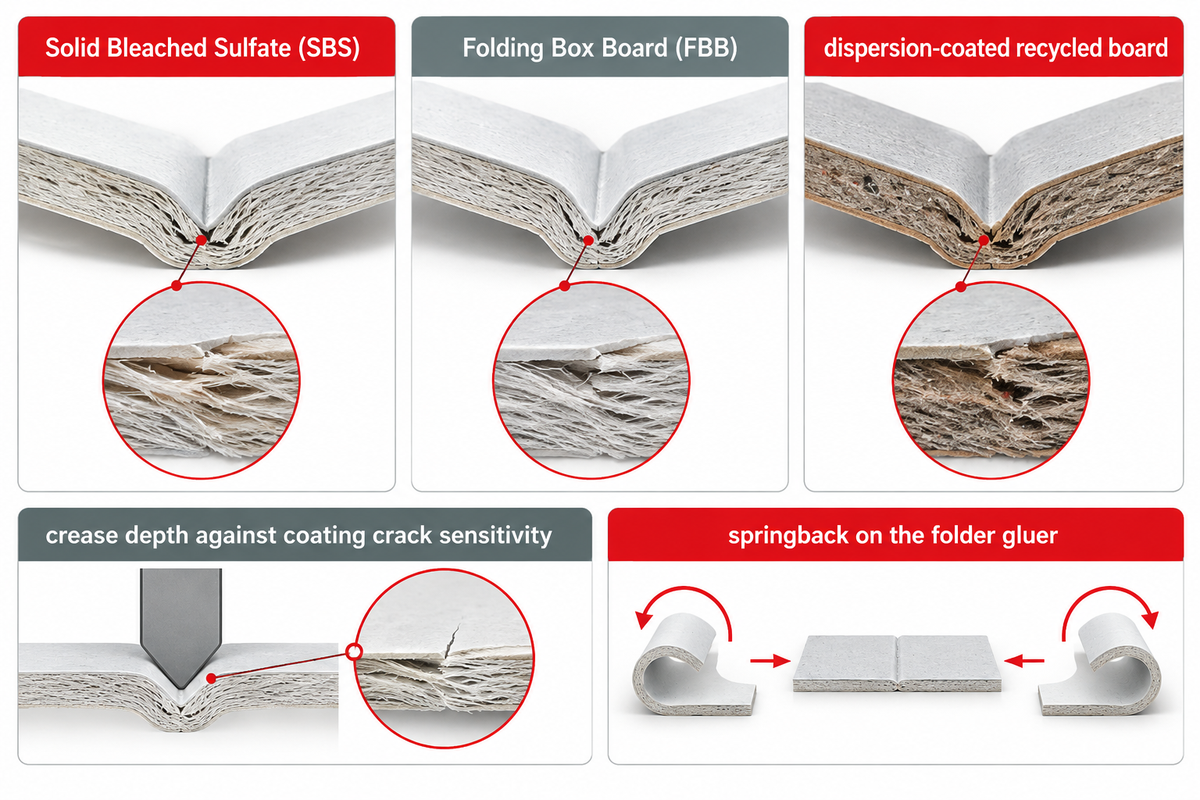
Using different types of paperboard as well as paperboard with a higher recycled fiber content can impact the stiffness of blanks, delamination, and springback on the folder gluer. When brands switch to Solid Bleached Sulfate (SBS), Folding Box Board (FBB), or dispersion-coated recycled board, converters balance crease depth against coating crack sensitivity and calibrate pre-folding belts for variations in board stiffness.
An increasing emphasis on corporate sustainability is driving paperboard substitution across secondary drug packaging. A peer-reviewed paper on the mechanics of die-cut creasing in the BioResources Journal of NC State University discusses how creasing internally delaminates paperboard at the fiber level, thereby decreasing folding stiffness. If a score isn’t deep enough to delaminate fibers, stiff FBB or recycled board may resist folding and spring open during gluing. Cracking barrier coatings during creasing weakens protection against moisture during transport.
No universal crease depth or channel width exists for every board grade. Converters establish die-cutting and pre-folding patterns based on mill data, such as board caliper, moisture content and grain direction. Virgin SBS uses a chemical pulp. Grain direction and board moisture impact score cracking and folding performance. Multi-ply FBB (GC1 and GC2) uses a mechanical pulp middle layer that boosts bulk and stiffness per gram. However, FBB has more elasticity and higher springback after folding. Recycled content boards and their varying fiber lengths and ply structures affect folding performance. Crease tooling and carrier support have to be adjusted for each board grade and moisture level.
Worked Scenario: A converter changes a chronic-disease tablet carton from a PET-laminated board to a dispersion-coated FBB blank. During high-speed trial runs, finished cartons show micro-cracking along the fourth crease line, and inconsistent glue seam alignment. Rather than increasing compression roll pressure, the technician checks samples at the feeder exit and crease entry. The check shows that the dispersion coating increases surface friction against the folding sword. Score delamination is verified before each fold, which eliminates liner cracking.
What Do Serialization and 2D DataMatrix Mandates Require on the Folder Gluer Line?
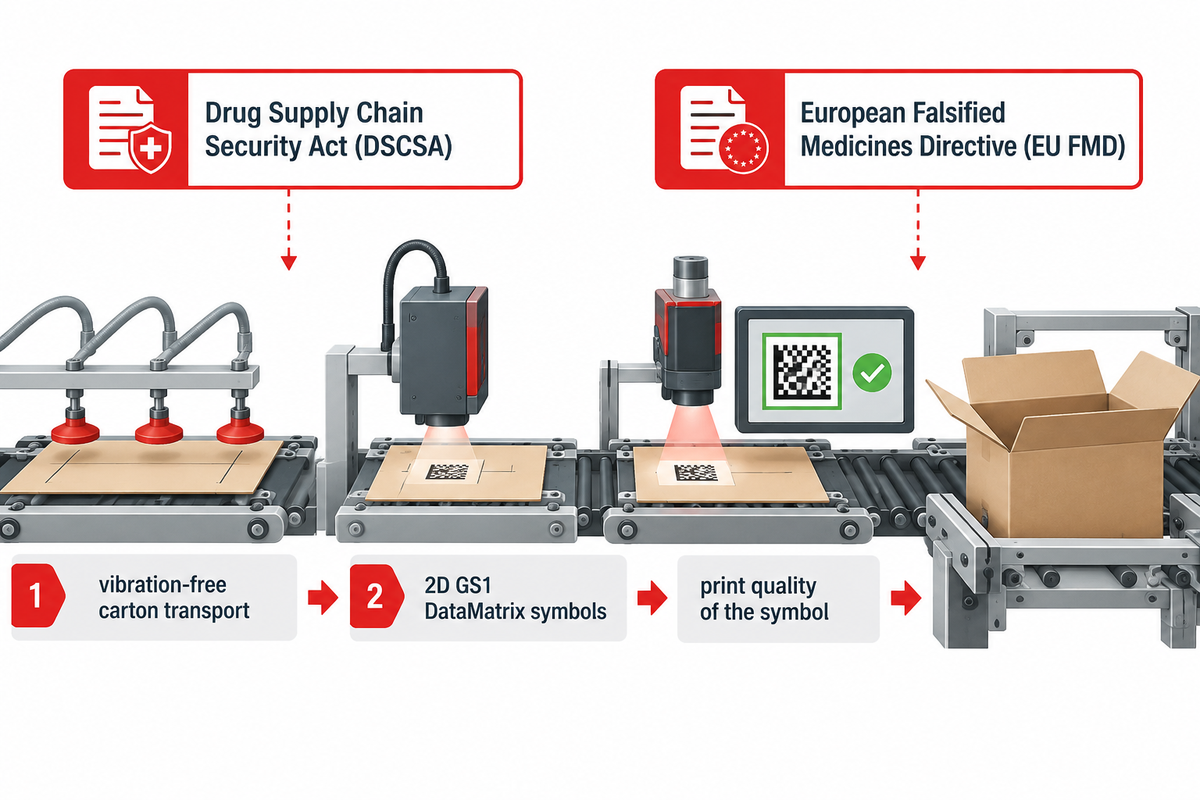
Unit-level drug serialization under the U.S. Drug Supply Chain Security Act (DSCSA) and the European Falsified Medicines Directive (EU FMD) requires stable, vibration-free carton transport during printing and camera verification. Keeping the carton flap planar allows 2D GS1 DataMatrix symbols to achieve at least an ISO/IEC 15415 Grade C (1.5) print quality score.
Plant engineers must distinguish two different serialization requirements. The first is the print quality of the symbol, which is determined by camera graders. According to Certified Labeling Solutions’ ISO/IEC 15415 verification guide, camera graders evaluate 2D DataMatrix symbols on a 0.0 to 4.0 scale. Industry requirements typically stipulate a minimum of Grade C (1.5) at scanning. Converters aim for Grade B (2.5) or Grade A (3.5) during converting to trade for permitted print wear.
Validation of GS1 application identifiers and the uniqueness of the serial number requires a separate assessment from passing the ISO/IEC 15415 optical test. DSCSA product identifier requirements were applicable to manufacturers from 2017 and repackagers from 2018. The enforcement policies were phased. The statutory identifier includes the NDC and a unique serial number, plus the lot number and expiration date, while GS1 implementations encode the NDC within a GTIN. When converters print serialized 2D codes inline on a folder gluer, stable blank registration and controlled working distance support print quality. Vacuum transport belts are a good way to steady the blank. Rotational skew can cause printing to go outside the camera acceptance window, resulting in code rejection.
As documented in Healthcare Packaging’s report on Keystone Folding Box, converters handling serialized and anti-counterfeiting orders are pairing high-speed folding gluers with dedicated inspection and CAD workflows. Keeping the coding panel clean from adhesive mist or belt scuffing helps protect downstream code reads.
How Are Connected Packaging, QR e-Leaflets, and Short-Run Batches Changing Changeover Demands?
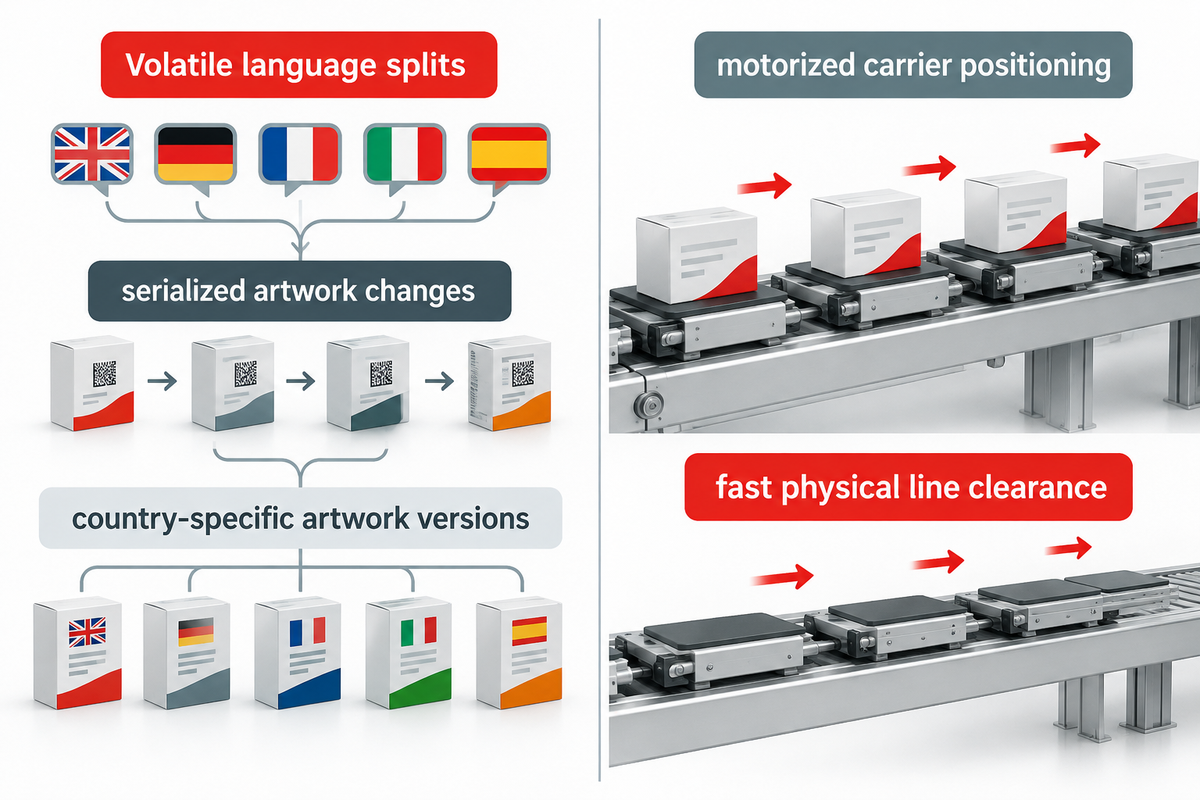
Volatile language splits, personalized medicine, biosimilars, and serialized artwork changes, are fragmenting large carton orders into multiple small orders. Converters are efficiently running small orders through motorized carrier positioning and fast physical line clearance. While mandatory serialization drives batch documentation, optional or pilot QR electronic patient information (ePI) codes add country-specific artwork versions that require rapid, error-free changeovers.
Increased research and development in targeted drug development and specialized packaging is projected to increase SKU counts in coming years. Regulatory authorities consider marketing/e-leaflet QR codes and statutory serialization symbols differently. The EMA is currently pilot testing electronic Product Information (ePI) in Europe. Meanwhile, Swissmedic’s December 2025 working instruction permits QR codes on medicinal packaging only for healthcare-professional information, keeping printed patient leaflets mandatory. Meanwhile, orphan biologics, dosage of specific strengths and regional packs of emerging markets require smaller batch quantities.
Extensive serialization and batch variations result in an extensive number of SKUs and a major operational bottleneck. Operators must reconcile serialized artwork versions with job recipes. Physical line clearance is also required before running the next carton order. Some drug manufacturing plants consolidate filling batches to offset that downtime. However, carton converters bear SKU proliferation while working to maintain cost-effectiveness. For more, see our technical brief on reducing folder gluer changeover time for short-run batches.
The folder gluer uses recalled recipe memory to restore recurring positions of carriers, belts, and glue nozzles for repeat jobs. This automation helps boost repeatability across shifts. Recipe recall restores saved machine settings, but operators must still remove residual blanks and complete physical line clearance between SKUs so zero stray cartons carry over.
How Do Tamper-Evident Glued Cartons Compare With Tuck-End Closures in Production?
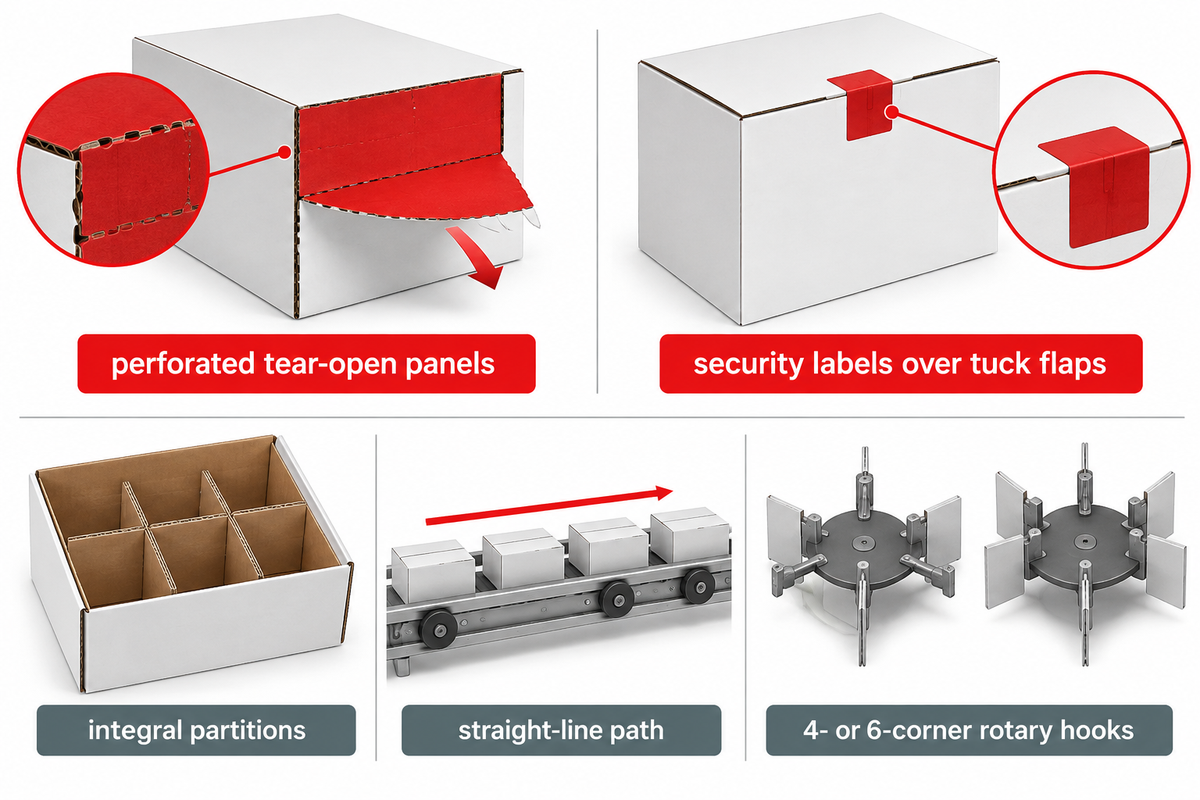
For packaging, glued-end cartons use glued closures with perforated tear-open panels, and tuck-end cartons use security labels over tuck flaps. The converter side-seals and side-glues the blanks, and the carton closing machine on the filler’s line completes the closure. For paperboard cartons with integral partitions, the design of the blank and the type of equipment used by the converter vary. Divider sleeves for simple panels run in a straight-line path, and for complex multi-panel cradles, 4- or 6-corner rotary hooks are used.
CCL Healthcare has supplied additional information (often illustrated) on the use of brands to achieve tamper evidence and safety and integrity in compliance with the EU FMD anti-tampering requirements. Tuck-end cartons use security labels, or brands specify glued-end cartons with perforated tear-open panels that, upon opening, show visible fiber tear or irreversible tear-strip damage. Additionally, U.S. Patent US7121991B2, describes a multi-panel carton blank that may integrate auxiliary folding walls and/or partitions to create individual carton compartments.
| Carton Structural Style | Converter Folder-Gluer Operations | Downstream Cartoner Operations | Primary Quality Failure Risk |
|---|---|---|---|
| Standard Reverse-Tuck Carton | Pre-break on Crease 1 and Crease 3. Cold-glue longitudinal side seam and pre-fold slit-lock or friction tuck flaps | Rotary or suction erection, blister or bottle insertion, and mechanical tuck closure (plus tamper label if required) | High opening resistance or slit-lock tearing if Crease 1 and Crease 3 springback is excessive |
| Tamper-Evident Glued-End Carton | Side-seam gluing, precision die-cut micro-perforation transport without premature tearing, and glue-free reserve zones on end flaps | Hot-melt adhesive application on end flaps and compression sealing for a bonded closure that shows visible fiber tear when pulled apart | End-flap pop-opens if UV varnish encroaches on glue reserve zones or if micro-perforations weaken blank transport |
| Multi-Panel Partition / Cradle Carton | Configured by actual box geometry: straight-line divider folding for simple sleeves, or conditional wide asymmetric feeding and 4/6-corner rotary hooks for multi-panel cradles | Top-load or side-load placement of vials, syringes, or auto-injectors into pre-formed paperboard compartments | Internal divider collapse or adhesive stringing across device compartments during high-speed folding |
The converter must keep varnish, aqueous coating and silicone release agents out of the glue flaps when making tamper-evident glued-end cartons. That exclusion is valid both on the side-seam lap of the converter and the end-flap zones that are reserved for the filler’s hot melt seals. A single misaligned coating blanket can cause field pop-opens after the product leaves the packaging line.
What Folder Gluer Specifications Support ISO 17351 Braille Embossing and Small-Format Cartons?
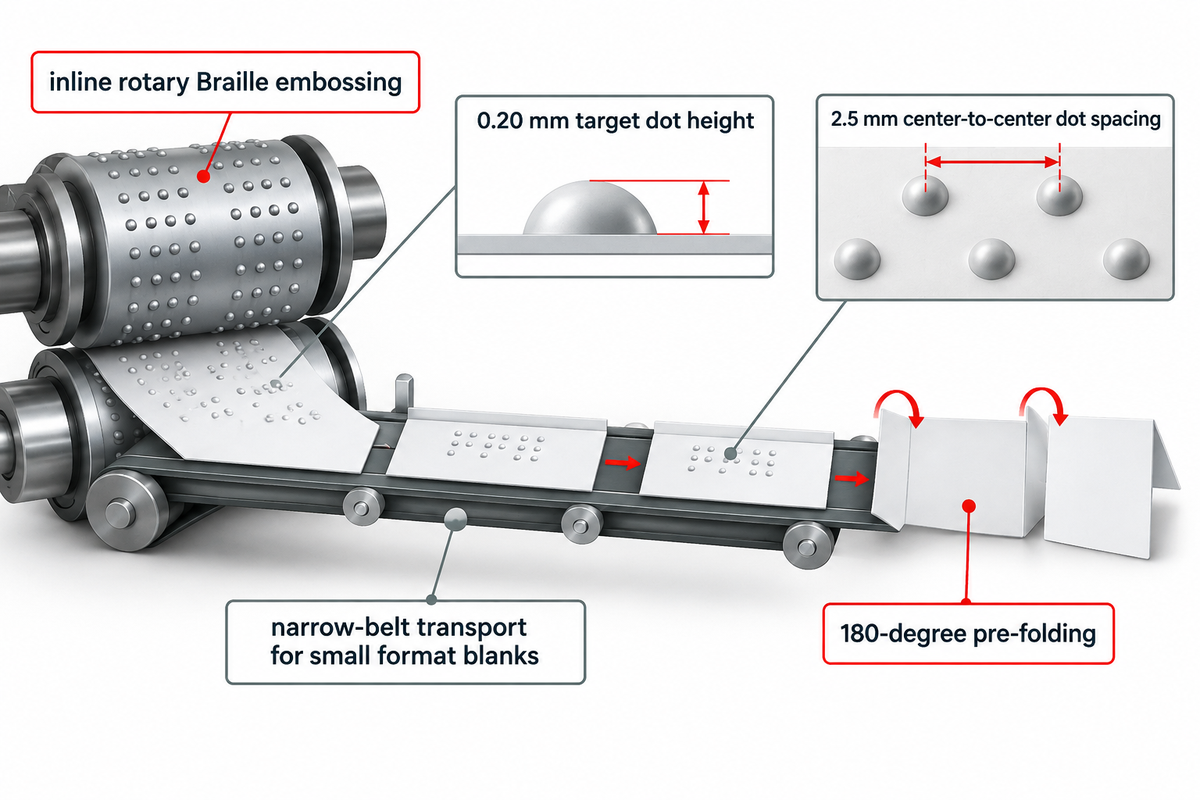
Heidelberg’s Diana Braille module provides inline rotary Braille embossing for medicinal cartons that follow ISO 17351 and Marburg Medium geometry, including a 0.20 mm target dot height. It also supports narrow-belt transport for small format blanks. To reduce opening force on automated blister cartoners, converters specify 180-degree pre-folding on the first and third crease lines where required by the carton style.
According to PharmaBraille’s Marburg Medium technical specification, medicinal Braille requires a 1.3 mm to 1.6 mm dot base diameter. The standard specifies 2.5 mm center-to-center dot spacing, 6.0 mm cell-to-cell spacing, and a 0.20 mm target dot height under ISO 17351. When converters emboss Braille inline on the folder gluer rather than on the die-cutter, rotary tooling forms the 0.20 mm dots at converting speed. Heidelberg’s Diana Braille module, for example, specifies rotary embossing registration at speeds up to 200 m/min (up to 85,000 cartons per hour). After embossing, downstream carrier belts and compression rollers must straddle the Braille panel so pressure rollers do not flatten the raised 0.20 mm dots.
Small format vial, ampoule, and eye-dropper cartons pose a separate mechanical challenge because of the requirements of minimum open-blank width and pre-break geometry. Paper physics prove that score delamination governs folding resistance. In converting practice, 180-degree pre-folding of the first crease (glue-lap side) and third crease (opposite main panel) is an established OEM specification for automated cartoning lines. When the first and third scores wrap through a full 180 degrees around swords and rollers, the flat-glued carton pops open cleanly under rotary vacuum cups. You can explore the mechanical belt and sword geometry in our dedicated folder gluer pre-folding mechanism design article.
For miniature unit-dose cartons, prioritize the machine’s narrow-stack feeder kit and a central transport belt width that allows the belt to enter narrow carton panels without colliding with the folding hooks.
How Do Cold-Chain Biologics and Auto-Injector Cartons Change Adhesive and Folding Requirements?
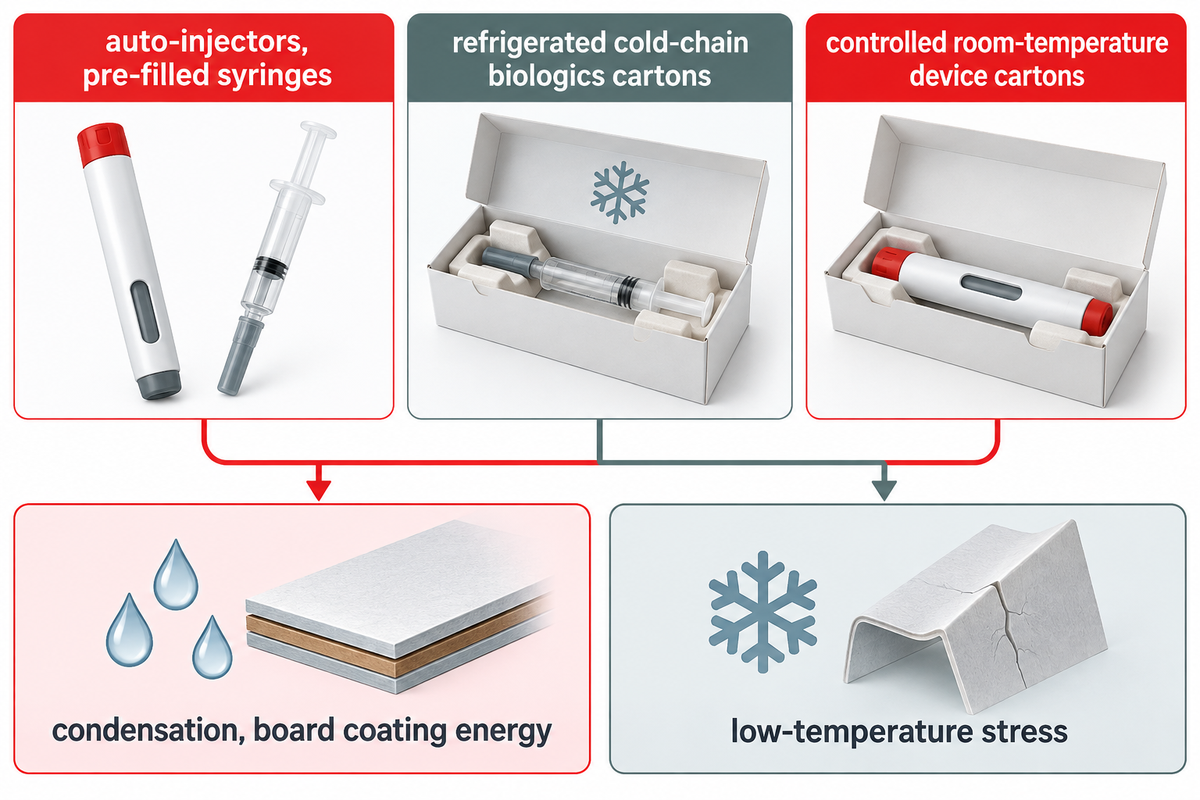
Structural paperboard cradles for auto-injectors, pre-filled syringes, and self-administration devices should be designed to maintain adhesive strength across the specified storage conditions and to protect the glass barrels. Converters must distinguish refrigerated cold-chain biologics cartons from controlled room-temperature device cartons according to the drug’s stability profile. Teams test adhesive seams for condensation, board coating energy, and low-temperature stress.
Growing demand for home injection devices, and rising pharmaceutical biologics have made multi-panel paperboard cradles a core converting segment. These integral partition cartons are plastic free and substitute for thermoformed trays. They vary widely with respect to formulation. Refrigerated biologics cartons, like monoclonal antibody pens and vaccine cartons, are stored in the cold-chain to protect the dose inside the original carton from light and thermal shock. By contrast, several emergency auto-injectors are stored at controlled room temperature and must not be refrigerated. Packaging engineers therefore match the board and adhesive to the drug’s stability profile rather than assuming every injectable box enters a cold room.
On the folder gluer, high-performance adhesive selection balances open time, fiber penetration, and thermal resilience. Polyvinyl acetate dispersion glue penetrates uncoated paperboard and develops strength as the water in the glue evaporates. Fiber tear occurs when the bond strength of the adhesive is greater than the strength of the paperboard. High-speed folder gluers use hot-melt adhesives. However, Henkel’s hot-melt pop-open troubleshooting guide warns that low surface energy coatings, wrong open time, or weak compression cause seams to pop open under cold storage or moisture cycling. Converters modify nozzle and wheel hardware as well as the conditioning protocol as described in our folder gluer glue system configuration guide.
Worked Scenario: A converter produces a 6-corner crash-lock carton with an integral paperboard cradle for a refrigerated prefilled syringe. During initial production runs, samples passed room-temperature pull tests. However, after refrigerated conditioning, seams on the side of the carton popped open. Inspection of the failed joints reveals smooth, glossy adhesive beads sitting on top of a clay-coated back liner without fiber penetration. By using a plasma treatment to the glue lap before the cold glue jet and extending contact time of the compression belt, the converter was able to restore full fiber tear during refrigerated conditions.
How Do Zero-Defect Vision Inspection and Single-Carton Ejection Prevent Line-Clearance Failures?
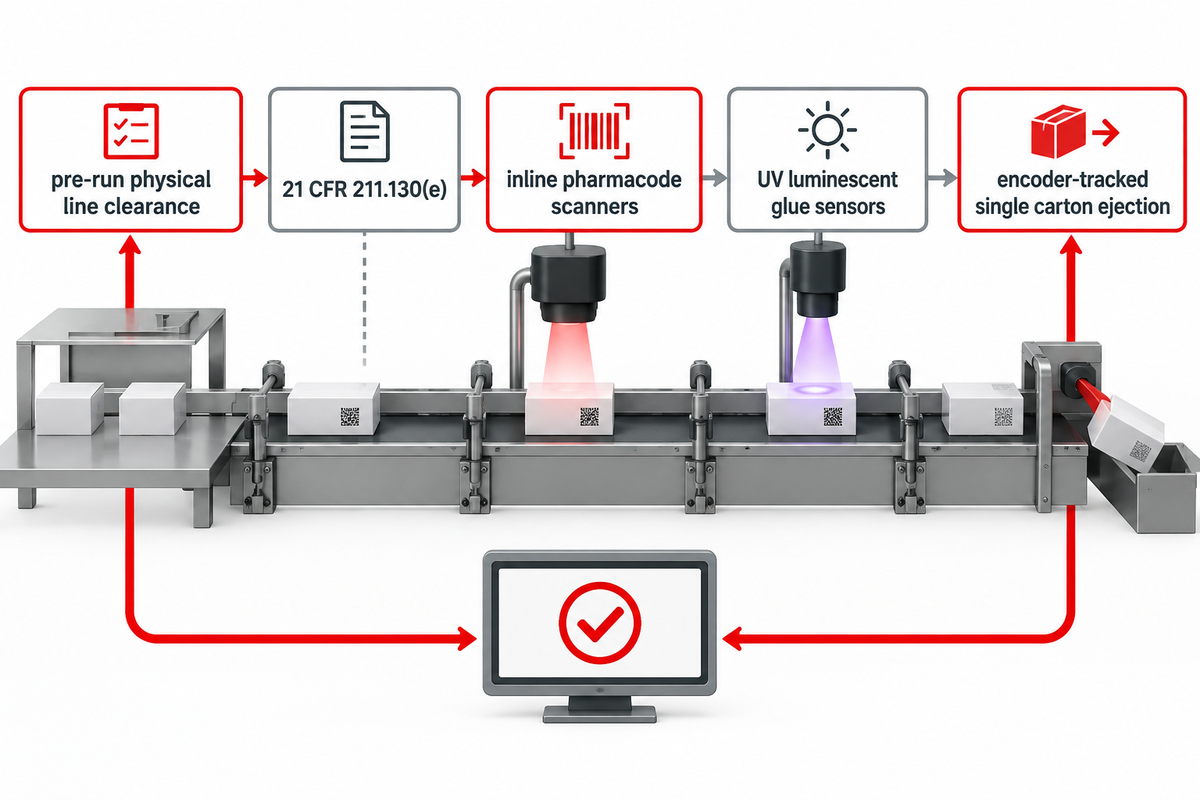
Preventing packaging mix-ups combines pre-run physical line clearance and automated runtime inspection with single carton ejection. For drug packaging operations under 21 CFR 211.130(e), facilities inspect and document packaging lines before use. On the folder gluer, converters reinforce line clearance with inline pharmacode scanners, 2D vision cameras, UV luminescent glue sensors, and encoder-tracked single carton ejection gates that are verified by a reject-bin photo eye.
Compliance engineering starts with an accurate reading of federal rules. Under 21 CFR 211.130(e), drug packaging and labeling facilities are inspected immediately before use. This check ensures that previous drug products and unsuitable packaging or labeling materials have been removed, and the inspection results are documented in the batch production records. Inline sensors on a converter’s folder gluer don’t replace pre-run physical line clearance. Instead, they provide real-time engineering defense against stray blanks, missing glue lines, and print defects during high-speed converting.
Hardware suppliers like Baumer hhs and Heidelberg (Diana Inspection) have developed closed-loop tracking systems for folding cartons. Water-based cold glue is colorless, so converters use adhesives doped with an optical brightener that fluoresces under UV light. So, the presence of the adhesive is sensed by a UV luminescence sensor, and the length of the glue line is sensed by an encoder. Sensing the glue line’s width and position requires spatially resolved inspection. Simultaneously, a pharmacode reader or 2D vision camera verifies SKU identity before the side seam closes.
Zero-Defect Pharma Line-Clearance Gate
The Zero-Defect Pharma Line-Clearance Gate has nine pre-run and runtime verification barriers. This sequence is used to audit fault detection and the removal of single cartons during Factory Acceptance Testing (FAT) and normal production.
| Gate Stage | Verification Target | Control Mechanism or Sensor | Fail-Safe Disposition & FAT Challenge Test |
|---|---|---|---|
| 1. Pre-Use Line Clearance | Removal of prior batch blanks, labels, and unsuitable materials before starting a new order (aligned with 21 CFR 211.130(e) inspection principles) | Two-person physical sweep of feeder, guides, under-guards, and reject bin | Signed line-clearance record entry before loading new pallet |
| 2. Recipe & Tooling Lock | Match drawing revision, dieline, Braille wheel, and sensor tolerances | HMI recipe verification against approved quality standards packet | Hold startup if drawing revision or Braille layout differs from job order |
| 3. Feeder Double-Sheet Check | Prevent overlapping blanks from hiding an unglued or uninspected carton | Ultrasonic or mechanical caliper double-sheet detector at feeder exit | Immediate feeder clutch stop or tracked ejection of overlapped pair |
| 4. Inline Pharmacode / 2D Identity | Detect foreign SKU blanks or wrong artwork language mix-ups | High-speed pharmacode scanner or 2D DataMatrix camera on flat blank | Trigger encoder tracking register for downstream single-carton rejection |
| 5. Print & Surface Vision | Catch missing lot/expiry windows, print hickeys, or surface defects | Print inspection camera for print defects, paired with angled-lighting embossing inspection when Braille checks are specified | Flag defective blank ID in shift register without halting main drive |
| 6. UV-Luminescent Glue Sensor | Verify side-seam adhesive presence and encoder-linked glue-line length (with spatially resolved vision when width or offset checks are specified) | Optical UV luminescence sensor reading fluorescent tracer in cold glue | Reject blanks with short or missing glue lines before folding |
| 7. Encoder-Tracked Single Ejection | Remove only the faulted blank at line speed before the compression belt | High-speed pneumatic or servo flipper synchronized to belt encoder pulses | Divert defective blank into locked reject collection box |
| 8. Reject-Confirmation Photo-Eye | Prove the faulted blank physically entered the locked reject chute | Closed-loop optical sensor inside the reject throat timed to ejector stroke | Controlled machine stop if an expected reject fails to break the beam within the tracking window, followed by quarantine of downstream cartons |
| 9. Consecutive-Fault Line Stop | Prevent runaway scrap if a glue nozzle clogs or a guide shifts | PLC counter monitoring consecutive or windowed reject frequency | Automatic feeder halt after a configured consecutive-reject threshold for operator root-cause check |
The eighth stage in the gate, the reject-confirmation photo-eye, serves as the final quality control step. For instance, if a pneumatic valve releases pressure and doesn’t deflect a bad carton, that bad carton would proceed to the compression belt undetected. With closed-loop reject confirmation configured to stop the line, the PLC initiates a stop when the expected throat-sensor signal is absent at the end of the tracking window. The folder gluer then decelerates to a stop.
How Should Packaging Converters Specify and Audit a Folder Gluer for Pharmaceutical Cartons?
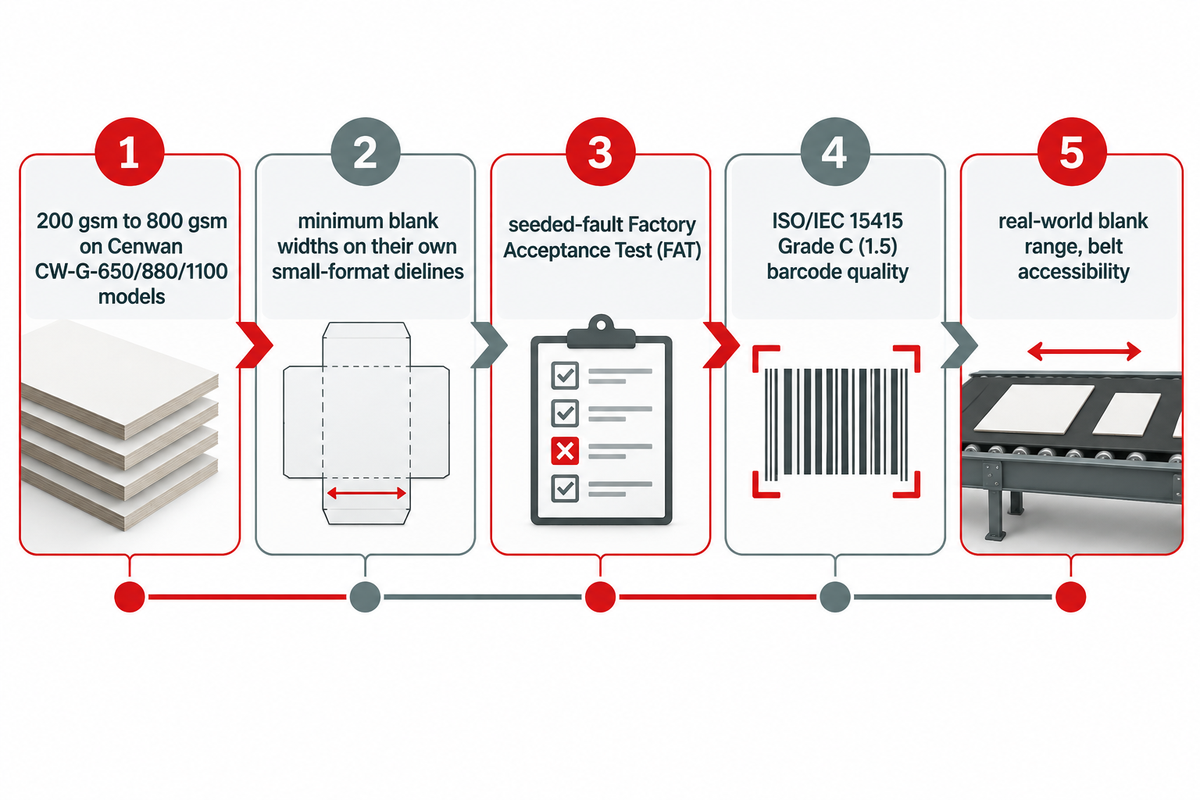
Specifying a medicinal carton folder gluer brings engineering, quality and procurement in line with actual dielines and model-specific board ranges, e.g. 200 gsm to 800 gsm on Cenwan CW-G-650/880/1100 models. Purchase personnel are advised to validate the minimum blank widths on their own small-format dielines, and maintain pre-run physical line clearances. Where specified, a seeded-fault Factory Acceptance Test (FAT) audits 180-degree pre-folding, 0.20 mm Marburg Medium Braille dot height, ISO/IEC 15415 Grade C (1.5) barcode quality, and single-carton ejection.
Insights shared by experienced converters on PrintPlanet’s folder-gluer engineering forum emphasize evaluating a machine’s real-world blank range, belt accessibility, and after-sales service support across coated duplex, SBS, and recycled boards. Cenwan Machine’s verified public catalog parameters (CW-W-1250AC-S 290-1250 mm width at up to 200 m/min; CW-G-650/880/1100 for 200-800 gsm board at up to 400 m/min; CW-G-650PC 13.5 kW crash-lock; CW-W-1250PCW 180 m/min 4/6-corner) anchor the converter RFQ/FAT matrix with explicit catalog-vs-validation boundaries. When a converter creates an RFQ, they’re able to set design constraints based on certified public catalog parameters from Zhejiang Chengwang Intelligent Packaging Equipment engineering team (Cenwan Machine).
- Straight-Line & Pre-Folding Envelope (CW-W-1250AC-S): Public catalog specification lists a 290 mm to 1250 mm open blank width range, belt speed up to 200 m/min, and 22 kW motor power for outer cartons and multipacks.
- High-Speed 4-Fold Carton Envelope (CW-G-650 / 880 / 1100): Public catalog specification covers 650 mm, 880 mm, and 1100 mm width classes and supports 200 gsm to 800 gsm paperboard at design speeds up to 400 m/min.
- Crash-Lock Bottom Envelope (CW-G-650PC): Public catalog specification lists a 650 mm width class and a 13.5 kW drive configuration for automated crash-lock bottom folding cartons.
- Multi-Panel 4/6-Corner Envelope (CW-W-1250PCW): Public catalog specification lists a 1250 mm width class, speeds up to 180 m/min, and 25 kW power with rotary hooks for 4-corner and 6-corner partitioned device trays.
| Stakeholder Role | RFQ Specification Input | Factory Acceptance Test (FAT) Verification Method | Scope Boundary & Documentation Output |
|---|---|---|---|
| Plant Engineering | Smallest and largest production dielines, model-specific board range (such as 200 gsm to 800 gsm on CW-G-650/880/1100), Crease 1 and Crease 3 pre-fold angles, and Braille/plasma ports | Run continuous trials on smallest vial carton and stiffest board at target speed, verifying 180-degree crease recovery and 0.20 mm Marburg Medium Braille dot height | Catalog blank-width limits and model-specific maximum speeds are mechanical envelopes. Actual run speed depends on blank geometry and adhesive dwell. |
| Quality Assurance (QA) | Pharmacode reader, 2D verifier (ISO/IEC 15415 Grade C / 1.5 minimum), UV glue sensor, single-carton ejector, and reject photo-eye | Complete pre-run physical clearance, seed customer-agreed fault blanks into a live run, and verify single-carton capture | Machine FAT verifies the agreed equipment functions. The converter’s process qualification is governed by its quality system and customer agreements, while the pharmaceutical manufacturer is responsible for qualification of its drug-packaging operations. |
| Procurement & Operations | Model-specific total installed power including inspection and auxiliary modules, spare belt and nozzle kit, electrical schematics, and escalation SLA | Verify delivered component serial numbers, safety guard interlocks, PLC recipe backup, and operator maintenance documentation before final release | Unit pricing and lead times are not standardized publicly and require a formal engineering quotation based on installed inspection peripherals. |
Keeping public catalog ceilings distinct from job-specific validations defends the converter and protects the stakeholder team. FAT testing validates the agreed functions of the equipment. How a process qualification of a converter is validated is subject to its quality system and customer agreements. It’s the responsibility of the pharmaceutical manufacturer to validate process qualification of the packaging operations. A converter producing miniature unit-dose ampoule boxes, along with wider medical products, isn’t in and of itself a concern. The engineering team must specify narrow-format carrier tooling during the quotation review for automatic folder gluer machine solutions rather than assuming a wide-format frame handles miniature blanks without special carriers.
Frequently Asked Questions
What are the most important pharmaceutical carton production trends for packaging converters in 2026?
Five regulatory and structural shifts dominate 2026 production.
Brands are adopting recyclable mono-material paperboard designs aligned with EU PPWR recyclability goals alongside unit-level GS1 2D DataMatrix serialization for applicable medicines under U.S. DSCSA and EU FMD. Pharmaceutical carton production options include glued fiber-tear closures, inline Marburg Medium Braille embossing, UV glue monitoring, and single-carton ejection. CCL Healthcare also describes tear-away security structures, while multi-panel paperboard cradles increasingly replace secondary plastic trays.
Why is 180-degree pre-folding critical for pharmaceutical folding cartons?
Full pre-breaking lowers opening resistance on blister cartoners.
Pre-folding mechanically conditions the creases to reduce carton opening resistance for downstream cartoning. When specified at 180 degrees on the first and third scores, flat-glued cartons pop open smoothly under vacuum suction on horizontal or vertical blister cartoners. Without consistent score pre-breaking, stiff mono-material or recycled-fiber blanks exhibit elastic springback that causes feed jams and line stops.
How do folder gluers prevent carton mix-ups and missing glue seams in pharmaceutical production?
Synchronized inline sensors trigger tracked single-carton ejection.
Modern folder gluers combine inline pharmacode scanners, 2D barcode cameras, and UV-luminescent glue detectors ahead of the compression belt. When any sensor detects a mixed SKU, missing glue bead, or skewed blank, the encoder tracks that exact carton to a high-speed flipper before compression. A reject-throat photo-eye then verifies physical removal into a locked collection bin.
Can mono-material paperboard inserts replace thermoformed plastic trays in pharmaceutical cartons?
Yes, multi-panel paperboard cradles replace secondary plastic trays.
Die-cut paperboard dividers and 4-corner or 6-corner cradles increasingly replace non-exempt PVC and PET secondary blister or vial trays. Depending on the actual box geometry, simple divider sleeves fold on straight-line stations, whereas complex multi-panel cradles use wide-sheet feeder alignment, multi-point glue registration, and synchronized rotary folding hooks.
What should a converter verify during a Factory Acceptance Test (FAT) for a pharmaceutical folder gluer?
Test seeded fault blanks on actual production board grades.
During a Factory Acceptance Test, converters should test their smallest, largest, and stiffest production dielines, including UV-varnished boards with unvarnished glue reserve flaps. Where specified, the audit verifies 180-degree crease recovery, 0.20 mm Marburg Medium Braille dot height, ISO/IEC 15415 Grade C (1.5) barcode quality, and single-carton fault rejection. Finally, confirm that a missed reject-throat photo-eye signal triggers a controlled stop.
Does inline vision inspection on a folder gluer replace cGMP pre-use line clearance?
No, pre-run physical line-clearance inspection remains essential.
Under 21 CFR 211.130(e), drug packaging and labeling facilities are inspected immediately before use. This check ensures that previous drug products and unsuitable packaging or labeling materials have been removed, and the inspection results are documented in the batch production records. Inline pharmacode and glue sensors provide runtime defect removal but never replace pre-run physical line clearance.
Specify Your Carton Folder Gluer Configuration
Send your smallest and largest carton dielines, board grammage range, Braille requirements, and inline inspection checklist to our engineering team. We’ll review station geometry, pre-folding angles, and FAT acceptance criteria for your converting line.
Prepared from European Union and U.S. FDA regulatory texts, peer-reviewed paperboard converting research, PMMI industry data, and manufacturer technical specifications reviewed in October 2026. Worked scenarios are illustrative engineering examples. Always follow site-specific cGMP validation protocols and installed equipment safety instructions.
References & Sources
- Packaging and packaging waste (from 2026): Summary of Regulation (EU) 2025/40 EUR-Lex, Official Journal of the European Union.
- 21 CFR 211.130: Packaging and labeling operations Electronic Code of Federal Regulations (eCFR), U.S. Food and Drug Administration.
- Converting and Its Effects on Barrier Properties of Coated Packaging Materials: A Review BioResources, North Carolina State University.
- PMMI Pharma Infographic: Manufacturing and Regulatory Challenges and Future Packaging Trends PMMI, The Association for Packaging and Processing Technologies.
- US7121991B2: Method and apparatus for producing a folding carton United States Patent and Trademark Office (via Google Patents).