Get in touch with Cenwan Machine Company


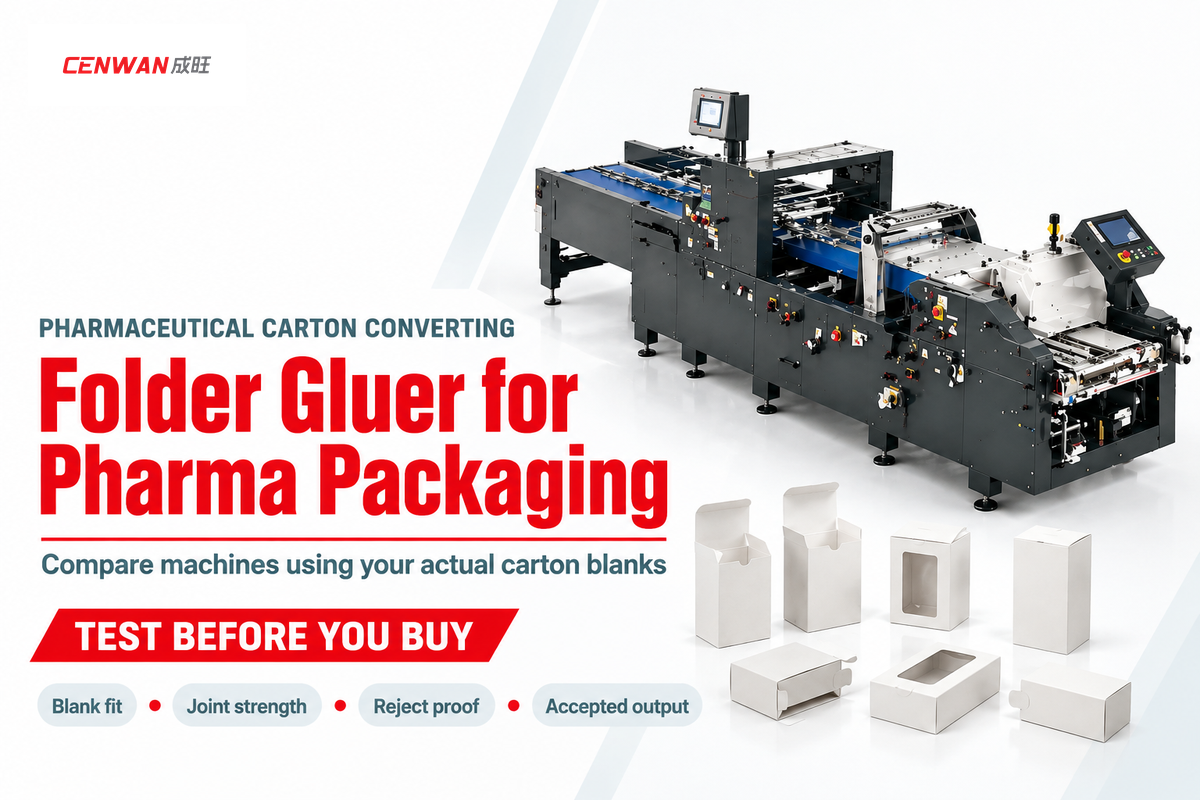
A folder gluer for pharma packaging folds and glues printed paperboard blanks into empty cartons that usually leave the machine flat. In packaging production, the folder gluer finishes gluing before the medicine goes into the carton. Run your smallest blank, hardest glue joint and most easily confused artwork on the quoted machine. Compare bids on accepted cartons per shift with required options running.
Define what “accepted” means before the trial. An empty carton may pass at the folder gluer’s outfeed and still open poorly on the cartoner after storage. Keep these results separate. The folder-gluer outfeed count tells you what the converter produced. The check later tells you whether the cartons can feed and open on the packing line.
What to put in the request for quotation
- Bring actual printed blanks and drawing revisions, including the narrowest carton and a difficult seam.
- Ask to see a correctly diverted reject, then inspect retained cartons for seam strength and opening.
- Put startup loss, time per change, and the running reject count on separate lines of the trial sheet.
Where the Folder Gluer Fits in a Pharma Carton Line
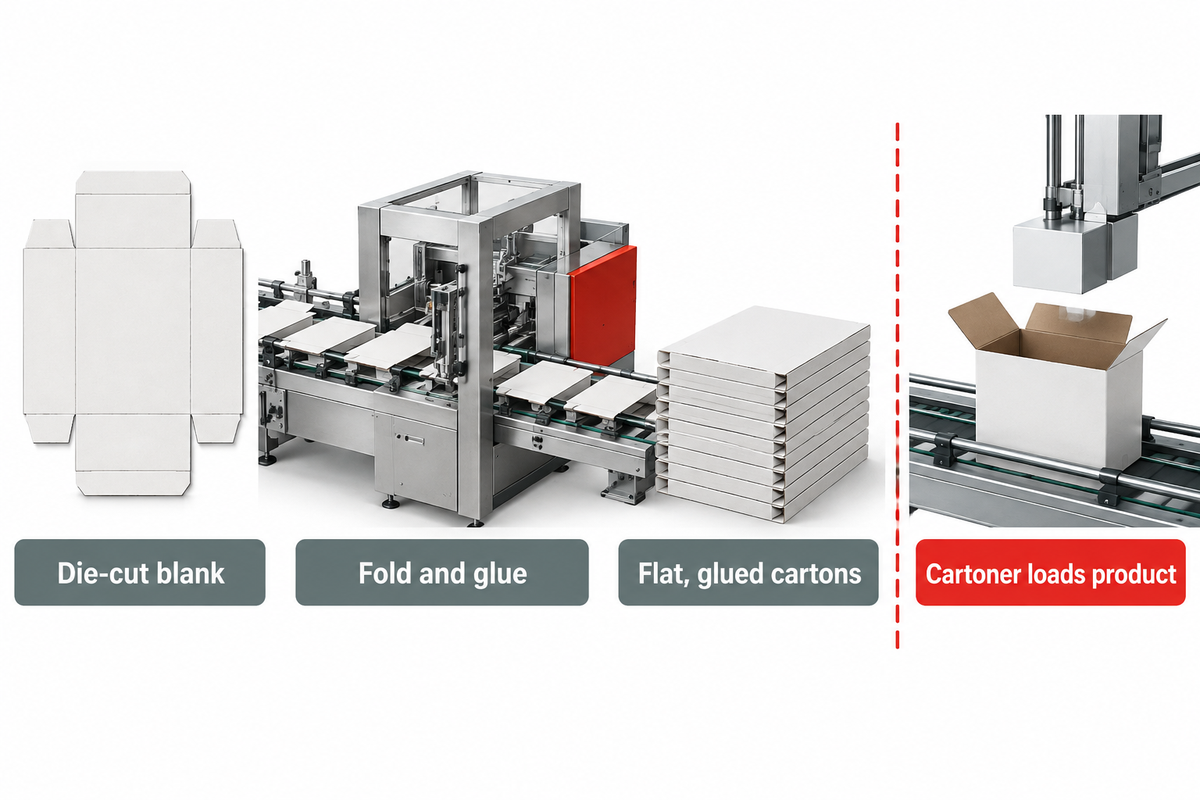
On a paperboard carton production line, the folder gluer makes the empty carton after carton printing and die-cutting. The feeding system separates blanks and alignment guides position them. The folding and gluing process brings the intended panels together and the compression section holds the glued joint closed until delivery.
In the packaging industry, these are often separate production steps. Where the carton goes next is as important as how it leaves this machine. Efficient packaging depends on the joint made at the converter and the box forming that happens on the cartoner.
Where Does Carton Converting End and Cartoning Begin?
Carton converting ends when the folded, glued carton is delivered for the next operation. The cartoner will erect the carton, load the product or a dummy for a trial and close the package. The converter supplies flat, glued samples and the packer checks opening and feed behavior under the agreed handling conditions.
In a tuck-end carton, the maker’s joint usually bonds the side of the sleeve. End flaps serve a different purpose and close later. If a drawing requires a glued automatic bottom, the converter has extra bottom tabs to fold and bond. The Paperboard Packaging Council’s carton style guide shows why the closure name and gluer configuration need to be read together.
Packaging machinery catalogs may group corrugated box manufacturing equipment and solid-board gluers together. A semi-automatic gluing machine is an option for intermittent, hand-fed work; a fully automatic line is an option if the sample run demonstrates the required feeding and handling. A flexo folder gluer machine may be integrated with a corrugated cardboard line, where flexo printing and slotting precede folding of the corrugated board. This type of setup is used to handle a corrugated carton differently from a thin pharmaceutical carton. This guide focuses on solid paperboard cartons for secondary packaging; a capability on corrugated stock doesn’t demonstrate handling of small, printed pharmaceutical blanks.
Choose the Machine from the Actual Blank
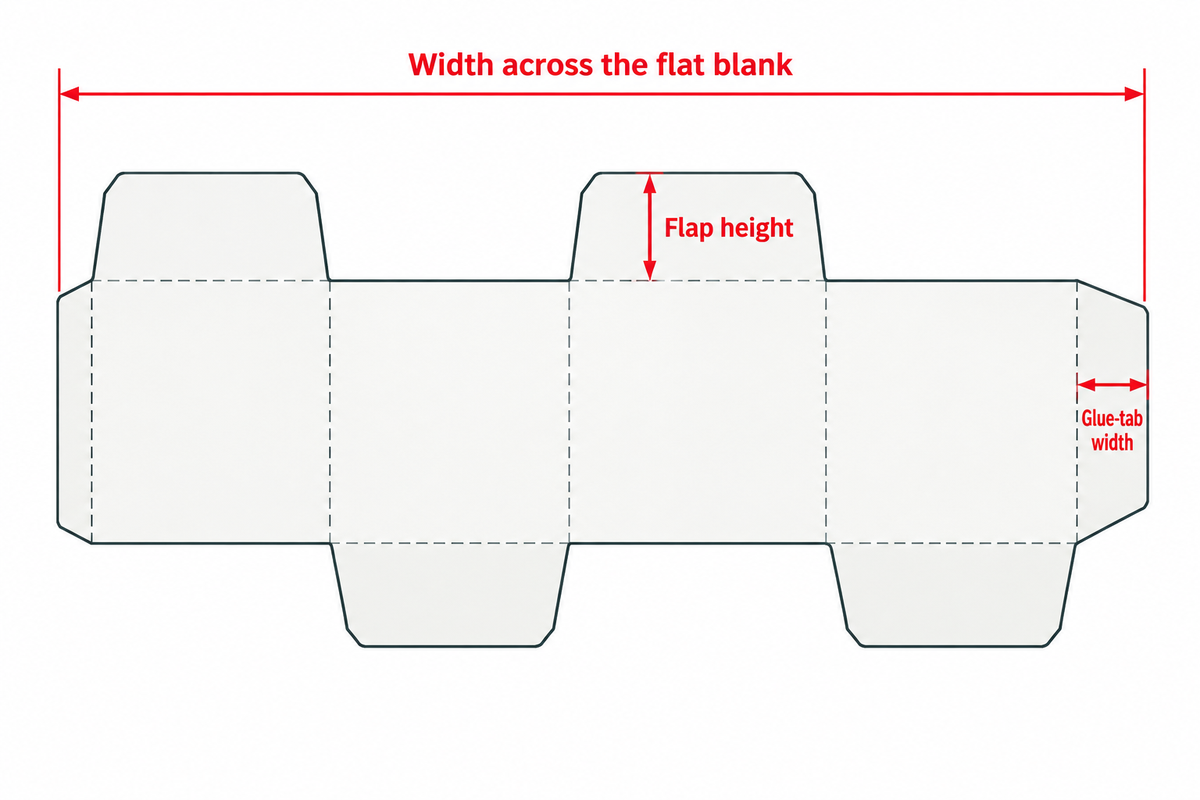
Choose straight-line tooling for a carton with only a glued side seam or add bottom-folding equipment for glued crash-lock tabs, then locate the blank on the supplier’s layout in the correct feed orientation and mark the length, width, glue flaps and all crease lines.
Just having the assembled box dimensions isn’t enough to determine the contact points for the belts and guides. Define production needs using the full range of blanks across the jobs you run.
Which Folder Gluer Fits the Smallest Carton?
For the smallest straight-line blanks, start with the CW-G-650: Cenwan’s drawing table lists 130–650 mm for the CW-G-650 and 140–880 mm for the CW-G-880 on the same A+B+C+D+E dimension. The wider model raises the listed minimum by 10 mm. Trial the smallest actual blank in its printed stock and coating; watch whether it feeds and folds repeatedly without losing alignment. The small-box folder gluer guide covers the wider model and format range.
Cenwan lists a minimum flap height of 25 mm and a glue-tab range of 30–100 mm for the CW-G-650. The CW-G-880 has a listed glue-tab range of 25–120 mm. For a short glue flap, check the actual overlap and carton compatibility, not just overall width.
Get production stock from the printer, including the actual varnish or laminate around the glue flap. Two carton samples with the same outline can behave differently when the board or finish changes. Bring both if both will be used. Note grain direction when it’s part of the drawing or material specification; an unprinted sample can prove the blank path while leaving the printed joint untested.
If two artwork versions share the same dieline and board, the mechanical setup may carry over. The artwork check still needs its own change. Ask the supplier to demonstrate how the next job’s reference is selected and how the line handles one wrong-version sample. A saved servo recipe can help with both setup efficiency and precision by recalling machine positions, but it can’t verify that the loaded stack matches the artwork on the job sheet.
When to Add Inspection or Inline Braille
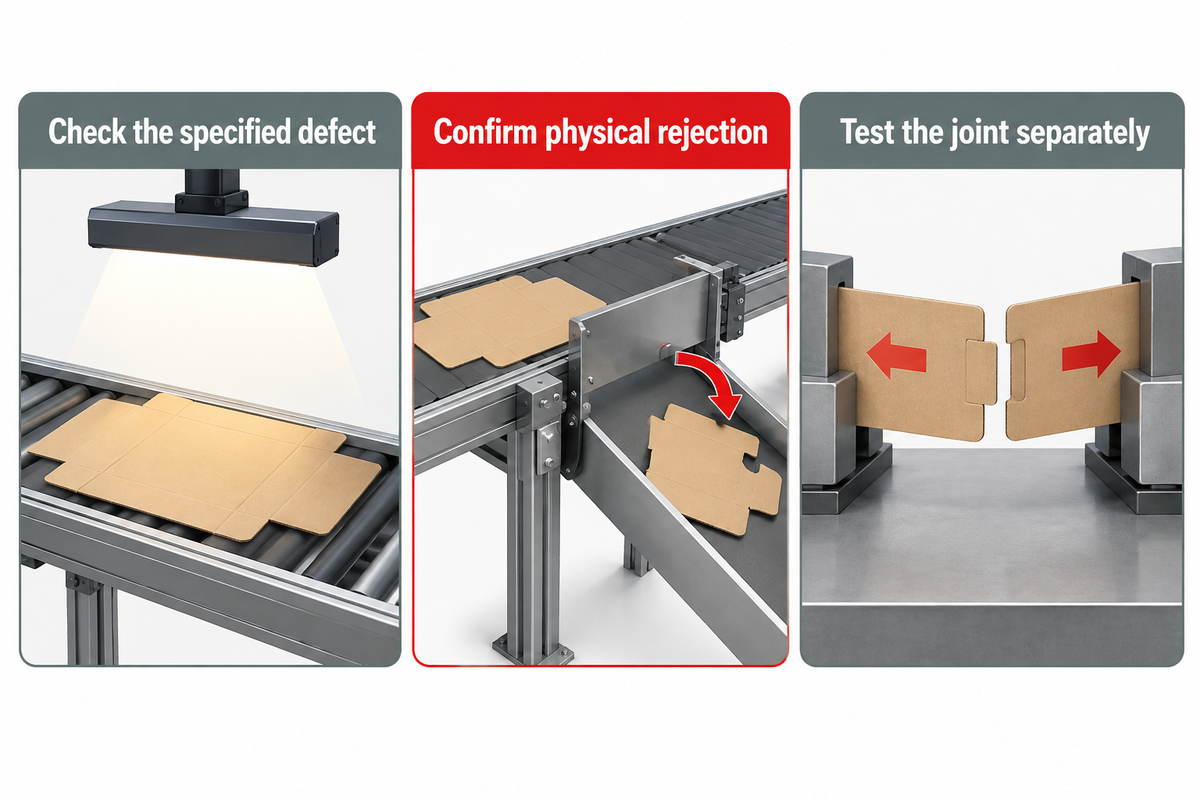
Choose dedicated inspection or embossing on the gluer for repeated jobs requiring that function. A standard automatic folder gluer can do straight-line work in production environments with separate inspection. If the gluer will emboss the carton, compare trial speeds with the embossing module active and inactive.
Does a Pharma Folder Gluer Need Inline Braille?
Yes, include inline Braille if the approved artwork calls for embossing and the folder gluer will perform that step. If approved blanks arrive already embossed, run them through folding, compression and delivery to check the final result. Agree with the buyer on how they’ll assess legibility and panel damage for the retained cartons under the conditions specified.
HEIDELBERG’s Diana Pharma 85 technical data lists a maximum of 250 m/min and gives 300 m/min without the active Braille module. Those are specs for that machine. Run the module during the trial for jobs requiring it.
The same Diana sheet gives different size limits for different box styles. Its straight-line carton length is 55–400 mm and the minimum width is 75 mm, or 45 mm with the small-carton option. Its lockbottom length is 80–600 mm and its minimum width is 146 mm. Both sections list solid carton board at 200–600 g/m². Screen each style on its own drawing; the straight-line minimum is no substitute for a lockbottom trial.
A print or code check compares identity against a reference; a glue sensor checks the adhesive trace in its monitored area. Joint strength needs a test of the bonded carton. If a supplier offers adjustable glue application, record the settings used for the coated sample so the joint can be reproduced. BOBST’s ACCUCHECK inspection system, for example, lists automatic ejection as a separate capability. It doesn’t turn a print inspection into a seam test. Keep the site’s serialization and print-quality checks handy if you also need background on code or print requirements.
What to Put on the Carton Trial Sheet
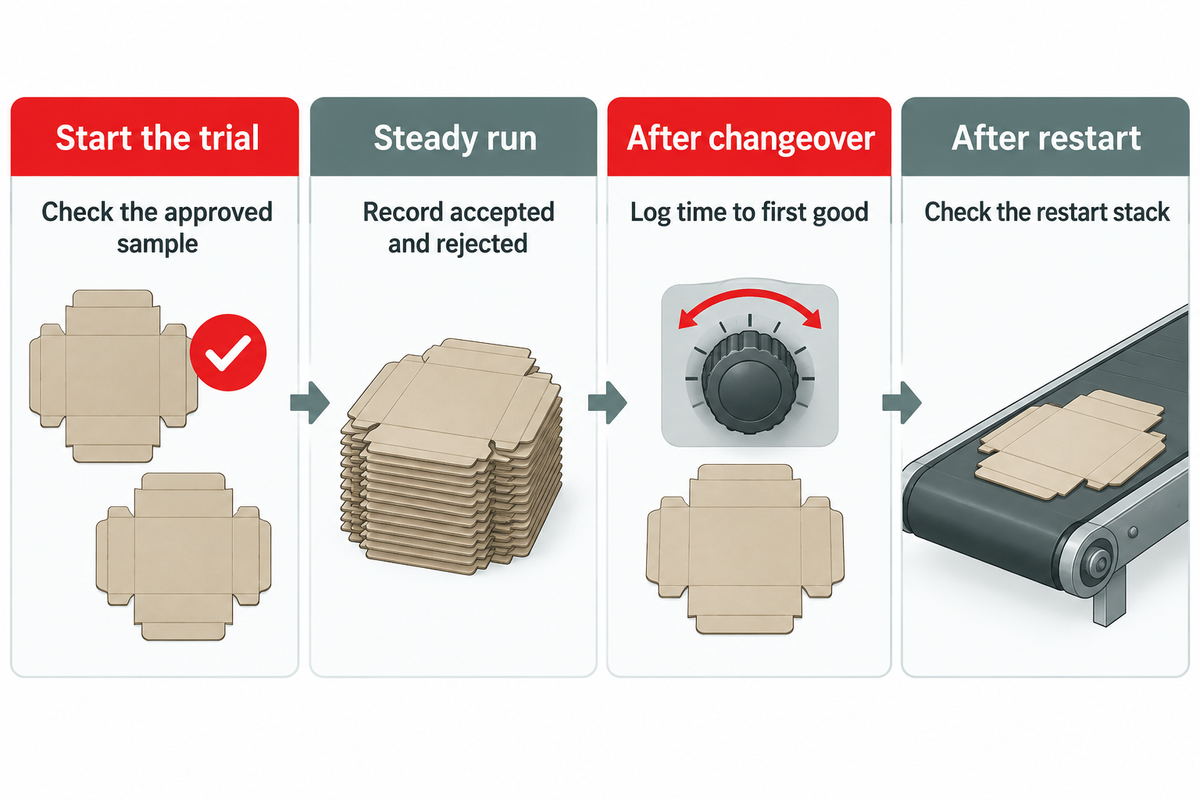
Use the same carton trial sheet for every bid. List each sample’s stock, dieline revision, artwork, feed orientation, adhesive and options in use. Reach an agreement with production and quality staff as to what constitutes a pass and how to document a failed sample, and determine if any checks need to be repeated after holding or moving the cartons.
| Sample type or trial condition | What to observe | Evidence to retain | Decision owner |
|---|---|---|---|
| Routine production carton | Run at the agreed configuration; count feed, rejects, and good output | Run record and identified good cartons | Production |
| Narrowest production blank | Watch feeding and fold position after a setup and restart | Drawing orientation, stop log, first accepted stack | Production and supplier |
| Coated board with a difficult side seam | Check the glue trace and separately test the bonded joint | Seam samples, stock and adhesive IDs, agreed test result | Quality |
| Same dieline, wrong artwork sample | Demonstrate identity detection and physical diversion when specified | Marked challenge pieces, count at reject and good outlets | Quality and supplier |
| Stop and restart | Identify cartons caught between glue application and compression | Restart log and separate suspect stack | Production and quality |
| Repeat job from memory | Time the change until an acceptable stack is delivered | Start and finish times, settings changed by hand | Production |
| Different box structure | Use the offered tooling on the drawing with the most folds | Tooling identification and signed carton sample | Supplier and procurement |
| Embossed carton, if required | Check the agreed Braille and print criteria after compression | Approved reference and retained finished samples | Quality |
| Carton after the agreed hold | Check opening and transfer to the actual carton loading equipment | Retained sample ID and downstream opening result | Receiving production team |
How Can Buyers Verify That a Flagged Carton Was Removed?
Run marked test pieces through the agreed inspection configuration. Document each piece introduced, each detection and each piece physically recovered at the reject outlet. Make sure no marked pieces go to the good stack and that known good cartons continue through. Use a documented and implemented challenge procedure and differentiate challenge pieces from ordinary production rejects.
Pause and restart as agreed for testing. The patent publication EP3941733B1, which lists WH Leary Co as assignee, describes a stop leaving glued cartons that haven’t been fully folded or compressed. It indicates one supplier’s technical response. Record what happens on the offered machine between the restart and the first accepted stack, regardless of which reject design it’s using.
Keep a set of flat glued cartons to open later, on the receiving line, or in the agreed handling test. Berry and colleagues’ research examined moisture and springback across creasing, folding, and subsequent erection. Make decisions regarding what passes based on your own carton specification. If carton opening changes after storage, report the downstream opening result alongside the converter count, keeping the definition of accepted output fixed.
If the restriction is in the seam, check the structural integrity of the bonded sample. Then use the adhesive trace and bond checks to prepare questions about the offered application system and production adhesive.
Compare Quotes on Accepted Cartons per Shift
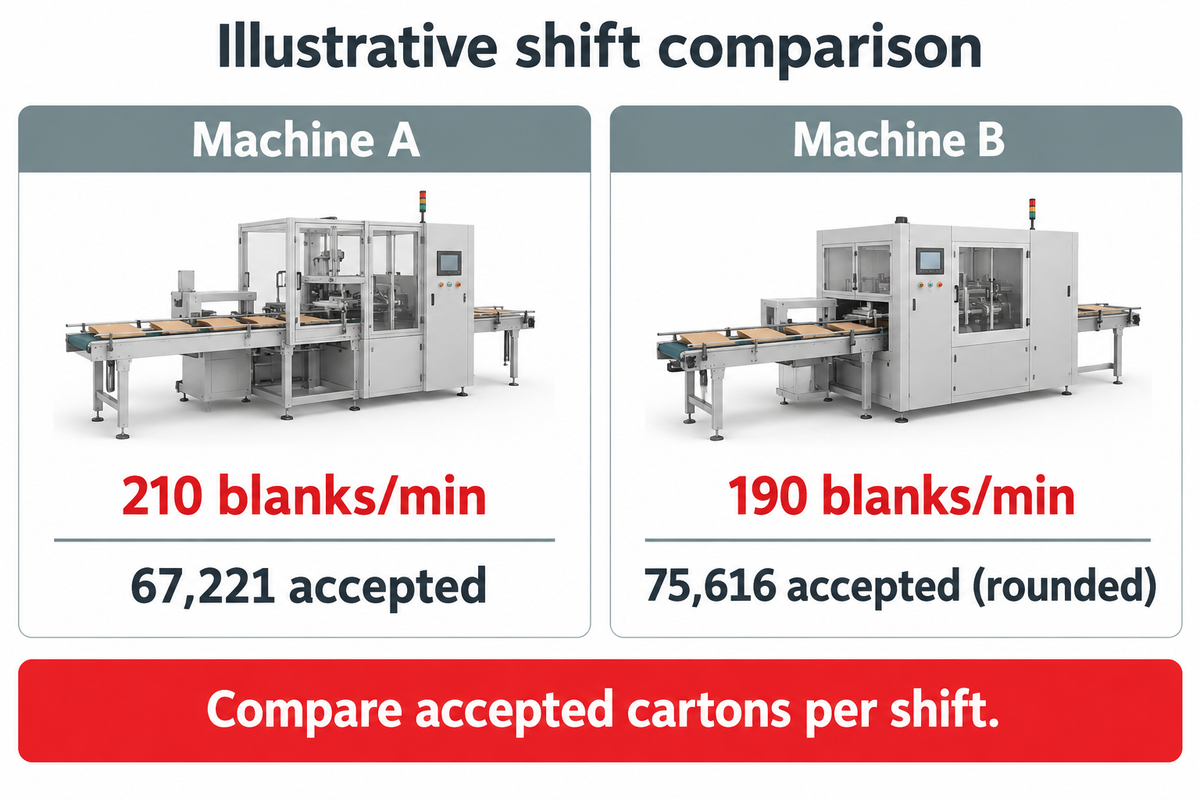
Compare equipment based on counted blanks/running minute, minutes available to run and the fraction accepted during that run. For both trials, use the same start and stop boundaries. According to Cenwan, maximum line speed at no load is 400 m/min for the small box series.
Keep a separate entry for downtime and for time spent on changeovers. High-speed production only improves productivity when the line keeps delivering accepted cartons between changes. Production efficiency starts with finding the loss that consumes most of the scheduled shift. With productivity and efficiency comparisons, time a change from the last accepted stack on the old job to the first accepted stack on the new job. Track brief stops and non-productive time separately from time spent at a reduced running rate. The U.S. Environmental Protection Agency’s equipment loss framework separates setup time, idle time, reduced rate, and defects for the same reason: each loss is considered a different opportunity for improvement.
Accepted-Carton Shift Comparison
Accepted cartons = blanks per running minute × running minutes × accepted fraction. Running minutes = scheduled minutes minus changeover minutes and other stopped minutes. Use one carton per blank for this worksheet. Use the measured feed and acceptance counts for each job if rates vary materially across the shift.
| Input or result | Machine A | Machine B |
|---|---|---|
| Feed during running time | 210 blanks/min | 190 blanks/min |
| Time per change | 30 min | 12 min |
| Total changeover time | 120 min | 48 min |
| Other stopped time | 30 min | 30 min |
| Running time | 330 min | 402 min |
| Accepted fraction during running time | 97% | 99% |
| Estimated accepted cartons | 67,221 | 75,616, rounded |
| Shift cost to enter | Actual cost for Machine A | Actual cost for Machine B |
| Cost per 1,000 accepted cartons | Divide A’s shift cost by accepted cartons and scale to 1,000 | Divide B’s shift cost by accepted cartons and scale to 1,000 |
Multiply 210 × 330 × 0.97 for A and 190 × 402 × 0.99 for B. Machine B, despite the lower running feed, delivers about 8,395 more accepted cartons. The comparison changes if the number of changeovers or the percentage of rejected cartons changes. Separately count scrap that occurs during a changeover if it falls outside the running sample.
For a cost comparison, divide the cost assigned to a shift by the accepted count and multiply by 1,000. Include the same costs on both sides: labor, adhesive, scrap treatment and equipment costs, allocated on the same basis. In this case, B adds production capacity. Compare the unit costs using the actual shift costs for each quote. If a faster line doesn’t change staffing or paid hours, distinguish time freed from a reduction in labor costs. Use the line speed and carton length estimator for an initial throughput estimate; replace it with counted blanks for a purchase decision.
What Changes the Price of a Pharma Folder Gluer?
Width of the machine, some supported carton styles, and fitted modules impact price. Price inspection and ejection, Braille embossing, changeover automation and outfeed equipment separately from the base machine. The ownership-cost example by Cenwan uses $120,000 for a new CW-G and $6,000 for the installation and training. Those are modeling inputs. Compare installed quotes by adding freight, training, installation and spares on the same basis.
The cost guidance from the Association for Packaging and Processing Technologies includes operating and maintenance costs alongside the purchase cost. Judge cost-effectiveness over the same operating period. Determine which consumables or spare parts will affect your budget, what after-sales service is included, and what the line will hand off to the next production stage. This is important on a high-volume job as well as a short run: a slower stacking machine can set the pace for the entire line.
Shortlist Machines by the Evidence Each Supplier Can Show

When the catalog drawing fits the blank and the supplier can run the required joints, a compact Cenwan CW-G configuration can be shortlisted. The same is true for the Diana Pharma 85 sold by HEIDELBERG if the job calls for inline embossing and fits the listed carton envelope. For now, consider these different ways to configure a carton folder gluer machine; the offers only become comparable when both suppliers test the same job and report the same outputs.
Request that each supplier list the actual feeder, folding stations, glue system, inspection equipment and reject unit. A proposal may list several packaging solutions; check which pieces are included in the specific quote. How are adjustments accomplished when the production requirements change, and does after-sales support cover a second carton format? In the packaging sector, industrial packaging features that reduce setup effort can differ from those that maintain fold position on a short flap. A carton box listed as lock-bottom or four-corner on a family page may require tooling outside the quoted configuration. Get the quoted machine configuration in writing, especially when two brochures use similar model numbers.
Separate checks that apply at the supplier’s factory from those that depend on your site. A sample run demonstration can show feeding and seam behavior on the equipment offered. Include the packaging materials you’ll purchase and put the checks in the product quality record. A site test can verify the line installed on site and its handoff to your stacker or cartoner. The OpX acceptance test guidance differentiates factory and site tests. Agree up front on what results will be transferred, and what will need to be repeated following installation.
Send a Carton Trial Pack Before the Purchase Order
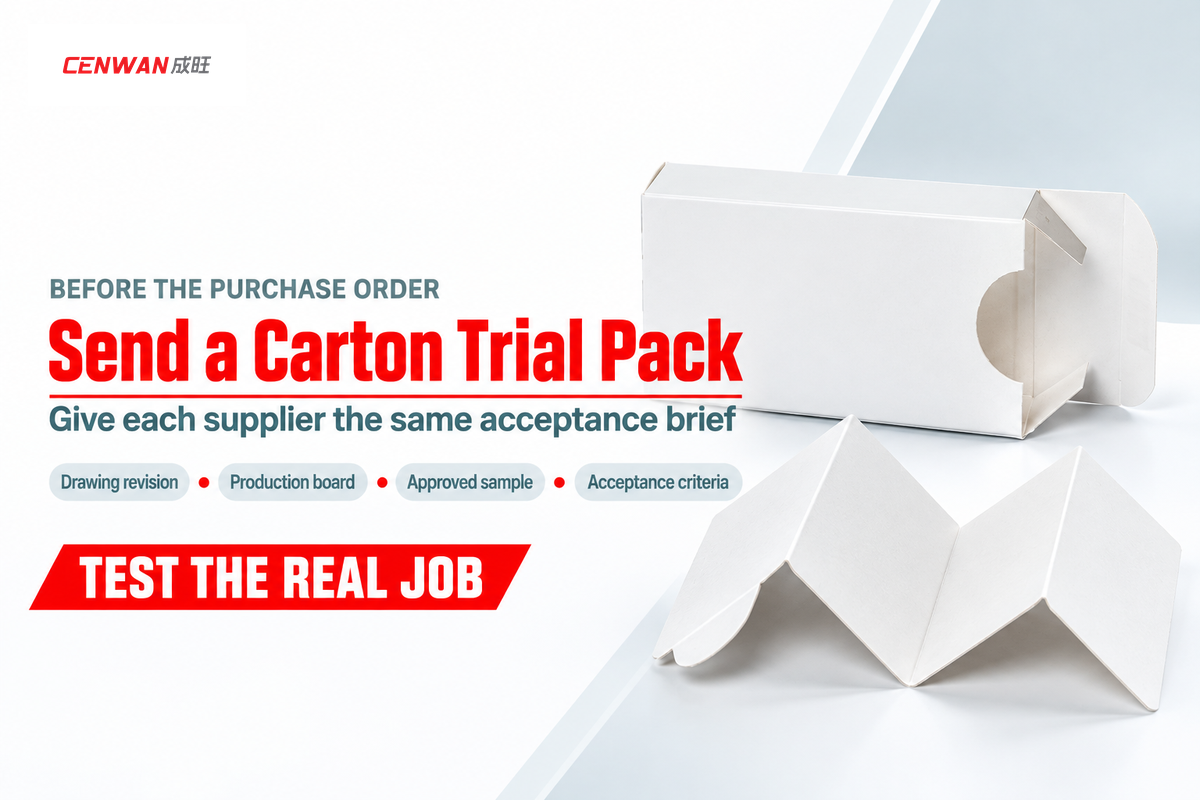
Send dieline revisions, actual board and print samples, anticipated order quantities, the expected number of daily changeovers and requirements for outfeed checks. Identify jobs that require embossing or identity checks. Request one scheduled trial and a written list of options included. Retain sample IDs, counts and actual setup notes with the quotes so purchasing can compare bids later.
Have a difficult medicine carton or several versions on one dieline? Discuss the carton trial with Cenwan. Share the actual drawings and stock, and ask for a configuration quote that states which checks can be demonstrated before purchase.
Frequently Asked Questions
What should I check when trialing a used folder gluer?
Run your actual blanks on the machine as offered, including any inspection or reject equipment included in the price.
Ask whether the tooling, manuals and spare parts are included and whether technical support is available for the existing controls. A gluer that runs acceptably today can still require a separate allowance for installation, wear parts or training.
What key features should be prioritized when selecting packaging equipment?
Prioritize the feeder, carton style tooling, glue application and inspection features that your existing orders need.
For frequent changes, ask the operator to run the next job rather than watching a saved recipe load. If the line regularly stops for the same reason, verify which feature addresses that stop before paying for a faster drive or a larger machine. Minimizing downtime requires a repeatable change, not just a quicker motor.
What are the specific benefits of automation in box-making machinery?
Automation can repeat adjustments, count cartons and handle steps that otherwise rely on the operator. In carton making, those changes can improve operational efficiency when a repeated setup is the problem.
Its value depends on which step consumes time or causes scrap at your plant. Recalling settings can help repeat jobs, but a new blank still needs approval. Measure the complete change and count usable cartons to see how much production time the feature returns.
Does the quote include packing the flat cartons into cases?
Only if the quote includes a case packing station or a defined downstream packing scope.
Ask where the gluer delivers the cartons, who counts and stacks them, and whether cases are filled manually or by separate equipment.
Can a carton trial begin before the final adhesive is selected?
Yes, if you separate a mechanical trial from the bonded carton acceptance.
Start by checking whether the actual blank feeds, aligns and folds consistently. Document what adhesive was used in any provisional samples and mark the bond result as provisional. When the final adhesive and printed board are available, repeat the joint test using the production configuration and agreed conditioning. A mechanically sound blank can still need a different joint process when a coating or glue changes.
Why is quality important in folder gluer machines?
A weak side seam or an out-of-square carton can interrupt downstream handling.
Keep identified samples from startup and stable running. If a problem appears later, that record helps separate issues that started at the gluer from changes during storage or transfer.
How do I choose the right folder gluer machine if I may add a second carton style next year?
Choose for today’s proven jobs and request a written expansion option for the new carton style.
For example, adding a glued bottom may require hardware that your straight-line configuration lacks. Ask the supplier what can be installed later, what the conversion involves, and whether both formats fit the offered frame. If the next design is already drawn, bring it to the trial. If it’s still speculative, compare the cost of reserving that capability with the cost of adding it later.
References & Sources
- Paperboard Packaging Council, folding carton designs.
- Cenwan Machine, small box folder gluer specifications.
- HEIDELBERG, Diana Pharma 85 technical data.
- BOBST, ACCUCHECK inline inspection system.
- European patent EP3941733B1, carton rejection system.
- Berry et al., environmental conditions and cartonboard performance, 2005.
- U.S. Environmental Protection Agency, equipment loss categories.
- OpX Leadership Network, acceptance test guidance; PMMI, machinery ownership-cost guidance.