Get in touch with Cenwan Machine Company


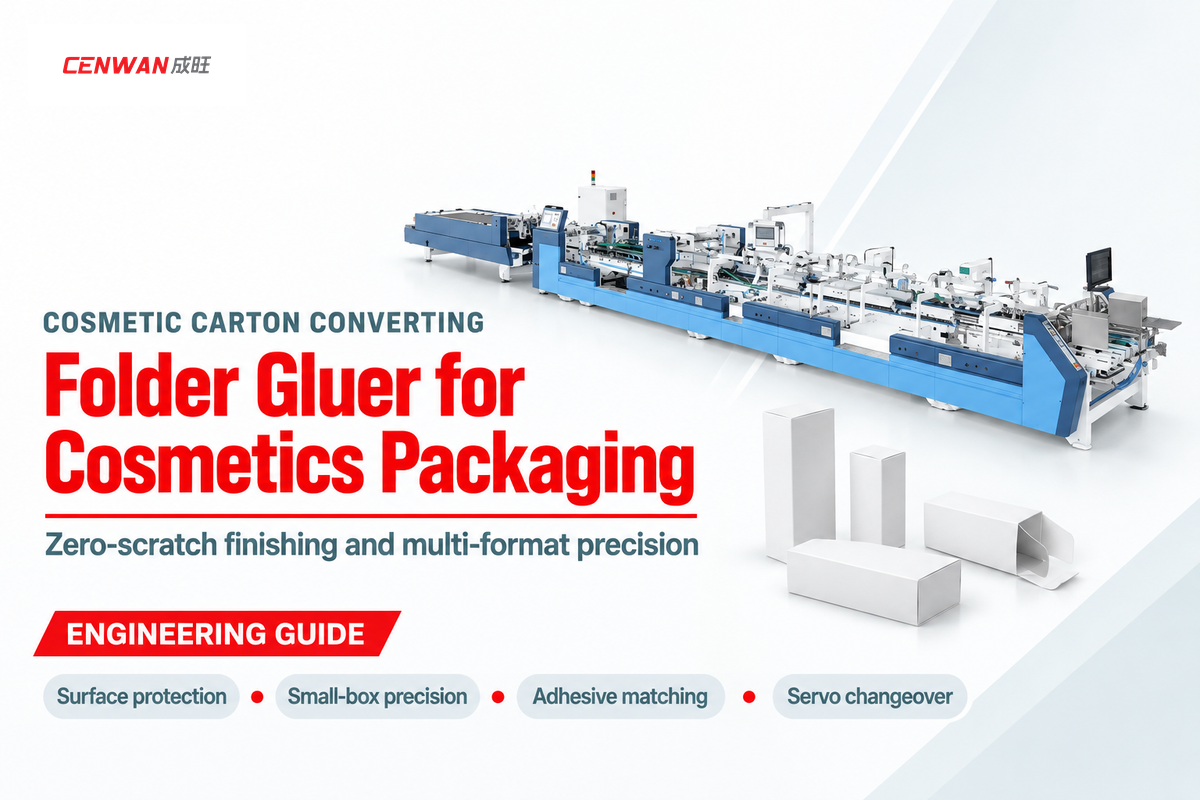
Selecting a folder gluer for cosmetics packaging demands enhanced surface protection compared to standard shipping carton production. Global trends in beauty packaging employ soft-touch matte films, hot foil stamping and metallized boards. High gloss ultraviolet (UV) coatings and varnishes are commonly used for prestige packaging. On a conventional gluing machine, metal feed gates and stiff rubber belts leave burnishing marks on dark boxes. Uncontrolled score marks can also crack the metallized surface coating. Stiff creases in a packaging material can cause the packaging material to spring open or snap to an undesired form during further processing. Control of crease stiffness is essential during folding and gluing. High-quality cartons at high speed describe the output of a properly coordinated packaging industry gluing process.
Updated November 2026 | Technical Review by Cenwan Machine Converting Engineering Team
Key Engineering Benchmarks for Cosmetic Carton Converting Plants
- There are experimental and numerical studies on creasing in the International Journal of Solids and Structures, which involve minor strains at 377 μm and 753 μm depths. The researchers also attempted 2.25 mm and 2.75 mm creasing channel widths to prevent board breakage during folding.
- According to Cenwan Machine’s small box folder gluer specifications, a pneumatic vibrator feeds 200 to 800 gsm paperboard at line speeds up to 400 m/min. Smaller cosmetic cartons achieve a real-world benchmark of 30,000 pcs/hr at 200 m/min.
- A MDPI surface treatment review states that there is a clear threshold for wetting. For spontaneous wetting of a substrate by a liquid, the surface free energy of the substrate must be higher than the surface tension of the liquid by at least 10 mN/m. This is verified on press with ASTM D2578 dyne test pens from 30 to 72 dynes/cm.
- As documented in Sinosun’s 2026 folder gluer machine guide, a 0.5 mm misalignment at speed creates a defective carton. Inline vision and glue verification systems cut material waste by 30–40%.
- Switching formats takes 15-45 minutes on operator-adjusted, stand-alone systems. By contrast, one-touch servo lines switch formats in less than 60 sec according to Cenwan Machine’s automatic packaging line benchmarks.
They pre-fold scores to 180° to eliminate springback and match adhesives to substrate dyne levels.
Why Cosmetics Packaging Demands Specialized Folder-Gluer Engineering: Surface Protection and Crease Mechanics
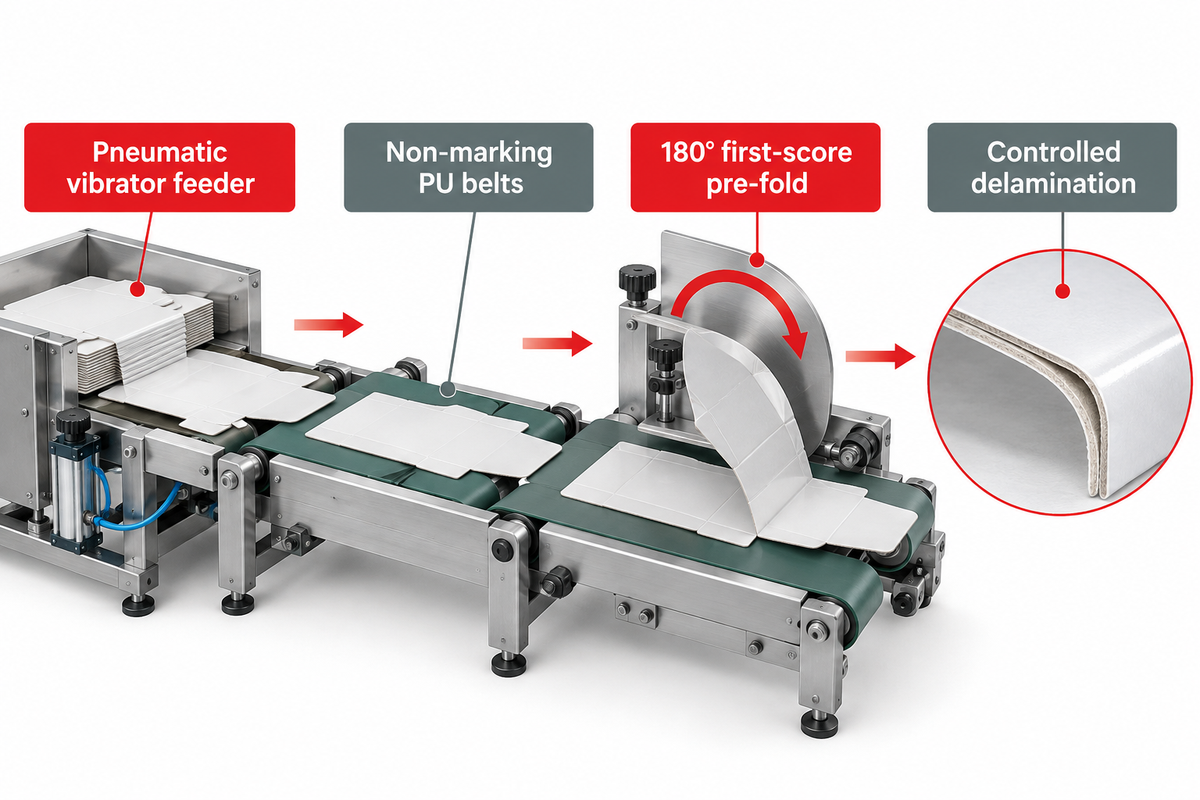
Cosmetics folding cartons use delicate soft-touch laminates, metallized films, and hot foil stamping that scratch easily on standard lines. Engineers also use controlled crease delamination across 2.25 mm to 2.75 mm channels and 180° pre-folding.
Standard commercial cartons forgive minor friction marks. Prestige beauty boxes face strict visual inspection under retail spotlighting. Any cracked folds are immediately rejected. After printing and die cutting, flat sheets enter the feeder. Unequal gate friction at the feeder can scuff matte varnish or delaminate edges. Additionally, Sinosun’s 2026 engineering guide reports 10–15% waste rates when a feeder cannot handle paper thickness variation during the production process.
How cosmetic boxes crease mechanically determines whether they cleanly crease or split along the outer fiber layer. An important study in the International Journal of Solids and Structures considered the creasing of laminated paperboard. The authors explained that a good crease leads to controlled delamination, thereby decreasing the bending stiffness of the board, and consequently preventing the board from breaking during box folding. Their experimental and numerical studies measured minor strains at crease depths of 377 μm and 753 μm. Also, they evaluated moment-angle curves for creasing channel widths of 2.25 mm and 2.75 mm. Without sufficient internal delamination within the folding gluing machine, stiff laminated paperboard resists folding and cracks along the outer coating.
How does an automatic folder gluer prevent surface scratches and crease cracking on laminated or foil-stamped cosmetic folding cartons?
An automatic folder gluer machine prevents cosmetic surface damage by isolating the printed face from metal to metal contact and scoring stiffness. On the (Cenwan Mini Series small box folder gluer) a pneumatic vibrator feeds paperboard in the 200-800 gsm range and doesn’t gouge the bottom sheet. Soft cellular polyurethane and felt transport belts carry the die-cut (blank). Polished folding plows guide the sheet without burnishing foil stamping or soft-touch film.
To eliminate crease cracking and cartoner jams, the automatic folding section bends the first crease line to a full 180°. It simultaneously pre-breaks the third crease line to 135° to 180° before final closing. The European patent for a folder-gluer folding and feeding station (EP1593482A2) documents this type of geometry. Blank parts carrying an adhesive strip are folded by 180° in the folding station to form a flat adhesive bond. Pre-breaking the score fibers on folder-gluer machines reduces spring-back. Lipstick and serum cartons are opened on high-speed lines.
| Cosmetic Carton Surface Finish | Typical Board Grade & Weight | Primary Converting Defect Risk | Feeder & Carrier Belt Setup | Pre-Folding & Crease Control |
|---|---|---|---|---|
| Soft-Touch Matte BOPP Film | 250–400 gsm SBS / FBB | Friction burnishing & glossy rub tracks | Pneumatic vibrator feeder (200–800 gsm); non-marking PU belts | Gradual 180° pre-fold with low-friction plows |
| Hot Foil Stamping (Gold / Silver) | 300–450 gsm FBB / GC1 | Foil flaking & hairline score whitening | Matched upper/lower belt drive speed; felt guide rails | Controlled delamination (377–753 μm depth study benchmark) |
| Metallized PET Laminated Board | 300–500 gsm SBS / MetPET | Elastic crease springback & seam pop-open | Suction-assisted feed gate preventing sheet skew | Full 180° first-score & 135° third-score pre-breaking |
| High-Gloss UV Spot Varnish | 250–350 gsm SBS | Brittle coating micro-cracks along crease | Calibrated feeder gap avoiding 10–15% thickness waste reported by Sinosun | 2.25 mm to 2.75 mm creasing channel geometry alignment |
| Deep-Embossed Textured Cartonboard | 300–450 gsm specialty board | Emboss crushing under excessive roller pressure | Segmented roller cheek clearance over embossed panels | Soft pneumatic trombone compression belt profiling |
| Dark Dyed Uncoated Kraft / Pulp Board | 250–400 gsm virgin fiber | Visible adhesive squeeze-out & scuff marks | Clean cellular belts with anti-static brush bars | Precision 0.5 mm folding alignment control |
| Windowed Eyeshadow & Palette Cartons | 300–450 gsm FBB + PET window | Window film scratching & corner catching | Narrow central transport clearance around window patch | 4/6-corner servo rotary hook synchronization |
| E/F/N Microflute Fragrance Outer Pack | 400–800 gsm microflute | Flute crushing & crash-lock hook jam | Heavy-duty pneumatic vibrator feeder (up to 800 gsm) | Fourfold crash-lock pre-folding up to 400 m/min |
Cosmetic Carton Formats and Machine Specifications: From Miniature Lipstick Sleeves to Crash-Lock Perfume Boxes
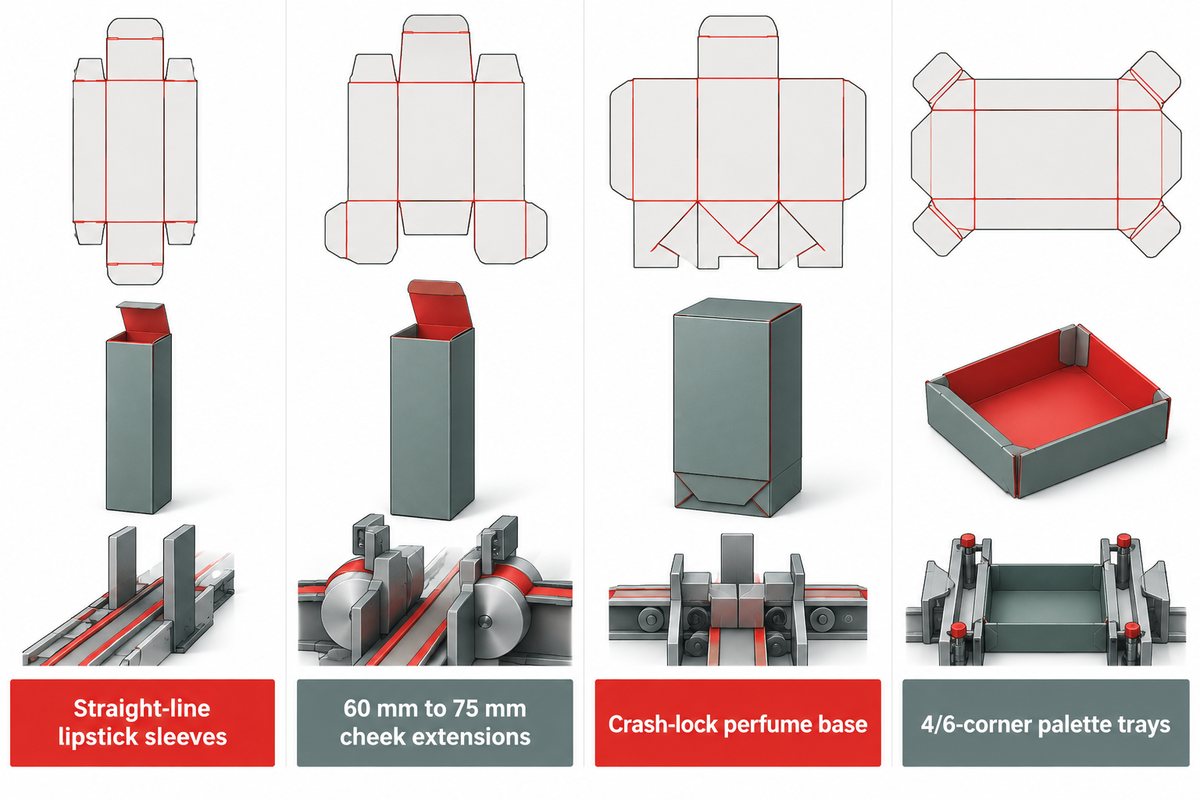
Cosmetics converters produce everything from miniature straight-line mascara sleeves to heavy crash-lock perfume cartons on one shop floor. Matching these formats requires a box gluing machine rated for 200–800 gsm board and 400 m/min belt speeds. Narrow blanks also require 60 mm to 75 mm cheek roller extensions and 180° pre-folding.
The launch of a single beauty collection often spans five distinct types of boxes. Lipsticks, eyeliners and concealers are packaged in ultra-narrow straight-line tuck-end boxes. Facial serums and creams use reverse-tuck or double-wall frame cartons that hold glass dropper bottles steady. Heavy fragrance glass flacons require a crash lock bottom folder gluer or corrugated box liner. Auto-bottom locks in heavy bottles of perfumes prevent them from dropping through the base of the retail shelf. Gift sets and eyeshadow palettes use four-corner and six-corner folded trays.
Trade press benchmarks highlight how modern multi-style platforms consolidate these jobs with high versatility. WhatTheyThink’s folding carton production report documents this multi-format capability. High-speed machines run straight-line, double-wall, crash-lock, four- and six-corner with single-finger servo folding, inner partition, and Z-fold cartons at up to 400 m/min. On smaller cosmetic formats, Cenwan Machine’s CW-G-650 / 880 / 1100 production data shows high output rates. Smaller cosmetic cartons achieve a benchmark of 30,000 pcs/hr at 200 m/min on a 400 m/min line. Actual output is governed by glue setting time, stacker setup, and operator make-ready efficiency.
What minimum blank width, paperboard GSM range, and pre-folding angles should I specify when choosing a folder gluer for lipstick, mascara, and perfume boxes?
Specify a 200–800 gsm paperboard range, a 180° first-score pre-folding angle, and 60 mm to 75 mm narrow-blank roller cheek extensions when selecting a making machine for lipstick, mascara, and perfume boxes. Note an important hardware limitation on standard 650–880 mm crash-lock folder gluers. Minimum open-blank widths below 126–140 mm require an optional detachable narrow-belt mini-box attachment. European patent EP1593482A2 details how lower middle roller cheeks extend between 0 mm and 100 mm, and preferably 60 mm to 75 mm. Spindle drives also lift the central transport frame 1.5 m vertically so crews can retool narrow blanks rapidly.
Serialization and Braille embossing are the main topics of our pharmaceutical folding carton folder gluer guide. Cosmetics converters, by contrast, must bridge miniature straight-line tubes and heavy E/F/N microflute fragrance boxes. According to Sinosun’s 2026 machine benchmark, a mid-range automatic folder gluer processes 200–300 cartons per minute. That throughput is equivalent to 15-20 skilled manual workers simultaneously converting flat blanks into finished boxes with good quality.
The Cosmetic Carton Surface-to-Adhesive Matrix (CSAM): Matching Cold PVA, EVA/PUR Hot-Melt, and Plasma Treatment
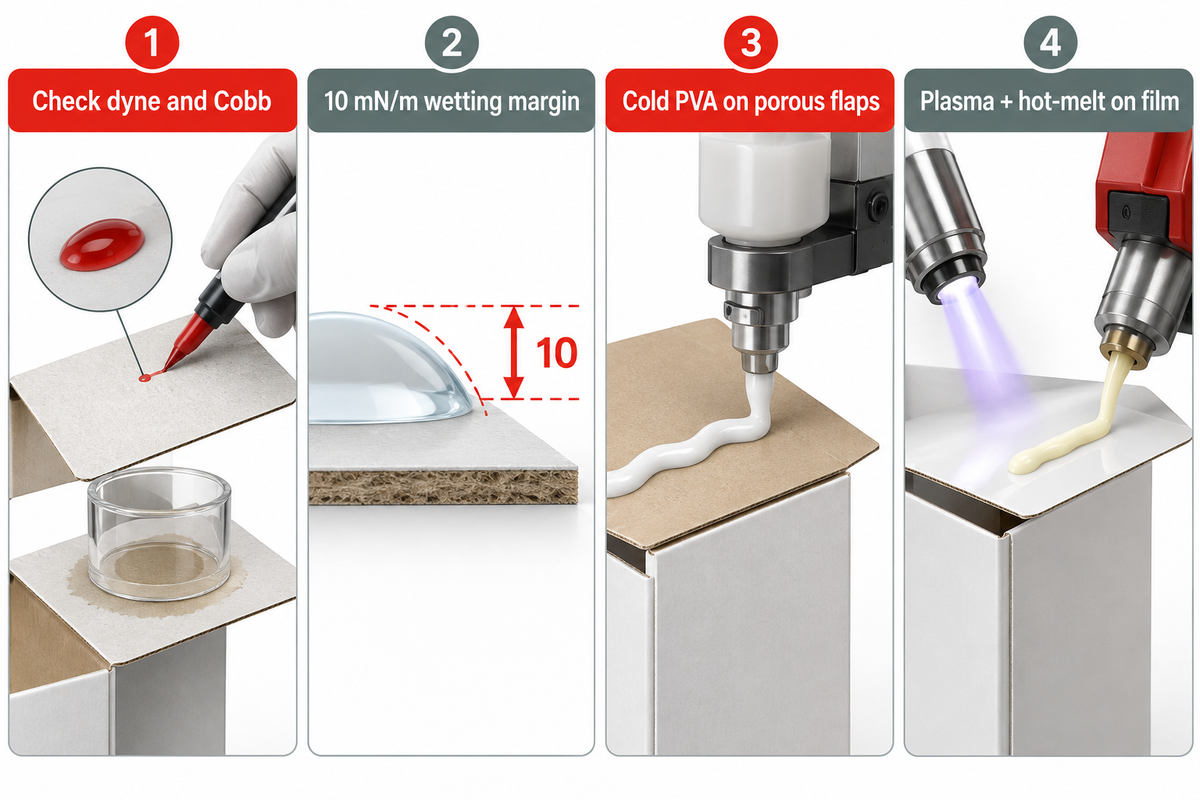
Cosmetic glue flaps frequently carry UV coatings, BOPP laminates, or metallized films that repel standard water-based glue. The Cosmetic Carton Surface-to-Adhesive Matrix (CSAM) allows engineers to maintain the surface energy of the substrate at least 10 mN/m above the adhesive surface tension. They use PVA or hot-melt adhesives.
Adhesive bond failures are one of the costliest hidden risks in beauty packaging. In a delayed failure mode analysis, published by Sinosun’s hot-melt versus cold glue engineering analysis, wrong adhesive selection on a carton box folder gluer often shows up as a pallet rejection three days after shipment. The cold glue never wet the coated flap during production. Reliable sheet pasting requires matching cardboard and glue chemistry to the process line speed. Surface treatment of substrates, as per a MDPI peer-reviewed paper, should ensure that the surface energy of the substrate is at least 10 mN/m greater than the liquid surface tension for effective adhesion.
Prior to selecting folder gluer equipment for coated stock, quality technicians test both wetting tension and water absorption. Operators measure wetting tension using Accu Dyne Test ASTM D2578 dyne pens across 22 standard dyne levels from 30 through 72 dynes/cm. All test solutions are formulated from 100% reagent-grade materials. Simultaneously, laboratories evaluate uncoated or sized board water uptake under TAPPI T 441 and ISO 535 Cobb testing. The Cobb test reports water absorption in grams per square meter (g/m²) over 1 minute.
When should a cosmetics packaging converter use PUR or EVA hot-melt adhesive instead of cold PVA dispersion glue or plasma surface treatment on a folder gluer?
Apply cold PVA dispersion glue to porous uncoated or skived flaps where water-based paste achieves fiber-tear at 15–25 g/m² within 10–30 seconds, and switch to plasma treatment and hot-melt adhesive on non-porous films or lines above 150–200 m/min. When working on the production floor, keep in mind the two shop-floor limitations from Sinosun’s adhesive study. First, the cure time of cold PVA dispersion glue is increased by the presence of humidity. In damp coastal regions, this increases the required pneumatic compression time or hot-melt time. Second, standard EVA hot-melt beads can become brittle at low temperatures on thin cosmetic paperboard below 250 g/m².
| Glue-Flap Substrate Condition | ASTM D2578 Dyne & TAPPI T 441 Cobb Profile | Recommended Surface Prep | Optimal Adhesive Chemistry | Speed Window & Compression Dwell |
|---|---|---|---|---|
| Uncoated SBS / FBB Glue Flap (Coat-Free Window) | High surface energy; open fiber network (TAPPI T 441) | None required (keep die-cut flap coat-free) | Cold PVA water-based glue (15–25 g/m² fiber-tear) | Below 100–150 m/min; 10–30 s compression press time |
| High-Speed Uncoated Skincare Carton (>200 m/min) | Porous board; insufficient dwell for water evaporation | Dust extraction brush at feeder | Dual system: EVA hot-melt tack dot + cold PVA seam | 200–400 m/min; hot-melt holds seam while PVA cures |
| BOPP Soft-Touch Laminated Glue Flap | Low untreated dyne; fails ≥10 mN/m wetting margin | Inline atmospheric plasma treatment (verify 30–72 dynes/cm) | Formulated copolymer emulsion or reactive PUR hot-melt | 150–250 m/min; verify zero spring-back within 30 s |
| Metallized PET (MetPET) Fragrance Carton | Non-porous film surface (zero water uptake) | Inline plasma pretreatment or mechanical flap skiving | Reactive PUR hot-melt or plasma-assisted dispersion glue | 150–250 m/min; pneumatic trombone compression |
| UV Varnished Color Cosmetics Box (<250 g/m²) | Cross-linked UV topcoat; thin board stock | Glue-lap mask during printing or inline plasma | Plasma + cold copolymer glue (avoid brittle EVA <250 g/m²) | 150–250 m/min; balanced roller pressure |
| Heavy Crash-Lock Perfume Box (350–500 gsm) | Multi-layer folded base with high spring-back force | 180° pre-folding + plasma on coated bottom tabs | High-tack hot-melt gun on lock bottom + side-seam glue | 150–250 m/min; segmented compression belt adjustment |
| High-Humidity Shop Floor Operation (Damp / Coastal Shifts) | Elevated board moisture slows capillary drainage | Condition board stack; monitor Cobb60 batch certificate | Hot-melt adhesive or fast-setting high-solids dispersion | Cold glue cure time doubles in humid shop conditions |
| E/F Microflute Cosmetics Gift & Mailer Box | Corrugated cardboard linerboard (400–800 gsm) | Verify liner Cobb value per TAPPI T 441 / ISO 535 | Dual hot-melt and cold glue application | Up to 240–400 m/min; regulated trombone pressure |
High-Speed Inspection, Glue-Line Verification, and Non-Marking Ejection Systems for Prestige Brands
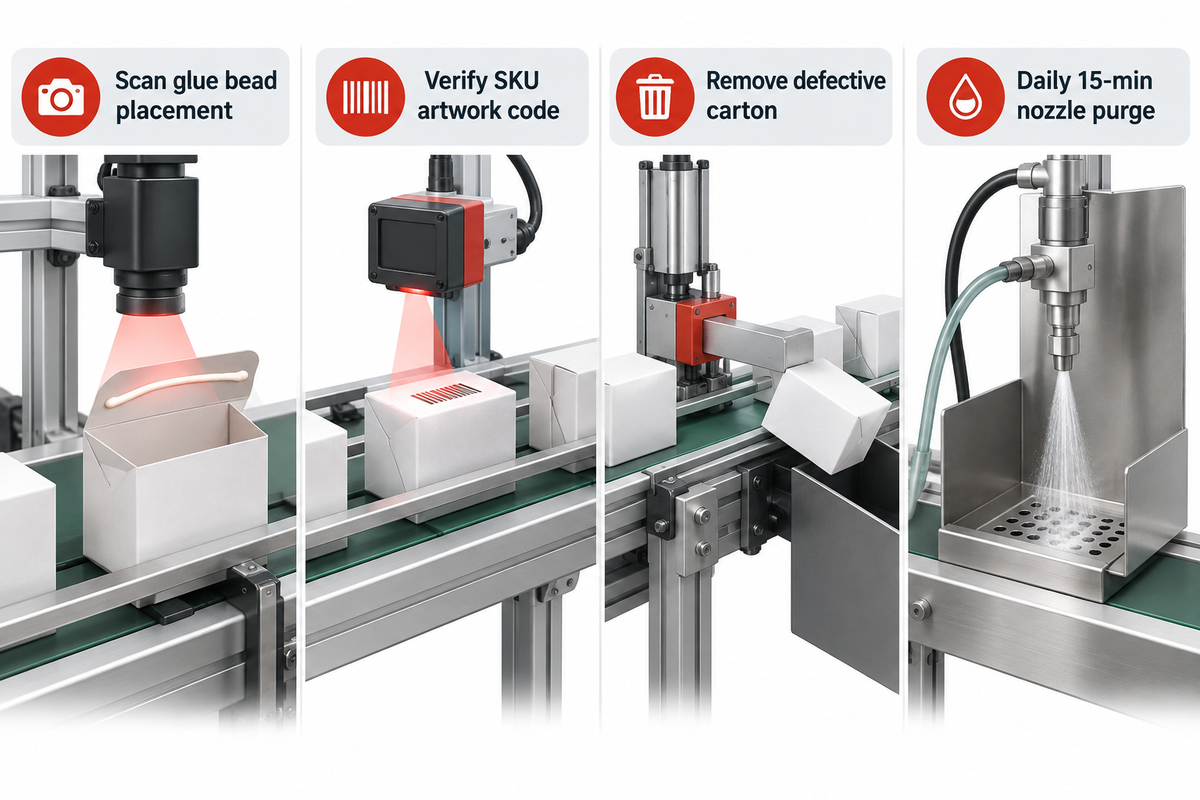
Continuous high-speed production of cartons requires automated quality control. Running cosmetic cartons at 200 to 400 m/min requires automated quality control because a 0.5 mm folding or gluing error ruins the finished box. As documented by Sinosun, inline optical glue cameras, barcode verifiers, and single-blank pneumatic ejectors cut material waste by 30 to 40%.
At high speed, human operators can’t identify a missing glue bead before thousands of cartons enter the packing case. Sinosun’s 2026 folder gluer engineering guide emphasizes this tight mechanical window. A folder gluer folds, glues, and presses blanks at speeds where a 0.5 mm misalignment creates a defective carton. The data collected during the operations show inline inspections and glue application reduce carton waste by 30-40%.
Preventive maintenance on the gluing station is just as essential for continuous productivity. According to Folder Gluer Inc.’s troubleshooting checklist, a 15-minute daily purge of adhesive nozzles prevents 80% of nozzle clogs. Operators should also run test sheets at 50%, 75%, and 100% speed to verify seam integrity across speed ramps. Additionally, Sinosun’s operational study provides a critical shop-floor cue. Cartons springing back open within 30 seconds of exiting the trombone conveyor indicate that the adhesive hasn’t bonded.
How do inline UV glue cameras and pneumatic ejection prevent glue squeeze-out and mixed-SKU defects?
Ultraviolet (UV) cameras and optical cameras inline to the gluing head scan every glue flap milliseconds after nozzle firing to verify if the adhesive bead is even and setback to the job specification. A bead shifting closer than 0.5 mm to the score edge causes glue squeeze-out onto dark matte or foil-stamped panels. Pharmacode scanners simultaneously check every blank for mixed lipstick shade artwork. When a sensor detects a defect, the control system tracks that particular carton to the delivery section. A non-marking servo pneumatic ejector then removes the defective carton without stopping the high-speed belt.
Cosmetics Folder-Gluer Cost Tiers, Servo SKU Changeover Economics, and ROI Benchmarks
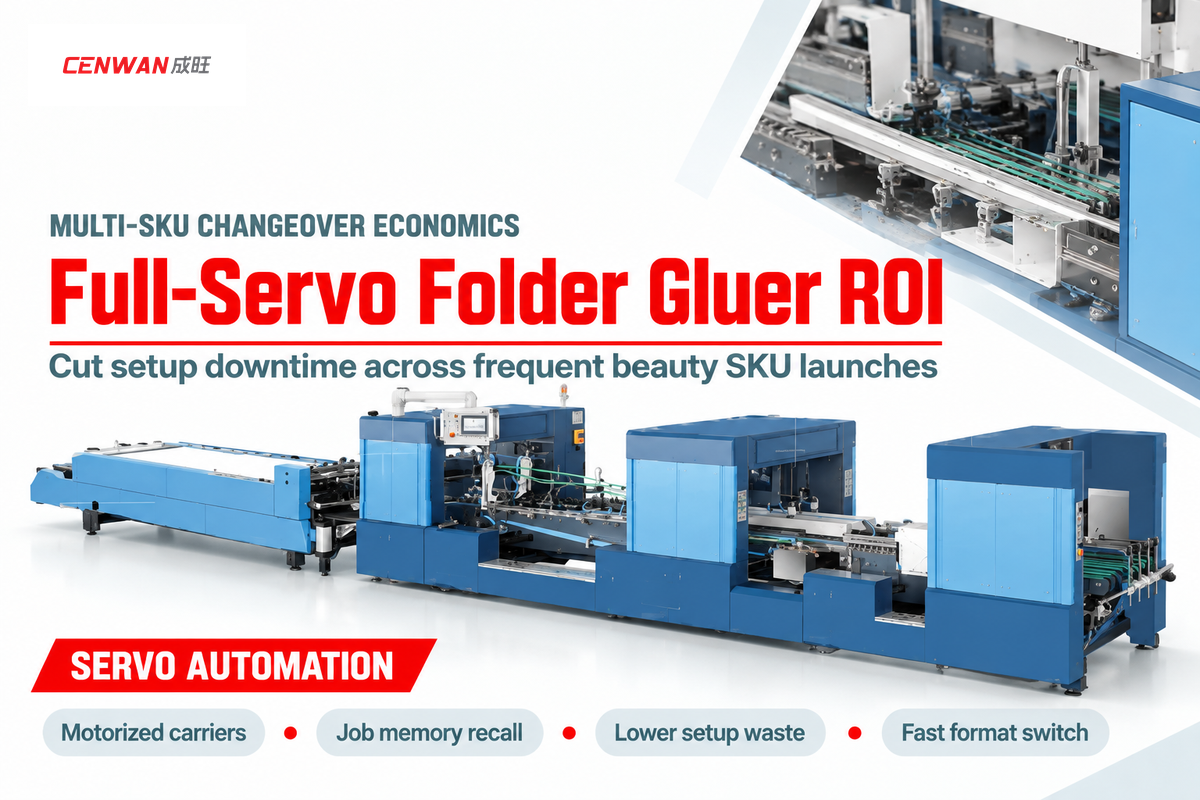
Global folding carton demand reached USD 194.09 billion in 2026, driven by short-run, multi-SKU beauty launches. Factory-direct servo folder gluers cost 40,000–80,000 USD FOB, while dual-channel integrated lines cost 140,000–280,000 USD FOB. As stated by Sinosun, full servo models provide less than 60 second repeat changeover times and provide payback within 18-24 months.
Cosmetics packaging converters face relentless SKU proliferation across small-scale seasonal color palettes and regional language packs. According to Precedence Research’s folding cartons market report, the global folding cartons market is valued at USD 194.09 billion in 2026. The market is projected to reach USD 287.55 billion by 2035 at a 4.47% CAGR. Asia Pacific held a 40% share at USD 74.29 billion in 2025. When plants automate a packaging machine, setup downtime between runs governs profitability more than top belt speed.
Documented plant data show the financial impact of automated setup. Cenwan Machine’s high-speed folder gluer engineering page illustrates a converter running 18 SKUs in a week. The plant couldn’t afford a 90-120 minute manual recalibration between runs. On the CW-W-1250AC-S, servo push-button re-zero of job parameters takes less than 10 minutes. End-to-end makeready time drops to less than 30 minutes for repeat orders. Cenwan’s automatic packaging line benchmarks show that changing standard box sizes on an operator-adjusted stand-alone setup takes 15 to 45 mins. One-touch servo packaging lines complete the same format switch in less than 60 sec. Post-press managers on PrintPlanet’s post-press efficiency forum also pre-set folder-gluers while the upstream die-cutter is still running.
How much does an automatic folder gluer for cosmetics packaging cost across entry-level, mid-range, and high-speed servo models, and how long does SKU changeover take?
Cenwan CW-W servo recipe changeover benchmarks deliver <60-second motorized carrier repositioning for repeat straight-line jobs at 40,000–80,000 USD FOB, while the CW-IL-Dual integrated dual-channel line operates at 240 m/min (up to 1,300,000 boxes/day) at 140,000–280,000 USD FOB. Tiered machine comparisons can be found in Cenwan Machine’s packaging line price benchmarks and our folder gluer machine price guide. Quoted folder-gluer FOB prices don’t include destination import duties, sea freight, local transformer wiring, and in-line plasma or UV cameras. According to Sinosun’s 2026 guide, the cost of a 2026 model intelligent folder gluer is 30% higher compared to a 2018 model. As reported by Sinosun, energy savings and lower waste, along with faster servo automation changeovers, deliver payback within 18–24 months while improving production capacity and procurement ROI.
4-Gate Cosmetic Folder-Gluer FAT Protocol and Multi-Format Architecture Selection
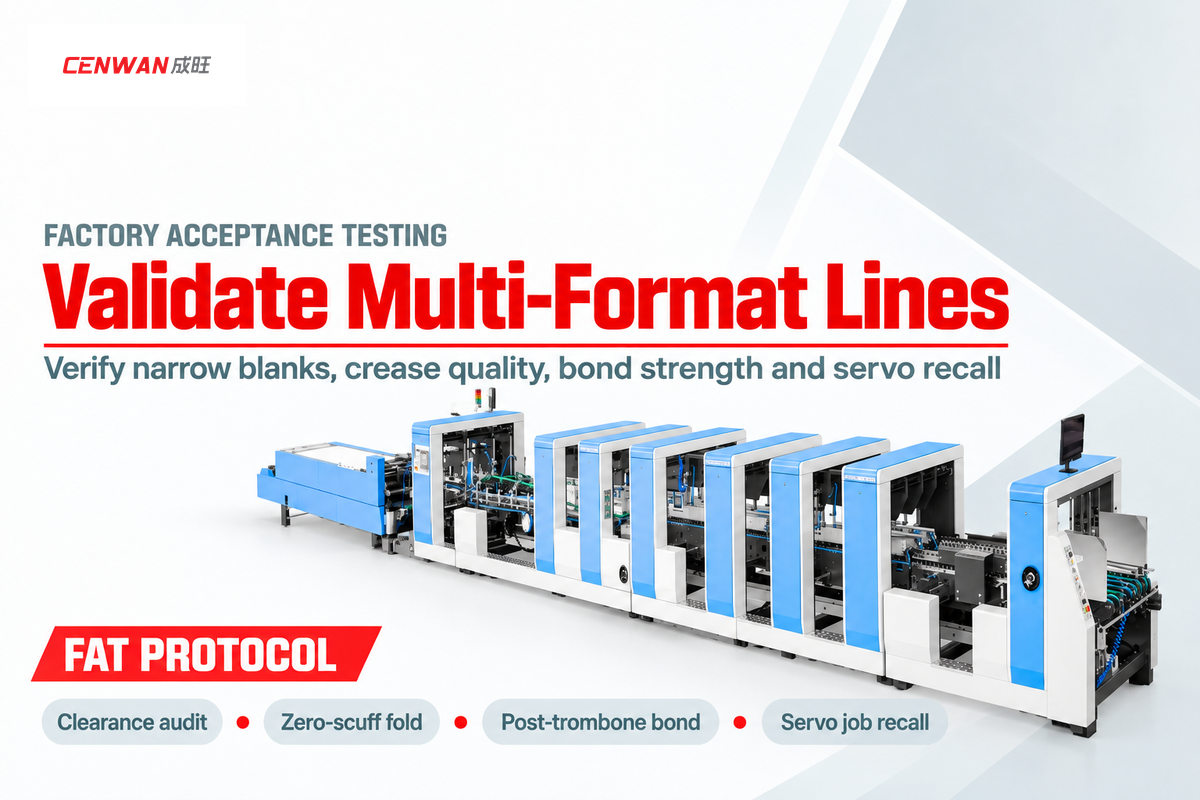
Purchasers selecting a multi-format folder gluer for cosmetics packaging must validate narrow-blank clearances, scuff-free 180° pre-folding, adhesive fiber-tear, and servo changeover speed before shipment. The 4-Gate Cosmetic Folder-Gluer FAT protocol is performed under EN 415-10 and the Machinery Directive 2006/42/EC to match Cenwan CW-G and CW-W platforms to their box mix.
When evaluating a folder gluer manufacturer or supplier, plant directors compare European OEMs with factory-direct packaging manufacturers. Cenwan Machine manufacturing facility (Zhejiang Chengwang Intelligent Packaging Equipment in Wenzhou) provides global after-sales service and spare-parts coverage across 40+ countries. As MachineBuilding.net’s guide to EN 415-10 explains, European standard EN 415-10 works alongside EN 415-1. Together they simplify CE marking of packaging machinery under the Machinery Directive 2006/42/EC.
Which folder gluer manufacturers supply machines capable of running both miniature straight-line cosmetic boxes and crash-lock bottom perfume cartons?
Leading manufacturers supplying multi-format machines for both miniature straight-line cosmetic cartons and crash-lock perfume boxes include Bobst, Koenig & Bauer, and Cenwan Machine. Cenwan’s cosmetics converting lineup starts with the CW-G-650/880/1100 series high-speed fourfold folder gluer (up to 400 m/min, 200–800 gsm paperboard and E/F/N microflute, 126×60 mm minimum folded size) and the CW-G-650PC crash-lock specialist (13.5 kW). For wider formats, plants pair the CW-W-1250AC-S twofold servo (22 kW, 200 m/min, 290–1250 mm width) with the CW-W-1250PCW 4/6-corner folder gluer (25 kW, 180 m/min). Keep a realistic speed limitation in mind during Factory Acceptance Testing (FAT). Maximum rated belt speeds of 400 m/min apply to straight-line uncoated cartons. Soft-touch laminated or crash-lock perfume cartons run at 150–250 m/min (achieving 30,000 pcs/hr at 200 m/min) to prevent scuffing. Execute this 4-Gate Cosmetic Folder-Gluer FAT Protocol before signing off on machine delivery:
- Gate 1 (Narrow-Blank & Multi-Format Clearance Audit): Run your narrowest lipstick dieline and widest perfume carton first. Verify 60 mm to 75 mm lower roller cheek extensions (EP1593482A2) and 200–800 gsm pneumatic feeder stability.
- Gate 2 (Zero-Scuff & 180° Crease Delamination Check): Inspect 500 soft-touch and hot-foiled blanks folded at 180° under illuminated magnification. Confirm zero belt burnishing, zero foil cracking, and 0.5 mm alignment precision.
- In Gate 3 (ASTM D2578 Dyne & Post-Trombone Bond Test) check plasma-treated glue flaps with 30-72 dynes/cm (ASTM D2578 pens). Confirm zero seam spring-back within 30 seconds of exiting the trombone conveyor.
- In Gate 4 (Servo Job Recall & Safety Interlock Verification), time an end-to-end SKU changeover (under 30 minutes on CW-W-1250AC-S or under 60 seconds for one-touch servo switches). Verify all EN 415-10 and 2006/42/EC safety interlocks.
| Machine Platform / Model | Supported Cosmetic Box Styles | Board Weight & Format Range | Rated Belt Speed & Output | Changeover & Primary Cosmetic Use Case |
|---|---|---|---|---|
| Cenwan CW-G-650 Mini / High-Speed | Straight-line, crash-lock, double-wall | 200–800 gsm board; narrow cosmetic blanks | Up to 400 m/min (30,000 pcs/hr at 200 m/min) | Lipstick, mascara, eyeliner & serum sleeves |
| Cenwan CW-G-880 Multi-Format | Straight-line, lock-bottom, optional 4/6-corner | 200–800 gsm SBS / FBB & E/F/N microflute | Up to 400 m/min belt speed | Skincare jars, fragrance cartons & gift boxes |
| Cenwan CW-G-1100 Wide Cosmetics Line | Straight-line, crash-lock, 4/6-corner, partitions | 200–800 gsm board & corrugated packaging | Up to 400 m/min belt speed | Large cosmetic holiday sets & display trays |
| Cenwan CW-W-1250AC-S Full-Servo | Straight-line, lock-bottom, multi-SKU formats | 290–1250 mm blank width; 200–800 gsm | 150–400 m/min configuration window | Sub-10-min servo re-zeroing; <30 min repeat makeready |
| Cenwan CW-IL-Dual Integrated Dual-Channel Line | FEFCO 0110, 0114, 0200, 0201, 0203, 0206 | Format 13# through 7# postal & mailer boxes | 240 m/min (240 meters/min; up to 1,300,000 boxes/day) | <60-second one-touch servo size switch; e-commerce beauty mailers |
| Koenig & Bauer Allpro 110 Benchmark | Straight-line, crash-lock, 4/6-corner, Z-fold | Commercial & cosmetics folding carton stock | 400 m/min maximum belt speed (WhatTheyThink) | Single-finger servo fold for multi-style carton plants |
| EP1593482A2 Narrow-Blank Transport Module | Small straight-line & 180° pre-folded boxes | 60 mm to 75 mm lower roller cheek extension | High-speed central belt transport | 1.5 m vertical central frame lift for rapid retooling |
| Inline Plasma + Dual Hot/Cold Glue Station | Soft-touch BOPP, MetPET & UV-varnished flaps | 30–72 dynes/cm verified wetting tension | Synchronized up to 400 m/min | Cuts waste 30–40% reported by Sinosun; 15-min daily nozzle purge |
Frequently Asked Questions About Folder Gluers for Cosmetics Packaging
What is the difference between a mini folder gluer and a standard small-box crash-lock folder gluer for cosmetics?
A dedicated mini folder gluer uses narrow central carrier belts for ultra-slim straight-line sleeves, whereas a small-box crash-lock machine adds bottom-lock hooks and multi-gun adhesive stations.
Lower roller cheek extensions of 60 mm to 75 mm prevent sheets from twisting during 180° pre-folding. Conversely, a 650 mm or 880 mm crash-lock platform, such as the Cenwan CW-G-650 or CW-G-880, can handle 200-800 gsm paperboard and E/F/N microflute at speeds of up to 400 m/min. Equipping a CW-G series machine with a detachable small-box attachment allows one line to run 30,000 mini straight-line tubes/hr and heavy auto-bottom perfume cartons.
How can operators prevent glue stringing and adhesive squeeze-out on dark matte or foil-stamped cosmetic cartons?
Operators eliminate glue stringing and squeeze-out by pairing non-contact electromagnetic extrusion valves with a 15-minute daily nozzle purge and calibrated pneumatic compression pressure.
As line speeds approach 200–400 m/min, mechanical glue wheels throw adhesive or apply uneven coat weights. Switching to encoder-timed micro-dot extrusion nozzles maintains bead placement within the 0.5 mm alignment window. As reported by Folder Gluer Inc., performing a 15-minute daily nozzle purge prevents 80% of dried adhesive clogs. Regulating trombone belt pressure also ensures the 15–25 g/m² adhesive film wets the plasma-treated flap without extruding onto outer soft-touch panels.
When does a cosmetics carton converter need a 4/6-corner folder gluer instead of a straight-line and crash-lock machine?
A converter needs a 4/6-corner folder gluer when producing flat-blank hinged eyeshadow palettes, luxury skincare gift trays, and windowed retail display units.
Straight-line and crash-lock machines fold tubular cartons parallel to the belt travel direction. On the other hand, hinged beauty palettes and double-walled gift trays, use webbed corners. Those flaps must be folded inward from the leading and trailing edges. To achieve this, a 4/6-corner folder gluer uses servo-synchronized rotary back-folding hooks and timed glue guns, to fold all four or six corners, in one pass.
Does running metallized PET or soft-touch laminated board reduce folder-gluer belt speed?
Yes, converters typically run laminated or foil-stamped crash-lock cosmetic cartons at 150–250 m/min rather than the 400 m/min maximum straight-line rating.
Uncoated straight-line boxes can run at speeds up to 400 m/min. Operating around 200 m/min (30,000 pcs/hr on smaller cosmetic cartons) prevents friction burnishing on soft-touch films. Running at moderate speeds also gives hot-melt or cold dispersion glue sufficient compression dwell to prevent 30-second post-trombone spring-back.
Can one automatic folder gluer handle both solid paperboard cosmetic boxes and E/F microflute fragrance mailers?
Yes, fourfold folder gluers rated for 200–800 gsm board process both solid SBS/FBB cosmetic cartons and E/F/N microflute fragrance packaging.
The Cenwan CW-G-650, CW-G-880, and CW-G-1100 units use a pneumatic vibrator feeder rated for 200-800 gsm stock. Adjustable carrier clearances provide clean transfers for thin sleeves of skincare and bulkier protective corrugated fragrance boxes.
Configure Your Cosmetics Packaging Folder-Gluer Line with Cenwan Machine
Send our converting engineers your smallest lipstick sleeve dieline, crash-lock perfume box spec, and the basis weight of the paperboard (200–800 gsm or E/F/N microflute). We will perform a factory trial and cycle time study on our CW-G Mini/High-Speed or CW-W Full Servo systems.
References & Sources
- An experimental and numerical study of the mechanical behavior of laminated paperboard during creasing and folding, International Journal of Solids and Structures (ScienceDirect).
- Surface Free Energy and Wetting Tension Principles in Composite and Packaging Substrates, MDPI Journal of Composites Science, 2024.
- ASTM D2578 Wetting Tension Dyne Test Pens (30 through 72 dynes/cm) Technical Specification, Accu Dyne Test / Diversified Enterprises.
- TAPPI T 441 / ISO 535 Water Absorptiveness of Sized (Non-Bibulous) Paper and Paperboard (Cobb Test), Purple Diamond Testing Services.
- EN 415-10: A New Safety Standard for Packaging Machines under Machinery Directive 2006/42/EC, MachineBuilding.net Technical Reference.
- Common Folding Carton Defects: Cracking, Creasing, and Glue Failure Prevention, PK Paper Box Quality Engineering Guide.
- Folder Gluer Troubleshooting Checklist and Daily Preventive Maintenance Protocol, Folder Gluer Inc.
- Steps to Efficient Post-Press: Die-Cutter and Folder-Gluer Make-Ready Synchronization, PrintPlanet Post-Press Engineering Forum.
- Folding Cartons Market Size, Share, and Growth Forecast 2026–2035, Precedence Research, 2026.
- What is a Folder Gluer Machine? The Ultimate Engineering Guide for 2026, Sinosun Packaging Machinery, 2026.
- WestCamp Accelerates Folding Carton Production with High-Speed 400 m/min Multi-Style Folder Gluer, WhatTheyThink Industry News.
- Carton Box Folder Gluer Adhesives: Hot Melt vs. Cold Glue Engineering Comparison, Sinosun Packaging Machinery.
- EP1593482A2: Folding and Feeding Station in a Folder-Gluer, European Patent Office / Google Patents.