Get in touch with Cenwan Machine Company


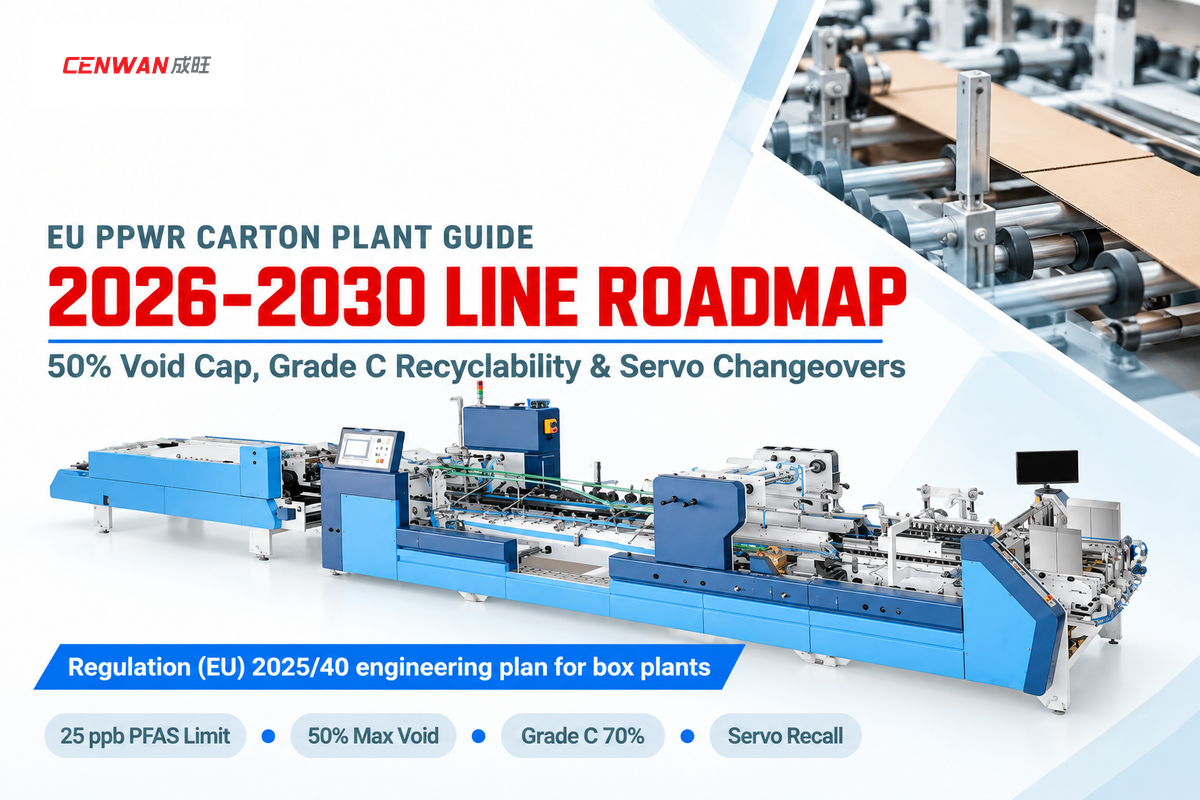
Updated October 2026 | Corrugated & Folding Carton Engineering Guide for Regulation (EU) 2025/40
According to the eu ppwr packaging framework under Regulation (EU) 2025/40, carton converters face three strict plant-floor deadlines. First, a 25 ppb food-contact per- and polyfluoroalkyl substances (PFAS) limit takes effect on August 12, 2026. Second, boxes must reach a 70% Design for Recycling (Grade C) score for recycling by 2030. Third, as documented in Article 24, the 50% empty-space cap applies to grouped, transport, and e-commerce packaging. It takes effect on January 1, 2030, or three years after the implementing acts enter into force, whichever is later. While Article 29(4)(a) exempts corrugated boxes from the 40% reuse quota, box plants run shorter, more frequent right-sized batches.
Direct Answer: According to Regulation (EU) 2025/40, EU PPWR packaging rules apply from August 12, 2026. They mandate ≥70% recyclability by weight in 2030 and a ≤50% empty-space ratio from January 1, 2030 or three years after the implementing acts take effect. Corrugated boxes are exempt from Article 29 reuse targets when converters eliminate excess void space and non-repulpable coatings.
Key Takeaways for Corrugated & Folding Carton Plants (2026–2030)
- According to Article 29(4)(a), corrugated transport and e-commerce boxes are exempt from the 40% reusable quota in 2030 and the 70% target in 2040.
- As documented in Article 24, kraft paper dunnage, air pillows, and foam count as empty space and do not reduce the calculated void ratio, driving demand for right-sized FEFCO box footprints.
- According to Article 6 and Annex II, packaging must reach at least Grade C (70%-79% recyclable by weight) in 2030 and Grade B (80% by weight) from January 1, 2038.
- With nine changeovers per shift, reducing a complete changeover from 18 to 3 minutes recovers 135 minutes; reducing it from 25 to 5 minutes recovers 180 minutes.
August 12, 2026
General application date & 25 ppb PFAS food-contact limit according to Regulation (EU) 2025/40
General application date & 25 ppb PFAS food-contact limit according to Regulation (EU) 2025/40
50% Max Void
Article 24 empty space ratio cap for grouped, transport, and e-commerce cartons as documented in PPWR
Article 24 empty space ratio cap for grouped, transport, and e-commerce cartons as documented in PPWR
≥70% / ≥80%
Annex II minimum recyclability by weight in 2030 (Grade C) and 2038 (Grade B) according to Article 6
Annex II minimum recyclability by weight in 2030 (Grade C) and 2038 (Grade B) according to Article 6
<60 Seconds
Servo axis recall on Cenwan CW-W lines vs. 18–25 min manual setups
Servo axis recall on Cenwan CW-W lines vs. 18–25 min manual setups
EU PPWR Packaging Timeline: Mandatory Enforcement Milestones From 2026 to 2030
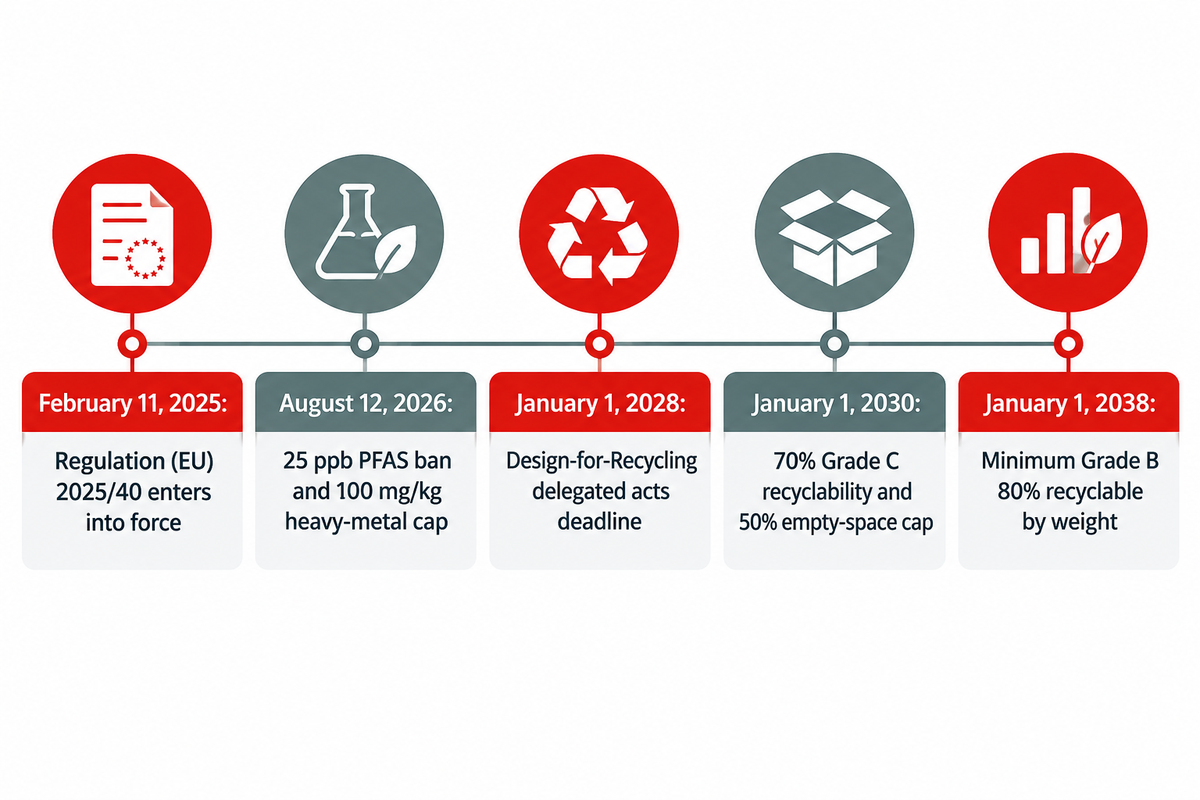
According to Regulation (EU) 2025/40, the law entered into force on February 11, 2025, and PPWR applies across all 27 EU Member States from August 12, 2026. Mandatory Design for Recycling grades (> 70% recyclable by weight) came into effect on the 1st of January, 2030. As documented in Article 24, the 50% empty-space cap starts on January 1, 2030 or three years after the implementing acts take effect, whichever is later. January 1, 2028 is the deadline for adopting Design-for-Recycling delegated acts, rather than a deadline for carton plants to install new glue or servo systems.
The Official Journal text of Regulation (EU) 2025/40 on EU packaging and packaging waste is directly applicable to EU Member States, whereas Directive 94/62/EC allowed for transposition into national law. Both are binding laws of the European Union. This new EU packaging regulation applies directly in every member state without national transposition delays. The European Green Deal and circular economy Action plan brought these far-reaching packaging regulations to the fore after Eurostat published 186.5 kg of waste packaging per capita in 2022. PPWR provides specific sustainability duties across the entire lifecycle for packaging placed on the EU market. Converters provide technical files, while companies must align their converting and packing specifications.
Which EU PPWR deadlines hit corrugated converters in August 2026 versus January 2030?
According to Regulation (EU) 2025/40, August 12, 2026 triggers chemical and record limits (the 25 ppb food-contact PFAS ban, the 100 mg/kg heavy-metal cap, and Annex VII technical files), while January 1, 2030 triggers ≥70% Grade C recyclability. For 2030, obligations ≥70% Grade C recyclability apply. As per Article 24, the less than 50% empty space ratio applies from January 1, 2030, or three years after the implementing acts take effect, whichever is later. Until those dates, February 12, 2028, sets the deadline for determining voids.
According to the European Commission’s stakeholder briefing on the Packaging and Packaging Waste Regulation, PPWR obligations take effect in stages from 2024 adoption through 2038. Key milestones include 2026 general application, 2030 recyclability grades, and the 2038 Grade C phase-out. Every converter, brand owner, and importer should track those staged dates. In addition, the European Commission issued Commission Notice C(2026) 3702 on June 5, 2026 to clarify transitional rules for existing inventory. The table below maps each statutory deadline in the EU’s new requirements to concrete converting-line actions.
| Enforcement Date | PPWR Article / Act | Statutory Threshold | Affected Packaging Types | Carton Plant Engineering Action |
|---|---|---|---|---|
| Feb 11, 2025 | Article 71 Entry into Force | Regulation enters into force as documented in EUR-Lex | All packaging placed on the EU market | Initiate multi-stage capital expenditure roadmap for converting lines |
| Feb 25, 2026 | Delegated Decision (EU) 2026/429 | Exempts pallet wrapping & straps from 100% reuse per the standard | B2B pallet unitization & strapping | Retain inline automatic strapping & stretch-hooding at line discharge |
| Aug 12, 2026 | Article 5(5) PFAS Restriction | <25 ppb single PFAS; <50 ppm total PFAS as documented in Article 5 | Food contact packaging & takeaway boxes | Replace fluorochemical grease barriers with aqueous dispersion coatings |
| Aug 12, 2026 | Article 5(2) Heavy Metals | ≤100 mg/kg sum of Pb, Cd, Hg, and Cr(VI) per the standard | All corrugated board, inks, and glues | Audit flexo ink batches and recycled testliner mill certificates |
| Jan 1, 2028 | Article 6(4) Delegated Acts | Design for Recycling criteria and performance-grade rules established via Commission delegated acts | 30 packaging categories in Annex II | Evaluate cold PVA adhesive and coating repulpability per the standard |
| Feb 12, 2028 | Article 24(2) & Article 24(4) | Void ratio calculation act & sales box minimization | Primary sales cartons & retail sleeves | Eliminate false bottoms and oversize retail folding carton cavities |
| Aug 12, 2028 (or 2 yrs post-act) | Article 12 Labelling System | Harmonized material-sorting labels apply from Aug 12, 2028 or 2 years after implementing acts enter into force, whichever is later | Consumer, grouped, and e-commerce boxes | Schedule artwork and flexo plate changes against the applicable timetable |
| Jan 1, 2030 | Article 6(2) & Annex II Table 3 | Mandatory Grade A (≥95%), B (≥80%), or C (≥70%) as documented in Annex II | All packaging placed on the EU market | Phase out wax-saturated and heavy polyethylene-laminated boards |
| Jan 1, 2030 (or 3 yrs post-act) | Article 24(1) Empty Space Cap | Maximum 50% empty-space ratio applies from Jan 1, 2030 or 3 years after Article 24(2) implementing acts enter into force, whichever is later | Grouped, transport, and e-commerce boxes | Evaluate equipment against the required right-sized FEFCO box schedule |
| Jan 1, 2038 | Article 6(2)(b) Grade C Sunset | Minimum Grade B (≥80% recyclable by weight) as documented in Article 6 | Cartons and composite packs | EN 643 classifies recovered paper and board; Cepi v3 evaluates repulpability |
Plants supplying customers across the EU should lock in machine specifications for these requirements for packaging at least 18 months before January 1, 2030. Brand owners that delay die-line redesigns until 2029 create bottlenecks for carton plants by compressing lead times for servo retrofits and rotary dies.
Article 24 Empty Space Ratio Limits: How the 50% Void Cap Changes Box Sizing
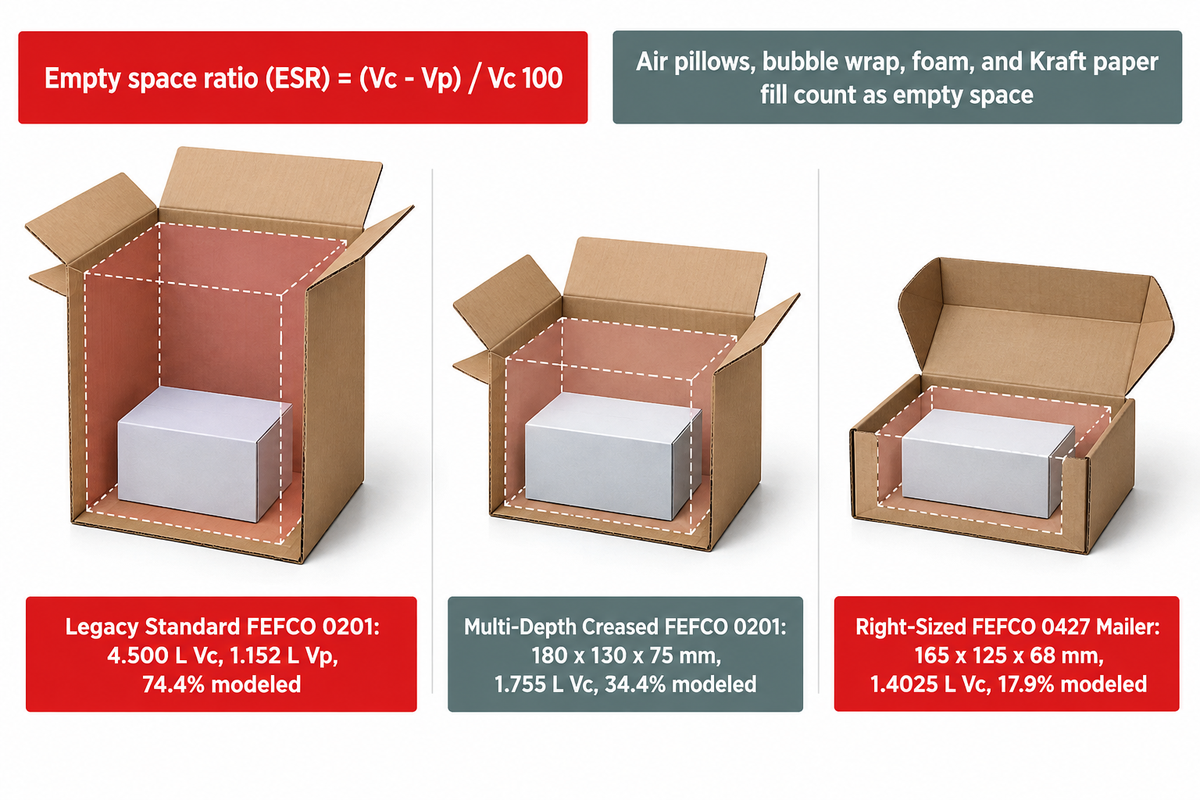
According to Article 24, PPWR introduces a strict formula for the empty space ratio. It equals outer box internal volume minus sales packaging volume, divided by outer box internal volume, capped at 50%. The empty space definition states that the empty space ratio must be 50% or less. Air pillows, bubble wrap, foam, and Kraft paper fill count as empty space.
Article 24(1) sets the statutory timing for this 50% maximum percentage. It applies by January 1, 2030 or 3 years after the Article 24(2) implementing acts enter into force, whichever is latest. The European Commission must adopt those calculation rules by February 12, 2028, accounting for fragile items where extra space is operationally necessary. As MHI Solutions Magazine’s review of automated right-sized packaging notes, capping void space at 50% forces fulfillment centers to replace oversized shippers with custom corrugated footprints.
How is the 50% empty space ratio calculated for e-commerce corrugated shipping boxes?
Empty space ratio (ESR) = (Vc – Vp) / Vc 100
Where Vp is the sales packaging volume, and Vc is the internal volume of the corrugated shipping carton. Once the Article 24 limit takes effect, covered packaging exceeding 50% empty space will be non-compliant unless an exemption under Article 24(2) or Article 24(5) applies; the examples below illustrate that future threshold calculation. The example below shows how the threshold will be calculated.
Worked Example (FEFCO 0201 E-Commerce Shipper Right-Sizing): Assumed inputs: a beauty brand ships two folding cartons of serum. Each unit measures 120 × 80 x 60 mm. Placed side-by-side along their 80 mm edges, the two cartons form a 160 x 120 x 60 mm pack with a combined sales packaging volume (Vp) of 1.152 L. That 160 x 120 x 60 mm pack physically fits inside all three corrugated shippers compared below.
| Carton Configuration | Internal Dimensions (L x W x H) | Internal Volume (Vc) | Product Volume (Vp) | Empty Space Ratio | Article 24 Status |
|---|---|---|---|---|---|
| Legacy Standard FEFCO 0201 + Kraft Paper Fill | 250 x 180 x 100 mm | 4.500 L | 1.152 L | 74.4% modeled in example | Non-Compliant (>50% per the standard) |
| Multi-Depth Creased FEFCO 0201 (Folded to 75 mm) | 180 x 130 x 75 mm | 1.755 L | 1.152 L | 34.4% modeled in example | Compliant (≤50% per the standard) |
| Right-Sized FEFCO 0427 Die-Cut Mailer | 165 x 125 x 68 mm | 1.4025 L | 1.152 L | 17.9% modeled in example | Compliant (≤50% per the standard) |
As modeled in the inputs, the 4.500 L carton leaves 3.348 L of empty space (74.4%), even when kraft paper is inserted. In the worked example, a product volume of 1.152 L and a mailer internal volume of 1.4025 L give a calculated empty-space ratio of 17.9%. Engineered fluted inserts and loose-fill cushioning can protect glass during transit.
False Bottoms, Double Walls, and Multi-Pack Collars Under Annex IV Design Bans
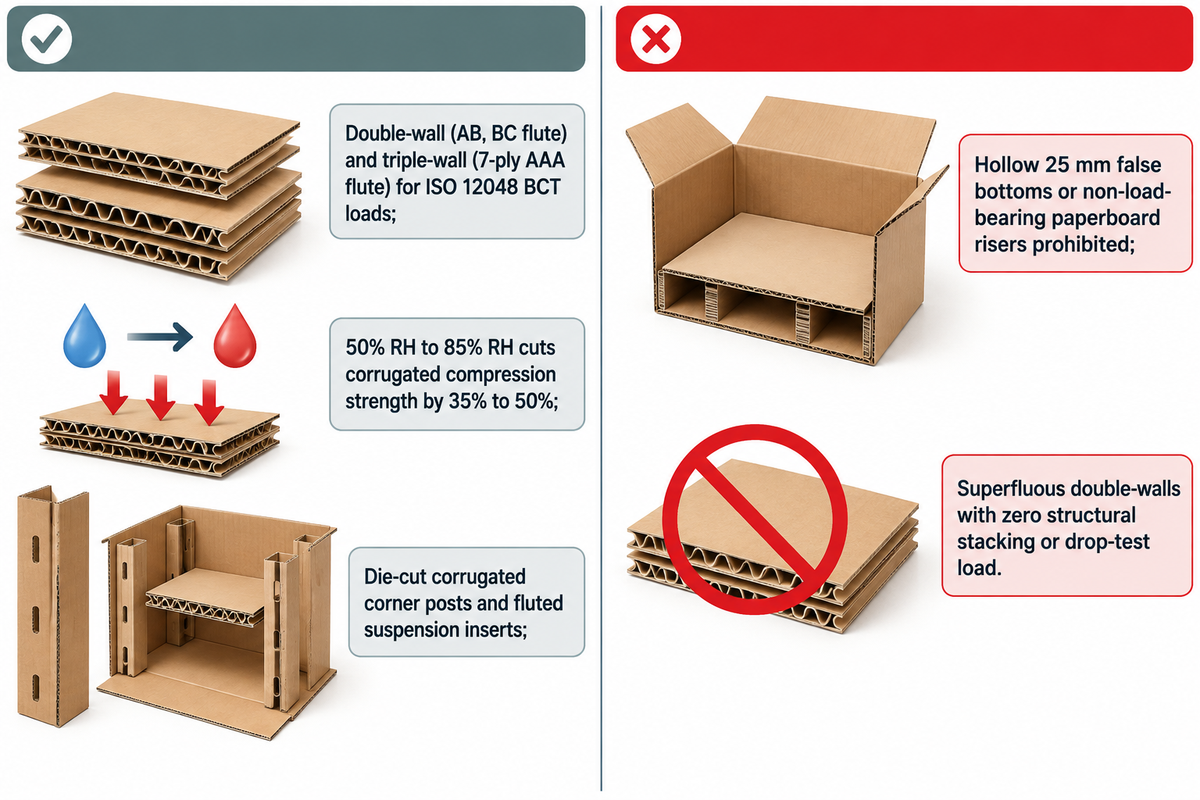
Article 10 and Annex IV ban packaging design features that only inflate perceived product size. Prohibited features include falsified bottoms, superfluous double-walls, and decorative outer sleeves. Double-wall (AB, BC flute) and triple-wall (7-ply AAA flute) corrugated boards remain compliant when used for structural stacking loads documented with ISO 12048 Box Compression Test (BCT) data.
This rule separates deceptive retail cosmetics boxes from structural transport engineering. Think of corrugated flute profiles like the steel trusses of a bridge. Adding an extra truss layer is illegal when used only for aesthetics, but is legal when needed to support a 600 kg pallet. Under Annex IV Point 1, new packaging must keep weight and volume to the minimum needed for safety and hygiene.
When does a double-wall corrugated carton qualify as necessary mechanical protection under Article 10?
A double-wall BC or AB flute carton qualifies under Article 10(2) whenever single-wall board fails the required compression load under ISO 12048. Converters prove this need by pairing Edge Crush Test (ECT) board values with pallet-stacking heights in the Annex VII file.
In daily converting practice, engineers estimate stacking strength with the empirical McKee equation. BCT equals k multiplied by ECT and the square root of board caliper (h) times box perimeter (Z). However, McKee estimates shift with linerboard moisture. Raising warehouse relative humidity from 50% RH to 85% RH often cuts corrugated compression strength by 35% to 50%. Therefore, plants running heavy-duty boxes on a corrugated box folder gluer must record physical ISO 12048 test curves before downgauging board grades.
As Packaging Strategies reported on Confederation of Paper Industries PPWR analyses, fiber converters must balance weight reduction against transit damage. Taking 15% off linerboard grammage can result in pallet collapse during transit to another member state and can generate more waste from damaged goods than it saves in fiber.
Compliant Under Article 10 & Annex IV
- Double-wall BC or AB flute shippers provide structural protection, with ISO 12048 stacking tests documenting compression performance for heavy pallet loads.
- Die-cut corrugated corner posts and fluted suspension inserts replace loose plastic bubble wrap while protecting fragile corners.
- Single-wall E or F micro-flute retail cartons are commonly sized within 15% of internal product dimensions to minimize void volume.
Prohibited Under Article 10 & Annex IV
- Hollow 25 mm false bottoms or non-load-bearing paperboard risers inside cosmetic folding cartons are prohibited under Annex IV.
- Double-wall cosmetic sleeves where the outer wall carries zero structural stacking or drop-test load violate Article 10 minimization rules.
- Promotional gift boxes used as grouped, transport, or e-commerce packaging fall under Article 24’s 50% empty-space cap, while sales boxes must minimize unnecessary cavity volume.
Design for Recycling (DfR) Grades and Adhesive Selection for Corrugated Lines
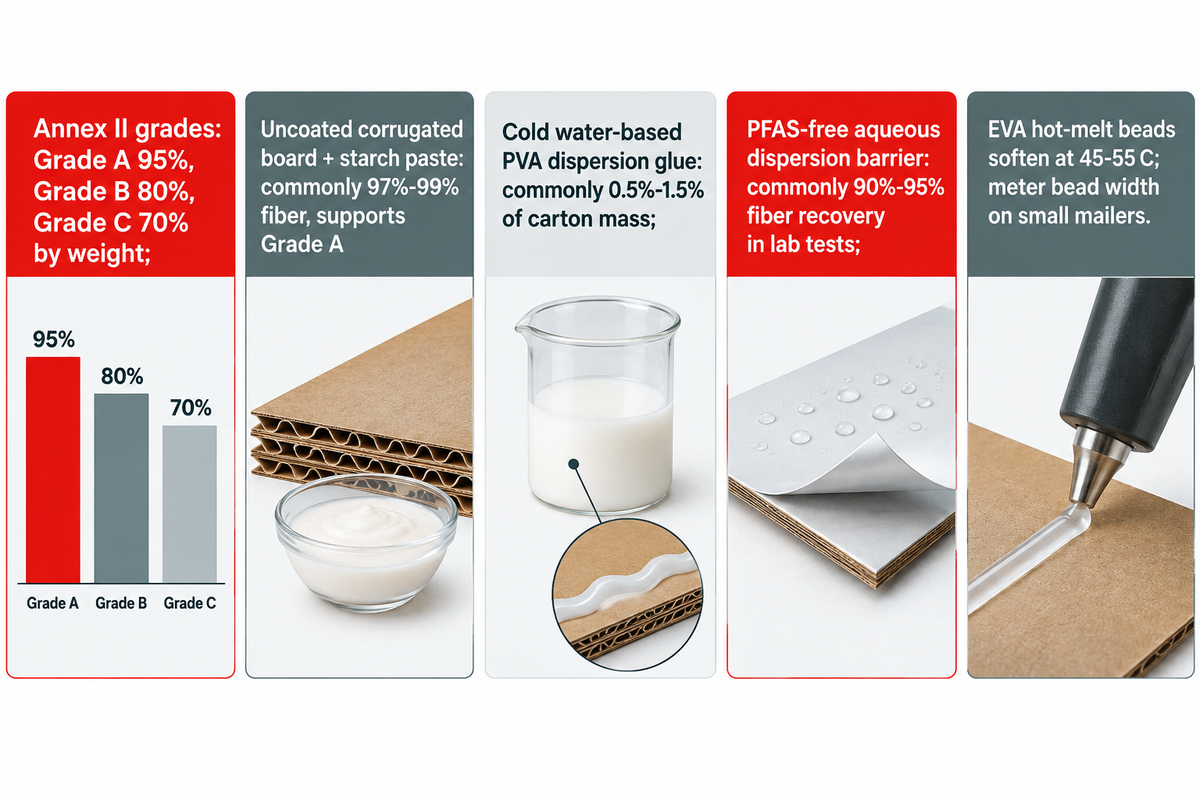
According to Article 6 and Annex II Table 3, EU packaging made of paper and cardboard must reach Recyclability Grade C (≥70% by weight) in 2030. From January 1, 2038, boxes must reach Grade B (≥80%). Cold water-based PVA glues and aqueous barriers commonly keep non-fiber content under 5% to support Grade A (≥95%) assessments.
Statutory grading under Annex II will use harmonized European Committee for Standardization (CEN) criteria adopted via delegated acts by January 1, 2028. Until 2028, mills and converters rely on the Cepi Recyclability Test Method Version 3 laboratory protocol and the 4evergreen evaluation protocol as the baseline. EN 643 classifies paper and board for recycling. Repulpability testing evaluates the coated carton’s fibre release, screening rejects, and sheet adhesion. Article 5 also requires converters to minimize substances of concern across board, inks, and adhesives.
“The Cepi method and the values it generates serve as the technical basis for the 4evergreen protocol to evaluate the recyclability of fibre-based packaging in recycling mills operating conventional repulping and screening processes.”
How do folder-gluer adhesive weight and ink coverage affect a carton’s PPWR recyclability grade?
Cepi v3 and the 4evergreen protocol evaluate fibre recovery, coarse and fine screening rejects and sheet adhesion in laboratory repulping. Article 6 and Annex II grade the recyclability of the complete packaging unit (Grade A ≥ 95%, Grade B ≥ 80%, Grade C ≥ 70%) and suggest Extended Producer Responsibility (EPR) fee modulation. Repulpability testing evaluates if separable adhesive particles screen out cleanly and don’t form sticky micro-particles in the pulp.
Laboratory testing published by North Carolina State University BioResources on repulpability and fiber recovery shows that unlaminated kraft and old corrugated containers commonly yield 80% to 92% fiber recovery. Conversely, heavy polymer laminations trap cellulose fibers in screen rejects. Survey data from 86 mills in the American Forest & Paper Association (AF&PA) Design Guidance for Recyclability confirms that thick ethylene-vinyl acetate (EVA) hot-melt beads soften at 45–55 °C and plug fine mill screens.
Common Converting Mistake (Hot-Melt Over-Application): Operators often raise folder-gluer speed from 150 m/min to 300 m/min without closed-loop glue control. EVA Hot Melt nozzles can then be enlarged to reduce seam pop-open on B-flute blanks. Non-fibrous adhesive mass from EVA Hot Melt can lead to increased screening rejects or adhesive contamination during the Cepi v3 repulping process. Increased screening rejects can reduce recyclability scores and result in higher brand owner EPR fees.
| Carton Component / Chemistry | Common Weight Share | Cepi v3 / 4evergreen Screening Behavior | Complete-Pack Annex II Assessment | 2030 / 2038 Design Consideration |
|---|---|---|---|---|
| Uncoated Corrugated Board + Corn Starch Corrugating Paste | Commonly 97%–99% fiber; 1%–2% starch | Commonly >96% fiber yield in lab tests | Supports Grade A (≥95% per the standard) | Baseline mono-material fiber structure |
| Cold Water-Based PVA Side-Seam Dispersion Glue | Commonly 0.5%–1.5% of carton mass | Evaluated for fibre release and screening rejects | Graded on complete carton under Annex II | Meter coat weight on high-speed folder gluers |
| Water-Based Flexo Ink | Commonly 0.3%–1.2% of carton mass | Evaluated for washing and sheet adhesion | Graded on complete carton under Annex II | Assess Pb + Cd + Hg + Cr(VI) ≤100 mg/kg across packaging components |
| PFAS-Free Aqueous Dispersion Barrier Coating | Commonly 2.0%–4.5% of carton mass | Commonly 90%–95% fiber recovery in lab tests | Graded on complete carton under Annex II | Replaces restricted PFAS food-contact barriers |
| Metered EVA Hot-Melt Glue (Cohesive Removal Grade) | Commonly 1.5%–3.5% of carton mass | Commonly 82%–90% yield if pellets screen out | Graded on complete carton under Annex II | Avoid excessive bead width on small mailers |
| Single-Side Extruded Polyethylene (PE) Film (<15%) | Commonly 8%–14% of carton mass | Film layer rejected in coarse screen testing | Graded under 2028 delegated act criteria | Must reach ≥70% in 2030 and ≥80% in 2038 per the standard |
| Plastic Film Windows & Tear Strips (>5% unit weight) | Commonly 6%–18% of carton mass | Requires separate assessment of plastic rules and screen losses | Grade determined by complete-pack assessment | Assess complete design against 2030 and 2038 thresholds |
| Two-Side PE / Aluminum Foil Laminated Board | Commonly 20%–32% non-fiber mass | Commonly <65% yield in standard mill pulping | At risk of scoring <70% per the standard | Requires dedicated beverage-carton sorting stream |
| Paraffin Wax-Saturated Corrugated Produce Boxes | Commonly 15%–25% wax impregnate | Fails standard repulping; fouls paper wires | Scores <70% per the standard | Replace with repulpable wet-strength board by 2030 |
| Fluorinated PFAS Grease-Proof Food Contact Coatings | ≥25 ppb single PFAS as documented in Article 5 | Restricted substance in food-contact board | Prohibited under Article 5(5) | Banned from EU market Aug 12, 2026 |
Short-Run Box Size Multiplication: Folder Gluer Changeover Physics vs. Void Limits
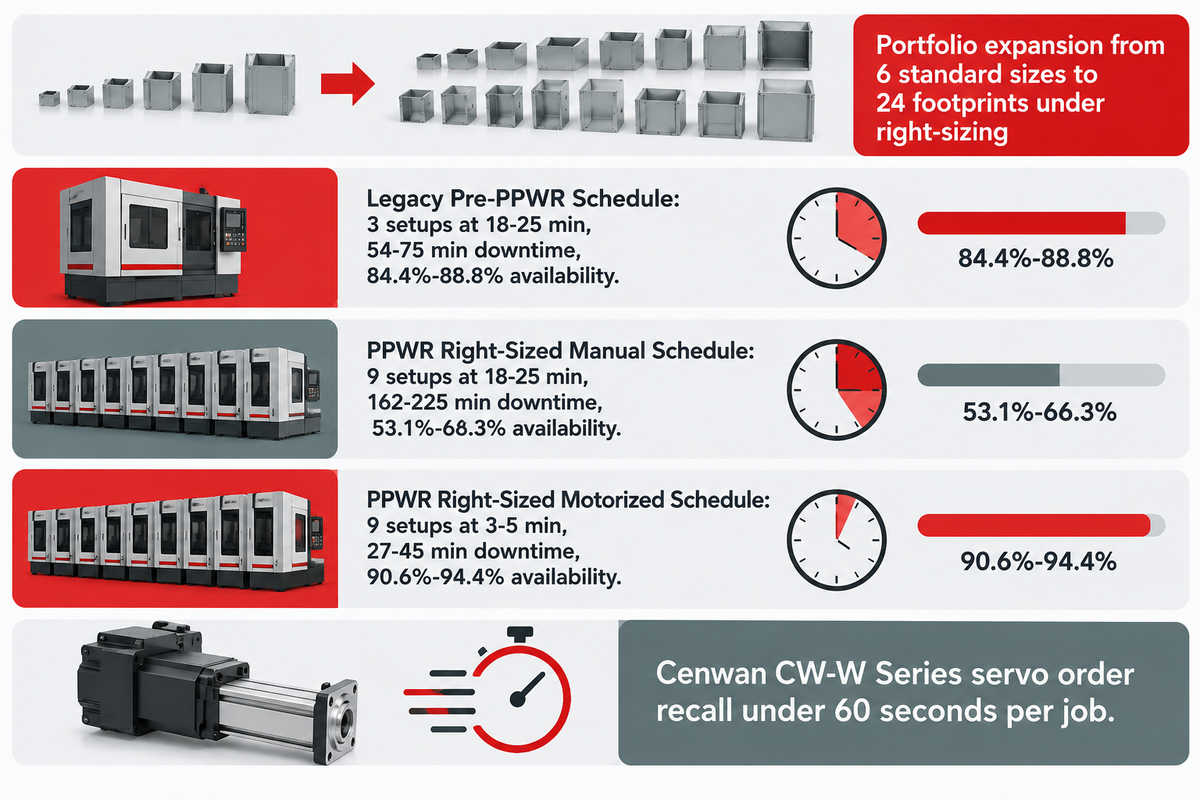
In an illustrative right-sizing scenario, a retail or e-commerce brand expands its box portfolio from 6 standard sizes to 24 footprints to reduce empty space. This shift can also reduce changeover times on the carton plant floor. Servo order recall can be achieved in less than 60 seconds, but capacity planning must include the full changeover time to be accurate.
Why do Article 24 void-space caps multiply daily SKU changeovers on a carton plant floor?
Brands may still use air pillows or crumpled Kraft paper for cushioning, but Article 24 will count those fillers as empty space, and won’t adjust the calculated void ratio. For instance, a shipper may split one 30,000 box monthly order into six 5,000 box runs of different dimensions. Each time a shipper makes such a split, it adds a full mechanical changeover on the converter’s die-cutter and folder-gluer.
Corrugated Void-to-Changeover Matrix (CVCM) for High-Mix Box Schedules
Corrugated Void-to-Changeover Matrix (CVCM) is a shift-capacity model connecting the Article 24 void-ratio caps to daily setup counts and folder-gluer availability.
Consider a 480-minute (8-hour) shift in a corrugated plant supplying European fulfillment hubs. Under a legacy schedule with 3 setups per shift at 18 to 25 minutes (within a common 15 to 45 minutes manual lead-screw setup range), operators lose 54 to 75 minutes to downtime. When right-sizing pushes the shift from 3 setups to 9 setups (6 extra setups), manual adjustment adds 108 to 150 minutes of extra downtime. Total setup downtime reaches 162 to 225 minutes (2.7 to 3.75 hours) per shift.
With nine changeovers per shift on a motorized high-speed folder gluer machine, reducing each complete changeover from 18 to 3 minutes recovers 135 minutes; reducing it from 25 to 5 minutes recovers 180 minutes. On Cenwan Machine’s CW-W Series, servo order recall takes under 60 seconds per job, while complete changeover time also includes manual board loading and glue checks. Shift availability is one factor in Overall Equipment Effectiveness (OEE equals Availability times Performance times Quality). The counter-ejector mechanism documented in Google Patents US20110268551A1 on box-making machine counter ejectors addresses bundle jamming and skewing during carton batching, while servo side-guide alignment strengthens the Quality factor during feeding and folding.
| Shift Schedule Scenario (480-Min Shift) | Daily Setups | Time per Setup | Total Setup Downtime | Net Running Time | Shift Availability % |
|---|---|---|---|---|---|
| Legacy Pre-PPWR Schedule (Manual Folder Gluer) | 3 setups | 18–25 min | 54–75 min | 405–426 min | 84.4%–88.8% modeled in shift |
| PPWR Right-Sized Schedule (Manual Folder Gluer) | 9 setups | 18–25 min | 162–225 min | 255–318 min | 53.1%–66.3% modeled in shift |
| PPWR Right-Sized Schedule (Motorized 3–5 Min Complete Setup) | 9 setups | 3–5 min | 27–45 min | 435–453 min | 90.6%–94.4% modeled in shift |
Corrugated Line Equipment Architecture: Single-Channel vs. Dual-Channel Retrofit Paths
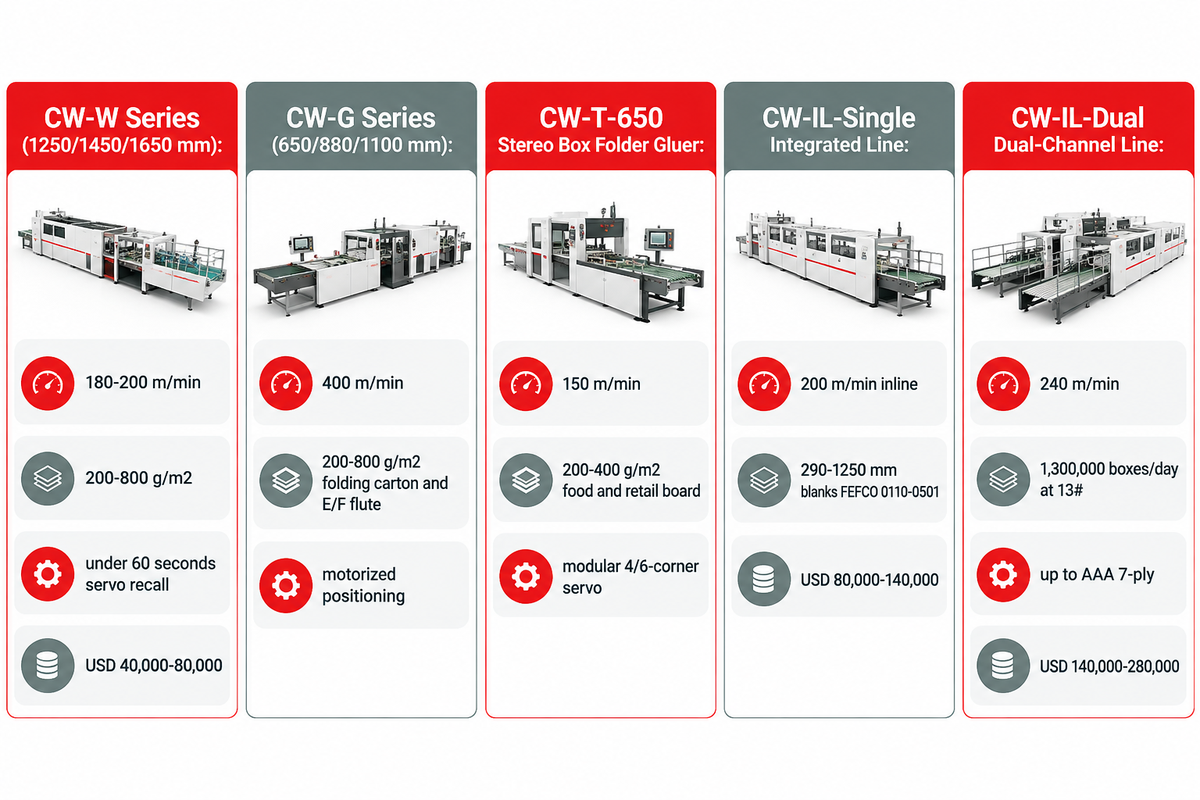
Carton plants running 5 to 15 die-cut SKU switches per shift should go for standalone servo folder gluers like the Cenwan Machine CW-W Series. Plants making 500,000 to 1,300,000 right-sized e-commerce mailers daily should go for integrated dual channel packaging lines.
Article 29(4)(a) exempts corrugated boxes from mandatory reusability quotas. Commission Delegated Decision (EU) 2026/429 exempts pallet wrapping and straps from the 100% B2B reuse rule. Targets are set for refill systems in the takeaway sectors and Annex V bans certain types of single-use plastic packaging in hospitality and fresh produce bans shift millions of units to sustainable fiber cartons.
Should a corrugated plant invest in standalone servo folder gluers or an inline dual-channel packaging line for 2030 compliance?
Choose a standalone servo folder gluer (USD 40,000 to USD 80,000) when floor space is under 50 m 2 and orders span crash-lock and 4-corner styles. For in-line printing, die-cutting, folding, gluing and strapping go with an automatic packaging line (between USD 80,000 and USD 280,000).
To align capital budgets with Regulation (EU) 2025/40 reuse and recycling rules, plant engineers can perform the 3-Gate Carton Plant PPWR Readiness Audit :
Gate 1 — Fiber & Adhesive Recyclability Check (Article 6): Annex II Grade A represents ≥95% recyclability by weight as documented in PPWR; adhesive and coating effects on fibre recovery and screening rejects also enter the assessment.
Gate 2 — Dimensional Right-Sizing Range (Article 24): Confirm that the selected line handles the box styles, dimensions, and board grades required by the plant’s actual orders. Calculate the empty-space ratio separately for each packed configuration.
Gate 3 — Servo Changeover & CE Safety Audit: EN 415-1:2014 covers packaging machinery terminology and classification, while EN ISO 12100:2010 provides the framework for risk assessment and risk reduction.
At Cenwan Machine (Zhejiang Chengwang Intelligent Packaging Equipment), our Ruian factory builds converting lines exported to over 40 countries. Selected configurations are supplied with CE compliance documentation for Machinery Directive 2006/42/EC and EMC Directive 2014/30/EU. ISO 9001:2015 addresses quality management systems, while EN 415-1:2014 covers packaging machinery terminology and classification. Plants upgrading existing gluers can also order servo retrofits and cold-glue assemblies through our folder gluer parts and service program. The table below compares five models from our catalog.
| Cenwan Machine Model | Max Belt Speed & Output | Board & Flute Range | Servo Recall / Setup | FOB Price Tier & Lead Time |
|---|---|---|---|---|
| CW-W Series Box Folding & Gluing Machine (1250 / 1450 / 1650 mm) | 180–200 m/min | 200–800 g/m2 paperboard; 3-ply & 5-ply corrugated | <60 seconds servo parameter recall (3–5 min complete changeover) | USD 40,000–80,000; 30–45 business days as documented in catalog |
| CW-G Series High-Speed Folder Gluer (650 / 880 / 1100 mm) | 400 m/min | 200–800 g/m2 folding carton board; E/F flute | Motorized memory positioning | Request configuration quote; 30–45 business days as documented in catalog |
| CW-T-650 Stereo Box Folder Gluer | 150 m/min | 200–400 g/m2 food packaging & retail board | Modular 4/6-corner servo setup | Request configuration quote; 30–45 business days as documented in catalog |
| CW-IL-Single Integrated Print-Die-Cut-Glue-Pack Line | 200 m/min inline | 290–1250 mm blanks; FEFCO 0110–0501 | Synchronized PLC order recall | USD 80,000–140,000; 45–60 business days as documented in catalog |
| CW-IL-Dual Dual-Channel Folder Gluer Line (17.5 x 4 x 1.8 m) | 240 m/min; 1,300,000 boxes/day @ 13# | Postal 13#–7#; N, F, E, G up to AAA 7-ply | Dual-lane independent servo setup | USD 140,000–280,000; 45–60 business days as documented in catalog |
PPWR Technical Files, Conformity Declarations, and Harmonized Label Rules
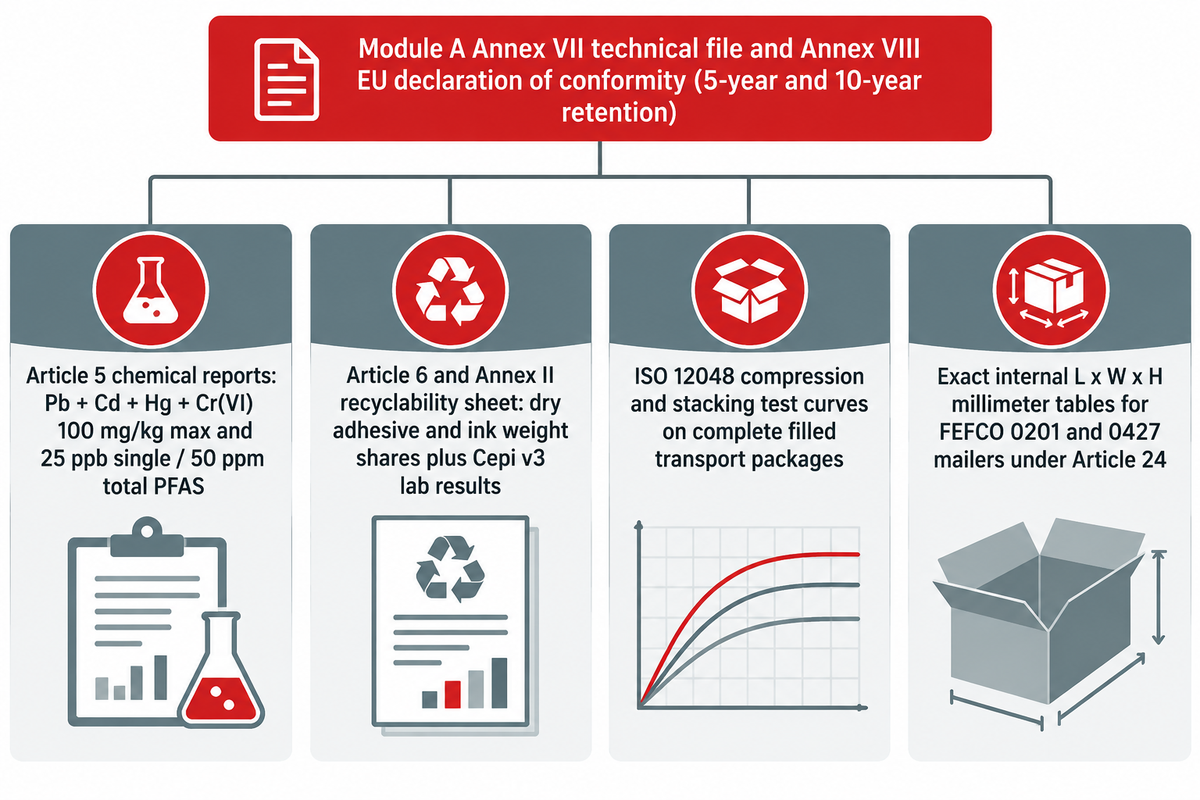
As per Articles 15, 35, and 39, packaging manufacturers are required to prepare an Annex VII technical file under Module A internal production control, and also issue an Annex VIII EU declaration of conformity. Records must be retained for 5 years on single-use cartons and 10 years on reusable formats.
Recital 109 clarifies an important rule for products, including packaging: finished cartons don’t carry a CE mark. Instead, conformity is declared through the Annex VIII document, while Article 12 establishes the harmonized labelling system. Starting August 12, 2028 or two years after the implementing act enters into force, whichever is later, those labels match box material pictograms with waste management bins in each member state. Conversely, converting machinery installed in an EU plant must carry CE marking under Directive 2006/42/EC. As Packaging World’s regulatory review of EPR and PPWR obligations notes, producers must keep batch traceability across the supply chain. Non-compliance brings a significant risk of market access blocks and an administrative fine in each member state.
What compliance data must a carton converter include in the Annex VII technical file for EU brand owners?
A converter’s Annex VII file must contain four records: a bill of materials, Article 5 chemical test reports, the Annex II recyclability grade sheet, and ISO 12048 BCT curves. Specifically, the bill of materials lists liner, fluting, glue, and ink weight shares, while lab reports verify Pb + Cd + Hg + Cr(VI) ≤100 mg/kg and Article 5(5) PFAS limits.
Carton Converter RFQ & Annex VII Verification Checklist (Consolidate Before Auditing):
- Obtain elemental heavy-metal analysis and Cr(VI) speciation reports for Pb + Cd + Hg + Cr(VI) ≤ 100 mg/kg alongside targeted organic fluorine and PFAS analytical test reports for food-contact packaging materials under Article 5.
- Record dry adhesive and ink weight shares alongside laboratory repulpability and screening reject results when compiling Annex II recyclability assessments under Article 6.
- ISO 12048 compression and stacking tests on complete, filled transport packages can support the protective need for double-wall AB or BC flute cartons during a packaging audit. Edge-crush testing measures the board separately.
- Provide exact internal L x W x H millimeter tables for every FEFCO 0201 and 0427 mailer SKU. That data lets the shipper’s Warehouse Management System (WMS) select a carton within the 50% empty-space cap as documented in Article 24.
Frequently Asked Questions About EU PPWR Packaging Rules
Does EU PPWR ban single-use corrugated cardboard boxes in 2030?
No, Regulation (EU) 2025/40 doesn’t ban single-use corrugated cardboard boxes in 2030. According to Article 29(4)(a), cardboard transport packaging, e-commerce parcels, and grouped boxes are exempt from the 40% reuse quota in 2030 and the 70% target in 2040. Single-use corrugated boxes also face substance restrictions, weight-minimization duties and technical documentation requirements. As per Article 24, covered grouped, transport and e-commerce packaging, shouldn’t exceed a 50% empty space. This would apply from the 1st of January 2030 or three years from the implementing acts, whichever is later, as documented in PPWR.
Are post-consumer recycled (PCR) content quotas mandatory for paper and cardboard packaging under PPWR?
According to Article 7, mandatory quotas would apply to recycled content in plastic packaging only, such as 30% for single-use beverage bottles by 2030 and up to 65% by 2040. Virgin kraftliner and recycled testliner paperboard are exempt from statutory PCR quotas. However, plastic windows or tear-strips exceeding 5% of carton weight require a separate assessment, as documented in Annex II.
How does the August 2026 PFAS restriction affect food-grade folding cartons?
Starting August 12, 2026, Article 5(5) bans food-contact packaging on the EU market if PFAS levels reach 25 ppb for any single targeted substance or 50 ppm total polymeric and non-polymeric PFAS. Folding carton converters were replacing fluorinated grease barriers with PFAS-free aqueous dispersion coatings. EN 643 classifies paper and board for recycling. Repulpability testing assesses the coated carton fiber release and screening rejects and checks adhesion of the sheet to the backing.
Who is legally responsible for the 50% empty space ratio: the box factory or the shipper?
As per Article 24(1), the legal responsibility would lie with the economic operator who fills the grouped, transport, or e-commerce box. Converters would provide right sized FEFCO footprints and volume tables.
Can non-EU machinery be used to manufacture PPWR-compliant cartons for European export?
Yes, non-EU machinery can produce compliant cartons exported to Europe. Machinery installed inside an EU plant must comply with Directive 2006/42/EC; EN 415-1:2014 covers packaging machinery terminology and classification.
Plan Your 2030 Corrugated Line Upgrade With Cenwan Machine
Since machines can help with precise glue application and precision control of adhesive beads, consider our integrated automatic packaging line architectures. Our Ruian, China engineering team can be contacted directly to perform a cycle-time study with your FEFCO drawings.
Editorial & Engineering Methodology Disclosure: This guide was compiled by the packaging machinery engineering team at Zhejiang Chengwang Intelligent Packaging Equipment (Cenwan Machine). All legal thresholds cite Regulation (EU) 2025/40, Commission Delegated Decision (EU) 2026/429, and Cepi v3 laboratory repulping methods, paired with cycle-time logs from CW-W and CW-IL folder-gluer installations.
References & Sources
- Regulation (EU) 2025/40 of the European Parliament and of the Council on Packaging and Packaging Waste (PPWR) Official Journal of the European Union (EUR-Lex)
- Packaging and Packaging Waste Regulation (PPWR) Stakeholder Implementation Briefing European Commission Directorate-General for Environment
- Automated, Right-Sized Packaging and EU 50% Empty Space Rules MHI Solutions Magazine
- Confederation of Paper Industries Analysis on EU PPWR Cardboard Exemptions and ISO 12048 Compression Testing Packaging Strategies
- Cepi Recyclability Test Method Version 3 for Fibre-Based Packaging and EN 643 Grading Confederation of European Paper Industries (Cepi)
- Assessing Repulpability and Fiber Properties in Recovered Paper Products North Carolina State University BioResources
- Design Guidance for Recyclability of Paper-Based Packaging American Forest & Paper Association (AF&PA)
- US20110268551A1: Counter Ejector of Cardboard Sheet Box-Making Machine (EN 415-1:2014, EN ISO 12100:2010, ISO 9001:2015) Google Patents / USPTO
- Pallet Wrapping and Straps Exempt from 100% Reuse Requirement Under PPWR European Commission Directorate-General for Environment
- Looking Back to Look Forward on Extended Producer Responsibility and PPWR Packaging World
Related Corrugated Converting Resources
- Integrated Automatic Packaging Line (Print, Die-Cut, Fold-Glue & Strap)
- Corrugated Box Folder Gluer Systems for E, F, C, B, and AB Flute
- CW-G and CW-W Series High-Speed Box Folding & Gluing Machines
- Servo Folder Gluer Retrofit Kits, Cold-Glue Assemblies & Spare Parts
- Cenwan Machine Technical Blog: Carton Plant Automation & Line Engineering