Get in touch with Cenwan Machine Company


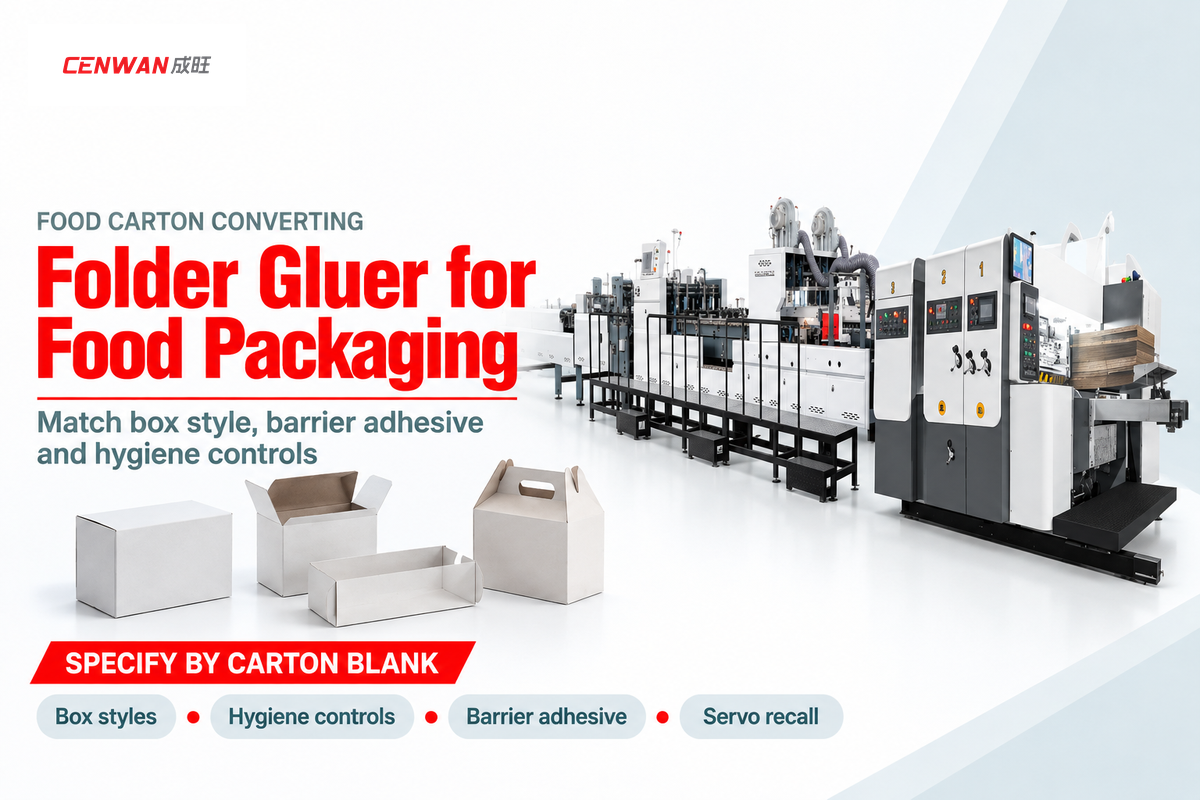
Choosing the right Folder Gluer for Food Packaging involves considering the geometry of carton folds, the stiffness of boards, and the type of food-safe adhesive. Most standard automatic machines operate at 50-300 m/min on folding cartons. High-speed models operate at 200-800 gsm paperboard and E, F, and N microflute stock at 400-450 m/min.
Food carton lines must also stop adhesive squeeze-out per U.S. FDA 21 CFR 175.105 and BRCGS Issue 7. Audits for BRCGS Issue 7 began in April 2025 across the global packaging industry. According to Packaging Digest, reducing the glue wheel from 20mm to a 0.5mm nozzle orifice reduces glue use by half.
Direct Answer: A folder gluer for food packaging is an automatic folding and gluing machine for 200-800 gsm board and E/F/N microflute. It operates at 180-400 m/min with 180-degree pre-folding and servo carrier recall. Closed 0.5 mm glue valves, and glue pots made of stainless steel, and optical ejection help maintain FDA 21 CFR 175.105 compliance.
Key Engineering Takeaways:
- Water-based cold glue requires a surface energy of 38-42 mN/m. According to Sinosun’s technical guide, untreated PE-coated food boards often pop open on pallets three days after shipment.
- Replacing a 20 mm open glue wheel with a 0.5 mm extrusion orifice cuts adhesive consumption in half (Packaging Digest). A narrower bead also stops internal stringing.
- Inline hot-melt sensors must be placed at least 30 mm from the nozzle of a heated glue gun (PostPress Magazine). Mounting them any closer causes radiant heat to trigger false passes.
- A full-servo job recall on the Cenwan CW-W-1250AC-S (< 60 second two-fold servo carrier changeover) cuts repeat makeready to under 30 minutes. Cam lined machines need 90-120 minutes for the same job changeover.
Quick Engineering Specifications: Industrial Food Packaging Folder Gluers
| Parameter | Standard / High-Speed Benchmark | Engineering Condition & Reference |
|---|---|---|
| Rated Belt Speed | 50–300 m/min (standard); 400–450 m/min (high-speed) | Straight-line cartons on 250–400 gsm board (SBL Acceptance Guide) |
| Applicable Paper & Flute | 200–800 gsm paperboard; E, F, N flute corrugated cardboard | Virgin SBS, FBB, CUK, and microflute (Cenwan CW-G Series) |
| 4/6-Corner Output Rate | Up to 28,000 boxes/hour | Multi-corner bakery and takeout trays with servo hooks (Packaging Strategies) |
| Cold-Glue Surface Energy Floor | 38–42 mN/m (dynes/cm) | Required for PVA dispersion wetting on coated board (Sinosun Technical Guide) |
| Pre-Folding Angle & Compensation | 180° crease break; 60–75 mm length compensation | First and third score lines for HFFS/VFFS cartoners (Patent EP1593482A2) |
| Repeat-Order Servo Makeready | <60 s two-fold servo carrier positioning; under 30 min total | CW-W-1250AC-S (22 kW, 290–1250 mm width) vs. 90–120 min manual (Cenwan Specs) |
| Site Floor Clearance | ≥60 cm side clearance; 1.5–2 m front and rear reserve | Operator passage and pallet staging (SBL Installation Standard) |
What Separates a Food Packaging Folder Gluer from a Standard Carton Gluer?
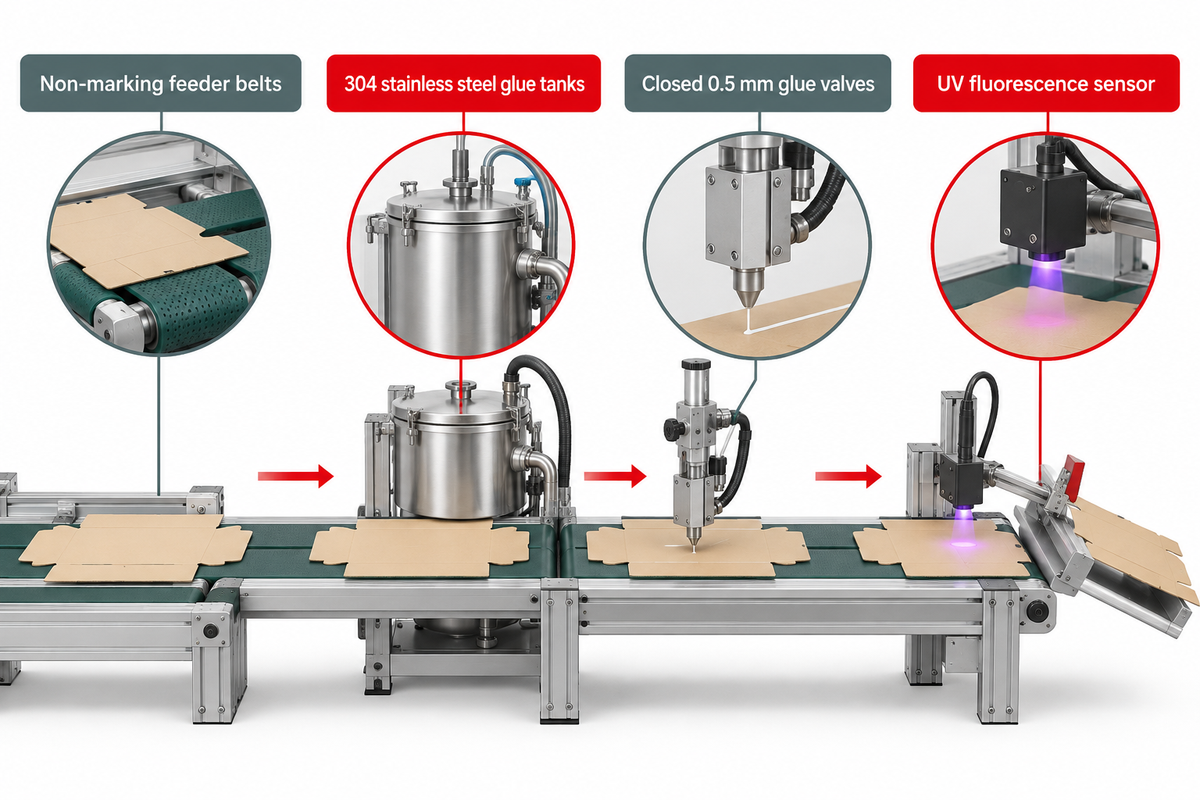
A food packaging folder gluer combines 180-400 m/min closing mechanics with closed 0.5 mm glue valves and stainless steel glue pots. Non-marking feeder belts and optical ejection eliminate adhesive squeeze out. These features allow adherence to FDA 21 CFR 175.105 and BRCGS Issue 7.
“The quantity of adhesive that contacts packaged dry food shall not exceed the limits of good manufacturing practice.”
Indirect Food Contact and Low-Migration Adhesive Containment
According to 21 CFR 175.105(a)(2), carton food adhesives are deemed indirect food additives. The adhesive should be placed behind a functional barrier or kept within GMP trace limits at seam edges. In May 2022, FDA final rule 2022-10531 removed 25 abandoned plasticizers from food contact regulations.
European converters adhere to EU Regulation (EC) No 1935/2004 and EC 2023/2006 GMP during production process. If glue goes inside a cereal carton during compression, the inner board face can transfer paste to the next blank. That set-off can contaminate the food-contact surface and can fail an audit.
Stainless Steel Glue Pots, 0.5 mm Extrusion Valves, and Hygiene Controls
Open glue wheels sling adhesive mist on machine speed at 250 m/min. Water-based paste also becomes airborne and can mix with paper dust. Replacing a 20 mm glue orifice with a 0.5 mm closed orifice cut glue in a case study published in Packaging Digest reduced glue consumption by 50%. The smaller orifice set quicker, thus stopping internal squeeze-out.
When BRCGS Packaging Materials Issue 7 was published in October 2024, global hygiene audits also tightened. Mandatory certification audits began in April 2025. More than 7,100 sites in 94 countries have BRCGS certification, which includes over 500 sites under Issue 7. Issue 7 demands documented line clearance, enclosed glue delivery and NSF H1 grease above the paper path.
In plant practice, box gluing machine and frozen food carton operators first check the squareness of the feeder and glue setback. We design our automatic folder gluer machine lineup with 304 stainless steel glue tanks and electronic valve brackets. These surfaces ease washdown between allergen-sensitive printing and packaging runs.
Food-Grade Folder Gluer Hygiene & Migration Audit Protocol
Use the Food-Grade Folder Gluer Hygiene & Migration Audit Protocol to check each station prior to box production.
| Machine Station | Contamination or Migration Failure Mode | Hardware Specification | Verification Target | Regulatory / Industry Standard |
|---|---|---|---|---|
| 1. Vacuum Suction Feeder | Black rubber marks or ink abrasion on inner food-contact board face | Non-marking carboxylated nitrile (XNBR) or polyurethane vacuum belts | Zero belt scuffing at 400 m/min feed velocity | BRCGS Packaging Issue 7 Clause 4.9 |
| 2. Feeder Trim & Dust Hood | Loose paper fibers and die-cut dust trapped inside folded cartons | High-velocity side-register brush + vacuum dust collector manifold | Continuous negative pressure across blank edges | EC 2023/2006 GMP Hygiene Control |
| 3. Pre-Folding & Carrier Rails | Mineral bearing oil dripping onto die-cut paperboard blanks | Sealed bearings lubricated exclusively with NSF H1 food-grade grease | Full H1 lubricant registration across the product zone | FDA 21 CFR 178.3570 / BRCGS Issue 7 |
| 4. Lower Glue Wheel Tank | Bacterial growth, dried skin flakes, or rust in water-based PVA paste | 304 stainless steel enclosed tank with quick-release scraper blades | Full tank drain and warm-water flush per shift | FDA 21 CFR 175.105(a)(2) GMP |
| 5. Upper Electronic Glue Valve | Interior glue squeeze-out contacting dry, fatty, or aqueous food | 0.5 mm closed-jet solenoid nozzle with encoder speed compensation | Half the glue volume of a 20 mm orifice; zero inner bleed | Packaging Digest Benchmark / 21 CFR 175.105 |
| 6. Hot-Melt Applicator Head | Charred adhesive degradation or sensor blindness from radiant heat | PID-controlled manifold with optical sensor mounted ≥30 mm from gun | ≥30 mm thermal standoff; zero char particles | PostPress / Baumer hhs QC Standard |
| 7. UV Optical Glue Monitor | Unbonded or over-glued cartons escaping into finished shipping cases | UV fluorescence sensor + 16-channel cold-glue pattern camera | Continuous seam coverage check at full belt speed | BRCGS Issue 7 Print & Glue Control |
| 8. Pneumatic Kicker Ejector | Defective food cartons mixed with good pallets during ramp-up | Single-box high-speed pneumatic ejection cylinder before press section | Automated removal of every flagged blank | ISO 9001 / BRCGS Non-Conforming Product |
| 9. Compression Delivery Belt | Adhesive set-off from seam edge onto adjacent shingled carton interior | Servo-regulated pneumatic press apron with independent tension control | Fiber-tearing bond with zero edge transfer | EU 1935/2004 Article 3 Migration Limit |
Matching Food Carton Box Styles to Folder Gluer Configurations
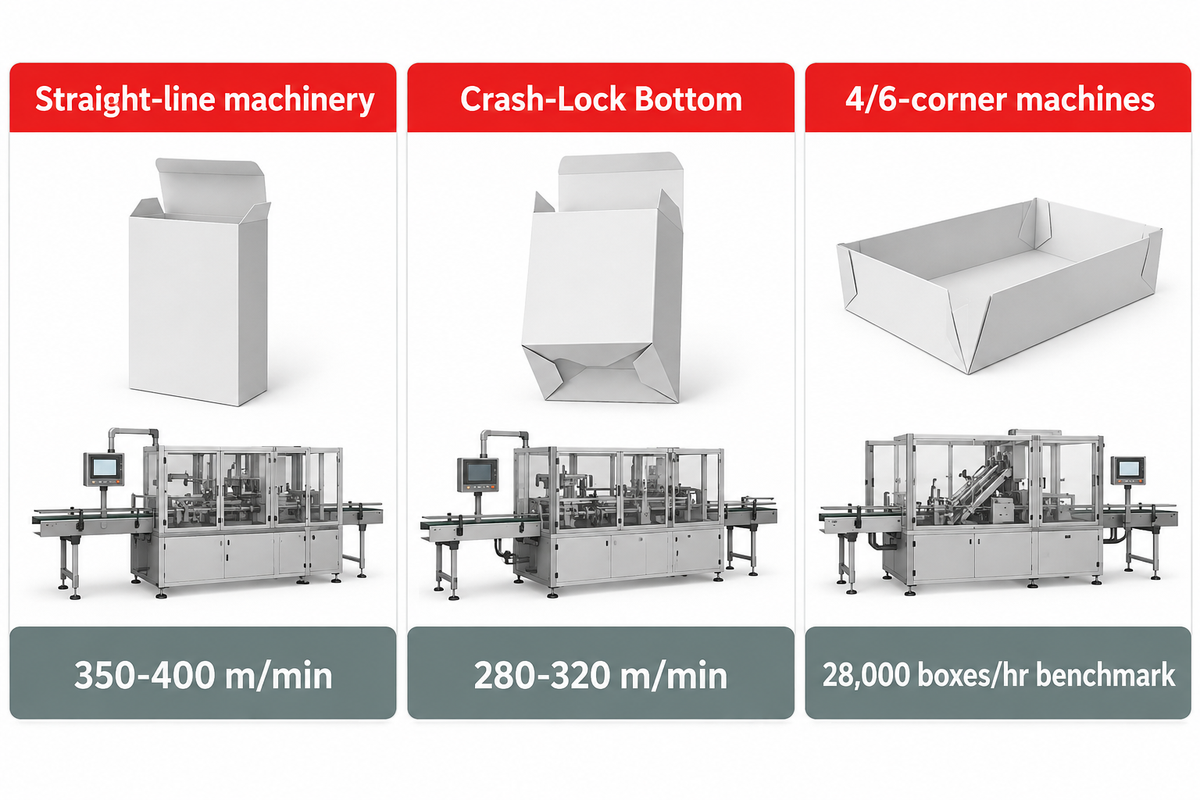
Food processing carton box style to folder gluer style begins with fold geometry. Straight-line machinery can run cereal and pasta boxes (up to) 400 m/min. Crash-lock machines can run snacks (auto-bottom) cartons at (up to) 320 m/min, while 4/6-corner machines can form bakery trays at up to 28,000 boxes per hour.
As per the SBL Machinery buyer acceptance guide, standard automatic folder gluers machines run at speeds of 50 to 300 m/min. High-speed platforms can run flat blanks at speeds of up to 400 m/min. With straight-line cartons, a speed of (up to) 400 m/min can be realized with flat 250-400 gsm board. However, crash-lock (280-320 m/min) and 4/6-corner cartons can run at lower speeds due to hook dwell time.
Food-Carton Style-to-Machine Configuration Matrix
The Food-Carton Style-to-Machine Configuration Matrix below maps nine food-related carton styles to folding mechanisms, applicable paper, motor power, and high-speed folding carton folder gluer models.
| Food Carton Style | Typical Food Application | Fold Sequence & Tooling | Substrate Range | Reference Machine Model | Rated Speed & Drive Power |
|---|---|---|---|---|---|
| 1. Straight-Line Reverse/Airplane Tuck | Dry cereal, pasta, tea bags, spice boxes | 1st & 3rd crease 180° pre-fold + side-seam glue lap | 200–800 gsm SBS / FBB | Cenwan CW-G-650 / 880 / 1100 | 350–400 m/min; 21.5–25.5 kW |
| 2. Straight-Line Heavy Microflute Sleeve | Frozen pizza, ready-meal sleeves, club packs | <60-second two-fold servo carrier changeover | 290–1250 mm blank width; E/F flute | Cenwan CW-W-1250AC-S | 200 m/min max; 22 kW drive |
| 3. Crash-Lock Bottom (Auto-Bottom) | Cookies, crackers, bottled sauces, frozen entrees | Bottom hook pre-folding + two-station glue application | 250–800 gsm board & E/F flute | Cenwan CW-G-650PC / CW-G Series | 280–320 m/min; 13.5 kW drive |
| 4. 4-Corner Bi-Fold Bakery Tray | Donuts, pastries, clamshell burger cartons | Rotary servo back-folding hooks + 4-corner glue jets | 250–600 gsm grease-resistant FBB | Cenwan CW-G Four-Fold / CW-W-1250PCW | Up to 400 m/min belt; 28,000 boxes/hr benchmark |
| 5. 6-Corner Hinged Lid Cake Box | Premium bakery, confectionery assortments, catering trays | Front & rear servo folding hooks + 6-point electronic nozzles | 300–700 gsm FBB / E-flute | Cenwan CW-W-1250PCW | 180 m/min; 25 kW drive |
| 6. Conical Takeout Noodle & Fry Pail | Quick-service restaurant fry scoops, wok pails | Dual-channel integrated printing, die-cutting, folding | 250–450 gsm PE-coated cupstock (size 13#) | Cenwan CW-IL-Dual Line | 240 m/min; 1,300,000 boxes/day |
| 7. Multi-Compartment Partition Carton | Artisanal chocolate dividers, snack variety packs | Inner tab plow folders + at least 3 glue gun heads | 250–500 gsm SBS / FBB | Cenwan CW-G-880 with 3+ HHS guns | 180–250 m/min depending on tab length |
| 8. Beverage Multipack Basket Carrier | Craft beer 6-packs, sparkling water carriers | Heavy-duty lock-bottom hooks + up to 16 cold-glue lines | 400–800 gsm wet-strength CUK | Cenwan CW-W-1250PC Heavy-Duty | 150–220 m/min; high-pressure press |
| 9. E-Commerce Food Mailer Box (13#–7#) | Meal-kit delivery boxes, subscription coffee mailers | Inline flexo printing, die-cutting, folding, and packing | E, N, and F corrugated flute | Cenwan CW-IL-Dual Consolidated Line | 240 m/min per channel |
Straight-Line Folder Gluers for Cereal, Pasta, and Dry Grocery Cartons
A straight-line folder gluer machine is equipment for high-volume dry foods. Its working principle is direct: the feeder registers each die-cut blank, pre-breaks creases 1 and 3, and applies a side-seam bead, and then presses the sleeve flat. Even a small box for tea bags or spice pouches requires exact registration to fold and glue flat without skewing. The Cenwan Machine CW-W-1250AC-S straight-line folder gluer operates at 22 kW with a 290 – 1250 mm blank width and 200 m/min max. belt speed. It provides <60 second two-fold servo carrier changeover in the USD 40,000 – 80,000 price band.
Crash-Lock Bottom Folder Gluers for Snack, Beverage, and Frozen Food Packs
Interlocking bases that pop-open on the packing line are used for heavier snack and frozen food cartons. A crash-lock bottom folder gluer uses stationary hooks and folding shoes to break the diagonal base creases. The CW-G-650PC crash-lock model runs on a 13.5 kW drive. The CW-G-650, 880 and 1100 high-speed series processes 200 – 800 gsm solid paperboard and E/F/N microflute at up to 400 m/min. Servo-driven pressure transfer cuts crash-lock reject rates in half at 280 to 320 m/min. You can review dieline geometry in our crash-lock bottom box structure guide.
4-Corner and 6-Corner Folder Gluers for Bakery Trays and Clamshells
Simultaneous folding of the front and rear corner flaps is required for box styles used in bakeries and for takeout. A 4 and 6 corner folder gluer uses electronic servo back-folding hooks synchronized with blank pitch. The Cenwan Machine CW-W-1250PCW 4/6-corner folder gluer uses a 25 kW drive and servo back-folding hooks and achieves speeds of up to 180 m/min. For higher volume, the CW-IL-Dual dual-channel line reaches speeds of up to 240 m/min and can produce up to 1,300,000 size 13# boxes in a day (USD 140,000 – 280,000). In a case study in Packaging Strategies, high-speed flexible folder-gluers are stated to achieve speeds up to 450 m/min. They can produce up to 28,000 boxes per hour on 4- and 6-corner cartons.
When a food carton includes internal divider tabs, posters in the PackagingDesign subreddit suggest a multi-gun solution. Straight tuck boxes with compartment tabs require a gluer with at least 3 heads. As noted in PostPress Magazine, beverage carriers can require up to 16 cold glue guns and 16 verification lines.
Can a Single Folder Gluer Run Straight-Line, Crash-Lock, and 4/6-Corner Food Boxes?
Yes, a modular four-fold folder gluer with crash-lock hooks and servo back-folding attachments runs straight line, crash-lock 4- and 6-corner food boxes. Engaging the 4/6-corner module on the Cenwan CW-G series (200 – 800 gsm board, E/F flute) cuts style-migration time from two days to one. The structural versatility lets converters handle seasonal food packaging solutions without buying separate dedicated lines.
Multi-Style Corrugated Food Converter Case Study: One corrugated case-maker running 200 to 800 gsm board and E/F microflute needed a box machine for three styles. The plant made straight-line sleeves, crash-lock bottom boxes and four corner bakery trays. Their old fixed-cam folding machine took two days of wrench work to changeover to 4-corner trays. Replacing it with a Cenwan CW-G Four-Fold gluer, rated at 400 m/min, reduced style changeovers to a day shift.
Handling Food-Grade Paperboard, Barrier Coatings, and Microflute Substrates
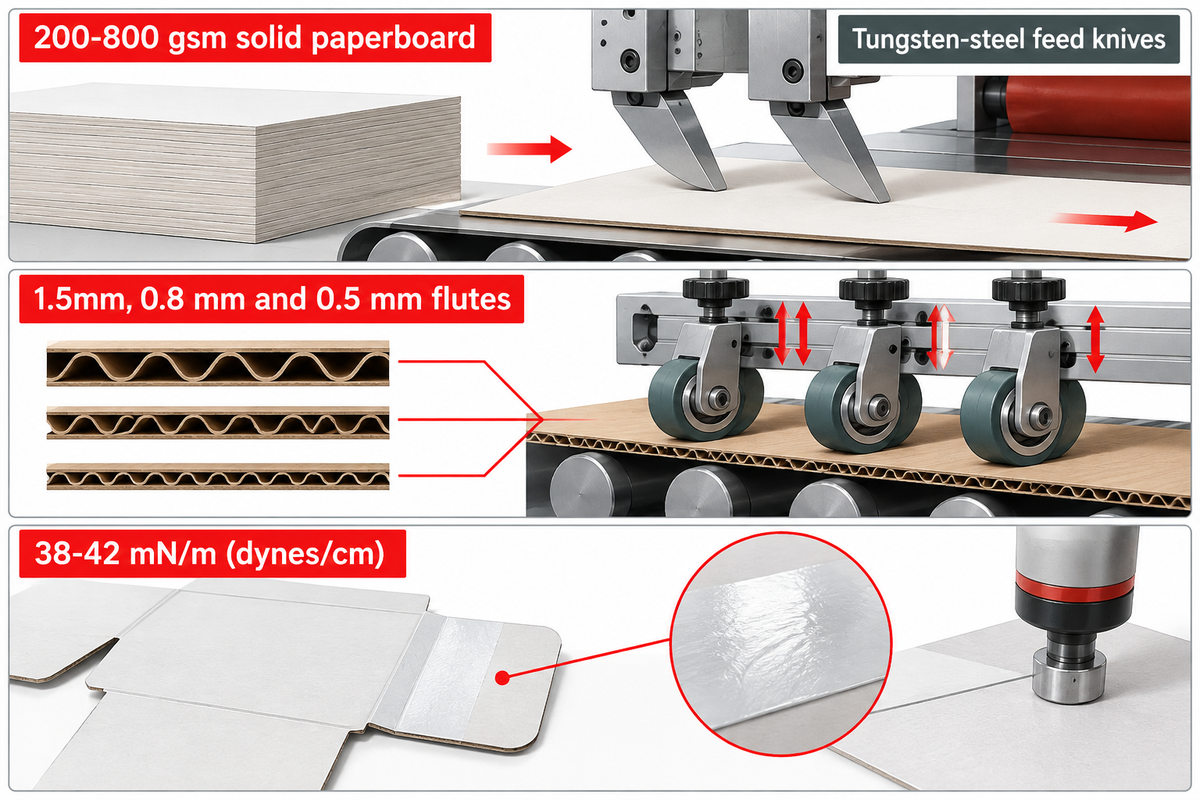
Handling food-grade paperboard, barrier coatings and microflute substrates requires feeder grips to be matched to the board’s stiffness. Automatic lines process 200-800 gsm solid paperboard (SBS, FBB, CUK) and E, F, and N microflute. Tungsten-steel feed knives and servo compression belts prevent flute crush and score-line springback at speeds of 180-400 m/min.
The Paperboard Packaging Council (PPC) outlook, as reported by Paperbox.org, projects the annual growth of U.S. folding carton demand at 1.3% to reach 5.4 million tons in 2026. During the same period, the total U.S. shipment value is expected to increase from $9.5 billion in 2021 to $13.3 billion in 2026. The capacity of board caliper and microflute (200-800 gsm and E/F/N flute) depends on creasing depth and grain direction which needs to be confirmed with actual die-cut food samples.
Virgin SBS, FBB, and Wet-Strength CUK Board Stiffness
Virgin SBS and Folding Boxboard (FBB) for Dairy, Chocolate and Bakery cartons range from 200-500 gsm. Freezer cartons and beverage carriers use CUK (up to 800 gsm) with Wet Strength resins. Virgin fibers offer stiffness which helps resistance to box folding and attempts to spring open along score lines.
To hold tight tolerances on dense Virgin paperboard, the Cenwan CW-G series pairs a Bobst class tungsten-steel feed knife with Swiss Habasit belts. The heavy duty feed assembly is run across multi-shift production and wears out minimally. Belts and blades are replaced periodically.
E-Flute, F-Flute, and N-Flute Corrugated Food Boxes: Preventing Flute Crush
Hot take-out containers use 1.5mm, 0.8 mm and 0.5 mm flutes. Corrugated boxes are heavy and require a rigid framework to prevent buckling. Lack of sufficient stacking strength often results from collapsing flutes. Compression of flutes loses the vertical load bearing capacity of the medium and skews the lap.
Modern folder gluers address flute crush by using adjustable roller rails and servo tension on the transfer band. As cited in Packaging Digest, replacing the top carrier with a low pressure vacuum transporter cuts the number of moving parts by 80%, and can increase speed to 2,300 fpm.
Why Do PE-Coated, Aqueous Dispersion, and Grease-Resistant Food Boards Reject Standard Cold Glue?
Hot fluted medium isn’t acceptable to boards coated with water or aqueous dispersion for food service because their coatings drop surface energy to 38-42 mN/m (dynes/cm). Glue with cellulose fibers above 38 mN/m peels apart from coated boards.
As Lanco Adhesives and SBL Machinery describe, PE coatings and UV varnishes create a greaseproof barrier. Standard cold glue system (curing by the transfer of water) can’t form a fiber-tearing bond when unskived.
Cold Dispersion Glue vs. Hot-Melt Systems on Barrier-Coated Food Board
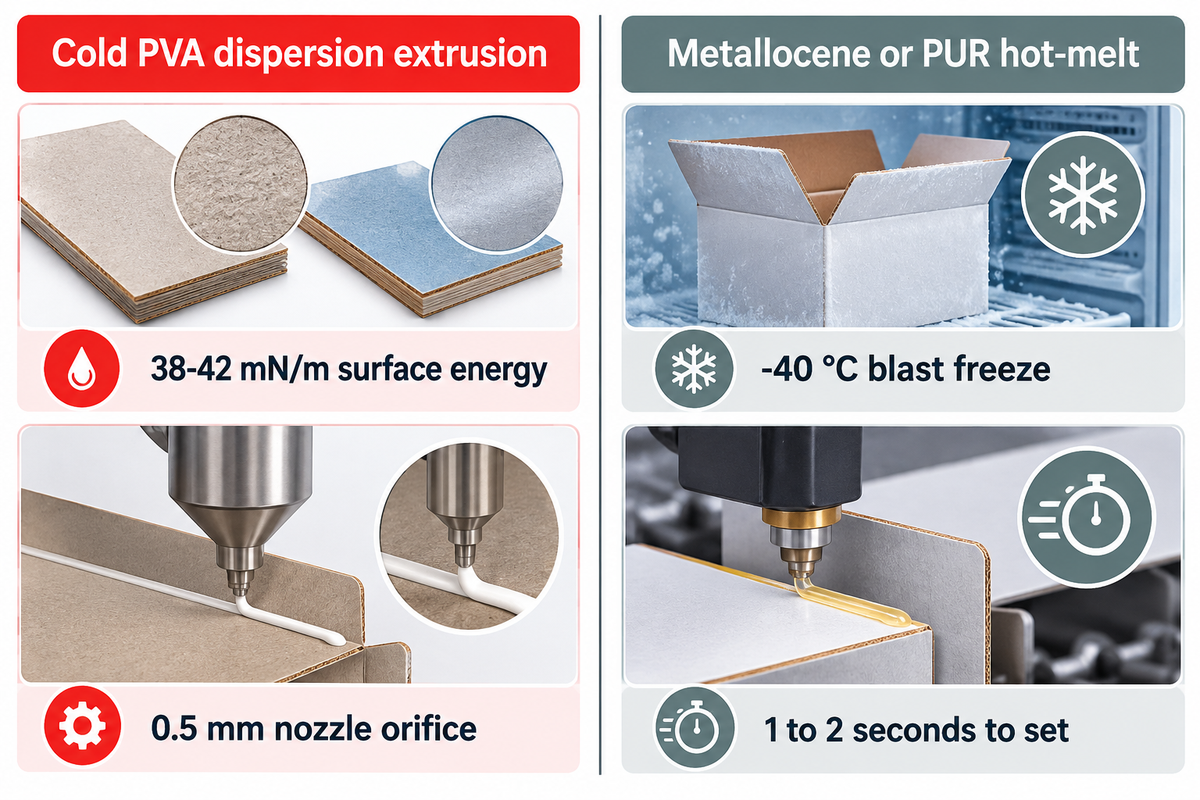
In cold dispersion systems, surface energy is more important than freezer temperature. Cold water-based PVA/EVA extrusion can yield the lowest adhesive cost for uncoated board or glue windows with surface energy between 38-42 mN/m. By contrast, hot-melt systems based on metallocene or PUR can be used for PE-coated or blast frozen (-40 °C) food cartons.
Water-based PVA cold glue bonds reliably only when the glue flap is uncoated or corona/plasma-treated to at least 38-42 dynes/cm. Full PE-extruded or deep-freeze (-40°C) cartons require metallocene or PUR hot-melt systems. For more on jetting manifolds vs. wheel pots, see our folder gluer glue system selection guide.
Coated Food Board Seam Failure: As Sinosun’s adhesive engineering guide warns, the wrong glue choice on a box folder gluer rarely shows up at the belt. According to Sinosun’s field report, it shows up three days later as a rejected pallet. When cold glue hits film lamination below 38-42 mN/m, it can create a weak surface skin that pops open in cold storage.
Barrier-Board Adhesive & Surface-Energy Qualification Grid
The nine-row Barrier-Board Adhesive & Surface Energy Qualification Grid that follows matches food packaging board substrates to their surface energy floor and glue application system.
| Food Board Substrate | Typical Food Carton Use | Untreated Surface Energy | Required Flap Preparation | Recommended Glue System | Service Temperature Window |
|---|---|---|---|---|---|
| 1. Uncoated Virgin SBS (200–500 gsm) | Dry pasta, flour, tea, and cereal cartons | 44–50 mN/m | None (raw cellulose fiber exposed) | Cold PVA dispersion extrusion (0.5 mm nozzle) | -10 °C to +45 °C |
| 2. Clay-Coated FBB with Glue Window | Biscuits, snack bars, dry grocery sleeves | 40–44 mN/m in knock-out window | Die-line varnish knock-out on glue lap | Cold PVA/EVA copolymer extrusion or wheel | -15 °C to +45 °C |
| 3. Wet-Strength CUK (400–800 gsm) | Chilled beverage carriers, refrigerated packs | 38–42 mN/m | High-solids copolymer dispersion or hot-melt tack | High-tack EVA emulsion or dual cold + hot-melt | 0 °C to +40 °C high humidity |
| 4. Aqueous Dispersion Barrier Board | Plastic-free burger clamshells, bakery trays | 34–38 mN/m | Inline corona or atmospheric plasma to ≥42 mN/m | Formulated barrier-grade PVA or metallocene hot-melt | -20 °C to +60 °C |
| 5. Single-Side PE-Coated Board | Frozen vegetables, ice cream novelties | 30–32 mN/m on PE face | Mechanical skiving or plasma treatment on glue lap | Metallocene polyolefin hot-melt jetting | -40 °C blast freeze to +30 °C |
| 6. Double-Side PE-Extruded Cupstock | Takeout noodle pails, soup containers, fry cartons | 30–32 mN/m both sides | Inline atmospheric plasma + thermal hot-melt | Metallocene or reactive PUR hot-melt gun | -40 °C to +85 °C hot-fill |
| 7. PET-Metallized Laminated Board | Specialty confectionery, premium coffee boxes | 32–36 mN/m on PET film | Inline plasma treatment or mechanical wheel skiving | Reactive PUR or high-peel metallocene hot-melt | -20 °C to +50 °C |
| 8. PFAS-Free Greaseproof Tray Stock | Donut trays, fried chicken boxes, pastry cartons | 35–39 mN/m | Plasma activation to ≥42 mN/m or knockout window | Emulsion copolymer cold glue or metallocene dot | -10 °C to +65 °C warm grease |
| 9. E/F/N Microflute Corrugated Board | Pizza boxes, food delivery mailers, club packs | 40–46 mN/m (kraft/white-top liner) | Controlled compression gap to prevent flute crush | Dual-gun: hot-melt tack dot + cold PVA structural bead | -20 °C to +50 °C |
Electronic Non-Contact Extrusion Valves vs. Mechanical Glue Wheels
Mechanical glue discs are well suited to simple straight line cartons, but for multi-corner food cartons, electronic extrusion valves (like Baumer hhs, Nordson, or Valco Melton) are used. A nozzle orifice of 0.5 mm reduces the volume of adhesive by 50% compared to a 20 mm setup (Packaging Digest). It can also continuously stitch together glue dots at up to 400 m/min to create high-quality seam bonds.
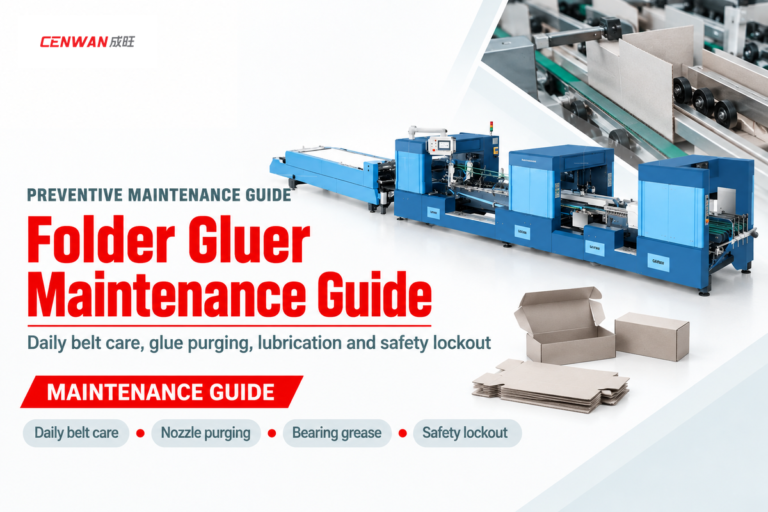
Performing daily nozzle care helps prevent unscheduled stops. From Folder Gluer Inc.’s troubleshooting checklist, unscheduled folder gluer downtime costs $500 to $2,000 per hour. Their maintenance records state a 15-minute daily nozzle purge prevents 80% of adhesive clogs and maintains optimal performance.
Combining Cold Glue and Hot-Melt Tacking for High-Speed Barrier Cartons
At 300 m/min, glue alone on a wet-strength board may not set before the carton leaves the press. A dual-gun system uses a fast-setting hot-melt dot to lock the flap and a cold PVA glue to set a fiber-tearing bond. The hot-melt dot takes 1 to 2 seconds to set, and the cold glue takes a few seconds to set.
High-Speed Pre-Folding, Servo Changeover, and Inline Quality Inspection
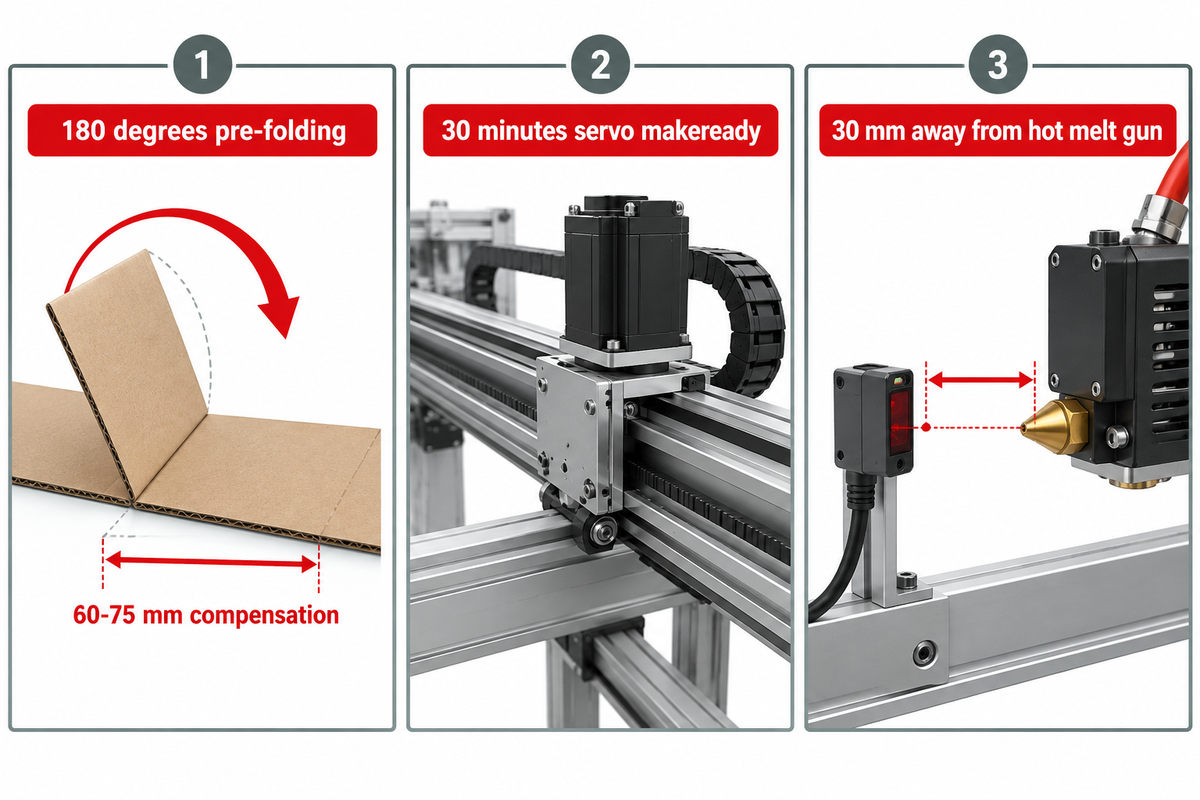
Barrier coated food cartons are kept running by high speed pre-folding, servo changeover, and inline quality inspection. Cartons which use pre-creased board for automation require creases 1 and 3 to be pre-folded to 180 degrees with 60-75 mm compensation. For further automation, repeat makeready is cut to less than 30 minutes, and UV optical sensors verify glue placement before pneumatic ejection of the box.
“The sensors need to be kept at least 30 mm away from the heated hot melt gun in order not to affect the functionality of the hot melt sensor.”
180-Degree Pre-Folding Angles and Cartoner Erection Reliability
Horizontal and vertical form-fill-seal (HFFS/VFFS) cartoners in cereal and frozen pizza plants pull flat blanks from a magazine using vacuum cups. If creases 1 and 3 are only pre-folded to 90 or 135 degrees, board memory makes the carton jam in the erection turret.
To resolve erection jams, high-speed food folder gluers fold creases 1 and 3 at a full 180 degrees. According to the European Patent EP1593482A2, a 180-degree folding station requires length compensation of 0 mm to 100 mm, with a preference of 60 mm to 75 mm. There’s an equal importance on plate accuracy: Folder Gluer Inc. states that folding plates set even 1 mm off a blank dimension causes a visible gap. See our folder gluer station setup and squaring checks, for alignment.
Motorized Servo Carriers: Cutting Multi-SKU Food Carton Changeovers
Different regional languages and flavors for food brands often lead to multiple SKUs for a single carton order. On manual folder gluers, it takes operators 90 to 120 minutes to turn handwheels on every crease bar and carrier rail for changeovers (Cenwan High-Speed Engineering Data).
This servo control system advancement decreases run times for productivity. On the Cenwan CW-W-1250AC-S auto folder gluer, a servo carrier positions a 2-fold bar in <60 seconds and recalls stored job coordinates to automation in less than 10 minutes, with full makeready taking less than 30 minutes. The CW-W-1250AC-S increases operational efficiency across multi-shift plants.
Plant Case Study – 18 SKU Weekly Carton Line: A mid-sized packaging plant running 18 carton SKUs per week lost up to 120 minutes for manual changeovers. Operators had to hand-adjust folder bars and glue nozzles for each run. The plant gained servo folder gluer stored job parameters on a Cenwan CW-W-1250AC-S, which reduced makeready time to 30 minutes.
Optical Glue-Bead Monitoring and Single-Box Pneumatic Ejection
Inspecting at speeds of 300-400 m/min isn’t possible. PostPress Magazine’s quality control analysis explains that just knowing that a product didn’t kick out doesn’t mean it’s good. If a thermal sensor sits 30 mm or less from a hot melt gun, radiant heat from the gun will distort the sensor and cause false passes.
Use a properly spaced (≥30 mm standoff) hot-melt detector with a single box pneumatic kicker to prevent false passes. In the case of a missing bead or a skewed blank, the ejector kicks out that single carton before the press belt.
Machine Price Tiers, Net Shift Output, and Changeover Economics
Payback periods for automatic folder gluer for food packaging machines are determined by price tiers, net shift output, and changeover economics. Industrial automatic folder gluers pair span USD 40,000-80,000 for servo straight-line units. Dual-channel lines range from USD 140,000-280,000 (240 m/min and 1,300,000 boxes/day at size 13#), and new Tier 1 European machines cost USD 400,000 – 900,000+.
According to Global Market Insights, the worldwide folder gluer machine market was worth USD 678.4 million in 2025. It’s expected to increase from USD 722 million in 2026 to USD 1.30 billion in 2035 at a CAGR of 6.8%. Price bands for the machines exclude shipping costs, import duties, and local adjustment. Optional extras like UV cameras or plasma modules and specific delivery dates are determined by the equipment specs (quotation needed).
Capital Equipment Tiers and Procurement Lead Times
Folder gluers for sale buyers assess four equipment tiers when considering a new folder gluer machine or a used folder:
- Lower-tier equipment systems (e.g., the Cenwan CW-M-650 / 880 / 1100 series) feature drive units in the 21.5 – 25.5 kW range and board ranges from 200 – 800 gsm. Supported feed types include straight-line and lock-bottom as well as 4/6 corner runs. These equipment systems are appropriate for small-scale shops testing new box styles to support a machine small footprint.
- Flagship equipment models (e.g., the Cenwan CW-G-650 / 880 / 1100 series) can achieve maximum speeds of up to 400 m/min (350 – 400 m/min straight-line, 280 – 320 m/min crash-lock). Each 6,400 – 7,800 kg frame pairs a tungsten-steel feed knife with Habasit (Swiss) belts.
- Cenwan’s intelligent full-servo platforms include the CW-W-1250AC-S and CW-W-1250PCW. The former boasts a 22 kW drive, 290-1250 mm width, and costs between USD 40,000 and 80,000. The latter has a 25 kW drive and reaches 180 m/min. Both provide <60-second two-fold servo carrier positioning and <30-minute repeat changeover.
- The CW-IL-Dual integrates three processes (flexo printing, die-cutting, and packing) into a single line at 240 m/min. Each channel has a capacity of 1,300,000 size 13# boxes per day and costs between USD 140,000 and 280,000.
BOBST-, Koenig & Bauer-, and Heidelberg/MK-based machines operate at a peak speed that’s 11% faster than European Tier-2 machines. The lowest priced machine at Global Market Insights / PMMI, is the Bobst Expertfolio (automated folding carton machine) at USD 500,000. Secondhand European machines can be purchased for between USD 500,000 – 1.5 million. Non-servo-controlled continuous feed systems lack CE interlocks. Servo drives are also not included in these machines. In the United States and Europe, some OEMs can build a CE-compliant machine for about 20-30% of the cost of a Tier-1 machine. This is made possible by Zhejiang Zhongte Technology Co. Ltd (parent company of Cenwan Machine). This company has the capability to manufacture folder gluing machine machines. The SBL Machinery installation guide states that on-site installation of a machine takes between 2 – 3 days and an operator is trained to use the machine in 3 – 5 days. Lead times for machine fabrication are determined by the model, and specifications (please request a quote).
Worked 480-Minute Shift Calculation: Belt Speed vs. Net Accepted Food Cartons
Worked Shift Output Calculation (Manual vs. Full-Servo Changeover):
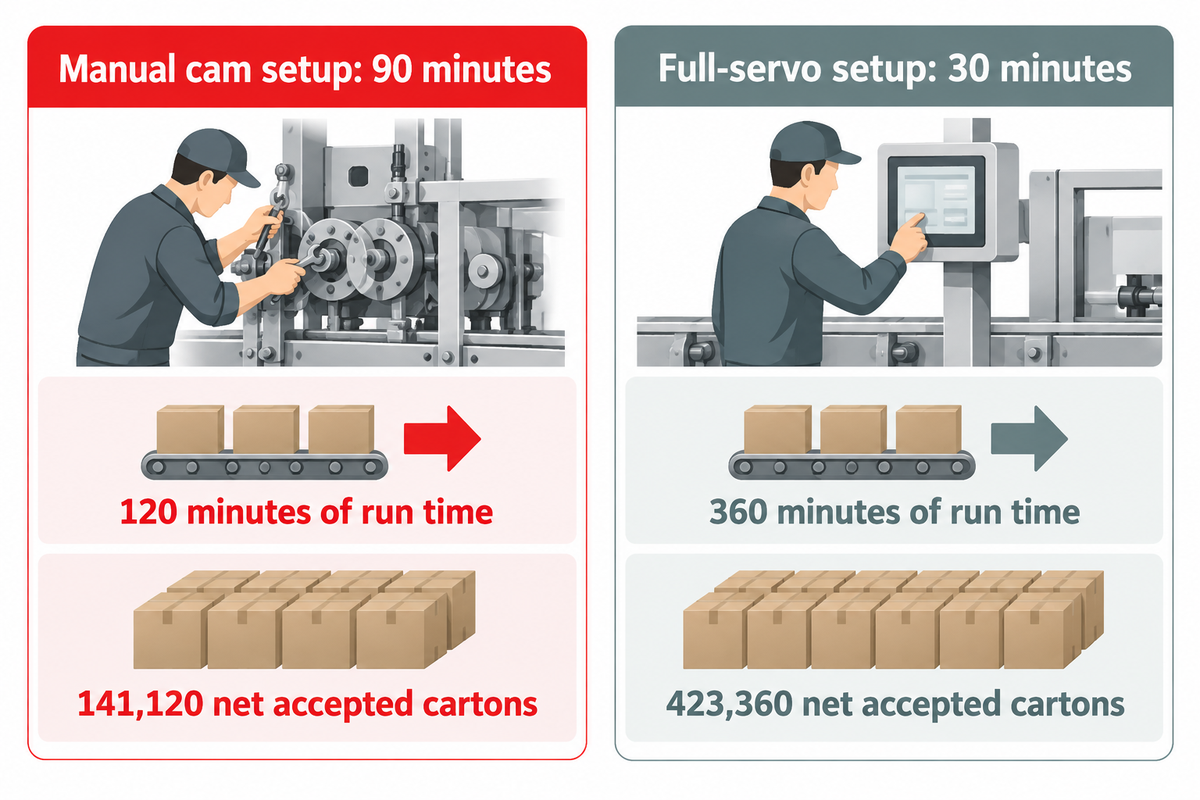
Assumed inputs: We simulate one 8-hour shift with 4 food carton SKU changeovers. The line runs at 300 m/min with straight-line dry grocery cartons with a 0.25m (250mm) blank pitch. That pitch yields 300 ÷ 0.25 = 1,200 cartons/min. Manual cam setup takes 90 minutes per changeover (Cenwan 90–120 min benchmark), vs. 30 minutes on the full-servo CW-W-1250AC-S, with a 2% reject rate.
Calculation: On the manual machine, 4 changeovers take 360 minutes, leaving 120 minutes of run time. Net output is 120 min × 1200 cartons/min × 0.98 = 141,120 net accepted cartons. On the full-servo CW-W-1250AC-S, 4 changeovers take 120 minutes, leaving 360 minutes of run time. Net output is 360 min × 1200 cartons/min × 0.98 = 423,360 net accepted cartons. With the above inputs, servo job recall triples net shift output (+282,240 cartons/shift) at the same belt speed. This calculation compares setup time only; output is impacted by the speed of the packing line and the board caliper.
When Does a Servo-Automated Folder Gluer Outperform a Cheaper Manual-Changeover Machine?
A servo-automated folder gluer outperforms a manual-changeover machine, when a food carton plant runs 3 or more SKU changeovers per shift, or swaps box styles weekly. Cutting each changeover from 90-120 minutes to under 30 minutes recovers 3-6 hours of production per shift.
Servo pressure transfer cuts crash-lock carton reject rates in half over mechanical cam gluers. Replacing a semi-automatic line with a fully automatic speed-matched line saves one operator headcount per shift.
Comparing Folder Gluer Manufacturers and Factory Acceptance Tests
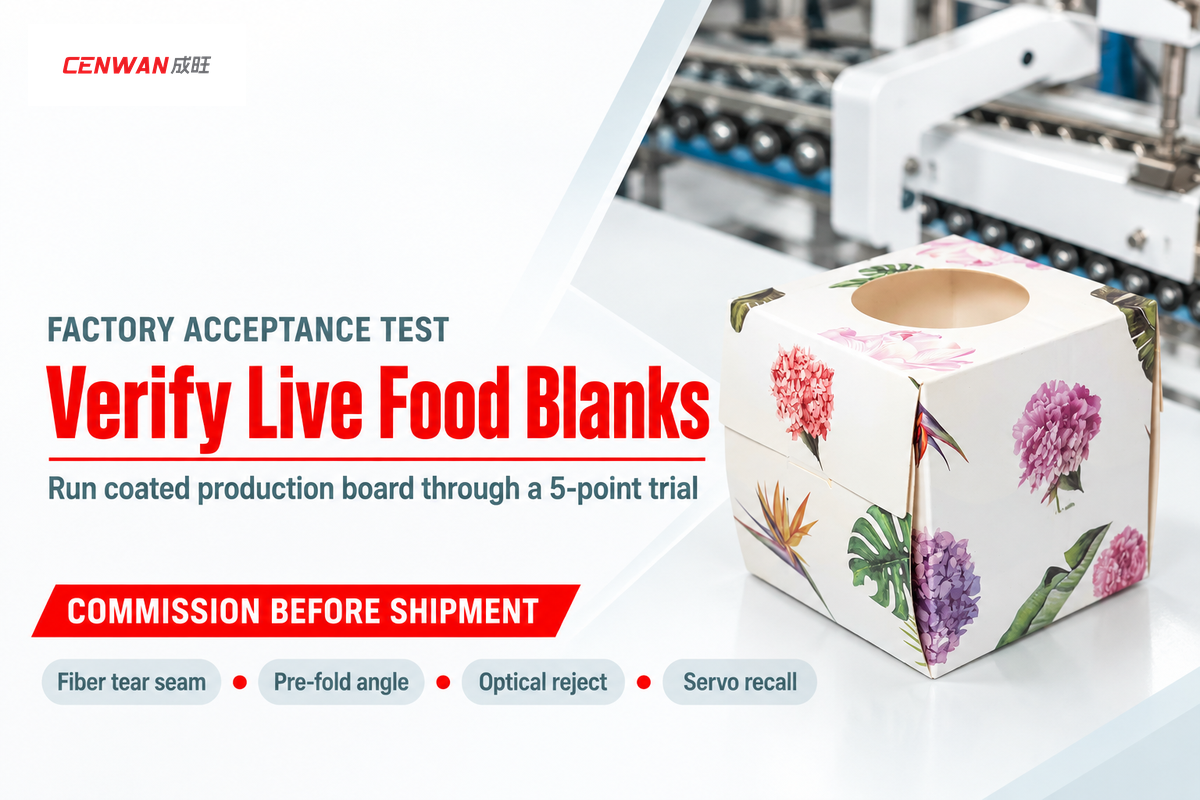
Comparing folder gluer vendors and Factory Acceptance Tests (FAT) is dependent on the assessment of mechanical builds as well as live-blank commissioning processes. In the case of Food carton conversion, Tier-1 European Builders (Bobst, Koenig & Bauer, Heidelberg / MK) are pitted against CE builders in Zhejiang, China (Cenwan Machine, Ruian, Wenzhou) & others. Performance is judged using three-step FAT at 50%, 75% and 100% belt speed on actual food blanks.
According to Global Market Insights, the global folder gluer market was worth USD 678.4 million in 2025. Leading builders include Bobst Group SA, Koenig & Bauer AG and Heidelberg. Factory Acceptance Tests (FATs) benchmark seam integrity and speed against live food substrates.
Global OEM Comparison: European Tier-1 Systems vs. Direct-Factory Platforms
European platforms like the Bobst Expertfold run up to 450 m/min and produce 28,000 4/6-corner boxes per hour (Packaging Strategies). Jagenberg and Diana systems (such as the Diana 105-2 cited in EP1593482A2) serve high-volume plants. Bahmüller and HERMA specialty lines run 250 labels/min with 15-20 minute slide-out rail reel changes (Packaging Strategies). Taiwan-based SBL Machinery and industrial builders in Ruian and Wenzhou, Zhejiang supply high-speed machines to mid-to-large converters.
Cenwan Machine fills the pricing gap between European Tier-1 precision machines and direct factory prices. Every CW-G or CW-W machine box frame meets the requirements of the Machinery Directive 2006/42/EC, and comes equipped with a tungsten steel feed blade, and Swiss Habasit belts. Spare-parts are provided for 40+ countries.
5-Point Factory Acceptance Test (FAT) & Site Preparation Checklist
Run this five-point verification checklist before authorizing shipment and final milestone settlement.
- As per the Folder Gluer Inc. commissioning protocol, take your coated food blanks and run them at graduating speeds up to the full rated speed of the system. Check for fiber tear and glue lap registration (≤1 mm).
- Measure the pre-folding angles of crease 1 and crease 3 of your 600-800 gsm or E/F-flute food blanks. Check 60-75 mm longitudinal length compensation, as stated in Patent EP1593482A2.
- Check 0.5 mm closed-jet cold-glue cutoff with no interior squeeze-out. Test single box pneumatic ejection and confirm ≥30 mm sensor clearance from hot-melt guns (PostPress Magazine).
- Time for a complete changeover from straight-line to crash-lock or 4-corner mode. Achieve a <60-second two-fold servo carrier positioning and sub-30-minute repeat-order makeready.
- Reserve a minimum of 60 cm side clearance and 1.5 to 2 m front and rear space according to the SBL Installation Guide. Allot 2 to 3 days for installation and 3 to 5 days for training, and run a nozzle purge for 15 minutes each day according to the SBL guidelines.
Frequently Asked Questions
1. What glue is safe to use on a folder gluer for food packaging?
EVA or MCT hot-melts and food grade PVA dispersions are adhesives that are suitable for food contact. Their use in food packaging requires certification as described in FDA 21 CFR 175.105 and the EU Regulation (EC) No 1935/2004. As per 21 CFR 175.105(a)(2), the adhesive should be placed behind a functional barrier or be within the limits of GMP seaming. Converters use the adhesive in enclosed extrusion valves, 0.5 mm, to eliminate internal squeeze-out.
2. What belt speed and hourly carton output can a food packaging folder gluer achieve?
Automatic food carton folder gluers run at 50 to 300 m/min on standard lines and at 400 to 450 m/min on high-speed lines. Straight-line dry grocery cartons run at 350 to 400 m/min on the Cenwan CW-G-650, 880, and 1100 series (200 to 800 gsm board and E/F/N microflute). Crash lock bottom food cartons run at 280 to 320 m/min on the 13.5 kW CW-G-650PC. High speed flexible folder-gluers on 4-corner and 6-corner bakery trays produce up to 28,000 boxes per hour. Cenwan’s CW-IL-Dual line runs two parallel streams at 240 m/min (up to 1,300,000 size 13# boxes per day).
3. How do you prevent fishtailing and pop-open joints on barrier-coated food cartons?
Fishtailing can be corrected by placing folding plates within 1 mm of exact blank dimensions and squaring the feeder stack. Pre-fold creases 1 and 3 to 180 degrees with a length compensation of 60-75 mm. Sinosun’s technical guide states that untreated coatings may cause a three day pop-open joint on PE-coated or aqueous-dispersion food boards. To address this, the feeder flaps can be treated with a plasma or corona discharge to 38-42 mN/m or switch to a metallocene or PUR hot melt glue.
4. Should a food carton converter buy a used European folder gluer or a new servo-equipped machine?
A new servo folder gluer outperforms most used European machines at high-mix food carton plants. A top-end second-hand folder gluer costs between USD 500,000 and USD 1.5 million, cites PMMI data in Global Market Insights. Older models don’t have <60-second two-fold servo carrier recalls or 0.5 mm closed-jet glue valves. New Cenwan CW-G or CW-W servo machines cost 20%-30% of the first tier European spend (USD 40,000-80,000 for the CW-W-1250AC-S) and meet the requirements of BRCGS Issue 7.
5. What floor space, maintenance routine, and installation time are required for a food carton folder gluer?
According to the SBL Machinery installation guide, a minimum of 60 cm clear side space and 1.5 to 2 m of clear space at front and rear are required for the installation of a automatic food carton folder gluer. Per the same SBL guide, on-site installation takes 2-3 days and training of the operators takes 3-5 days. Daily care takes 25 minutes per shift. Operators do a 10 minute check of belts, interlocks and sensors (keeping them at least 30 mm away from hot-melt guns) and 15 minute nozzle purge (Folder Gluer Inc.). Build time in the factory and ocean shipping time to a destination varies by configuration of the model; request a quote for availability and lead times.
References & Sources
- U.S. Food and Drug Administration (FDA) – 21 CFR 175.105: Indirect Food Additives: Adhesives (eCFR)
- Cornell Law School Legal Information Institute – 21 CFR § 175.105 Adhesives Statutory Text
- U.S. Federal Register Document 2022-10531: Indirect Food Additives: Adhesives and Paperboard Components
- BRCGS BRCGS Packaging Materials Issue 7 Revision (Published October 2024, Audits Effective April 2025)
- Paperboard Packaging Council (PPC) Trends: U.S. Folding Carton Market Outlook Through 2026
- European Patent Office (EPO) — Patent EP1593482A2: Folding Station in a Folder-Gluer (180° Pre-Folding & 60–75 mm Compensation)
- Packaging Digest — Folder/Gluer Yields Texas-Sized Benefits (0.5 mm Orifice & 50% Glue Reduction Case Study)
- Packaging Strategies Case Study: High-Speed 450 m/min & 28,000 Boxes/Hour 4/6-Corner Carton Production
- Packaging Strategies Specialty Folder-Gluer Inline Applicator Engineering (250 Labels/Min & Slide-Out Rails)
- PostPress Magazine – Quality Control Systems Key to Folder-Gluer Production Success (≥30 mm Sensor Standoff)
- Global Market Insights — Folder Gluer Machine Market Size, Share & Forecast 2026–2035
- Lanco Adhesives – Best Practices for Folding Carton Adhesives on Coated and Laminated Board
- Sinosun Packaging Machinery — Carton Box Folder Gluer Hot Melt vs. Cold Glue (38–42 mN/m Surface Energy Threshold)
- Folder Gluer Inc. Folder Gluer Troubleshooting & Maintenance Checklist (15-Minute Purge & 1 mm Plate Tolerance)
- SBL Machinery – Folder Gluer Machine Installation and Acceptance Guide & 4 Common Folder Gluer Failures and How to Fix Them