Get in touch with Cenwan Machine Company


Bar to PSI is a pressure-unit conversion in which one bar equals approximately 14.5037738 pounds per square inch. Multiply bar by 14.5037738; divide PSI by the same factor to return to bar. Keep the source reading’s practical precision and its gauge or absolute reference when you record the result.
Updated August 2026
Bar to pound-force per square inch converter
Convert the approved pressure value in either direction, then keep its gauge or absolute reference and round to the source instrument.
Result
psi
1 bar = 14.5038 psi
1 bar14.5037738 PSI before display rounding
6 bar87.02 PSI for a two-decimal display
÷ 14.5037738Reverse PSI to bar
The converter changes the unit, not the engineering requirement. If a manual states gauge pressure, the converted value remains gauge pressure. If a regulator display has a resolution of 0.1 PSI, an eight-decimal calculator result does not make that instrument more accurate. Treat the output as a translation to be checked against the machine manual, component label, or supplier documentation.
How to Convert Bar to PSI and PSI to Bar
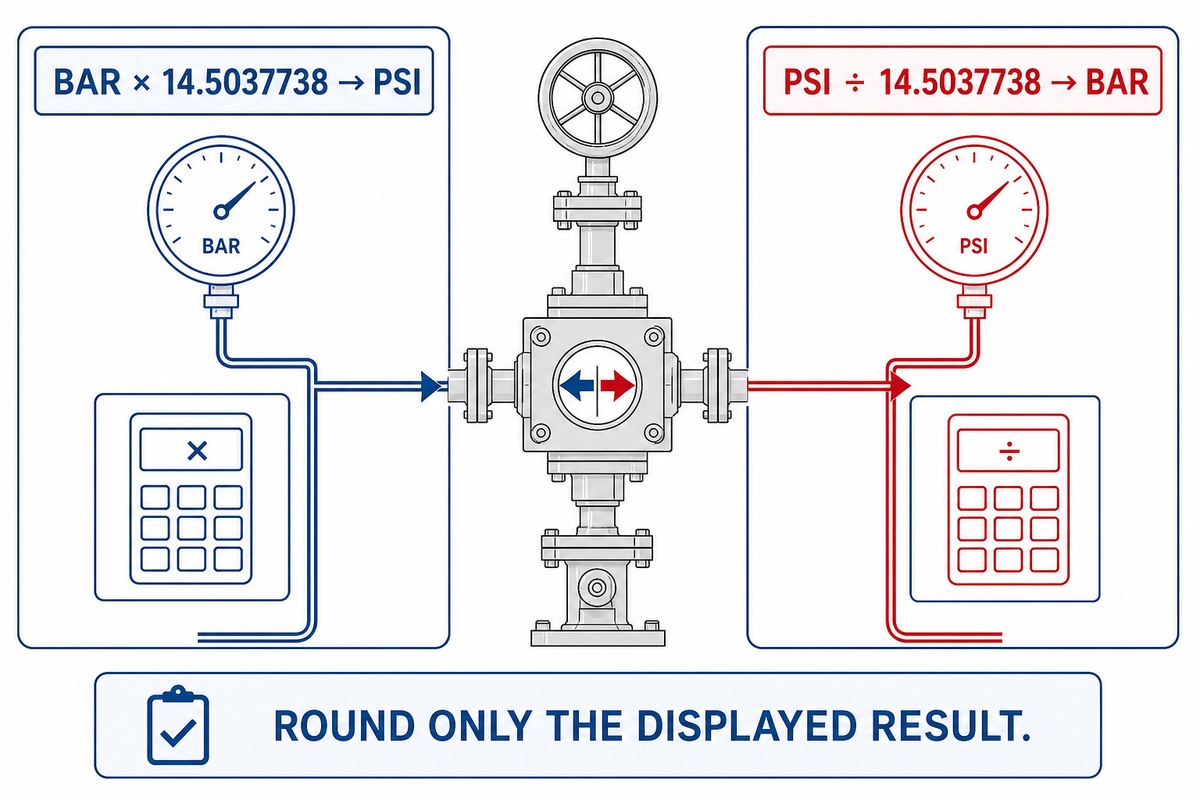
Use one registered factor in both directions: multiply by 14.5037738 for bar to PSI and divide by 14.5037738 for PSI to bar. This keeps the forward and reverse calculation consistent and avoids the common mistake of using 14.5 in one document and 14.7 in another.
Bar to PSI: PSI = bar × 14.5037738
PSI to bar: bar = PSI ÷ 14.5037738
The bar to PSI conversion factor can be traced to pascals. The U.S. National Institute of Standards and Technology lists one bar as 100,000 pascals and one pound-force per square inch as 6,894.757 pascals. Dividing 100,000 by 6,894.757 gives approximately 14.5037738. The arithmetic is universal; the acceptable operating pressure isn’t.
1 bar to PSI
1 × 14.5037738 = 14.5037738 PSI, commonly displayed as 14.50 PSI.
2.5 bar to PSI
2.5 × 14.5037738 = 36.2594345 PSI, commonly displayed as 36.26 PSI.
6 bar to PSI
6 × 14.5037738 = 87.0226428 PSI, commonly displayed as 87.02 PSI.
87 PSI to bar
87 ÷ 14.5037738 = about 5.9984 bar. Do not silently rewrite that as an exact 6.0000-bar measurement.
For a spreadsheet, place the bar value in one cell and multiply it by 14.5037738. For the reverse direction, divide the PSI cell by the same factor. Round only the displayed result; retain the unrounded calculation internally if a later formula needs it.
Bar-to-PSI Conversion Chart for 0.5–10 Bar
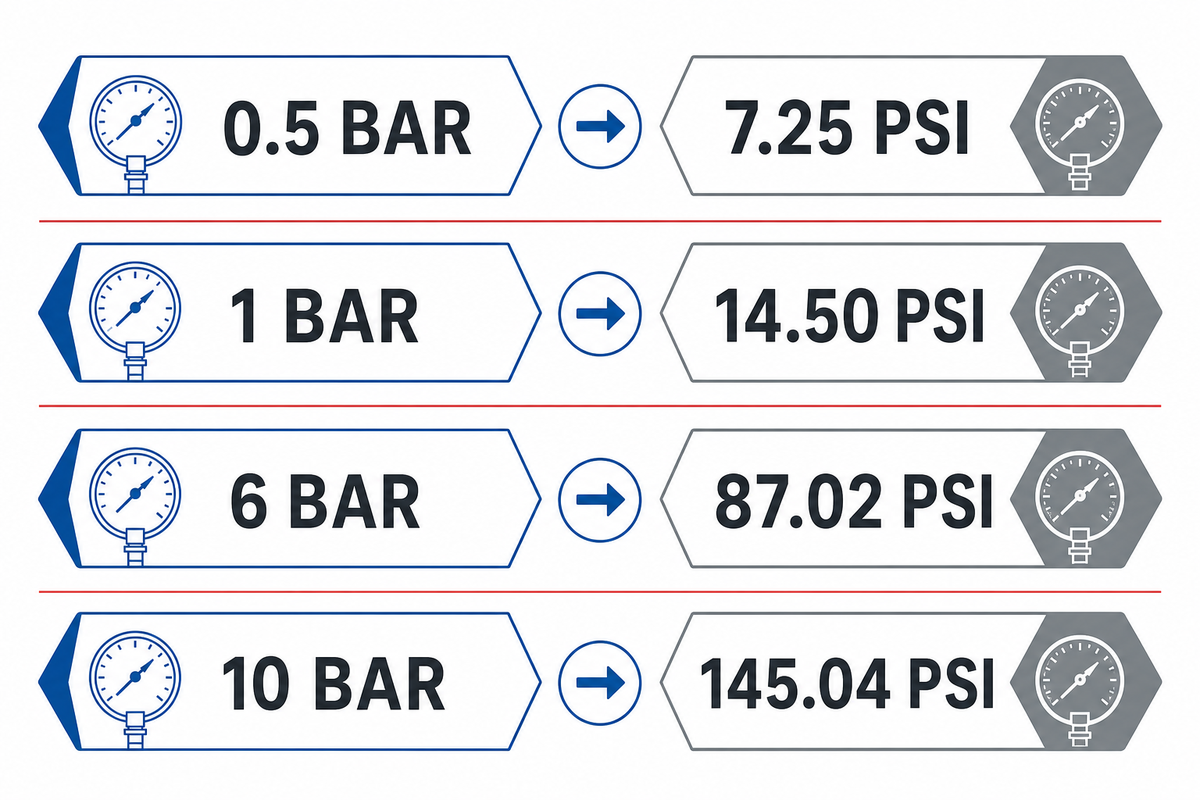
This bar-to-PSI conversion table uses the same 14.5037738 factor as the calculator. A wrong rounded chart creates a mismatch risk because it departs from the NIST conversion factor. Examples include 3.1 bar to PSI at 44.96 PSI and 2.3 bar to PSI at 33.36 PSI.
| Bar | Working value in PSI | PSI, 2 decimals |
|---|---|---|
| 0.5 | 7.2518869 | 7.25 |
| 1.0 | 14.5037738 | 14.50 |
| 1.5 | 21.7556607 | 21.76 |
| 2.0 | 29.0075476 | 29.01 |
| 2.5 | 36.2594345 | 36.26 |
| 3.0 | 43.5113214 | 43.51 |
| 3.5 | 50.7632083 | 50.76 |
| 4.0 | 58.0150952 | 58.02 |
| 4.5 | 65.2669821 | 65.27 |
| 5.0 | 72.5188690 | 72.52 |
| 5.5 | 79.7707559 | 79.77 |
| 6.0 | 87.0226428 | 87.02 |
| 6.5 | 94.2745297 | 94.27 |
| 7.0 | 101.5264166 | 101.53 |
| 7.5 | 108.7783035 | 108.78 |
| 8.0 | 116.0301904 | 116.03 |
| 8.5 | 123.2820773 | 123.28 |
| 9.0 | 130.5339642 | 130.53 |
| 9.5 | 137.7858511 | 137.79 |
| 10.0 | 145.0377380 | 145.04 |
Why 6 bar is about 87.02 PSI, not exactly 87 PSI
The unrounded conversion is 87.0226428 PSI. Showing 87.02 PSI is a two-decimal presentation of that result. Showing 87 PSI may be suitable on a whole-PSI display, but it’s a rounded display value, not a new definition. The Setpoint Relay Card rule is simple: preserve the original value and reference, calculate once, and label the rounded output clearly.
What Bar and PSI Measure
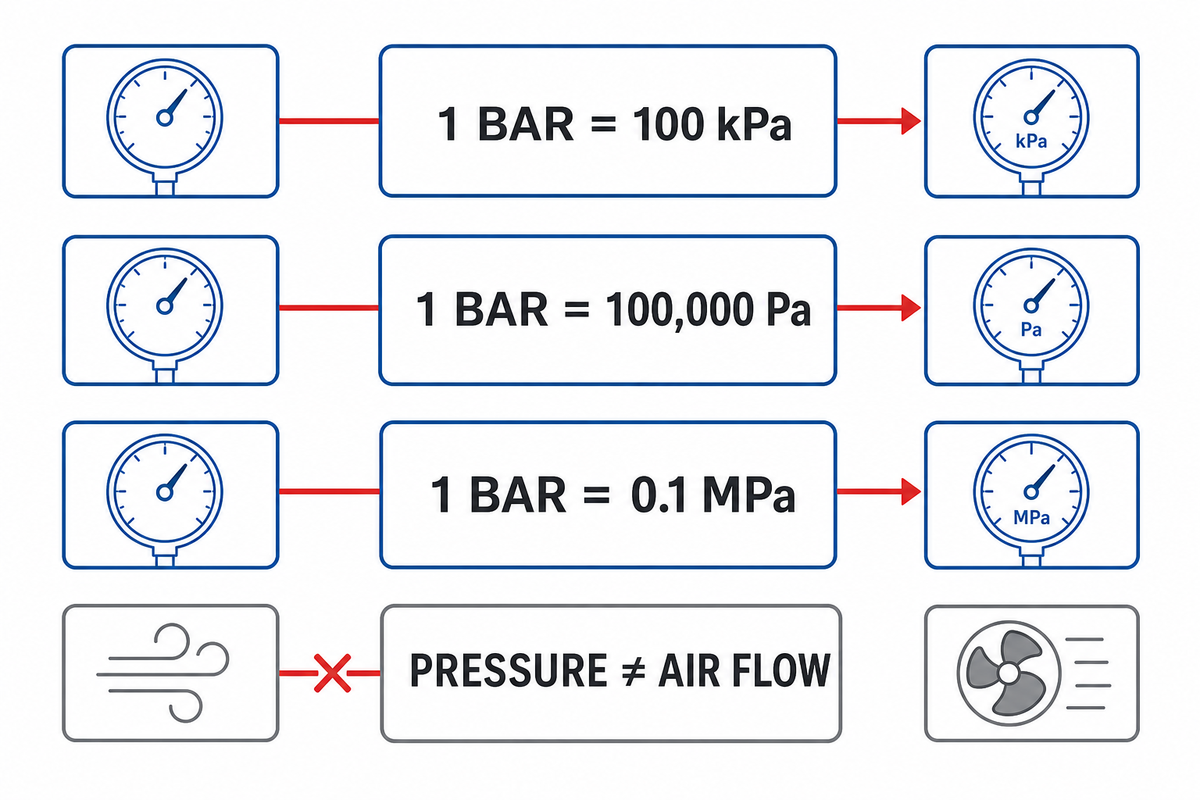
Bar and PSI are both units of pressure: force distributed over area. To compare them without mixing definitions, use the pascal as the common reference unit listed by NIST. Bar is widely used with metric equipment, but it is not an International System of Units unit. PSI means pound-force per square inch.
One bar equals 100 kilopascals (100 kPa), 100,000 pascals (100,000 Pa), or 0.1 megapascals. That compact relationship is useful when a component drawing uses adjacent pressure units. It does not justify combining unlike quantities. Air consumption in cubic metres per hour, for example, is a volume-flow requirement, not a pressure value.
The physical medium does not change the factor. Six bar converts to the same PSI number in a pneumatic line, a hydraulic circuit, or a laboratory pressure reading. What does change is the permitted operating range, the reference condition, the test method, and the consequence of exceeding a component rating.
Bar is used alongside the metric system, while PSI means pound-force per square inch and is commonly used in U.S. customary and some Imperial contexts. Pressure describes force exerted by a fluid per unit area. A reading measured in bar can be converted to the equivalent pressure in PSI, and vice versa, but PSI and bar still need the same reference condition when engineers measure pressure or convert pressure records.
Low pressure may also appear in millibar—1000 millibar equals 1 bar—or as a column of water. Scuba and petrol-station equipment can use the same unit arithmetic, but each application retains its own limits and procedures.
How Many Decimals Should a Pressure Conversion Keep?
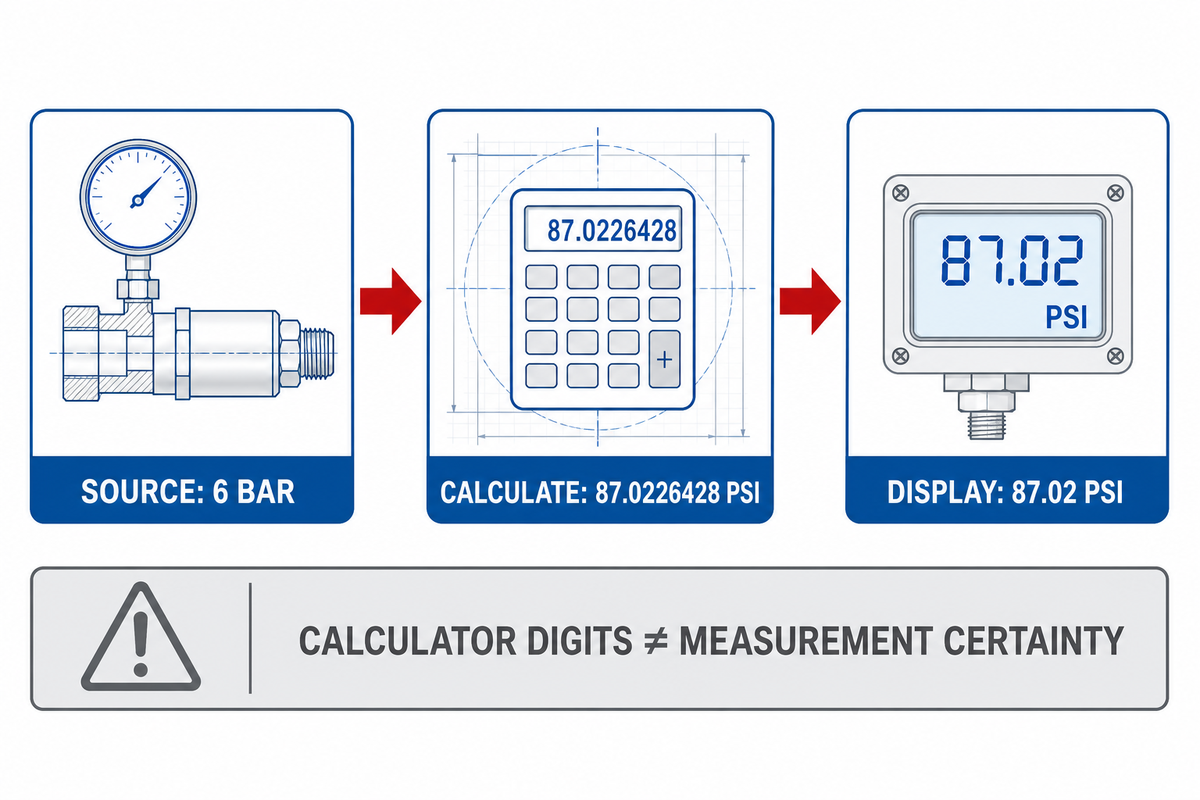
Each converted value shouldn’t claim more precision than the source reading can support. The risk of a precision mistake exists because resolution, uncertainty, source rounding, and the record’s purpose determine the final digits. Preserve the unrounded calculation separately from the practical displayed value.
Suppose a manual states simply “6 bar.” The exact arithmetic returns 87.0226428 PSI, but the source doesn’t establish an eight-decimal setpoint. A two-decimal chart can show 87.02 PSI for unit comparison; a regulator marked only in whole PSI may be read as about 87 PSI. Neither presentation improves the source instrument’s accuracy.
Now suppose a calibrated record states 6.00 bar with a documented measurement uncertainty and a suitable display. The extra source resolution may justify more digits in the converted record. The correct rule isn’t “always keep the same number of decimal places.” National Institute of Standards and Technology guidance ties converted significant digits to the rounding error of the original numerical value.
Do
Carry the registered factor through the calculation, then round once for the stated display or record requirement.
Do not
Round the factor first, round intermediate values repeatedly, or present calculator digits as measurement certainty.
Do Not Drop the Reference: Barg/PSIG and Bara/PSIA
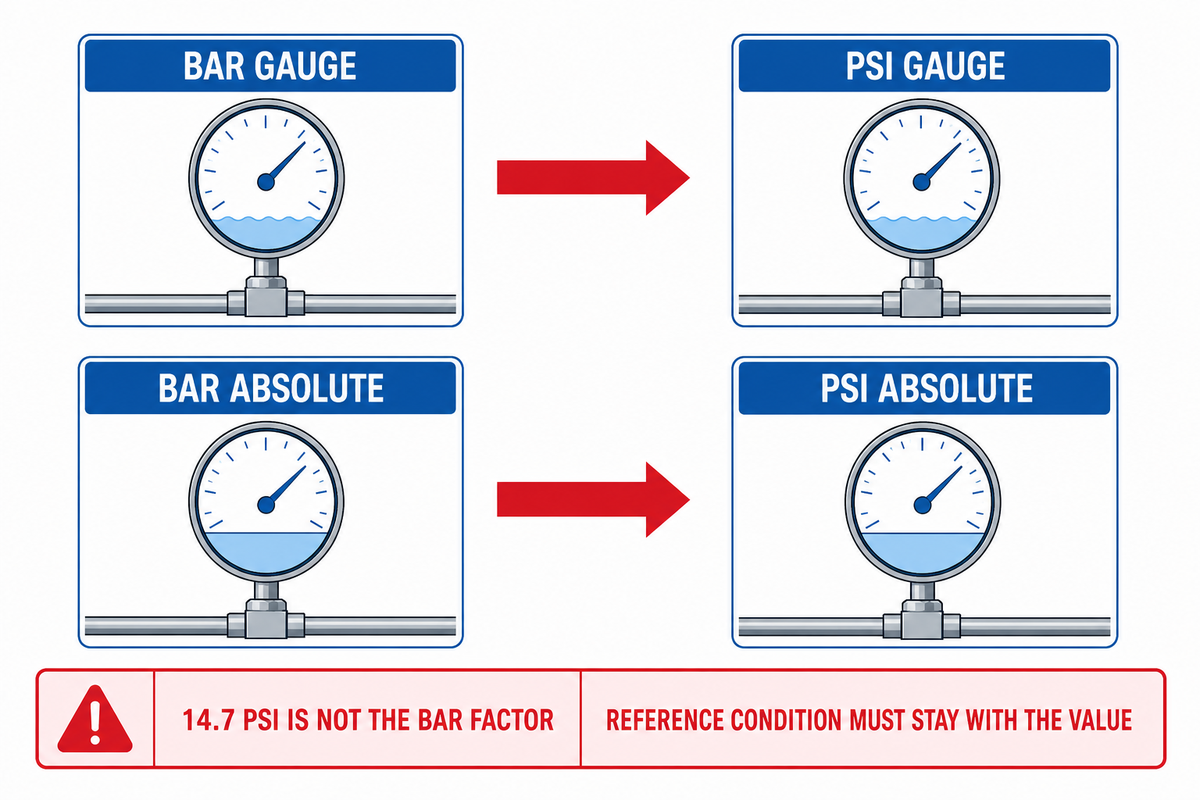
Changing the unit does not change the pressure reference. The mismatch risk is serious because a hydraulic valve application cannot swap gauge and absolute pressure. Gauge-referenced bar becomes gauge-referenced PSI unless a separate reference calculation is performed.
Maintenance documents often use barg and psig as industry labels for gauge-referenced quantities, and bara and psia for absolute-referenced quantities. Under strict National Institute of Standards and Technology style, information about the measurement condition belongs with the quantity rather than being attached to the unit symbol. The labels remain useful for recognizing what a manual or gauge means, but the reference condition should be written explicitly when ambiguity matters.
The Reference-Condition Pairing rule is therefore: bar gauge to PSI gauge, and bar absolute to PSI absolute. Do not use a basic unit conversion to move between gauge and absolute pressure. That second operation requires a stated atmospheric reference.
The familiar 14.7 PSI figure is not the bar-to-PSI factor. National Institute of Standards and Technology lists one standard atmosphere as 14.6959 PSI, while one bar is about 14.5038 PSI. Local atmospheric pressure also varies with altitude and conditions, so 14.7 PSI is not a universal local offset.
Using Bar-to-PSI Conversion on a Folder Gluer
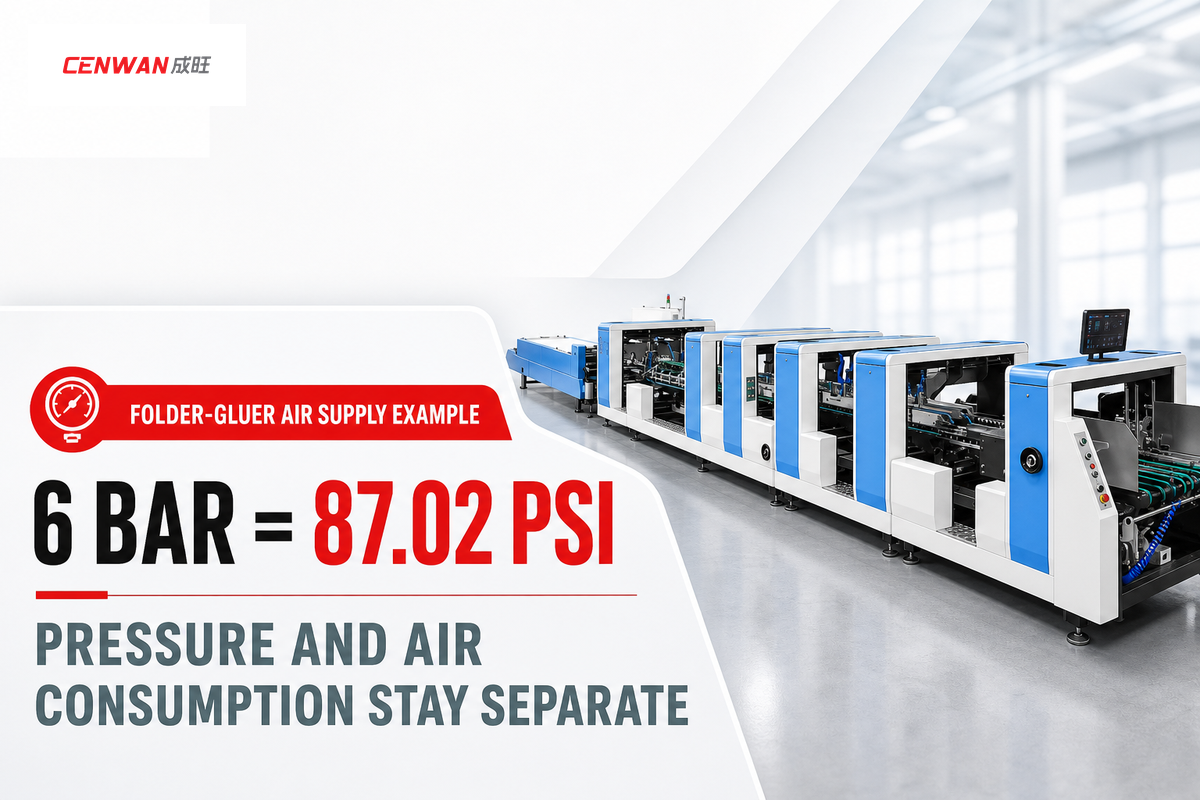
Folder-gluer teams may meet bar in a manual and PSI on a regulator. A wrong copy creates a mismatch risk because the NIST unit conversion only translates the number; a valve application needs Cenwan’s model-specific documentation, not a general parts range.
For the listed CW-G high-speed models, Cenwan’s 6 bar air-supply specification also lists air consumption separately as 10 cubic metres per hour. Six bar converts to approximately 87.02 PSI. Pressure and air consumption remain separate requirements; an 87.02 PSI supply with inadequate flow may still fail to support the machine under demand.
Cenwan’s published 4–8 bar pneumatic-parts context shows the range for pneumatic parts. The endpoints convert to about 58.02–116.03 PSI. That published band isn’t a universal setting for every folder gluer, cylinder, valve, filter, or regulator. Use the machine model, part number, and manual to establish the intended operating value.
Setpoint Relay Card
4 bar → 58.02 PSI; 6 bar → 87.02 PSI; 8 bar → 116.03 PSI. These are unit translations for maintenance communication, not permission to select or raise a setpoint.
Four-Step Manual-to-Regulator Handoff

The safest record preserves its source. A mismatched record can cause a valve application to fail because operators, procurement teams, and Cenwan need the same number, unit, reference condition, and rounding basis.
- Record the source exactly. Copy the number, unit, gauge/absolute condition, model, component, document revision, and operating context. Don’t begin with a number detached from its label.
- Confirm the target display. Check whether it reads bar or PSI, whether it’s gauge or absolute, and whether its smallest division is 1, 0.1, or 0.01 unit.
- Convert once and round once. Use 14.5037738, retain the unrounded result in the record, and show the rounded value appropriate to the target display.
- Verify before adjustment. Compare the result with the machine manual or ask the equipment supplier to confirm it. Cenwan users can ask the team to confirm a machine air-pressure requirement by providing the model and source document.
A hypothetical handoff template could read: “Manual revision [recorded revision], equipment [exact model], source pressure [recorded value and reference condition]; converted working value [calculated value]; target display resolution [recorded resolution]; displayed value [rounded to the recorded resolution]; verification status [recorded status].” This format separates the calculated conversion from fields that must be copied from the actual manual, gauge, or supplier confirmation.
What This Conversion Does Not Tell You
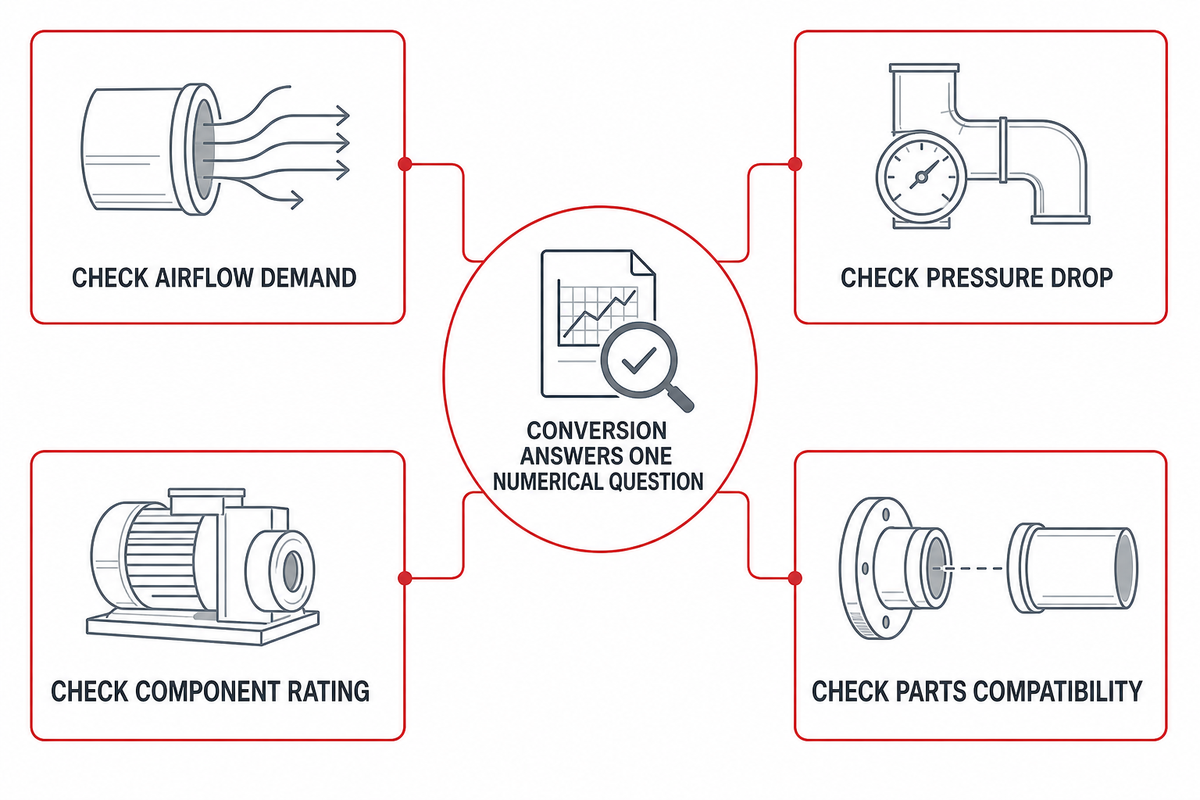
Correct pressure conversion answers one numerical question. It doesn’t size the compressed-air system or prove that a component is safe for the application. Treat the converted number as one field in an engineering check, not as a substitute for the surrounding specifications.
| Information type | What it answers | Evidence to retain |
|---|---|---|
| Source pressure | What value the manual, drawing, or label states | Original number, unit, model, and revision |
| Reference condition | Whether the quantity is gauge or absolute | Written gauge/absolute condition, not an inferred suffix |
| Target display | Which unit and resolution the operator can read | Gauge scale, smallest division, and working range |
| Airflow demand | How much air the machine consumes under stated conditions | Flow unit, reference conditions, and demand profile |
| Pressure drop | How much supply pressure is lost before the point of use | Measured upstream and downstream values under demand |
| Regulator capacity | Whether outlet pressure can be maintained as flow rises | Manufacturer flow curve, inlet pressure, and droop data |
| Distribution size | Whether hose, pipe, ports, and fittings restrict the system | Inside diameter, length, fittings, and simultaneous demand |
| Component rating | Which pressure limits apply to each installed part | Part number, operating range, maximum rating, and medium |
| Compressor duty | Whether the source can meet the whole system’s demand over time | Capacity, duty cycle, receiver, treatment, leakage, and controls |
The first three rows belong directly to the unit handoff. The remaining six are system-design or condition-monitoring questions. Keeping them in separate fields prevents a correct converted number from being misread as proof that the air source, regulator, distribution line, and endpoint component form a suitable system.
- Air demand in cubic metres per hour, litres per minute, or standard cubic feet per minute describes flow at stated conditions. It can’t be derived from bar alone.
- Pressure drop across filters, hoses, fittings, and valves can reduce downstream pressure under simultaneous demand.
- Regulator performance at low flow doesn’t prove the same pressure will be held under demand; capacity and droop matter.
- Component rating separates maximum allowable pressure, normal operating pressure, and test pressure.
- Compressor selection also depends on receiver volume, duty cycle, leakage, demand profile, treatment, and distribution loss.
Pressure can also change with machine state. A static gauge may show the expected value while the machine is idle, then fall when several cylinders actuate together. That observation doesn’t make the conversion factor wrong. It points to a supply, restriction, leakage, regulator, or demand issue that needs measurements under the relevant operating cycle. Record both the upstream and point-of-use pressure with the machine state and time attached.
Likewise, a replacement valve rated above the converted operating pressure isn’t automatically a correct substitute. Port pattern, flow coefficient, voltage, response time, seal material, environmental limits, and control logic may still differ. Conversion clears only the unit-language barrier; it doesn’t close the parts-compatibility decision.
Compare Cenwan configurations by carton format because the range includes different configurations and applications. Don’t transfer one product-page value across models without model-specific confirmation. The same boundary applies when a supplier offers a replacement pneumatic part: fit, pressure range, port, flow capacity, materials, and controls all require separate checks.
If the exact model family is still unclear, use the Cenwan folder gluer series selector before requesting the corresponding air-supply documentation.
Common Bar-to-PSI Mistakes
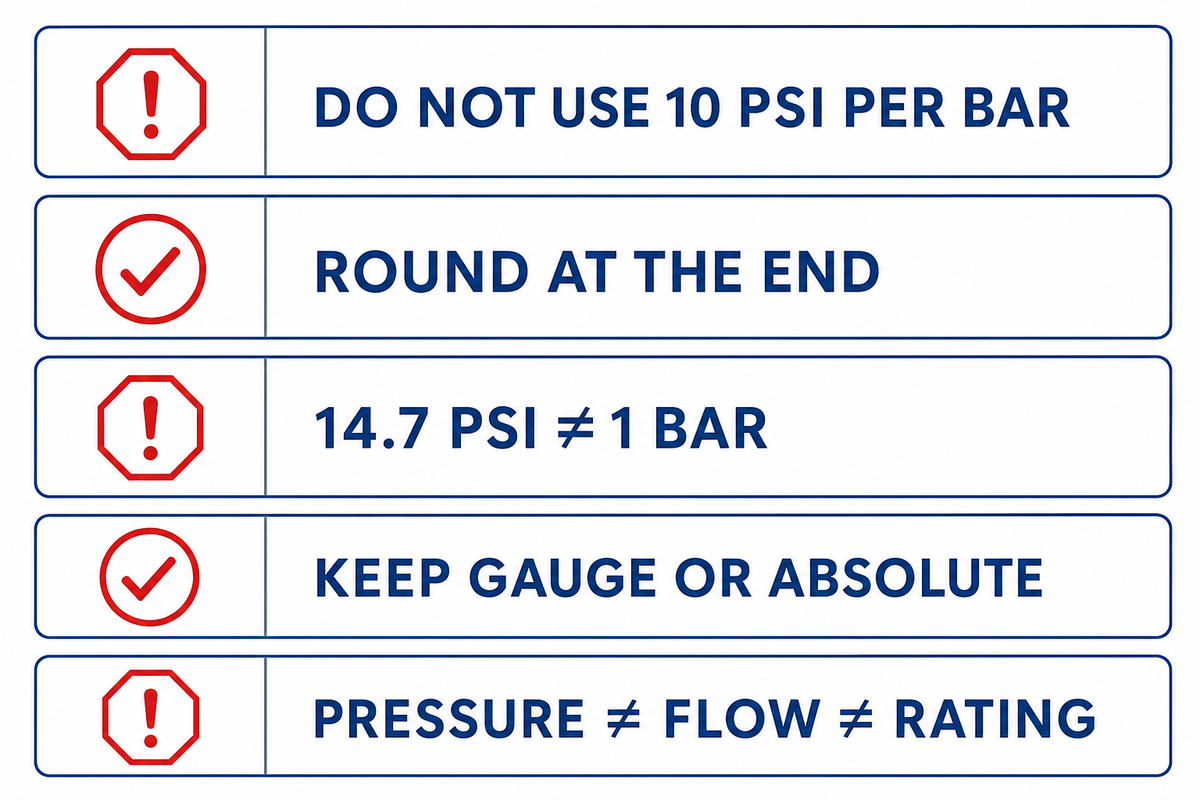
Most conversion mistakes come from a shortcut, lost label, or correct number used outside its scope. The risk persists because NIST arithmetic alone can’t authorize a valve application, work order, or regulator adjustment.
When two documents disagree, return to their source conditions before choosing either number. Check whether one value is a rounded display, whether one document uses gauge pressure and the other absolute pressure, whether the values describe different machine states, and whether a revision changed the requirement. A conversion check can expose the disagreement, but only the controlled model-specific document or supplier confirmation can resolve which operating value governs.
- Using 10 PSI per bar makes the result about 31.05% lower than the correct 14.5038-PSI value.
- Rounding too early can move a result away from the registered-factor calculation. Carry the full factor and round at the end.
- Treating 14.7 PSI as one bar confuses a rounded standard atmosphere with the bar definition.
- Dropping the reference lets gauge pressure silently become absolute pressure, or the reverse.
- Confusing pressure, flow, and rating hides whether supply flow and component ratings are suitable.
Consumer tire pressure and tyre pressure conversion charts may use the same unit factor, but their recommended values, temperature advice, and load context don’t apply to industrial pneumatic equipment. In the UK and countries like the United States, the vehicle manufacturer sets the automotive value; a packaging-equipment chart does not. Metric countries may show bar pressure, while other displays emphasize an imperial unit. Use the universal arithmetic while keeping the application guidance separate.
Frequently Asked Questions
Is 1 bar 10 PSI?
Answer
No. One bar is approximately 14.5038 PSI because one bar is 100,000 pascals and one PSI is 6,894.757 pascals. Ten PSI is only about 0.6895 bar. Using 10 as a shortcut makes the result about 31.05% lower than the correct one-bar value, which is too large for translating a machine manual, pneumatic component label, or regulator setting.
What does 2.5 bar mean in PSI?
Answer
Multiply 2.5 by 14.5037738 to obtain 36.2594345 PSI. A quick-reference chart normally shows 36.26 PSI, but the appropriate display precision depends on the source reading and instrument resolution. The conversion doesn’t tell you whether the original quantity is gauge or absolute pressure, so retain that reference condition with the number.
Is 14.7 PSI equal to 1 bar?
Answer
No. It’s a useful rough mental comparison but not the exact bar conversion. One bar is approximately 14.5038 PSI, while one standard atmosphere is approximately 14.6959 PSI. Confusing bar with standard atmosphere explains the familiar 14.7 figure. Local atmospheric pressure isn’t a universal 14.7-PSI offset, so use the registered factor for unit conversion.
What is 6 bar in PSI?
Answer
Six bar is 87.0226428 PSI before display rounding, or about 87.02 PSI to two decimal places. Keep the original gauge or absolute reference with the result.
What is 32 PSI in bar?
Answer
Divide 32 by 14.5037738. The result is approximately 2.2063 bar. Round it to the precision supported by the source reading and intended display.
Can I use the converter to set a pneumatic regulator?
Answer
Use it to translate an approved value into another unit. Before adjustment, verify the actual setpoint, pressure reference, display resolution, and operating condition against the machine manual or equipment supplier.
Does the same factor apply to hydraulic and pneumatic pressure?
Answer
Yes. The unit relationship is the same for any pressure quantity expressed in bar and PSI. The permitted pressure, component rating, fluid compatibility, and safety procedure still depend on the system.
References & Sources
- National Institute of Standards and Technology: Pressure and Gas Flow Unit Conversions
- National Institute of Standards and Technology Guide to the International System of Units, Appendix B
- National Institute of Standards and Technology Guide to the International System of Units, Chapter 7
- Lawrence Berkeley National Laboratory: Pressure Reference Definitions
- U.S. Geological Survey: Atmospheric Pressure and Altitude Context
- Compressed Air and Gas Institute Resource Library