Get in touch with Cenwan Machine Company


Updated August 2026
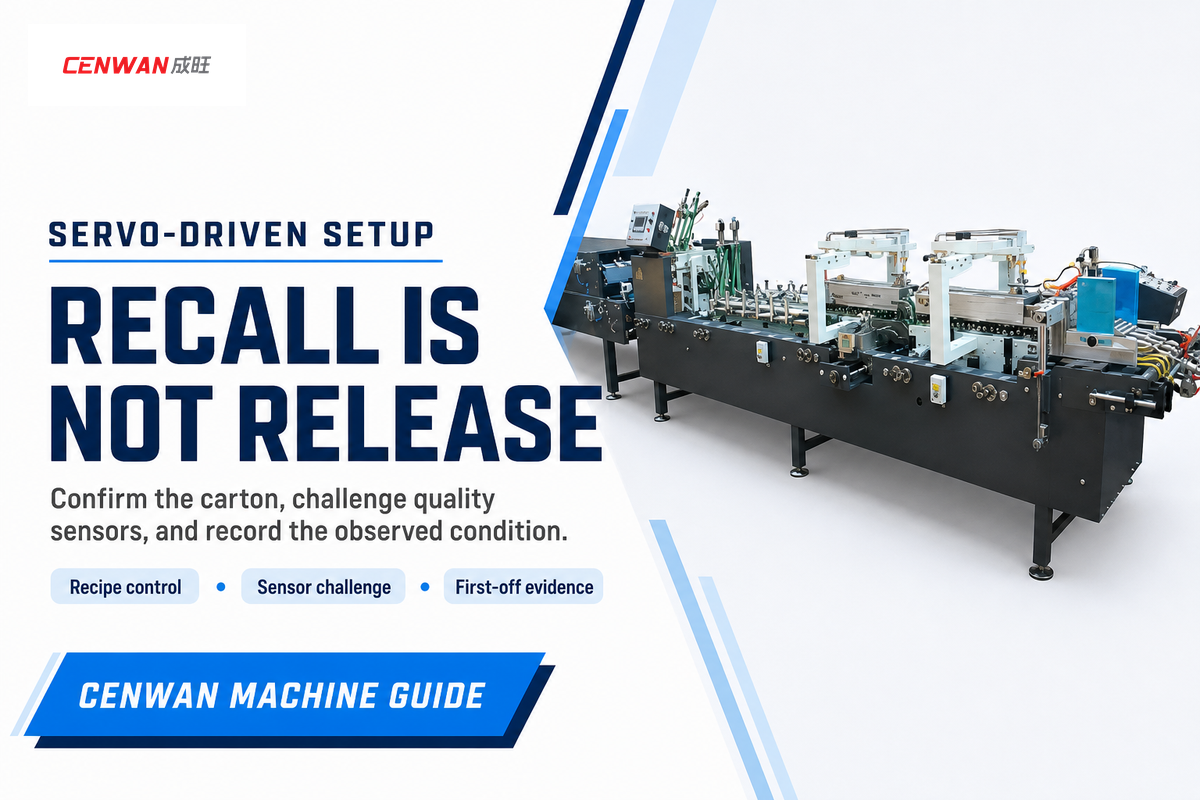
This servo driven folder gluer setup is a controlled process of recalling an approved recipe, confirming the resulting physical state, challenging required quality sensors, inspecting first-off cartons, and recording a scoped release decision. Recipe completion alone does not release production; the actual carton, board condition, adhesive, feeder, folds, reject path, compression, delivery, and connected-line handoff still matter.
In practice, the sequence is straightforward: identify the job, load the approved recipe, validate the physical result, challenge the required quality sensors, verify controlled first-off cartons, record the observed state, and let the named production or quality owner decide whether to stop, adjust, escalate, or release.
Key setup boundary
Servo automation can repeat commanded positions. Only an approved check of the carton and the complete process can support release for the recorded condition.
What Automation Changes, and What It Does Not Prove
Servo drives, motorized carriers, and stored settings can reduce repeated manual positioning and make repeat jobs more consistent. They do not identify the correct blank, verify adhesive use, prove fold quality, confirm reject segregation, or show that upstream and downstream equipment are ready. Recipe recall is therefore evidence of a commanded state, not evidence of a good carton.
PostPress’s signed practitioner article reports that motorized carriers and industrial computers improved repeatability while operators still made carton, feeder, and delivery refinements. That supports a narrow conclusion: automation changes where setup attention is spent. It does not establish a universal changeover time or prove that every servo architecture stores the same parameters.
In practice, the remaining constraint may move toward recipe ownership, carton refinements, material variation, sensor conditions, reject confirmation, and line handoff. That is an editorial operating pattern assembled from the reviewed evidence, not a controlled-study finding that servo automation always moves the bottleneck in the same way. The ANSI packaging-machinery safety overview separately supports assigning integration, validation, and record responsibilities; it does not supply a servo-performance result.
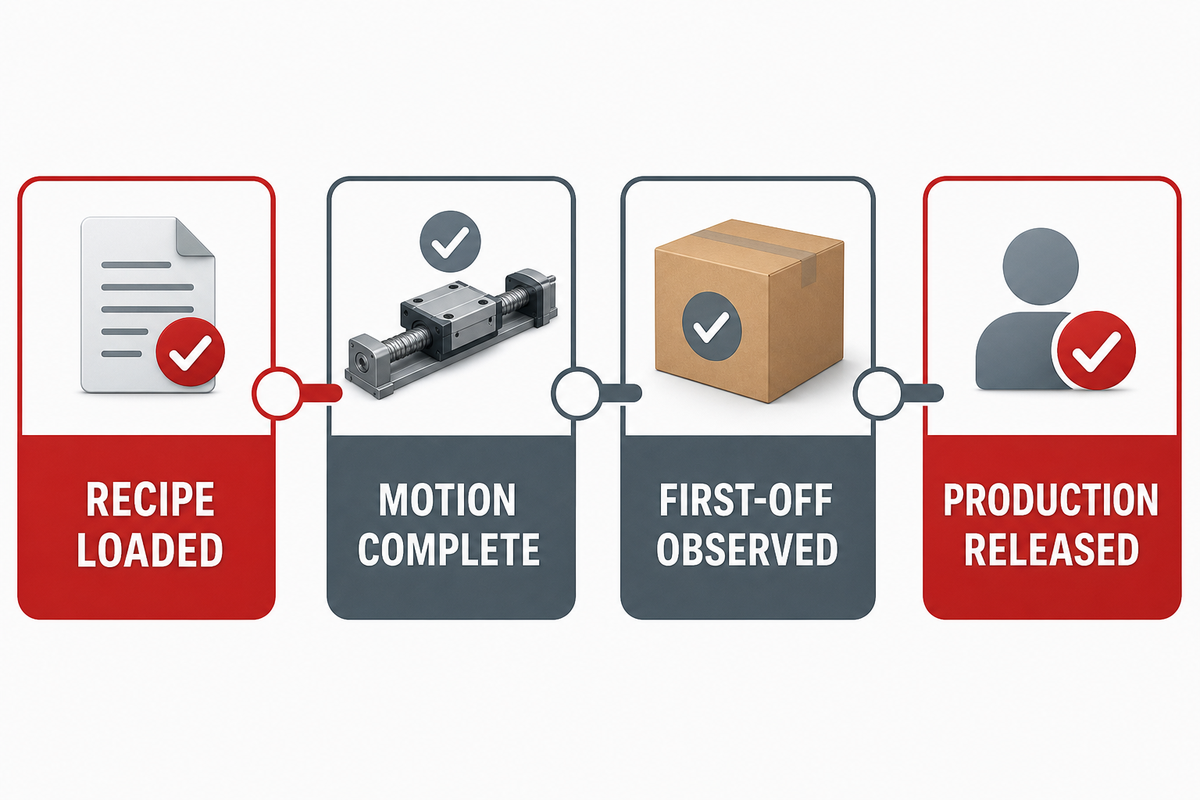
| State | What is known | What is still missing |
|---|---|---|
| 1. Recipe loaded | The selected data set is active | Correct revision, authority, and physical result |
| 2. Motion complete | Commanded axes report their end state | Manual confirmations and actual carton behavior |
| 3. First-off observed | The checked cartons passed or failed stated checks | Authorized disposition and untested range |
| 4. Production released | The named owner accepted the recorded condition | Ongoing control remains governed by the job plan |
Freeze the Job Record Before You Move the Machine
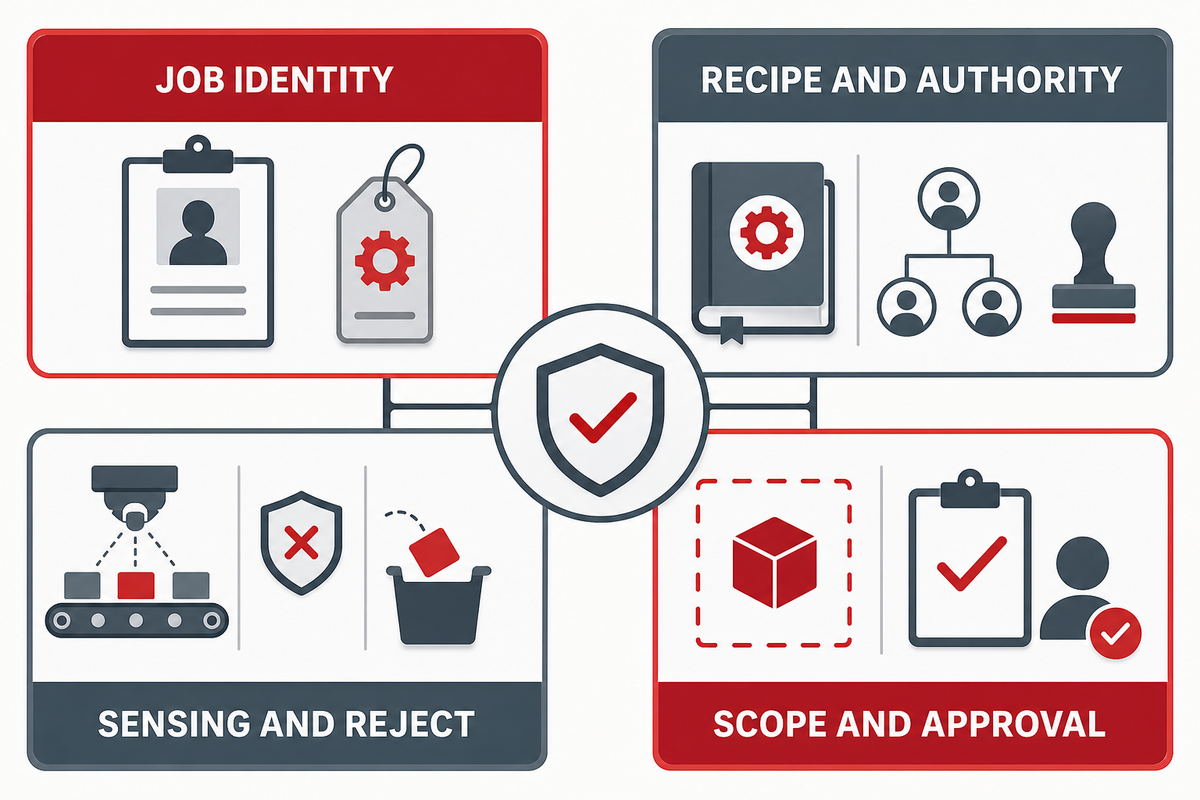
Start with job identification, not the recall button. Bind the setup record to the job number or SKU, approved drawing or sample, box style, blank dimension, board grade or flute, lot condition, print and die-cut orientation, adhesive, fold sequence, compression requirement, recipe name, and recipe revision.
Then identify control ownership. Who may change the recipe? Which quality sensors are required? What response is expected? Where should a rejected carton go? Which upstream and downstream stations exchange ready, stop, fault, count, or reject information? The ANSI overview of ANSI/PMMI B155.1-2023 describes integration responsibilities, validation, and documentation at packaging-machine boundaries. If stored settings can be edited remotely, the site also needs an owner for access, change history, backups, and restoration. Those are configuration-integrity questions for the site’s operational-technology controls, not a reason to publish a generic cybersecurity procedure.
Where a release decision depends on a quantitative measurement, record the method, instrument identity, calibration state, and resolution required by the site’s quality system. A visual glue-location check is not automatically a metrology exercise, but a dimensional acceptance value without a defined method and suitable instrument may not be comparable across operators or shifts.
Scope the machine, carton, and connected line
Keep enough vocabulary in the record to distinguish the machine in use without turning the article into a machine selection guide. An automatic folder gluer or automatic folder gluer machine may process folding carton, corrugate, corrugated board, or corrugated boxes. A box folder gluer configured for straight-line work is not the same setup as a carton folder gluer running lock-bottom, crash-lock-bottom, glue-flap, or another complex carton folding sequence. Record the box style, blank width, and any mm width limits taken from the specification and prior accepted job.
For the machine architecture, name the driven sections and interfaces that matter to the job. A full-servo design may use several servo motors and section-level servo control, while another folding and gluing machine may automate fewer axes. Record the feeder, roller, conveyor, folding sections, glue system, compression, delivery, and human-machine interface (HMI) state used during machine operation. Do not infer folding accuracy, production capacity, reliable operation, or a high-speed condition from the words “full-servo.”
For an integrated packaging line, identify the source die-cut product or die-cutting machine, downstream side feeding, and the CAD layouts that define the approved carton blank orientation. This matters in carton production and corrugated box gluing because an upstream or downstream job change can alter the condition reaching the gluing machine. Record whether the folding carton was dimensionally checked and whether the trial represents paperboard or corrugated work. Treat setup time, downtime, operator input, and technician support as job data, not guarantees across every high-speed carton configuration.
This scope language also prevents semantic drift. “Folding and gluing,” “folding gluing,” “carton gluing,” “corrugated packaging,” “integrated packaging,” and “packaging solutions” may describe different commercial boundaries. Packaging manufacturers serving food, pharmaceuticals, cosmetics, logistics, or other consumer goods still need the same evidence discipline: define the folder gluer product, packaging production interfaces, quality criteria, and responsible owners before claiming packaging efficiency. Procurement questions that fall outside setup belong in Cenwan’s box gluing machine selection guide.
| Record category | Minimum questions | Release value |
|---|---|---|
| Job identity | Which SKU, drawing, sample, and revision? | Prevents a correct setup for the wrong job |
| Material condition | Which blank, board lot, surface, flute, and adhesive? | Keeps material variation visible |
| Recipe and authority | Which recipe/version loaded, and who may change it? | Makes changes traceable |
| Physical confirmation | Which feeder, rail, fold, glue, compression, and delivery states were checked? | Separates commanded from observed state |
| Sensing and reject | Which quality condition was challenged and where did the reject go? | Links detection to an observed response |
| Measurement system | When quantitative, what method, instrument, calibration state, and resolution? | Makes results comparable |
| First-off quality | What glue, fold, dimension, compression, and delivery checks were applied? | Defines what “passed” means |
| Connected line | Which ready, stop, fault, count, and reject interfaces were observed? | Preserves handoff conditions |
| Scope and approval | What condition was observed, what remained untested, and who released it? | Stops a narrow result being presented as universal |
Run Automated Changeover in a Controlled Sequence
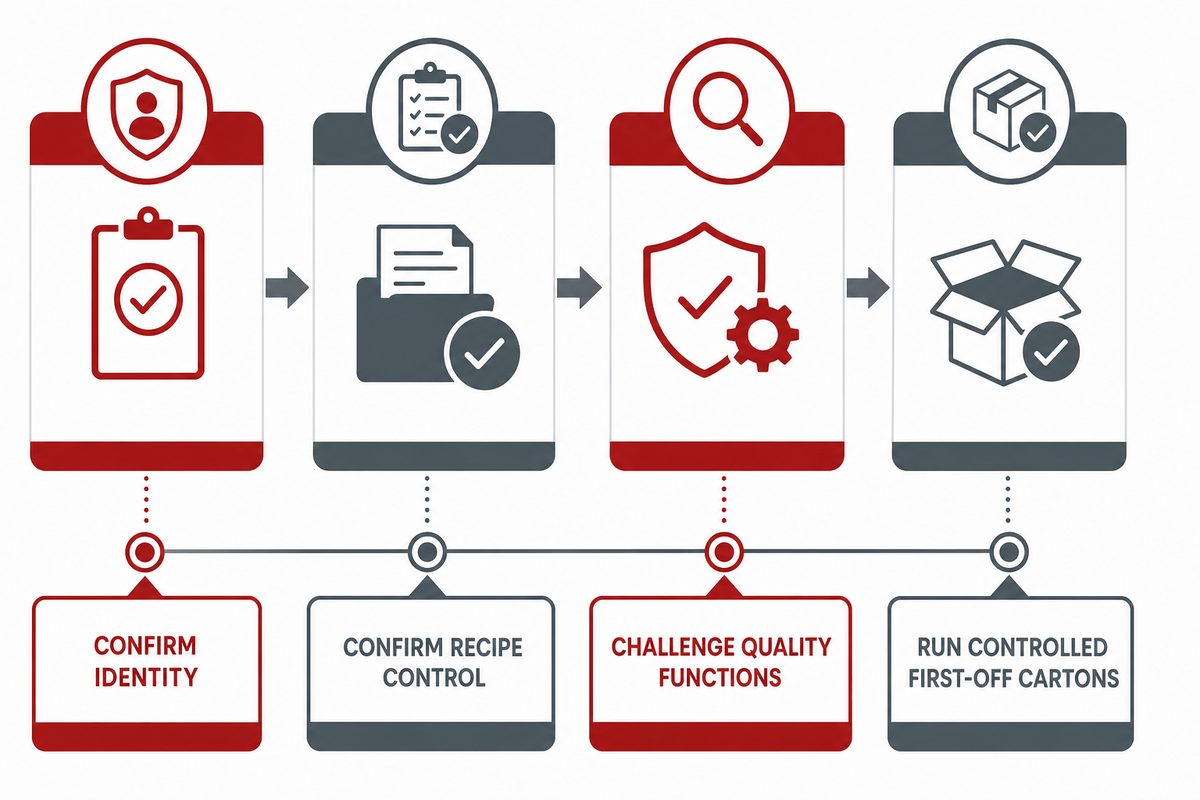
Use the sequence below as a document-control framework, not a machine-specific operating procedure. Actual motion, guarding, access, and adjustment steps come from the applicable manual, validated site procedure, trained role, and authorization.
7-Step Setup Framework
- Confirm identity. Match the job, carton, material, adhesive, drawing or approved sample, and connected-line scope.
- Classify the task. Decide whether the planned work remains normal production, is an authorized minor routine adjustment, or enters servicing or maintenance.
- Confirm recipe control. Load the approved name and revision; record who authorized the change.
- Observe automated motion. Verify the sections reach the expected state without treating a green screen as carton approval.
- Complete manual confirmations. Review feeder, register, pre-fold, glue, folding, compression, delivery, and line interfaces as required by the model and job.
- Challenge quality functions. Test required process sensors and reject routing under the approved site method.
- Run controlled first-off cartons. Inspect and document the recorded condition before production release.
“The unexpected energization or startup of the machines or equipment, or release of stored energy, could cause injury to employees.”
This is a United States reference. The OSHA rule also contains conditional boundaries for normal production operations and minor servicing activities, so a generic article cannot classify a site’s task. Outside the United States, apply the relevant jurisdiction, responsible safety owner, machine manual, and site procedure. The point is to classify before exposure, not to copy a universal energy-control sequence from the internet.
Teach and Challenge the Quality Sensors
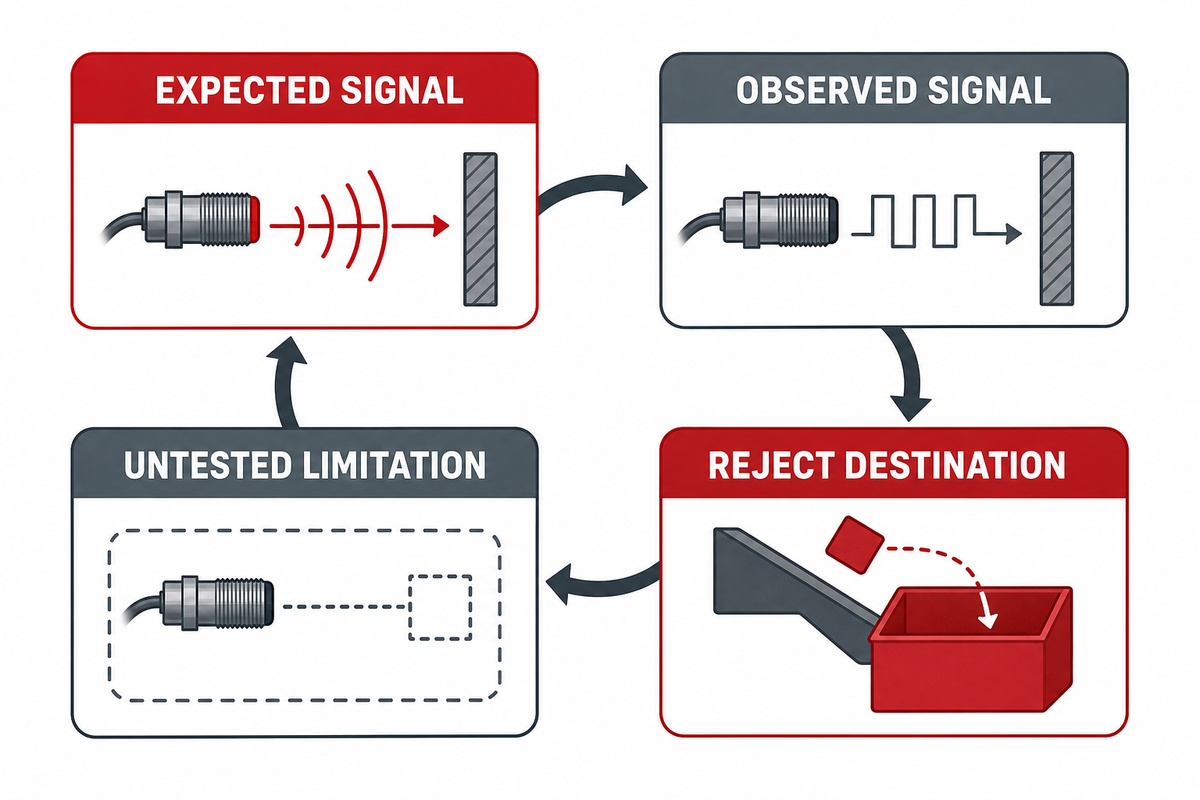
A normal sensor indicator shows the state observed at that moment. It doesn’t prove detection coverage. For each required quality function, the setup record should name the target, reference or teach state, authorized challenge, expected signal, observed signal, machine or reject response, reject destination, reset owner, and any untested limitation.
Group sensors by function: blank or feed presence, registration, glue presence or application, carton or fold condition, jam or line state, and reject confirmation. The exact sensor technology matters because a photoelectric target, glue-detection arrangement, force response, or downstream count can fail differently under dust, glare, material color, moisture, mounting changes, or product movement.
Do not turn those examples into a universal obstruction or calibration method. Patent records and trade articles show that sensing arrangements differ; they do not prove commercial prevalence, Cenwan implementation, or a valid challenge for another model. Use the selected machine’s documentation and the site’s approved safe test condition.
Quality-sensor check
- Defines a product or process condition
- Records expected and observed reject behavior
- Uses the model-approved teach/challenge method
Not covered here
- Safety-function validation
- Interlock performance-level determination
- Guard bypass or live hazardous-area testing
Process-quality sensors and safety-related protective devices are not the same validation problem. A glue-presence check cannot validate a safety function, and this guide does not provide a functional-safety testing procedure. The ANSI packaging-machinery safety overview is useful for the responsibility boundary, but any guarding, safety interlock, or protective-device concern still belongs with the qualified site owner and applicable machine-safety process.
Likewise, the presence of safety guards or emergency stop buttons does not prove that a particular setup task is correctly classified or validated. Their inspection and testing belong to the applicable machine documentation and qualified safety process, separate from the quality-sensor challenge card used for folding and gluing results.
Verify Glue, Fold, and Compression as One System
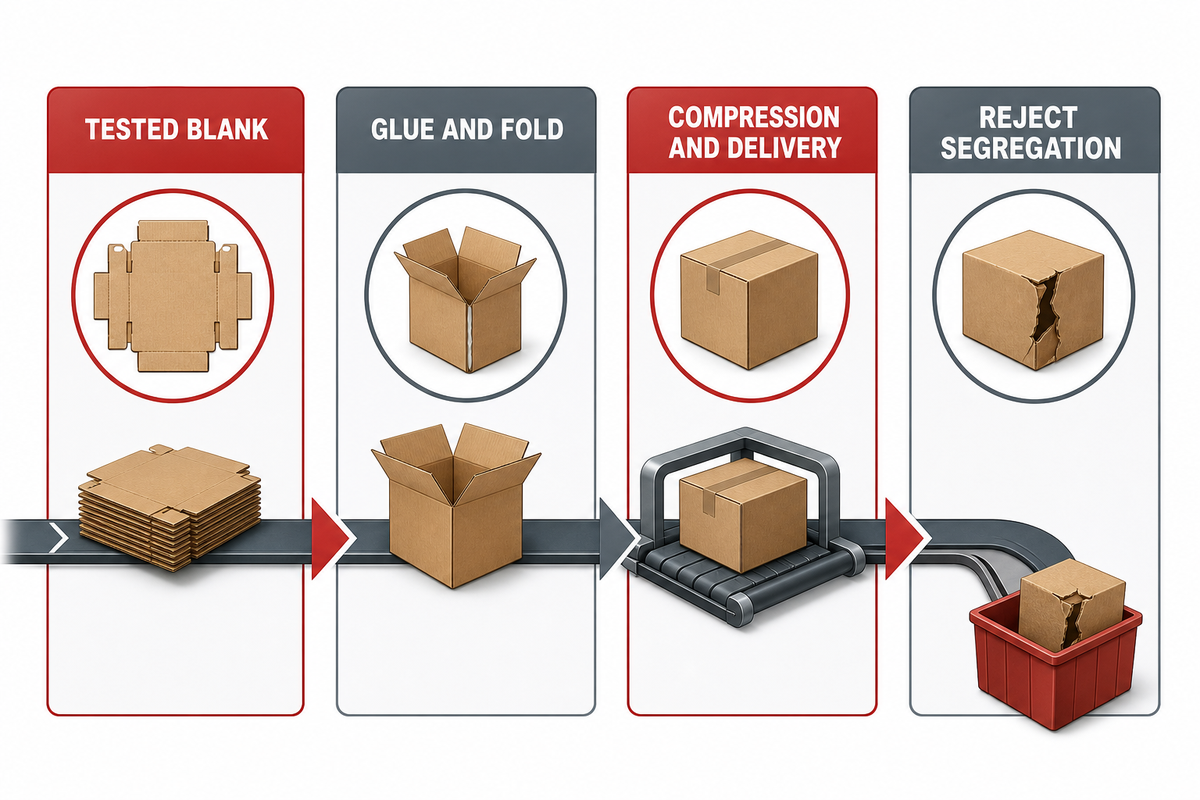
A folder gluer produces a finished carton through a chain, not a single station. A glue trace can look correct while a fold shifts it out of the bond area. A fold can look square before inadequate compression or unstable delivery changes the result. A detector can identify a fault while the reject path fails to segregate the carton. This connected-system view is consistent with the integration and validation responsibilities summarized in the ANSI packaging-machinery safety overview.
Use a First-Off Quality Chain: confirm the tested blank and board condition; inspect feed and register; review glue location and continuity by the approved method; observe fold tracking; check the specified dimensions or squareness; verify compression and delivery; confirm quality-reject segregation; and retain the connected-line state. If any intervention changes the comparison, such as a rail adjustment, adhesive change, sensor re-teach, or recipe edit, record it and repeat the affected checks.
Consider a repeat job recalled on a new board lot. The servo positions may reproduce perfectly, yet blank stiffness, warp, surface, print, die-cut condition, or moisture can change feeding, folding, adhesive behavior, and sensor response. Recipe recall removes re-entry error; it does not remove material variation. That is why a first-off check after recall remains valuable.
A successful bond observation also does not establish regulatory authorization for a particular adhesive or food-contact use. Route formulation and compliance questions to the adhesive owner and the relevant regulatory process.
Release the Job With Evidence, Not a Green Screen
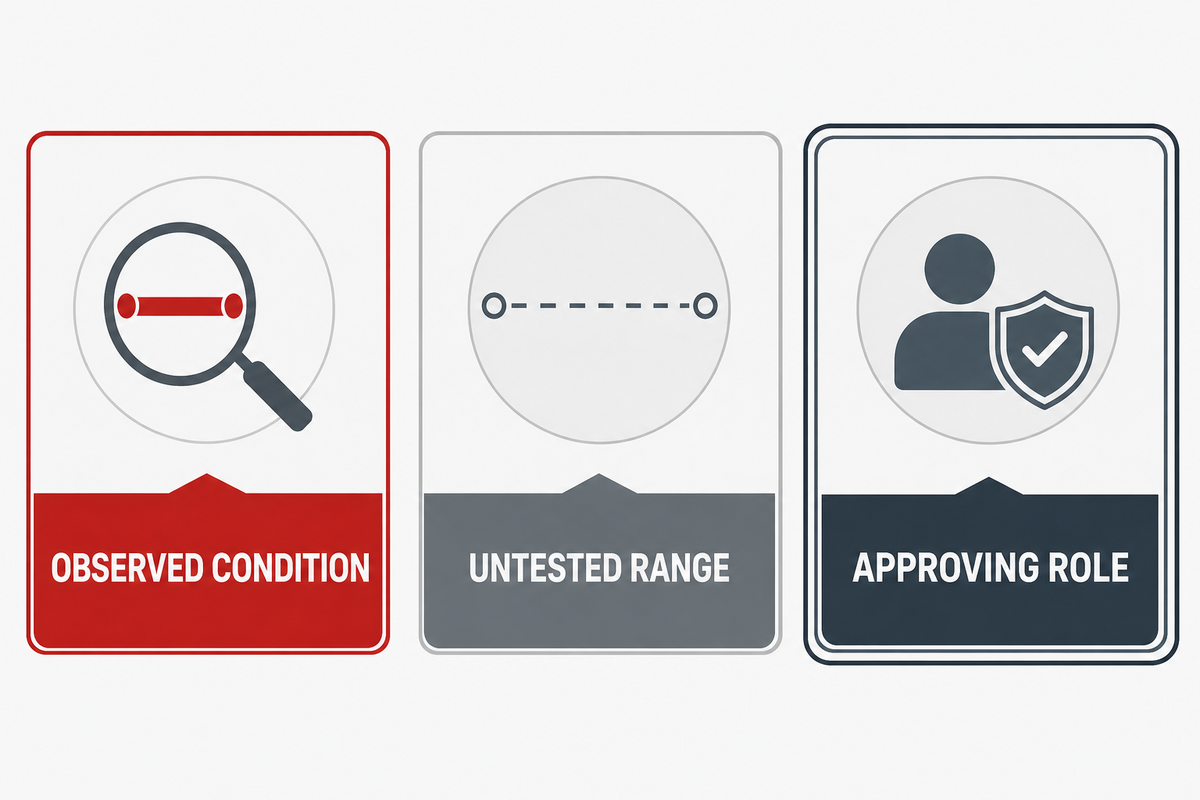
A release record should identify the job, observed condition, checks completed, defects found, adjustments made, untested range, and approving role. Machine-screen status is equipment-state evidence; it is not the quality disposition for the carton. Keep that distinction visible to the next shift and the next repeat order.
NIST’s historical acceptance-sampling overview distinguishes sample-based lot disposition from long-run quality control. Applied narrowly here, that means a first-off observation is not automatically a defined sampling plan, a random lot-acceptance decision, or proof of process capability. The site’s actual control plan determines sample selection, acceptance criteria, reaction rules, and ongoing checks.
| You may record | Do not infer without separate evidence |
|---|---|
| The named cartons passed stated checks at the recorded setup condition | Every carton in the lot will pass |
| The challenged quality sensor and reject path produced the observed response | The detector covers all faults, materials, speeds, and positions |
| The recipe and material condition were identified | Another revision or board lot is equivalent |
| The required manual confirmations were completed | An unchecked section or configuration is acceptable |
| The stated measurement method and instrument were used | Another method or instrument gives an equivalent decision |
| The connected-line signals and handoff were observed | Every upstream or downstream state was validated |
| An adjustment was recorded and the affected checks were repeated | Unrelated acceptance checks remained valid automatically |
| The untested range and unresolved limitations were named | The full operating envelope is proven |
| The named owner released the job under the site’s plan | The generic framework is a global release protocol |
Stop, Adjust, Escalate, or Release: The Decision Matrix
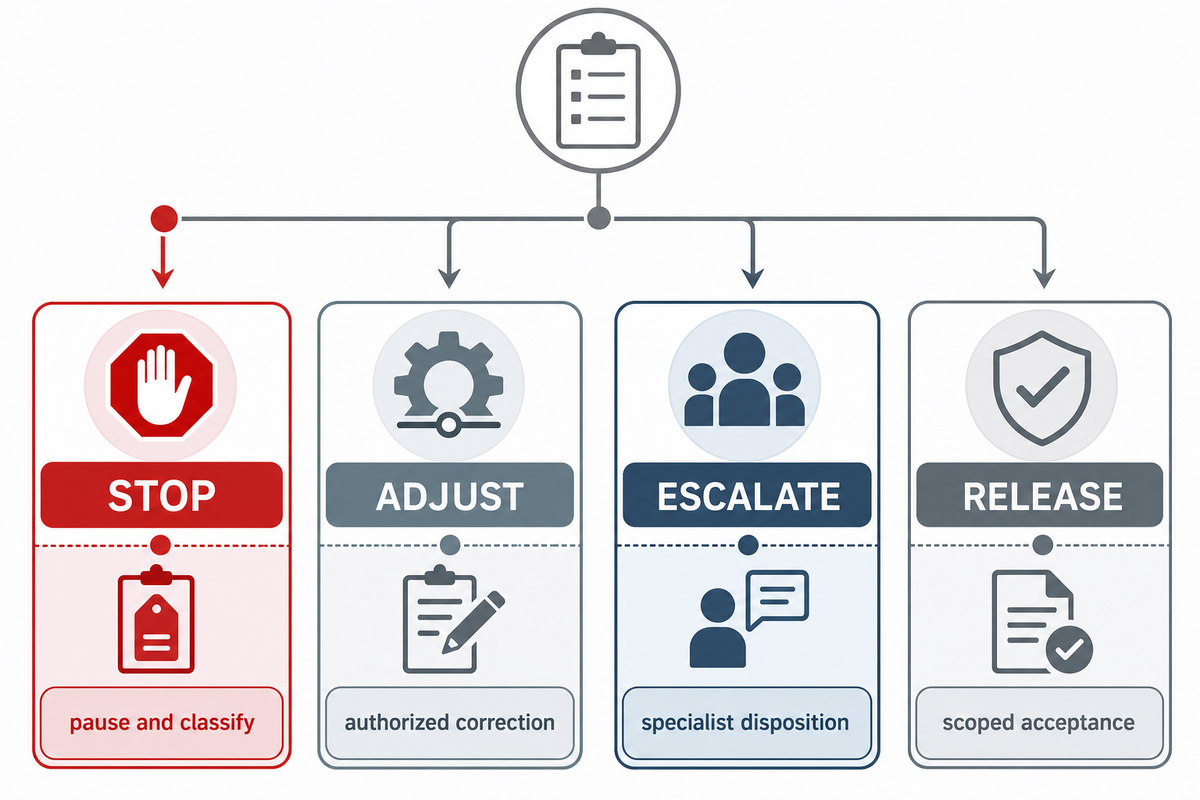
This decision matrix keeps the operator inside defined authority. It prevents endless adjustment when the job should stop, and it prevents a single corrected issue from being mistaken for complete release evidence. For United States workplaces, the task-classification boundary is grounded in OSHA 29 CFR 1910.147; other jurisdictions require their own applicable rule and site procedure. Conditions classified as service-only can be routed through Cenwan’s folder gluer parts and service channel with the recorded evidence pack.
| Decision | Observed condition | Next owner and evidence |
|---|---|---|
| Stop | Job mismatch, unclassified safety exposure, guarding/interlock concern, uncontrolled material or motion, missing approved input, or unconfirmed reject | Production lead plus the responsible safety or quality owner classify before continuation |
| Adjust | Authorized correction within the validated recipe, role, and job scope | Record the change and repeat affected first-off checks |
| Escalate | Repeated drift, unclear sensor state, recipe corruption, interface failure, adhesive/compliance question, or service-only task | Quality, maintenance, integrator, adhesive owner, or supplier provides model-specific disposition |
| Release | Required observations pass for the identified job and recorded condition | Named production/quality owner accepts the scope and untested range |
What the Available Trend Data Cannot Tell You
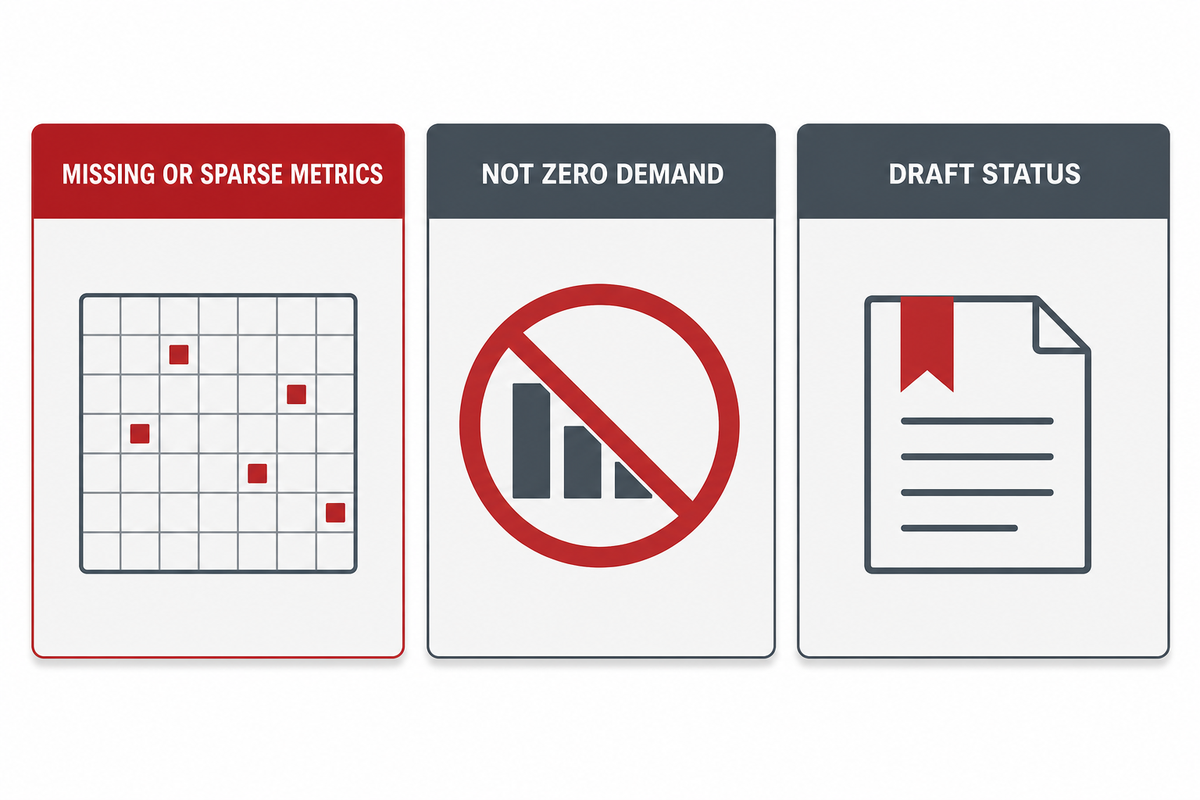
Search data for the exact focus term and adjacent phrases, including automatic folder gluer setup, folder gluer changeover, and folder gluer sensors, returned missing or sparse metrics in the available monthly series. The risk is misrepresenting that gap as a market trend because sparse data does not show demand, growth, decline, or seasonality. It is a boundary on what this dataset can support.
The reviewed FprEN 415-7:2025 preview is an emerging standards signal for secondary and group packaging machinery, but the page showed a draft/formal-approval status. It is not treated here as a final published standard. This article therefore makes no adoption-growth forecast, “best speed” claim, or universal changeover benchmark.
How Cenwan Fits Into a Repeatable Setup Program
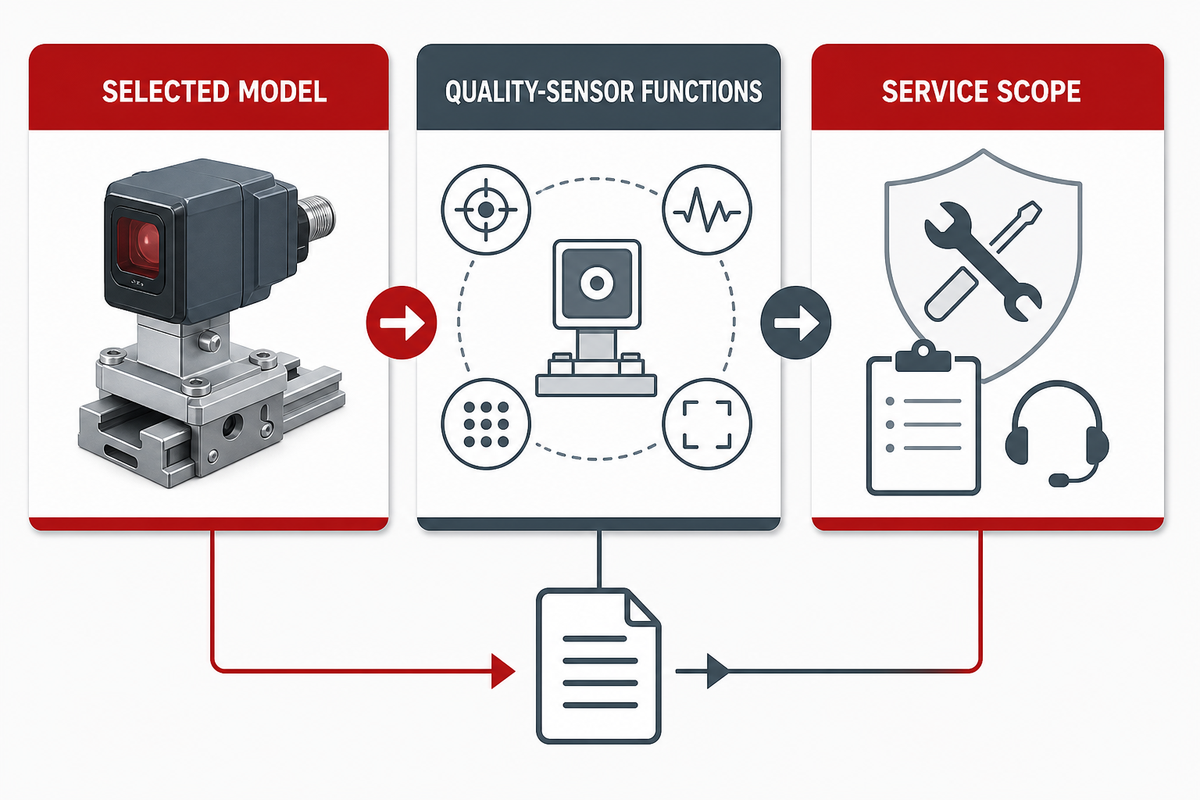
Cenwan states that it is a Wenzhou-based folder-gluer and box-gluing-machine manufacturer with more than ten years of engineering experience and clients in more than forty countries. The company describes optional one-click adjustment on selected mid-to-high-end configurations, integrated-line engineering, remote technical support, continuing after-sales response, and spare-parts supply.
Those are first-party capability statements, not independent proof of a setup result. Confirm the selected model, stored parameters, quality-sensor functions, reject integration, remote-access boundary, installation country, training, spares, and service scope in the quotation and technical agreement. The integration responsibilities summarized by ANSI reinforce why the technical agreement must identify owners rather than treat several connected machines as a simple connection. To compare configurations and discuss carton types, automation level, and support, use Cenwan’s folder gluer machine overview.
Frequently Asked Questions
What is the first step in a servo-driven folder gluer setup?
Answer
Confirm the job identity before pressing recipe recall. Match the SKU, drawing or approved sample, carton construction, blank dimensions, board condition, adhesive, fold and glue requirements, recipe revision, required quality sensors, reject destination, and connected-line state. Also confirm who may change the recipe and who owns the release decision. If a required input is missing, or the task may expose someone to unexpected startup or stored energy, stop and route the condition to the responsible site owner before motion begins. Starting with identity prevents the team from building a technically tidy setup around the wrong carton or revision.
Does a stored recipe eliminate manual checks during changeover?
Answer
No. A stored recipe can command repeatable axis positions and reduce repeated manual positioning, but it can’t verify the actual blank, adhesive, fold tracking, compression, delivery, quality-sensor response, or reject destination. Trained operators still need the manual confirmations and first-off checks defined by the machine documentation and site quality plan. Treat recipe recall as a controlled starting state, then release only from recorded carton and line evidence.
How should quality sensors be checked after automatic changeover?
Answer
Check each required quality sensor by function and with an authorized challenge, not only by looking for a green indicator. Record the target, expected normal state, approved challenge, observed signal, machine or reject response, reject destination, reset owner, and limitation. Exact teach, calibration, tolerance, and bypass rules are model-specific. Keep this work separate from functional-safety validation of protective devices.
How many cartons should be checked before release?
Answer
There’s no universal sample size. Use the approved job control plan and record exactly what was checked; a first-off observation isn’t long-run capability.
Why can a recalled job fail on a new board lot?
Answer
Recipe recall repeats stored machine commands; it can’t make materials identical. Board stiffness, warp, moisture, surface, print, die-cut condition, flute, and blank geometry can change feeding, folding, adhesive behavior, compression, and sensor response. Preserve the new lot and condition in the setup record, then repeat the affected checks.
When should the issue go to maintenance or the machine supplier?
Answer
Escalate when the condition is outside the authorized setup scope: repeated drift, unexplained sensor behavior, recipe mismatch or corruption, guarding or interlock concern, failed reject confirmation, connected-line signal failure, recurring glue or fold defects after approved corrections, or any service-only task. The correct owner may be quality, maintenance, the integrator, the adhesive owner, or the machine supplier; Cenwan’s parts and service support page provides the supplier route.
Make repeatability auditable
Identify → recall → confirm → challenge → inspect → record → decide. Automation repeats motion; a scoped evidence pack makes release accountable.
References and Sources
- OSHA 29 CFR 1910.147, The Control of Hazardous Energy (United States servicing/maintenance scope and conditional exclusions).
- ANSI: ANSI/PMMI B155.1-2023 Packaging Machinery Safety (public scope, integration responsibility, validation, and documentation overview).
- NIST/SEMATECH e-Handbook: Acceptance Sampling (historical sampling-versus-long-run-quality distinction; not a folder-gluer standard).
- PostPress: A Viewpoint on Folder-Gluers, Yesterday and Today (signed practitioner perspective on motorized carriers, repeatability, and remaining setup refinements).
- PostPress: Quality Control Systems Key to Folder-Gluer Production Success (background on inspection conditions and detection limitations).
- Flexographic Technical Association: Folder/Gluer Purchasing, Five Components to Evaluate (job-mix and changeover evaluation context).
- FprEN 415-7:2025 public preview (draft/formal-approval standards signal; not presented as final).