Get in touch with Cenwan Machine Company


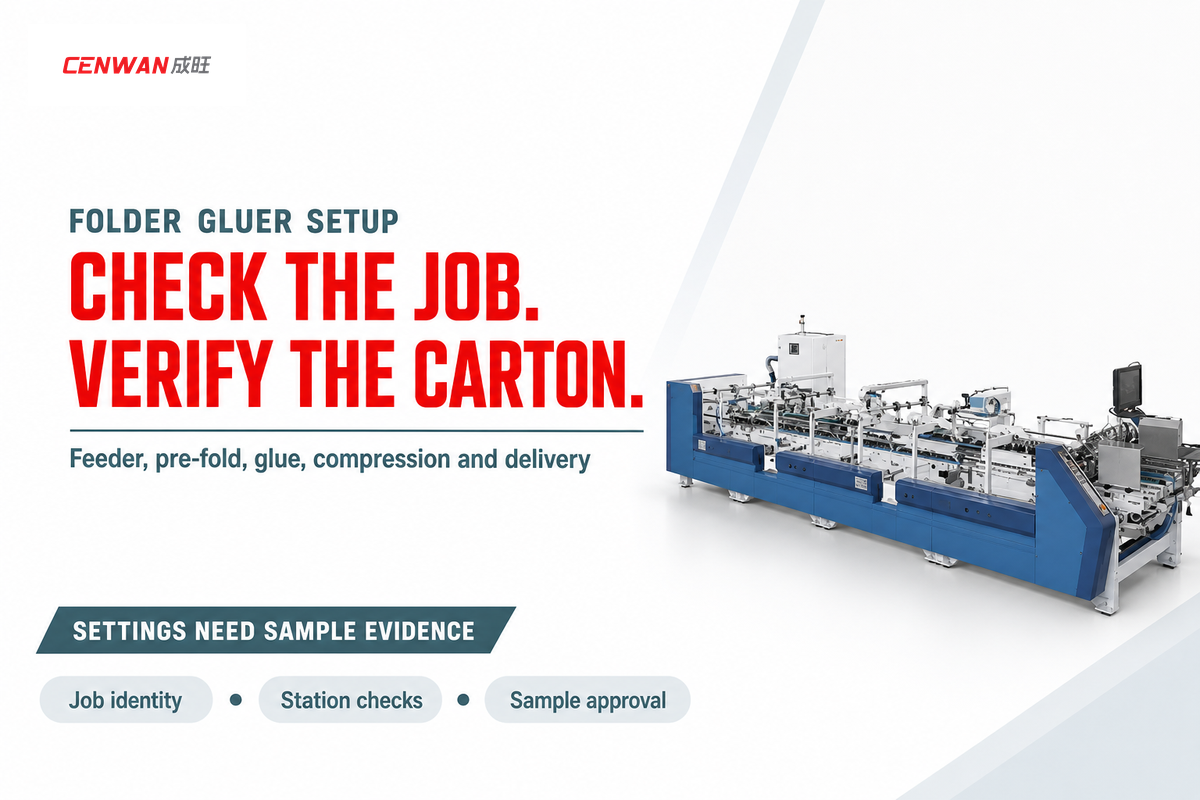
Folder gluer setup begins with the approved carton drawing and ends with an identified sample, a recorded result and permission to start the job. Between those points, feeding, folding, glue application and downstream handling must work together. A square-looking carton at the delivery end can still hide a misplaced glue line or a joint that opens later.
Updated October 2026
Job setup at a glance
Use the actual machine model, installed tooling, blank revision, board/coating and adhesive grade. Follow the approved safe setup procedure. Release the job against agreed sample checks, then continue the production inspection plan.
Folder gluer setup matches the job, tooling and materials, then checks feeding, folding, glue, compression and delivery. Record the location of the first defect and approve identified samples before proceeding to production.
- A stop button doesn’t isolate hazardous energy.
- Check the feeder before correcting a defect that first appears there.
- Match the adhesive and checking conditions to the actual substrate.
- Keep first-article approval, batch acceptance and ongoing inspection separate.
Folder Gluer Setup Sequence and Job Inputs
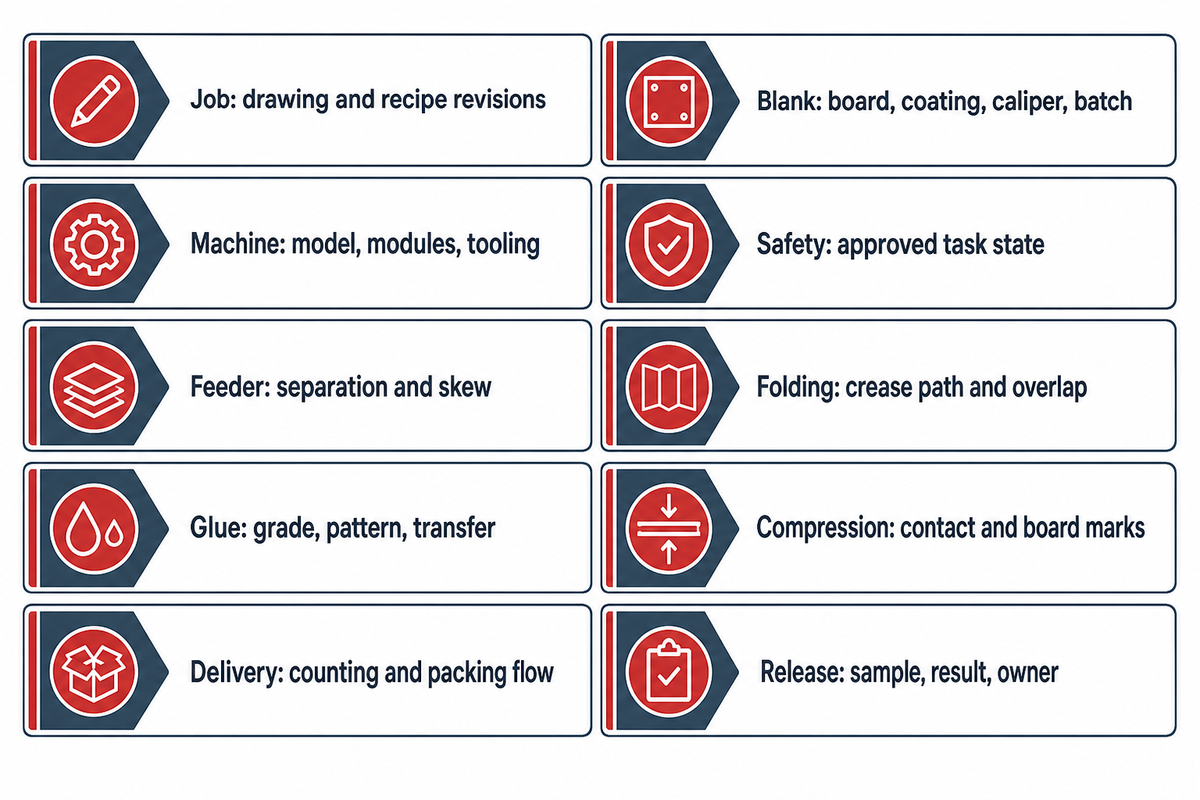
A setup sequence for folder gluer starts with job identity, follows the path of the installed materials, and ends with sample approval. Establish which drawing, substrate and adhesive the operator is setting up before loading a stored recipe. The station checks below follow the functions requested for the job; actual modules and folding order vary with the machine and carton style. For example, Heidelberg describes the Bestfold pre-fold and lock-bottom modules for different folding scenarios and carton styles.
Use this step-by-step record to prepare the carton folder gluer for the approved job. An approved flat drawing is placed with the job record. Identify the intended glue joint, print orientation, crease lines and finished opening direction. A folding gluing machine may move a blank cleanly while following the incorrect revision. Catching the mismatch prior to trial prevents the setup process from being used to correct the wrong geometry.
Station Evidence Card
A Station Evidence Card links each setup check to its job reference, safe task state, sample observation and release owner.
| Check | Record or inspect | Hold the job when |
|---|---|---|
| Job identity | Drawing and recipe revisions; carton style | Versions disagree |
| Incoming blank | Board grade, coating, caliper and batch | Material differs from approval |
| Machine configuration | Model, installed modules and tooling | Required folding device is absent |
| Safe task state | Applicable setup and energy-control procedure | Safe access has not been established |
| Feeder exit | Separation, orientation and observed skew | Misfeeds or unstable registration continue |
| Pre-fold and main fold | Crease path, panel overlap and opening | Cracking or geometry is unacceptable |
| Glue application | Grade, pattern and transfer to intended joint | Application misses the approved area |
| Compression | Contact, recorded line conditions and board marks | The joint opens or board is damaged |
| Delivery | Shingle, counting, separation and packing flow | Handling disturbs the joint |
| Release | Sample IDs, test conditions, result and owner | Acceptance or disposition is unresolved |
Use one record for the entire packaging line rather than separate notes that lose the connection between stations. Proper setup retains changes in board batch or adhesive grade next to machine settings. If a quotation is only for a basic box gluing machine, the job packet should indicate any additional bottom-folding or inspection functions that need to be performed prior to booking a trial.
Safe Checks Before Machine Setup
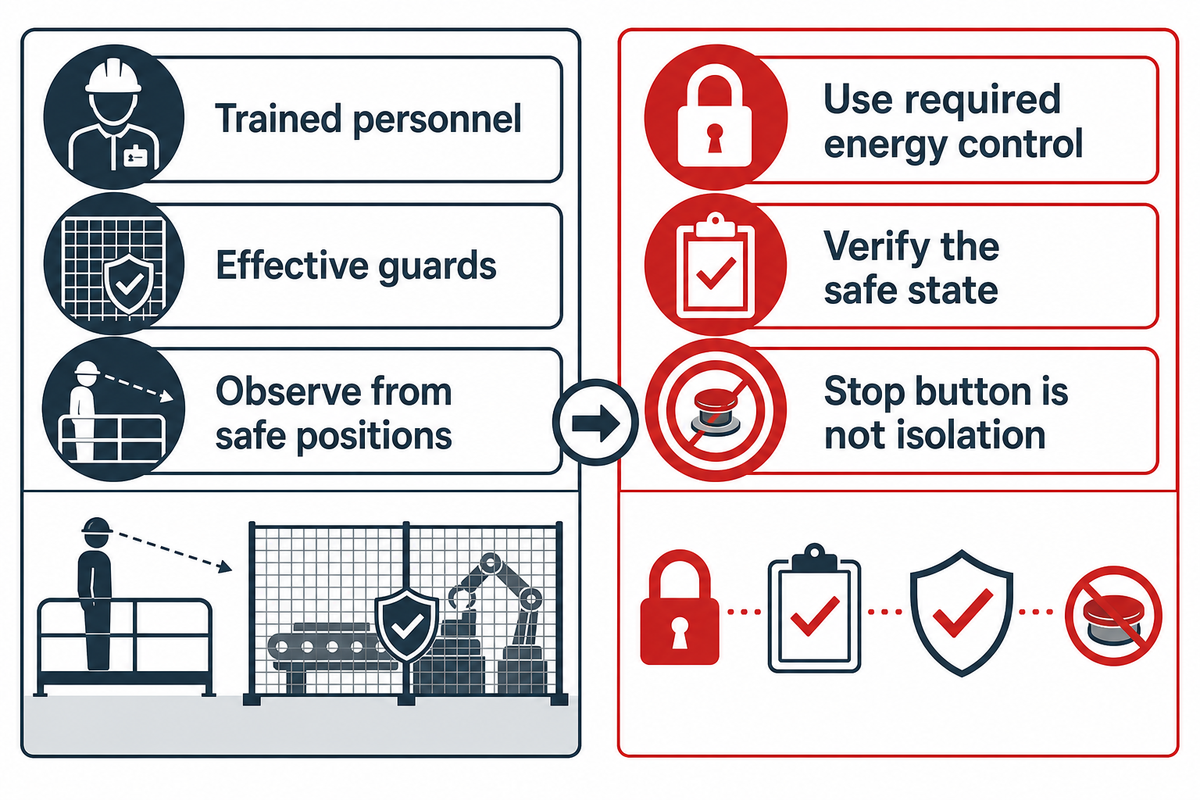
Safe folder gluer machine setup separates the observation from the access to moving, hot or otherwise hazardous parts. Identify the task and use the employer’s approved machine procedure before adjusting the equipment or clearing a jam. The functions of the control panel, safety guards and energy-isolation points differ; an operator requires training on the arrangements of the machine that he/she is using.
How to operate a folder gluer machine safely?
Operate a folder gluer with trained personnel, effective guards and the approved startup, adjustment and shutdown procedures. Observe production from designated safe positions. Before work that exposes a person to hazardous motion or stored energy, implement and use the required energy-control procedure to verify the safe state. Never treat slow running or a stopped drive as permission to reach inside.
“Push buttons, selector switches and other control circuit type devices are not energy isolating devices.”
In the United States, OSHA’s covered servicing rules include exposure to unexpected startup or stored energy. The exception for minor servicing requires routine, repetitive, integral work during normal production and effective safeguarding against unexpected energization, startup or release of stored energy. It does not give every adjustment or jam-clear a live-working exception. Emergency stop buttons are emergency controls and shouldn’t be considered machine isolation.
For example, a folded blank lodged near a belt nip calls for the approved jam-clearing procedure, not a hand reaching after the next carton. Keep electrical connections, grounding checks and installation work with qualified personnel under the appropriate commissioning procedure. This guide is concerned with recurring job set up after machine installation.
Safety documentation should include the machine’s manufacturing date and relevant requirements. ISO 12643-4:2023 addresses converting equipment and systems. Its scope is limited by a manufacturing-date boundary. The responsible engineer’s assessment, in combination with actual equipment instructions, should be applied when equipment is changed or when a supplier acceptance visit is conducted.
Feeder and Alignment: Start with a Stable Blank
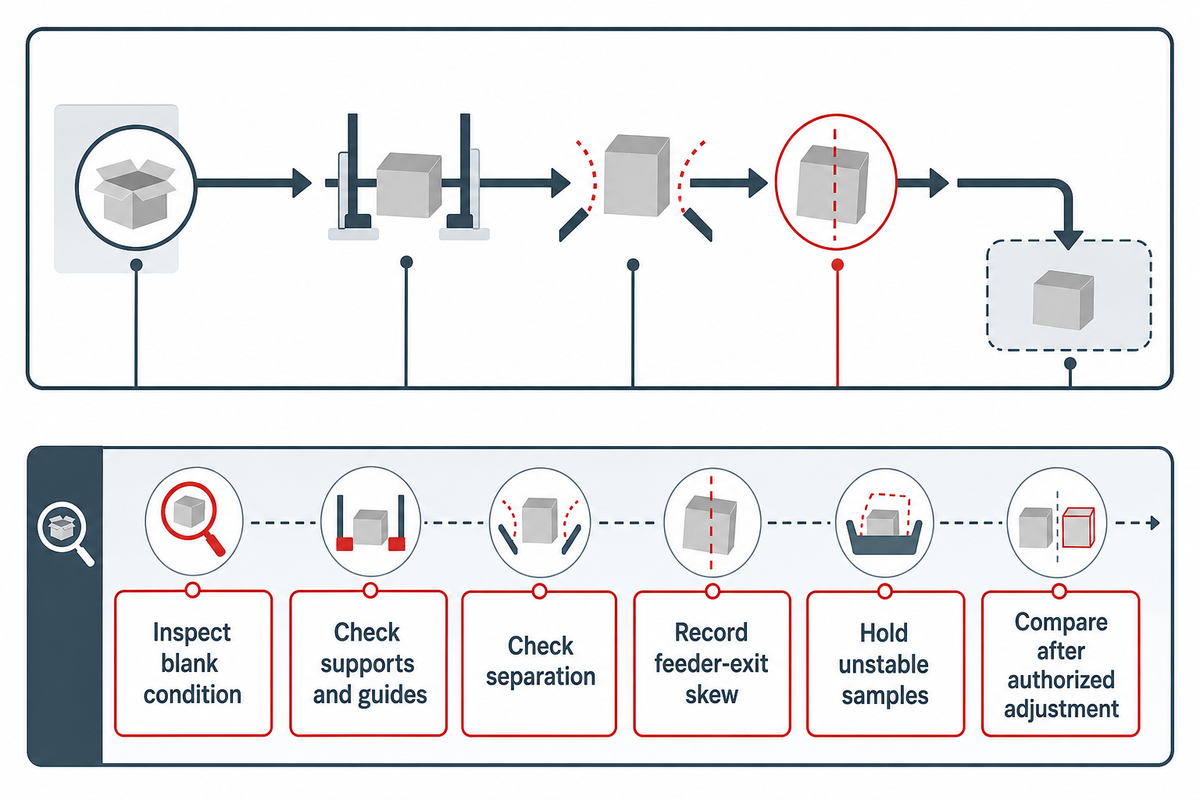
The intended orientation of the blank, with stable separation and alignment prior to the commencement of folding, should be checked. Start by assessing the condition of the blank, and the feed arrangement. Double feeds, hesitation or skew at the feeder exit give the next station an inconsistent starting position, so later folding adjustments can conceal an upstream problem.
Check the job’s supports and guides fit the shape and dimensions of the blank, including narrow sections and cutouts. Refer to the equipment instructions for gate clearance, support placement, belt tracking and vacuum arrangements. AIM’s Signature aligner guidance identifies feed setup, competing alignment pulls and transfer pressure as troubleshooting variables. Its scope is that of the assembly being aligned, rather than a universal setting for folder gluers.
Example: A narrow-center carton enters the line with intermittent skew, but folds its panels cleanly when aligned. The operator sees the same skew at the feeder exit and on finished samples. Increasing a downstream carrier’s pressure may make some samples appear straighter while causing marks to appear on other samples. The best next action is to hold the samples with skew, determine where in the feeder skew first appears, and return to the approved feeder setup checks under the correct safe task state. After an authorized adjustment, compare samples at the same operating condition. Resume downstream tuning only after feeding is stable. Following this procedure keeps an upstream transport problem from becoming many folding adjustments.
For a repeat job, include the exit condition in the recipe notes. Precise alignment means conformity to the job’s agreed upon geometry, not a visually straight stack at delivery.
Pre-Fold and Main Folding: Match the Carton Style
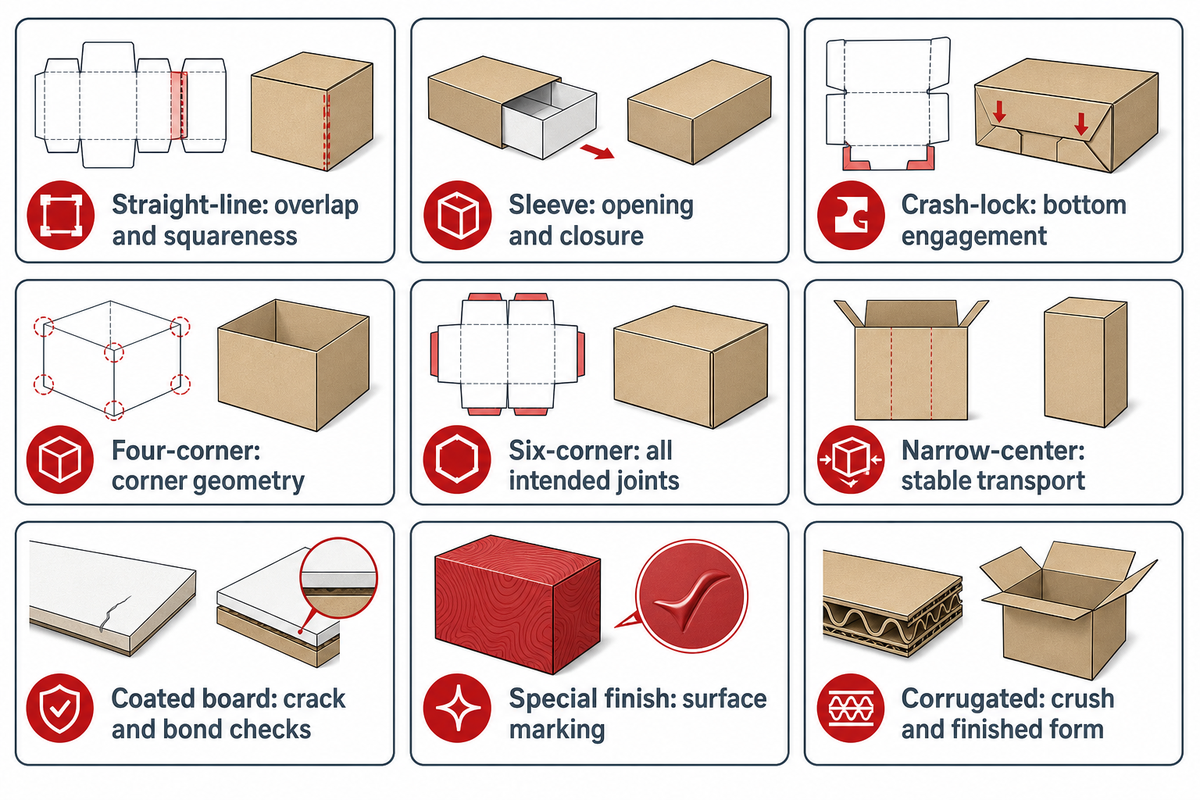
Follow the carton’s crease pattern for both pre-fold and main folding setup. The main folding setup should address material behavior as well as the installed folding devices. Different actions are required for a straight line side seam, crash-lock bottom and corner-folding carton. Check the sample’s ability to open and form as intended, alongside panel overlap and appearance, before treating the folding setup as acceptable.
| Job feature | Setup focus | Sample evidence |
|---|---|---|
| Straight-line side seam | Side-seam fold path | Overlap and squareness |
| Sleeve | Panel closure and opening | Usable formed sleeve |
| Crash-lock bottom | Installed bottom-folding devices | Correct bottom engagement |
| Four-corner style | Specified corner-folding sequence | Corner geometry and opening |
| Six-corner style | Additional panel and corner actions | All intended joints and folds |
| Narrow-center blank | Supported transport through folds | Stable registration |
| Coated paperboard | Crease response and joint surface | Cracking and bond behavior |
| Embossed or special finish | Contact locations | Surface damage or marking |
| Corrugated boxes | Flute/caliper and installed tooling | Crush, folding and finished form |
For corrugated packaging, as well as folding cartons, match the application to the actual straight-line folder gluer, crash-lock bottom folder gluer or 4/6-corner folder gluer configuration. Sealing the bottom concerns the specified bottom construction and glue pattern, rather than just adding pressure to a side-seam job.
Keep observation timing consistent when comparing springback. Nagasawa and colleagues’ 2019 laboratory experiment on 0.3 mm white-coated paperboard found time-dependent release behavior after folding. Record prior folding or hold history and elapsed time after removing constraint. The experiment’s angles and times describe its specimens; machine settings still follow the approved job recipe.
Glue System: Verify the Pattern on the Actual Substrate
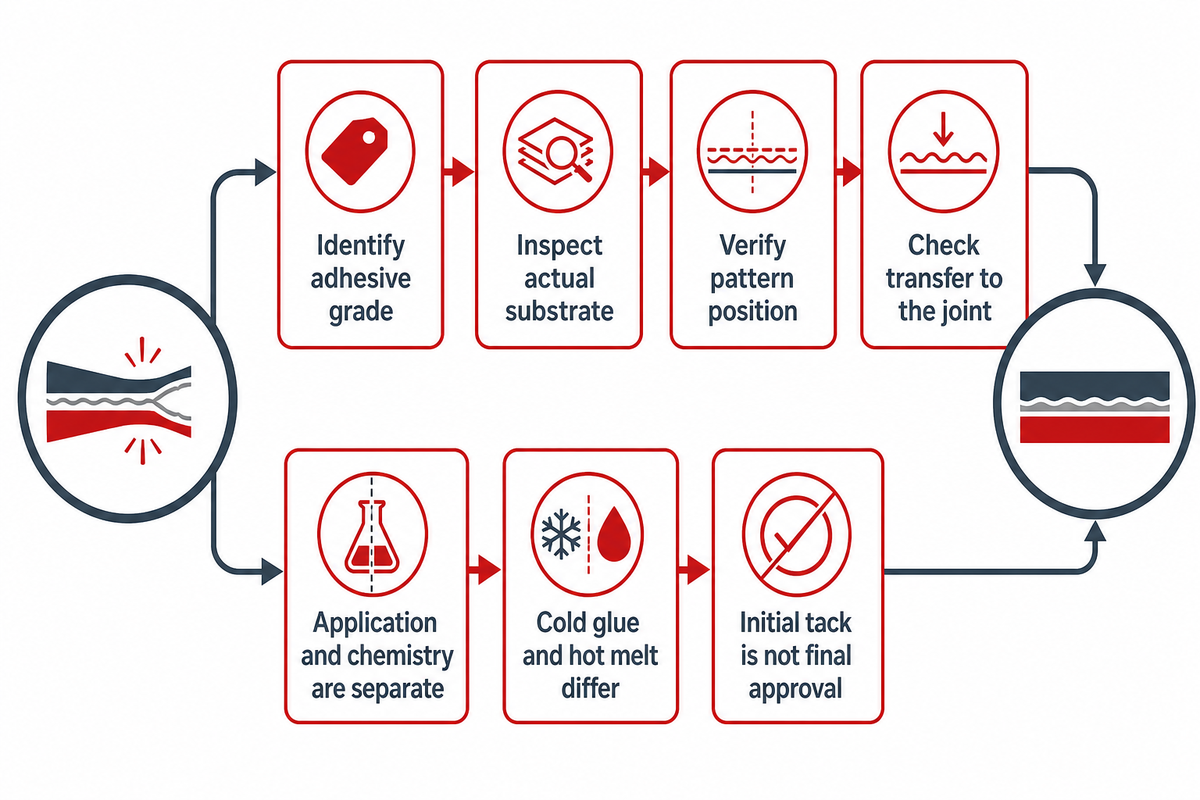
The setup of the glue system should place the adhesive on the specified bonding area at the required point along the folding path. Prior to adjusting the delivery system, identify the adhesive grade and application equipment, and inspect the substrate surface. Pattern position, transfer and condition of the joint should be considered in combination; initial tack shouldn’t be regarded as a final bond check.
For cold glue, use the product’s handling and application instructions.
Regarding the viscosity and temperature of glue and its effect on dosing, and stray adhesive that can cause sticking (internal and external), refer to Intercol’s folder-glue bonding discussion. Hot-melt systems have their own application temperature windows, open time and set requirements. A glue wheel and a nozzle system don’t share one universal set-up recipe.
Example: A coated paper box holds together at delivery but its seam opens during the agreed later sample check. The job has changed to a different coated board while the recipe name stayed the same. Rather than increasing glue quantity, retain the failed sample, identify adhesive, surface, location and checking conditions. Examine whether adhesive reached both intended surfaces and whether the opening occurred before or after handling. Review the result with the responsible adhesive or machine specialist. Adjusting the recipe can then be compared to the original condition. The record should show what changed and which sample passed, instead of treating a stronger wet tack as the release decision.
When dealing with inconsistent glue application, always keep application behavior and chemistry compatibility separate. A blocked or unsuitable nozzle, unstable dosing or a shifted pattern needs a different investigation from a joint that receives glue correctly but fails under its intended conditions. Procurement should include the actual coating and adhesive identity in the trial packet, not just the carton box dimensions.
Compression: Check Contact, Time and Board Condition
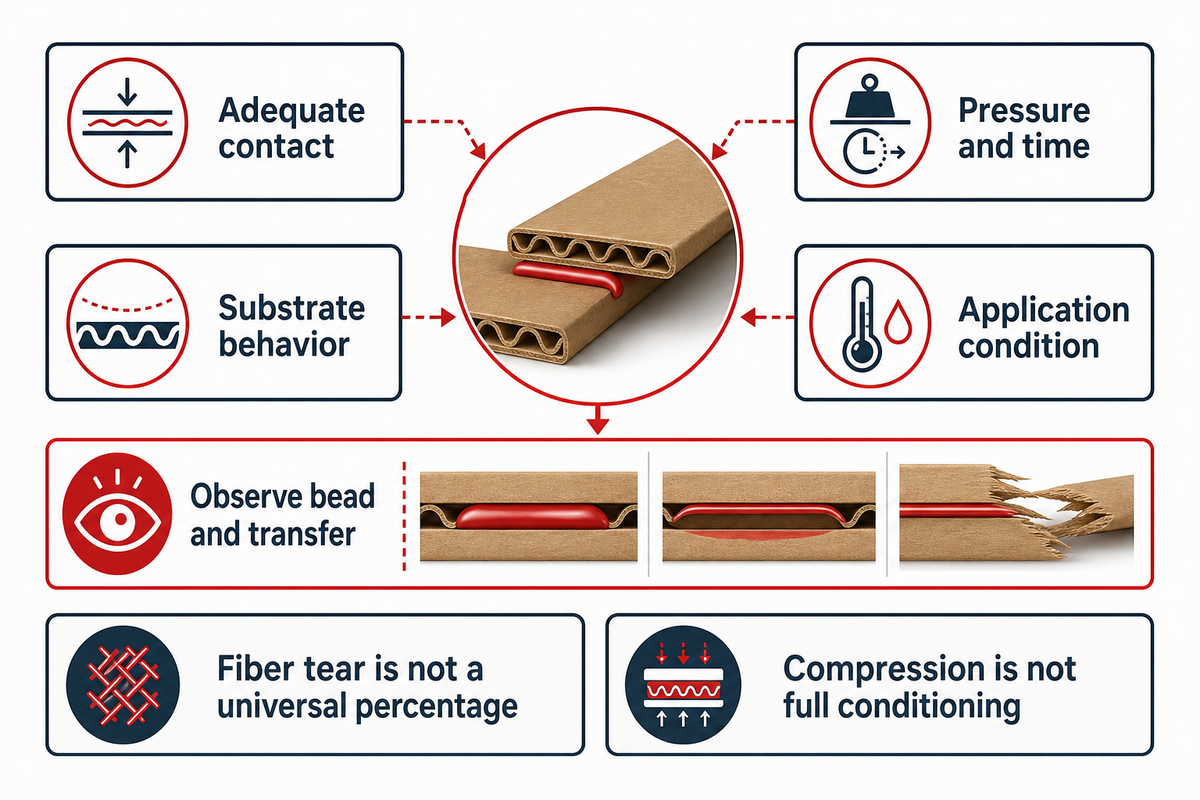
Compression setup needs adequate contact for the approved bond process without unacceptable board damage or distortion. Judge the joint considering the condition of the line, and follow the adhesive’s instructions. Application, substrate behavior, pressure and time interact, and an open seam should prompt an evaluation of the entire bonding process before increasing pressure becomes the default option.
According to Henkel’s hot-melt troubleshooting guide, preset and poor compression and temperature-related failures may occur. It describes inconsistent transfer, bead shape and fiber tear as observations that help investigation. Use the agreed bond-test method and conditioning requirements for release; do not turn a fiber-tear observation into a universal percentage criterion.
Inspect safely removed samples for joint opening, displacement, glue squeeze-out and board marking. Compare like-for-like material at recorded production speed. Follow approved procedures for any related compression or application changes when speed changes, and review new samples at the intended production condition. Check samples under the required production conditions, and maintain consistent observation conditions when comparing them.
Separate the folder gluer’s compression function from full adhesive conditioning. A buyer evaluating production efficiency should record accepted output and rejected cartons over the agreed trial, and the bond check after the agreed conditioning. Maximum speed by itself says little about that result.
Delivery: Keep Inspection and Packing from Disturbing the Joint
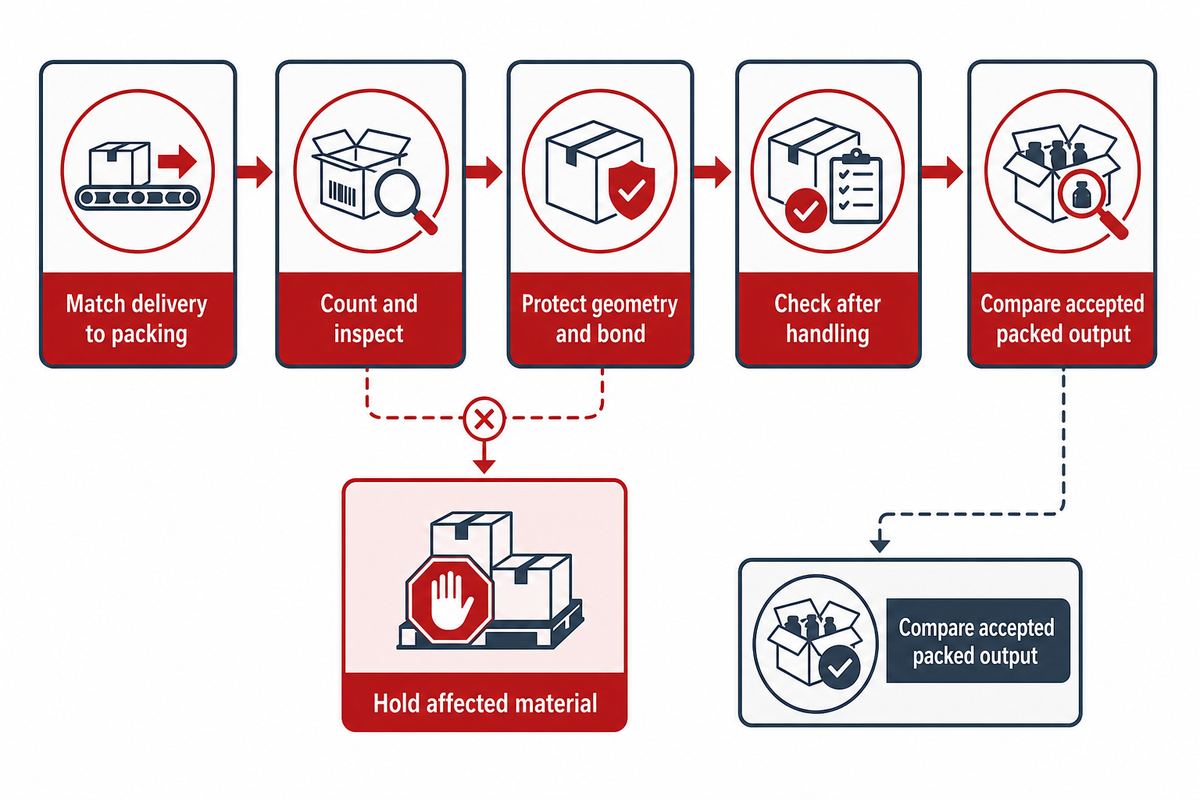
Move folded cartons through counting, inspection and packing without disrupting their geometry and bond. Adjust the conveyor and delivery arrangements to the downstream work rate. Watch the finished material flow from designated safe positions and review removed samples after handling, rather than judging quality only at the folder-gluer exit. Don’t judge quality only at the folder-gluer exit.
Heidelberg’s Bestfold configuration has adjustable delivery speed for matching packing. That interface is important since a high-speed machine can supply cartons faster than the crew can unload and pack them. Smooth production requires space to unload accepted cartons. Packing congestion belongs in the line review, not in a glue-pressure correction.
Example: Trial samples leave compression square and closed, but cartons begin to accumulate while the packing crew changes an outer case. The next inspected group shows bent edges and disturbed seams. The operator records that the defect first appears after accumulation, holds affected material and follows the approved response to restore orderly delivery. The trial is repeated using the actual packing arrangement, staffing and counting method. Glue settings are separate variables, unless sample evidence indicates otherwise. The production target can be assessed against accepted packed cartons, rather than the display upstream that ignores the bottleneck.
Troubleshooting: Find the First Bad Station
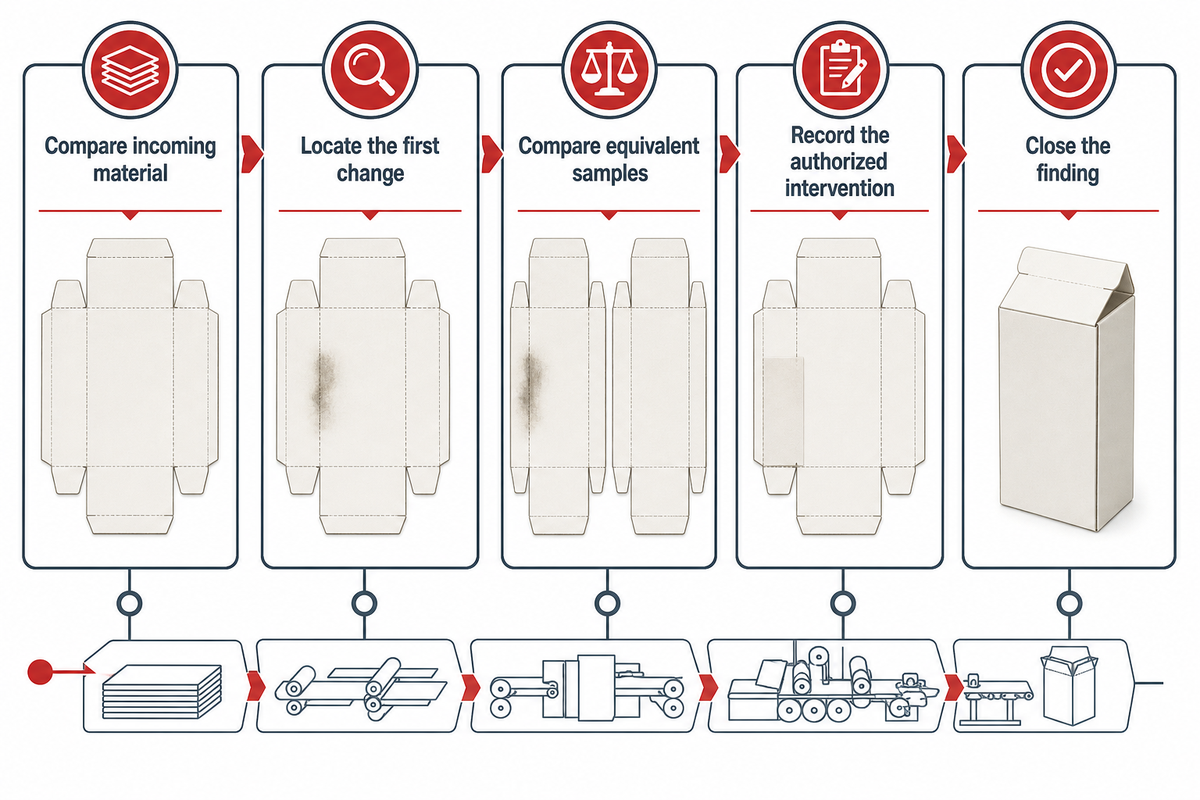
Folder gluer troubleshooting starts by locating the earliest observable defect and comparing it with the incoming blank and approved job conditions. Track a misaligned sample through safely obtainable evidence from feeding, folding, bonding and handling. Change only one authorized variable at a time, and retain comparison samples. Document the results of each change before proceeding to the next.
First-Bad-Station Trace
A First-Bad-Station Trace records the earliest observed defect, comparable sample conditions and the next controlled check.
What are common folder gluer problems during production?
Common folder gluer problems are misfeeds, alignment issues, crease cracking, incorrect glue patterns, weak joints and delivery jams. Locate the first point of origin for each of these symptoms before taking a corrective action. A skewed finished carton may have occurred at feeding, while an opened seam can be attributed to the substrate, adhesive, or contact or later handling conditions. One symptom can have multiple causes.
- Start with incoming material. Compare batch identity, warp, die-cut geometry and crease condition with the approved blank.
- Locate the first change. Record whether skew or damage is already present before the next station acts.
- Compare equivalent samples. Keep speed, material and observation time aligned; include time after release when checking springback.
- Record the intervention. Identify the authorized adjustment and the person responsible for retesting.
- Close the finding. Record acceptance, further investigation or continued hold against the job requirements.
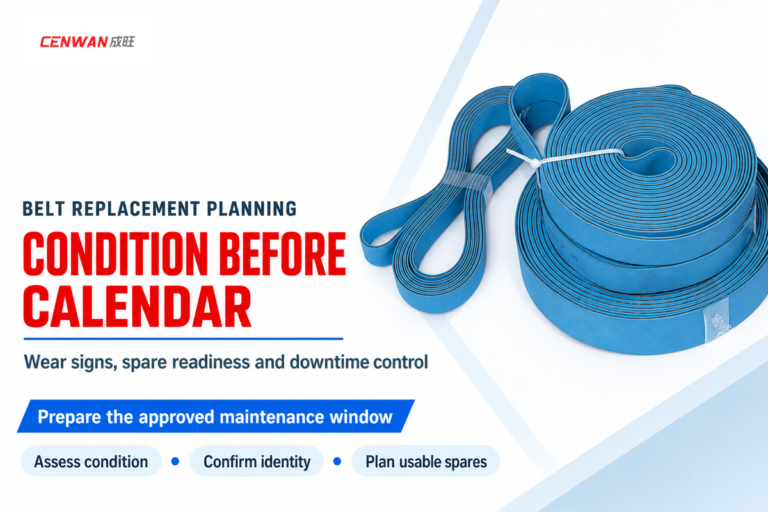
Misalignment that follows a repeatable wear pattern needs investigation by the responsible technician. Use your findings to open a maintenance task as appropriate. A setup correction shouldn’t be used in lieu of assessing damaged belts or rollers. Our folder gluer belts and rollers maintenance handoff guide covers inspection and identification for that separate discussion.
First-Article Approval and the Supplier Handoff
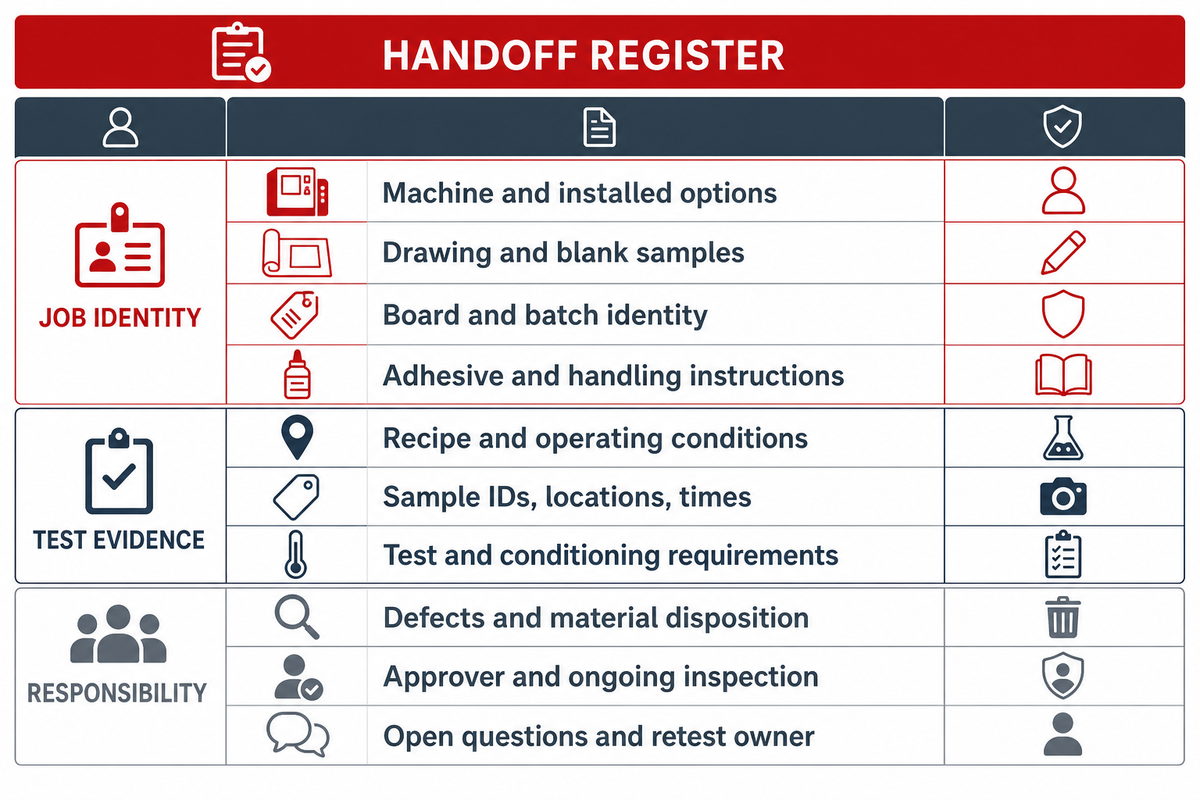
First-article approval records whether identified setup samples meet the agreed job checks before routine production starts. Name the approver, sample conditions and next inspection points. Keep that decision separate from statistical batch acceptance and continued process monitoring: passing selected initial samples doesn’t establish that every later carton will remain acceptable.
NIST’s acceptance-sampling guidance differentiates one-shot decisions about lots from continuous quality control. Structure the inspection plan for production based on the order’s defect definitions and the sampling and responding strategies. A restart, material change or adjusted setting should have a clear review route.
Job Release and Supplier Handoff
- Machine model, serial identification and installed options.
- Carton style, drawing revision and representative blank samples.
- Board grade, caliper in mm, coating and batch identity.
- Adhesive product, batch and applicable handling instructions.
- Recipe revision and relevant recorded operating conditions.
- Sample IDs, collection locations and observation times.
- Test method, conditioning and agreed acceptance requirements.
- Inspected population, defects and disposition of affected material.
- Approver, release time and continuing inspection responsibility.
- Supplier questions, unresolved findings and retest owner.
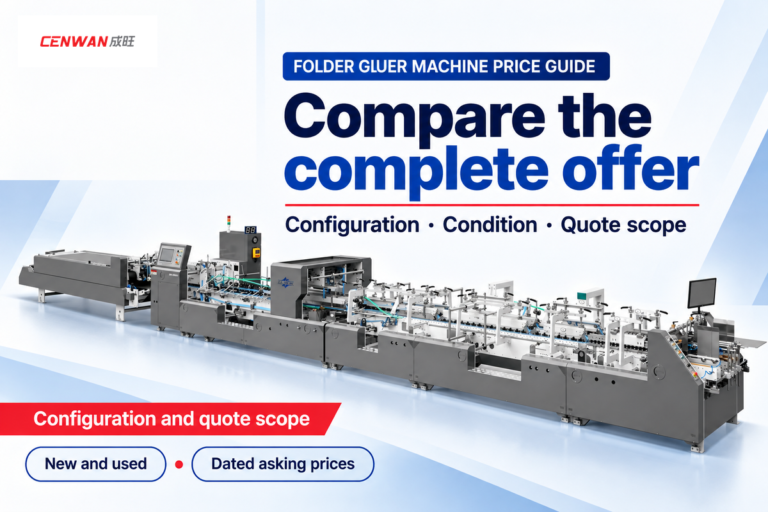
Compare trials using the same material and inspection scope and accepted output definition. Include downtime in the comparison. Setup labor, waste and downstream staffing can change the economics even when rated speeds look similar. Get these conditions for comparisons in the trial agreement rather than accepting an unsupported changeover or yield promise.
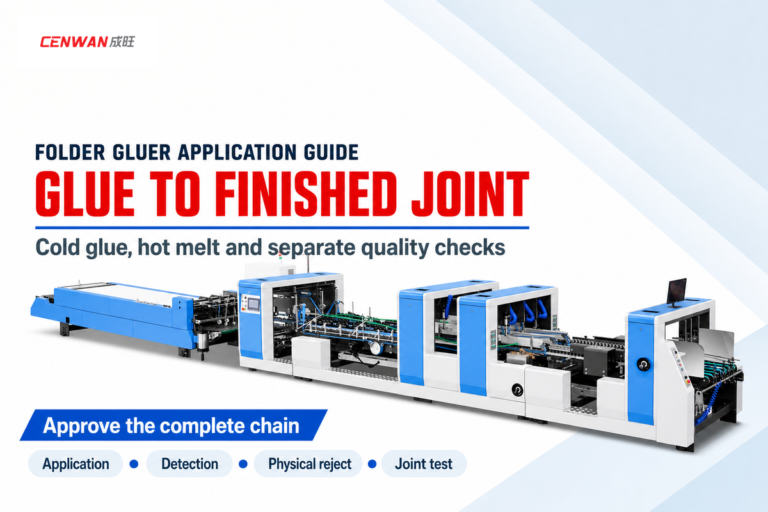
At Cenwan Machine, we manufacture folder gluers and configure equipment based on carton styles and line requirements. Send the job packet to review Cenwan folder gluer machines, so application review can start with the actual blank, folding and production constraints.
Recipe Management Helps Repeat Jobs, but Samples Still Decide
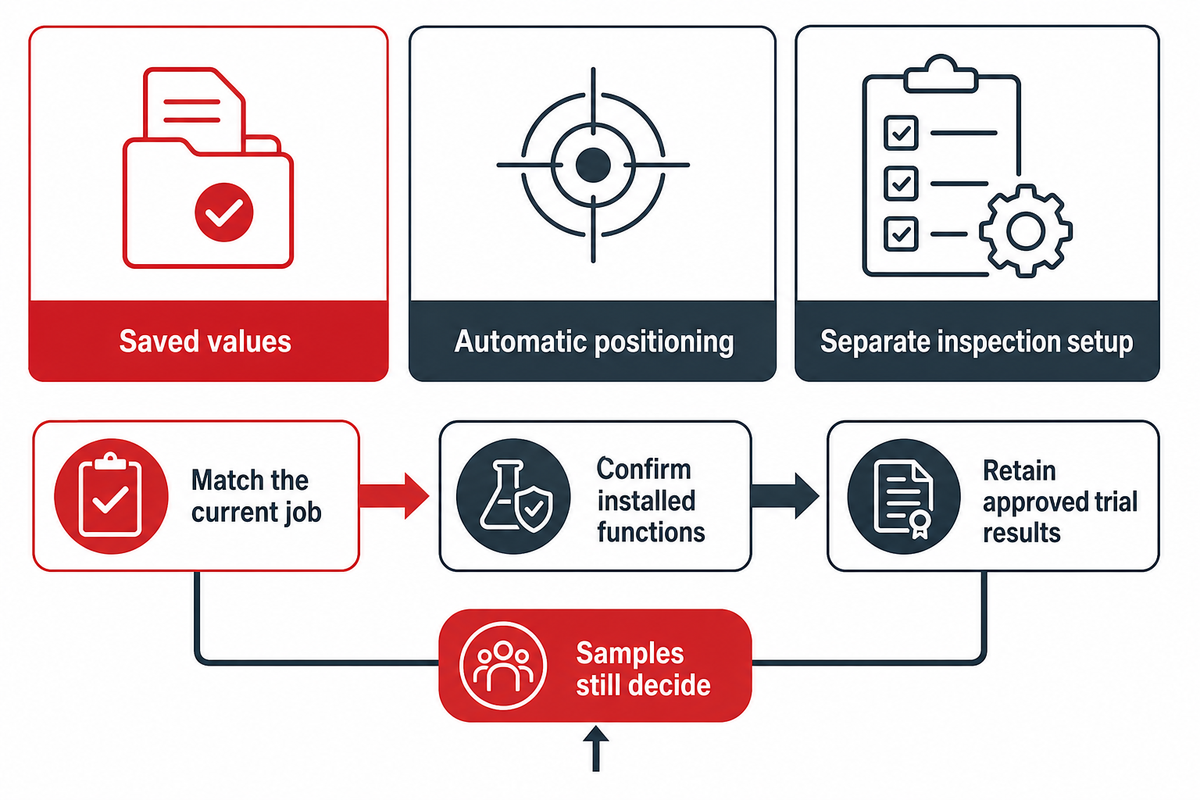
Recipe management allows for the retention of approved values and allows operators to make changes traceable. Match the saved job to the current drawing, board, adhesive and tooling before using it. Parameters stored in memory should be distinguished from automatic positioning and inspection recipes. When assessing an automatic folder gluer machine, those functions are reliant on the installed equipment.
In its 2 October 2025 announcement, BOBST mentioned SPHERE HMI and Job and Recipe Management for EXPERTFOLD 145/165 and SPEEDPACK, as well as an automated blank aligner. This is a specific BOBST workflow. A machine equipped with recipe memory may still need manual positioning and separate inspection setup. This guide covers station-by-station checks across installed machine configurations; for recipe recall, automated positioning and quality-sensor challenges on servo equipment, see our servo recipe verification and sensor-check workflow.
Save approved results of trials, including authorized changes and their rationales. Distinguish superseded results. For an automatic folder gluer quotation, establish which settings are stored, which axes reposition automatically and which checks remain operator tasks. For a practical means of evaluating repeatability, provide a sample result of an identified job.
Frequently Asked Questions
What is the first step in folder gluer machine setup?
Start with the approved job identity.
Start by matching the approved carton drawing, material and adhesive to the installed machine and tooling. Record the drawing and recipe revisions before loading the feeder. Proper folder gluer setup gives the operator a clear job-level reference. Review the applicable safe setup procedure, then work through the installed line. A familiar job name can hide a changed coating, blank or glue specification.
How to fix folding issues in a folder gluer machine?
Find the earliest visible defect.
Trace the defect back to the first station where it appears, using safely removed samples and comparable conditions. Check incoming blank quality and feeder alignment before changing folding settings. Inspect crease position, overlap and opening behavior. After an authorized adjustment, retain the comparison samples and repeat the agreed checks before releasing production.
Why is glue consistency important during operation?
Stable application makes bond results easier to assess.
Consistent application helps maintain the intended glue pattern and transfer to the joint. Changes in dosing or adhesive condition can produce missed areas, stray glue or variable bonding. Use the specified product and application instructions, then inspect samples under the agreed checking conditions. Cold glue and hot melt need their respective process controls.
Why is operator training important for folder gluer machines?
Training connects safe tasks with correct job decisions.
Training gives operators the machine-specific procedures for startup, adjustment, inspection and fault response. It also establishes who may perform exposed work and who releases samples for consistent quality. An experienced operator moving to different folder gluer equipment still needs instruction on its controls, tooling and safeguards.
How does an automatic folder gluer process a carton?
The installed modules transport, fold and bond the prepared blank.
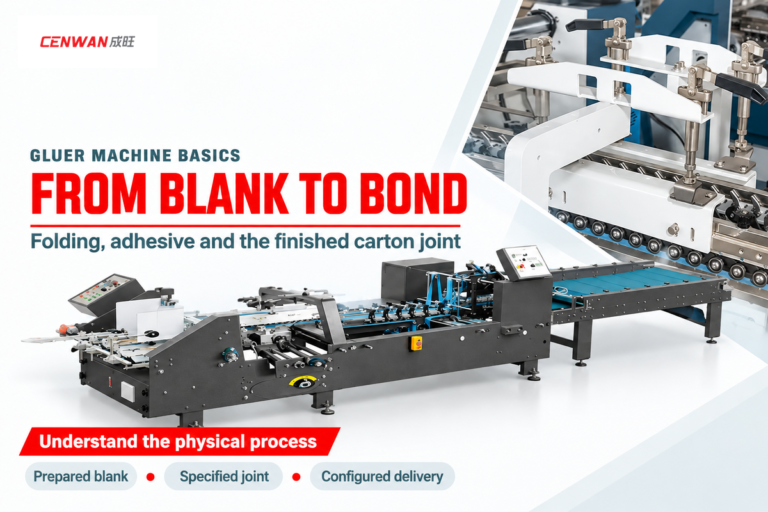
An automatic folder gluer feeds a prepared flat blank through its installed alignment, folding, gluing and compression functions, then delivers it for inspection and handling. Extra modules support the specified bottom or corner actions. Follow the actual machine path: a folding carton gluing machine doesn’t necessarily open every box into its final three-dimensional form during that pass. Sample checks include the carton’s intended later opening and use.
Can a saved recipe replace first-article approval?
No. Check current samples before release.
No. A stored recipe provides a repeat-job reference, while approval checks the current material, drawing, adhesive and machine condition. Review fresh identified samples, document authorized changes and retain the approved version. Continue the agreed inspection plan during the production run.
How should buyers compare supplier setup trials?
Use the same job and accepted-output definition.
Compare trials with representative production blanks, the same finished-carton requirements and an agreed test and inspection plan. Record setup labor, waste, accepted output and downstream handling conditions as well as speed. Separate initial sample approval from batch acceptance and ongoing checks. A useful supplier report identifies the machine configuration, changes made, failed samples and retest results, so the comparison reflects the actual application rather than a nominal speed claim. Include the recipe version and the handling arrangement used after compression. When two offers use different packing crews or inspection conditions, separate those effects before comparing accepted production rates or operating labor.
Prepare Your Next Setup Trial
Bring the drawing, representative blanks, adhesive details and required finished-carton checks. Discuss the line configuration and sample plan with our team before scheduling the trial.
Scenarios used in the illustrative examples are hypothetical. Use the installed equipment instructions and approved site procedures for machine operation.
Prepared from guidance by manufacturers and adhesive articles, and abstracts and references of public authorities reviewed in October 2026.
References & Sources
- The control of hazardous energy, 29 CFR 1910.147 OSHA.
- ISO 12643-4:2023: Converting equipment and systems International Organization for Standardization, public abstract.
- Effects of rotational velocity and hold time on creased paperboard release behavior Nagasawa, Kaneko and Adachi, 2019, research abstract.
- What is Acceptance Sampling? NIST/SEMATECH Engineering Statistics Handbook.