Get in touch with Cenwan Machine Company


By GW · Updated October 2026
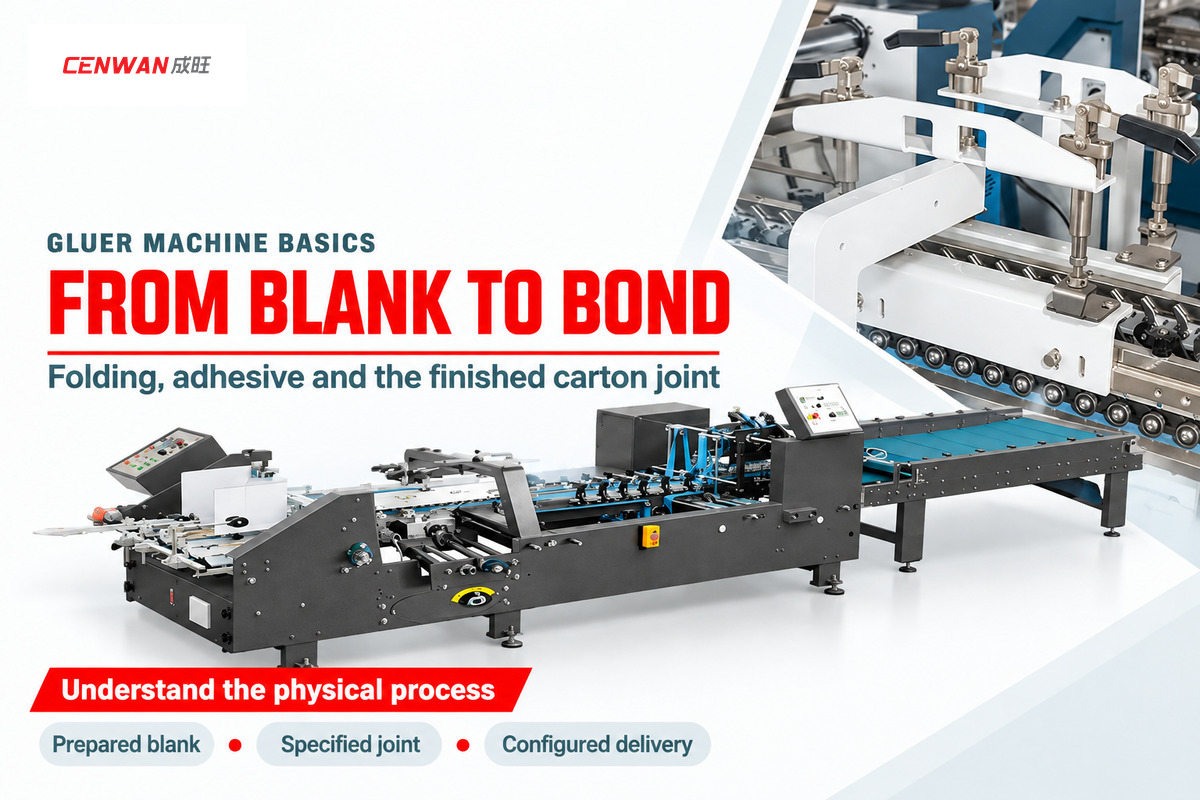
For a buyer asking “What’s a gluer machine?”, a joint is a good place to start. A packaging gluer uses adhesive to join different parts of a carton. A folder gluer also folds a blank. An integrated flexo folder gluer can combine upstream printing and converting with folding and gluing. The normal carton-converting output is delivered flat for later erection and packing.
This guide follows a prepared blank through a standalone folder gluer. It explains how the panels meet, why the glue flap matters and what changes when another operation joins the line. For model selection, drives and purchasing detail, use the existing folder-gluer buying guide.
Quick reference: the machine’s job
| Typical input | Die-cut and creased carton blank |
|---|---|
| Core work | Controlled folding, adhesive application and joint compression |
| Usual delivery | Glued, collapsed carton ready for later opening |
| Configuration questions | Feeding, material, carton folds, glue system and delivery |
A summary of the process depicted in FEFCO’s converting examples, and manufacturing examples outlined in this report, is presented below. Special forming equipment may have different delivery arrangements.
What does a gluer machine actually produce?
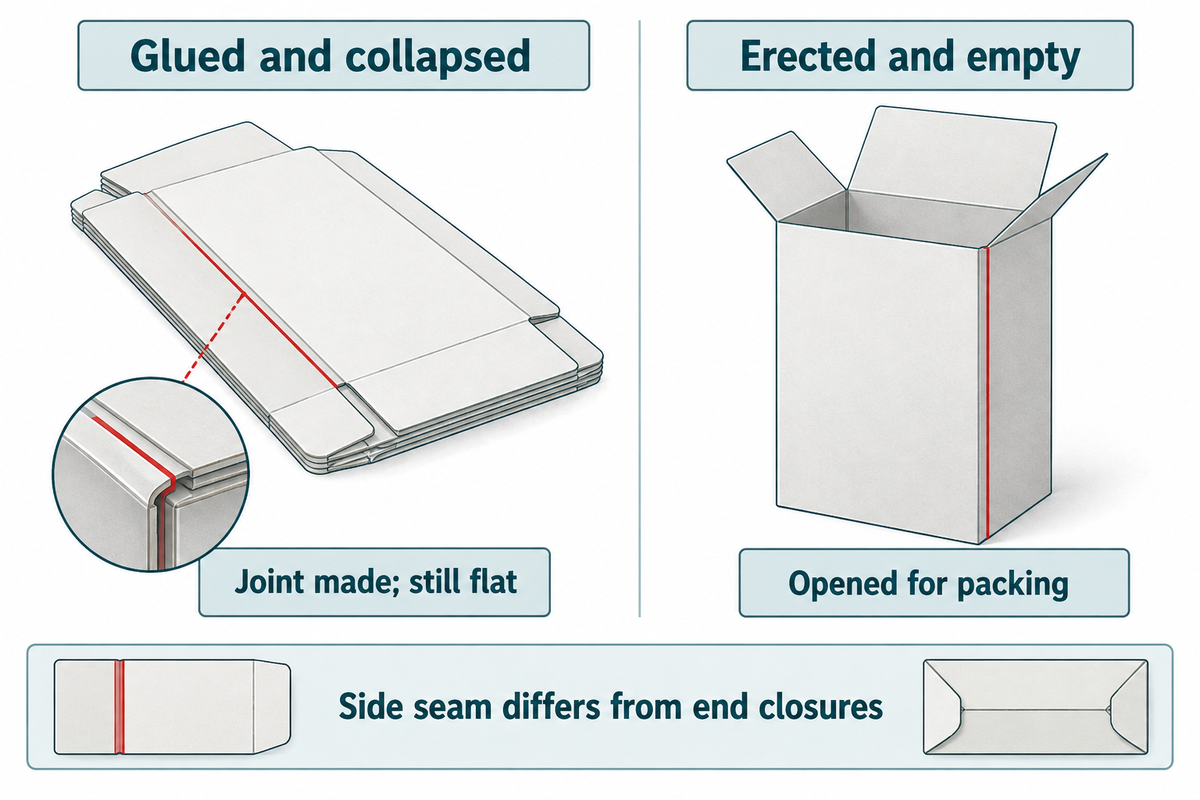
An ordinary carton folder gluer creates the joint in the folded and glued packaging, which is often collapsed. It produces the given joint, like a side seam, leaving the opening, filling and closing to the packing process. A converted carton is a completely different product from a filled shipping case.
FEFCO’s description about corrugated board’s production process mentions palletizing and flat shipping. That’s useful because a stack of flat cartons may represent the intended finished product of the converting machine.
Carton boxes, when shipped flat, fully occupy their three-dimensional shape upon opening. A side seam serves a different purpose from the end closures.
Consider a tuck-end retail carton. Before gluing, its panels are in a cut and creased sheet with a narrow glue flap along one edge. Folding brings that flap to the matching panel to form the side seam. The carton can then be placed in a stack in a flat position. At the packing line, the carton is opened to provide volume, the product is loaded, and the end flaps are closed. From the converter’s perspective, the carton has been made, and the remaining operations make it ready for the market. From the production and purchasing perspective, the main consideration is which of the physical changes the offered machinery can perform.
Glued and collapsed
The specified joint is made. The carton can still be stacked flat and opened later.
Erected and empty
The carton or case has been opened into its three-dimensional shape, ready for the next packing operation.
How does the folding and gluing process work?
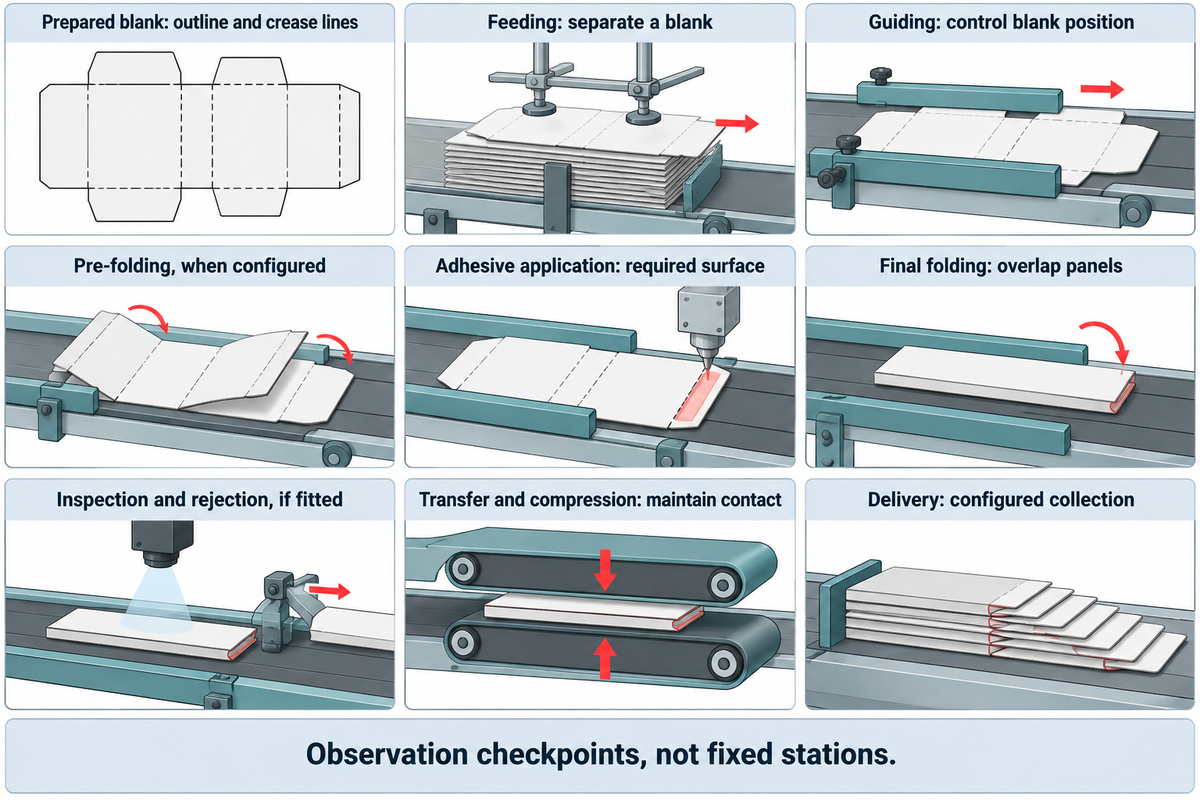
A folder gluer separates blanks, works the prepared folds, places adhesive where the joint requires it, and folds the panels together to form the joint, and holds it till delivery. A folding and gluing machine uses belts, guides and rollers in a configuration suited for the carton. Certain jobs may require additional folding or inspection devices.
How does a folder gluer machine work?
A folder gluer machine controls the position of a selected carton blank as its panels fold and overlap to close the joint. Prior to its closure, adhesive reaches the joint. Compression maintains contact between the surfaces, and the delivery section of the device controls the outgoing carton stream. The blank, adhesive, and installed equipment determine the timing and position of the actions.
Pre-breaking works prepared creases, which can be reopened prior to final folding. The upstream die-cutting operation has previously formed the blank outline and crease geometry. Separating these tasks gives a rationale for why an accurately guided blank may fold poorly when its prepared crease is unsuitable.
Box folding turns panels around those prepared lines. Registration provides the positional precision that brings the intended panels and glue area together.
Blank-to-Bond Trace
Use this trace in conjunction with a dimensioned flat blank and a finished sample. Production employees can trace the position change; Quality can identify the actual joint; Procurement can ask which machine performs the task. The rows are observation checkpoints, rather than guaranteeing that each machine has nine separate stations.
An approved sample also shows what a high-quality fold and joint should look like for that job.
| Checkpoint | What changes | Observation to carry forward |
|---|---|---|
| Prepared blank | The cut outline and crease lines define the panels. | Identify the glue flap and intended mating surface. |
| Feeding | A blank separates from the supply and enters the transport path. | Follow the complete flat shape, including narrow sections. |
| Guiding and registration | Guides and conveyors control the blank’s position. | Locate the fold lines relative to the transport direction. |
| Pre-folding, when configured | Selected creases are worked before final closure. | Distinguish working a crease from creating it. |
| Adhesive application | A wheel or configured valve places glue on the required surface. | Mark the joint before the mating panel covers it. |
| Final folding | Panels overlap to make the specified carton structure. | Match each fold and glue point to the carton design. |
| Inspection and rejection, if fitted | The selected system checks features and identifies rejects. | Ask exactly which feature is inspected and how rejection occurs. |
| Transfer and compression | The folded carton transfers while the joint surfaces remain in contact. | Identify the pressing arrangement for the chosen adhesive and carton. |
| Delivery | Glued cartons leave in the configured stream or collection arrangement. | State whether the next operation receives collapsed or formed packaging. |
This synthesis of published folder-gluer features and gluing system descriptions gives a general idea about joints and their functionality. Optional equipment and its location vary from machine to machine; just identifying a glue pattern doesn’t ensure the final joint is strong.
A 2025 discussion by an operator about the first folder-gluer job shows the feeding checkpoint. The operator said the job folded, but a blank with a narrow center twisted during feeding. He asked where an experienced operator would position the feeder stops. This indicates a problem, but not a solution. For an operator looking at a similar carton, it highlights the whole flat shape. The finished box dimensions leave out the geometry the feeder actually handles. A drawing, along with a sample, helps the supplier talk about the geometry before the job reaches production.
Automatic movement still requires job preparation and monitoring. Operators set up the selected carton, supply blanks, observe folding and adhesive application, and manage the delivery arrangement. Saved positions can help repeat work, while the individual blank can still need refinement. The detailed folder gluer operator responsibilities belong with the site’s role guide.
ICPCBF3950, Set up and operate folder gluer machine, describes feeder preparation, folding, gluing and stacker units, and provides a summary of the job. It isn’t a statement of a US licensing requirement.
“Having an experienced folder-gluer operator still is very important, even with automation and computer technology.”
Which types of gluer machine are used in packaging?
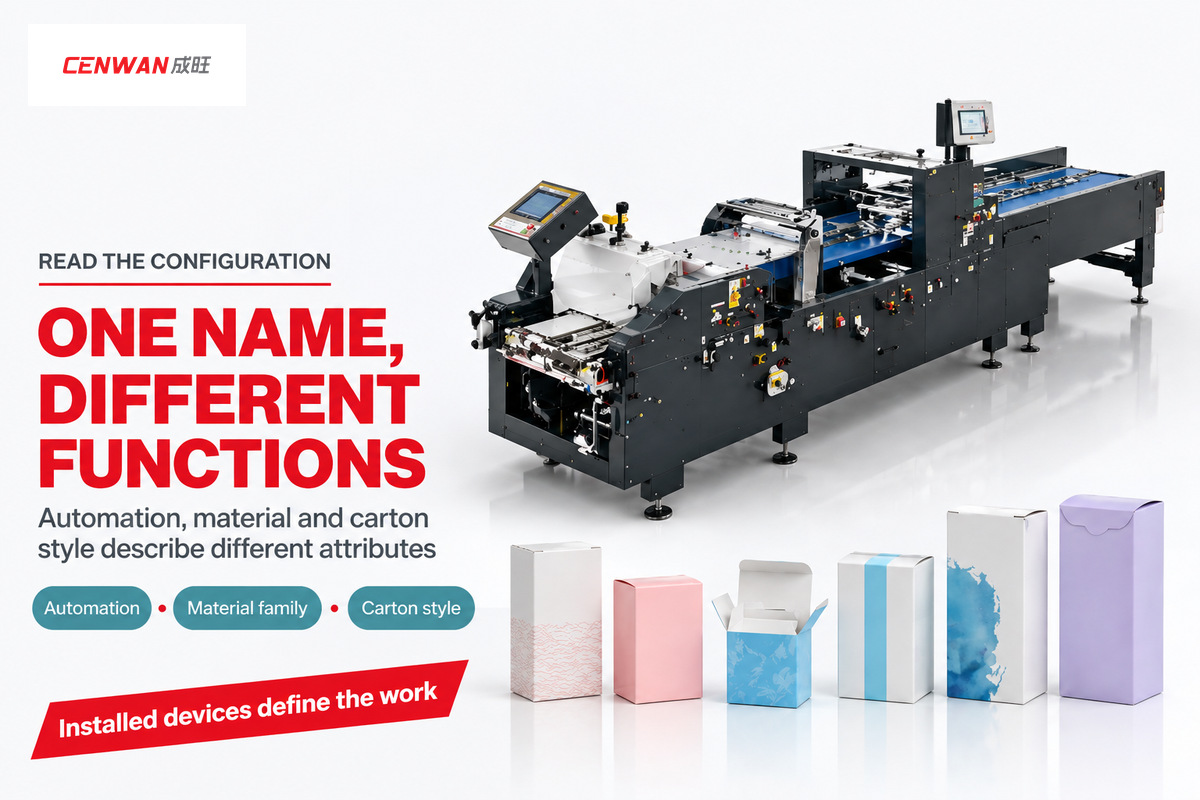
Types of folder gluer are described in detail through separate configuration questions. Manual or automatic describes how the blank is positioned and how the board is fed into the machine. Paperboard or corrugate describes the family of materials. Straight-line, lock-bottom or multi-corner describe various styles of carton and the folding required. A folder-gluer machine can handle more than one carton style.
For example, a box gluer, which is manually fed, can apply a programmed adhesive line, while the operator positions the blank. Published equipment descriptions also offer optional automatic feeding and folding attachments. In this instance, calling the equipment a gluing machine leaves a critical question unanswered: which movements does the installed configuration perform?
An automatic folder gluer uses mechanized feeding and transport of blanks to fold and glue. “Automatic folding and gluing” describes those functions; it doesn’t describe the range of the board, every carton design or the work around the machine. More complicated packaging designs can require special folding devices or glue points.
Versatility is derived from the functions and their format limits.
A high-speed specification is yet another attribute in addition to those described previously. Packaging manufacturers, while handling large volumes, require the arrangements provided to match their carton and delivery work. The main comparison, however, is with the required operation. The deeper comparison is available in the existing carton-style selection guide.
Which carton materials and box styles can it handle?
A material range comprises only part of a folder gluer’s application. The flat blank must also suit the transport and folding arrangement of the machine, and its glue surfaces must suit the adhesive. The carton structure, its surface condition and the installed machine devices must be considered.
A review of coated packaging materials, published in a scholarly journal, discusses how converting can change a substrate and its coating. A study on paperboard folding discusses how prepared crease deviation impacts the folded geometry. These are material studies of defined conditions and don’t provide universal folder-gluer settings.
Carton Style-to-Joint Map
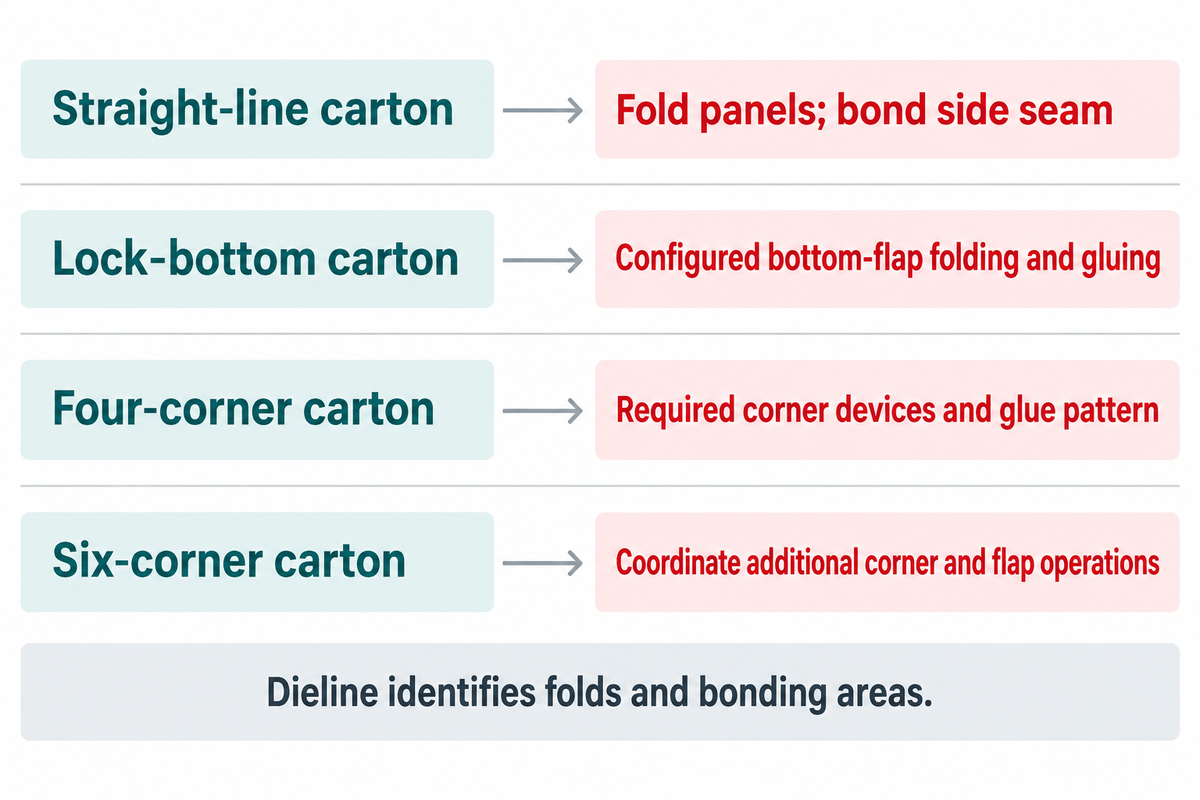
The map links a familiar carton label to the operation it requires of the machine. Use the dieline to identify the folds and bonding areas. A catalog illustration is a starting point. The specified format, together with the function of the machine, defines the scope of the offer.
| Carton structure | Joint and folding work | Useful sample detail |
|---|---|---|
| Straight-line carton | Fold the panels and bond the side seam. | Show the glue flap and the overlapping panel. |
| Lock-bottom carton | Add the configured bottom-flap folding and gluing sequence. | Include the complete bottom geometry in the flat blank. |
| Four-corner carton | Use the required corner-folding devices and glue pattern. | Identify the corner panels and their folding direction. |
| Six-corner carton | Coordinate the additional corner and flap operations. | Supply the full structure, including the lid arrangement. |
Public-source descriptions of carton styles and folding modules help characterize a suitable machine configuration. The descriptions aren’t mutually exclusive.
Suppose an in-house carton shop wants to add a six-corner cosmetic box to its straight-line work. Both jobs use cardboard, but the new blank asks for another folding sequence and glue-joint pattern. Cenwan’s published CW-G format matrix lists straight-line and lock-bottom work for CW-G-650, while CW-G-880 and CW-G-1100 add four- and six-corner formats within their respective size limits. The useful enquiry therefore includes the new flat blank and required structure. Naming the same board material for both jobs leaves the extra folding work unspecified.
The surface condition of the joint also plays a role. According to Kevin Koplin and Shawn Rogers of American International Machinery, adhesion to a coating on the glue-flap area could be unreliable, and therefore that area should be left uncoated. Joints require an appropriate surface while surrounding areas can have a different function.
A 2026 industrial die-cutting and creasing study separates blank preparation and folding work. Tooling trials are done for particular coated boards. Across packaging industries, the handoff requires the actual material and prepared geometry. A pharmaceutical carton, food and beverage pack or cosmetic box calls for its intended joint and product quality, and the durability expected of the final product.
How does a folder gluer differ from other packaging machines?
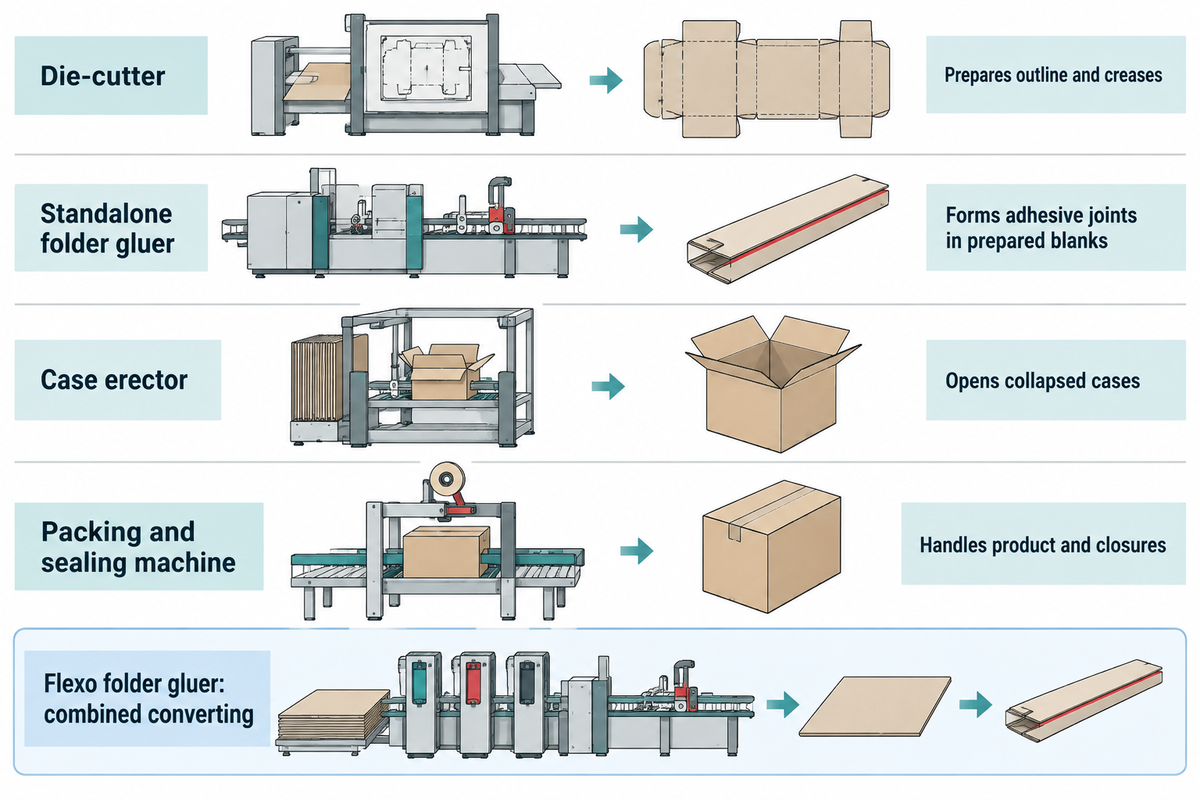
A standalone folder gluer works on the prepared blank and its adhesive joints. A die-cutter prepares the outline and creases; a case erector opens collapsed cases; a packing and sealing machine handles the product and closures. A flexo folder gluer integrates several converting operations. The capability of the system defines the limits. For comparisons across equipment categories, see how to compare gluing, pasting and case-sealing routes.
FEFCO distinguishes machinery that combines converting operations from machinery that performs them separately. This also separates the corrugator (corrugated board) from the converting equipment that turns that board into corrugated boxes. Printing is a separate function to identify when describing the line.
Inline work can alter the layout. A Packaging Strategies report on the HERMA and BAHMÜLLER integration shows that label application is performed between feeding and folding. This is a specialized third-party arrangement that demonstrates that additional gluing equipment, labeling or inspection should be named in the machine scope.
How much does a glue machine cost?
Request a quotation for the described configuration and carton. The supplied packages may vary, and feeding, format, folding devices, adhesive application, and inspection may describe different packages under the same broad machine name. Include installation and operational scope when you compare a box-gluing machine quotation. A flat blank and the required output state provide a good starting point for the supplier.
Key takeaway
Describe the incoming blank, the fold and glue joint, and the required outgoing carton. Those physical details make a gluer-machine discussion useful before a model or a production rate enters the conversation.
Frequently asked questions
What is a pasting machine?
A pasting machine applies adhesive to join the materials or surfaces required by its application.
In packaging, the term can describe equipment applying glue to a carton joint, but the name alone leaves the folding and handling arrangement open. Identify the material, the bonding area and whether the supplied equipment folds the blank. Applications such as envelope work can use different movements from a carton folder gluer. Before selecting a box folder, identify whether the job needs folding alone or a bonded seam.
Where can I find a carton pasting machine for sale?
Carton pasting machines are offered by equipment manufacturers and machinery dealers serving the required converting process.
Start with the carton rather than a generic listing. Provide a dimensioned flat blank, its material and a finished sample, then ask which folding and adhesive operations the offered machine includes. Cenwan’s published product range is one place to discuss its available configurations. Include the material supply and delivery arrangement in the enquiry so the supplier understands the complete work.
What does a gluer operator do?
A gluer operator prepares the job and monitors the machine’s folding, adhesive application and output.
The role includes matching the job to the installed equipment, supplying material and observing the carton as it passes through the line. An adjustable belt or roller position belongs to a particular machine and job setup. Automated positioning and saved settings can support repeatability, while an operator still manages the feeder, delivery and quality checks for the actual carton.
Can a folder gluer switch corrugated box jobs quickly?
Changeover time depends on the cartons and the installed adjustment systems.
Ask for a demonstrated change between your actual blanks. Maximum belt speed describes a different operation from preparing the machine for another carton design.
How many operators does a folding and gluing machine need?
Staffing depends on the complete operating arrangement, including material supply and delivery handling.
Automatic folding and gluing shifts repetitive work from manual labor to equipment, but people can still replenish blanks, monitor the process, remove output and perform checks. A collecting device or automatic feeder changes how those tasks are shared. To assess a proposal to reduce labor costs, follow the carton through the offered line and identify each remaining task. Compare the same carton, run length and accepted output when discussing productivity. That gives the team a concrete arrangement to evaluate. A machine’s advertised automation level is only one input; the work around it determines how duties can be combined during the actual shift.
References and sources
- Australian public training unit ICPCBF3950: Set up and operate folder gluer machine, Release 1, job preparation and unit functions.
- FEFCO: Production process corrugating, converting and flat shipment.
- Lev and colleagues, BioResources, 2023: Converting and its effects on barrier properties of coated packaging materials.
- Jina and colleagues, AIMS Materials Science, 2023: Folding behavior of paperboard with a deviated crease.
- Lev and colleagues, BioResources, 2026: Industrial die cutting and creasing of dispersion-coated folding boxboards.
- Jeff Wilcox, PostPress, 2024: A Viewpoint on Folder-Gluers, Yesterday and Today.
- Kevin Koplin and Shawn Rogers, PostPress, 2020: Working with Short-Run Cartons authors affiliated with American International Machinery.
- Packaging Strategies, 2024: BAHMÜLLER and HERMA specialty folder-gluer integration product news with supplier comments.
![Folder Gluer Parts: Components, Wear & Replacement [2026]](https://cenwanpack.com/wp-content/uploads/2026/05/0-1-150x150.png)