Get in touch with Cenwan Machine Company

How to Select a Box Gluing Machine for Your Production Mix

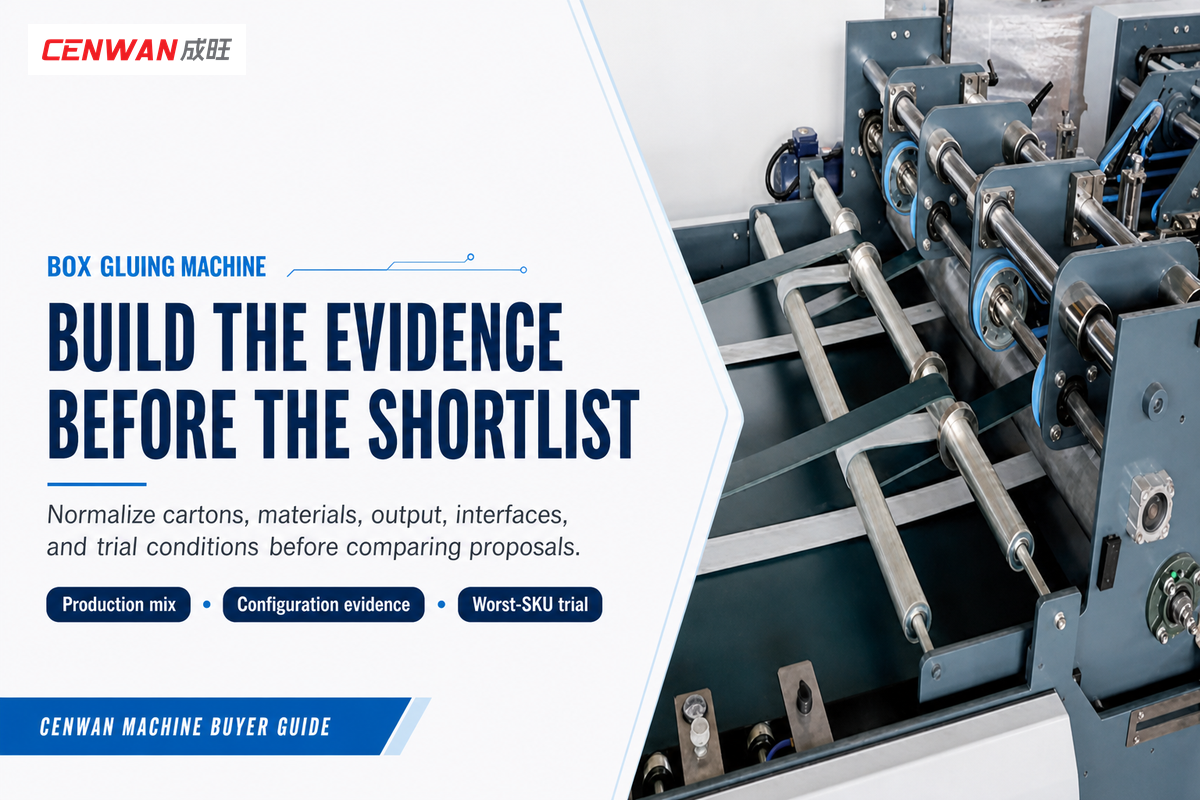
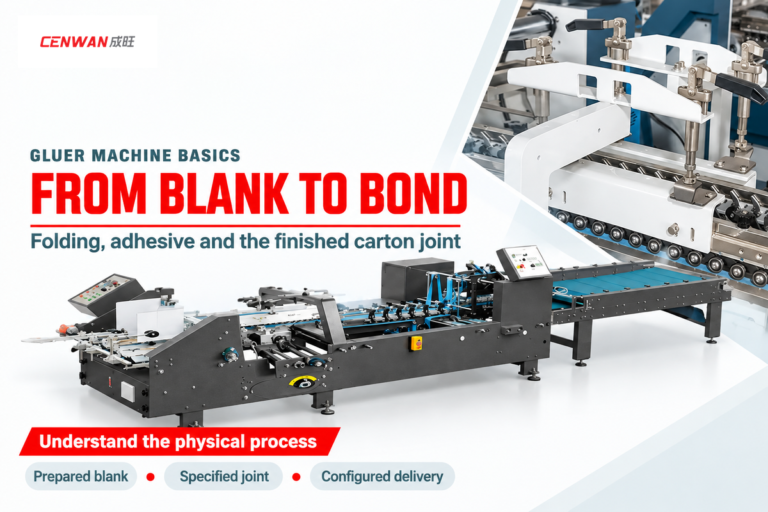
A box gluing machine is equipment used to fold and bond compatible carton constructions within a packaging workflow. Choose a box gluing machine from the cartons you must run, not from the largest speed figure in a brochure. Useful buying briefs record the carton construction, dimensional envelope, material and adhesive process, production mix, changeover pattern, observed good-box output, utilities, line interfaces, and pre-purchase trial evidence. Suppliers can then quote against the same job instead of interpreting a vague request in different ways.
This is a requirements-normalization guide for production, engineering, quality, and procurement teams. For a plant that must manufacture cartons for the packaging industry, the useful solution brief explains what the line must fold and glue and which evidence is still missing. Such a brief isn’t a machine-type catalog, an automatic-versus-semi-automatic comparison, a changeover improvement method, a throughput calculator, or a model recommendation. Cenwan already has separate resources for those decisions. Here, the goal is to build a common evidence package before a shortlist or request for quotation is approved.
Search labels such as “manual box gluing machine,” “automatic box gluing machine,” and “box gluer” are only starting points. The same applies to “small box gluing machine,” “box gluing machine price,” and “best box gluing machine”: translate each phrase into the evidence fields below before creating a shortlist.
Supplier terminology crosswalk
Catalogs may describe a folding and gluing machine as a carton folder gluer, carton folder gluer machine, box folder, box folder gluer, folder-gluer machine, or simply box machines. Treat box folding, box folding and gluing, folder-gluing, and accurate folding and gluing as functions to verify, not interchangeable proof.
For an automatic folding and gluing or high-speed box line, record whether high-speed, servo, adjustable, pre-folding, feeding section, crash lock bottom, and cold glue refer to included hardware, options, or test conditions.
Do not turn a statement that a line runs efficiently into a measured efficiency or productivity result. Keep production speed and boxes per hour in separate, condition-bound fields.
Translate corrugated box, RSC, packaging materials, printing, packaging line, box production, and packaging needs into specific drawings, samples, interfaces, and outputs. Market labels such as pharmaceutical, cosmetic, and beverage describe intended packaging categories, not regulatory approval.
ISO and CE are document labels in a proposal, not proof by themselves. Require the exact standard, scope, issuer, applicable machine configuration, and current supporting record.
Start With the Production Mix, Not Rated Speed
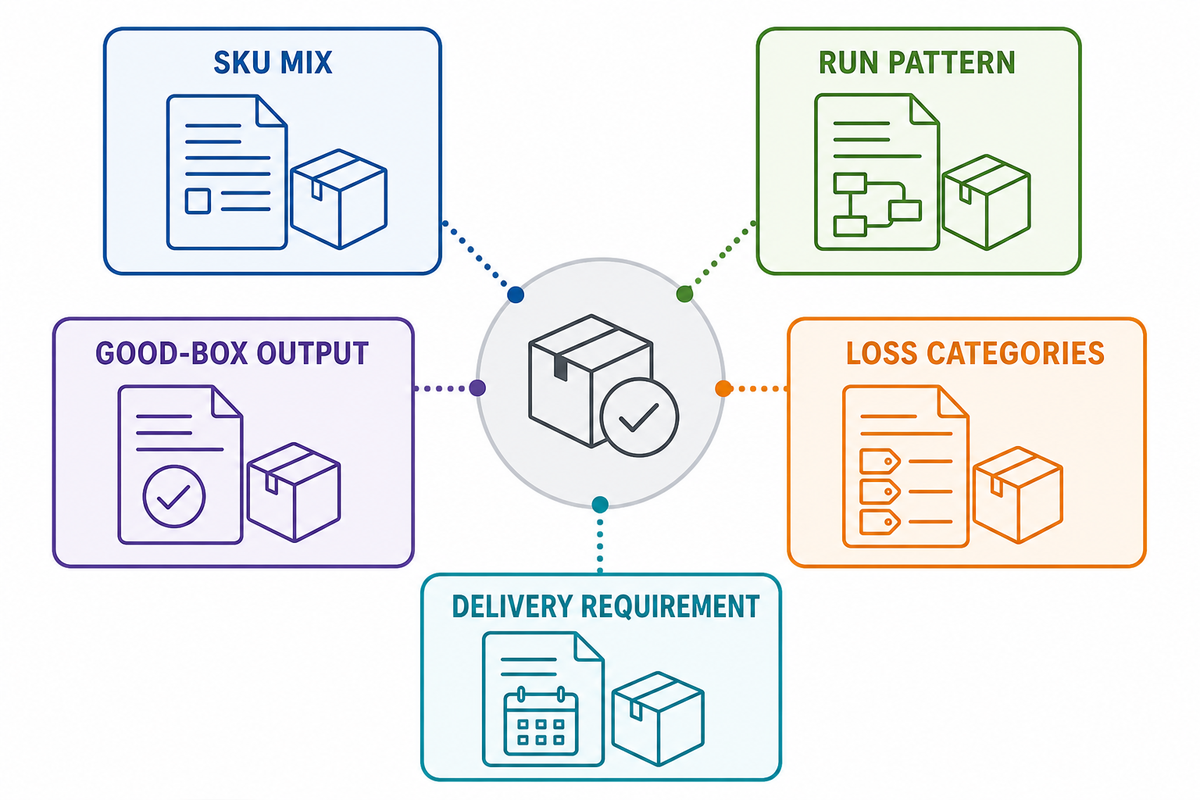
Catalog maximums describe machines under conditions chosen by their manufacturers. They don’t tell a production manager how many saleable cartons a mixed shift will deliver. Mixed shifts also contain setups, first-article checks, feeding interruptions, inspection decisions, rejects, short stops, and downstream constraints. Start instead with a dated production-mix record.
| Input | Record | Evidence state | Owner |
|---|---|---|---|
| SKU mix | High-volume, frequent, seasonal, and difficult cartons | Measured / estimated / unknown | Production planning |
| Run pattern | Typical and shortest run lengths; shifts and planned minutes | Current record / forecast / unknown | Production |
| Good-box output | Accepted cartons by SKU and stated time window | Observed / supplier trial / not tested | Quality and production |
| Loss categories | Setup, startup waste, reject, rework, stop, and downstream wait | Observed / not separated / unknown | Production engineering |
| Delivery requirement | Output needed by shift, day, or campaign | Approved / provisional | Planning and procurement |
Use “unknown” where the plant has no defensible measurement. Blank fields are more useful than safe-looking assumptions because they tell the supplier and buyer what still needs to be tested. One named 2014 implementation reported about 4 min to recall a stored repeat job and 1–2 hr to program an entirely new job; the same case also described glue, inspection and rejection, compression, prefeeding, and downstream packing as parts of the result. Those figures belong only to that installation and are not purchasing benchmarks, but they show why a headline rate needs its operating conditions. Packaging Digest’s named folder-gluer case
Unit discipline matters throughout the record. Keep linear speed separate from cartons per hour, gross output separate from accepted output, and setup time separate from stable-run time. Preserve the observation window and carton identity next to every number. Converting unlike measures into one apparent rate may make a proposal look easier to compare, but it can hide the actual production constraint.
Match Carton Construction to Machine Architecture
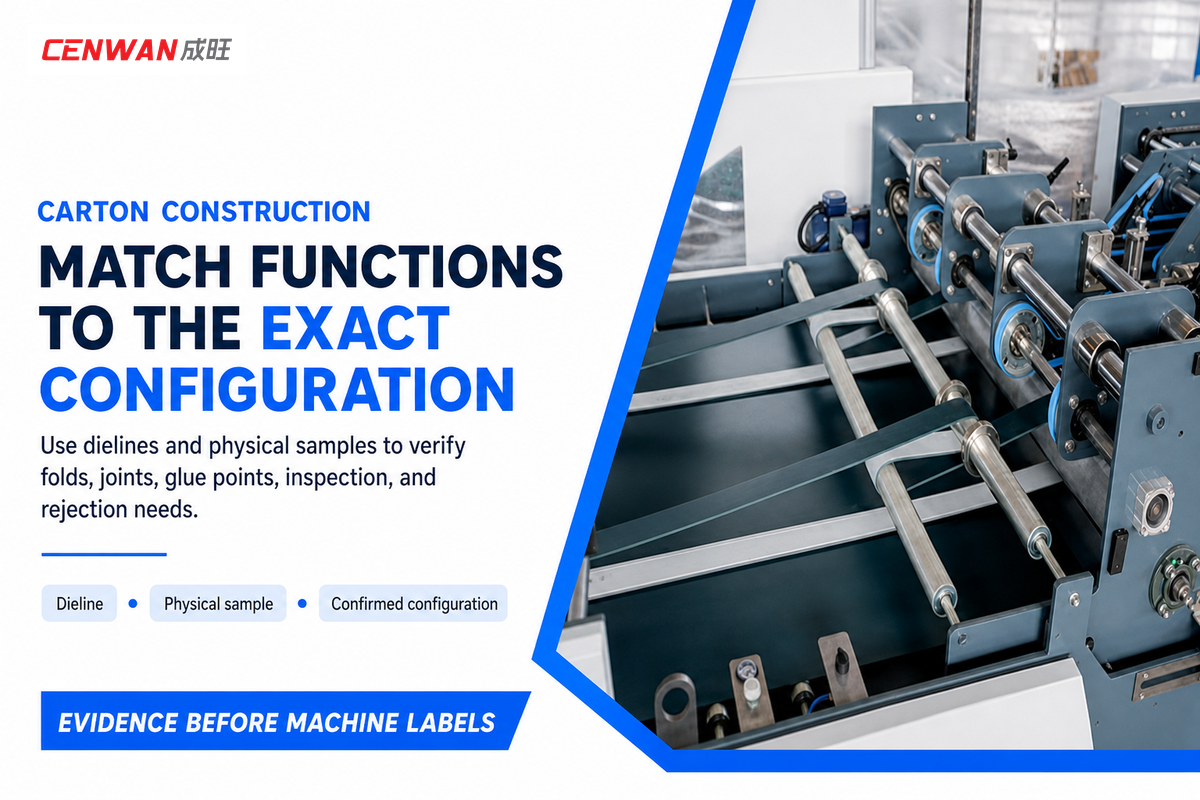
Begin with dielines and physical samples. For each carton, identify the joint to be glued, the fold sequence, pre-fold requirements, bottom-forming work, number and location of glue points, and any section that must be inspected or rejected. This converts a product name such as “straight-line” or “four-corner” into functions a supplier can confirm against an exact configuration.
FEFCO describes corrugated packaging production as a converting route that’s specific to the packaging being made. That supports a narrow but important boundary: construction and converting requirements come before a universal machine label. Nothing on that page proves which model will run a buyer’s carton. FEFCO production-process overview
Keep the actual type comparison on the pages that own it. Use Cenwan’s folder gluer machine types guide for machine-class differences and the box style guide for straight-line, lock-bottom, and four- or six-corner tradeoffs. In this buying record, list only the required functions, the representative sample, the supplier-confirmed configuration, and anything not proved.
Define the Smallest and Largest Production Envelope
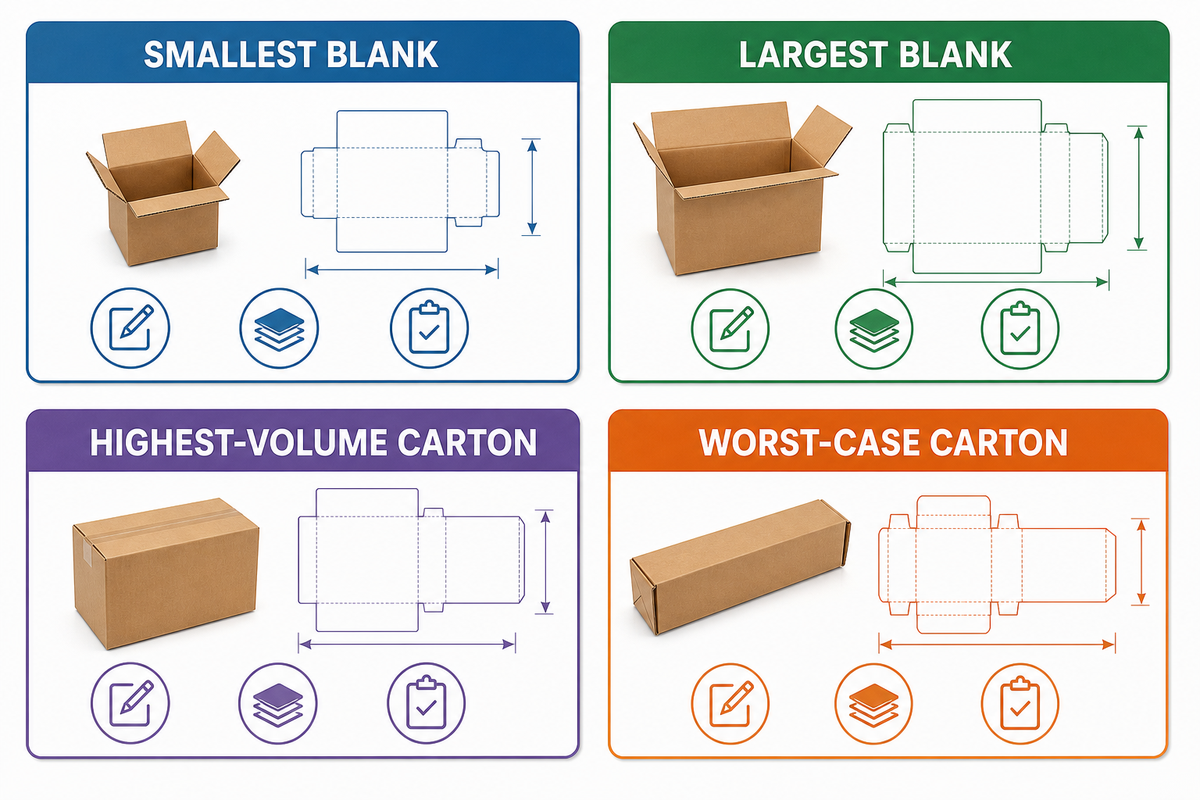
Published minimums and maximums do not prove that every format between them feeds, folds, glues, compresses, and exits reliably. Record blank length and width, finished dimensions, board thickness or flute, and grain or corrugation direction where relevant. Add the dieline and a physical sample for the smallest, largest, highest-volume, and hardest-to-feed cartons.
Engineering must ask where the constraint appears, not merely whether a blank fits within a range. Small blanks may challenge feeding or tracking; large blanks may fit the nominal width but require a configuration, access space, or downstream handling arrangement not included in the proposal. Coated or highly creased samples may introduce a different folding and bond question from uncoated cartons with the same dimensions.
The risk is a false compatibility assumption because nominal width alone does not describe feeder control, inspection access, service access, compression, or downstream handling.
Dimension-envelope worksheet
- For the smallest blank, record the drawing revision, material, travel orientation, physical sample and feeding result.
- For the largest blank, record the drawing revision, material, required sections, access constraints and delivery result.
- For the highest-volume carton, record required good-box output and the conditions attached to that requirement.
- For the worst-case carton, record why it’s difficult, sample quantity, untested conditions, and owner of the evidence.
Ask the supplier to mark each row as confirmed from model documentation, demonstrated on the agreed configuration, not tested, or outside scope. Do not turn a nominal range into a compatibility statement that the evidence does not support.
Compare Automation by Good-Box Evidence, Not Labels
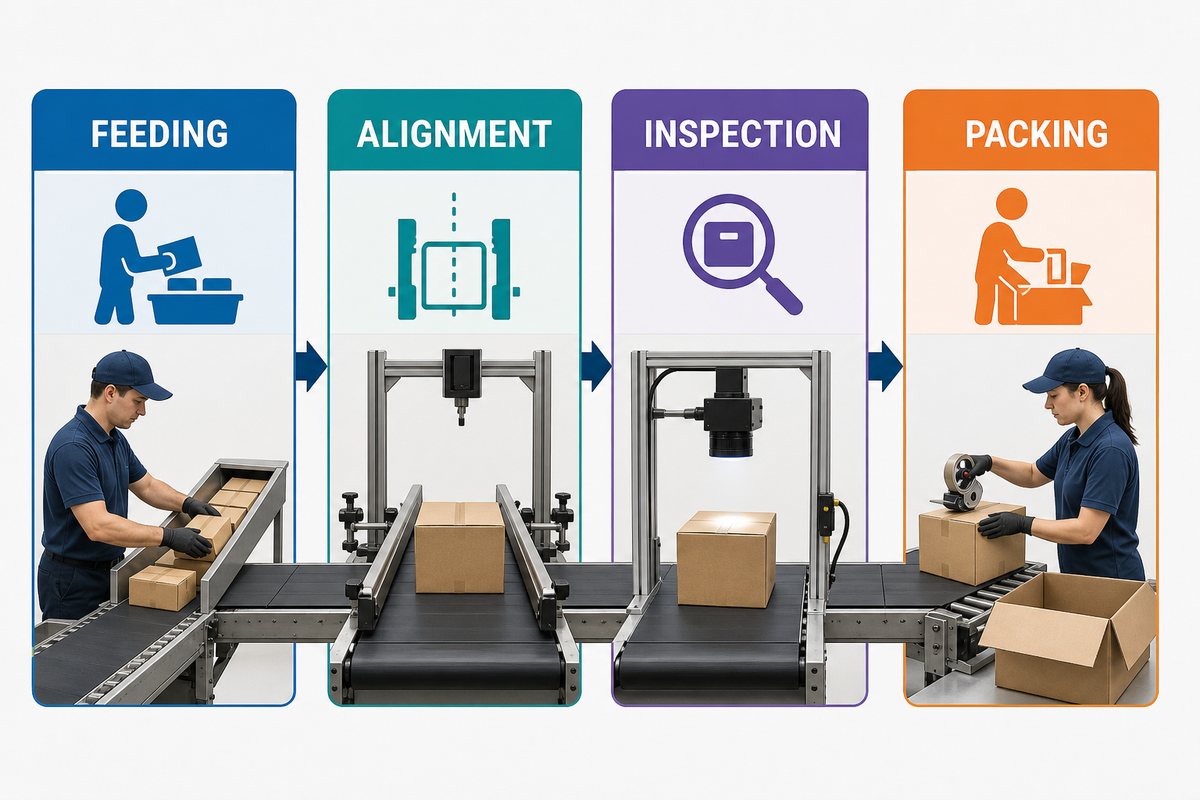
Before deciding among manual, semi-automatic, and automatic approaches, document the work that people and connected equipment currently perform. Count feeding, alignment, transfer, inspection, rejection, packing, and material-handling touchpoints. Record staffing by shift, run-length distribution, startup waste, rework, and the capacity of the process immediately before and after the gluer.
This section deliberately stops there. Cenwan’s automatic versus semi-automatic folder gluer guide owns the comparison of throughput, labor, quality, volume, mixed fleets, upgrade triggers, and cost. Its folder gluer throughput estimator owns planning calculations. Do not duplicate either decision with a second formula or a one-size-fits-all payback claim.
Bring five facts to those resources: current labor touchpoints, observed good-box output, short-run frequency, changeovers per shift, and the downstream limit. Keep any unknown field unresolved until measurement or a controlled supplier trial closes the gap.
Validate Board, Adhesive, Folding, and Compression Fit
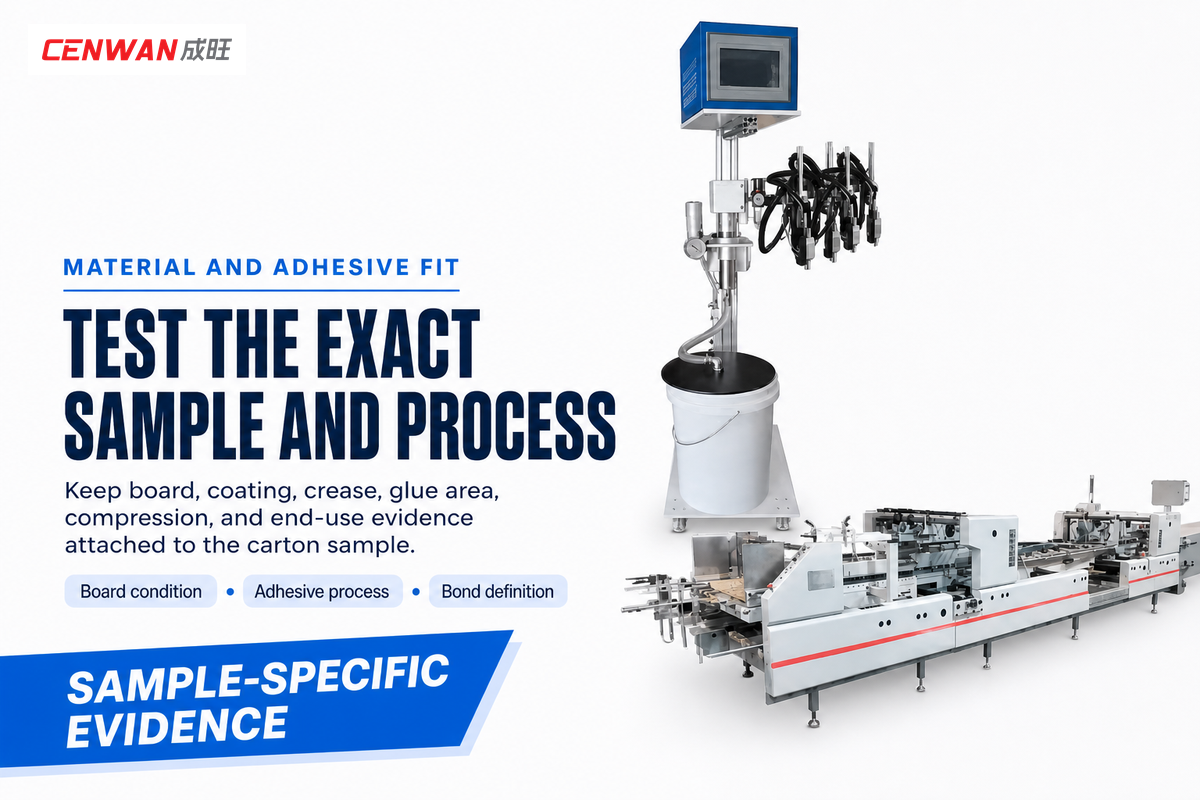
“Cardboard” is too broad for a decision-grade specification. Identify whether the job uses folding carton or corrugated board, then record grade or flute, thickness, coating or surface treatment, crease and fold condition, glue area, and the required compression or cure context. Keep the material specification with the exact carton drawing and sample.
Adhesive performance belongs to a material-and-process combination. Record the adhesive system or supplier process, application location, ambient conditions, open-time constraints where applicable, compression arrangement, and the buyer’s good-bond definition. Success on one sample does not prove the whole portfolio, and general material labels do not prove every coating or surface treatment.
What types of cardboard can the machine process?
Compatibility is configuration- and sample-specific. Ask for the model’s documented range, then test representative folding-carton or corrugated samples with the stated flute or grade, blank dimensions, coating, crease condition, glue area, and box style. Results should say what was tested and what was not; they should not convert “paperboard,” “corrugated,” or a nominal thickness range into proof of every material inside that label. Include feeder, fold, glue, compression, and delivery observations in the trial record.
For food-contact packaging, add the target market, end use, conditions of use, and named compliance owner. Under 21 CFR 175.105, adhesives may be used as components of articles intended for packaging, transporting, or holding food only under the section’s prescribed conditions. That rule does not establish that a particular adhesive is suitable for this carton, and a good bond result is not a regulatory authorization. 21 CFR 175.105 — Adhesives
The risk is an unsupported material claim because bond performance and food-contact compliance answer different questions and require different inspection and evidence owners.
Treat Changeover and Waste as Recorded Capacity Inputs
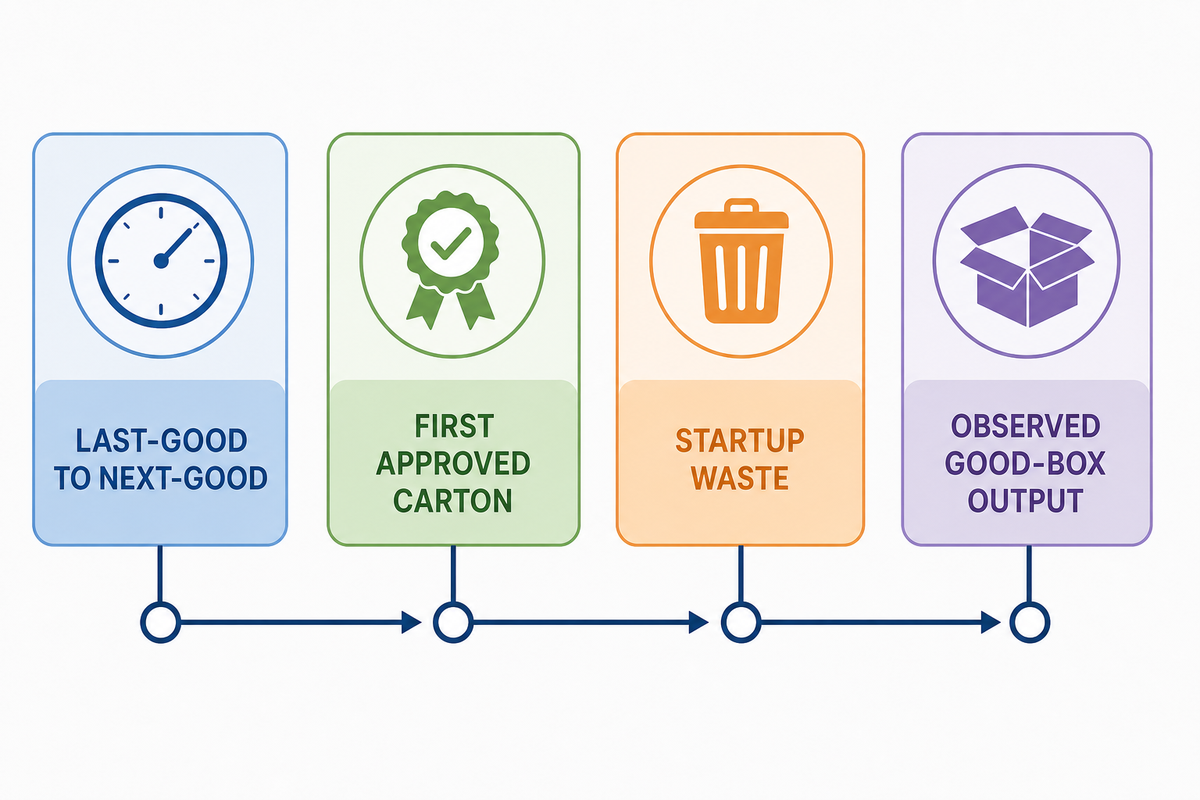
For a mixed-SKU plant, collect four fields: last-good-box to next-good-box time, time to the first approved carton, startup waste, and observed good-box output. Retain the SKU sequence and run length with those numbers. That creates a traceable input for a later capacity discussion without publishing a generic changeover benchmark or formula.
Cenwan’s folder gluer changeover guide owns definitions, setup-reduction methods, machine levers, sequencing, and payback. This guide does not reproduce those methods. Its role is to make sure the buyer brings actual plant data into the decision.
There is also a safety boundary. Setup, adjustment, clearing, and servicing are not merely capacity events when unexpected energization, startup, or stored energy could injure someone. In the United States, OSHA 1910.147 defines a servicing and maintenance scope and makes the normal-production exclusion conditional. The buyer’s site safety owner should classify the applicable tasks and document the safeguarding and hazardous-energy-control boundary before a trial. This article does not provide operating or lockout instructions, and legal duties vary by jurisdiction. OSHA 29 CFR 1910.147
The risk exists because a changeover observation can cross from normal production into a task with different safeguarding or hazardous-energy duties.
What is the maximum speed of the machine?
Maximum speed is a model-specific catalog claim, not a promise of sustained saleable output for every carton. Useful trial records state the SKU, blank, material, configuration, setup assumptions, run window, feeding conditions, downstream constraint, good-box definition, defects, stops, and changeover observation.
Report the observed result for that condition, then use the existing throughput estimator for planning. Keep theoretical line speed, observed gross output, and accepted output in separate fields. Note whether the rate came from a stable repeat job, a new setup, or an estimate. If the downstream process stopped the run, preserve that fact instead of assigning the entire result to the gluer. Neither the estimate nor one trial proves long-run process capability.
Record Integration, Utilities, and Control Boundaries
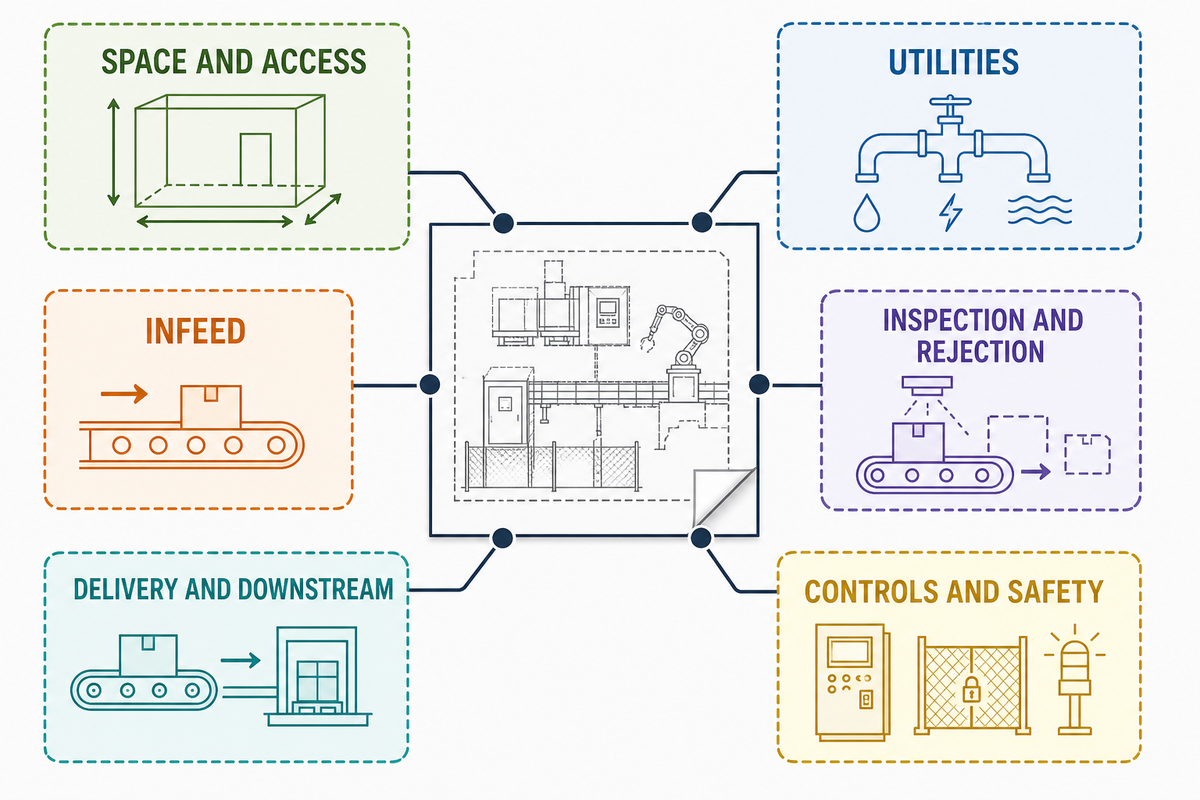
Even a suitable gluer can fail a project if the installation boundary is vague. Engineering should issue a single interface sheet before the purchase order. Procurement should require the proposal revision to answer it, while production and quality should confirm the operating and inspection assumptions.
| Boundary | Buyer record | Supplier confirmation | Unresolved risk |
|---|---|---|---|
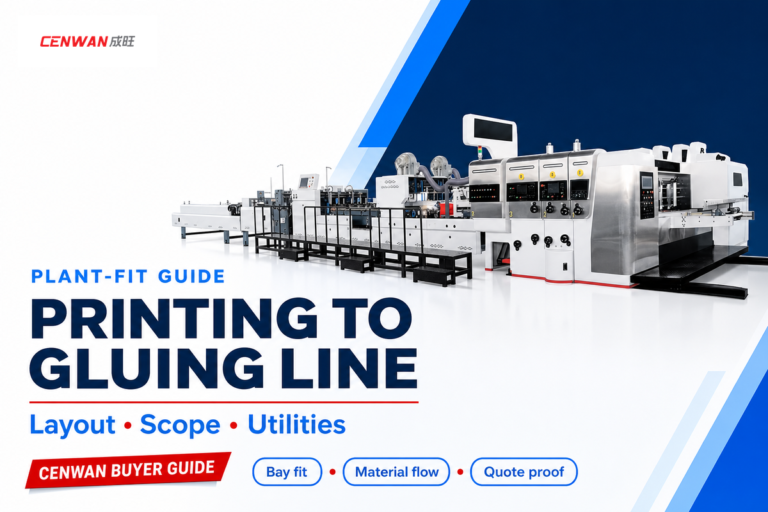
| Space and access | Layout, service clearance, material routes, operator positions | Installed footprint and access assumptions | Required / confirmed / unresolved |
| Utilities | Available power, air, and extraction where applicable | Consumption, connection points, and included equipment | Required / confirmed / unresolved |
| Infeed | Upstream format, rate, accumulation, and handoff | Accepted input and interface ownership | Required / confirmed / unresolved |
| Inspection and rejection | Defect definitions, reject destination, data needs | Detection function, limits, and exclusions | Required / confirmed / unresolved |
| Delivery and downstream | Compression, collection, packing, or connected-line limit | Output interface and rated condition | Required / confirmed / unresolved |
| Controls and safety | Control ownership, emergency interfaces, site task classification, jurisdiction | Supplied controls, guarding scope, documentation, and remaining user duties | Required / confirmed / unresolved |
ANSI’s public explanation of ANSI/PMMI B155.1-2023 covers packaging and converting machinery, coordination of connected equipment, responsibilities, risk assessment, validation, and documentation. Use that as a process and responsibility anchor, not as evidence that a Cenwan model or a buyer’s installation is certified. ANSI overview of ANSI/PMMI B155.1-2023
One dated U.S. OSHA interpretation also states that an employer remains responsible for applicable machine guarding even when packaging machinery was sold without guards. This is a U.S.-specific responsibility example, not universal legal advice. Buyers should verify current local requirements and allocate supplier, integrator, and user responsibilities in the project documents. OSHA machine-guarding interpretation
Compare Suppliers With Evidence, Not Headline Claims
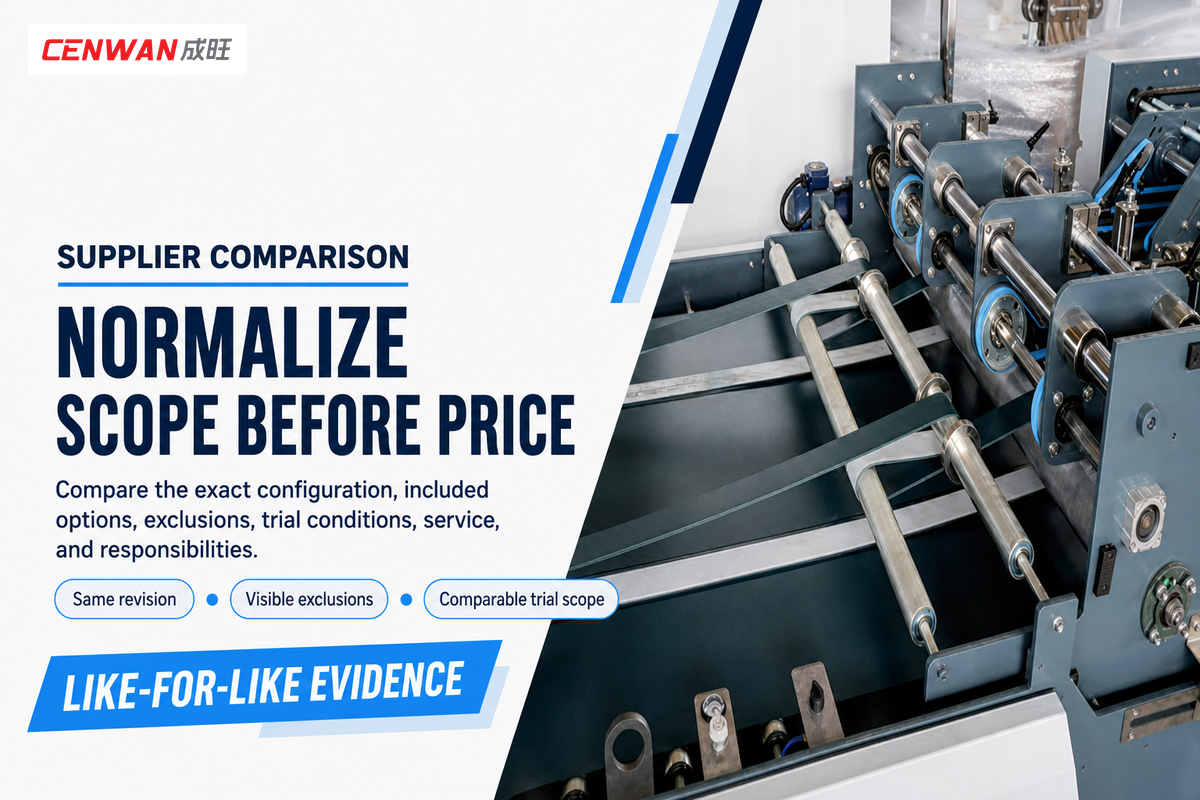
Make every supplier respond to the same requirement revision. Ask for the model and exact configuration, documented size and material range, included options, exclusions, sample-trial and inspection conditions, service and training scope, spare-parts assumptions, warranty terms, delivery basis, and commissioning responsibilities. A lower price may simply cover less scope; a higher speed may describe a different carton or test condition.
References matter too. One signed practitioner account in PostPress describes how operator-specific setup habits can undermine repeatability and recommends checking user experience rather than relying only on technical claims. Treat that as practitioner guidance, not a universal performance result. Ask reference users about cartons similar to yours, the setup record, the gap between the proposal and delivered scope, and how unresolved issues were owned. PostPress practitioner viewpoint
“Having an experienced folder-gluer operator still is very important, even with automation and computer technology.”
Jeff Wilcox, PostPress
Proposal comparison rule
If two proposals do not share the same requirement revision, included configuration, sample conditions, and unresolved-evidence register, they are not yet comparable. Normalize the scope first; compare price second.
Assign every open field to a decision owner
Production owns the mix and loss record. Operators and supervisors can identify recurring carton families, short runs, first-good-box delays, startup waste, and downstream waits, but their observations need dates and SKU context. Memory alone should not become a capacity promise. Where shifts use different methods, the record should show the variation instead of averaging it away.
Engineering owns the configuration and interface boundary. That role checks drawings, utilities, access, controls, infeed, delivery, connected equipment, and responsibility splits. Questions that affect guarding, energy control, or site risk go to the competent safety owner; questions that affect food-contact or market compliance go to the designated compliance owner. Supplier confirmation should never be used to erase a remaining user or integrator duty.
Quality owns defect language and the separation between a supplier challenge trial and a production acceptance plan. Terms such as “good box,” “skew,” “open seam,” or “acceptable bond” need an agreed observation basis. Without it, two suppliers can report different results from the same cartons and both appear to pass. Quality should also identify representative production conditions not covered by the worst-SKU trial.
Procurement owns proposal normalization and revision control. Commercial comparison begins only after the technical scope, included options, exclusions, documentation, trial conditions, training, service, spares, delivery basis, and warranty assumptions are visible. Any unresolved field stays on the register with a named owner and due date. Removing the word “unknown” from a document does not remove the project risk behind it.
Joint sign-off prevents one function from approving evidence that belongs to another. Production should not accept a legal scope; procurement should not define a defect threshold; engineering should not infer material authorization from a successful bond. By the final shortlist, every required field should be confirmed, tested, explicitly excluded, or still unresolved with a decision owner. That outcome is more useful than a single composite score because it shows exactly what the buyer is accepting.
Run the Worst-SKU Challenge Trial Before Final Approval
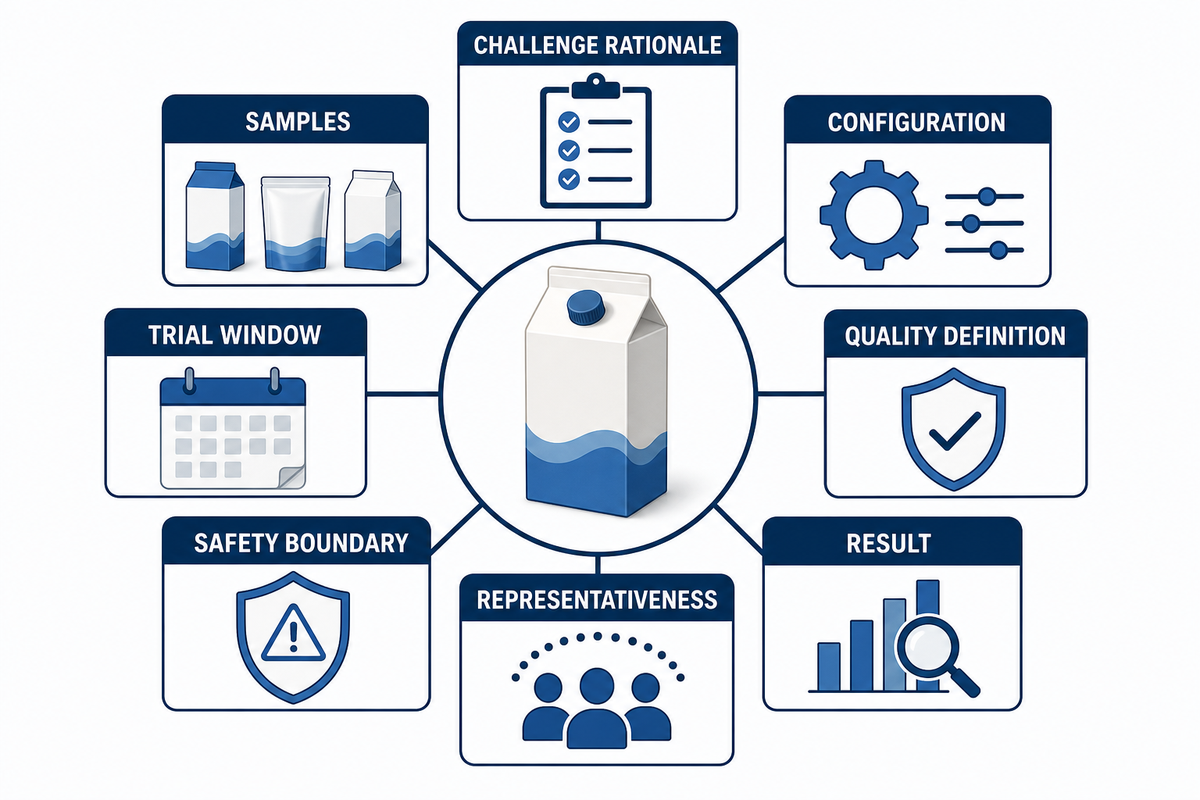
Choose a carton likely to expose a mismatch: the smallest feeder challenge, the largest format, a difficult fold, a sensitive glue area, a coated surface, or another documented risk. Call this a Worst-SKU Challenge Trial Record, not an acceptance record. It captures one observed pre-purchase condition.
| Trial field | Required record | Allowed state |
|---|---|---|
| Challenge rationale | Why this SKU is difficult and which mismatch it could expose | Defined / unresolved |
| Samples | Drawing revision, material, sample count, preparation, and custody | Agreed / changed / not supplied |
| Configuration | Machine revision, options, tooling, glue system, and connected modules | Confirmed / deviation |
| Trial window | Setup assumptions, observed run duration, feed and downstream conditions | Completed / stopped / not tested |
| Quality definition | Good-box definition, defect categories, observation method, stopping conditions | Pass / fail / deviation |
| Safety boundary | Site owner’s task classification and applicable safeguarding/energy-control decision | Confirmed / unresolved |
| Result | Observed output, defects, stops, waste, and signed deviations | Pass for this trial / fail / not tested |
| Representativeness | Other cartons and operating conditions that remain untested | Listed / incomplete |
This record isn’t random lot acceptance sampling, proof of production-population quality, or evidence of long-run process capability. The legacy NIST/SEMATECH e-Handbook overview describes acceptance sampling as a sample-based decision about a lot and separates that one-shot or short-run activity from long-run quality control. It’s used here for that conceptual distinction, not as a current box-gluer standard. Even a difficult sample can’t represent the complete operating range by itself. Production acceptance planning remains a separate responsibility for the buyer’s quality team. NIST/SEMATECH e-Handbook: acceptance sampling
The risk is overgeneralization because one challenge carton cannot represent every SKU, operating condition, or long-run production state.
Use the 9-Input Production-Fit Scorecard for the RFQ
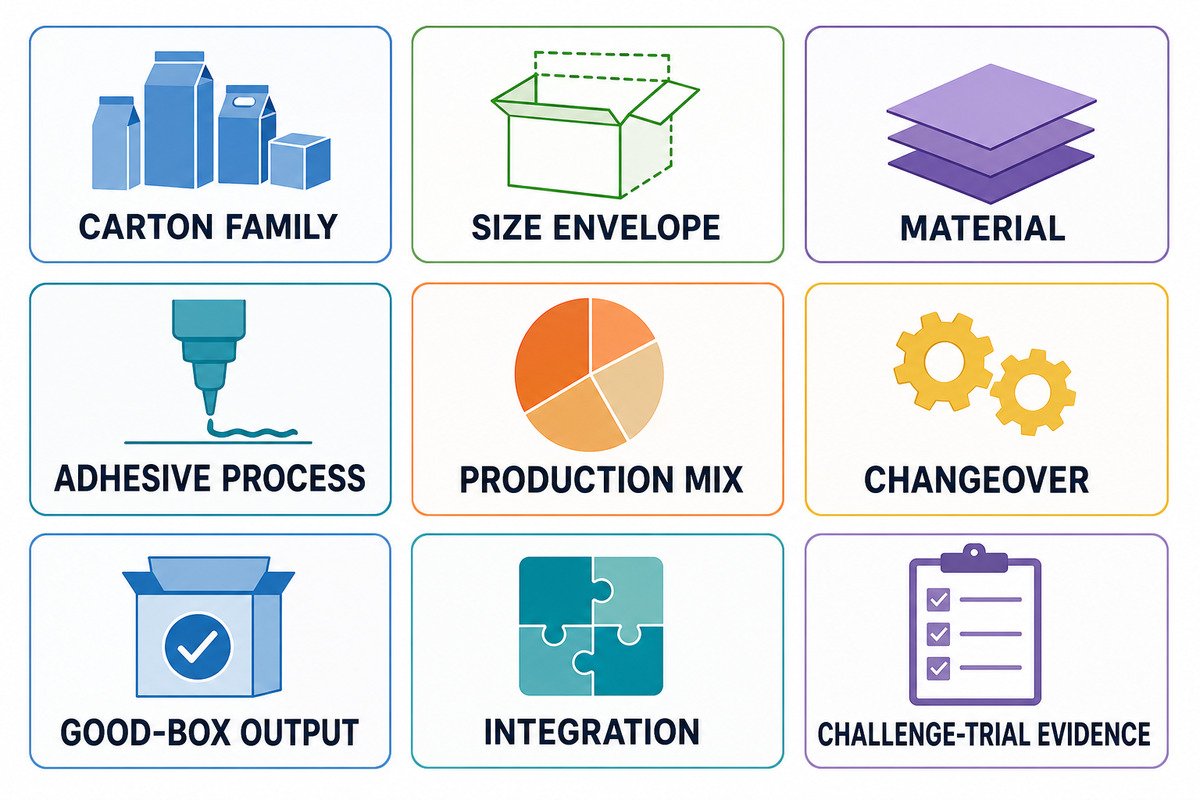
The name “scorecard” refers to evidence completeness, not a machine-performance score. It doesn’t calculate fit, rank suppliers, or fill missing fields with assumed safe values. Production, engineering, quality, and procurement should review it together before the request for quotation is released.
The risk is false certainty because an empty field remains unresolved even when every completed field looks strong.
| Input | Required evidence | Status |
|---|---|---|
| 1. Carton family | Dielines, joint and fold functions, representative samples | Required / confirmed / tested / unresolved |
| 2. Size envelope | Smallest, largest, highest-volume, and difficult formats | Required / confirmed / tested / unresolved |
| 3. Material | Board or flute, thickness, coating, crease condition | Required / confirmed / tested / unresolved |
| 4. Adhesive process | System, application location, bond criteria, end-use compliance owner | Required / confirmed / tested / unresolved |
| 5. Production mix | SKU share, run lengths, shifts, and delivery requirement | Required / confirmed / tested / unresolved |
| 6. Changeover | Sequence, last-good to next-good time, startup waste | Required / confirmed / tested / unresolved |
| 7. Good-box output | Observed accepted cartons with conditions and defect definitions | Required / confirmed / tested / unresolved |
| 8. Integration | Layout, utilities, controls, infeed, inspection, delivery, safety ownership | Required / confirmed / tested / unresolved |
| 9. Challenge-trial evidence | Worst-SKU record, deviations, and untested representative cartons | Required / confirmed / tested / unresolved |
Only after the record is complete should the team move to commercial machine selection. At that point, use the Cenwan folder gluer machine range as a product-level starting point and require every proposed configuration to answer the same evidence package.
Frequently Asked Questions
How much does a glue machine cost?
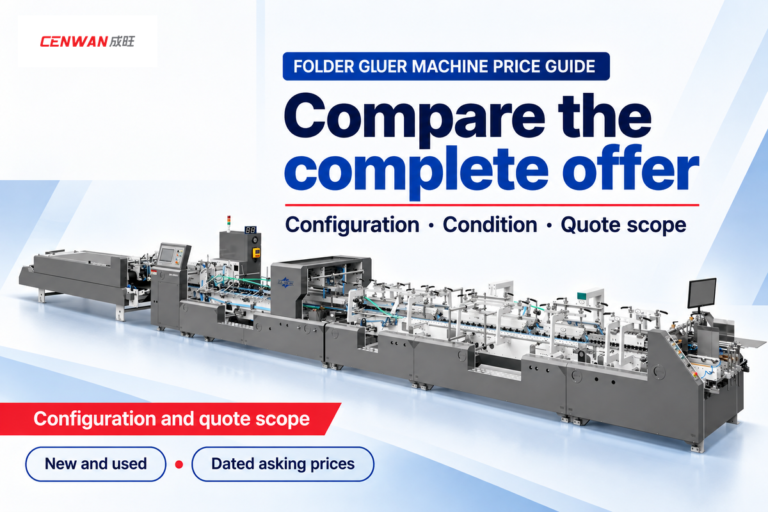
Compare price only after suppliers quote the same carton styles, size range, feeding arrangement, glue equipment, inspection options, installation work, training, trial scope, spares, and warranty assumptions. This guide does not publish a universal price range because the reviewed sources do not support one across different configurations and proposal scopes. A usable quote also states the currency, tax and freight basis, installation boundary, acceptance trial, and excluded optional modules. This keeps price comparisons tied to a defined procurement scope.
If any scope field remains unanswered, keep it on the comparison sheet as an open item instead of treating the lowest total as a like-for-like result.
What types of cardboard can a box gluing machine process?
Compatibility depends on the exact machine configuration and sample. Record whether the job is folding carton or corrugated board, then add the grade or flute, thickness, coating, dimensions, crease condition, glue area, and box style. Ask for model documentation and representative sample evidence instead of relying on the word “cardboard.”
What is the maximum speed of a box gluing machine?
The maximum is a model-specific catalog claim under stated or unstated conditions. For procurement, record observed good-box output with the exact carton, material, configuration, run window, rejects, stops, and connected-line limit. Use a planning estimator separately, and do not treat either a calculation or one trial as proof of long-run capability.
What are the main uses of a gluing machine?
A gluing machine folds and bonds compatible carton or corrugated constructions within a packaging workflow. The supported styles, materials, output, and interfaces depend on the actual configuration and evidence. Use dielines and physical samples to translate the intended use into required functions. Straight-line, lock-bottom, four-corner, and six-corner work still require a compatible configuration and representative trial.
Is customization available for this machine?
Customization is proposal-specific. Define the carton or line requirement and ask the supplier to identify the included change, affected drawings and controls, test evidence, responsibilities, and remaining limits. Don’t assume a custom option extends every size, material, speed, safety, or box-style capability.
What troubleshooting issues might I encounter?
Record the symptom and conditions, then route feeding, folding, glue, compression, alignment, sensor, rejection, or downstream issues to the applicable manual and qualified owner. Capture the SKU, blank, adhesive, latest setup change, stop time, and last good condition before comparing corrective actions.
References & Sources
- European Federation of Corrugated Board Manufacturers: Production Process
- American National Standards Institute: ANSI/PMMI B155.1-2023 Overview
- American National Standards Institute: ANSI/PMMI B155.1-2023 Catalog Record
- Occupational Safety and Health Administration: 29 CFR 1910.147
- Occupational Safety and Health Administration: Packaging Machinery Guarding Interpretation
- Legacy NIST/SEMATECH e-Handbook: Acceptance Sampling
- Electronic Code of Federal Regulations: 21 CFR 175.105 — Adhesives
- Packaging Digest: Named Folder-Gluer Implementation Case
- PostPress: A Viewpoint on Folder Gluers
Manufacturer Background
Cenwan Machine is a Wenzhou, China-based manufacturer of folder gluer machines, corrugated box gluing equipment, and integrated packaging lines. For more than 10 years, we have supported carton and corrugated packaging manufacturers in 40+ countries with equipment selection, custom configuration, installation support, spare parts, and after-sales service.
Our blog content is written to help packaging buyers, plant managers, and procurement teams understand folder gluer technology, box style compatibility, production capacity, ROI, maintenance, and supplier selection before requesting a quote.
- 10+ years of folder gluer engineering experience
- Factory base in Ruian, Wenzhou, Zhejiang, China
- Folder gluer machines, corrugated folder gluers, and automatic packaging lines
- CE / ISO 9001 manufacturing and quality references
- Remote diagnostics, spare parts support, and 24/7 technical response
- Equipment and service experience across 40+ countries
Brand
Cenwan Machine
Company
Zhejiang Chengwang Intelligent Packaging Equipment
Business Type
B2B Machinery Manufacturer
Factory Base
Ruian, Wenzhou, Zhejiang, China
Email
sales2@cenwanmachine.com
Phone / WhatsApp
+86 139 0664 6788