Get in touch with Cenwan Machine Company


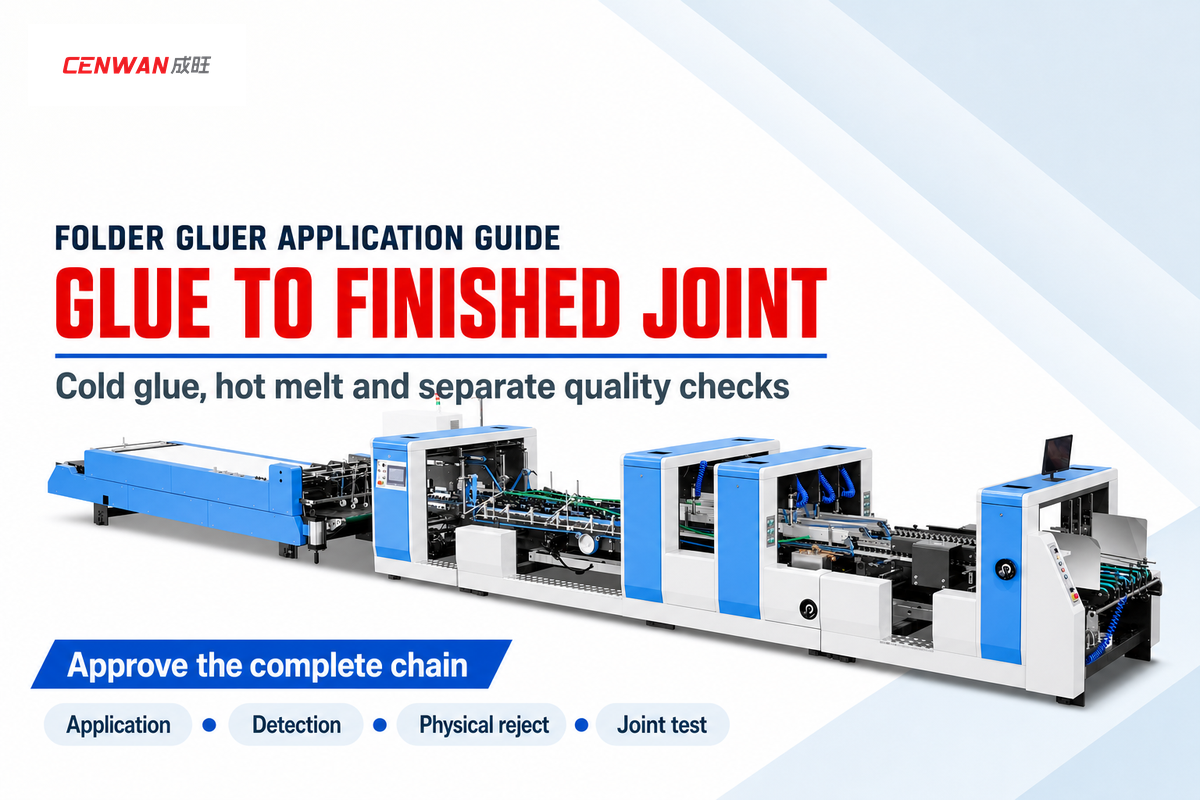
A folder gluer glue system must apply the proper adhesive to the glue lap, hold that pattern in place as the blank moves, and support a joint that survives its intended use. A clean looking bead is just one indicator. The inspection settings, reject mechanism, and finished carton test all need their own acceptance tests.
Updated October 2026
Quick application guide
- Cold glue: qualify the actual board, coating and compression window.
- Hot melt: match the adhesive grade, heated equipment and service conditions.
- Pattern control: separate position tracking, valve response and adhesive quantity.
- Inspection: select the sensing method for the adhesive and background.
- Release checks: verify physical rejection and test the finished joint.
A folder gluer glue system combines adhesive supply, application heads and pattern control. Sensors monitor selected application features; a reject device removes identified defects. Finished-joint testing checks whether the carton meets the agreed bonding requirements.
For folding cartons, this guide follows pre-die-cut blanks through the gluing operation. A flexo folder-gluer can include printing, creasing, slotting and die cutting, as explained in TAPPI’s flexo folder-gluer course. That equipment distinction is helpful when determining application heads and the signals a retrofit must exchange.
Before selecting equipment
- Some cold-glue inspection works without a fluorescent tracer.
- Changing a coating can affect adhesive bonding and optical detection.
- A controller’s channel count describes outputs, rather than the number of qualified carton styles.
- A detector alarm, a rejected carton and an acceptable joint are separate results.
Folder Gluer Glue System: Follow the Complete Application Chain
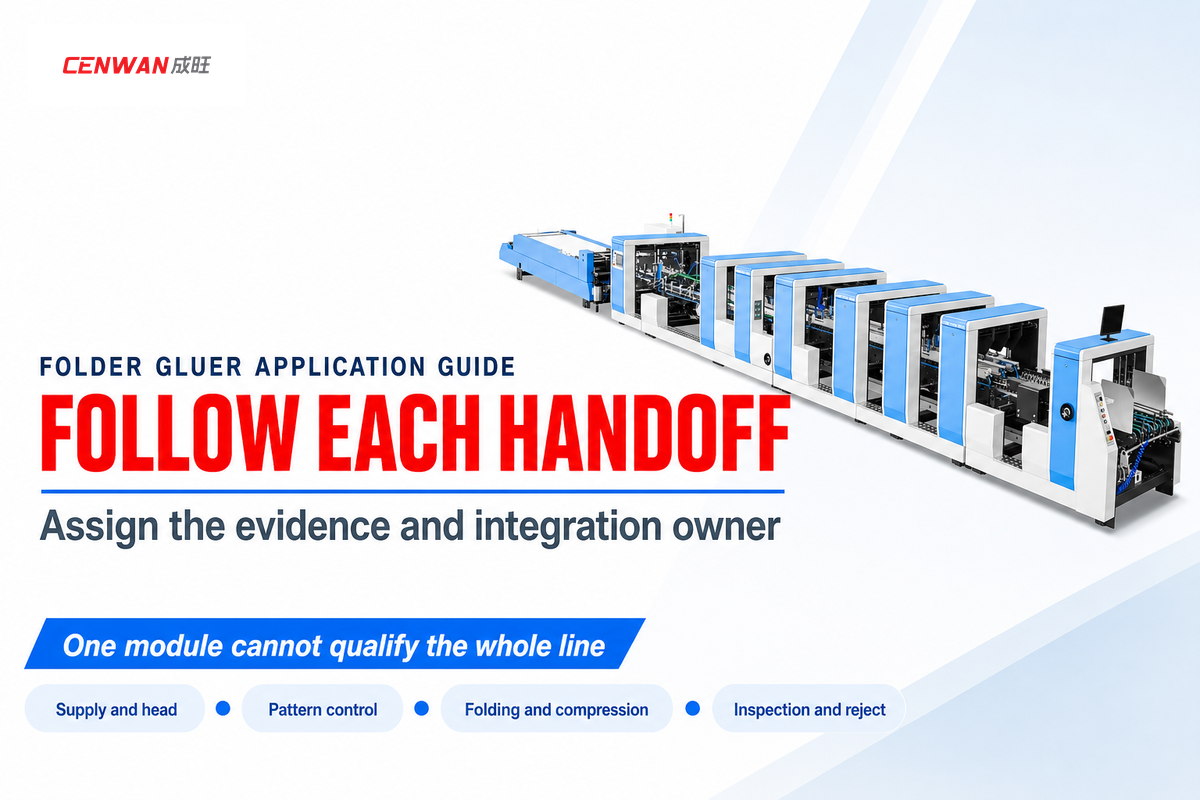
A folder gluer glue system connects storage and delivery of adhesive to the applicator, pattern controller and inspection devices, and to the reject mechanism. The folding section brings the two surfaces in contact, and compression holds the joint while it sets. Each handoff can introduce a different fault, so selecting a pump or nozzle alone leaves important production requirements unresolved.
Valves, pumps, regulators, and filters are separated from pattern controls, sensing, imaging and ejectors in Valco Melton’s folding-carton system. This provides a way to structure a quotation. List the required functions first, then identify which module provides each one and who integrates it with the complete machine.
| Handoff | Function | Production evidence |
|---|---|---|
| Adhesive container | Holds the specified grade and batch | Label, shelf-life and storage record |
| Pump or pressure supply | Delivers adhesive to the circuit | Stable supply during the agreed run |
| Filter and hose | Carry adhesive to the application head | Condition and compatibility record |
| Valve and nozzle | Start, form and stop the deposit | Bead or dot sample |
| Blank trigger | Detects the incoming product reference | Repeatable trigger location |
| Pattern controller | Places the programmed pattern | Start/end positions through speed changes |
| Folding and compression | Bring and hold the joint surfaces together | Closed carton and joint sample |
| Sensor or camera | Evaluates the configured application feature | Known-good and deliberately defective samples |
| Reject device | Removes the identified carton | Physical reject recovery and count |
When walking through the process, follow one blank through the feeder to delivery. A glue pattern that starts in the right place can still fail if the blank loses alignment before closure. Conversely, a sound joint doesn’t fix mixed print codes or a downstream packing jam. Keep these outcomes separate in the production record.
A straight-line folder-gluer machine may have one principal glue lap while a multipoint job may need a pattern for each bonded location. Keep those locations visible on the blank drawing. A carton folder gluer machine specification should identify those prior to application head layout selection.
Purchasing decision: Specify the required application and inspection functions together. A box gluing machine quote that includes an applicator but excludes rejection should have an integration owner specified.
Cold Glue vs Hot Melt: Qualify the Board and Joint Together
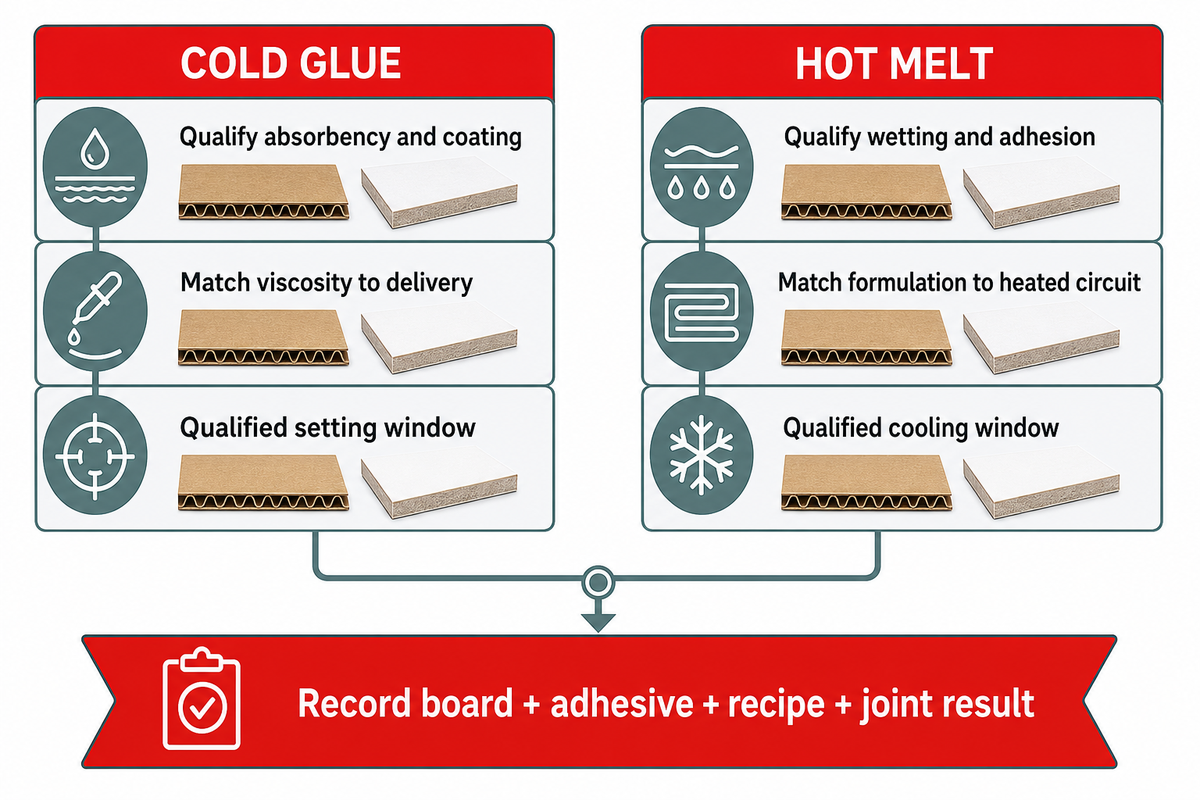
Cold glue and hot melt should be selected against the actual glue-lap surface and finished-carton duty. Water-based dispersion and thermoplastic hot-melt adhesives set by different mechanisms, so an adhesive change affects the application equipment and process window. Qualification should hold the board, coating, folding and test conditions together rather than rank the two families in isolation.
In a 2025 study on paperboard, Mubarak Khlewee, William Desisto and Douglas W. Bousfield found that both penetration and coating strength contributed to high peel forces. A stronger adhesive, for example, may still leave a weak coating layer as the failure surface. Inspect where the joint separates, not just how much force the carton resists.
Cold glue
- Evaluate the actual absorbency and coating.
- Match viscosity to the delivery and nozzle system.
- Keep closure and compression within the qualified setting window.
Hot melt
- Evaluate wetting and adhesion on the actual surface.
- Match the formulation to the heated circuit.
- Keep closure and compression within the qualified cooling window.
Conventional thermoplastic hot melt adhesives develop strength as they cool, as H.B. Fuller’s technical explanation states. Factors like service temperature and chemical exposure impact their performance and application. A reactive adhesive requires its own curing and equipment instructions; it should not inherit a conventional hot-melt recipe.
Which folder gluer glue system should I use?
Use a cold-glue system when the selected water-based adhesive produces an acceptable joint within the available application, folding and compression window. If a qualified hot-melt formulation and heated circuit best meet the production and joint requirements, then by all means select hot melt. In either case, base your decision on sample results for the defined use condition, and not on an assumed coating rule.
Adhesive-to-Joint Qualification Grid
When material, application, and finished joint acceptance are compared in the same trial, the Adhesive-to-Joint Qualification Grid is useful.
| Field | Record | Decision it supports |
|---|---|---|
| Board identity | Grade, supplier, caliper in mm and batch | Keep substrate comparisons equivalent |
| Glue-lap surface | Print, varnish, film or exposed board | Select adhesive for the bonded face |
| Adhesive identity | Exact product code and batch | Prevent family-name substitutions |
| Application recipe | Head/nozzle, pattern and approved settings | Repeat the trial deposit |
| Closure window | Application-to-contact sequence at trial speed | Keep the adhesive workable at closure |
| Compression | Contact arrangement and holding conditions | Restrain opening while the joint sets |
| Test conditions | Conditioning time, temperature and method | Compare finished-joint results fairly |
| End-use duty | Service temperature, load and storage exposure | Qualify durability beyond immediate opening |
| Food packaging, when applicable | Market, food type, contact path and adhesive declaration | Assess intended-use suitability separately |
| Release decision | Acceptance criterion, result and responsible person | Approve one defined board/recipe combination |
For food-packaging applications in the US, 21 CFR 175.105 states restrictions on adhesive composition and separation from food, or limited contact with food. Bond strength and food suitability should be assessed separately. A cosmetic carton or a corrugated carton may have a different use case, and a food-packaging declaration shouldn’t be copied to an unrelated adhesive grade.
Example: A folding-carton job changes from an exposed paperboard glue lap to a varnished face. The old recipe still leaves a neat bead, but the flap opens after packing. The production team keeps the carton style unchanged and compares the original and replacement surfaces, using the same adhesive batch. Quality records the failure surface and repeats the joint test after the agreed conditioning period. A second trial uses an adhesive compatible with the new surface, with its own application recipe. The useful result is a qualified combination of surface, adhesive and machine conditions. Increasing the quantity of glue prior to identifying the failure surface would change another variable and make the comparison difficult to interpret.
For a corrugated box, draw the flute profile and corrugated board construction with the lap drawing. Include intended long-term performance in the joint qualification. An envelope job should also have its own surface and pattern record rather than inheriting the carton recipe.
Material choice: regard the substitution of a coating or adhesive as a new qualification condition. The corrugated folder gluer guide explains the broader machine context for a different board construction.
Nozzles and Valves: Match Flow, Pattern and Cutoff
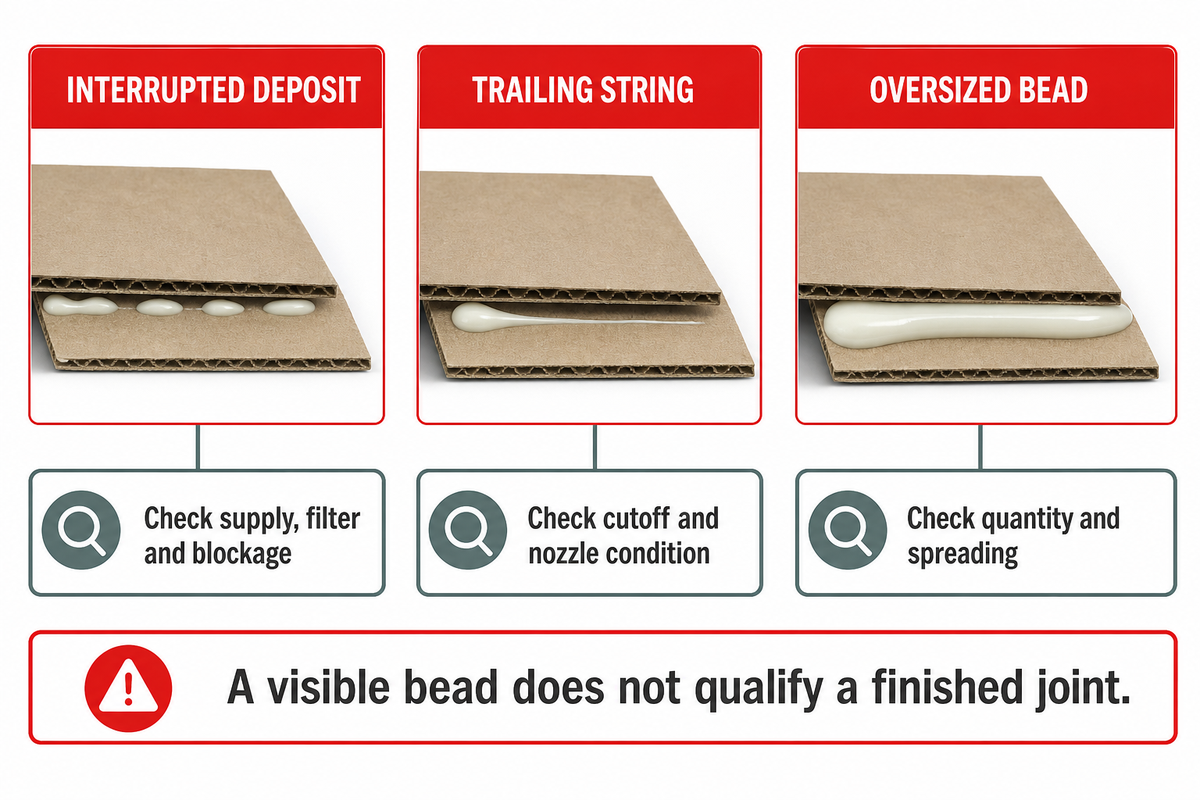
The nozzle determines the shape of the deposit, along with the valve, the adhesive’s properties and the supply pressure. A larger opening can change quantity and cutoff, but it will not correct every weak joint or missing bead. Select the head and nozzle as a matched application package and compare the deposit to a qualified reference pattern.
Robatech’s nozzle guidance states the quantity of adhesive deposited is related to the nozzle geometry and the pump pressure. It also identifies viscosity and temperature sensitivity as selection factors. If a weak joint exists, treating it with a larger nozzle may create other process or timing constraints during folding and compression.
- Missing or interrupted deposit: examine supply, filter condition and blockage before changing the pattern.
- Trailing string: compare cutoff with the reference; inspect the nozzle/valve condition and adhesive state.
- Oversized bead: examine deposit quantity and spreading at closure.
- Correct bead, weak joint: return to surface, closure and finished-joint evidence.
A useful preventive maintenance sample should include the beginning and end of the bead. Sometimes, only the middle is sampled, which can hide a trailing tail or a delayed opening. Keep the part number of the nozzle that’s removed, and refer to it when a nozzle with a similar opening is replaced. The same approach can be taken when a narrower lap glue is being used, or when a folding and gluing machine is being used to handle cardboard blanks.
A universal pressure increase isn’t a permitted recipe for process troubleshooting. Replacement decision: Use the specified nozzle with the qualified valve parts. Keep adhesive pressure and hot-melt temperature within the installed equipment and adhesive instructions.
Controllers and Encoders: Keep Glue in Position as Speed Changes
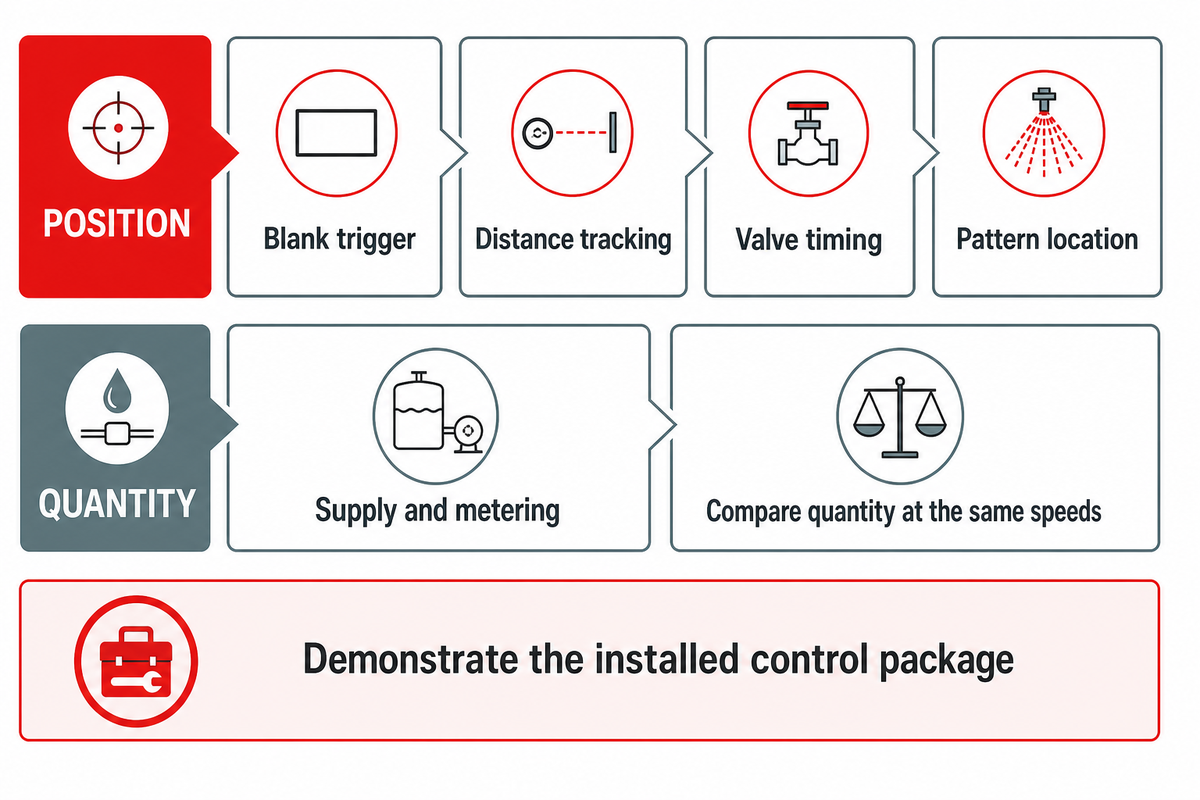
Pattern control must keep adhesive start and stop positions aligned with the moving blank through the production speed range. Product detection, distance tracking and valve actuation also occur. A label on a programmable controller leaves these functions undefined. The quotation and trial must show what functions the control package provides.
The Glue Machinery Z2 product page lists encoder or timer operation, two photocell inputs, one encoder input and a separate 0–20 mA proportional-valve output. Its two-channel version and storage for 99 programs are model features. They do not qualify a speed, recipe or precision for another gluer line.
PLCopen’s motion-control user example builds an application-specific registration function from TouchProbe and other function blocks. That distinction explains why the control specification needs more detail than “PLC included.” The touch screen should enable the operator to identify the active job, pattern dimensions, reference the trigger and fault history without erasing the stored recipe.
Glue-Line Bottleneck Map
The Glue-Line Bottleneck Map separates pattern position, deposit quantity, joint setting and packing restrictions before a speed increase.
| Observed restriction | First comparison | Retrofit question |
|---|---|---|
| Bead shifts during acceleration | Trigger reference and position tracking | Which control function compensates application timing? |
| Position holds but quantity changes | Supply and metering at the same speeds | How is quantity adjusted as speed changes? |
| Joint opens after speed increases | Closure and compression conditions | Does the adhesive remain suitable for the new window? |
| Good cartons back up at delivery | Accumulation and packing capacity | Is the restriction downstream of the glue system? |
Example: An automatic folder gluer machine makes good cartons during setup. During acceleration, the bead starts to run late. Maintenance first compares the saved pattern with the blank trigger and encoder arrangement, leaving the adhesive grade unchanged. A second check compares bead quantity at the same operating conditions. If the pattern moves while quantity stays consistent, the position-control investigation takes priority. If location holds while the bead becomes intermittent, supply and application need attention. For production, both checks are done during the same trial, and the focus of the investigation can be limited to the handoff of the gluing system.
Control selection: require a demonstration through the agreed operating range, and a recoverable recipe backup. A high-speed job requires the same position and quantity checks as the setup run. Channel count and screen size are useful specifications, but the trial establishes operational fit.
Sensors and Cameras: Check What Each Device Measures
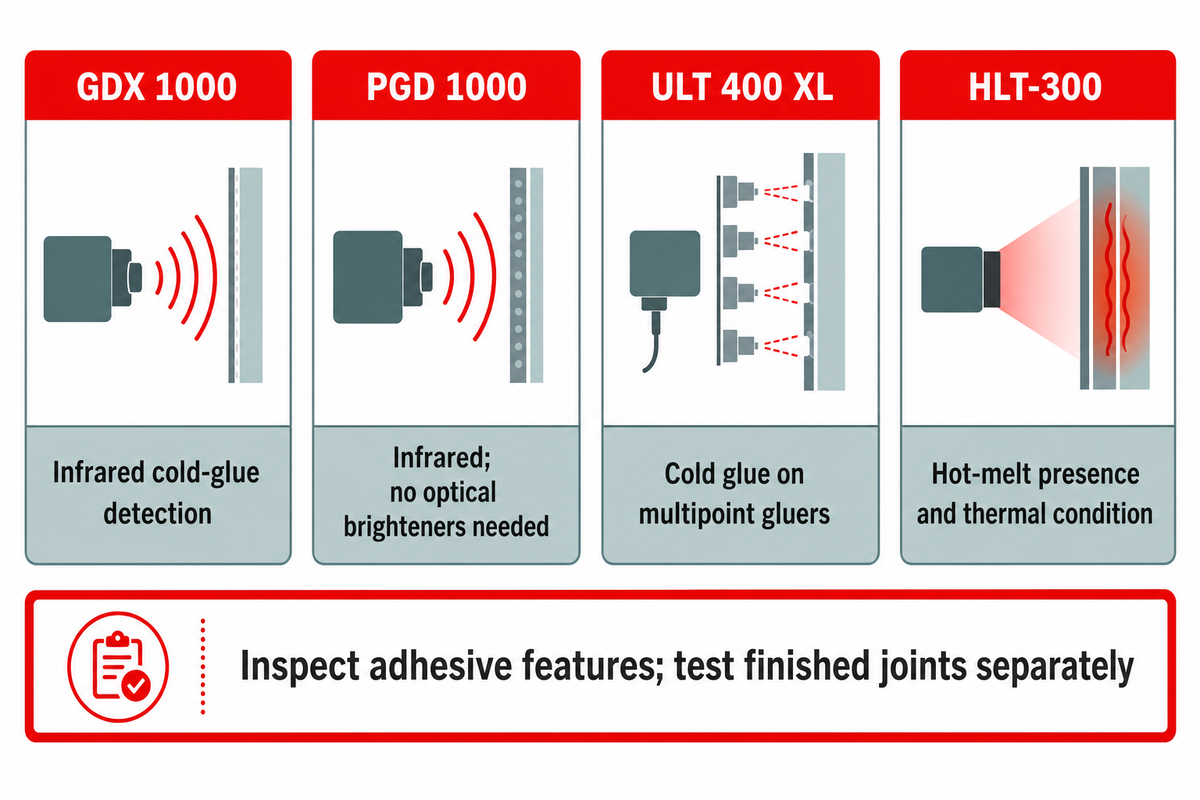
Glue sensors and cameras can evaluate features such as presence and placement of adhesive and thermal condition. Choose the method of detection based on the actual adhesive and printed background. Cold-glue detection can use methods other than fluorescence, while hot-melt inspection may evaluate heat. Final joint strength is to be assessed separately.
Baumer hhs publishes the following model data. GDX 1000 has an infrared measurement at 20 kHz with a 1 × 1 mm minimum monitorable dot, and a product distance of 25 ± 5 mm. The PGD 1000 also uses infrared measurement and doesn’t require optical brighteners in the adhesive.
| Model | Application | Published frequency | Product measuring distance | Selected optical geometry |
|---|---|---|---|---|
| GDX 1000 | Infrared cold-glue detection | 20 kHz | 25 ± 5 mm | 5 × 1.6 mm spot |
| PGD 1000 | Infrared cold-glue detection | 10 kHz | 25 ± 5 mm | Approximately 55 mm viewing width |
| ULT 400 XL | Cold glue on multipoint gluers | 20 kHz | 62.5 ± 12.5 mm | 12 × 2 mm spot |
| HLT-300 | Hot-melt presence and thermal condition | 10 kHz | 20 ± 5 mm | 8 × 2 mm spot |
Optical geometry is important when a narrow flap moves under the sensing head. A published measuring distance refers to the surface of the product to be measured, as opposed to a universally defined clearance from adjacent heated components. Install the selected model to its own mounting instructions and qualify it on the printed production blank.
In a 2020 PostPress technical feature, Baumer hhs executive Richard Pallante discussed how a damp background, or the use of UV-active inks and coatings, can affect some sensing methods. This can also give quality teams another reason to recheck a board change. The same new surface can also affect the joint and the inspection signal.
Example: A carton job changes to a UV-coated design and begins producing inconsistent glue alarms. The application sample still aligns with the approved pattern. Quality compares a clean unglued blank, a known-good glued blank, and a deliberately defective blank, using the printed artwork. This helps differentiate background response from missing adhesive. A sensor designed for a different detection principle may be a better alternative, but the team repeats the same sample before approving it. Clearing alarms by widening the acceptance window would mask the difference between new background and a true application defect. The material and detector recipe are released together.
Inspection choice: compare field of view, number of glue lines, setup work and traceability. A camera is most useful when its viewing arrangement covers the required pattern; a single point sensor needs an appropriate location to measure.
Quality Checks: Trace a Defect from Glue Head to Reject Bin
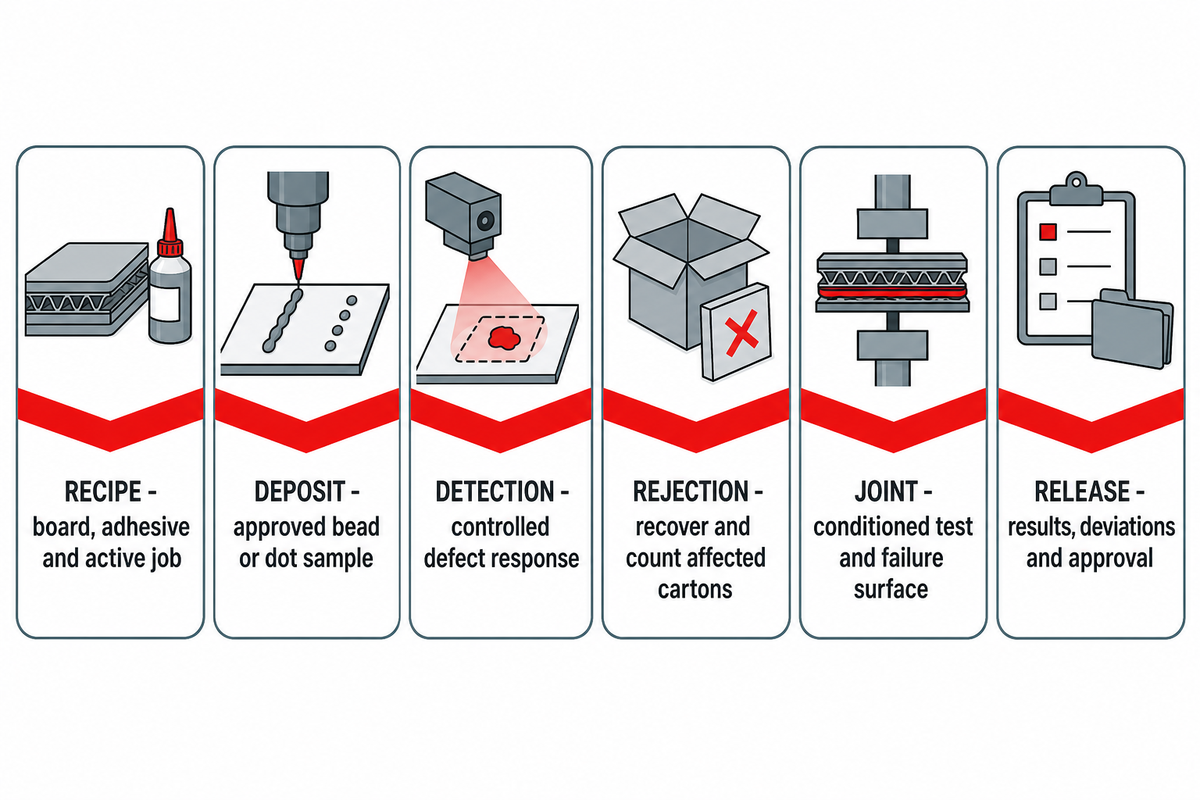
Quality checks should follow the carton through application, detection, physical rejection and finished-joint testing. Start with the approved recipe and reference sample; apply controlled application defects using the supplier’s safe test method; and account for affected cartons. Release the job against agreed joint criteria after the specified conditioning and end-use checks.
Glue-to-Reject Trace
The Glue-to-reject trace determines if an application defect is removed and reconciled with the production record.
| Check | Evidence to retain | Responsible role |
|---|---|---|
| 1. Correct recipe | Board, adhesive, pattern and active job identity | Production |
| 2. Reference deposit | Approved bead/dot locations and actual sample | Quality and production |
| 3. Deliberate defect detection | Safe test sample, fault response and recorded settings | Quality and integrator |
| 4. Physical rejection | Recovered defective cartons, destination and count | Integrator and maintenance |
| 5. Finished-joint performance | Test method, conditioning, acceptance result and failure surface | Quality |
| 6. Signed production release | Recipe revision, results, deviations and approval | Authorized production/quality owner |
Pallante’s PostPress discussion of verification relates to measured parameters, set up and traceability. At acceptance, the key question is, where did the test carton go after its alarm? The reject mechanism must eject the identified carton at the intended production speed, and the delivery stream must be accounted for after the test.
Test the finished product at the agreed conditioning time. Record whether separation occurs within the adhesive, at the surface or in the board/coating. State the service temperature, sustained load and the packaging requirements as required. The TAPPI paperboard study shows the importance of examining test specimens and the failure surface.
Acceptance should cover restart and changeover as well as steady running. A saved recipe that loads the wrong trigger reference can result in a different pattern, even with the same adhesive. Keep a physical reference carton with the job record, especially if similar named carton styles are in use.
Release rule: approve the defined board, adhesive and recipe combination after the six checks, with outstanding deviations assigned. A count of alarms alone isn’t a release record.
Glue Defects: Find the Cause Before Changing the Recipe
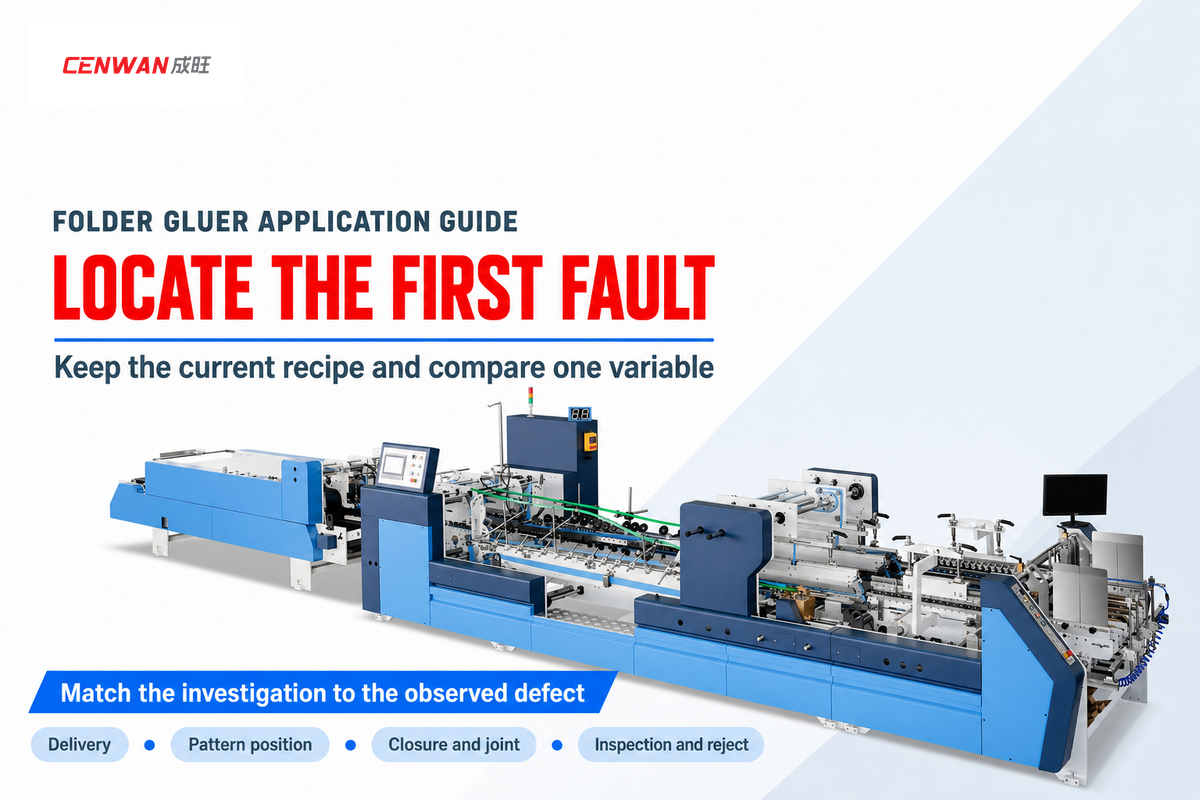
Diagnose glue defects by evaluating location, quantity, closure and joint performance independently. Preserve the current recipe, and sample it, before changing a setting. A change in conditions (e.g. compression-belt) may cause defects, which should also be investigated.
Why is my folder gluer glue system not working?
First find the first defect in handoff: adhesive delivery, application, pattern registration, closure or inspection. Next, compare the stage with a known good sample under the same conditions, and change one variable, and repeat the check. If a bead is missing, we would investigate differently from if there’s a bead and the joint separates after conditioning.
| Observed defect | Possible cause class | Next check |
|---|---|---|
| No adhesive | Supply, blockage or missing command | Trace delivery and valve actuation |
| Interrupted bead | Restricted or unstable application | Compare supply and nozzle condition |
| Bead starts late | Trigger, tracking or response mismatch | Compare pattern position through the speed range |
| Stringing after cutoff | Nozzle/valve condition or adhesive state | Inspect the trailing end of the deposit |
| Glue squeezes outside the lap | Quantity, position or closure mismatch | Compare open deposit and closed joint |
| Flap springs open | Joint setting or folding stress | Compare pre-fold, closure and compression |
| Joint separates on coated board | Surface/formulation or coating failure | Identify the failure surface |
| Good samples trigger alarms | Background or detector-recipe mismatch | Compare glued and unglued production blanks |
| Alarmed carton reaches delivery | Tracking, reject timing or mechanism fault | Recover and trace the deliberate defect |
Lanco’s folding-carton adhesive guidance connects weak coated-surface joints and stringing with different process variables. Rather than telling users to increase the temperature for every string and apply more pressure for every weak bond, the matrix uses those as paths for investigation.
For a four- or six-corner carton, check each glue lap after the folding hook operation has been carried out. A defect that occurs at one corner can often be masked by a flattened sample stack. The four- and six-corner folder gluer guide provides the machine style context for those additional folding operations.
Adjustment Rule: keep the original sample, make one documented change and compare the same fault. A high-quality carton needs an acceptable joint as well as a clean external appearance.
Cleaning and Changeover: Control Residue and Stored Energy
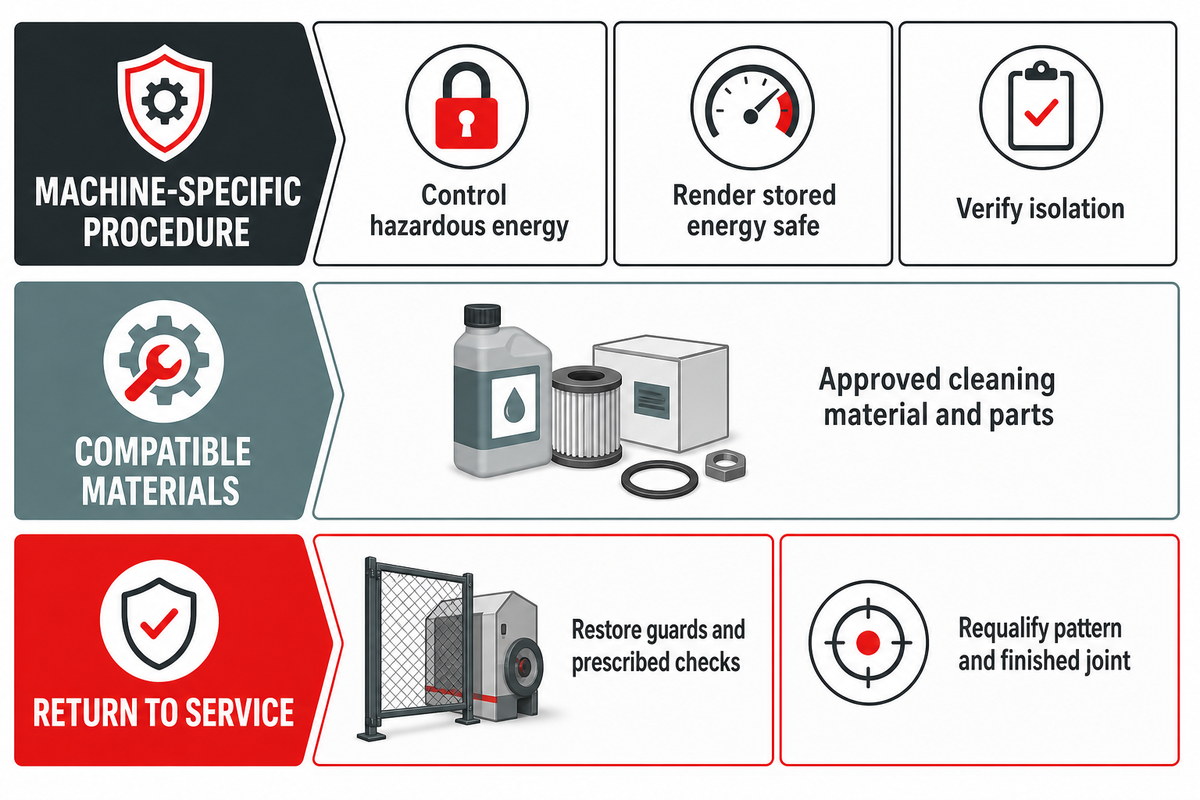
Cleaning should remove contamination without damaging the adhesive circuit or exposing personnel to stored pressure, heat or machine movement. Use the adhesive handling instructions and the equipment’s preventive maintenance procedure. Cleaning material, sequence and interval are for that combination of equipment, adhesive and process; they shouldn’t be adopted from an unrelated procedure or manual.
“Contamination and deposits in the adhesive application system are the most common causes of malfunctions.”
Residue may make a replacement nozzle a temporary solution if the contamination remains upstream. During a changeover, maintenance needs to identify the source of the restriction and the compatibility of the approved cleaning material. Increasing pressure or heat to push through a blockage can leave the underlying problem in place.
For US servicing covered by OSHA 1910.147, authorized personnel must control hazardous energy, render stored energy safe and verify isolation. The machine-specific procedure determines the isolation points and safe sequence. A stopped conveyor or a zero reading on one gauge doesn’t, by itself, address every trapped-pressure or thermal hazard in a glue circuit.
ISO 12643-4:2023 addresses hazards relevant to converting equipment and systems. Maintain the machine’s safety documentation with application system instructions and do not treat nozzle cleaning as a stand-alone bench task.
- Identify the installed head, hose, pump and adhesive grade.
- Follow the approved isolation and pressure-relief sequence.
- Use the specified cleaning materials and replacement parts.
- Record the removed part’s condition and likely contamination source.
- Restore guards and complete the prescribed safe return-to-service checks.
- Requalify the application pattern and joint before releasing the job.
Maintenance decision: Incorporate compatible spares and technical support in the changeover plan. Cenwan’s folder gluer parts and service page provides the service enquiry route.
Retrofit Quotes: Confirm Interfaces, Trials and Responsibility
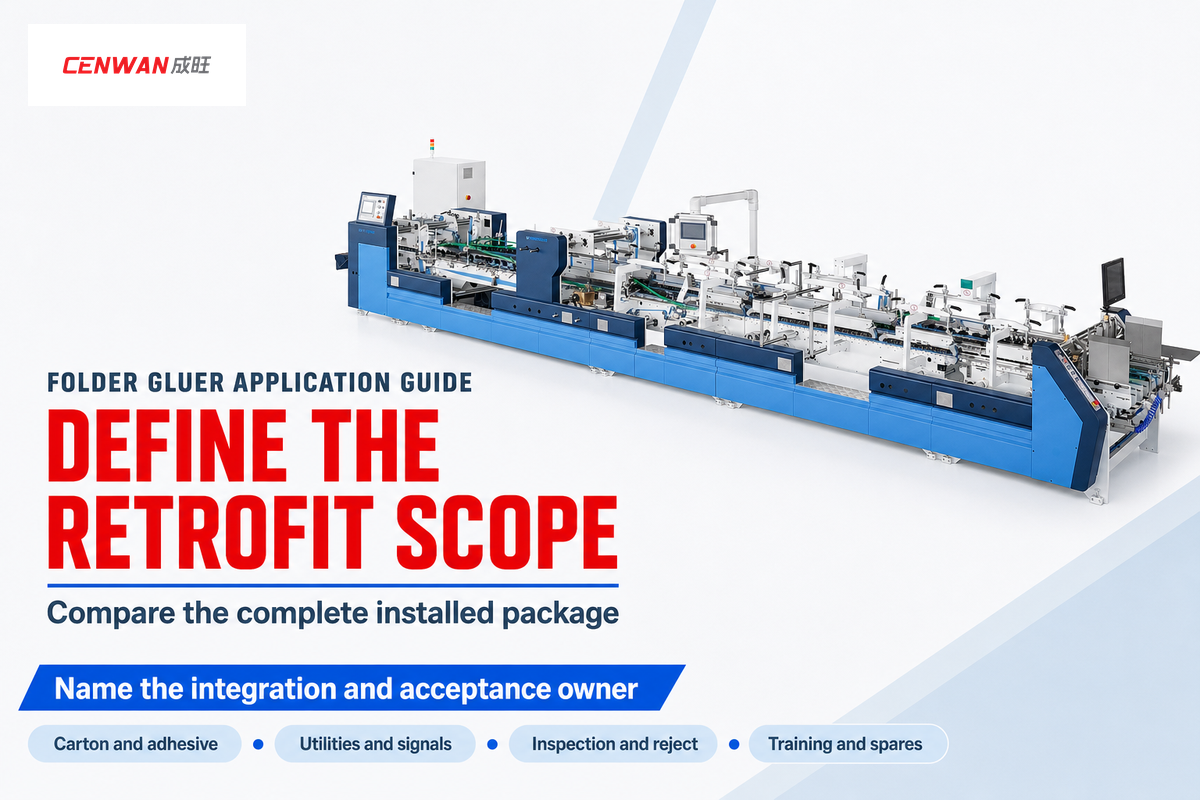
A quote for a retrofit of the glue-system gives a good definition of the carton range, application circuits and control interfaces, as well as the inspection and acceptance trial. It should also assign responsibility for installation, safety integration and operator training. Comparing those in the quote with like services prevents an incomplete project when the machine reaches commissioning.
The control configuration must connect the trigger, encoder and valve outputs and the reject interface as an integrated package. Adjustable brackets must also provide clearance for the actual blank path. Supplier and distributor quotations should identify who owns the final machine interface and who supports it after an export installation.
Carton box making includes operations beyond the adhesive deposit. In the carton industry, moving a defect to packing doesn’t remove its cost. Keep the glue-system acceptance tied to the completed carton.
In the UK, HSE’s modified-machinery guidance distinguishes like-for-like replacement from changes that substantially alter design, function or safety. Record the planned modification scope and assign its assessment to a competent party under the rules applicable at the installation site.
Enter the information requested below. Specify the operating ranges from the anticipated jobs and installed machine documentation. Record supply frequency and voltage from the approved electrical schedule, rather than a generic product family data sheet.
RFQ checklist
| Parameter | Recommended range | Why it matters | How to verify |
|---|---|---|---|
| Carton and substrate | Actual blank sizes and caliper in mm | Application access and surface fit | Production blanks and drawings |
| Operating speed | Required setup-to-production range in m/min | Pattern and joint stability | Trial at agreed operating points |
| Glue pattern | Each lap, line or dot dimension in mm | Head layout and inspection coverage | Marked reference blank |
| Adhesive grade | Exact grade and permitted recipe window | Circuit and end-use suitability | Supplier instructions and joint samples |
| Utilities and signals | Actual supply V/Hz and interface ratings | Electrical and control integration | Approved diagrams and interface schedule |
| Inspection and rejection | Every specified lap and defect class | Define the acceptance coverage | Controlled defect-to-reject trace |
| Handover | Recipe backup, manuals, training and spares | Keep the package maintainable | Documented handover and responsibility list |
A PostPress feature by IMPACK’s Stefan Badertscher places folding/gluing quality ahead of downstream packing automation. That ordering prevents an investment in faster packing from inheriting unstable joints. A factory comparing a carton box gluing machine upgrade with new carton machinery should use an acceptable finished output rather than the main drive’s maximum setting, as the production objective.
Key takeaway
Approve a folder gluer glue system against a defined carton, adhesive and recipe, with separate records for application, detection, physical rejection and finished-joint performance.
When discussing a new production line or retrofit, compare Cenwan’s folder gluer machine range with the carton and integration requirements specified in the inquiry. Provide the model of current equipment, and a marked blank, to help the discussion focus on the requirements of the job in question.
Folder Gluer Glue System FAQs
Can cold glue and hot melt be used on the same folder gluer?
Cold glue and hot melt can be used on a folder gluer equipped with compatible, separately specified application circuits.
The machine needs suitable mounting space, controls and services for each circuit. Each adhesive must match its own pump, hose, head and cleaning requirements. Keep the product grades and patterns separate in the recipe record, then qualify the intended joint on the actual carton. An adhesive-family name doesn’t establish interchangeability between a cold-glue head and a heated hot-melt applicator.
How does a folder gluer glue system work?
A folder gluer glue system delivers adhesive to an applicator and times the deposit to the moving carton blank.
The blank trigger provides a product reference, while the selected pattern-control arrangement governs application location. The folding section closes the coated surfaces and compression holds the joint as it sets. Where fitted, sensors or cameras check configured application features and a reject device removes identified defects. Quality then assesses the finished joint under the job’s agreed test and conditioning requirements.
Can a carton box gluing machine support automatic packaging?
A carton box gluing machine can feed an automated packaging operation when carton quality and the downstream handoff are controlled.
Stable folding, glue application and joint setting come before increasing packing output. The delivery arrangement also needs suitable accumulation, orientation and reject handling. Otherwise, defective cartons or an uneven stream can move the restriction to the packer. Evaluate the folding gluing machine and its downstream equipment together, using the required carton styles and the planned operating range during acceptance.
Does a larger glue nozzle always fix a weak joint?
A larger glue nozzle fixes a weak joint only when the qualified process needs a different deposit and the replacement matches the application system.
Surface incompatibility, coating failure, delayed closure and insufficient compression need different corrections. Excess adhesive can spread beyond the glue lap or extend the required holding window. Identify the failure surface before increasing quantity.
What should be checked after replacing a nozzle or changing adhesive?
Recheck the pattern, inspection recipe, physical reject function and finished joint before returning the changed glue system to production.
Begin with the approved maintenance and return-to-service procedure for the installed equipment. Record the replacement part number or exact adhesive grade so the change remains traceable. Compare the first deposit with the reference blank, including the start, end and any separated dots. Repeat the comparison at the operating points agreed for the job, rather than relying solely on setup speed. Quality should then use the specified known-good and controlled-defect samples to check detection and recover the affected cartons from the reject destination. Test the closed joint after its defined conditioning period and under the relevant service conditions. Retain the observations with the recipe revision and release decision. If the new adhesive requires a different cleaning material, sensor approach or operating window, update those instructions before the next changeover.
Do all cold-glue sensors need fluorescent adhesive?
Cold-glue sensors do not all need fluorescent adhesive; infrared and other detection options are available.
Baumer’s PGD 1000 is a published infrared example that requires no optical brighteners in the adhesive. Select the method for the actual adhesive and printed surface, then qualify the production background with glued and unglued samples.
Discuss your glue-system application with Cenwan
Send the carton drawing, board and coating details, current machine model and required production conditions. Include photographs of the glue lap and any repeated defect.
Technical basis: This guide consolidates publicly available equipment documentation, adhesive recommendations, and published research. The qualification and trace tables organize buyer decisions; installed-machine procedures and the agreed carton specification define operating and release requirements. About Cenwan Machine.
References & Sources
- Water-based adhesive penetration into paperboard and coated paperboard, TAPPI Journal, January 2025, public abstract.
- Corrugated packaging courses: flexo folder-gluer sections, TAPPI.
- Motion-control user guidelines, PLCopen.
- Control of hazardous energy, 29 CFR 1910.147, US OSHA.
- Adhesives, 21 CFR 175.105, eCFR.
- ISO 12643-4:2023: converting equipment and systems, ISO public catalogue.
- Refurbished and modified machinery, UK HSE.
- Quality control systems for folder-gluer production, Richard Pallante, PostPress, 2020.
- Folder-gluer productivity and downstream investments, Stefan Badertscher, PostPress, 2021.