Get in touch with Cenwan Machine Company

Bobst Folder Gluer vs Chinese OEM Folder Gluer: Cost, Parts, and Service Tradeoffs

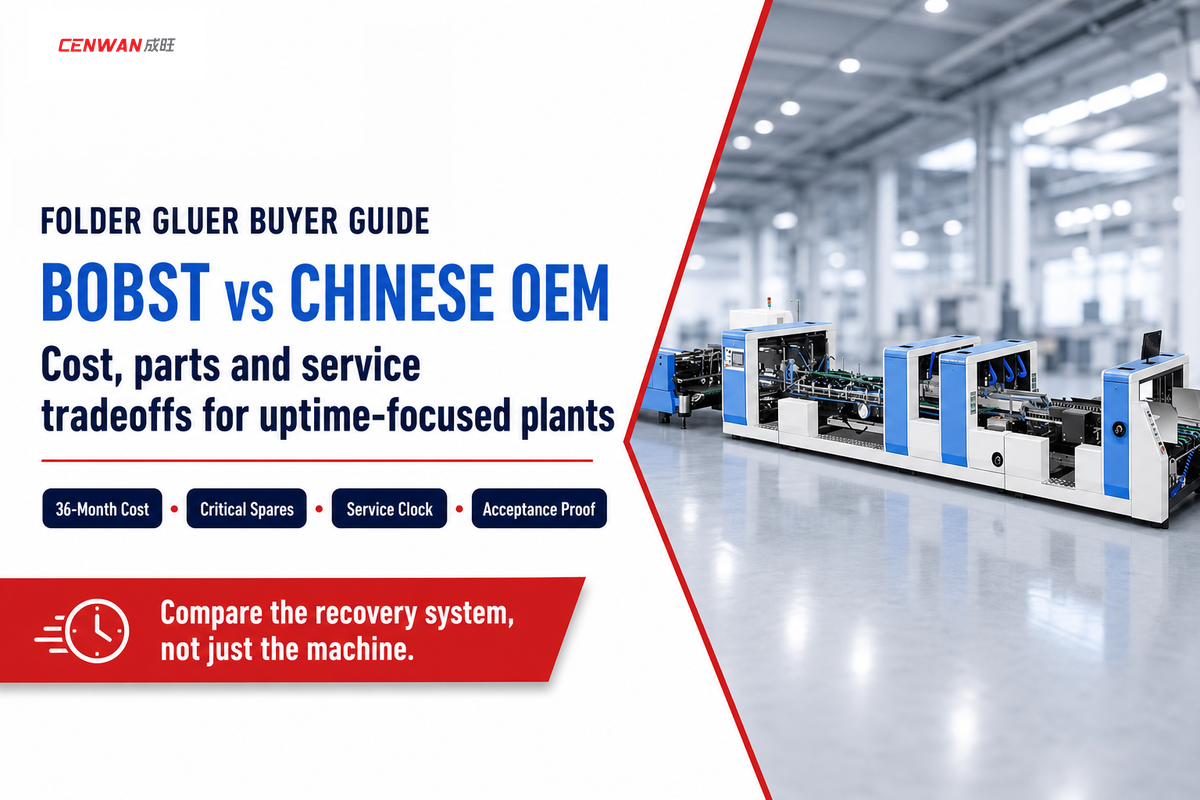
A BOBST folder gluer is best evaluated as a configured production system, not as one standardized machine. Select BOBST when integrated automation, repeatability, quality-control options, and a mature service system justify the higher acquisition burden. Select a qualified Chinese OEM folder gluer when its signed configuration is compatible with your carton mix and you can validate output, parts, training, and service before shipment. Neither origin is a shortcut to a correct decision.
Sound comparison isn’t about a “luxury European badge against a low-cost Chinese item.” It’s one proven production system against another. That means matching machine width, carton styles, board, glue pattern, inspection, peripherals, utilities, training, initial spares, and acceptance jobs. It also means costing what occurs after the line halts.
Key takeaway
Do not approve either proposal until representative-carton acceptance, critical-spare coverage, service escalation, and 36-month risk-adjusted cost are documented on the same basis.
Bobst vs Chinese OEM at a Glance
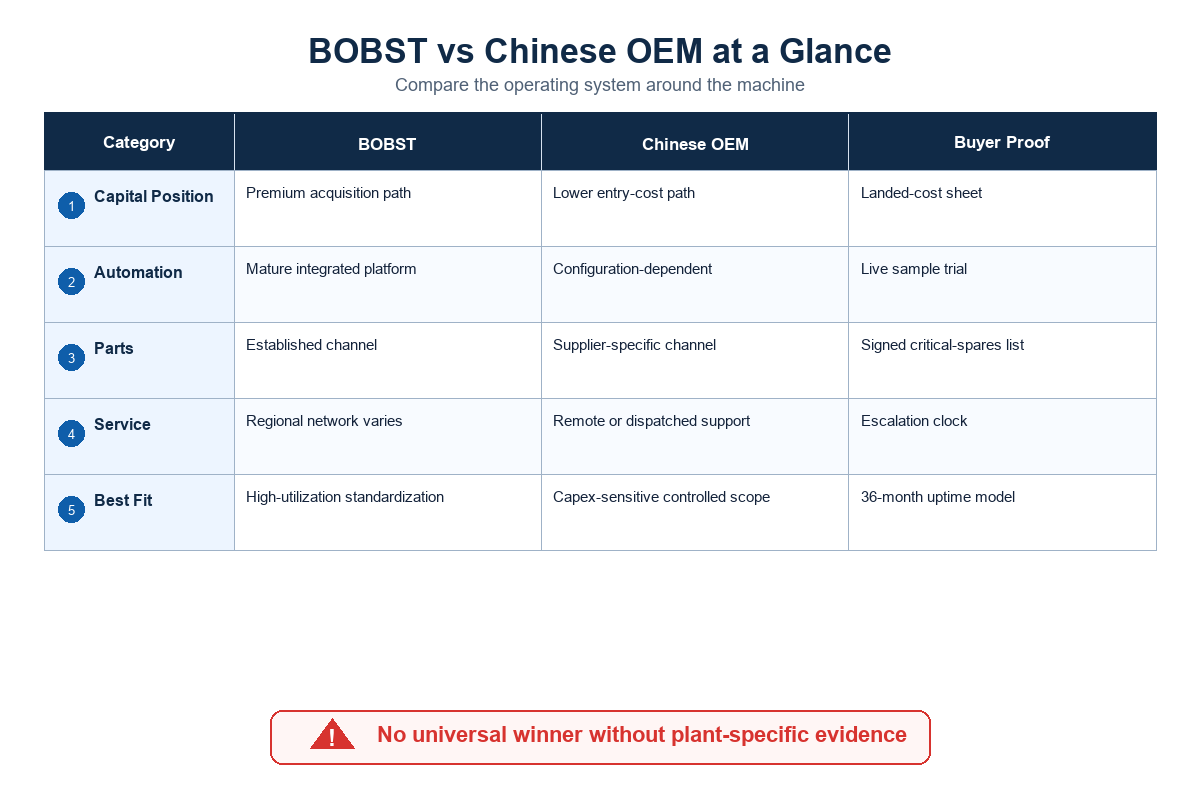
BOBST proposals usually start from a proven platform and a framework of options, service tools, parts catalogs, and process experience. Chinese OEM bids may offer new machines built around a smaller budget or a more customized scope. Buyer validation differs, but it never goes away.
BOBST route
- Established folding-gluing platforms and option ecosystem
- Documented digital parts and remote-support infrastructure
- Strong fit where repeatability and quality risk dominate
- Higher acquisition burden must still be justified by the exact job mix
Qualified Chinese OEM route
- New-machine configuration can be tailored around a defined application
- Factory-direct communication may shorten some diagnosis loops
- Strong fit where capital discipline and in-house maintenance are important
- Specifications, parts stock, technical records, and service promises need deeper verification
| Decision area | BOBST proposal | Chinese OEM proposal | Evidence to request |
|---|---|---|---|
| Automation | Confirm included and optional setup, alignment, inspection, ejection, and job-management functions. | Confirm servo scope, recipe storage, automatic adjustments, inspection interfaces, and exact branded components. | Signed option list, control architecture, and video of your jobs. |
| Production | Do not treat a published maximum speed as your output. | Do not treat a published maximum speed as your output. | Saleable pieces per hour, waste, stops, and changeover time for representative cartons. |
| Parts | Check portal availability and local or regional stock for the exact configuration. | Check stock location, drawings, compatibility, dispatch, and shipping route. | Critical-spare list with part numbers and commitments. |
| Service | Define remote, field, and escalation coverage for the destination plant. | Define time-zone coverage, remote access, field engineer route, and local partner responsibility. | Milestone-based service schedule and named escalation contacts. |
| Risk | Premium price is not proof of fit. | Lower quote is not proof of savings. | Matched 36-month cost model and acceptance record. |
Compare Cost as a 36-Month Operating Decision
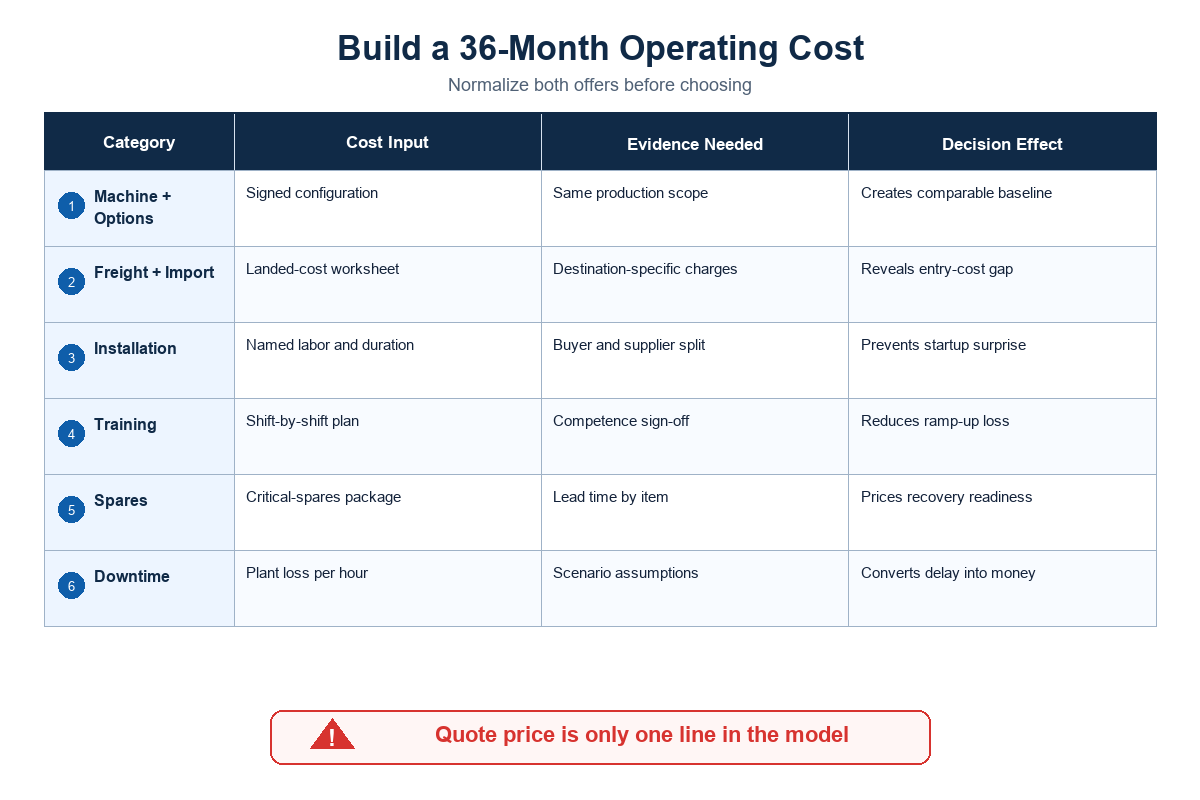
New folder-gluer costs are configuration-dependent and region-dependent, so a public “BOBST price versus China price” range would be unreliable. Start by standardizing the scope. Freight, insurance, duty, brokerage, rigging, utilities, installation, commissioning, training, initial spares, finance, and acceptance work belong alongside the machine price.
First-year landed cost = configured machine + options + export packing + freight + insurance + duty/tax + inland delivery + rigging + utilities + installation + commissioning + training + initial spares.
36-month risk-adjusted cost = first-year landed cost + planned maintenance + expected downtime exposure + scrap/rework exposure + service/travel cost + financing cost − credible residual value.
Downtime exposure shouldn’t be concealed within a single broad efficiency figure. PMMI’s 2026 packaging-machinery survey page distinguishes downtime, output, and performance as separate plant measures. That separation matters: a line can run fast while moving and still lose the week through setup delays, microstops, parts shortages, or quality holds.
An illustrative calculation, not a market quote
Let’s say Proposal A shows a hypothetical first-year delivered cost of 500 units and Proposal B costs 340 units. Across 36 months, your team estimates 60 versus 45 units for scheduled maintenance and 35 versus 150 units for downtime and service exposure. The equivalent figures then show 595 and 535 units. Proposal B remains the cheaper alternative in this example, but its initial 160-unit advantage has decreased to 60. If the risk considerations can’t be substantively backed up by maintenance logs, parts commitments, or test trial data, show them as a range rather than fooling yourself into thinking they’re accurate.
This model becomes especially important when someone places a used BOBST auction listing beside a commissioned new OEM quotation. Used listings may omit inspection, dismantling, missing tooling, controls work, freight, installation, guarding upgrades, and acceptance. Those are different scopes, not two quotes for the same result.
Where a BOBST Premium Can Earn Its Keep
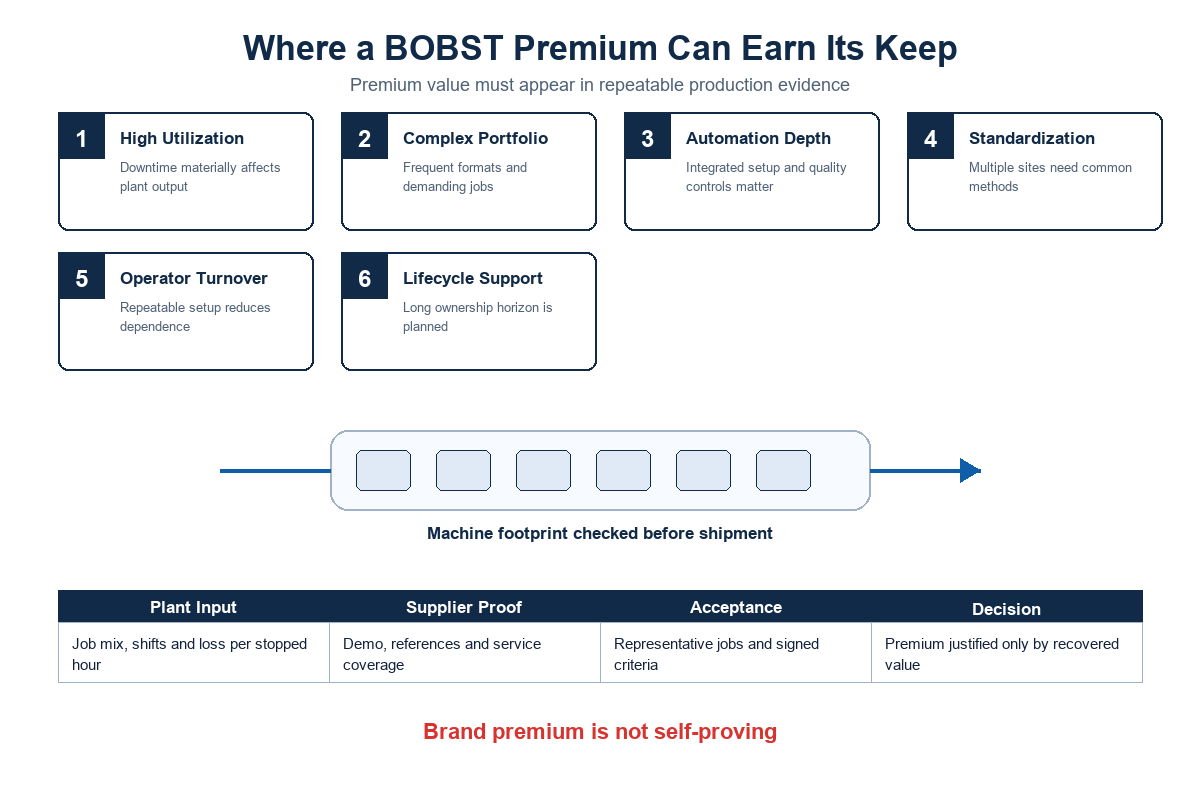
BOBST offers different platforms for different production envelopes. Its EXPERTFOLD page lists variants up to 450 m/min, whereas MASTERFOLD material lists up to 700 m/min. Those are platform specifications, not commitments for your carton, adhesive, feeder condition, staffing, or quality limit. Your quotation should identify the exact platform, width, modules, peripherals, and software—not merely “a BOBST folder gluer.”
Premium pricing starts making business sense when the purchased setup reduces variation, stabilizes demanding folds, integrates quality control, and improves repeat-job consistency. BOBST’s 2025 Grigeo customer case described alignment, pre-breaking, a five-metre folding section, quality control with ejection, low-waste setup, and training. Grigeo expected the line to double its folding-gluing capacity. That is one scoped installation, not a universal return-on-investment guarantee.
Buyers should therefore ask: Which functions are included? Which are priced options? Which performance claims have been demonstrated on this setup? If quality-inspection or automatic adjustment is central to the business case, put the hardware, software license, interfaces, training, and acceptance criteria into the contract.
“Catalog promises aren’t acceptance records. Capability earns value only when the purchased configuration produces your cartons at the agreed quality, waste, changeover, and output conditions.”
Where a Chinese OEM Can Be the Rational Choice
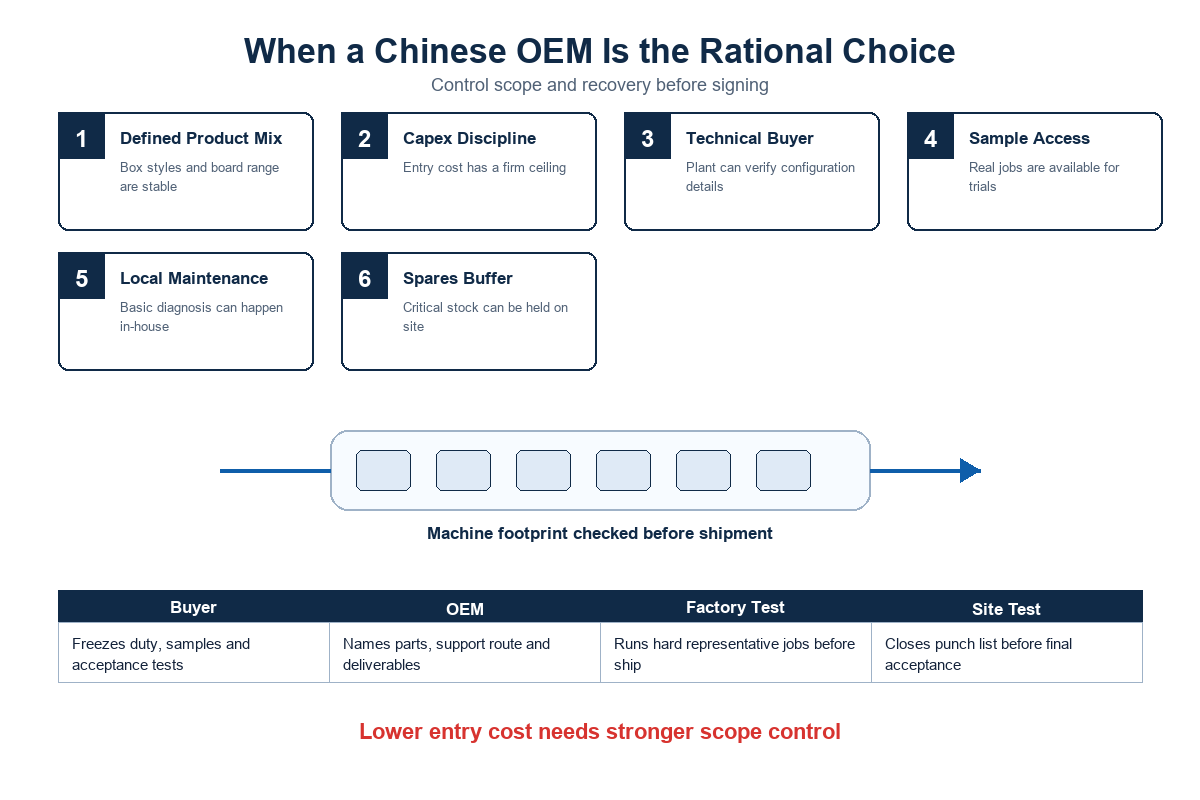
New Chinese OEM machines can be logical choices when applications are well defined, the required options are available, the plant has capable maintenance staff, and the buyer can run a disciplined acceptance process. They can also suit factories that need application-specific customization without paying for functions they won’t use.
For example, Cenwan’s current folder gluer machine range publishes up to 400 m/min for selected CW-G variants. Its CW-W straight-line folder gluer page publishes a 200 m/min maximum gluing speed, a 290–1,250 mm box-width range, and 22 kW power for the named configuration. The high-speed folder gluer page lists 200–800 g/m² paperboard and 21.5–25.5 kW across selected models. Cenwan’s crash-lock folder gluer range separately lists 180–800 g/m² board and a 6 bar compressed-air requirement for named models. These are supplier-published specifications, not verified saleable output.
Turn each numerical claim into a test. Run the smallest and largest cartons, the lightest and heaviest board, the hardest fold style, and the intended adhesive. Record good pieces, rejects, stops, glue faults, setup time, and restart behavior. A 400 m/min unloaded line-speed claim should never appear in a business case as 400 m/min sustained production.
Component disclosure matters too. Familiar drive and control brands can help local troubleshooting, but a brand name doesn’t confirm the exact model, regional availability, program access, or replacement compatibility. Request the bill of materials for critical components, electrical drawings, the backup procedure, software ownership terms, and a change-control clause that prevents silent substitutions.
Parts Strategy: Run the Critical-Spare Coverage Test
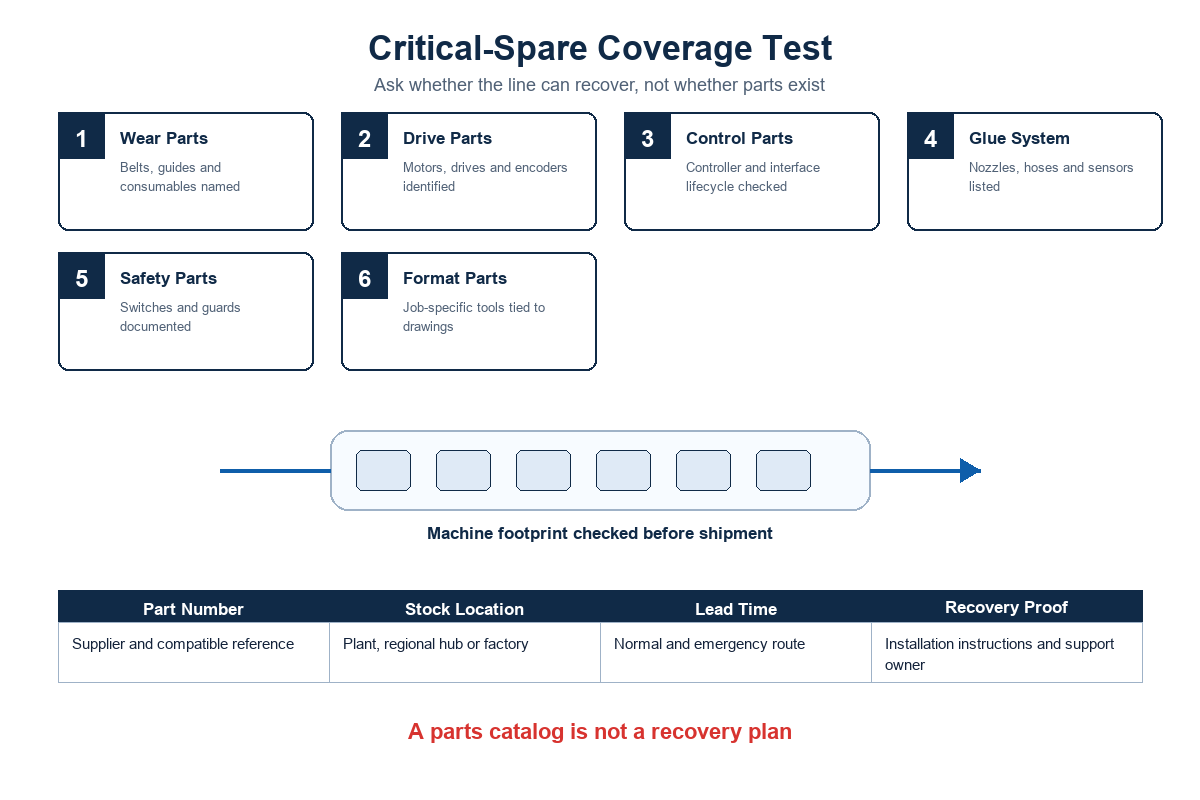
Folder-gluer parts aren’t one commodity. Wear items such as belts, glue discs, and scrapers have different stocking and replacement patterns from bearings, drives, power modules, input/output devices, sensors, and proprietary assemblies. BOBST’s MyBOBST system provides parts catalogs, availability, pricing, and order history, while its maintenance content identifies bearings and belts as recurring attention points. That structure is useful only if parts for your serial number are identifiable and available in your region.
Cenwan’s parts and service page states a 7–30 day lead time for multiple brands and a replacement policy lasting 12 months after defect verification. Treat both as supplier-published terms. They don’t prove every item is stocked, that customs will clear on schedule, or that an offered part matches a specific machine revision.
The Critical-Spare Coverage Test
| Question | Documented | Conditional | Missing |
|---|---|---|---|
| Exact part number and revision? | Drawing or serial-specific catalog confirms it. | Supplier will identify it after failure. | Only a generic part name is provided. |
| Where is it stocked? | Named warehouse and current quantity. | Factory stock subject to confirmation. | No stock location. |
| When does it leave? | Dispatch commitment in business hours. | Estimated lead time after payment. | Only “fast delivery.” |
| Will it fit? | Serial, revision, drawing, and interface match. | Photo-based confirmation. | No compatibility evidence. |
| What happens if it is wrong? | Written warranty, return, and replacement route. | Case-by-case handling. | No remedy. |
Run the Critical-Spare Coverage Test before ordering, then build an initial-spares kit from the result. The best kit is not the longest list; it covers items with serious downtime consequences, uncertain supplier availability, or a high chance of secondary damage when they fail. Planned cleaning, inspection, lubrication, belt-tension checks, and glue-system maintenance remain essential because inventory cannot compensate for weak maintenance.
Service Tradeoffs: Put Both Suppliers on a Service Escalation Clock
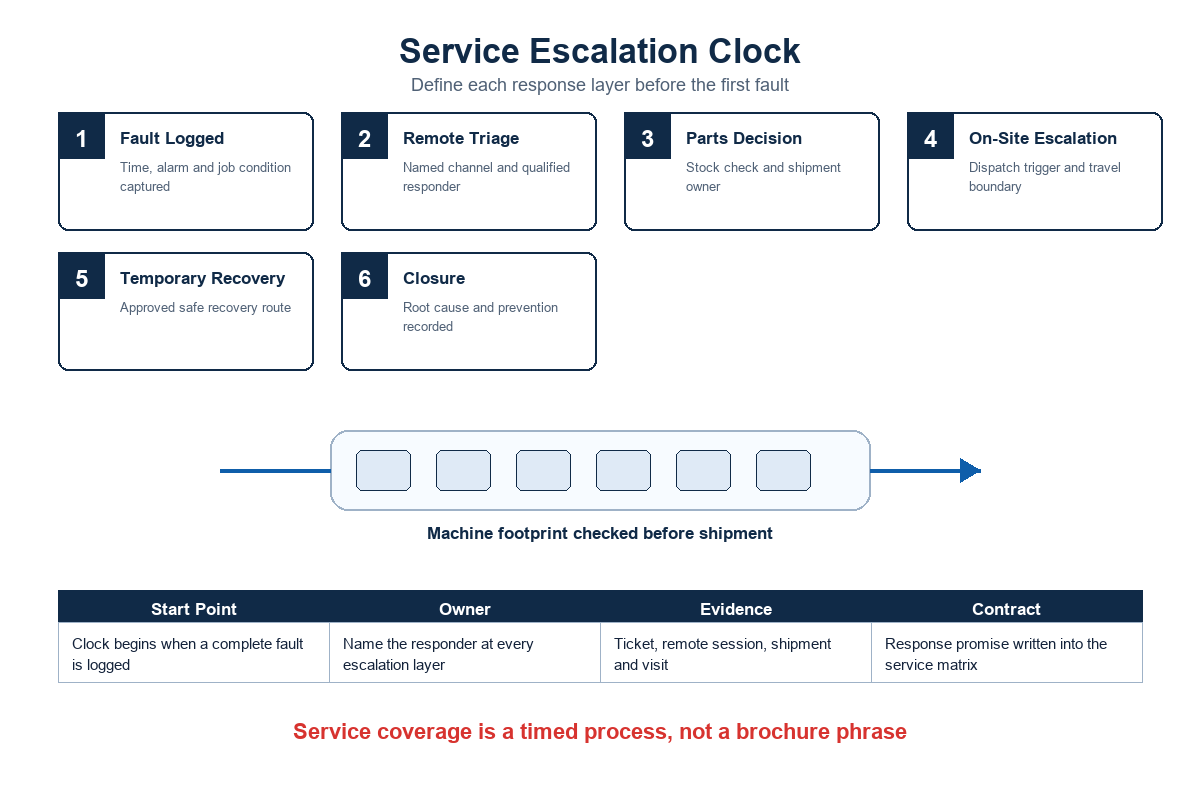
“Response within two hours” doesn’t equal “production restored within two hours.” A useful service comparison breaks the event into recovery milestones. This avoids penalizing a supplier for freight time outside its control while preventing a quick acknowledgement from masking the full recovery period.
- First response: a qualified person acknowledges the case and confirms ownership.
- Diagnosis: the team identifies likely causes and the data needed to isolate them.
- Workaround: a safe temporary operating path is proposed when one exists.
- Dispatch: the correct part or field engineer is released.
- Arrival: the resource reaches the destination plant.
- Verified restart: the line returns to agreed output and quality; powered-on status alone isn’t enough.
BOBST describes remote assistance, the MyBOBST portal, Maintenance Plus, and connected service tools. One official customer story reported an exceptional expedition that reduced one part timeline from four months to two weeks. It shows escalation capability in that case, not a universal two-week delivery promise.
A Chinese OEM may provide factory-direct support through messaging, video, or a remote connection, followed by parts dispatch or a travelling engineer. That can work well when the technician knows the exact machine and the plant has staff who can measure, adjust, and replace components. Ask who responds outside the factory time zone, who pays for travel, which secure remote-access device and protocol are used, and whether the local partner has service authority or only a sales role.
Do
- Contract separate service milestones
- Name the escalation contacts and time-zone coverage
- Define the data, remote access, and safety steps needed for diagnosis
- Close the case only after a verified production run
Don’t
- Equate acknowledgement with recovery
- Assume every part is local
- Allow uncontrolled remote access
- Generalize one exceptional service case into a universal promise
What 2026 Search Signals Mean for Buyers
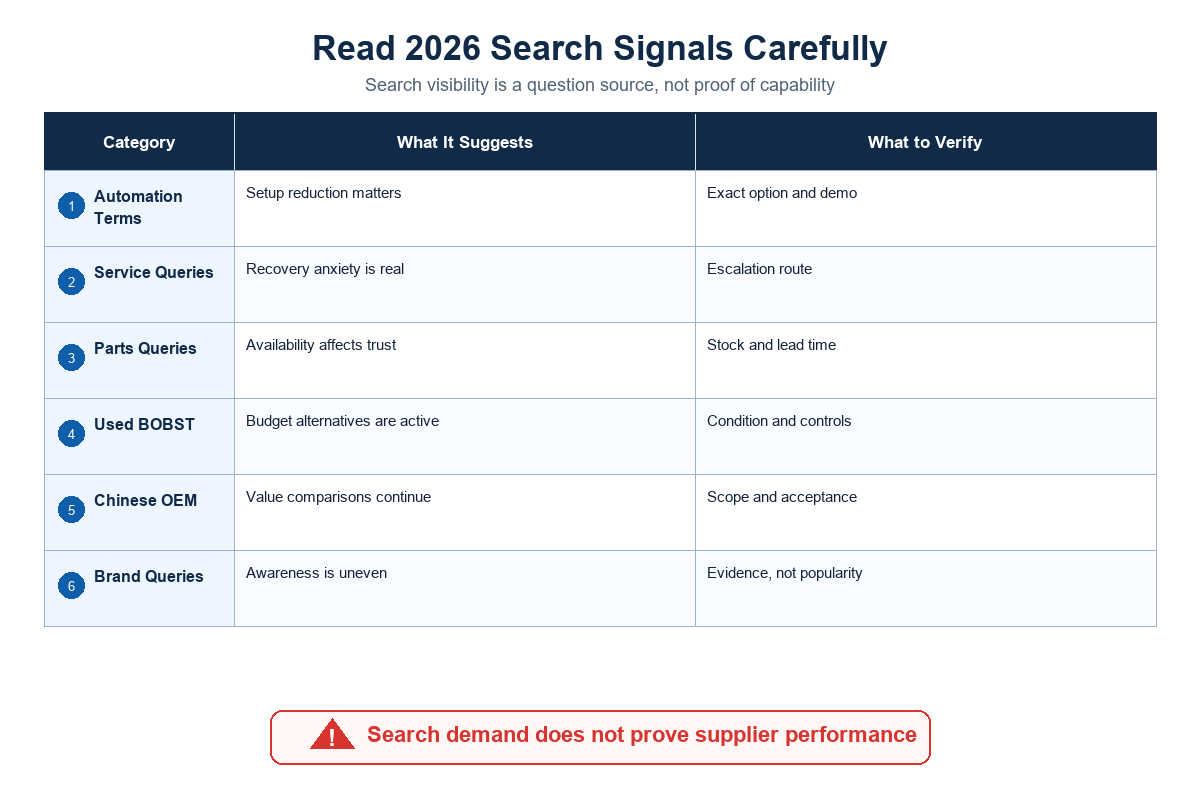
Current folder-gluer search data is too small to prove a market-growth trend, but it does show which purchasing questions buyers are trying to resolve. DataForSEO recorded the exact term “bobst folder gluer” at 50 monthly searches in January 2026 and 90 in June. “Folder gluer parts” remained low-volume but active.
“Corrugated folder gluer machine” rose in June. Observed searches including “Bobst folder gluer price,” “Bobst folder gluer parts,” and “Bobst folder gluer for sale” point to purchasing and support questions. Cenwan’s Google Search Console data also shows impressions around parts, operators, automatic machines, and corrugated applications.
Buyer meaning matters more than the figures. Prospects aren’t only asking whether a machine exists. They’re asking who can operate it, what fails, how parts arrive, and whether the line suits corrugated or folding-carton work. Give those questions more weight in due diligence, but don’t turn a single-month rise from a low base into a claim that the whole market is surging.
New Chinese OEM vs Used BOBST Is a Separate Decision
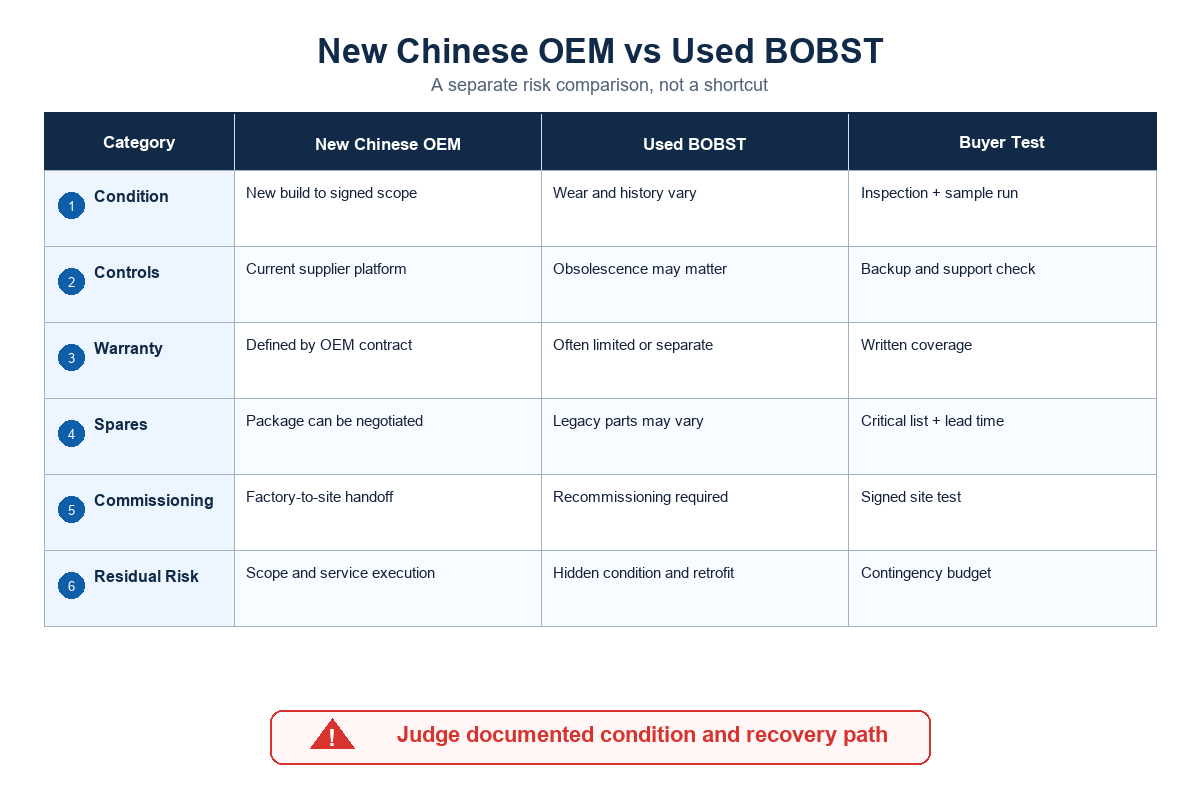
Used BOBST machines can have proven platforms, a mature secondary market, and skilled technicians—and they might come with unknown wear, missing tooling, legacy controls, limited software access, or setups built for somebody else’s cartons. The used-machine condition must therefore be inspected rather than inferred from the badge. New Chinese OEM machines have a defined build and warranty from the outset, but depend more on acceptance quality and support validation. Neither route wins automatically.
The Used-vs-New Recommissioning Gap
Add the following items to the used BOBST asking price before comparing it with a commissioned new-machine proposal:
- Independent mechanical, electrical, and controls inspection
- Available manuals, backups, passwords, licenses, and wiring drawings
- Wear measurements for belts, bearings, shafts, folding sections, and glue systems
- Missing tooling, peripherals, guards, and quality-control equipment
- Dismantling, packing, freight, insurance, rigging, and reassembly
- Electrical, guarding, and hazardous-energy modifications for the destination plant
- Software or controls obsolescence work
- Training and representative-carton acceptance runs
Jurisdiction matters. European Commission guidance says European Union machinery rules apply to products first placed on that market and can also apply when existing machinery is modified so substantially that it becomes de facto new machinery. Regulation (EU) 2023/1230 becomes mandatory on 20 January 2027. In the United States, OSHA machine-guarding and hazardous-energy requirements remain plant responsibilities. Factory performance testing doesn’t replace site safety acceptance.
Use the Quote-to-Uptime Decision Grid
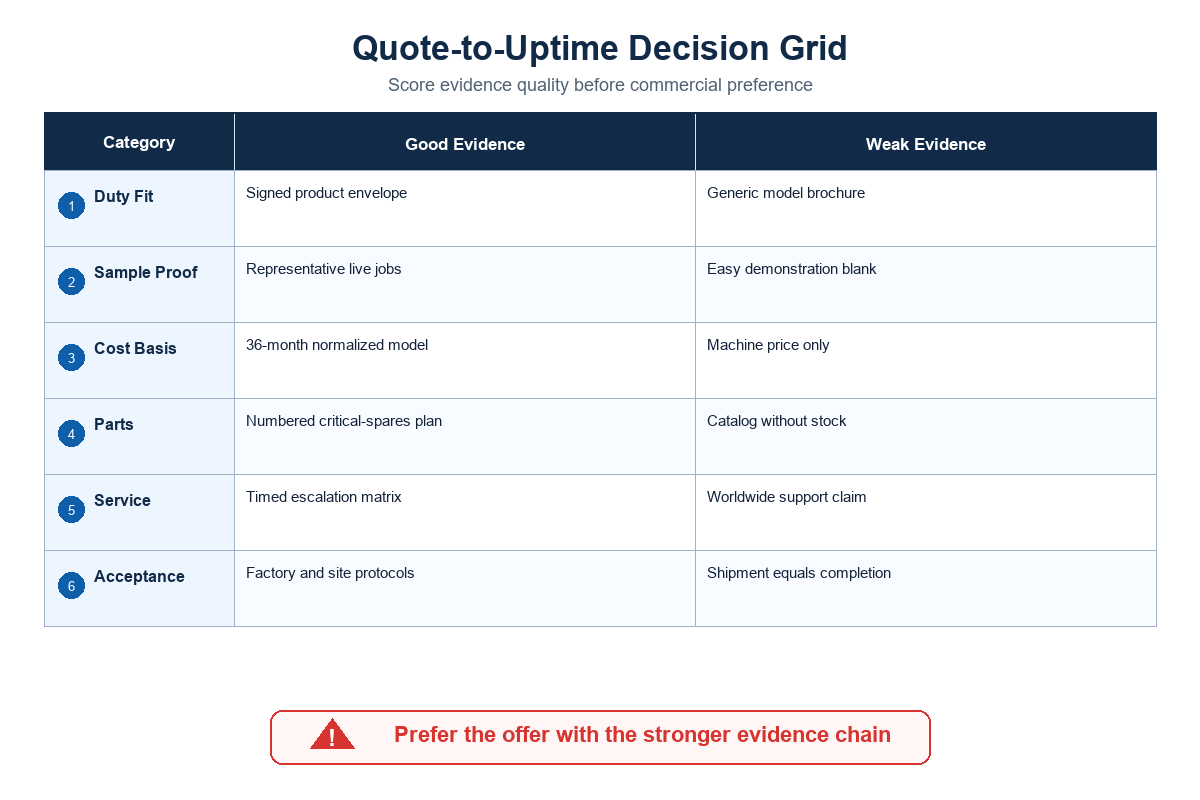
The Quote-to-Uptime Decision Grid prevents a polished proposal from masking an unverified operating assumption. Mark each block documented, conditional, or missing. Conditional items have stated dependencies, such as “part stock to be confirmed at order.” Missing items have no usable evidence.
| Evidence block | Documented means | Pause when |
|---|---|---|
| Representative-carton acceptance | Named jobs, board, glue, target output, waste, quality limits, changeovers, and signed results. | The test uses only an easy demonstration carton or unloaded speed. |
| Changeover and quality evidence | Timed transition, recipe handling, first-good-piece result, inspection logic, and reject record. | Automation is described but not demonstrated. |
| Critical-spare coverage | Part numbers, stock location, dispatch, route, compatibility, and warranty are recorded. | The proposal says only “parts available.” |
| Service escalation | Response, diagnosis, workaround, dispatch, arrival, and restart ownership are defined. | One response-time number substitutes for recovery. |
| 36-month cost | Both proposals use the same landed-cost, maintenance, downtime, and residual-value fields. | A used listing or base machine price is compared with a commissioned project. |
Choose BOBST when its documented process control, repeatability, service depth, or resale profile closes risks that matter enough to justify the cost. Choose a qualified Chinese OEM when the acceptance evidence, parts plan, and support path are credible and the lower-capital configuration fits the plant. Pause when any decision-critical block remains missing, regardless of brand.
Request for Quotation and Factory-Acceptance Checklist
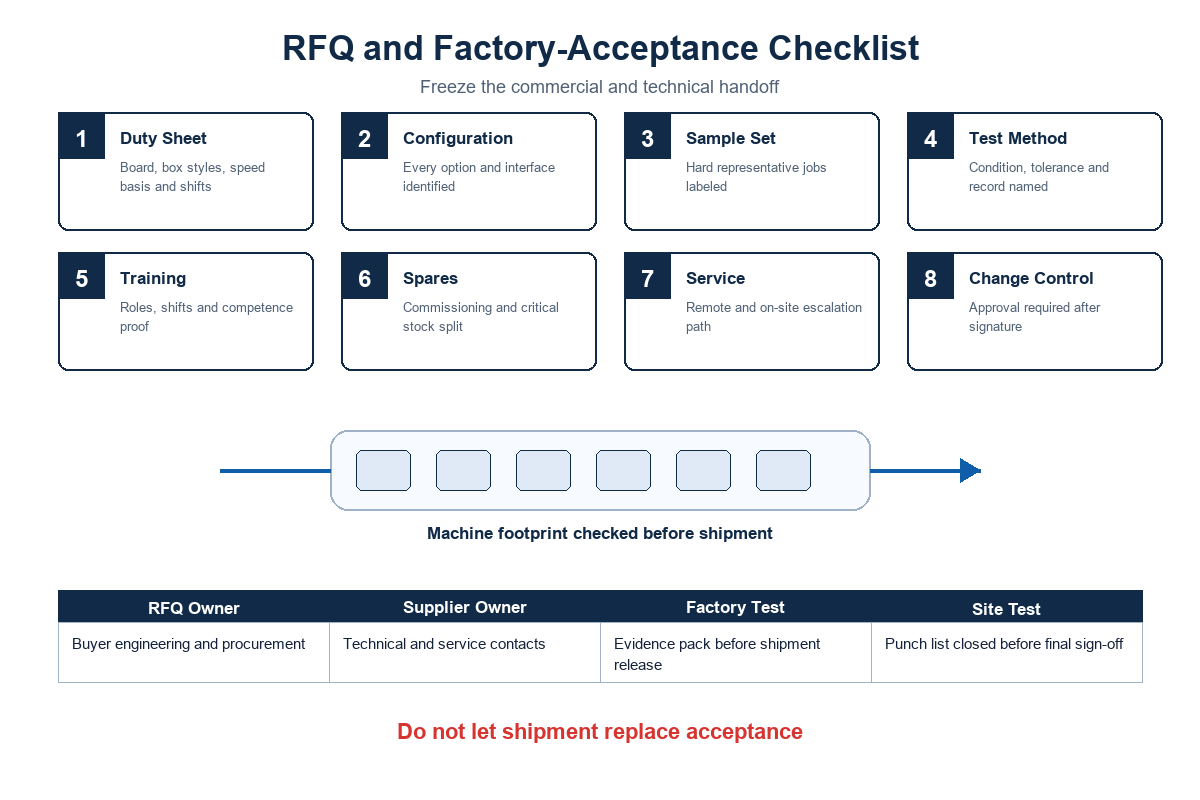
Issue an identical scope of work to both suppliers. A common brief reduces guesswork, limits scope creep, and makes additions or exclusions easier to identify before contract review.
| Parameter category | Put this in the request | Acceptance evidence |
|---|---|---|
| Carton families | At least three representative families: routine, smallest or lightest, and most difficult. | Approved drawings and physical samples. |
| Materials | Board grade, basis weight, flute if applicable, coating, warp tolerance, and adhesive. | Supplier tests the actual or agreed equivalent stock. |
| Output | Target saleable pieces per hour by job—not only line speed. | Timed run with stops, rejects, and good-count record. |
| Changeover | Start and end jobs, staffing, recipe use, and first-good-piece definition. | Observed and timed changeover. |
| Quality | Fold, glue, squareness, scuff, count, inspection, and reject criteria. | Sampling plan and signed defect record. |
| Utilities and integration | Power, compressed air, extraction, glue system, upstream/downstream interfaces, and floor plan. | Approved utility drawing and site checklist. |
| Manuals and safety | Language, manuals, schematics, backups, training, guarding, hazardous-energy provisions, and destination requirements. | Document register plus separate site safety acceptance. |
| Parts and service | Critical-spare kit, stock location, dispatch, escalation, remote access, field support, warranty exclusions, and travel cost. | Contract annex with contacts and milestones. |
At the factory acceptance test, use production-like board and adhesive. Record ambient conditions when they affect glue behavior. Include normal stops, restart, job recall, a changeover, reject handling, and recovery from a controlled fault. List deviations with an owner and closure date. Final payment should follow the agreed commercial milestones, not an informal “the machine looks good” message.
Final Recommendation by Plant Profile
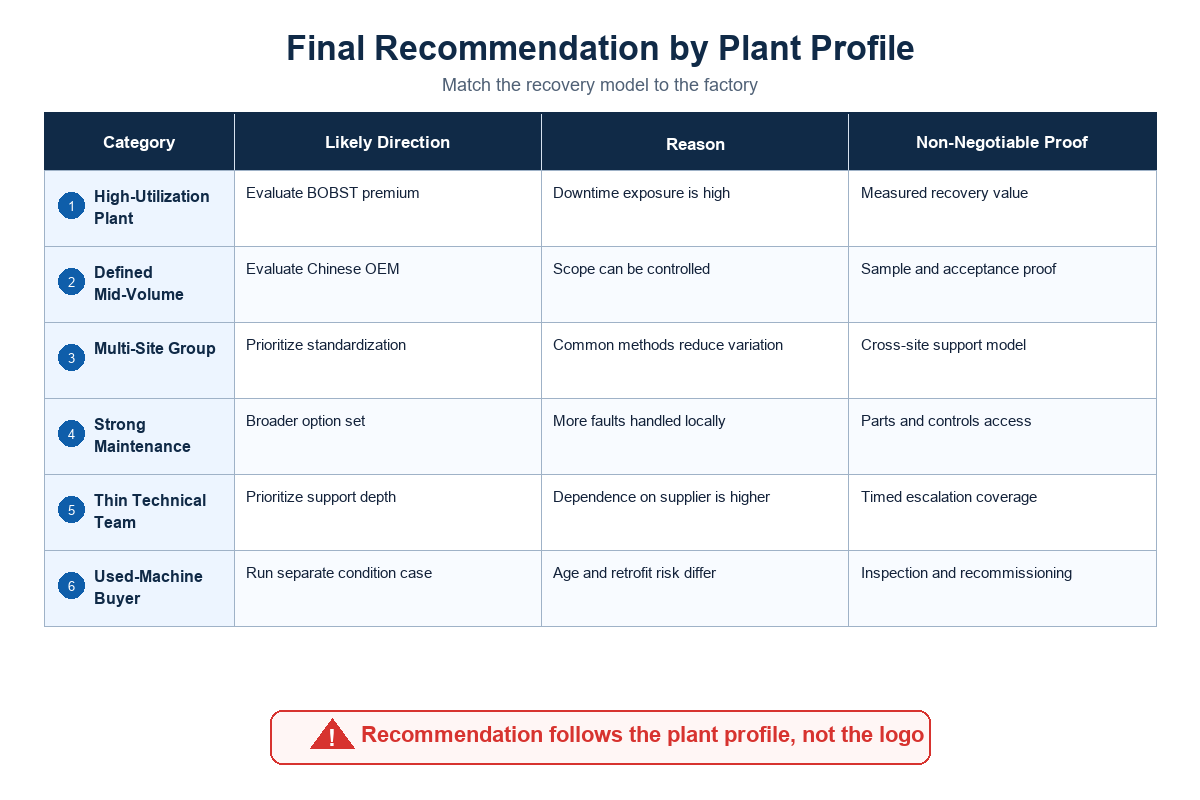
Choose by operating risk, job mix, maintenance depth, and the evidence attached to the exact proposal. The following profiles show where each route deserves greater weight.
High-mix or quality-critical folding cartons
Give BOBST serious weight when repeatability, complex folds, integrated inspection, rapid job recovery, and auditability carry high business consequences. Verify that the proposal includes the capabilities used in the business case; don’t pay for a platform reputation while omitting the relevant options.
Stable, cost-sensitive production with strong maintenance
Qualified Chinese OEMs may be the stronger fit when carton families are stable, the plant can troubleshoot effectively, and a rigorous factory test confirms saleable output and changeovers. Invest part of the capital difference in initial spares, technical records, and training.
Plant without local maintenance depth
Prioritize the supplier that can prove local or regional coverage, remote-diagnosis competence, parts visibility, and field escalation at the destination. Depending on the evidence, that may be BOBST, an OEM with a capable local partner, or neither current proposal.
Used-premium-machine buyer
Commission an independent inspection and complete the Used-vs-New Recommissioning Gap before negotiating on price. Confirm controls support, drawings, guarding, tooling, software access, dismantling scope, and representative acceptance. Recognizable badges don’t reveal a machine’s current condition.
If you’re comparing proposals now, send Cenwan your carton drawings, board specifications, adhesive, required styles, target saleable output, changeover pattern, quality limits, destination, and service requirements. Use the response to populate the Quote-to-Uptime Decision Grid—not to bypass it.
Frequently Asked Questions
Is a Chinese OEM folder gluer as good as a BOBST folder gluer?
A qualified Chinese OEM machine can be the better practical fit for some plants, but country of origin doesn’t prove equivalence. Compare the exact carton range, options, controls, sample-run quality, sustained output, technical records, critical-spare availability, warranty, and escalation path. Signed factory-acceptance testing with your cartons is more useful than a broad “same quality” claim.
How much does a BOBST folder gluer cost compared with a Chinese OEM?
New-machine prices are normally configuration- and region-dependent, so obtain two matched quotations. Normalize machine options, freight, duty, rigging, utilities, commissioning, training, initial spares, financing, maintenance, downtime exposure, and identical acceptance criteria. Used BOBST listings aren’t valid proxies for commissioned new projects.
Are BOBST folder gluer parts easier to obtain?
BOBST documents an online parts and support ecosystem, but actual availability depends on serial number, configuration, region, and stock. Chinese OEMs may offer direct communication or short supplier-stated lead times for selected parts. Verify both at the part-number level, including stock location, dispatch commitment, compatibility, freight route, and warranty handling.
What should be tested before buying a Chinese folder gluer?
Test your actual board, box styles, adhesive, hardest folds, changeovers, stop recovery, inspection, and rejects. Record saleable output, waste, stops, and every deviation. Run at least three representative job families and define the pass criteria before the factory test begins.
Should I buy a used BOBST or a new Chinese OEM folder gluer?
Treat it as a recommissioning decision, not a brand contest. Used BOBST machines may offer proven architecture and resale value, but controls age, wear, missing tooling, relocation, installation, software access, and safety upgrades can materially change the cost. New Chinese OEM machines offer defined builds and warranties, but demand strong acceptance and support verification. Price both routes through commissioning, representative production trials, initial spares, documentation, training, and recovery from a defined failure before selecting the lower-risk proposal.
References & Sources
- European Commission — Machinery
- US Occupational Safety and Health Administration — Control of Hazardous Energy
- US Occupational Safety and Health Administration — Machine Guarding Safety Considerations
- PMMI — Standards and Regulations
- PMMI — Overall Equipment Effectiveness Quickie Survey 2026
- Flexographic Technical Association — Five Components to Consider When Purchasing a Folder Gluer
Manufacturer Background
Cenwan Machine is a Wenzhou, China-based manufacturer of folder gluer machines, corrugated box gluing equipment, and integrated packaging lines. For more than 10 years, we have supported carton and corrugated packaging manufacturers in 40+ countries with equipment selection, custom configuration, installation support, spare parts, and after-sales service.
Our blog content is written to help packaging buyers, plant managers, and procurement teams understand folder gluer technology, box style compatibility, production capacity, ROI, maintenance, and supplier selection before requesting a quote.
- 10+ years of folder gluer engineering experience
- Factory base in Ruian, Wenzhou, Zhejiang, China
- Folder gluer machines, corrugated folder gluers, and automatic packaging lines
- CE / ISO 9001 manufacturing and quality references
- Remote diagnostics, spare parts support, and 24/7 technical response
- Equipment and service experience across 40+ countries
Brand
Cenwan Machine
Company
Zhejiang Chengwang Intelligent Packaging Equipment
Business Type
B2B Machinery Manufacturer
Factory Base
Ruian, Wenzhou, Zhejiang, China
Email
sales2@cenwanmachine.com
Phone / WhatsApp
+86 139 0664 6788