Get in touch with Cenwan Machine Company


Cenwan Machine technical team · Corrugated converting buyer guide
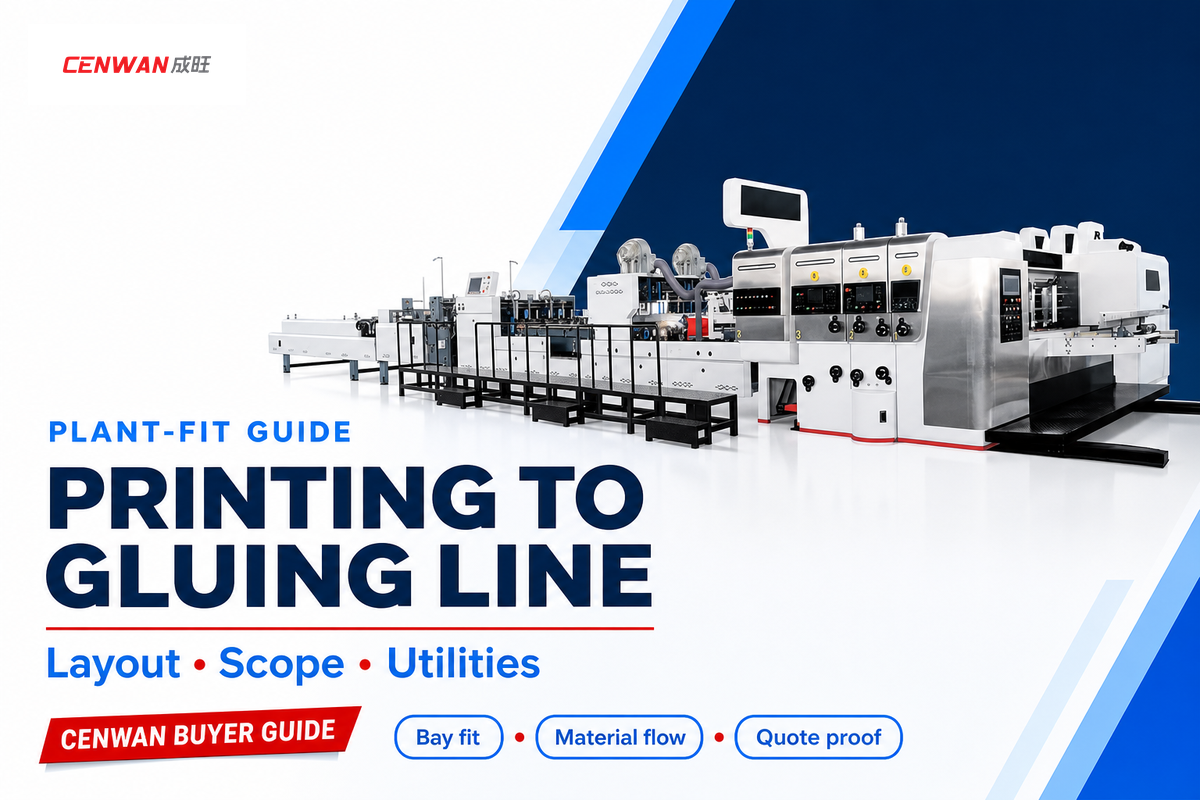
A printing die cutting folding gluing line can join multiple converting steps, with the printer and die-cutter configured around the carton cut line and die line. A published machine size can’t tell you if a complete, serviceable configuration of machinery can fit in your bay. First look at carton jobs. Next look at the detailed modules listed in the quote. Then ask for a revision-controlled arrangement drawing showing roller access, a utility schedule, a quality control plan and a same-job output trial. This aids your plant and purchasing teams to check the above items before treating a quote as final.
Short answer
Measure the usable bay, mark sheet and finished box routes, and get a drawing of the quoted configuration showing all accesses and utilities. The machine envelope number is an input to that check, not the output. If a print station, die cutter, delivery or pack station is optional, find out which of those stations the published size and power figure actually cover.
1. Start with the carton mix and line boundary
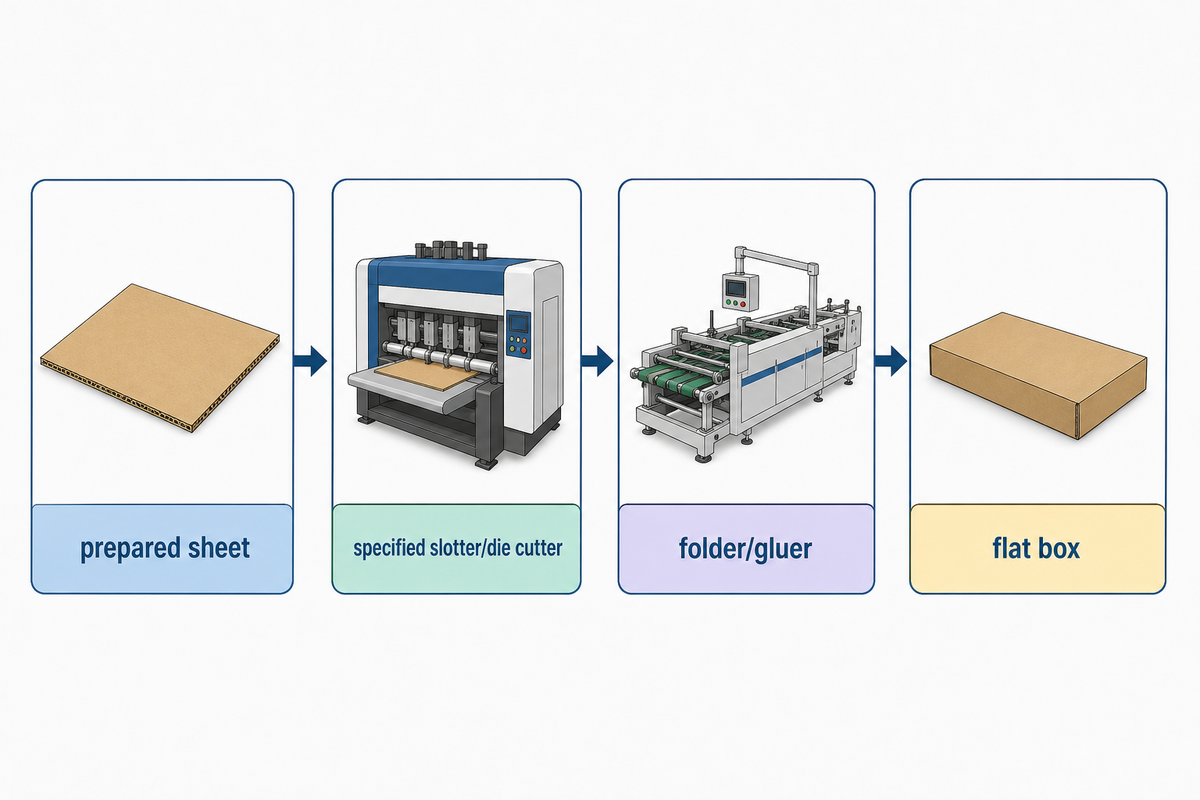
Define the first and last material state in the request for quotation. In this case, the first state is a flat, prepared corrugated sheet at the point where sheets are fed, and the last state is a folded and glued flat box ready for the next handling. The production-process description provided by FEFCO shows that board making and corrugating is separate from board converting, printing, and joining. Those converting processes can be integrated in the same machine or can be in separate machines, while the carton design process specifies the cutting process for either route. An upstream corrugator, a box erector and finished-goods packing therefore belong on separate scope lines unless the supplier expressly includes them.
What does a printing die cutting folding gluing line actually combine?
A proposed train may include modules for sheet feeding, flexographic printing, slotting or die cutting, scoring, folding, gluing and delivery, and the comparison asks whether printing slotting and slotting die cutting share a module or require a separate die-cutting machine. The order of the modules doesn’t indicate which are included in the priced configuration or the precision of the die-cutting process on a representative carton. Cenwan’s public product page states that inline flexo printing is optional and a rotary die cut slotter is compatible. Packing is also an option. Request a module-by-module inclusion list tied to the specific Single or Dual configuration. A “complete line” description without this list won’t define the physical and commercial boundaries.
Converting Route Boundary Map
Corrugator → prepared sheet → feeder → optional print → specified slotter/die cutter → folder/gluer → delivery → flat box → optional packing or erecting.
Map legend: Bold items are the default boundary markers used here. In the actual contract, the party responsible for each interface must be specified; the arrows are diagrams used for teaching, not Cenwan configuration diagrams.
Generate the carton schedule before drawing a box around any machine, including a quoted box making machine. Each box style and FEFCO code, sheet size, board flute and caliper, print colors, die cut, emboss and crease features, any steel rule tooling needs, glue features, bundle size, and long versus short runs must be included. A 13# postal carton, a larger regular slotted carton and a lock-bottom can have different sheet paths, fold line and glue flap positions, and requirements for finishing. Don’t assume a brochure range accepts all jobs on the schedule; have the supplier identify accepted, trial-required and excluded carton jobs, especially where board flatness or coating varies.
2. Draw the machine train and the plant-fit envelope
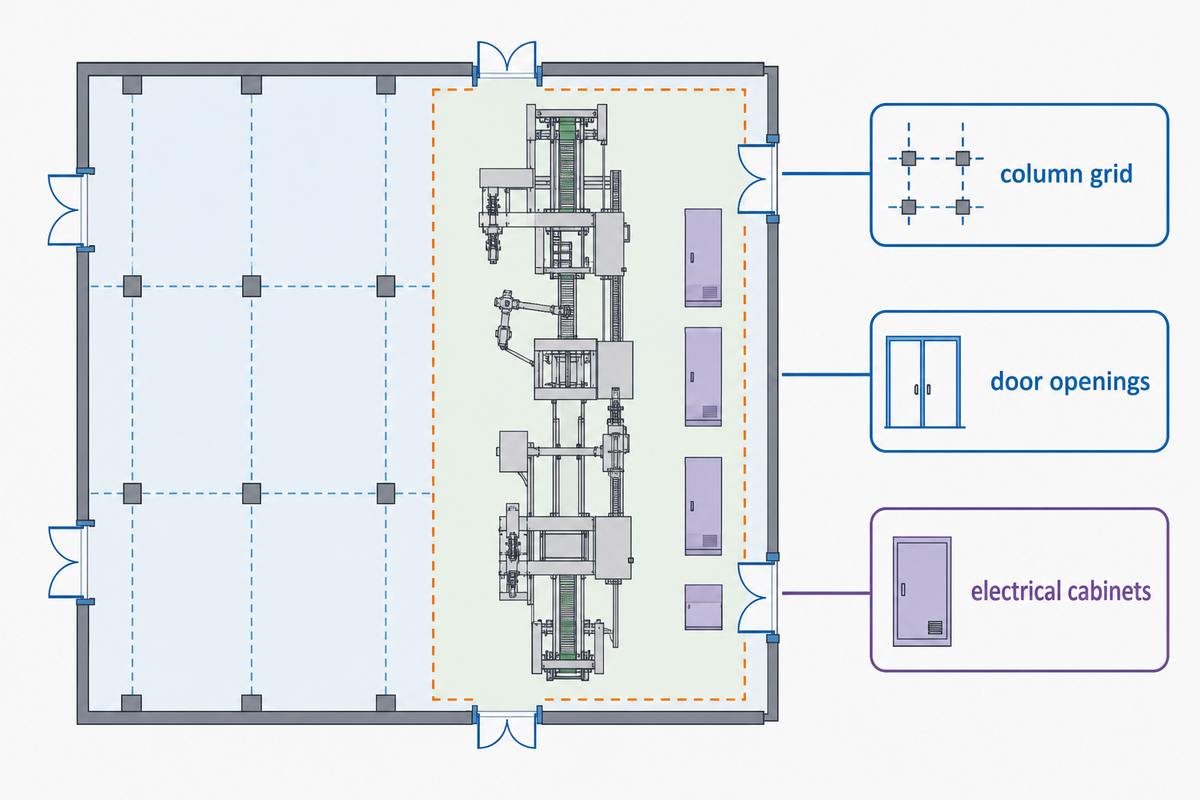
Use the fixed layer of the measured site plan and the proposed line drawing for the movable layer. On the site plan, mark the column grid, slab and floor levels, door openings, overhead services, existing machines, fire routes, delivery docks and the direction in which sheets arrive. The vendor drawing should be shown for each station with transport direction, the position of the feeder, delivery end, electrical cabinets, glue access, guards and auxiliary modules. Both drawings should be dated and assigned a revision number. A quote based on revision A shouldn’t be signed against a different layout.
What should be marked on the site drawing before the vendor sizes the line?
Nominal wall-to-wall dimensions shouldn’t be used to mark obstructions. Only usable dimensions should be marked. Show the narrowest route for machine-module entry, the routes for fully loaded pallet loads and the spaces where finished bundles are removed. Show who measured each dimension and the unit of measure. A vendor should be free to alter its layout around an existing line or column only if the obstruction is evident to the vendor at the time of the quote. If the proposed layout changes operator crossings or access to existing equipment, the plant manager should evaluate both the proposed changes together.
PUBLISHED MODEL VALUES GIVE A STARTING POINT. Cenwan’s web page reports the CW-IL-Single at 14.2 × 2.2 × 1.7 m and the CW-IL-Dual at 17.5 × 4 × 1.8 m, alongside other named model fields. Note these are SUPPLIER-REPORTED FIGURES. The public web page doesn’t say if each optional print, die-cut, outfeed and packing component is included in either envelope, nor does it present a signed access drawing for your site. Treat these figures as labels to request clarification.
A corrugated folder gluer guide can help your team name the folding and gluing functions, but the drawing remains the authority for this order. Ask the supplier to mark which configuration each overall-length and width value describes.
3. Calculate the usable bay, not only the machine footprint
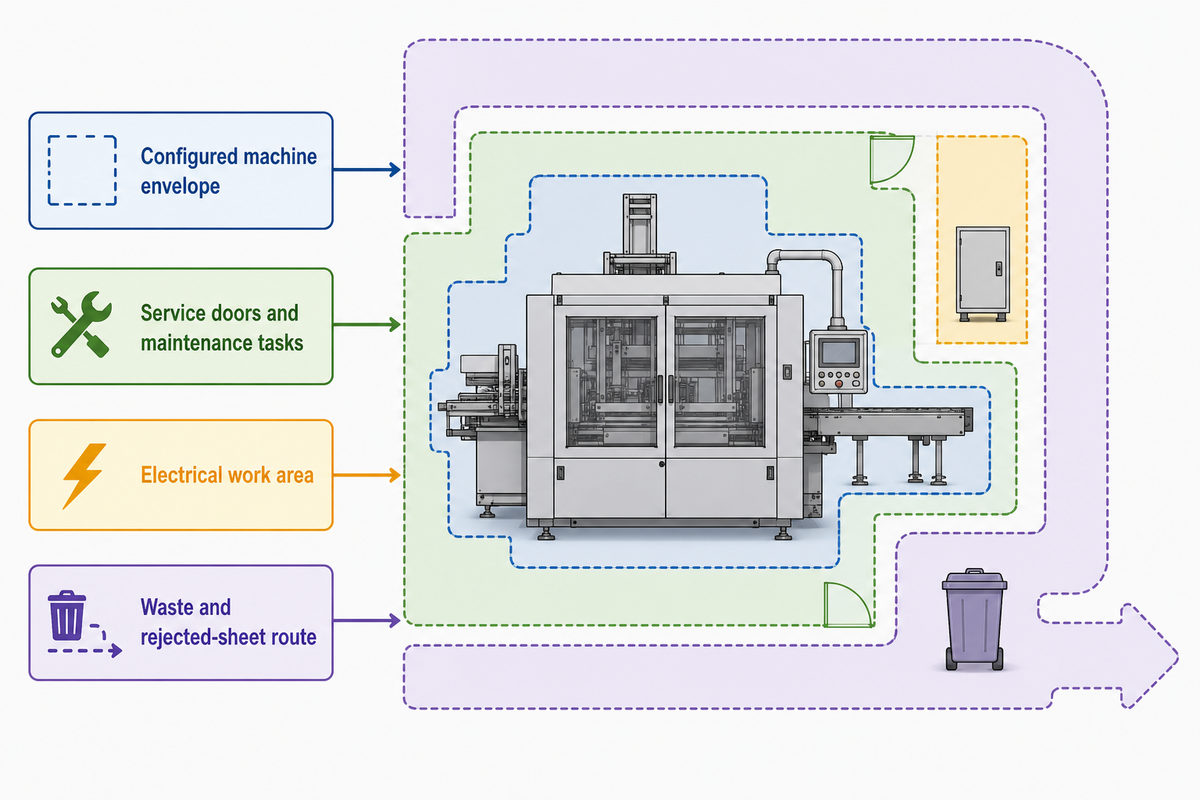
The physical decision is whether the line being designed will coexist with the operating zones within the surveyed bay. Separate the envelope of the machine from sheet staging, finished-box delivery, service-door travel, operator paths, electrical working space, material-handling turns, and fixed exclusions. A clearance added to every side of the machine envelope doesn’t guarantee clear access for operation and/or maintenance of the component. The U.K. Health and Safety Executive’s Maintenance Guidance states safe access to and use of the component should be in accordance with the manufacturer’s instructions. The U.S. OSHA’s Materials-Handling Rule states the employer should ensure the aisles, docks, doors, and turns are large enough for safe movement of materials and equipment. Neither source provided a universal Cenwan aisle width.
| Field | Unit / value | Owner and evidence | Open check |
|---|---|---|---|
| Configured machine envelope | m: ____ × ____ | Supplier drawing no. / revision: ____ | Which modules are included? |
| Sheet infeed and loading | m: ____ | Supplier + plant survey, date: ____ | Pallet and transfer route? |
| Delivery and bundle removal | m: ____ | Supplier drawing / handling plan: ____ | Exit direction and turn? |
| Service doors and maintenance tasks | task / m: ____ | Supplier maintenance drawing: ____ | Can the door fully open? |
| Electrical work area | m: ____ | Plant electrical review: ____ | Excluded from staging? |
| Columns, exits, other exclusions | grid / m: ____ | Measured site plan / revision: ____ | Which area cannot be used? |
| Overhead height and service reach | m: ____ | Plant ceiling survey / supplier access task: ____ | Any ducts, lights or cranes? |
| Waste and rejected-sheet route | m / bin: ____ | Production handling plan / date: ____ | Does removal cross the feed? |
| Installation and module entry route | m / door: ____ | Supplier shipping split / site survey: ____ | Can each module enter the bay? |
Add the documented lengths of the infeed, machine, delivery, and end-service for a first-pass rectangular estimate of the working space. Add the width of the largest station and of the access and crossing zones shown on the drawings. Subtract or route around columns and other unusable areas. Don’t double count zones. In U.S. installations where OSHA 1910.303(g)(1) applies to electrical equipment, the working space may not be used for storage and an apparent finished-box buffer can’t occupy the space. For equipment covered by that provision, the working width is at least the width of the equipment or 762 mm, whichever is greater, and a door must open at least 90°. These are conditional rules for electrical work, not a 762 mm clearance around a folder gluer. The exact applicability and dimensions require a competent site review.
Illustrative arithmetic only: suppose a fictional supplier drawing calls for an 18 m configured machine, 3 m infeed, 4 m delivery, and 1 m of task-specific space at each end. The first-pass length is 18 + 3 + 4 + 1 + 1 = 27 m. Suppose the same fictional project documents a 3.2 m widest station, 1.5 m access on one side, 1.2 m on the other, and a separate 2 m crossing route. The first-pass width is 3.2 + 1.5 + 1.2 + 2 = 7.9 m, and the rectangle is 27 × 7.9 = 213.3 m². None of these example clearances is a Cenwan recommendation or a code minimum. A real answer requires the drawing that was quoted, and a site measurement and safety and material flow assessment.
4. Size sheet infeed, finished-box outfeed and buffers
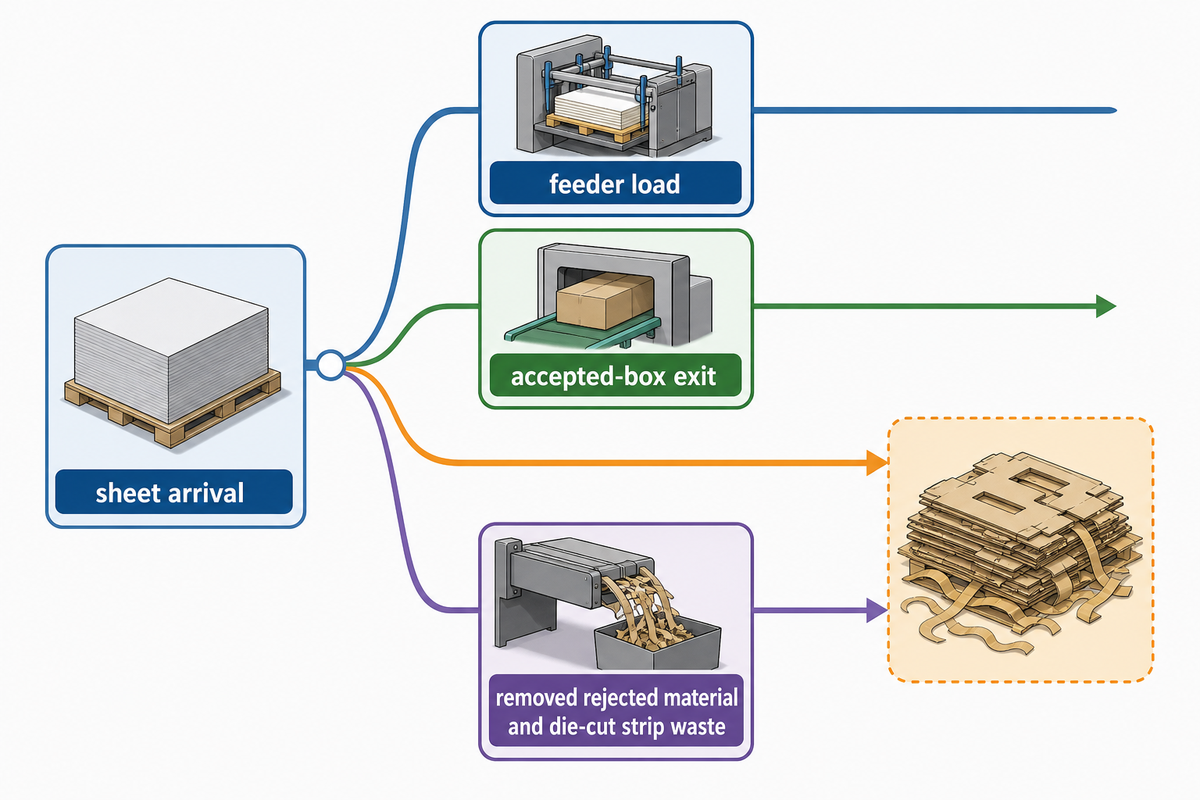
The most expensive layout surprise may be a space that appears empty on a machine drawing. Sheets have a route to arrive and a safe position to load. Folded boxes have a delivery route, and a temporary place to be accumulated before being bundled or packed. A Packaging World listing of a carton accumulator shows that downstream accumulation is a defined station; it isn’t proof of performance or layout dimensions of this corrugated line.
For each representative job, draw four arrows: sheet arrival, feeder load, accepted-box exit, and removed rejected material and die-cut strip waste. Mark the pallet or bundle size on each arrow. If the outfeed operator must cross the sheet delivery path, the drawing should show when and how that crossing works. A buffer placed in a fire route or electrical work area can’t be saved by an attractive total square meter figure.
Hidden Bottleneck Path
Faster machines will eject more material to the delivery point. If bundles cannot leave at the same accepted rate, accumulation grows at the outfeed, then the machine must pause or move work in progress elsewhere. Confirm this by testing the path on actual cartons and bundles. The public rated transport speed doesn’t provide the required information on accepted output or personnel handling.
A practical trial records the job, sheet size, run length, crew, run and changeover minutes, accepted cartons, rejects, bundle size and outfeed interruptions. Divide accepted cartons by paid hours for a trial to get a shop-floor denominator. The actual bundle and pallet geometry determines staging space. If no trial exists, leave the buffer size open and ask how the supplier proposes to verify it. More detail on defects and hand-offs is provided by the existing printing-to-gluing quality-gate guide. This layout check uses a documented trial primarily to reserve a workable material route.
5. Compare integrated and separate routes for your shift pattern
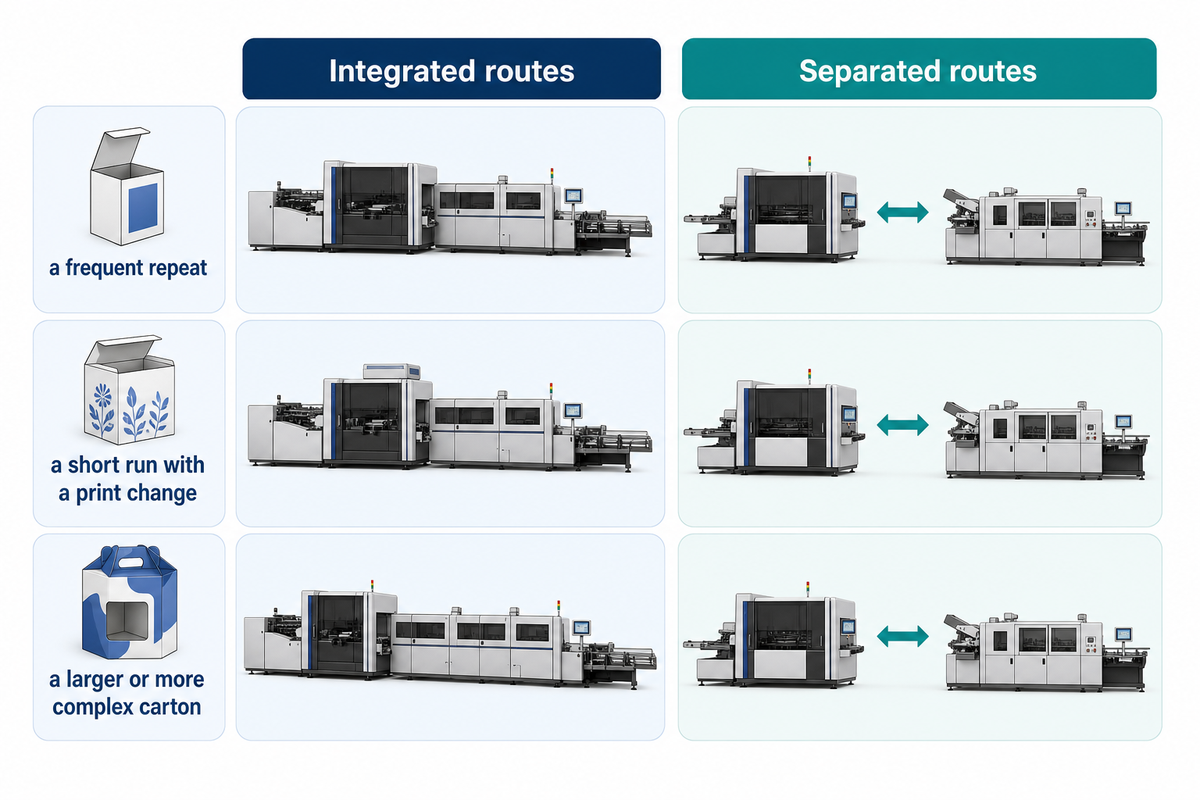
Integrated routes may mean fewer transfers between machines, but that doesn’t necessarily lead to better results for all plants. Separated routes may allow different scheduling options, with an added handoff and coordination step. For a packaging company, the right comparison uses the same carton jobs, acceptance rule, crew boundary and paid time. FEFCO identifies both integrated and separated converting opportunities. Reasons for preparing the next job while the first job is still running are explained in a SUN Automation paper on changeover approaches. This is a supplier viewpoint. It provides some example times and financial claims, but not your factory baseline. Your factory may be different.
When does a short-run converter gain from keeping printing and folding in one train?
It gains only when the complete route’s actual sequence improves the decision metric you care about (i.e. accepted cartons per paid shift, utilized floor space, crew workload, etc.). Pick three representative jobs: a frequent repeat, a short run with a print change, and a larger or more complex carton. Perform or have documented a trial for the proposed routes. Record changeover start and end, accepted boxes after setup, rejects and handling delays. If the vendor only proves one route, keep the comparison provisional and don’t fill in the missing routes with vendor literature estimated speeds.
The trial will help determine if both routes use the same crew and production schedules. If printing sits upstream on a separate printing press, account for queueing, intermediate pallets and print-to-glue registration checks. If production sits inline, account for the effect of a stop on the whole production line. Ask if work in progress can be staged without blocking an aisle. Your automatic packaging line guide can inform automation decisions, and this three-job test can inform converting and routing decisions for the bay.
6. Keep maintenance, guarding and staff movement in the layout
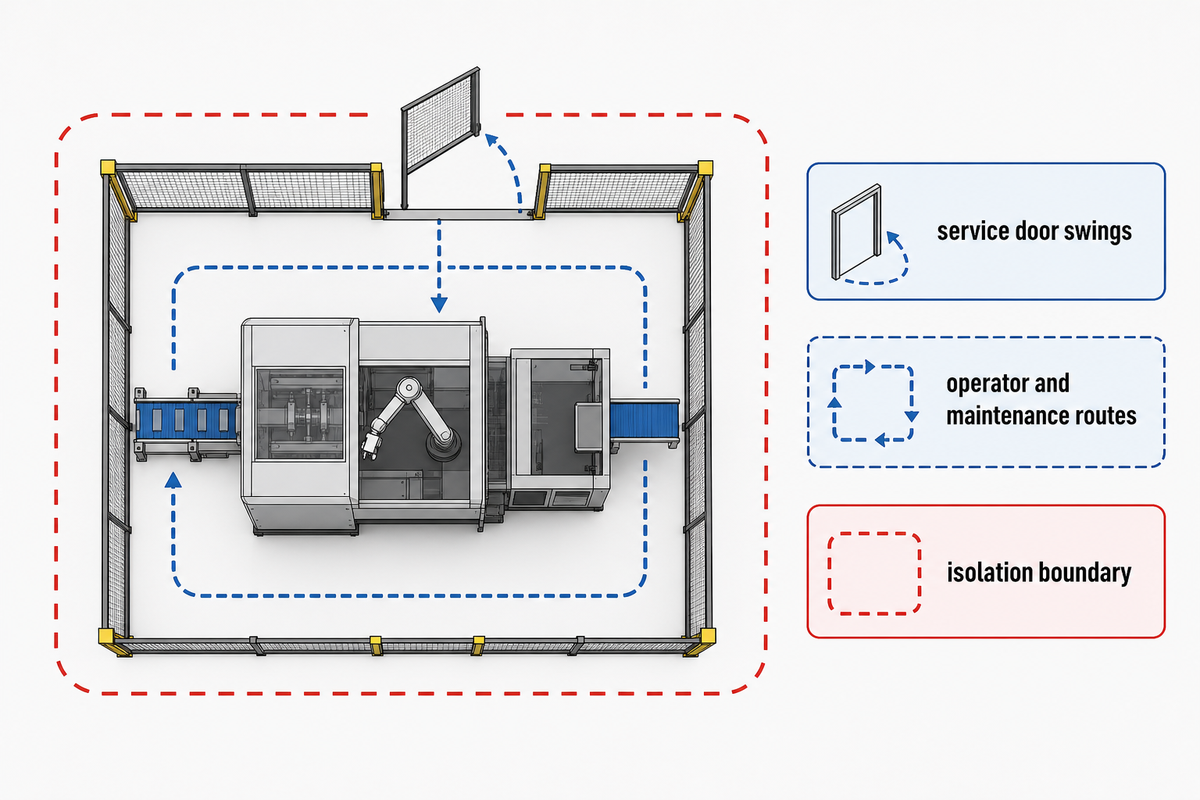
Certain features, like a service door, adjustment point or glue station, may not remain accessible after the line fits in the bay. Have the supplier superimpose service door swings and the maintenance tasks over the same bay check drawing. Then walk the operator and maintenance routes with the people that will use them. The machine selection guide suggests folding and glue choices. The maintenance instructions and layout drawings will show where staff will be working.
How can service doors and operator paths be checked before a line is installed?
Request the open-door geometry, the normal service tasks for each station, and the isolation boundary for work on connected machines. Place the feeder, print unit, die cutter, folder-gluer, delivery and electrical cabinets on one marked plan. A worker who services the folder-gluer may still be exposed to unexpected movement or stored energy from an interconnected station. OSHA’s U.S. guidance on interconnected equipment defines that exposure, and the site’s qualified safety team must define the energy control procedure for that exposure.
Guarding also needs its own review. OSHA 1910.212 covers machine hazards in applicable U.S. general-industry workplaces. The published abstracts of ISO 12643-2:2023 and ISO 12643-4:2023 distinguish prepress/press equipment from converting equipment not covered by other parts. That distinction is a reason to ask for a module-by-module safety review; citing either standard does not prove that a Cenwan model is certified. Check the supplied declaration, risk assessment and local installation requirements instead of treating a standards number as a completed acceptance test.
7. Send a site-input pack that suppliers can actually quote
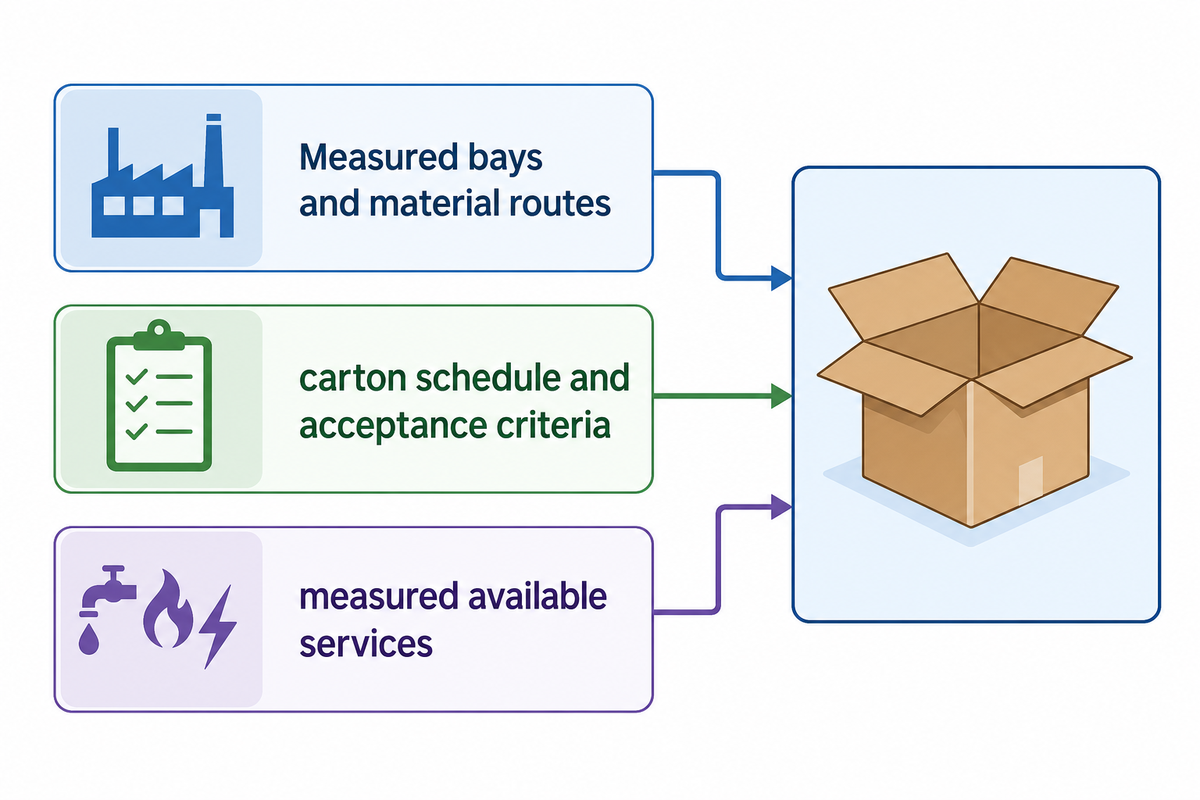
All bidders should receive the same site and product package for custom packaging jobs to price more consistently. Measured bays and material routes should be owned by the plant manager. Cartons’ schedule and acceptance criteria should be owned by production and quality. The electrical and utility teams should own measured available services. Purchasing should issue a controlled pack to every bidder and capture each clarification against that revision. This division of ownership would prevent a useful drawing from becoming an informal email attachment with no accountable dimensions.
Which drawings and product data should a buyer send with the first RFQ?
Send a scale site plan with grid, doors, elevations and exclusions; a list of representative carton jobs with sheet and finished-box dimensions; expected run lengths and changeovers; the required print, die-cut and gluing features; the preferred infeed and outfeed directions; and the desired boundary for packing or erecting, plus a dimensioned carton template for the quoted job mix. Include measured conditions for electrical and compressed air. Show anything that’s unknown. Have each bidder return a general arrangement drawing, an included-station list, a load schedule, safety and installation responsibilities. Show a trial method, exclusions and other relevant info.
Conversion-Scope Site Input Pack
- For jobs, state style, sheet size, board, print colors, die cut, glue and bundle for three typical products.
- For the bay, show a dimensioned plan, column and door grid, existing equipment, material-handling route and measured available height.
- For utilities, state electrical feed details, compressed air quality, pressure and flow; where not measured, state as open.
- Contract boundary: named stations, feeder and delivery, controls, guarding, installation, training, commissioning, optional packing and waste removal.
- Acceptance: same-job output denominator, reject definition, crew and changeover conditions with named person to sign trial record.
Don’t request a supplier to guarantee a real floor fit from this pack alone. It provides the supplier sufficient information to propose a plan that can be checked. If the site drawing or utility survey isn’t completed, show this gap in the Issue List and take the missing measurement prior to the purchase decision.
8. Normalize supplier proposals on the same scope and output metric
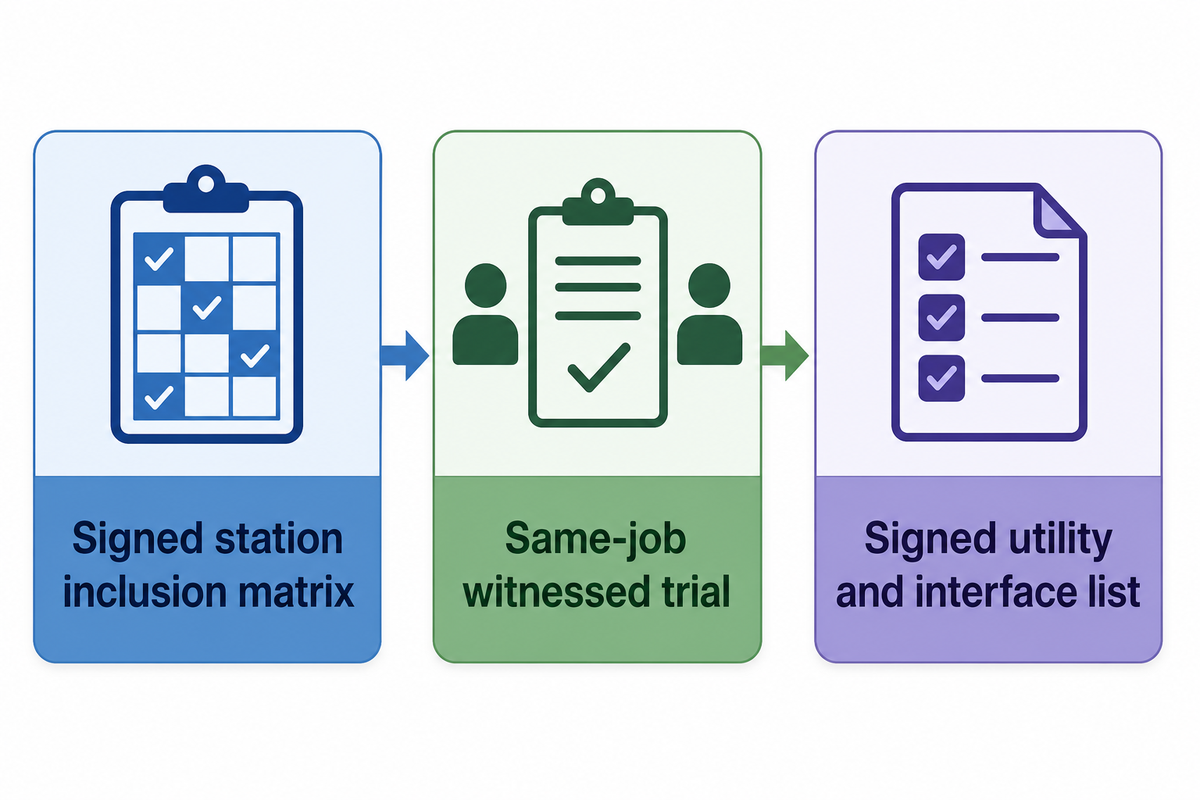
A quotation comparison fails when one offer includes printing and delivery and another gives only a folder-gluer body. It also fails when one vendor cites metres per minute and another cites boxes per hour without matching carton size, lane count, rejection rule and paid time. Cenwan’s public Single and Dual maximum speeds are stated in metres per minute. Macarbox’s own product page publishes a maximum mechanical speed in boxes per hour for its models. These are supplier-stated specifications with different units and configurations; they can’t establish an accepted-output ranking.
How do you compare line-speed claims when suppliers include different modules?
Start with the identical three job schedule and contract boundary with each vendor. Require each offer to say which model, lane count, print unit, die cutter, folder-gluer, delivery and optional packer its footprint, power and speed numbers cover. Next, request the same trial protocol, i.e. same sheets, the same quality acceptance rule, recorded run and change over times, accepted cartons per paid hour and observed outfeed interruptions. A missing trial cell should be left empty. Purchasing can evaluate commercial inclusion and exclusion, while production can evaluate process and think about whether the proposed route will function in the bay.
| Comparable field | Supplier A | Supplier B | Required proof |
|---|---|---|---|
| Print, die cut, fold, glue, delivery, packing | ____ | ____ | Signed station inclusion matrix |
| Sheet and box range by sample job | ____ | ____ | Accepted sample schedule |
| Published speed and its basis | ____ | ____ | Model, lane, unit and conditions |
| Accepted cartons per paid hour | ____ | ____ | Same-job witnessed trial |
| Installed envelope and service zones | ____ | ____ | Drawing number and revision |
| Electrical, air, extraction / drying | ____ | ____ | Signed utility and interface list |
| Installation, training and acceptance | ____ | ____ | Responsibility and exclusion schedule |
The grid doesn’t state that either supplier is lacking a feature; it indicates what the current buyer hasn’t yet proven. This is important when a product page says a print station is optional or a die cutter is compatible. Have the vendor connect every published envelope, rated speed and power to the signed inclusion matrix. Finance can then evaluate capital offers against an equal equipment and site-duty scope.
Misuse of figures becomes easier when their labels disappear during a comparison on a spreadsheet. The following audit has kept each figure close to its owner and its limit. Cenwan data comes from its named model page and Macarbox’s data comes from its technical listing. SBL’s access suggestion comes from its installation suggestion. None provides a witnessed same-job accepted-output or a signed Cenwan plant drawing.
| Figure category | Published value | What it does and does not establish |
|---|---|---|
| Cenwan Single machine envelope | 14.2 × 2.2 × 1.7 m | Supplier model figure; no total installed bay. |
| Cenwan Single mass and power | about 8 t; 22 kW | Supplier fields; no signed foundation or connected-load design. |
| Cenwan Single speed | up to 200 m/min | Transport maximum, not accepted cartons per paid hour. |
| Cenwan Dual machine envelope | 17.5 × 4 × 1.8 m | Supplier model figure; optional stations require scope confirmation. |
| Cenwan Dual mass and power | about 16 t; 20 kW | No inference about energy per box or installed electrical feed. |
| Cenwan Dual speed | up to 240 m/min | Rated transport maximum on the named variant only. |
| Cenwan air-pressure field | 6 bar for each listed variant | Pressure alone gives no required flow or receiver capacity. |
| Macarbox variant 1 | 710 mm | Supplier table column label, not working width or installed line width. |
| Macarbox variant 2 | 970 mm | Supplier table column label, not working width or installed line width. |
| Macarbox variant 3 | 1300 mm | Supplier table column label, not working width or installed line width. |
| Macarbox variant 4 | 1676 mm | Supplier table column label, not working width or installed line width. |
| Macarbox variant 5 | 2185 mm | Supplier table column label, not working width or installed line width. |
| Macarbox mechanical speed | up to 24,000 boxes/h | Maximum for its family, not a same-job accepted-output trial. |
| SBL installation example | 1 m front/rear; 60 cm side | That supplier’s guide, not a universal or Cenwan clearance. |
9. Integration and Utility Requirements
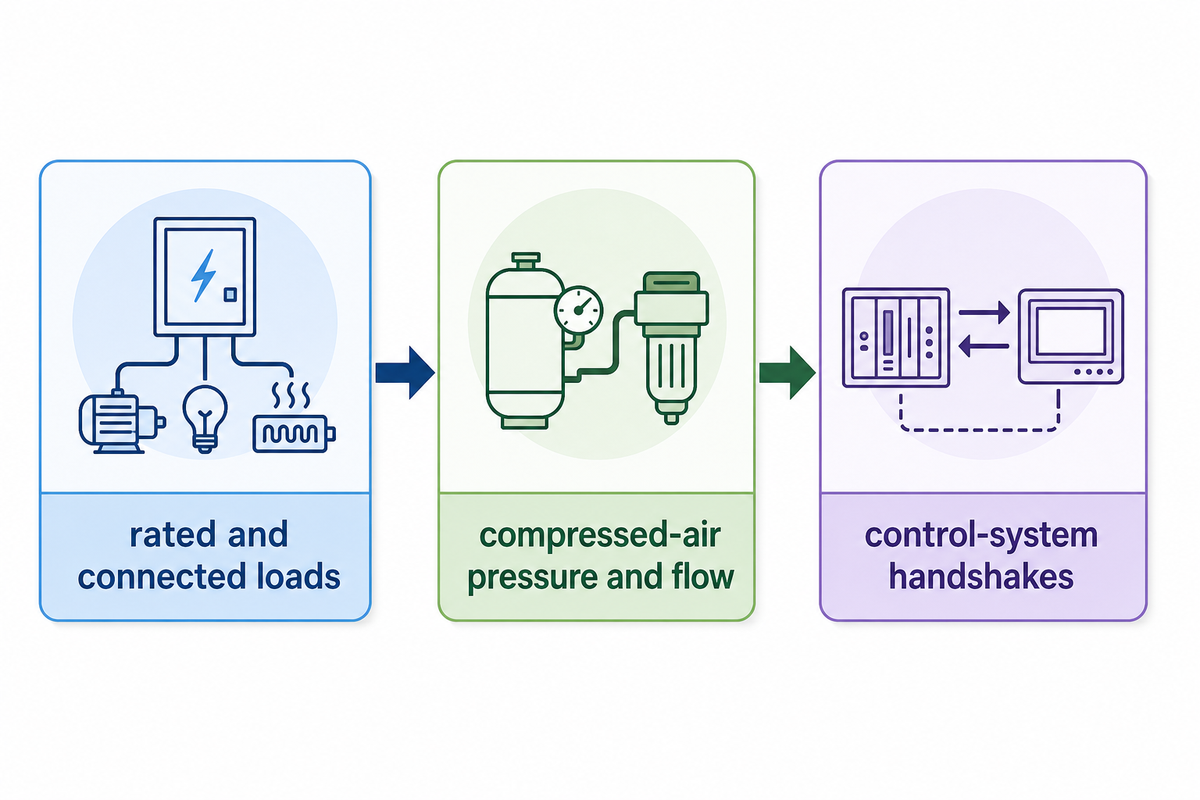
The purchase order should stipulate who supplies each physical and control interface. Cenwan’s public model page gives nominal kW and 6 bar air-pressure fields. These are supplier-stated brochure fields, not a signed connected-load schedule, a measured whole-line operating load or an air-flow requirement for your selected equipment. A pressure value alone can’t size the plant compressor: an Australian government guide to compressed air explains that storage and demand fluctuations affect system design. Oregon State University’s motor-analysis method also separates nameplate data from live operating measurements. Neither source verifies a Cenwan model’s project demand.
Request voltage, phase and frequency; number and placement of supply entries; rated and connected loads for the quoted configuration; expected startup and simultaneous demand; compressed-air pressure and flow at stated conditions; air quality; extraction, drying and glue-handling requirements, if any; and control-system handshakes at the feeder and delivery ends. The plant engineer is to compare the signed list to the surveyed supply capacity and the actual routing, and document any upgrades and their owners. For applicable U.S. electrical installations, OSHA 1910.303 addresses access and protective electrical characteristics; a competent electrical review should resolve the supply and protection issues. This article doesn’t assign a fault current rating to the line.
Purchase-order hold point
If an included station, access envelope, required utility or installation responsibility still has no named document and owner, consider that portion of the quote as provisional. Request a revision to the drawing and load/interface schedules. A missing cell in the grid is a procurement activity, not a justification to use a similar model and specify its parameters.
When the request and quote forms are complete, forward them to Cenwan’s printing, die cutting, folding and gluing line team or other potential source for a configuration specific response. State your three carton jobs and bay drawing revision in the request. State your questions. The commercial response is most valuable when it returns a marked configuration drawing and a list of what it includes.
Request a configuration and layout review
Frequently asked questions
Can one line handle multiple postal-carton sizes?
While it may handle various box and sheet sizes, the performance of the model is defined by the configuration specific to your requirements, along with the carton styles that you wish to run. The more representative the three selected carton jobs are, the better the comparison. These should include the type of board, the size of sheets, prints and die-cuts, the glue pattern and the manner in which the bundles are tied. It’s useful if the supplier highlights each job as accepted, requiring a trial or excluding. A published range or FEFCO code list does not replace a signed job schedule or confirm that every optional station supports every style. Include the smallest repeat job and the largest or hardest-to-fold carton; a machine can fit one of them and still require a different setup or module for the other.
What site drawing is needed for a folder-gluer quote?
Give us a dimensioned, revision controlled site plan showing usable bay width and length, columns, doors, overhead constraints, current equipment, sheet arrival and finished-box exit. Mark routes that can’t be blocked. Make the vendor return their own arrangement drawing of the quoted configuration showing feeder and delivery routes, service door travel and location of electrical cabinets. A brochure footprint is a starting point for discussions but won’t settle installation, operating and maintenance fit in that bay.
Does a flexo folder gluer always include die cutting?
No single product label guarantees the die-cutting station or its exact integration. Proposals vary from straight printing and slotting, to die-cutting, folding and gluing; to specifying compatible upstream equipment or optional modules. Checking Cenwan’s public page can help set limits on configuration. Ask for the station inclusion matrix and an arrangement drawing tied to the quoted model. Confirm the sample cartons’ cuts and scores on a trial plan before comparing rated speeds or prices.
What is the difference between rated machine speed and accepted cartons per hour?
Rated speed reflects a particular machine condition. Accepted cartons per paid hour counts usable boxes during a documented job trial, including its stops and changeovers. Record the conditions beside both figures.
Can a line be fitted around existing production equipment?
Possibly. Place the configured train against the existing column and machine grid and check material routes, access, electrical and other work space, exits. Resolve crossings before committing to layout.
References & Sources
Industry process: FEFCO, Production Process. Safety scope: ISO 12643-2:2023 abstract and ISO 12643-4:2023 abstract. U.S. rules and guidance: OSHA 1910.176, 1910.212, 1910.303, and interconnected-equipment energy control. Maintenance and utilities: U.K. HSE maintenance guidance, Australian government compressed-air guide, and Oregon State University motor-analysis method.
Supplier web pages cited in the body represent views of the suppliers and aren’t independent assessments of output, installed area and/or compliance. The numerical bay example is hypothetical. Buyer-specific drawings, loads, accepted output and utility surveys weren’t available for this article.