Get in touch with Cenwan Machine Company



Updated August 2026
Folder gluer speed vs carton quality is best judged by first-pass good cartons per elapsed minute, not by the highest number on the speed display. The winning setpoint is the highest confirmed job-specific speed that keeps the defined carton inside its acceptance window while producing the strongest repeatable good-carton throughput.
Rated speed is a capability limit under stated conditions. It isn’t an automatic production target for every folding carton, corrugated box, coating, adhesive, box style, or downstream arrangement. The same test logic applies to the machines discussed in Cenwan’s high-speed capability and selection guide, a flexo folder gluer, or other packaging machinery used across the packaging industry and linked to line automation. Running briefly at maximum speed can look productive while inspection rejects, rework, microstops, and collection problems quietly reduce sellable output.
Key takeaway
Treat the first upward scan as boundary-finding, not proof. Confirm the last-pass and first-fail neighborhood, then compare standard-setpoint control runs at the beginning and end before approving a production speed.
Measure Good-Carton Throughput, Not the Speed Display
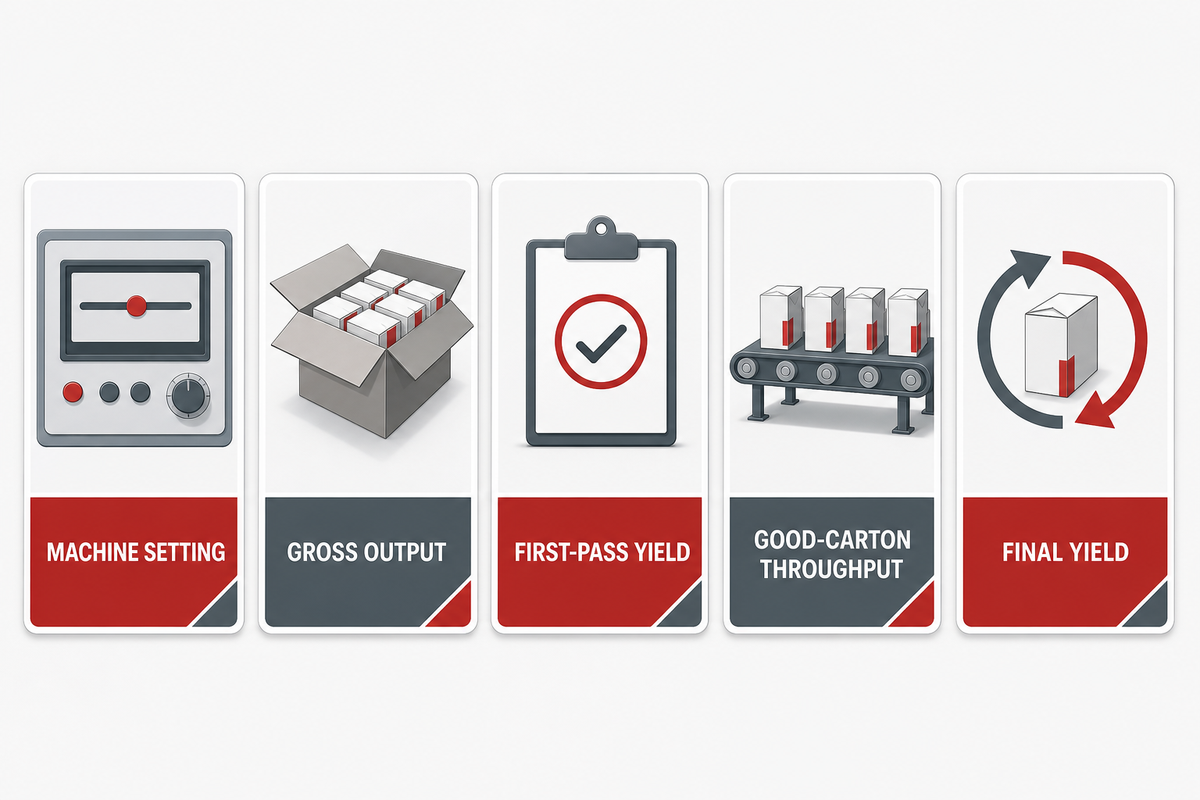
Good-carton throughput measures accepted first-pass cartons over elapsed trial time. It differs from the machine setting, gross output, first-pass yield, final yield after rework, and output measured only while the folder gluer is moving. Keeping those measures separate prevents a fast but unstable setting from looking better than a slower, cleaner run.
For any automatic folder gluer machine, this speed vs quality decision should be made for the defined carton job and inspection basis, not from the speed display alone.
Productivity and first-pass yield are different outcomes. The linked NIST Manufacturing Extension Partnership case study reports them separately rather than treating one as a substitute for the other. A supplier-authored PostPress trade article also notes that speed tuning can create waste and that failed cartons can create downstream losses; it is used here as trade evidence, not independent performance proof.
- Gross output: every carton counted at the delivery, before quality disposition.
- First-pass accepted count: cartons that pass the predeclared checks without correction or rework.
- First-pass yield: first-pass accepted cartons divided by total cartons evaluated.
- Good-carton throughput: first-pass accepted cartons divided by elapsed trial time.
- Final yield: accepted cartons after approved rework, reported separately.
Elapsed time should follow one declared rule for every comparable step. If microstops, inspections, or trial interventions remain inside the clock for one speed, they must remain inside it for the others. Reporting only running time can hide the very losses the trial is meant to expose.
Freeze the Carton and Its Quality Window Before Changing Speed
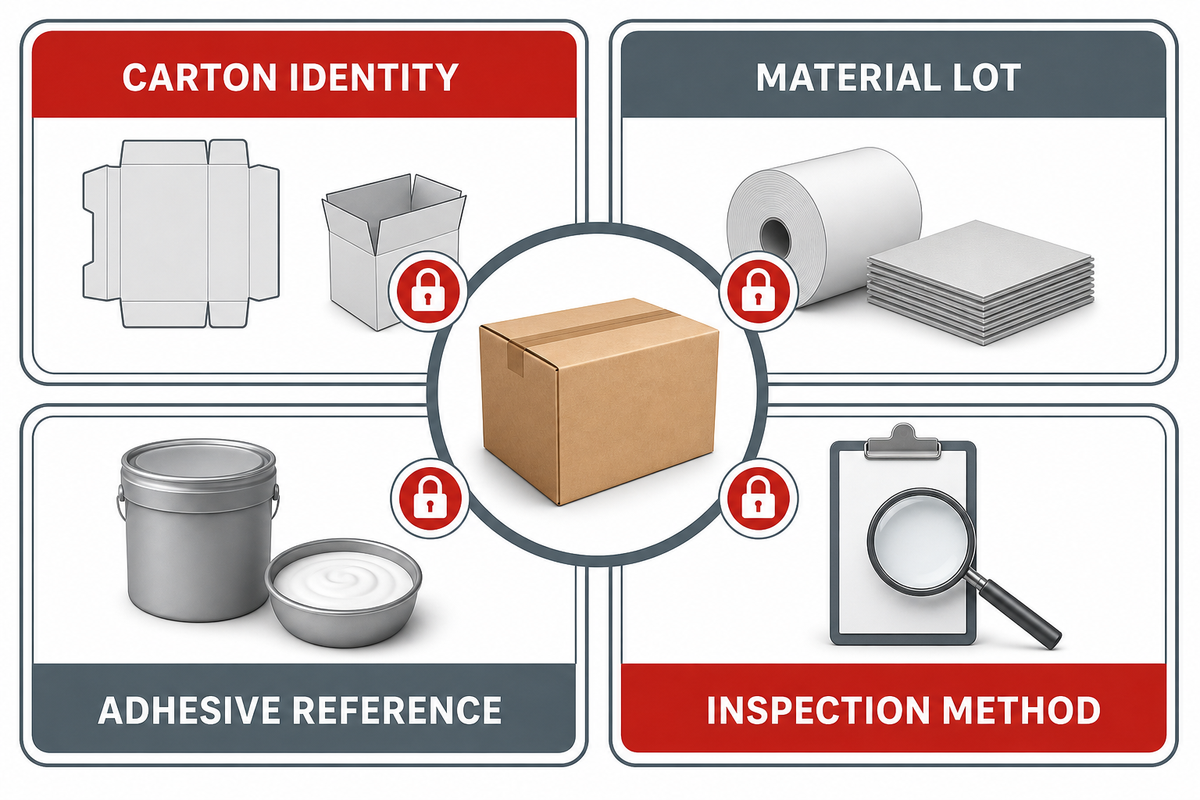
A fair speed comparison changes speed while holding the defined job and inspection basis constant. The trial card should identify the blank, material lot, coating, adhesive reference, box style, each fold and glue step, compression requirement, inspection method, and acceptance criteria. If any item changes during the folder gluing trial, record the intervention and treat the result as a new condition.
“Not rejected” is not the same as “verified good.” A supplier-authored PostPress quality-control article explains that the measured parameters and the way the operator set up the inspection system determine what a pass signal means. It is used here as trade evidence, not independent performance proof. Record the gauge, test, camera program, or other inspection identifier and the appraiser when people influence the result.
Material state belongs on the same card. Record the material lot, storage or exposure status, and ambient conditions required by the job specification and the site’s approved conditioning rule; do not invent a universal temperature, humidity, glue amount, compression time, bond target, or dimensional tolerance for the trial.
Do
- Freeze the job and inspection definitions.
- Record every intervention against its trial row.
- Keep first-pass and reworked cartons separate.
Don’t
- Change speed, glue, pressure, and alignment together.
- Relax acceptance limits after rejects appear.
- Transfer one job’s approved speed to another blank.
Establish a Stable Baseline Condition
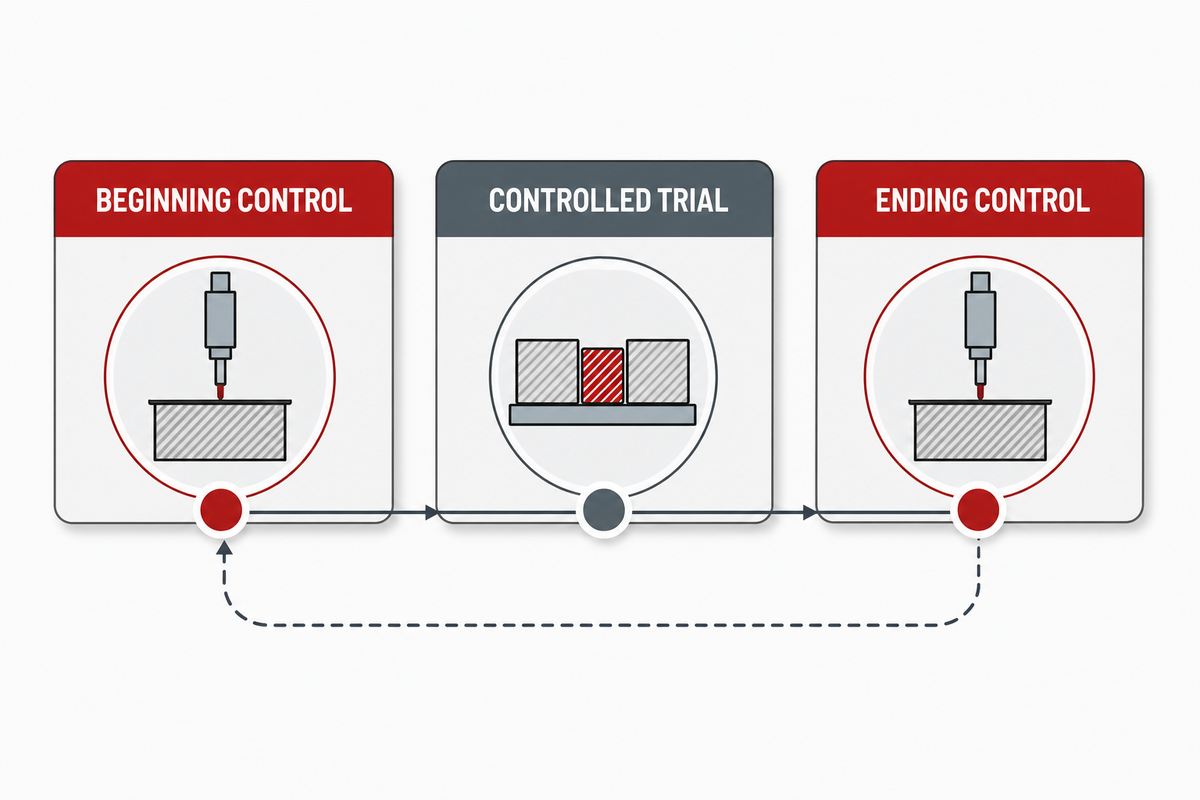
A baseline is a recorded standard-setpoint condition at both ends of the trial, not a quick cold-start impression. Each control row should identify the job, machine, material lot, approved settings reference, elapsed time, gross count, first-pass accepted count, interventions, and observed defects. A shifted ending control weakens any simple speed conclusion.
A NIST/SEMATECH experiment-design handbook passage gives a concise reason for the two controls:
“Experimental runs should have control runs that are made at the standard process setpoints.”
Beginning and ending rows don’t demonstrate that all nuisance variables or machinery conditions were held. Their comparison reveals whether the standard condition shifted during the trial. If the ending result shifts in a way that violates the site’s own acceptance criteria, consider the drift before concluding speed is the cause.
Run a Controlled Speed Ramp Without Mixing Variables
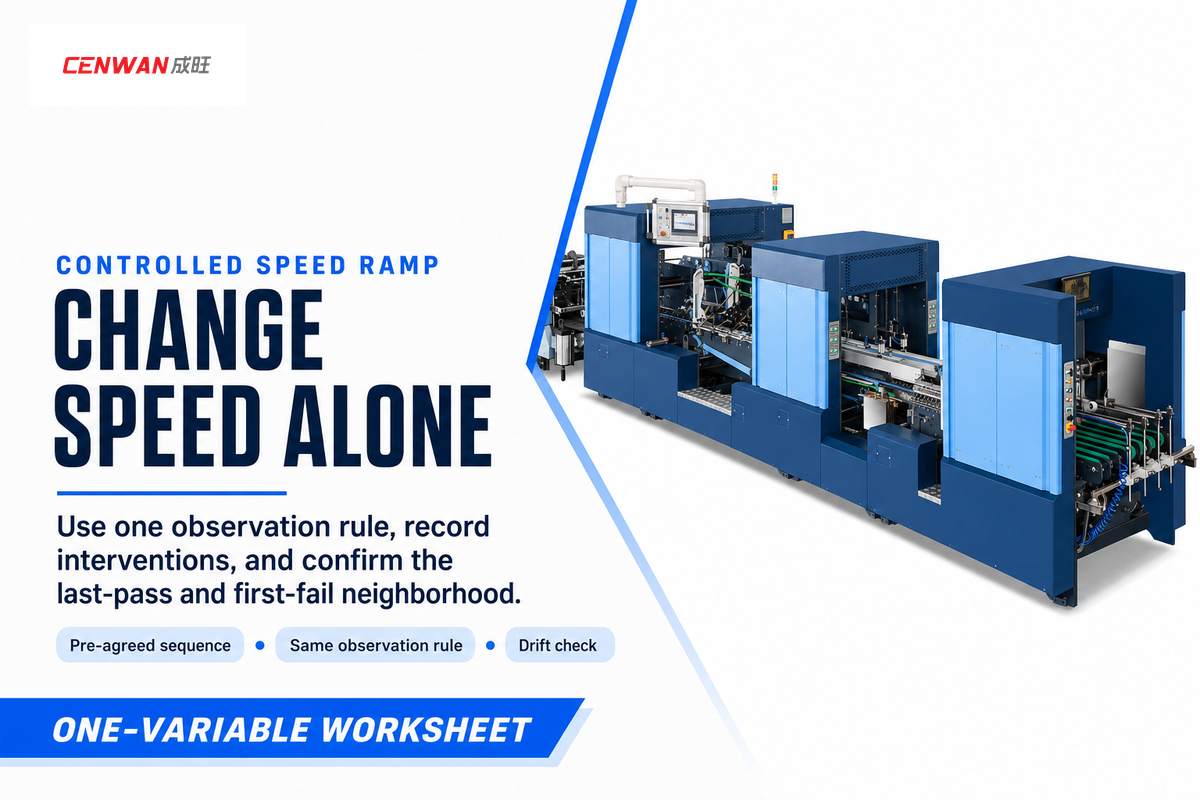
A controlled ramp uses a pre-agreed sequence, changes speed alone, applies the same job-defined observation rule at each comparable step, and records every intervention. The first ascending pass locates an approximate boundary. Confirmation then revisits the last-pass and first-fail neighborhood in an alternating or site-approved order that can expose time-related drift.
Monotonic speed increases can be confused with process drift, including possible machine, material, measurement, or operator changes. NIST guidance on experiment order cautions that sequential predictor levels can disguise drift. Randomization may not be acceptable in a live packaging process, but the practical lesson remains: don’t assume causality from one upward run.
These NIST sections are longstanding experiment-design references. They support the trial method, not current folder-gluer performance or a universal production setpoint.
One-Variable Speed-Ramp Worksheet
This one-variable worksheet is a format, not a process prescription. Machine manuals, job control plans, and site procedures determine the target speed range, when authorized staff may adjust the speed, hold conditions, sample rules, and who may act. Record line speed in the machine’s displayed units, whether cartons per minute or meters per minute.
| Record category | What to record | Why it matters | Limit |
|---|---|---|---|
| Trial row | Unique row identifier | Prevents result mixing | Not a production authorization |
| Job identity | Blank, material lot, adhesive reference | Binds the result to one carton | Do not transfer across jobs |
| Setpoint | Displayed speed and unit | Identifies the tested condition | Manual and site limits apply |
| Elapsed time | Start, finish, included stops | Makes throughput comparable | Use one declared clock rule |
| Gross count | All cartons evaluated | Supplies the yield denominator | Avoid duplicate counts |
| First-pass accepted | Cartons passing without correction | Measures useful first-pass output | Acceptance window stays fixed |
| Defect class | First repeatable stage and symptom | Locates the boundary | Not a component diagnosis |
| Inspection identity | Gauge, test, camera program, appraiser | Exposes measurement changes | Approved method only |
| Intervention | Stop, correction, material event | Prevents hidden time and waste | New condition may need a new row |
| Disposition | Pass, confirm, stop, or escalate | Links evidence to the next decision | Site authority remains controlling |
Source basis: NIST experiment-order guidance, Flexographic Technical Association folder-gluer guidance, and the reviewed job-control evidence set.
Calculate First-Pass Good-Carton Throughput
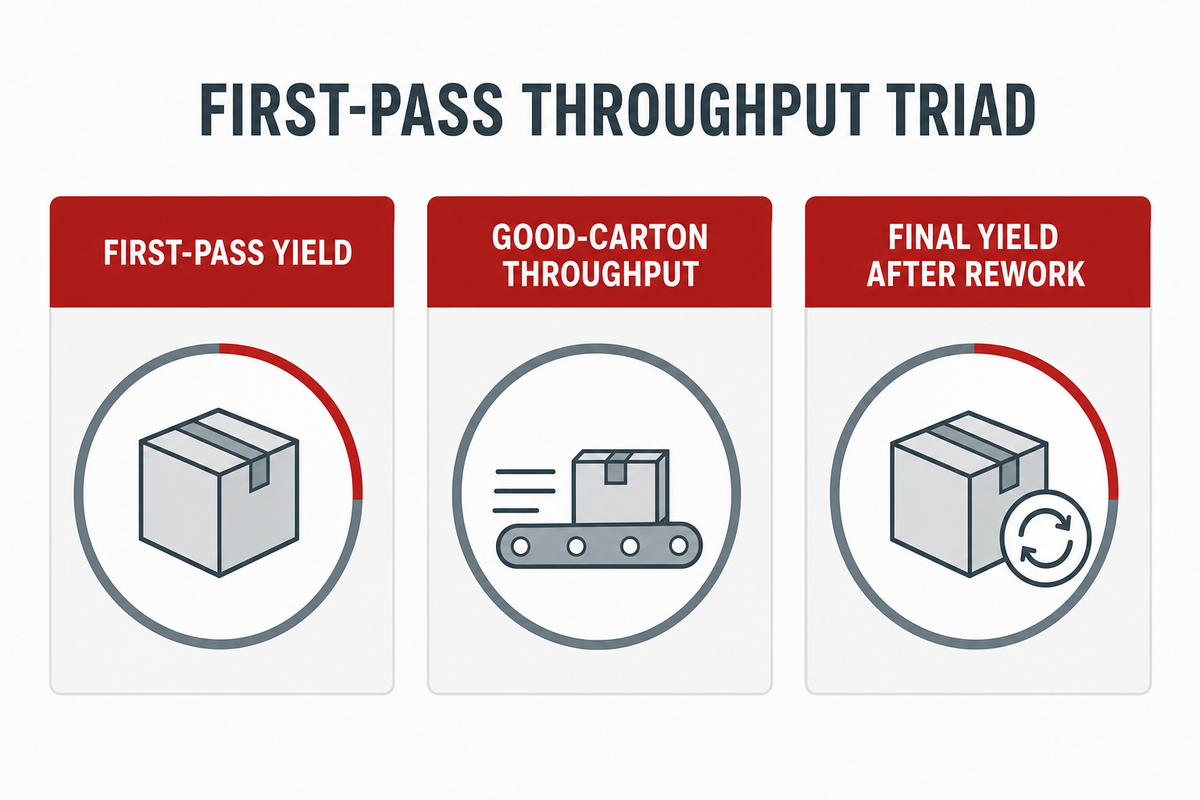
First-pass yield is a proportion; good-carton throughput is a rate; final yield after rework is a third measure. The speed decision needs all three because two runs can produce the same accepted cartons per minute while imposing very different reject loads, rework handling, and elapsed-time losses on the packaging line.
First-Pass Throughput Triad
Use three fixed definitions for the arithmetic:
- First-pass yield = first-pass accepted cartons ÷ cartons evaluated × 100%.
- Good-carton throughput = first-pass accepted cartons ÷ elapsed minutes.
- Final yield after rework = final accepted cartons ÷ cartons evaluated × 100%.
Illustrative calculation only: the figures below show the method and are not Cenwan test results or recommended speed settings.
| Trial | Illustrative setpoint | Elapsed window | Included interruption | Later rework handling | Gross count | First-pass accepted | First-pass yield | Good-carton throughput |
|---|---|---|---|---|---|---|---|---|
| A | 80 m/min | 15 min | 30 sec | 5 min | 1,200 cartons | 1,140 cartons | 95% | 76 cartons/min |
| B | 100 m/min | 15 min | 45 sec | 10 min | 1,500 cartons | 1,245 cartons | 83% | 83 cartons/min |
| C | 120 m/min | 15 min | 60 sec | 20 min | 1,800 cartons | 1,170 cartons | 65% | 78 cartons/min |
Trial B leads this example at 83 first-pass cartons/min even though Trial C produces 300 more gross cartons in the same 15 min. The 80 m/min, 100 m/min, and 120 m/min entries are arithmetic labels only, not recommended speeds or increments. Any later recovery belongs in final yield and rework records; it does not rewrite Trial C’s first-pass result.
Find the First Repeatable Defect Boundary
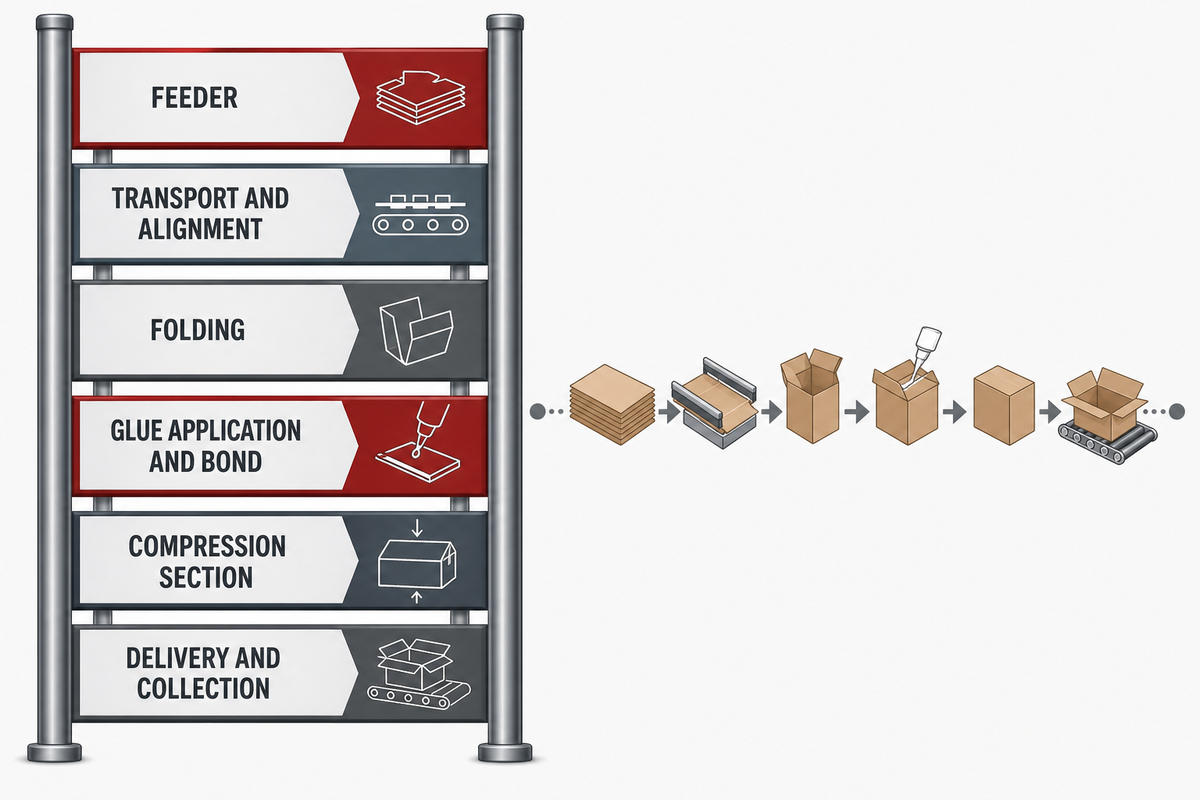
The first repeatable defect boundary is the nearest tested condition where a defined failure recurs under the same job and inspection basis. One bad carton is an observation, not a boundary. Classify where the symptom first appears, preserve its context, and confirm the last-pass/first-fail neighborhood before treating speed as the likely driver.
First-Defect Boundary Ladder
- Feeder: missed, doubled, late, or inconsistent blank entry.
- Transport and alignment: skew, slip, registration shift, or unstable belt control.
- Folding: panel, pre-break, auto-bottom, 4-corner, or 6-corner fold deviation.
- Glue application and bond: placement, presence, transfer, open seam, or bond-condition failure under the job’s approved check.
- Compression section: loss of the job-defined closing or hold result.
- Delivery and collection: shingling, counting, ejection, packing, or downstream accumulation that changes useful output.
Inline systems can check adhesive-edge presence and stack-surface unevenness during folding-box production. A published folding-box inspection patent shows that such checks are technically feasible, but it does not prove adoption, accuracy, or ownership by Cenwan. Inspection evidence still has to be tied to the actual machine and approved test method.
Use the ladder as a routing tool, not a parts diagnosis. Carton skew may involve the blank, feeder, transport, folding setup, inspection method, or another condition. Record recurrence, material lot, trial row, intervention, and a retained sample or photo when site rules permit.
Set Stop Rules Before the Trial Begins
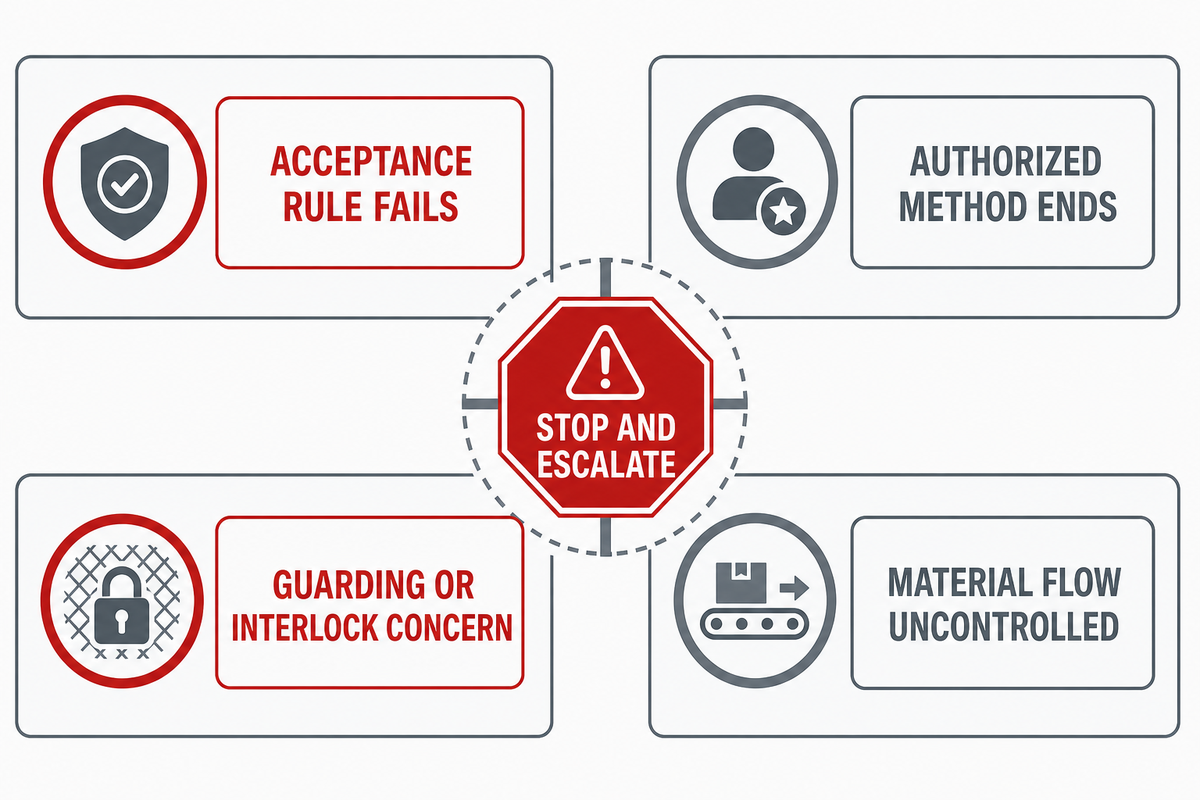
Stop rules should be written before the first speed change. Each trial step ends when its acceptance rule fails, and the trial escalates when an observation leaves the authorized method, guarding or interlock concerns arise, material flow becomes uncontrolled, or abnormal noise or movement appears. “Stop and escalate” is a decision label, not a shutdown procedure.
Prewritten boundaries matter because the temptation to “check one more carton” appears after the anomaly, when judgment is most vulnerable to schedule pressure. OSHA’s hazardous-energy standard separates normal production from servicing conditions, while ISO 12643-4:2023 addresses significant hazards in converting equipment. Neither source supplies a folder-gluer speed setting.
⚠️ Trial boundary
Don’t bypass a guard, defeat an interlock, reach into moving folder-gluer equipment, enter a danger zone, or improvise an energized adjustment. Follow the machine manual, training, authorized roles, and the site’s approved procedure.
The linked 2020 OSHA folder-gluer accident record documents an injury involving an energized machine and unguarded in-running rollers. The case supports the strict trial boundary; it doesn’t establish an industry incident rate.
Put a Carton Count and Real Cost on Trial Waste
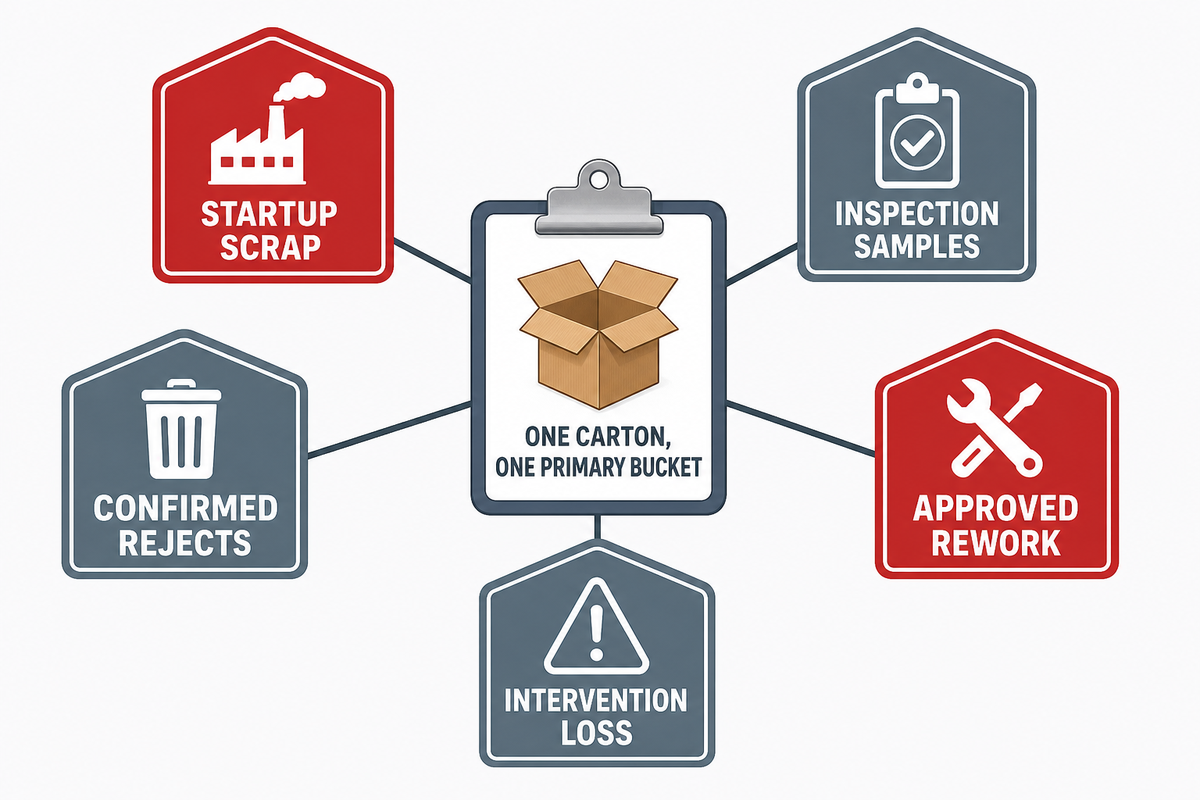
Trial waste should be counted by disposition before money is assigned. Separate startup scrap, inspection samples, confirmed rejects, approved rework, and material lost during interventions. Each carton belongs in one primary bucket for the trial ledger, with any later disposition linked to it, so the same loss is not counted twice.
Site-specific board, print, coating, adhesive, labor, disposal, and rework inputs form the cost layer. No generic waste percentage can substitute for those figures. Current industry attention to packaging waste is reflected in the Sustainable Packaging Coalition’s 2026 trends report, but that report does not supply a folder-gluer reject rate or plant cost.
The ledger should connect each waste bucket to the trial row, defect class, speed setting, and intervention. That makes the cost discussion auditable: the packaging team can see whether a faster setting reduced elapsed time, increased inspection samples, shifted quality issues into rework, added downtime, or caused downstream packing losses.
Use comparable elapsed windows before projecting any result per shift; a short trial is evidence for its recorded condition, not a guaranteed shift total.
Freeze the Approved Setpoint for the Next Shift and Repeat Job
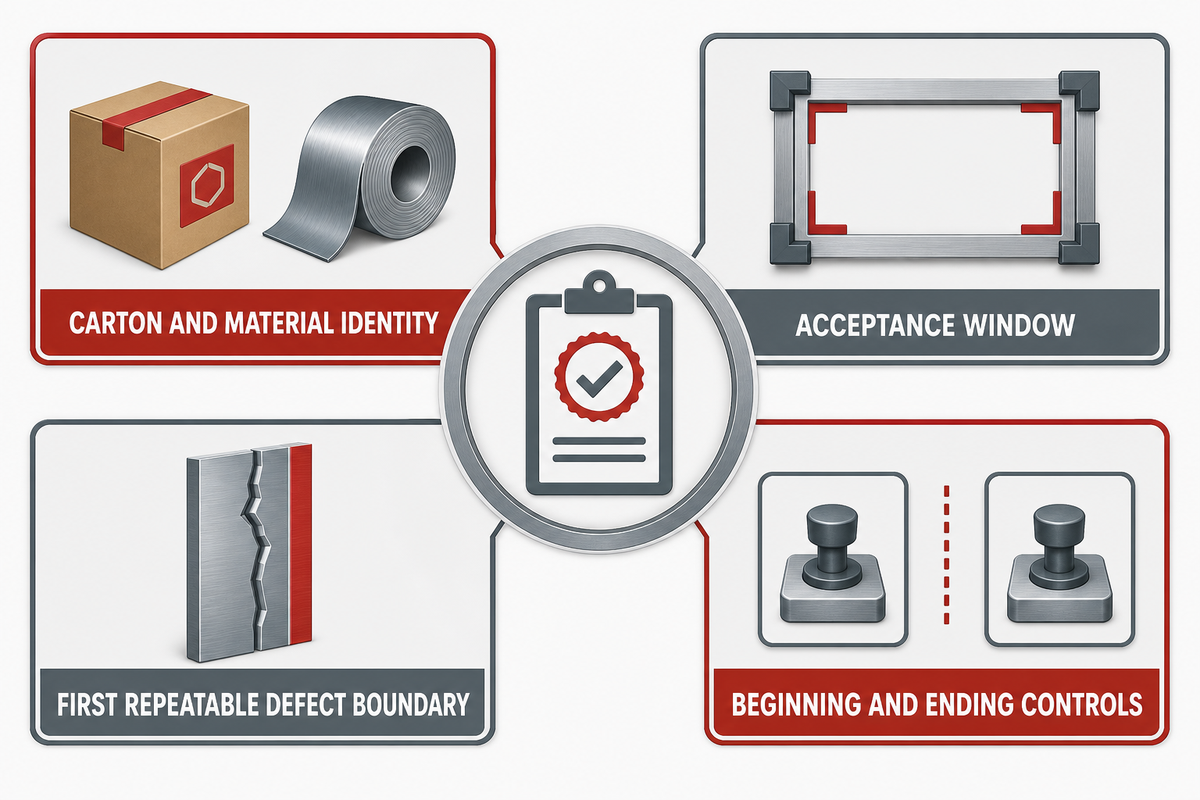
The reusable setpoint record binds speed to the exact carton and the evidence used to approve it. One bare number can’t show which blank, material lot, inspection method, defect boundary, trial order, or interventions produced the result. The next shift needs the envelope and its limits, not a speed copied from a whiteboard.
Job-Specific Speed Envelope
Complete the record with the tested speed range, approved setting, carton and material identity, adhesive reference, acceptance window, inspection identity, first-pass yield, good-carton throughput, first repeatable defect boundary, beginning and ending standard controls, interventions, owner, date, and approval reference.
The approved envelope supports the job ticket and control plan; it doesn’t replace either record, authorize an operator, or transfer a safety control. Repeat jobs and long runs should begin by checking that the recorded job identity and approved basis still match. Changes in blank, corrugated cardboard, coating, box folding pattern, gluing process, compression requirement, or downstream line can invalidate the old envelope.
Control runs at 2 points in the trial, one at the beginning and one at the end, provide a drift check that a single maximum-speed burst can’t supply. The accepted setpoint remains job-specific until the site’s approval method confirms it under the matching production condition.
When a Speed Loss Points to Wear, Parts, or Service
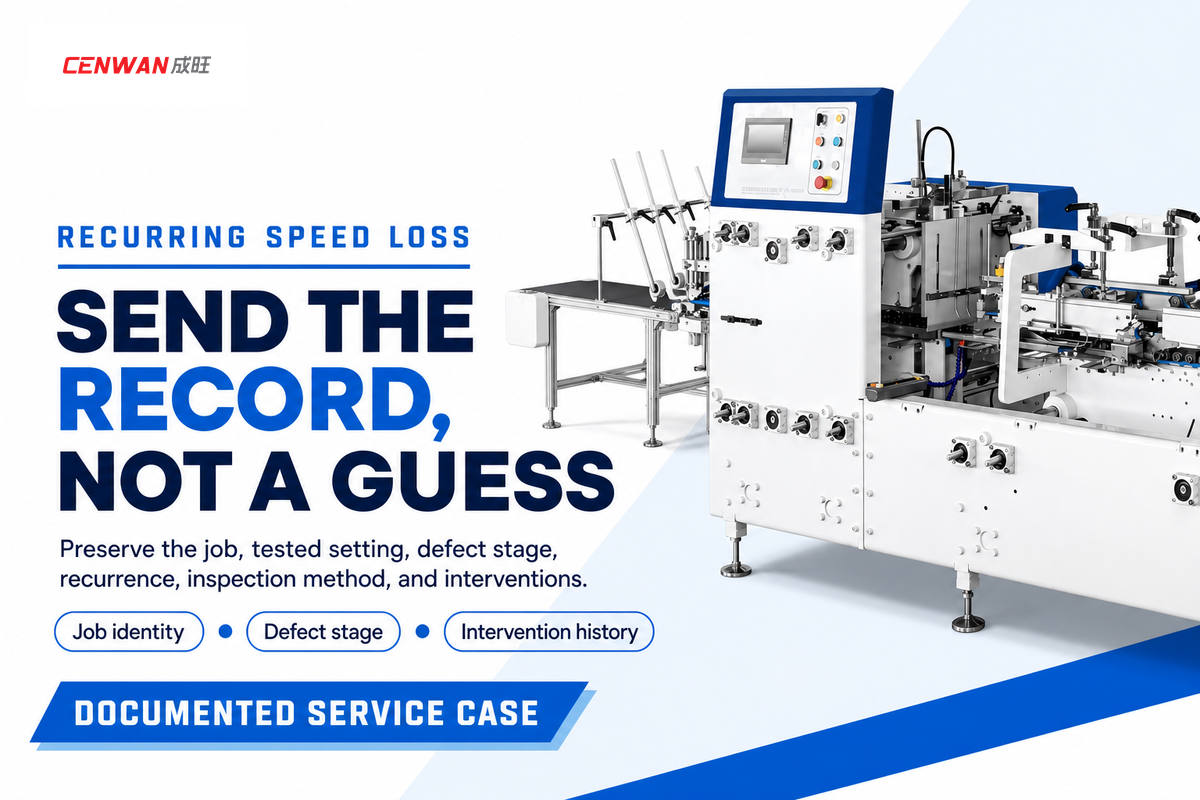
Recurring speed loss can move to maintenance or service after the approved job variables have been checked and the evidence has been preserved. The escalation package should identify the job, material, tested setting, defect location, recurrence, inspection method, interventions, and any retained samples or photos allowed by site rules.
Speed loss alone doesn’t identify a worn roller, belt, servo, glue-system item, or other machine component. The same symptom can arise from stock, folding sequence, adjustment state, measurement variation, collection pressure, or upstream and downstream conditions. Service decisions should start from the record, not from a guessed replacement part.
Cenwan states that it offers after-sales assistance and spare-parts support for folder gluer and box gluing machine users. For a recurring problem documented with the trial record, use Cenwan’s service route to submit a documented speed-loss case and confirm the appropriate next step.
FAQ
Should a folder gluer always run below its rated speed?
No fixed percentage below rated speed suits every carton job; use the approved trial range and choose the repeatable setting with the strongest first-pass good throughput.
Rated speed describes machine capability under stated conditions. The usable setting also depends on the blank, board or flute, coating, adhesive, box style, fold sequence, compression, inspection basis, and downstream handling. Define the test range through the manual and approved site method, then select the confirmed setting with the strongest repeatable first-pass good throughput.
How long should each speed step be held?
Set the hold condition before the speed ramp begins; the reviewed sources provide no universal duration or sample count, so follow the approved job-specific observation plan.
The reviewed sources do not supply a universal hold time or sample count; use the approved job-specific observation plan. Defect frequency, inspection method, carton value, control plan, production needs, and site procedure determine what counts as enough observation. Apply the same declared rule to comparable steps and record interruptions. A short clean burst can miss intermittent feeding, carton folding, bonding, compression, delivery, or collection failures. Near the apparent boundary, repeat the last-pass and first-fail conditions in a predeclared order, then compare the ending standard control with the starting control before approving the result for carton production.
What counts as a good carton in a throughput trial?
A good carton passes every predefined first-pass acceptance check without correction or rework, using the job specification and approved inspection method as the quality basis.
Checks may cover dimensions, fold alignment, glue placement, bond condition, squareness, print or surface condition, and downstream handling. Applicable limits must come from the job specification and approved inspection method. Record the inspection identity beside every accepted count. Define the checks before the trial so a higher speed cannot be favored by relaxing carton quality afterward.
Should reworked cartons count as good output?
Reworked cartons belong in final yield, not first-pass good-carton throughput; report them separately so a fast but unstable run cannot hide extra correction work afterward.
Report rework separately so speed and quality remain visible.
When should a speed issue move from the operator to service?
Escalate a repeatable loss after approved job checks are complete or when the observation leaves the operator’s authorized route, and preserve the full trial record for service.
Preserve the job identifier, material, tested setpoint, defect stage, recurrence, inspection identity, interventions, and permitted samples or photos. Add the beginning and ending control results so service can see whether the standard condition also shifted. That evidence gives maintenance or service a defensible starting point without claiming that one symptom identifies a failed part or that a spec sheet alone proves the cause.
References & Sources
- NIST/SEMATECH e-Handbook: Process Improvement
- NIST/SEMATECH e-Handbook: Randomization and Run Order
- NIST/SEMATECH e-Handbook: Acceptance Sampling
- OSHA 29 CFR 1910.147: Control of Hazardous Energy
- ISO 12643-4:2023 Converting Equipment Safety Record
- Flexographic Technical Association: Folder-Gluer Job and Changeover Guidance
- PostPress: Quality-Control Systems and Folder-Gluer Production
- PostPress: Supplier-Authored Folder-Gluer Productivity Article
- Sustainable Packaging Coalition: 2026 Sustainable Packaging Trends Report
How This Method Was Checked
The guide separates folder-gluer rated speed from first-pass good-carton throughput and traces its trial controls to government, standards-body, association, and reviewed trade sources. Cenwan’s company and service statements are treated as first-party information, not independent performance proof. The cited methodological claims were checked against the listed evidence.