Get in touch with Cenwan Machine Company


Updated October 2026 · Corrugated converting decision guide
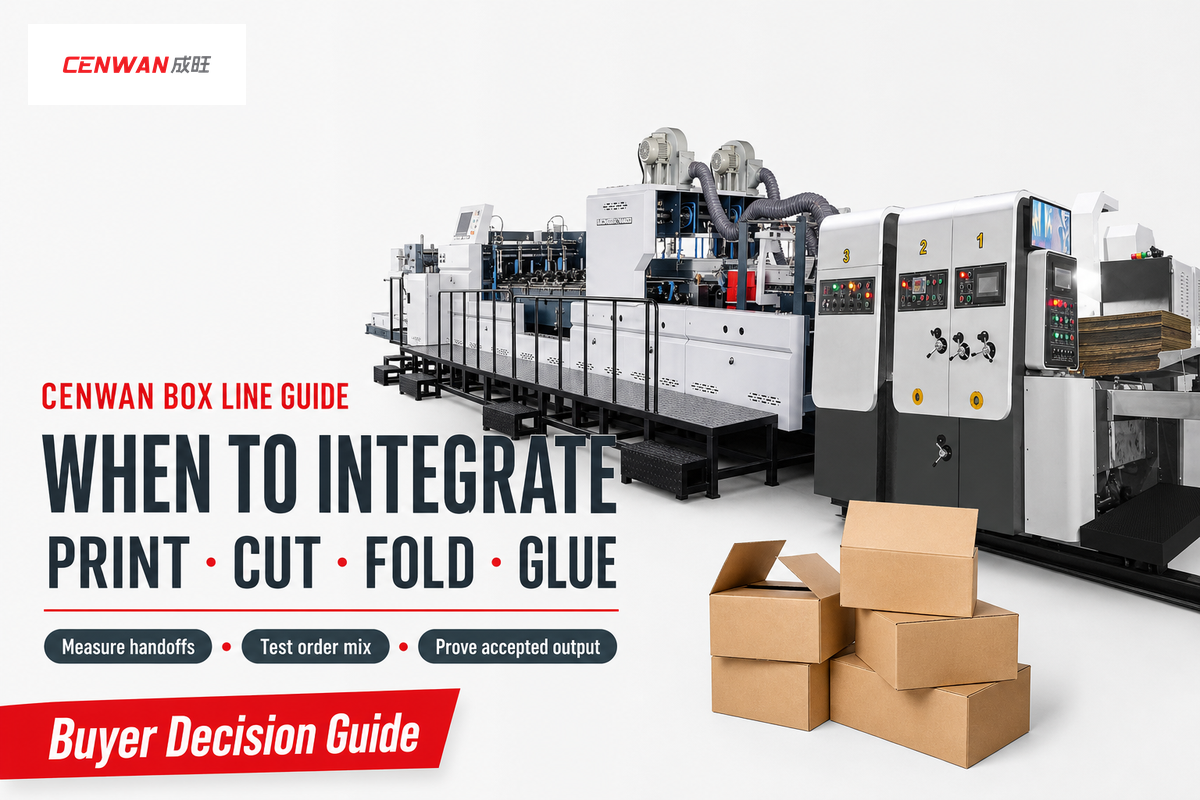
A single continuous box line can eliminate some manual handling but a faster connected machine doesn’t automatically bring additional saleable cartons. The investment decision depends on where time and defects occur across the real customer order mix. This document provides plant, quality, and finance teams a measurement ledger, a hidden bottleneck map, and a supplier request they can attach a route trial to.
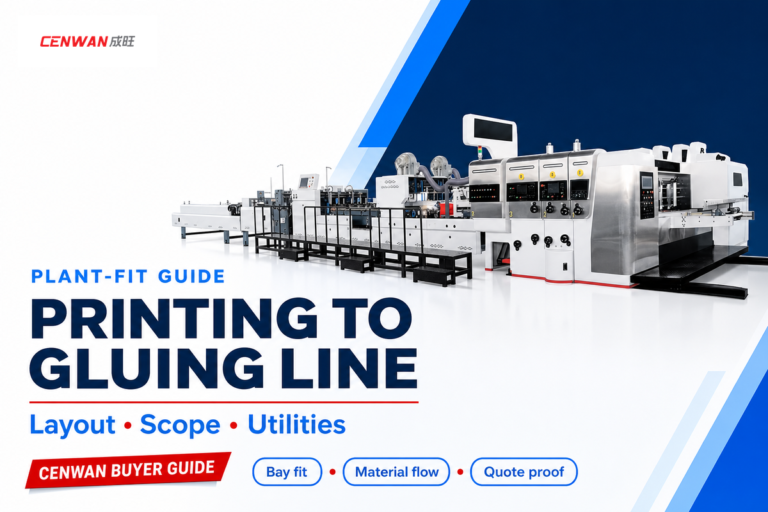
Scope: corrugated sheet printing, slotting or die cutting, folding, gluing and downstream packing. Filling a product into a carton is a different packaging process. Cenwan describes an integrated printing-to-gluing configuration; its public description doesn’t establish the result your plant would obtain.
Start with the decision: is the handoff the constraint?
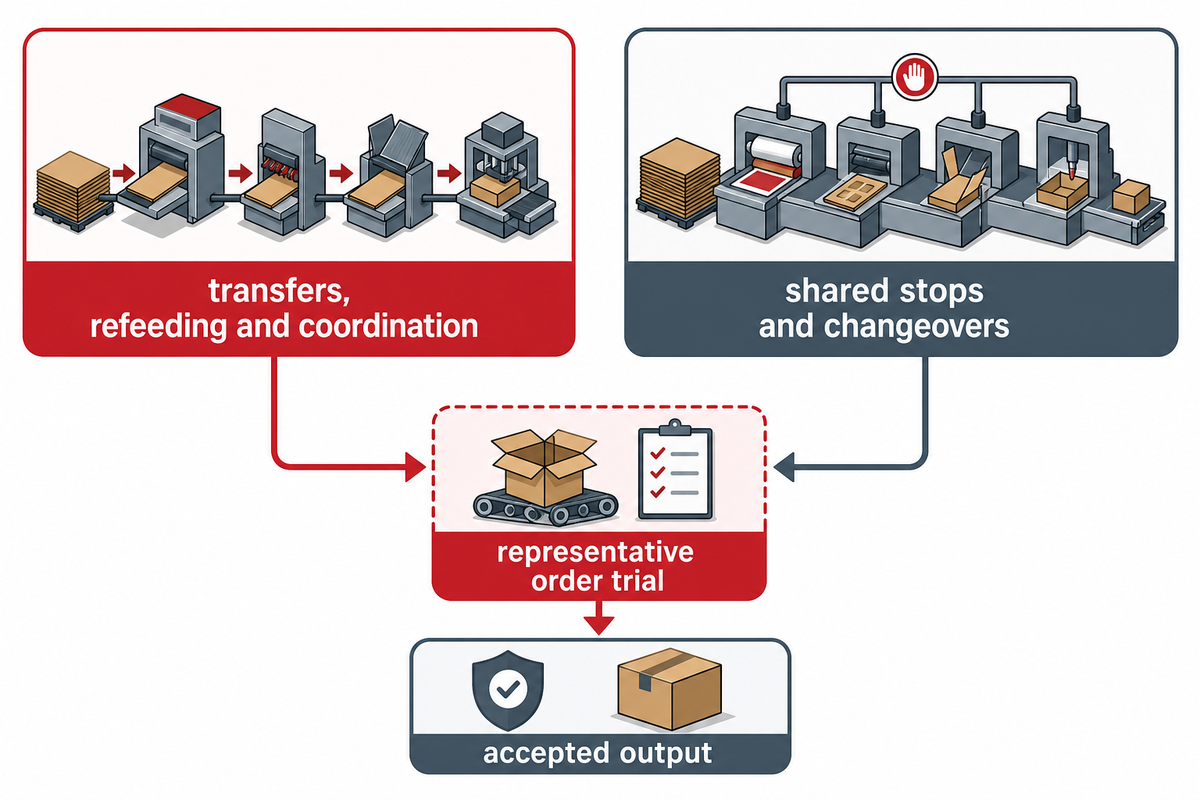
Integrate printing, die cutting, folding and gluing when a representative order trial shows that transfers, refeeding and coordination consume more useful capacity than the joined line would lose to shared stops and changeovers. If these transfers are minor, a better feeder, gluer or packing may resolve the true constraint with less disruption.
Ask operators to identify the last accepted sheet at each station, the time the next station receives it, and the first accepted box after each change. A connected line can also cause one stoppage to idle all the modules connected to it; NIST’s model of flexible serial lines examines how machine reliability, buffers and scheduling affect production rates under its stated assumptions. “Less handling” can be examined as a hypothesis against accepted output, reject mix and labor hours. Equipment quotes can’t answer these questions.
Decision checkpoint: If the observed transfer queue is shorter than the time lost to die setup or glue corrections, investigate those stations first. A joint machine still needs a compatible box drawing, board grade and verified path to packing.
Draw the current route before specifying an integrated line
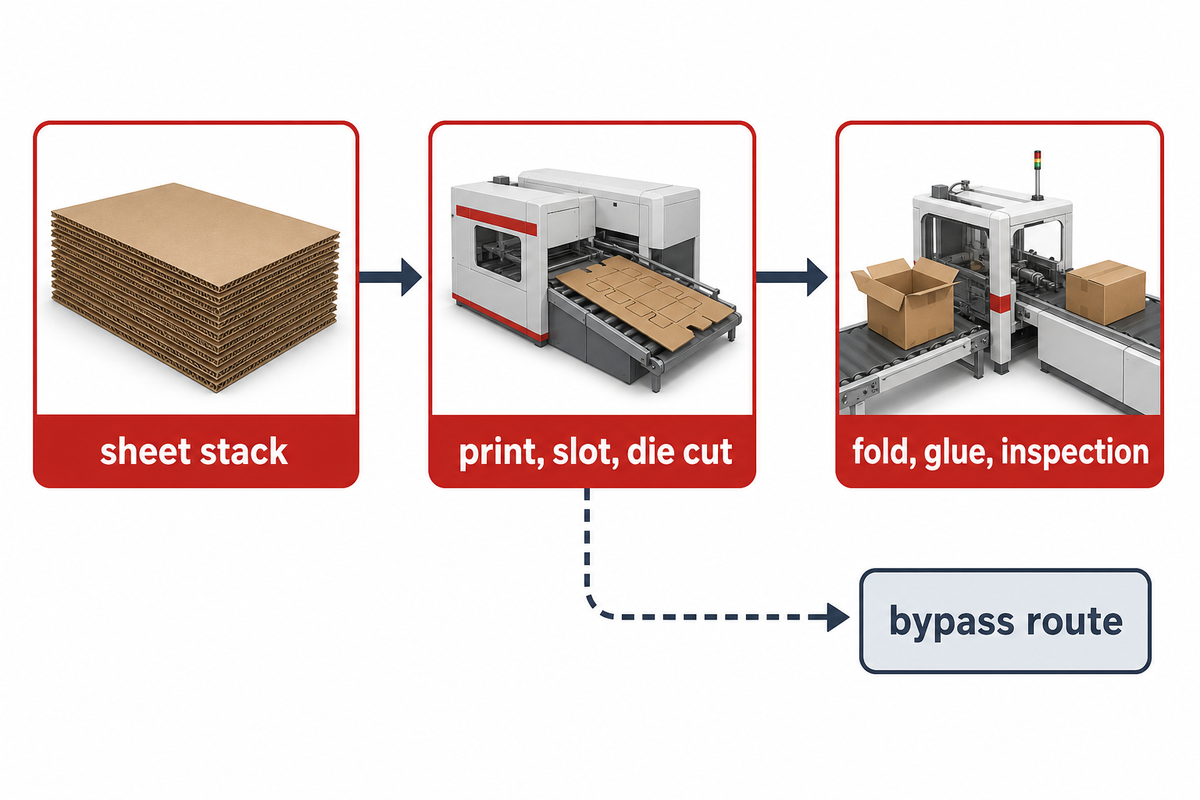
Map each corrugated job from sheet stack to packed bundle, including any print, slot, die cut, fold, glue, inspection and stacking steps. The European Corrugated Packaging Association says printing may be inline or offline and that flexo folder gluers can combine converting stages; the same operations can also run on separate machines. Your existing route determines which transfers are removable.
For each order family, show where sheets wait, where the operator squares or reorients a stack, and where a batch is removed and taken to another machine. Name the station owner and the accepted-box inspection point. A corrugated cardboard flexographic printing machine feeding a separate rotary die cutting machine is different from a flexo folder gluer machine with inline print and slot units. The corrugated folder gluer overview explains equipment terms; this page is about the timing of joining those functions.
During carton production, a flexographic printing machine for carton packaging may feed a separate cutter; measure the stopped and labor time at that handoff. The route drawing should show where the flexo printer hands sheets to the cutter and where paper feeding begins again. For corrugated carton printing, show the first accepted print after each handoff. The same is true for any other machine for corrugated board that may be substituted.
A corrugated paper box has to meet the same customer drawing, whether it’s on one connected line or multiple stations. Label each box machine in the route drawing with the operation it performs, so a quoted module can be compared with the plant’s existing equipment.
A material-flow drawing also shows a bypass route. If a particular folding box style or unusual glue flap can’t pass through one proposed section of the plant, a documented alternate path is needed. Don’t call a box incompatible from a general product family; ask the supplier for a drawing-level answer.
Measure accepted cartons per paid hour, not nominal sheets per minute
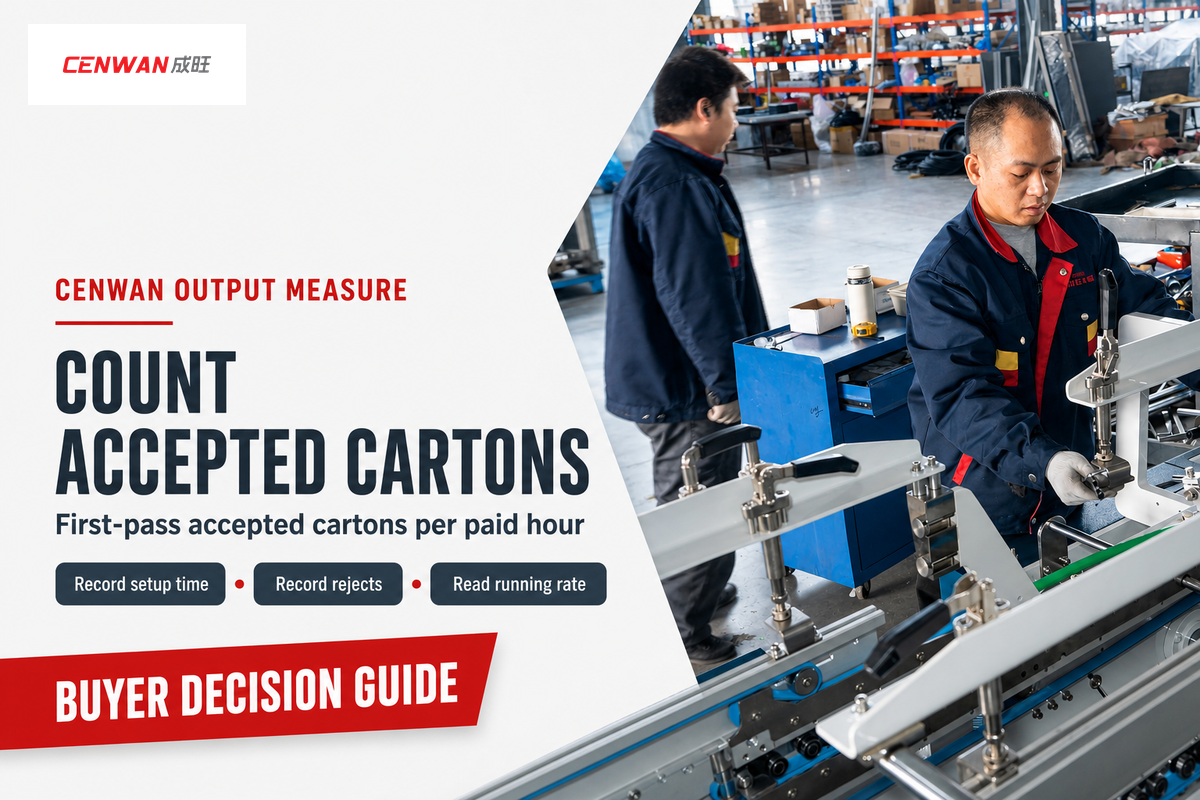
Count first-pass accepted cartons over the elapsed production window and, separately, over the paid hours of everyone operating, feeding, moving and packing that route. Keep both denominators. A machine display reports a running rate; it omits setup, starved time and rejected boxes. Paid-hour output is a plant measure, not an official labor-productivity statistic or a complete payback calculation.
The U.S. Bureau of Labor Statistics distinguishes hours paid from hours actually worked and separates labor productivity from measures that also consider capital, materials and energy. Use that distinction when finance compares routes. An apparent labor gain can coexist with a higher equipment or consumable bill. A published corrugated waste project recorded its own reduction at a corrugator; its figures can’t be used as a print-to-glue return estimate.
| Field | Unit to record | What it isolates |
|---|---|---|
| 1. Order size | sheets and cartons | Comparable job scale |
| 2. Last good to first good | minutes per change | Stopped transition, not preparation done while running |
| 3. Transfer and refeed | minutes per batch | Handling between independent stations |
| 4. Starved or blocked station | minutes per station | Constraint movement |
| 5. First-pass accepted cartons | cartons per order | Saleable output |
| 6. Rejects by cause | cartons per cause | Print, cut, crease, glue and strength failures |
| 7. Elapsed production time | line hours | Accepted cartons per line hour |
| 8. Paid operator time | person-hours | Accepted cartons per paid person-hour |
| 9. Equipment and running cost | currency per 1,000 good cartons | Capital, power, glue, maintenance and handling |
| 10. Work in process at shift end | sheets and cartons | Unfinished inventory carried forward |
Calculation: First-pass accepted cartons/elapsed line hours measures physical throughput, and the same accepted count/summed paid person-hours measures labor input. Keep the time window, inspection rule, and treatment of rework the same for all routes. A finance comparison should also include costs for purchase, installation, training, maintenance, utilities, scrap and inventory carrying cost.
Worked example, entirely hypothetical: Each route receives the same 3,000-sheet order. These numbers teach the calculation; they are not Cenwan test data, published benchmarks or promised savings. Replace every cell with witnessed plant values before making an investment decision.
| Route | Run | Setup | Transfer | Other stops | Total | Rejected | Paid labor | Accepted |
|---|---|---|---|---|---|---|---|---|
| Separate | 3.00 hours | 0.75 hours | 0.50 hours | 0.25 hours | 4.50 hours | 6% | 9.00 hours | 2,820 cartons |
| Staged | 3.25 hours | 0.50 hours | 0.25 hours | 0.25 hours | 4.25 hours | 5% | 8.50 hours | 2,850 cartons |
| Integrated | 3.50 hours | 0.25 hours | 0.00 hours | 0.75 hours | 4.50 hours | 4% | 9.00 hours | 2,880 cartons |
In this constructed example, the staged route yields about 671 accepted cartons per elapsed hour; the separate route yields about 627 and the integrated route about 640. Although the integrated route removes 0.50 hours of transfer and lowers the hypothetical reject share from 6% to 4%, it also carries 0.75 hours of linked stops. Other actual mixes can yield the opposite results. Relying on 4.25 hours versus 4.50 hours of elapsed time and 8.50 hours versus 9.00 hours of labor as two separate inputs, neither ratio on its own justifies the purchase of the machine.
Precision here has a testable meaning: print register, crease placement and glue position must remain inside the agreed limits. The high-quality carton counts only after customer-required function checks pass. Folding carton work on solid paperboard belongs in a separate sample family; it shouldn’t be pooled with corrugated carton output.
The separate folder gluer speed and quality discussion explains why the machine display and saleable cartons can diverge. Apply this ledger to the entire print-to-pack route and not to one equipment counter.
Find where queues and starvation move across your SKU mix
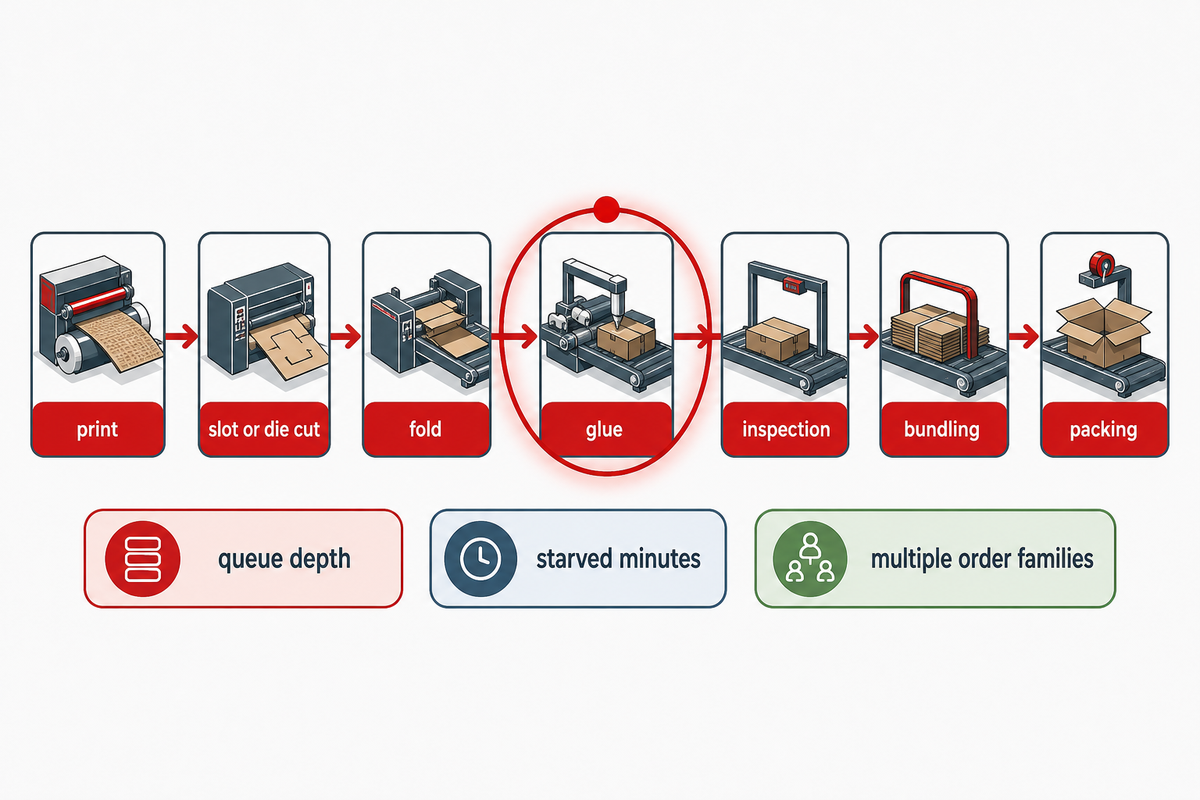
A bottleneck at transfer may disappear and a constraint may move to die cutting, glue cure, counting, or packing. Measure queue depth and starved minutes at every station for multiple order families. The U.S. National Institute of Standards and Technology has published research on changes in product mix and their effect on throughput and bottlenecks in serial manufacturing. Their application case study is automotive, so the carton implication is a valid hypothesis.
“throughput and bottlenecks as functions of the product-mix”
Make a simple map with columns for print, slot or die cut, fold, glue, inspection, bundling and packing. For each job, enter the queue at the station, the active time and the wait time. Analyzing filled maps can reveal insights. For example, folders may reveal bottlenecks in bundling after refeeding is reduced. A dealer-authored article gives the example of the potential downstream shift, but doesn’t quantify its occurrence in other plants.
Procurement objection: “The printer is rated faster than the folder.” A speed comparison matters only if the printer keeps the next unit fed on your actual board sizes and the final packing station clears the accepted boxes. A synchronized, observed run is preferable to combining brochure maxima.
Troubleshooting should follow the last good box. Common problems include a gluer that starves, an automatic carton counter with miscounts, and a strap or banding station that can’t clear the completed boxes. Record which event stopped the automatic production flow and who restarted it.
Treat changeover mix as an integration input
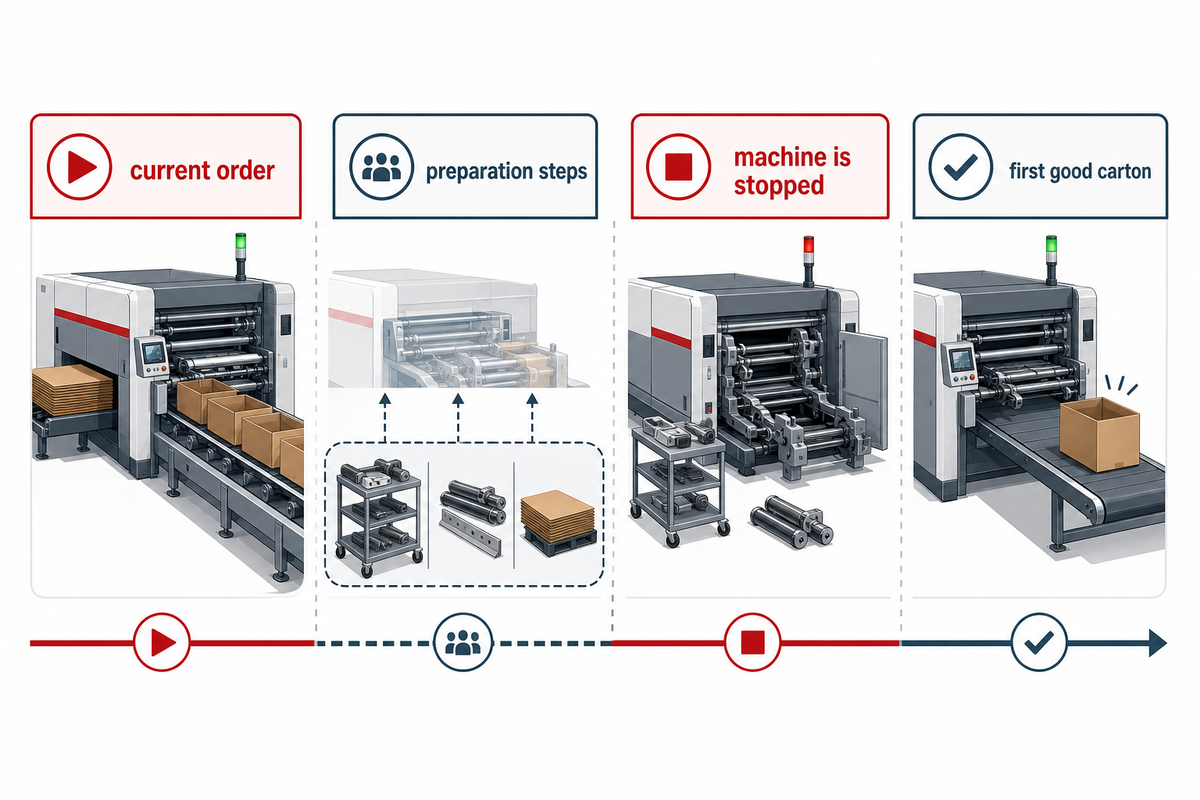
Count the number of order transitions per shift, the length of time the machine is stopped for each, and the preparation steps that can be safely performed during the previous job. Two plants producing the same annual volume of carton can face different economics based on how frequently a plant changes artwork and box dimensions. A continuous line can feature fast changeover mechanisms; NIST’s multi-job systems analysis shows that throughput and bottlenecks can vary with product mix and schedule, a general manufacturing finding rather than a carton-line benchmark.
Some integrated configurations can prepare a future print job while running the current order; others require a complete stop. The buyer should request a station-by-station list of safe concurrent activities and witness a changeover. No supplier’s catalog setting time determines another supplier’s performance or the buyer’s final accepted output.
Log the following for each order transition: the last good carton of the prior order, the first good carton of the next order, the length of time the machine is stopped, and the personnel minutes of advance work. Evaluate the same SKU sequence in the candidate routes. A nominally “high speed” printing machine for carton work can lose a short shift to repeated changes; a well-configured integrated line might avoid that loss. Annual volume, in a blanket rule, will miss these cases.
Advanced technology language is not a setup measurement. If a supplier offers auto plate locking or stored recipes, determine which concurrent activities are allowed during the previous order and the length of time for the next first good carton. The operator should know the actual stop sequence and explain it without referring to changeover statements in the supplier’s brochure.
Compare three routes on the same test orders
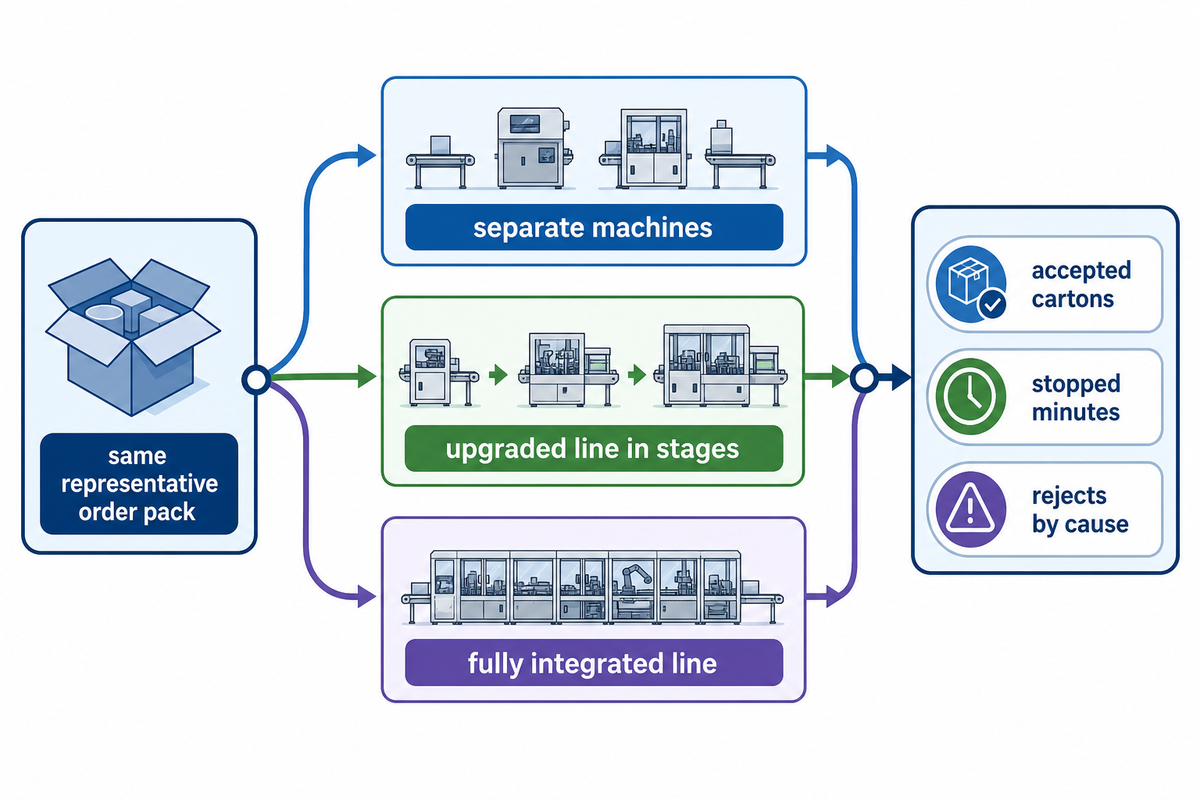
Test separate machines, an upgraded line in stages and a fully integrated line against the same representative order pack. The comparison must use the same drawings, board specification, print art, acceptance rule and order sequence. Also, record the operator, board lot and time of day. These factors can impact the results. The National Institute of Standards and Technology identifies operator and test time as experimental factors; recording board lot is this guide’s recommendation for the carton trial, not a factor named in that source.
| Order type / family | Route | Question the trial must answer |
|---|---|---|
| Long regular slotted box | Separate | How much refeed and transport time remains? |
| Long regular slotted box | Staged | Does targeted feeding or gluing remove the queue? |
| Long regular slotted box | Integrated | Is accepted output higher after linked stops? |
| Short print-heavy job | Separate | Can print prep overlap finishing work? |
| Short print-heavy job | Staged | Which setup actions become reusable? |
| Short print-heavy job | Integrated | How many stopped minutes remain per change? |
| Difficult board or box geometry | Separate | Where do crease or glue rejects appear? |
| Difficult board or box geometry | Staged | Can a retained specialist station preserve quality? |
| Difficult board or box geometry | Integrated | Does the offered line pass the full acceptance set? |
A staged route might retain a printer while adding an automatic folding gluing machine or rear-end packing equipment; a full route could link flexo printing slotting die-cutting, folding and glue delivery. For a printing slotting die-cutting machine, record which stations remain linked and where its output enters folding and gluing. Compare quoted module boundaries, not labels. The site’s broader automatic-line cost and layout guide covers general budgeting; this trial supplies the evidence that a budget model needs.
Record accepted cartons per line hour, labor person hours, causes of rejects, downtime, and cost per 1,000 accepted cartons, for each of the nine cells. A route wins only for the acceptance definition tested by the supplied mix. If a candidate is unable to perform a test box, report the alternate route and associated operations, rather than eliminating that test box from consideration.
Compare a staged route using the same cardboard box specification with a fully automatic product line. Automatic feeding can remove one lift, and a separate box printing step may allow the printer to serve a few finishing paths. Report both the handling saved and any extra printing and packaging coordination. “integrated” by itself doesn’t describe the actions performed by the line.
Put board and box compatibility into the acceptance trial
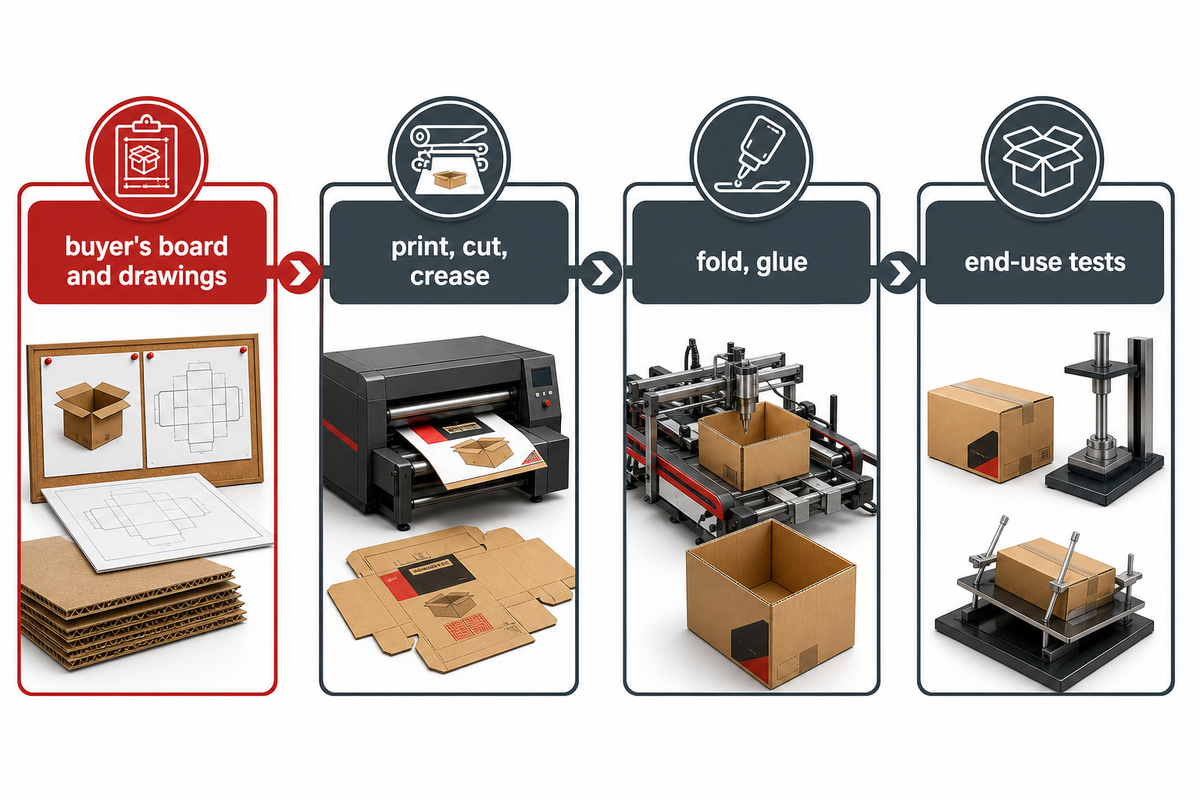
A line is acceptable only if the actual buyer’s board and drawings pass print, cut, crease, fold, glue and end-use tests after the planned production sequence. Test the widest and narrowest blanks, board grades, flute directions and difficult glue flaps. A corrugated box that looks square may still fail a required strength test, if, for example, converting damages the board.
A laboratory study on single-wall corrugated board (subject to 10% to 70% of original thickness crush with 10 µm precision) found that mechanical properties were reduced. Those are laboratory conditions, not a plant defect rate or a target operating band. The study doesn’t prove that integrated equipment causes more crush than other equipment. It does justify including the buyer’s applicable compression or edge-strength check alongside dimensions and appearance when the box must protect a load. The paperboard manual from Iggesund also discusses moisture related register and crease issues, but it pertains to paperboard, so we should use it to help with framing of questions instead of using it to transfer settings to corrugated stock.
Defect codes should be written prior to a supplier run for print-to-die registration, cut/slot position, cracked or weak crease, skewed fold, glue flap alignment, bond failure, crushed flute and miscount. Quality should sample the first, middle and last parts of each production run and retain samples that aren’t acceptable. For the detailed print-to-glue checks, see Cenwan’s seven-stage quality guide; its checks still need to be applied to the buyer’s board and box.
For a flat bed tool, the proposed creasing matrix should be suited to the test board and drawing. For rotary tooling, the same question should be addressed for the die and crease. After the cutter, check whether the waste will strip and leave a clean panel. Those checks should be made for the actual tooling being offered.
Use a seven-day log before requesting a quote
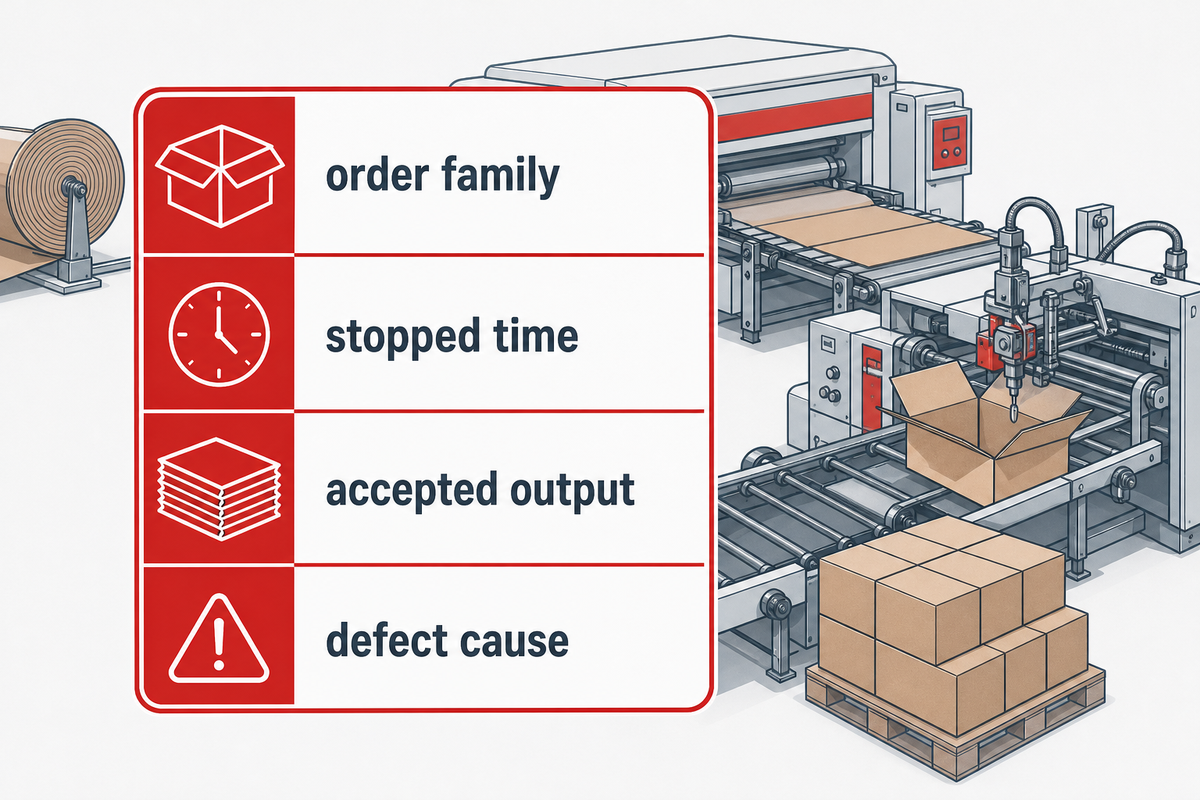
Seven days can identify where orders waste time, but it can’t guarantee a representative sample of every shift, board batch or seasonal box. Begin a daily log noting order family, intended quantity, set up time, stopped time, handling time, accepted output and defect cause. If a critical product or operating condition doesn’t appear during the scheduled observation, increase the length of the observation.
The plant manager selects awkward and high-volume orders that recur. Quality supplies the acceptance limits per customer specification. Finance documents operator hours, electricity, glue, scrap, maintenance, equipment, and work in process costs. Procurement adds drawings, art and board samples to request for quotation. If a site has other operating shifts not observed in the first week, add a trial on those shifts prior to making a plant-wide conclusion. For process stability, the National Institute of Standards and Technology suggests gathering observations over time; seven calendar days is this guide’s initial diagnostic window, not a prescribed sample size for corrugated equipment.
A missing value in a log should be noted, but kept blank until measured. A supplier should say which carton styles require an alternate route and which function(s) can be customized and/or adjusted and which performance value is to be measured. A missing value at a site should be treated as a measurement prompt, never as a safe default.
With the log, packaging professionals can distinguish between a request for higher speed and a request for fewer changeovers. Each request should indicate a measured loss and the affected box family. A broad carton packaging purchase brief without these fields results in incomparable offers.
A folder gluer operator checklist can help define who documents setups, feeds and glue checks during the observational window. Assign the measurement role before the shift, so a missing log doesn’t become a guessed zero.
Ask for a representative factory and site acceptance proof
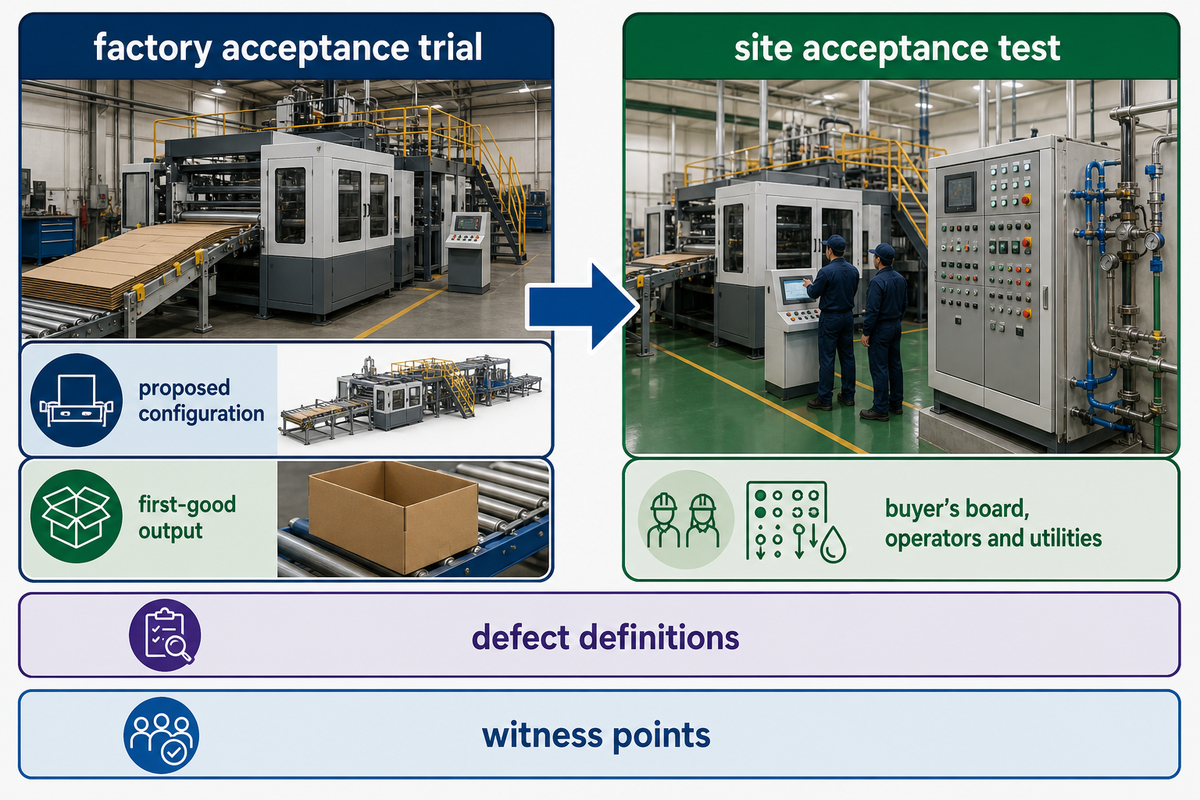
The agreed order pack should be run during a factory acceptance trial, and first-good output, changeover losses and rejects, and downstream handoff, should be demonstrated at the proposed configuration. A site acceptance test should repeat the relevant checks after installation with the buyer’s board, operators and utilities. Set defect definitions and witness points in the purchase terms before anyone quotes a speed target.
| Item | Evidence to request | Owner |
|---|---|---|
| 1. Order and board envelope | Signed drawing, grade and test sample list | Procurement / QA |
| 2. Print and die register | Measured accepted tolerance by SKU | QA |
| 3. Fold and glue quality | Defect codes and bond test method | QA |
| 4. Board strength | Applicable customer strength result | QA / customer |
| 5. First-good transition | Stopped minutes and advance labor per change | Plant manager |
| 6. Accepted output | Cartons per elapsed hour for each test job | Plant / finance |
| 7. Packing and counting | Complete bundles with count exceptions | Plant / QA |
| 8. Interface and controls | Integrator, interlocks, risk file and handover scope | Supplier / buyer |
| 9. Service and spares | Named response route, stocked parts and exclusions | Procurement |
Don’t interpret separate machine documents as signaling an assembly-wide safety review. In the UK, the Health and Safety Executive states that a qualifying combined machinery assembly can assign manufacturer responsibilities to the party constituting the assembly, including interface risks. Its guidance also states that mixed old/new installations require case-by-case assessment. These guidelines are specific to the UK. Request each project team to identify its integrator and the applicable local conformity path. For equipment placed on the EU market, the official EU machinery regulation summary states that the general application will be from the 20th January 2027, and certain provisions will apply from before; this is a procurement issue for EU projects.
Cenwan states that it provides after sales service and spare parts, but it’s the responsibility of the customer to specify in the contract the models covered, and stipulate response times and obligations. A public support claim is not proof of response time at the site in question.
Request professional technical support terms in writing, including controls handover, remote diagnostics, training and the first spare-parts shipment. The acceptance sheet should identify who verifies that the complete machine interface is ready after commissioning.
What changes in 2026: prove flexibility before buying capacity
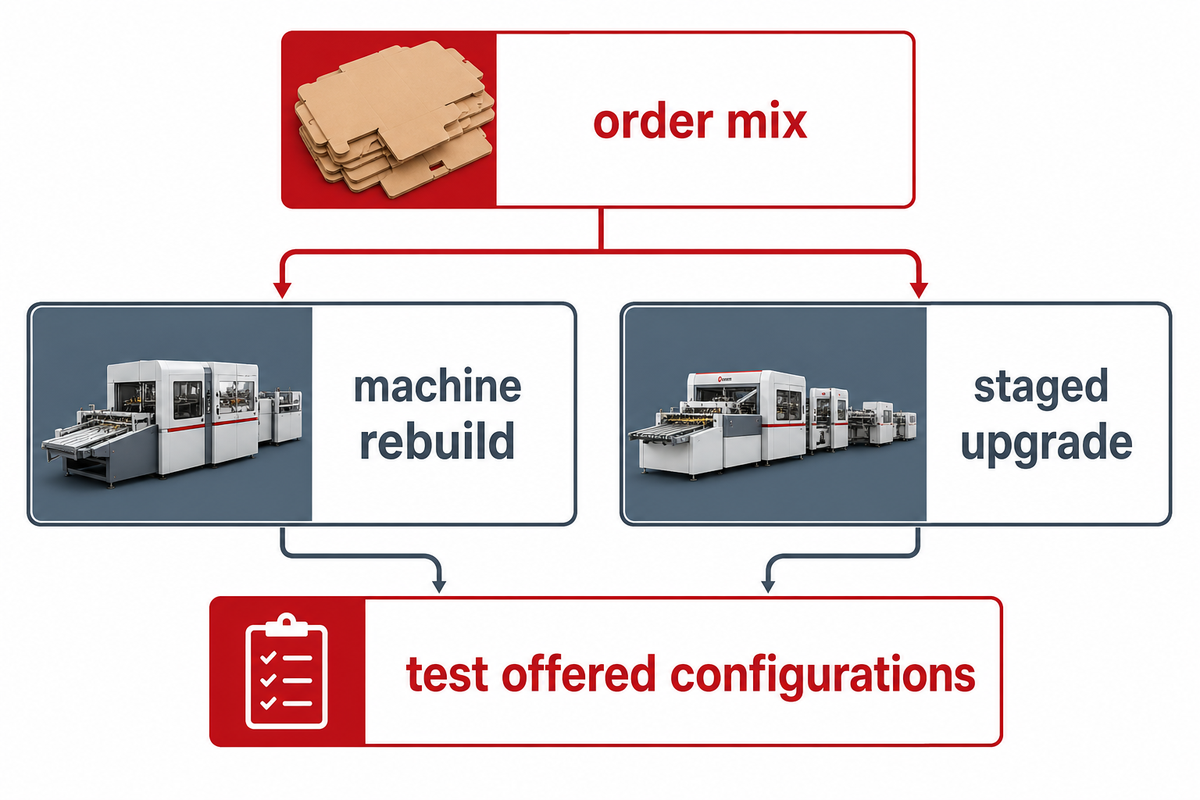
Shorter orders and greater customization can increase the value of quick, repeatable changeovers, but they don’t create a universal date to integrate a box line. A selected machine rebuild or a staged upgrade may solve the actual constraint. Treat 2026 as the date to refresh the order mix and test offered configurations, rather than as a deadline imposed by an unverified market forecast.
Many product catalogs include high-speed box production line configurations and quick changeovers, but rated limits are model and condition specific. Don’t mix one company’s printing machine speed with another company’s die cutting folder gluer capacity to claim a complete route. The accepted box trial will continue to be the primary means of selection.
No patent ownership or proprietary performance figure is needed to decide which configuration meets a buyer’s acceptance sheet.
Make the investment decision and hand the right brief to suppliers
Select the route whose measured and accepted output and quality improve for the plant’s relevant product mix after setup, staffing and ownership costs are considered. The handoff packet should contain the current route diagram, completed Transfer Loss Ledger, hidden bottleneck map, test orders, and the nine-point acceptance sheet. If critical cells on the acceptance sheet are blank, request a measurement or sample run before approving the investment.
Send Cenwan the box drawings, corrugated board grades, print art, planned order sequence, good-output target and sample defect codes. Ask which equipment modules fit each order, which stations can be run independently, and who owns the controls interface. Ask how packing joins the trial. A quote can then define the proposed box making machine rather than a generic automatic folding gluing machine. Compare this response to the other routes offered on the same basis.
Next step: Bring a completed order pack and loss ledger to a technical review. Cenwan can recommend an integrated line, a folder gluer or rear-end packing configuration against those samples. Discuss a sample-run plan
Frequently asked questions
Can a corrugated box be printed before it reaches a separate folder gluer?
Yes. Corrugated board printing may be offline or inline.
The European Corrugated Packaging Association describes both routes. A separate folding gluing station is viable when its print-to-die registration, transfer handling and quality checks meet the order specification. Map the extra stack and refeed steps and compare them with a proposed combined route on the same board and drawings, including the first accepted box.
How quickly can an integrated carton line switch between different SKUs?
There is no dependable universal minute target for every box mix.
Machine controls, printing plates, ink, dimensions and safe access determine the setup sequence. Ask the supplier to run a witnessed change from your previous order’s last accepted carton to the next order’s first accepted carton. Record stopped minutes separately from work prepared while the prior order runs. A product brochure’s setting time may omit several of those activities. Repeat the changeover after the crew has practiced it, and request both the first-trial and repeat results. Record who performed adjustments and whether the next order met its print, cut, fold and glue acceptance limits before calling the change complete.
What is die cutting in a carton printing line?
Die cutting shapes the printed sheet and may create cuts or creases needed for the box design.
The cut or slot must align with the artwork and the later folding path. A buyer should inspect cut position, crease function and board strength on finished samples. A carton can pass a visual print check and still fail when the panels fold or the glue flap lands incorrectly during a full production run.
How long does it take to go from ordering to full operation?
Require a supplier milestone schedule for the exact configuration and site.
Configuration freeze, drawings, utilities, installation, training and acceptance testing each have a date to agree. Ask who provides board samples, artwork and any interface or safety documentation. Do not use another plant’s lead time as a promise for this project.
What does a factory need to supply for an integrated-line trial?
Supply real board, box drawings, print art, order sequence and written acceptance limits.
Add operator staffing, intended packing method, current good-output observations and reject categories. Include the most difficult recurring order as well as the easy one. If a supplier cannot run a job on the proposed route, require an alternate flow and account for its extra handling in the comparison.
References & Sources
- Corrugated packaging production process FEFCO.
- Multi-job production systems and product-mix bottlenecks NIST-hosted research, 2018.
- Randomized block designs and process stability NIST Engineering Statistics Handbook.
- Productivity concepts and hours worked methodology U.S. Bureau of Labor Statistics.
- Crushing of Single-Walled Corrugated Board during Converting peer-reviewed laboratory study, 2021.
- In situ manufacture or assembly of work equipment and plant UK Health and Safety Executive.
- Machinery safety requirements EUR-Lex official summary.