Get in touch with Cenwan Machine Company


By GW · Updated October 2026
A glue machine for boxes is adhesive-application equipment whose required process depends on the workpiece and the remaining job. Folder gluers fold and bond prepared carton blanks. Pasting machines may coat a sheet or glue a seam. Manual gluing combines hand assembly and the application of adhesive. Closing an already filled shipping case is a separate packaging operation.
Quick answer
- Choose the process by the material entering and the box leaving the operation.
- Ask whether the output is flat, erected, wrapped or sealed around a product.
- Confirm folding, pressing and discharge separately from glue application.
- Compare accepted cartons within a specified time window rather than at maximum belt speed.
Before you compare equipment
Provide a finished blank drawing, coated stock, actual glue details, required output state and mix of orders. Public model specifications are a starting point for sample checks; they aren’t a guarantee for production.
Which glue machine for boxes matches your starting material?
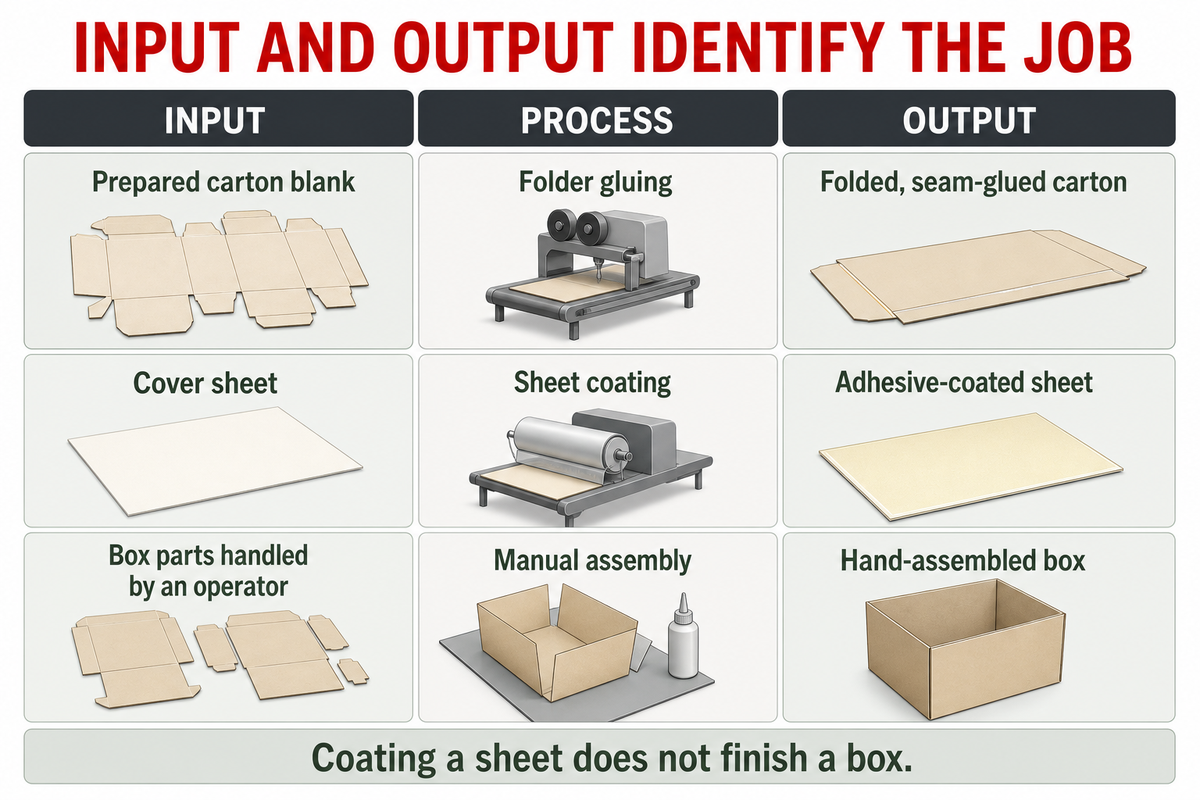
The right gluing process is determined by the input and output states. Die-cut and creased paperboard indicates folder gluing; a cover sheet requiring adhesive indicates coating or pasting. An already filled carton needing closure points to sealing. Define those states before comparing automatic equipment, manual labor and machine price.
A supplier may use “box making machine,” “pasting machine,” or “gluing machine” broadly. Translate the label into a clearly observable change. The European Federation of Corrugated Board Manufacturers’ FEFCO Code describes various constructions of corrugated boards; however, a design code alone isn’t sufficient to certify a machine configuration. Provide the drawing and finished sample.
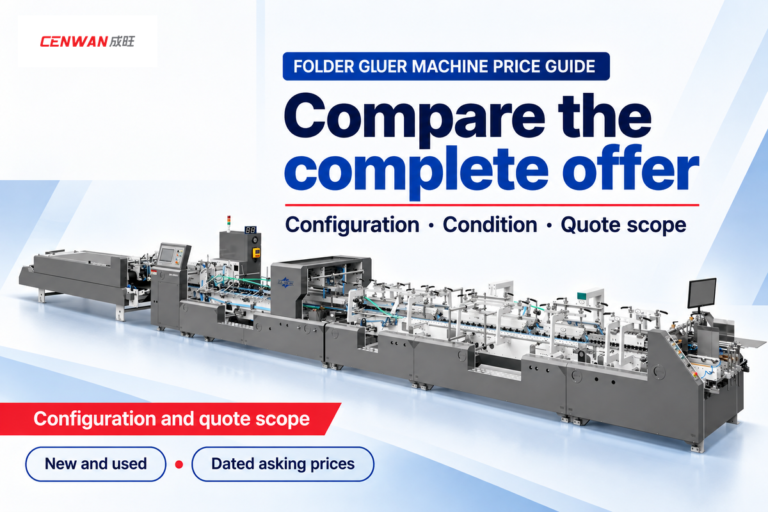
Supplier listings may call this a folding gluing machine or a carton folding and gluing machine. Before comparing folder gluer machine price quotations, establish the input, output and included operations. Apply that check to a small glue machine for boxes or a used folder gluer machine for sale too. An automatic box gluing machine quotation needs the same drawing and finished-output demonstration.
Workpiece Boundary Check
| Incoming workpiece / Quotation term | Required output to clarify | Process to investigate | Limitations / Not suitable for |
|---|---|---|---|
| Folder gluer — Die-cut, creased carton blank | Folded, seam-glued carton | Folding and seam gluing | Not product filling or filled-case sealing |
| Pasting machine — Sheet or carton seam | Coated sheet or glued seam, as quoted | Sheet coating or seam application? | A coated sheet is not a finished box |
| Manual box gluing machine — Parts handled by an operator | Hand-assembled box or glue-coated parts | Assisted adhesive application or hand assembly? | Application alone does not automate assembly |
| Carton sealing machine / carton sealer — Filled, erected shipping case | Closed shipping case | Closing the case around a product | Not making the empty carton blank |
| Cartoning machine — Product and carton material | Loaded or closed carton, as quoted | Forming, loading or closing the carton | Not proof of die-cut blank folding and gluing |
| Rigid-box gluing equipment — Chipboard and paper cover | Coated cover or wrapped assembly, as quoted | Coating only, or complete wrapping? | Thin-paperboard stereo-box data is not thick-board proof |
| PUR hot melt laminating machine — Panel and covering material | Laminated panel | Bonding broad surfaces | Not a carton seam folding operation |
| Corrugated folder gluer — Prepared corrugated blank | Joined, knocked-down shipping box | Joining a knocked-down shipping box | Printing and die cutting are not implicit |
| Integrated flexo folder-gluer line — Corrugated sheet entering converting | Printed, converted and joined blank | Printing, converting and joining | Not the scope of a standalone adhesive applicator |
For an illustrative 350 × 260 mm blank, quotes for coating a sheet and producing a folded carton cover differ in deliverables. Ask the supplier to mark the glue path and denote every operation following adhesive contact with paper. At that point, Procurement can evaluate deliverables of equal scope.
What a folder gluer does to a die-cut carton
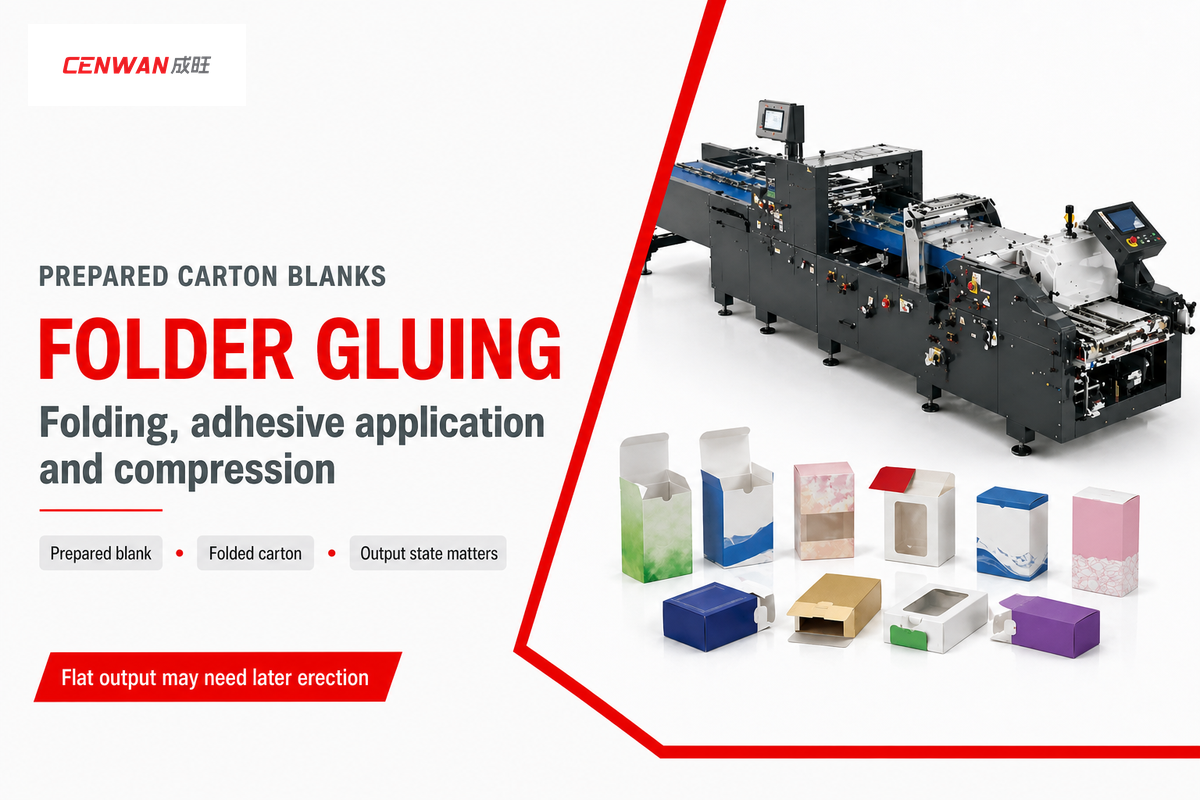
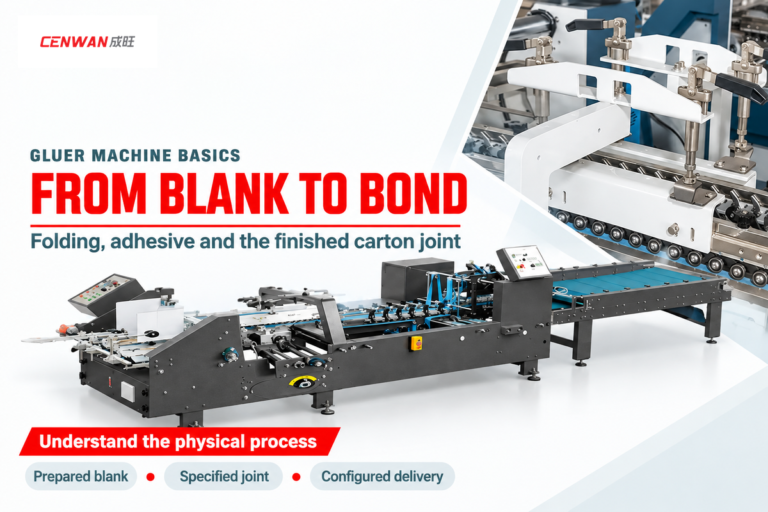
A folder gluer is a folding machine that feeds a prepared carton blank through folding, glue application and joint compression. The sequence of folding determines what box styles can be produced from a given configuration. Many cartons are left flat to be erected later; an erected or ‘ready-to-fill’ box must be specified separately. The word “automatic” doesn’t clarify that output state.
The TAPPI flexo folder-gluer course description mentions printing and converting corrugated in an integrated manner. A standalone paperboard folder gluer occurs later in the process. Alexandra Hartford’s Michigan State University packaging study hosted by the Institute of Packaging Professionals mentions flat-packed corrugated boxes on PDF page 10. That doesn’t represent a current model specification.
Cenwan’s public small-box page indicates that CW-G-650 is for straight-line and lock-bottom work, while CW-G-880 and CW-G-1100 add corner formats. The same page lists 200–800 g/m² paperboard and a maximum no-load speed of 400 m/min. Those are supplier published fields; they don’t define an accepted box volume per hour for your carton.
Use the information in the Cenwan folder gluer series for your blank to define the limits. Then use the information in the folder gluer box styles guide for construction details. Request a format-specific demonstration rather than accepting a video showing a different fold pattern.
The limits listed in the following fields are published overall fields and don’t imply approval of every box folding geometry within them.
| Published model | Minimum width | Maximum width | Listed power | Maximum no-load speed |
|---|---|---|---|---|
| CW-G-650 | 130 mm | 650 mm | 21.5 kW | 400 m/min |
| CW-G-880 | 140 mm | 880 mm | 25.5 kW | 400 m/min |
The 300 g/m² value is only a material description. Even if that grammage sits within a published 200–800 g/m² range, the glue flap, crease positions, coating and fold sequence remain separate acceptance questions. Before approving a straight line configuration, a buyer requiring corner gluing must identify that sequence. (Illustrative stock and conditional fit).
What does a box pasting machine actually do?
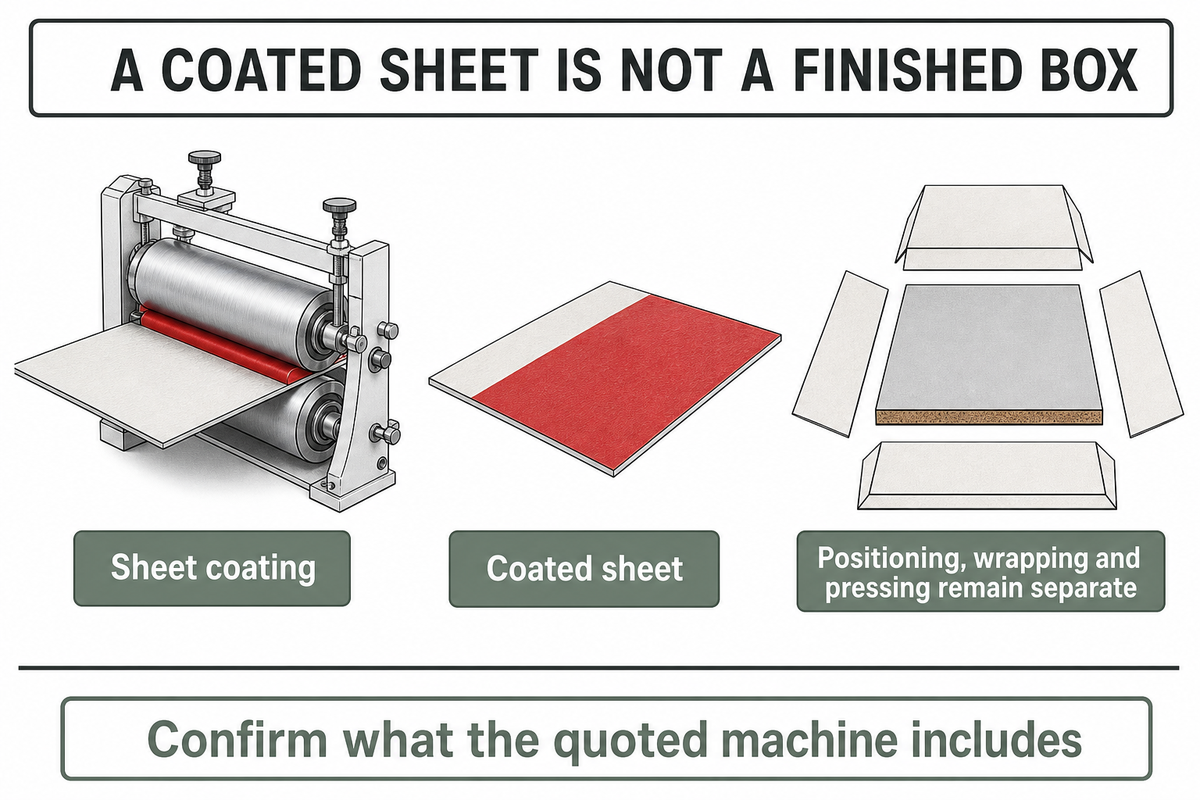
A box pasting machine may perform either seam gluing or adhesive application across a sheet, depending on the equipment. The important distinction is whether the machine performs folding, positioning, and compression of the parts. Roller applicators may deliver a coated workpiece while leaving the rest of the assembly to an operator or to another machine.
Listings for “carton box machinery” may cover a different step in production from the box forming step you require. Demand a workpiece-to-output demonstration as opposed to trusting the label.
One reviewed roll-coater product describes sheet coating and rigid-box attachments. It offers heated animal-glue arrangements as well as other adhesive applications. A heated glue reservoir on the device is therefore insufficient evidence that the machine uses hot melt glue. Ask for the adhesive grade and application method. The existing automatic pasting machine guide covers the deeper equipment questions.
Illustrative procurement scenario: A gift-box converter sends a 420 × 300 mm cover sheet and a 2 mm chipboard sample to two suppliers. One shows uniform roller coating. The other quotes positioning, wrapping and pressing. Both descriptions mention pasting. The factory manager must find out who puts the cover on the board, aligns it, and tackles the corners. Finance should compare the labor and equipment needed to finish that same box. QA should retain a finished sample from the proposed route, including the actual coating and adhesive. A good coated sheet is useful evidence of application quality, but it can’t settle the quality of a finished wrapped box. Neither quotation is comparable until the output state is written down.
For a 420 × 300 mm cover, a sheet coater may work if downstream finishing is already in place. It’s a bad buy if the expected finish is an assembled rigid box and the quote doesn’t include finishing. Review remaining work before accepting a lower applicator price.
When manual box gluing is a workable route
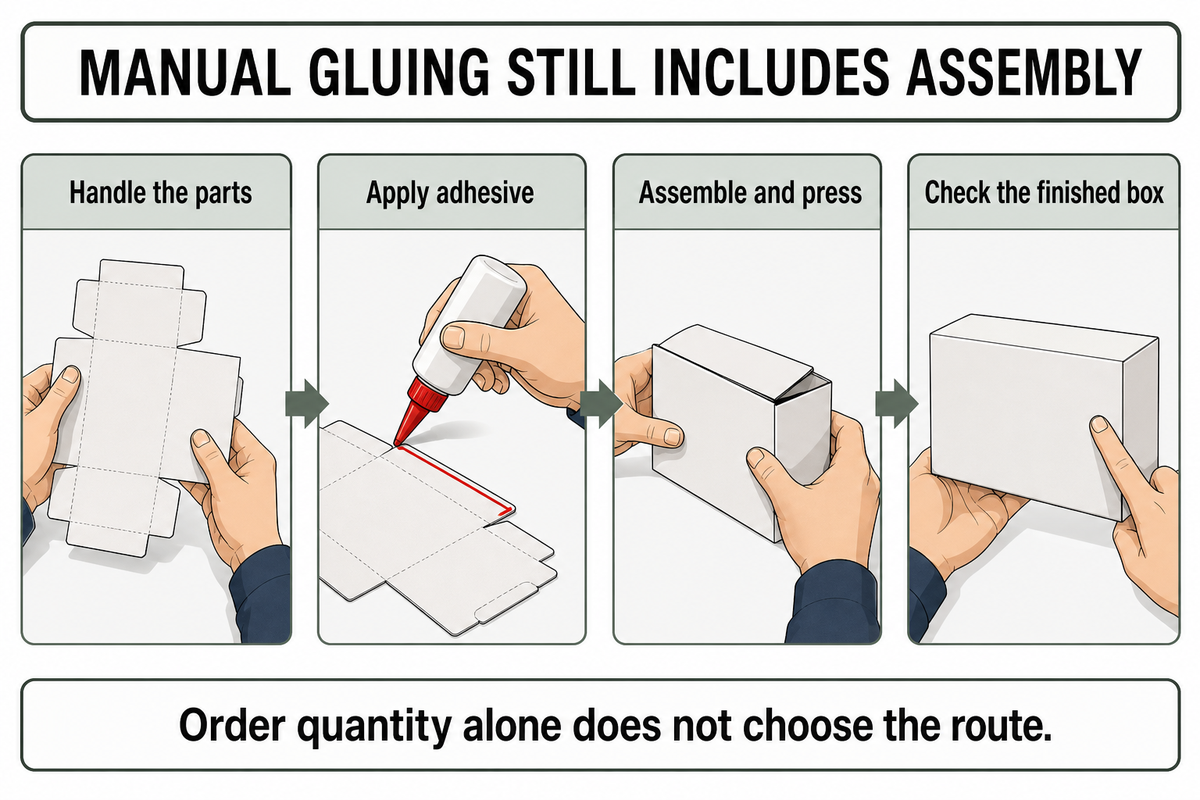
Manual box gluing is a route worth consideration for samples, variable constructions or processes lacking a proven machine. The decision is based on complete job labor, repeatability and expected output. Order quantity alone can’t determine the cutoff, as set up, glue application, assembly and handling can be different for various jobs.
In PostPress’s short-run carton discussion, practitioners emphasize setup and the incoming blank’s suitability. Reviewed printer forums likewise raise footprint and product-mix concerns; their order-volume opinions aren’t universal buying thresholds. For the next automation step, compare automatic and semi-automatic folder gluing against the work your team actually performs.
Illustrative production scenario: A converter needs 120 sample boxes before a customer approves a construction. The owner can authorize assisted glue application while QA checks the seam and appearance. Later, the order is for 6,000 boxes with the same drawing. A fresh route analysis, rather than just repeating the sample method, is warranted for the larger order. The production manager records time while finance prices the entire job, including wasted and set up pieces. Record rework alongside handling time when comparing the complete-job cost of this illustrative order. The result may favor automation, an outside finishing service or continued manual work. None of those outcomes follows from the quantity alone. The sample route answered a developmental question; it didn’t represent economical repeat production.
The UK Health and Safety Executive’s manual carton-assembly case also shows why a comfortable reported pace doesn’t remove repeated-handling concerns. Assess the actual task with the responsible workplace specialist; its case figures aren’t general operator capacity ratings.
For a 120 box sample job, consider the manual route and determine whether the seam and appearance of the sample is acceptable prior to discussing repeat orders. In the case where the brief is for 6,000 boxes, compare the complete-job time and accepted output. Changing quantity is a reason to reevaluate the route rather than an automation threshold.
Cold glue or hot melt glue: match the joint
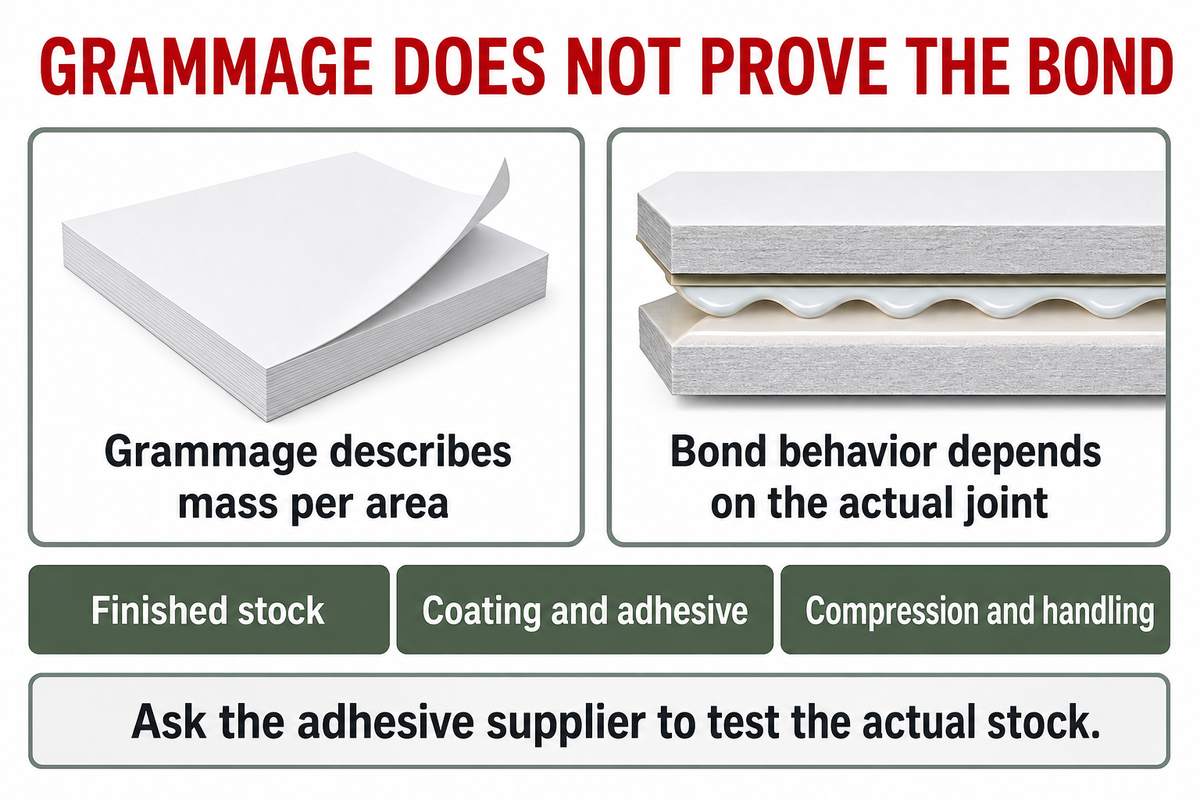
For cold glue and hot melt glue, make the selection based on the actual substrate and glue area and handling. The finished stock may differ from unprinted boards due to coatings and surface treatments. Ensure the interface with the proposed application and compression is validated by the adhesive supplier.
“This document specifies a method for determining the grammage of paper and board.”
Grammage doesn’t confirm adhesive compatibility. A brief reading “350 g/m² board” still lacks coating, exposed glue and joint geometry. Request proof for the finished printed stock. Just because two processes use similar terminology doesn’t mean they yield the same results. A laminating machine and a panel-processing PUR hot melt glue system, a carton seam applicator and case/carton sealing equipment perform various functions.
“Too much adhesive can actually slow down the set time”
Slezewski’s advice is for sealing cases and cartons and he works for an adhesive supplier. Thus, it supports advice to question excess glue in case and carton sealing. Asking the supplier to describe the glue pattern and bond assessment, and to define the handling intervals is more appropriate.
Why machine speed can hide an unfinished operation
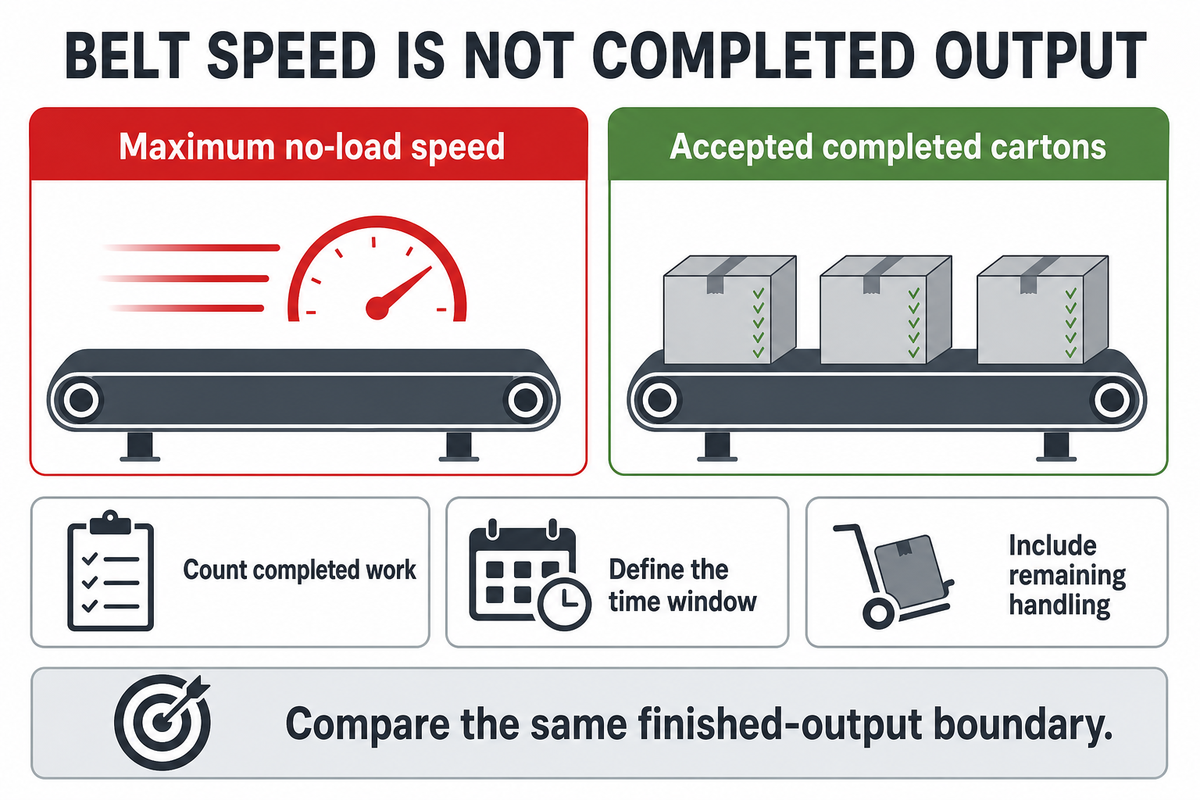
Machine speed refers to motion within the equipment. Accepted carton output refers to the finished work completed over time. Feeding delays, set-up time, and an assessment of bond can slow the output. Packing can also limit the output. For a comparison, a defined observation window and output condition need to be provided. Otherwise, a faster glue section may be covering unfinished or rejected cartons.
The National Institute of Standards and Technology’s public abstract of a 2016 production-performance paper describes relationships among throughput, availability and quality measures. It’s broad manufacturing context, not a folder-gluer rating. The PostPress productivity discussion by IMPACK’s Stefan Badertscher brings the issue back to delivery and packing around the gluer.
For performance testing, use the folder gluer speed and carton quality guide. Keep the scope of the test with every result; one trial doesn’t establish long-run average performance.
How to brief a supplier before comparing machine price
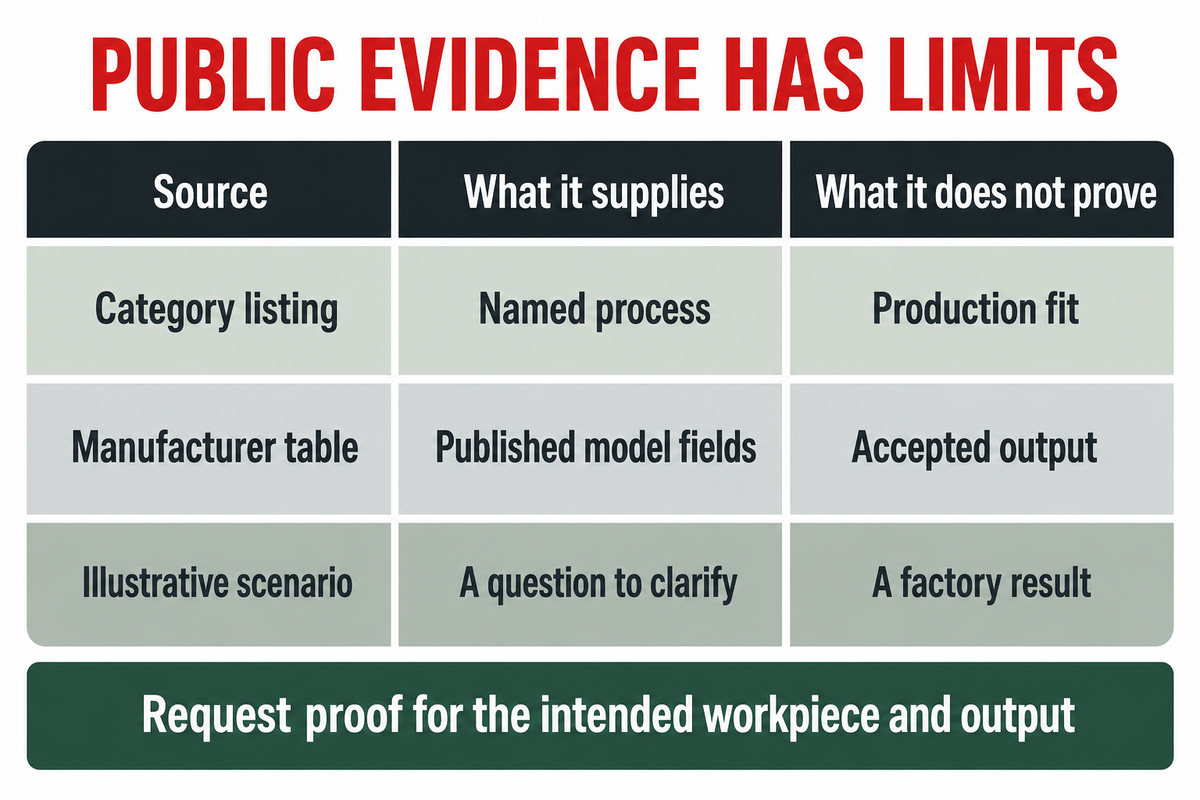
There needs to be an understood limit for the deliverable for procurement. QA needs evidence of the joint and finished carton. The remaining labor and handling costs need to be shown to finance. For a deeper production-mix comparison once the process family is clear, refer to the box gluing machine selection guide.
Wrong-Machine Tripwire
The Wrong-Machine Tripwire flags three different jobs that can appear around the same glue-machine search. Check the workpiece before interpreting a supplier’s label.
| Workpiece clue | Different equipment category | Boundary |
|---|---|---|
| The shipping case already contains a product | Case or carton sealing equipment | Closure does not make the empty carton |
| The job includes loading a product into a carton | Cartoning equipment | Loading is different from converting a carton blank |
| A panel covering is quoted with PUR lamination | PUR hot melt laminating equipment | Broad-surface bonding is different from carton folding |
What the public source actually establishes
These source boundaries explain the terminology; they are not a supplier scorecard or a production-fit approval.
| Quotation entry | What the source supplies | Source evidence | Limitations / Not suitable for |
|---|---|---|---|
| Paperboard folder gluer | Cenwan small-box catalog | Model, format and no-load fields | Catalog fields are not accepted production output |
| Stereo-box gluer | Cenwan CW-T catalog | Thin-paperboard and dimension labels | Not proof of thick-chipboard wrapping |
| Sheet pasting | Potdevin roll-coater description | Adhesive coating and attachments | Coating does not complete assembly |
| Integrated folder gluing | TAPPI public course scope | Printing and converting operations | Not the scope of a standalone applicator |
| Knocked-down box | Hartford packaging study | Flat corrugated output in its process | Educational study, not a current machine rating |
| Case and carton sealing | H.B. Fuller signed discussion | Substrate and sealing-adhesive advice | Commercial sealing advice, not a folder-gluer setting |
| Board grammage | ISO 536 public abstract | Paper and board mass measurement | Not an adhesive bond or machine certification |
| Cartoning equipment | Syntegon cartoning overview; PENGLAI video listing | Forming, loading and closing as configured; optional hot melt in the video listing | Not proof of carton-blank converting or tested output |
| PUR panel laminating | CLF-PT1300 supplier listing | Panel-surface coating and lamination | Different workpiece and joint from carton folding |
Fit the chosen process into your packaging line
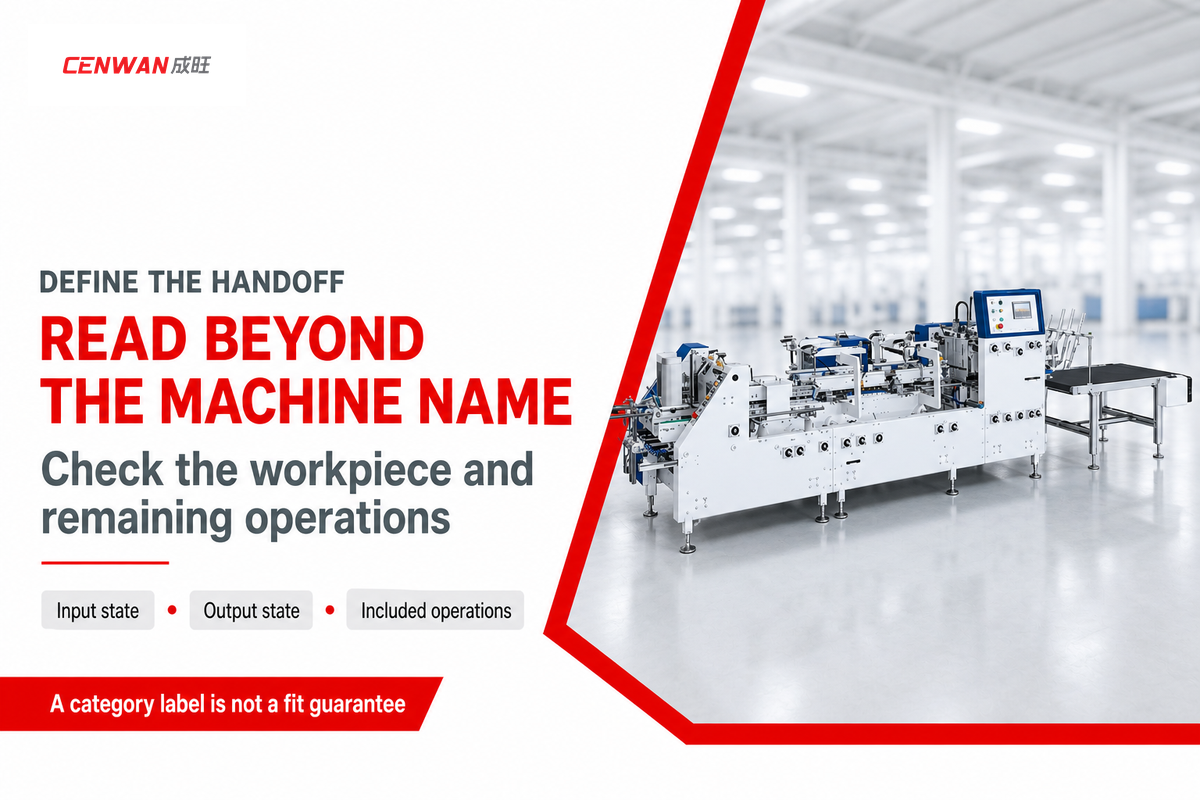
Box gluing equipment has to connect to the plant’s actual upstream preparation and downstream handling. Identify who supplies usable blanks, who accepts the finished joint, and who packs the output. We need to look at the integration features of the system, but connected control systems don’t supply missing mechanical operations or prove finished carton quality.
Industrial packaging machinery requires an explicit interface boundary. If a filling machine loads the product and a packing machine does the shipping case, record which machine accepts the erected carton. A folder gluer supplying flat blanks may require another step before either downstream work can begin.
Cenwan’s stereo-box page illustrates the need to read the table behind a category label: CW-T-650 is listed for 200–400 g/m² paperboard, with dimension B at 60–500 mm and 150 m/min maximum no-load speed. Public information doesn’t establish thick-chipboard wrapping capability for CW-T-650. The rigid-box buyer should submit the construction and request proof of the entire route.
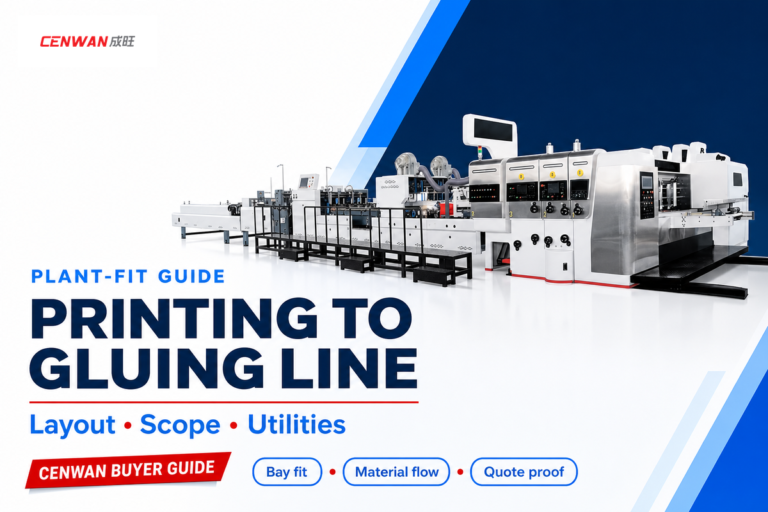
Use printing-to-gluing line planning for the detailed upstream and downstream interfaces once the equipment category is clear.
Key takeaway
Choose the box-gluing route from the incoming workpiece and required output. Send the drawing, finished stock and glue-area detail to the supplier, then compare quotations against sample evidence and the complete scope of work.
Ready to define the route? Forward a blank drawing to Cenwan along with a finished-box photo and adhesive requirements for a folder gluer configuration discussion. Keep the intended output and the rest of the operations in view with your request.
Frequently asked questions
What is a folder gluer machine?
Read answer
The folder gluer feeds prepared blanks, folds them along the creases, applies adhesive and compresses the joint. Its configuration is a determinant in the constructions that it can process. Many cartons are left flat for later erection. Printing, die cutting, product filling and filled-case sealing are distinct operations unless the supplier explicitly includes them in an integrated line. Request a demonstration of your exact carton and required output condition.
How much does a glue machine cost?
Read answer
There’s no single useful price for this term, as it refers to different jobs. Hand-fed adhesive applicators and automatic folder-gluing lines include different operations, controls and handling equipment. Ask for a quotation against the same blank drawing, material, glue pattern and output condition. List the feeder, folding sections, compression, discharge, installation, and training in detail, to avoid a lower price concealing work that’s yet to be done by your team.
Where can I find a carton pasting machine for sale?
Read answer
Consider manufacturers and dealers that provide the complete process rather than just the adhesive applicator. Submit a blank drawing and a photograph of the finished carton, then ask for a demonstration with comparable stock. If your work involves folding and seam-gluing die-cut blanks, take a look at Cenwan’s folder gluer range. If you have to do board lamination, cover-sheet coating or case sealing, mention that operation first, and then only ask for a quotation.
What type of glue works best on cardboard?
Read answer
The suitable adhesive depends on the actual glue area, coating, joint design, and handling conditions. Water-based cold glue and hot melt glue are both used in packaging, but neither is a universal adhesive. Ask the adhesive supplier to test the finished stock with the intended application equipment and compression process. Record the bond assessment and handling interval from that trial rather than choosing from the machine label.
Can the carton size be adjusted?
Read answer
Folder gluers may allow format adjustment within certain limits, depending on their configuration. Published maximum width is only one constraint; fold positions, flap size and glue pattern also matter. Send your smallest and largest blanks for a configuration check.
Is customization available for this machine?
Read answer
There are options within some suppliers that allow for process changes. Ask which feeding, adhesive and discharge changes are included, what remains optional, and which sample proves the finished result.
About this guide: GW compiled this comparison from public product pages, standards records, trade association and technical literature. The examples in numerals are illustrative only. Manufacturer’s specifications are attributed and require verification for the supplied carton. Learn more about Cenwan Machine in its company background.
References & Sources
- FEFCO Code European Federation of Corrugated Board Manufacturers.
- Flexo Folder-Gluer public course description Technical Association of the Pulp and Paper Industry.
- The Impact of the Flexo Folder-Gluer on Packaging Distribution Alexandra Hartford, Michigan State University; hosted by the Institute of Packaging Professionals. Educational paper; PDF page 10.
- Folding/Gluing: Working with Short-Run Cartons PostPress, 2020.
- Carton assembly case UK Health and Safety Executive.
- ISO 536:2019, Paper and board, Determination of grammage International Organization for Standardization; public abstract and status record.
- Food packaging and food-contact substances overview U.S. Food and Drug Administration.
- A Hierarchical Structure of Key Performance Indicators for Operation Improvement in Production Systems Kang and colleagues, International Journal of Production Research, 2016; public abstract hosted by the National Institute of Standards and Technology.
- Top 7 Ways to Improve Folder-Gluer Productivity with Simple Investments PostPress, 2021; signed supplier-expert discussion.
- ISO 12643-4:2023, Converting equipment and systems International Organization for Standardization; public scope and status record.
- 29 CFR 1910.212, General requirements for all machines Occupational Safety and Health Administration.
- 29 CFR 1910.147, Control of hazardous energy Occupational Safety and Health Administration.
- Industry 4.0 Automation Platform Elevates Packaging Efficiency Packaging World, August 2025.