Get in touch with Cenwan Machine Company


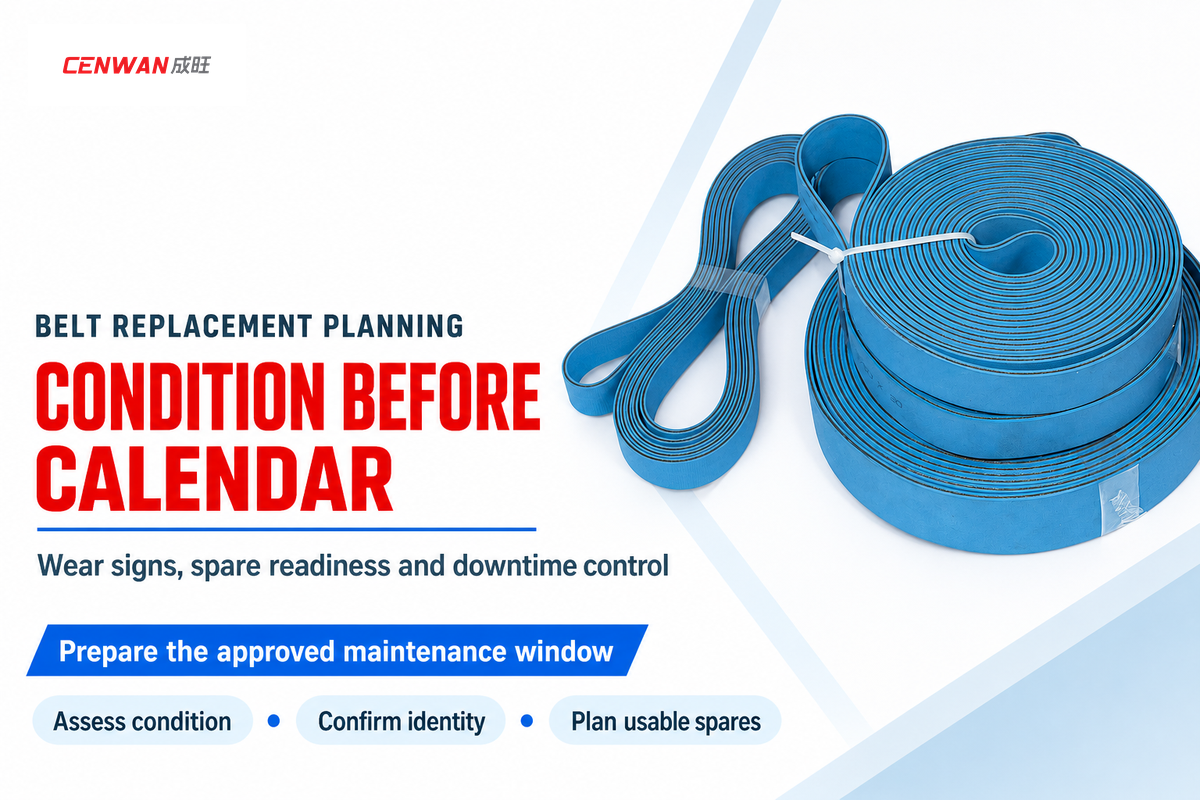
Folder gluer belt replacement intervals must adhere to the machine’s replacement criteria, and the condition of the belt, with purchase orders set prior to the approved service window. Replacement belts require a confirmed identity and allocation. A deteriorating belt requires a maintenance decision even if its planned replacement date is many months away.
Planning scope
Equipment: carton folder gluers. Decision: condition assessment, replacement scheduling and spare readiness. Records: belt position, part identity, running hours and removal reason. Maintenance authority: the installed machine instructions and qualified personnel.
A folder gluer belt replacement interval is a combination of machine criteria and condition record review. Compatible spares must be planned prior to the approved maintenance window; a stock deadline must not authorize the operation of a damaged belt.
Key takeaways
- A belt removed during a convenient shutdown hasn’t necessarily reached its failure life.
- Stock counts must distinguish compatible, available belts from reserved or unverified parts.
- Changing a belt without addressing the reason for its wear can leave the underlying problem unresolved.
- Cost waiting time using net lost contribution and separate incremental charges.
Updated October 2026
Set the Folder Gluer Belt Replacement Interval from Evidence
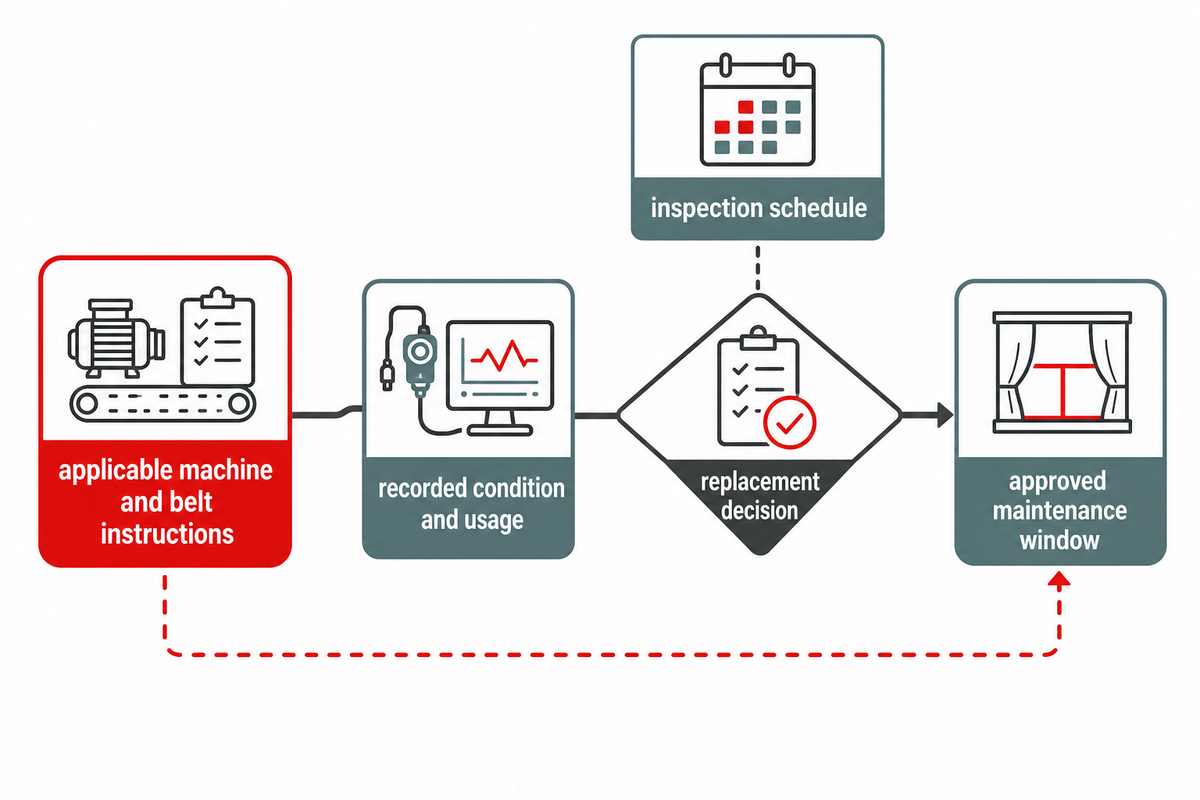
Set the replacement interval from the applicable machine and belt instructions. Review these against recorded condition and usage. Keep the inspection schedule separate from the replacement decision. A planned maintenance date organizes people and parts; it cannot establish how long a particular damaged belt remains fit for service.
The U.S. Department of Energy distinguishes time- or machine-run-based preventive maintenance from condition-based maintenance in its maintenance program guide. Applying that distinction to a folder gluer machine gives the planner two different questions: when must the condition be reviewed, and what finding requires replacement?
Record the prescribed or documented maximum service limit of a belt next to the source document and revision. In the absence of a belt-specific limit, route the gap through the supplier request, not the internet. A limit borrowed from a belt of a different construction or production duty creates a false deadline.
Belt Condition-to-Window Record
The Belt Condition-to-Window Record ties a belt’s identity, condition, and service to a maintenance window and spares allocation decision.
| Record field | What to enter | Decision it supports |
|---|---|---|
| Machine identity | Model and serial number | Select the correct documentation |
| Position | Section, side and belt function | Prevent a correct part reaching the wrong station |
| Part identity | Approved code and construction | Match the replacement |
| Installation baseline | Date and meter reading | Separate calendar age from operating use |
| Condition observation | Dated finding and safely obtained image | Compare like observations |
| Operating context | Job, substrate and production duty | Explain changes in wear pattern |
| Assessment | Authorized decision and its basis | Escalate unresolved deterioration |
| Spare allocation | Usable stock and reservation | Expose a supply gap |
| Window and release | Approved work window and release owner | Connect planning with accountability |
| Outcome status | Failed, removed while functional, or still running | Avoid treating every removal as failure |
Example: when reviewing a 40h week, both the current meter reading and assessed condition are required. Scheduling a service window 2 weeks out finalizes the calendar, not remaining life. An unsolved condition finding goes to the responsible maintenance authority before that scheduling becomes a production assumption.
Read Wear Signs Before Ordering Another Belt
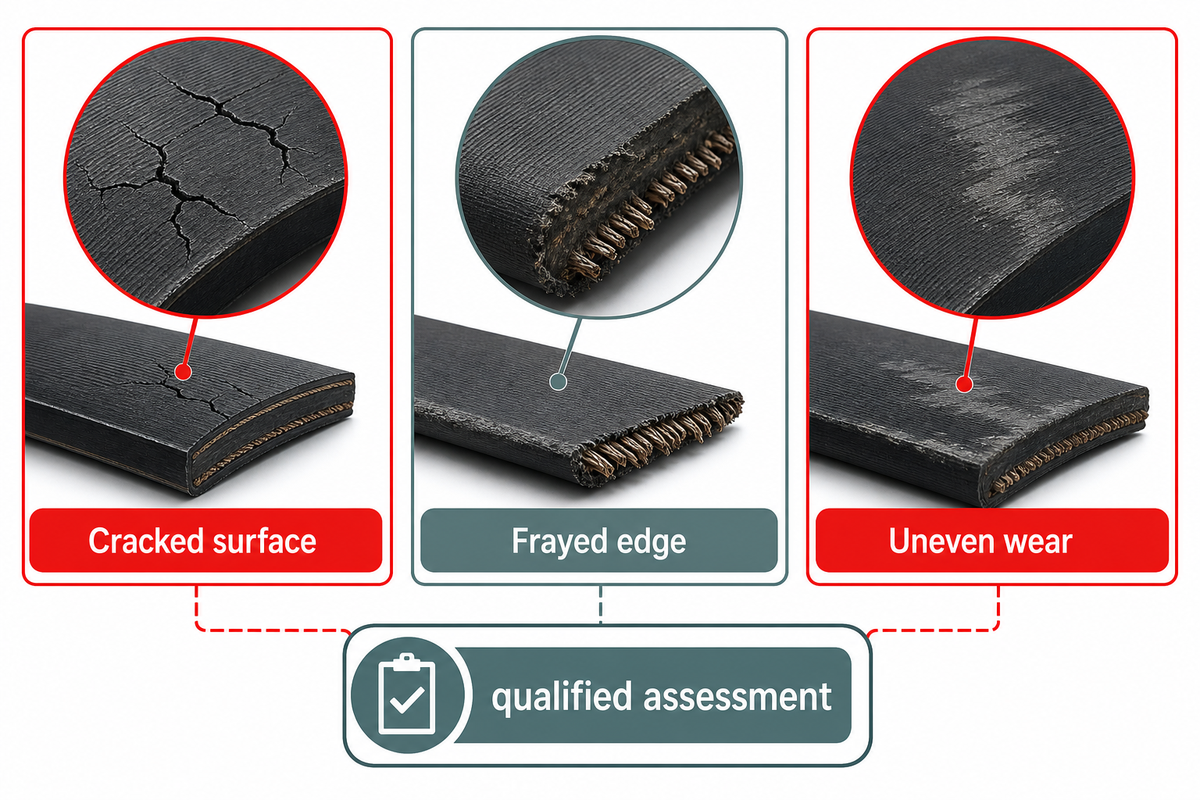
Use cracking, fraying edges, and uneven surface wear as evidence for a documented maintenance assessment. For each, state its belt position and the associated production symptom. Slippage or tracking problems indicate troubleshooting as well as a parts decision; a new belt alone may leave the cause of repeated wear in place.
AIM’s manufacturer advice identifies over-tightening of upper carriers as a cause of premature belt wear. This is a fault hypothesis, not a tension setting for a different machine. Keep tensioning, pulley alignment, bearing checks and roller assessments within the documented instruction and the qualified engineer’s work scope. An operator report of reduced machine efficiency should name the observed symptom rather than state a causal conclusion.
How does belt tension affect the operation of folder gluer machines?
Belt tension affects traction and the forces carried by the belt system. Too much upper-carrier pressure can accelerate wear; too little traction can hinder control of the carton system. The better maintenance response is to identify the affected station and assess the cause under the machine instructions, rather than increase tension whenever folding quality falls.
| Observation group | Record alongside it | Question for qualified assessment |
|---|---|---|
| Cracked surface | Location and dated photograph | Does the applicable criterion require removal? |
| Frayed edge | Side and affected length | Is contact or misalignment involved? |
| Uneven wear | Position and direction | Is the loading pattern contributing? |
| Surface contamination | Visible glue or paper dust | What approved cleaning or assessment applies? |
| Recurring slippage | Job and station | Is the cause belt condition or another setting? |
| Tracking change | Observed direction | Which guidance or drive components need assessment? |
| Splice concern | Joint identity and visible change | Does the joint meet its applicable condition criteria? |
| Repeated marking | Sample and affected side | Does the defect follow this contact surface? |
| Repeated replacement | Prior removal reasons | Was the earlier cause resolved? |
UK Health and Safety Executive maintenance guidance states competent personnel and correct maintenance information are key. Observations should come from the site’s approved inspection arrangements and not from reaching into machinery. Broader material and roller comparisons belong in the existing folder gluer belts and rollers guide.
Build a Belt Record for Each Machine Zone
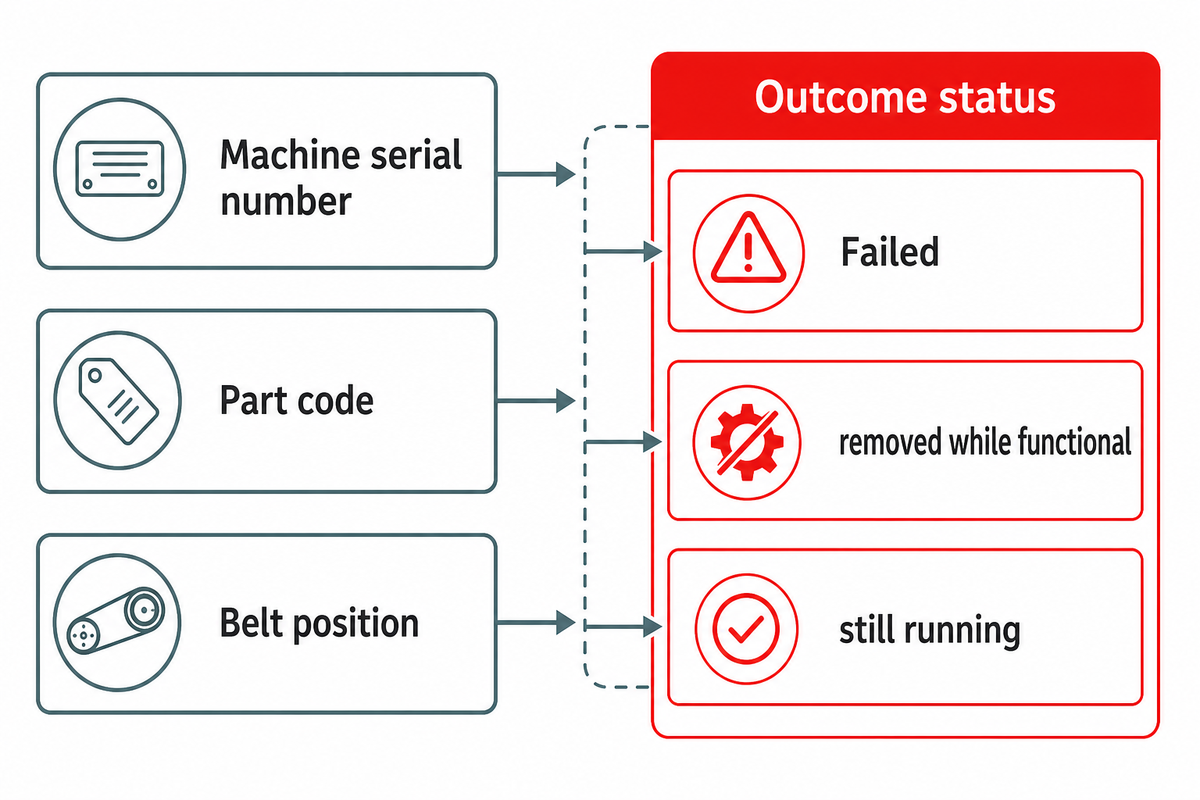
A belt position should be captured as a separate record, regardless of how many belts look alike. For each record, provide the part code and machine serial number and the construction and joint details. If a belt fails or is replaced, note if it was replaced because of a fault, or was replaced preventively. Record whether a removed belt failed or was replaced while still functional, so later planning does not confuse a convenient replacement with an observed lifespan. Indicate this in the record so it doesn’t confuse a convenient replacement with an observed lifespan.
Feeder belts and compression-section belts perform different functions. A conveyor position, folding section, or delivery section, should also be given a different identity. A belt of the right color may not explain the function. The carton path explains the function; belt color alone does not identify a compatible replacement. A useful stores label connects the part to the exact machine zone. Record an unplanned belt failure separately from a scheduled removal.
Habasit explains that folder-gluer belts may include polyamide or polyester tension members, covered with NBR. NBR means acrylonitrile butadiene rubber, also known as nitrile rubber or Buna-N. The functions of the cover and core are different. Treat descriptions such as nylon core belts, abrasion resistance or dimensional stability as construction information to match, rather than a promise that a belt will last longer.
Some Habasit Flexfold products are listed in 3 mm and 4 mm thicknesses. Those are product options, not interchangeable recommendations for a Cenwan machine. A 3 mm entry in stores and a 4 mm request require a compatibility decision before allocation; the apparent similarity of two flat belts is insufficient.
NIST’s reliability guidance on censored observations distinguishes actual failure times from units removed before failure. Making that distinction is important even in a simple log: keep “still running” and “planned removal” distinct. Analyzing reliability requires more than the average time between purchase orders. The folder gluer replacement parts guide covers the wider ordering record.
Compare Calendar, Run-Hour and Condition Planning
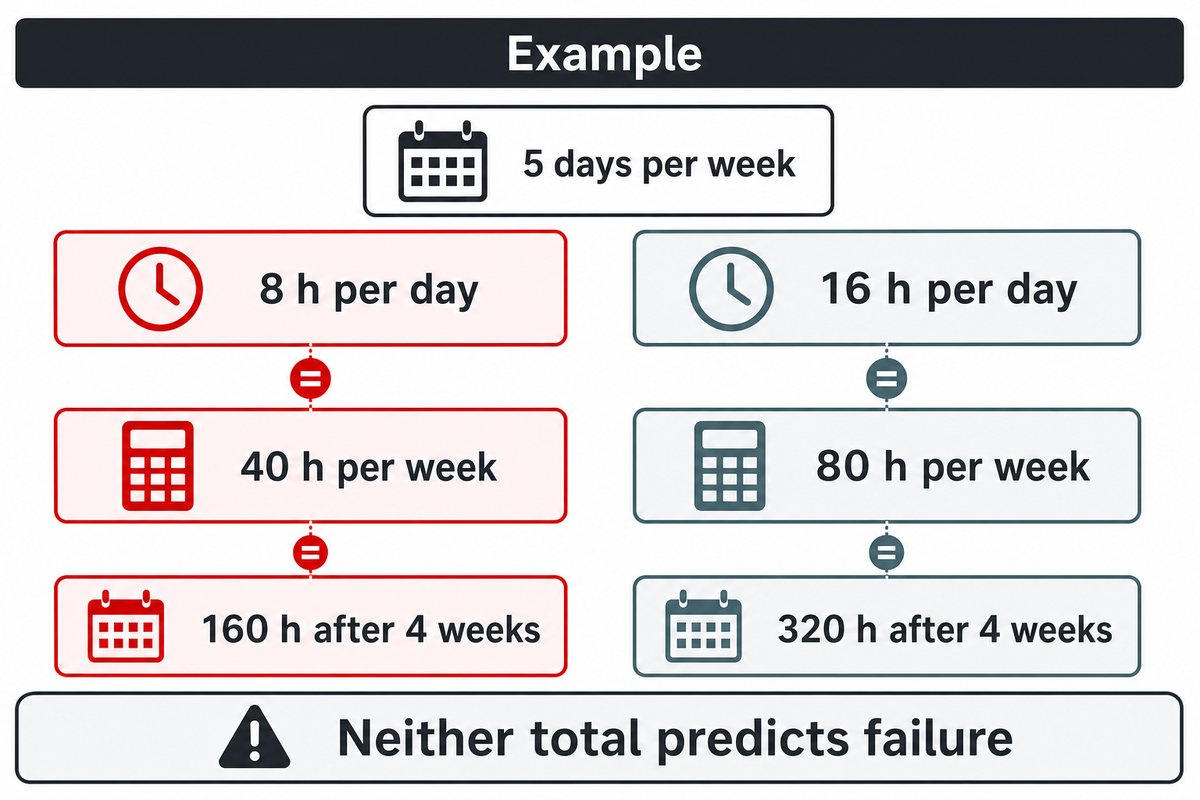
Organization of Routine Reviews: Use calendar planning to organize routine reviews. Describe exposure using operating hours. Determine how to respond to deterioration using condition assessment. Records should be combined instead of choosing one number to represent the entire policy. Different shifts and packaging jobs can produce very different use during the same calendar month.
Example: two packaging lines each run 5 days per week. One operates 8 h per day and the other 16 h per day. Their weekly totals are 40 h and 80 h respectively. After 4 weeks, the totals are 160 h and 320 h. Replacing both on the same date wouldn’t mean they had received equal operating exposure. Neither total predicts failure: job loading, belt identity and assessed condition still belong in the decision. A plant manager can use the comparison to allocate review effort and improve records without declaring that the busier line’s belt has half the calendar life.
| Basis | Useful question | Missing information |
|---|---|---|
| Calendar | When is the next scheduled review? | Actual operating exposure and condition |
| Running hours | How much has this installed belt run? | Job severity and present condition |
| Condition | What does the current assessment require? | A complete production and purchasing plan |
| Combined record | What decision is supported, and are parts ready? | Any unresolved machine-specific criteria |
The Department of Energy’s maintenance classifications provide the general distinction. They don’t supply a folder-gluer hour limit. For cardboard and corrugate jobs, retain the actual substrate description and duty in the record rather than guessing an adjustment factor for abrasion, humidity or high speeds. A high-speed job target doesn’t change an unresolved maintenance decision. Claims that a substitution will improve performance belong in the application review before the part code changes.
During a 4-week period, there’s a difference in exposure between an 8-hour and a 16-hour day. This comparison is to aid in logging, not to use a wear multiplier. Change the replacement interval only through the machine-specific assessment process, with the changed duty recorded so the next decision will have a comparable baseline.
Plan Spare Belts Against the Usable Arrival Date
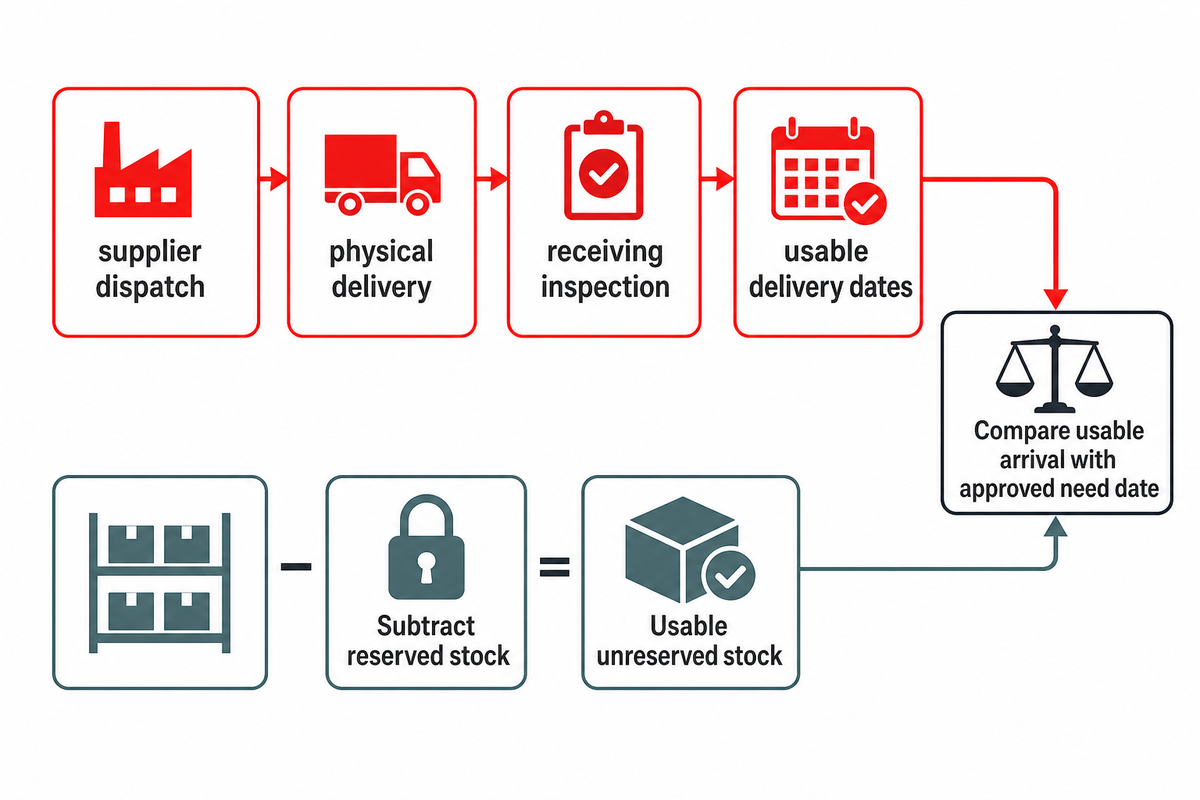
Plan spares based on when a compatible belt will be ready for its assigned job. Separate supplier dispatch, physical delivery and any necessary receiving inspection. Subtract reserved stock before deciding what to order. A belt on the shelf can’t support two concurrent maintenance demands just because both requests have the same description.
Spare Coverage Timeline
The Spare Coverage Timeline shows approved need dates vs. compatible, unallocated stock and confirmed usable delivery dates.
Packaging World’s Novo Nordisk maintenance-kit case describes the advantage of having required parts ready for shutdowns. The case focuses on pharmaceutical equipment. Its preparation principle is useful here; its service-hour schedules are not folder-gluer replacement intervals.
“Having all required parts right at hand allows us to execute our shutdowns much more smoothly than before.”
Example: The next window requires 1 belt. Procurement has added an additional contingency allowance of 1 belt and stores have 1 unreserved, compatible belt. The purchase gap is 1 + 1 – 1 = 1 belt. The contingency is a plant input, not a universal rule. If the stocked belt is reserved elsewhere, the gap becomes 2 belts. In this case, procurement has to compare the required date with a confirmed supply route. Maintenance on the other hand determines the condition response of the machine. Buying more stock changes supply coverage; it does not make continued operation acceptable.
Allow receiving time only where the site’s checks actually require it. ISO 2230:2026 includes inspection, records, packaging and storage in its public guidance scope for rubber products. Stored condition and identification therefore belong beside quantity when evaluating a rubber-covered spare; obtain the applicable product storage instructions in the purchasing handoff.
| Apparent readiness | Remaining bottleneck | Owner’s next decision |
|---|---|---|
| Part appears in stock | Identity, condition or another job’s reservation unresolved | Stores resolves usable allocation |
| Supplier has dispatched | Delivery and any required receiving checks incomplete | Procurement establishes usable arrival |
| Correct belt is available | Qualified personnel or approved access arrangements unavailable | Maintenance arranges the work scope |
| Installation is recorded | Authorized release and next-job quality acceptance incomplete | Site owners complete their release process |
Calculate the Cost of Waiting for a Belt
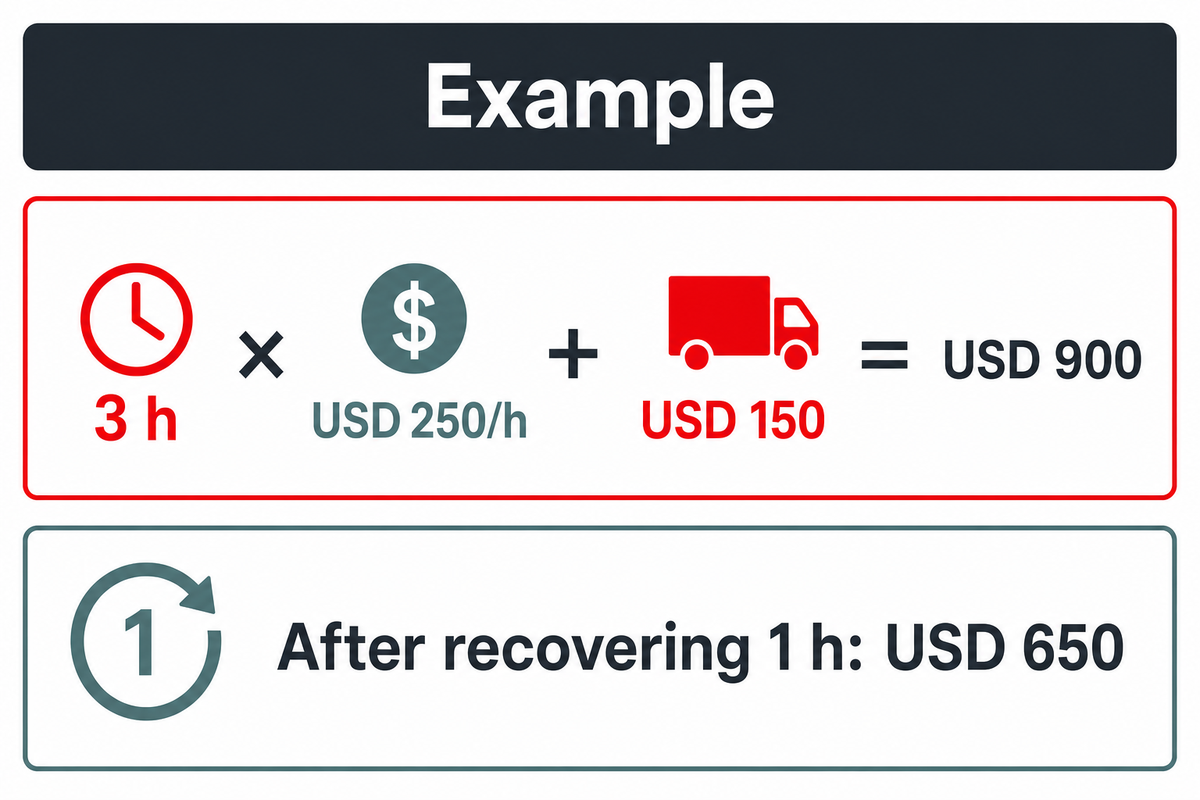
Calculate waiting cost from net unrecoverable production contribution plus incremental costs due to the delay. Isolate expedite freight, additional labor and verified scrap. Subtract output recovered from buffers or later produced to absorb losses, before writing it off. Lost sales value and lost contribution must not both be charged to the same output.
How much should a folder gluer belt cost?
Compare the quoted belt price with the cost of obtaining a compatible, usable part by the required date. Include joint preparation, freight and any agreed support in the comparison. A lower unit price can leave a larger purchase exposure when it excludes an item or service already included in the alternative quotation.
Example: a finance team estimates 3 h of unrecoverable line delay at USD 250/h contribution, plus USD 150 in incremental expedite freight. The event cost is 3 × USD 250 + USD 150 = USD 900. If 1 h of output can be recovered without an offsetting extra cost, only 2 h remain in the contribution calculation, giving USD 650. Fixed overhead already incurred doesn’t become a second cash expense merely because the line is idle. Purchasing can now compare an expedite option against the delay it would actually avoid, using its current quotation rather than treating USD 900 as a belt budget.
Thomas and Weiss’s 2021 NIST maintenance survey considers downtime and defects as separate outcomes. Use that distinction in the event record. A line that continues making cardboard boxes can still accumulate verified rejects or rework; don’t assume every defect was caused by the belt or count the same lost contribution twice.
For a 3 h delay, the useful finance question is how many hours remain unrecoverable after production rescheduling. At the assumed USD 250/h, recovering 1 h changes the estimate by USD 250 before extra recovery costs. Convert the productivity loss into contribution only after recovery has been considered. The cost model supports a purchasing choice; it never sets a machine safety threshold.
Prepare the Shutdown and Release the Next Job
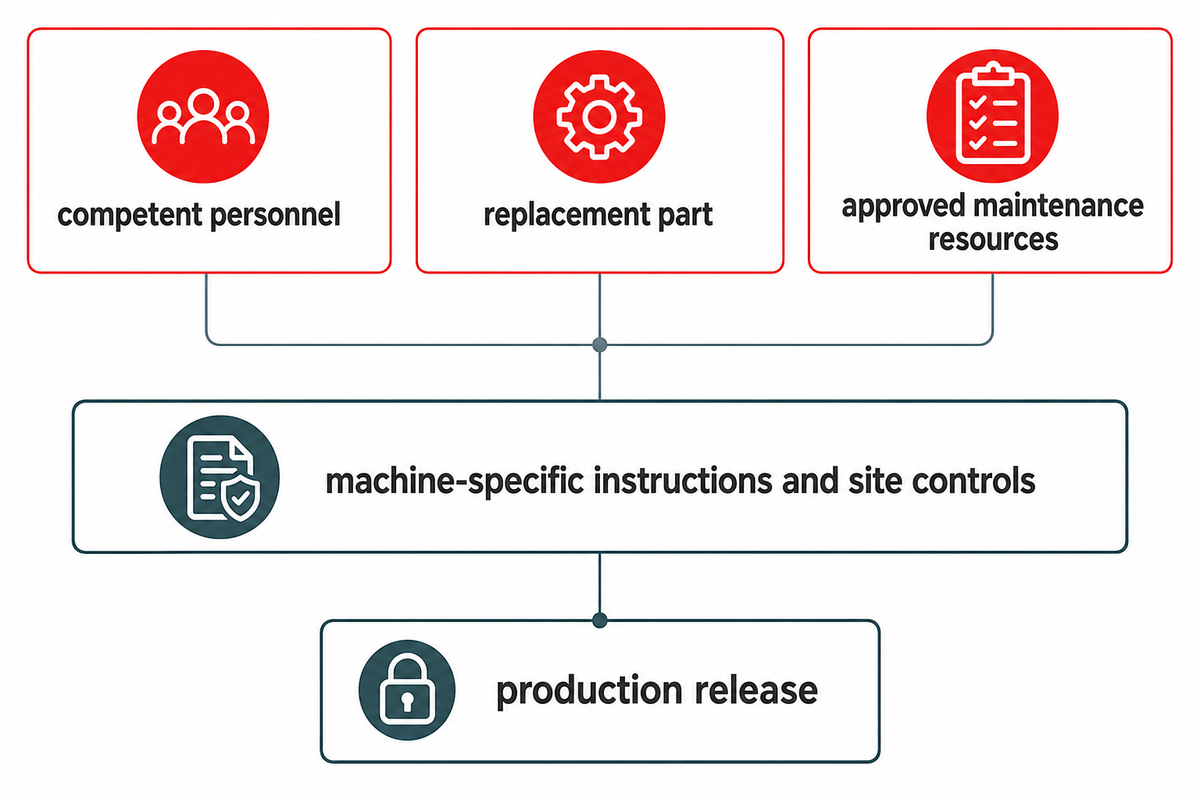
Do the prior work to shutdown by tasking competent personnel to arrange maintenance, obtain the replacement part, and marshal the approved maintenance resources. Keep production release with the authorized site process. A belt delivery or completed purchase order doesn’t close the work. The maintenance and job-quality records are still the responsibility of their owners.
An anonymous Bobst Pacifica maintenance discussion describes a worker struggling with access during belt replacement and having no other maintenance support until the morning shift. The best course of action is to develop a plan to address personnel and access issues. Improvisational suggestions for disassembly in a discussion thread aren’t service instructions.
The UK Health and Safety Executive calls for maintenance planning and the availability of competent personnel. Its guidance notes that access for maintenance may not have been designed into older machinery. Therefore, the shutdown estimate for a particular piece of equipment shouldn’t come from a replacement story of another piece of equipment on another plant.
Prepare
- Assign qualified maintenance resources.
- Allocate the identified replacement part.
- Record the applicable work and release documents.
Avoid
- Assume a delivery date guarantees an installation slot.
- Borrow another machine’s adjustment settings.
- Use a purchasing deadline as a condition decision.
The folder gluer maintenance checklist supports the record handoff. Stop, isolation, repair and restart procedures remain with the machine-specific instructions and site controls. These maintenance tips concern preparation, not instructions for servicing moving machinery.
Confirm Compatibility with Your Parts Supplier
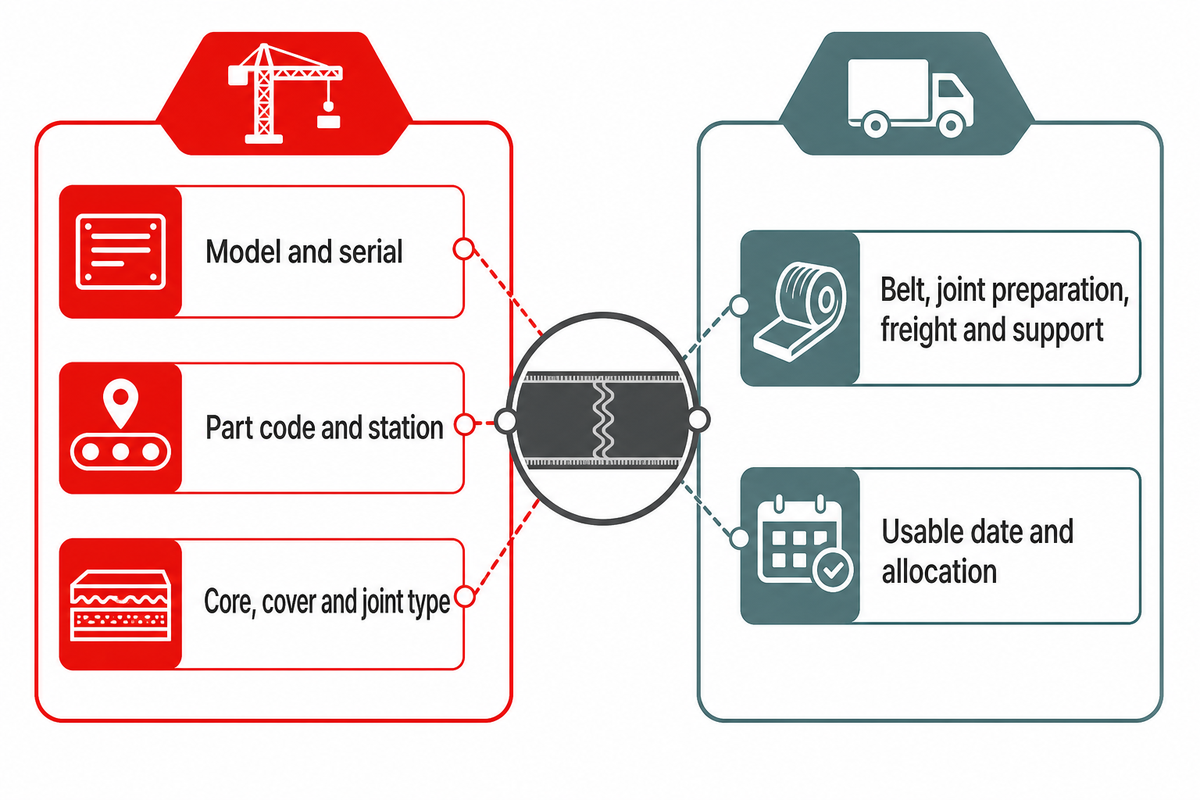
Send a machine-specific request to the supplier for the belt part with position and usable date. Make a comparison of quotations for the same scope and replacement before award. An OEM code, dimensions and joint description carry more useful compatibility information than a request for a wear-resistant or heavy-duty belt without a defined application.
Can you match a belt to my specific folder gluer machine?
Match the request through the machine serial number, belt position and approved part specification. Provide the existing belt code, and give joint details with the same request. A supplier review can then identify missing information before a quotation is treated as a confirmed replacement for that installed position.
Send the following handoff to the Cenwan folder gluer parts and service team in a single message. Confirm the identity of the part, the replacement criteria, and the supply scope together, rather than sending messages separately, which could break the connection between the machine and the belt.
Supplier request checklist
| Parameter | Requested detail | Why it matters | How to verify |
|---|---|---|---|
| Machine | Model and serial | Identifies installed configuration | Nameplate and machine record |
| Belt | Part code and station | Defines the replacement position | Parts list and stores label |
| Dimensions | Specified length, width and thickness in mm | Prevents size-only assumptions | Approved part drawing |
| Construction | Core, cover and joint type | Preserves the required belt design | Applicable supplier specification |
| Condition criteria | Documented replacement or discard guidance | Separates scheduling from condition assessment | Machine or belt documentation |
| Supply scope | Belt, joint preparation, freight and support | Makes prices comparable | Written quotation |
| Required date | Usable date and allocation | Exposes delivery and receiving gaps | Supplier commitment and receiving plan |
Belt suppliers and Forbo’s Siegling range use their own product designations. Retain the installed code when considering options, as brand familiarity is no substitute for a match. A quote for OEM parts should include the relevant part code and supply scope. The HSE guidance supports the retention of relevant manufacturer information for maintenance. Cenwan’s company overview provides an overview of the service business.
Industry Outlook: Make Belt Records and Stored Spares Usable
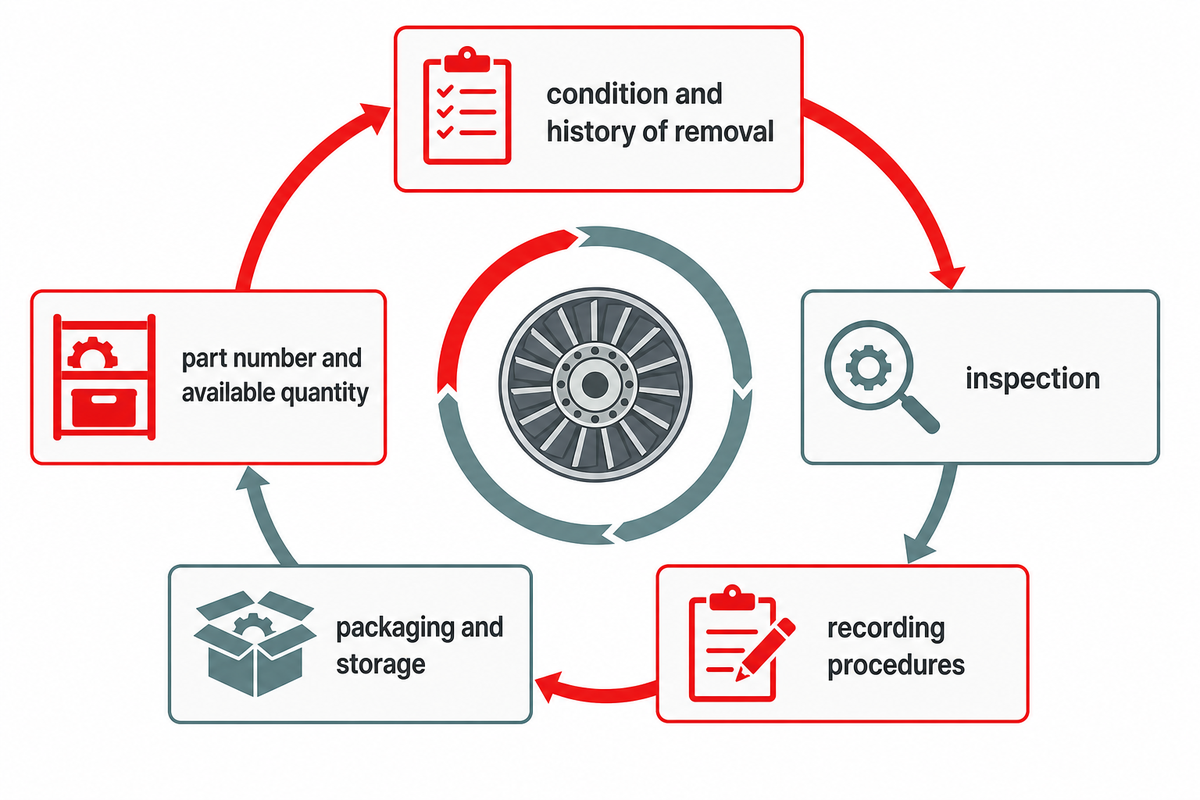
Retain the condition and history of removal when revising the next belt plan. The March 2026 edition of ISO 2230 gives a current reference for rubber-product storage guidance. For a plant buyer, the practical change is to treat stock condition as part of readiness, alongside the part number and available quantity.
ISO 2230:2026, edition 3, covers inspection, recording procedures, packaging and storage for vulcanized or thermoplastic rubber products before circulation. Use instructions of the product under consideration to determine the receiving and storage requirements of the product at the site. Do not assign a shelf-life number to every folder-gluer belt from its rubber cover alone.
Habasit’s October 2025 next-generation folder-gluer announcement emphasizes durability and reduced maintenance. New construction would prompt a review of the product option, but a wear-resistant label wouldn’t set the next replacement date of the installed belt. A change in belt materials belongs in the part record so that comparisons don’t combine unlike products.
Keep the state and reason for removal of a belt that has been removed, for example, for a shutdown. NIST’s treatment of failure and unfailed observations explains why a planned removal differs from a measured failure. High-volume packaging and automation make orderly records useful, but more records alone do not establish a reliable life model.
Key takeaway
Reduce downtime exposure by linking the assessed condition to usable spares and qualified maintenance resources. A 1-belt stock entry counts only after identity, condition and allocation are resolved.
Prior to the next review, bring the record and required service date of the belt to Cenwan. Then the parts request can focus on the installed position and supply gap, and the maintenance authority can retain the condition decision.
Frequently Asked Questions
How often should folder-gluer belts be replaced?
Follow the applicable replacement criteria and the belt’s assessed condition.
Separate the inspection schedule from the replacement decision. Record running hours, machine position and the reason for removal so later reviews compare similar service. A calendar interval can organize procurement and maintenance, but it can’t override a condition finding or an installed instruction. Put any missing belt-specific criteria into the supplier request before treating a provisional date as an approved interval.
What are the signs of a worn folder-gluer belt?
Cracking, frayed edges and uneven wear require maintenance assessment.
Record the affected position and the accompanying production symptom through the site’s approved inspection arrangements. Repeated slippage or tracking changes also warrant troubleshooting because the belt may not be the only cause. A qualified assessment links those findings to the applicable criteria. Avoid using an internet photograph, a generic wear percentage or another machine’s tension value as the replacement threshold.
How many spare folder-gluer belts should a plant keep?
Cover approved demand and the plant’s contingency allowance, less usable unreserved stock.
Count stock by exact compatible part and machine position. A belt already reserved for another job doesn’t cover the same window twice. Include supplier commitments and any receiving checks in the timeline. Select the contingency allowance from the plant’s interruption exposure and supply arrangements, rather than treating one spare set or a fixed percentage as a universal inventory policy.
Does a higher-priced belt always last longer?
No. Compare the specified construction and application fit before comparing price.
Purchase price alone doesn’t define belt life. A compatible product, the cause of prior wear and the actual operating duty matter to the replacement decision.
Should all belts be replaced during the same shutdown?
No. Group work only where the approved assessment and work scope support it.
A shared window can simplify resource planning, but each belt still needs its own identity and removal reason. Preserve the difference between failed parts and functional belts removed for a planned change.
Plan the next parts request. For the requested part, bring the machine serial number and the belt position to the Cenwan service conversation. Bring the completed condition record with that request. Match the required part and usable date before placing the order.
This article provides examples of purchasing and record keeping; it doesn’t provide instructions for servicing machinery. Planning examples use assumed inputs. Machinery maintenance and production release require the applicable machine instructions, qualified personnel and site controls.
References & Sources
- U.S. Department of Energy: Types of Maintenance Programs
- UK Health and Safety Executive: Maintenance of Work Equipment
- National Institute of Standards and Technology: Empirical Reliability Models and Censored Data
- Packaging World: Preventive Maintenance Kits Assist Novo Nordisk
- International Organization for Standardization: ISO 2230:2026, Rubber Products, Guidelines for Storage
- National Institute of Standards and Technology: Maintenance Costs and Advanced Maintenance Techniques in Manufacturing Machinery, 2021