Get in touch with Cenwan Machine Company


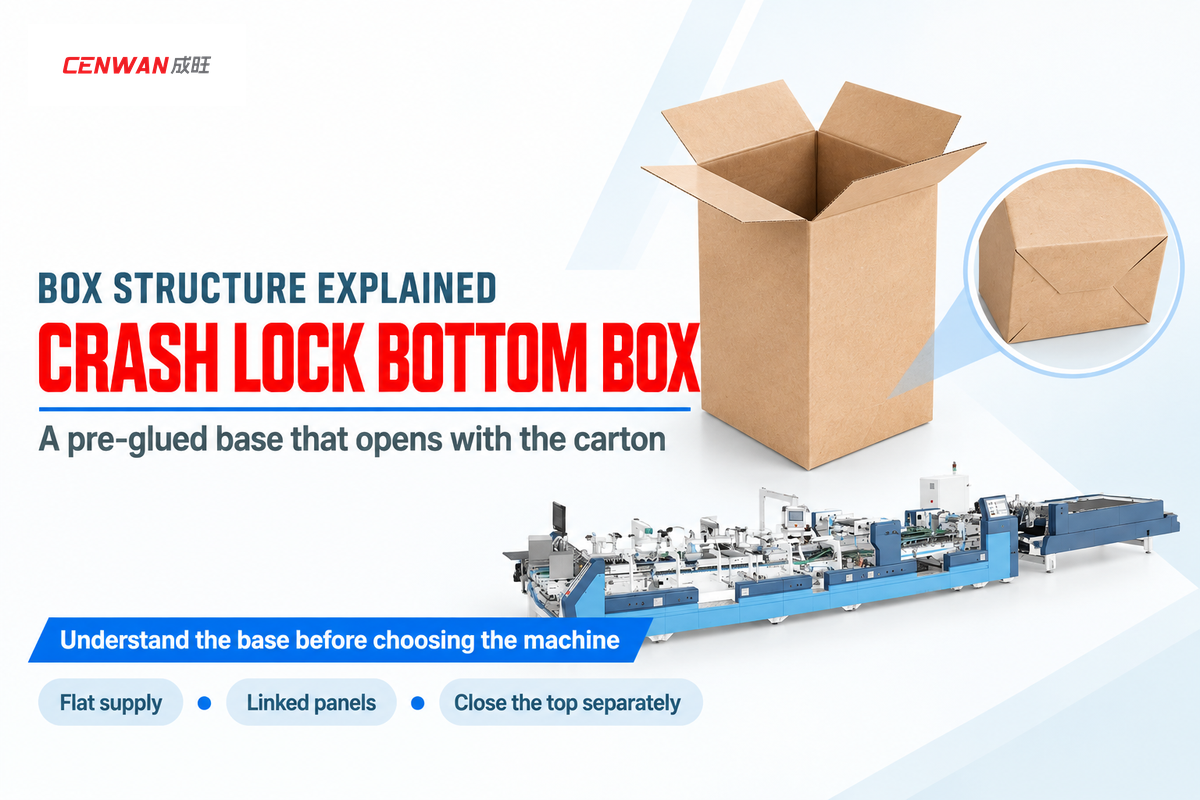
A crash lock bottom box is a flat-supplied cardboard box with a pre-glued base that opens into position when the sides are pulled apart. It’s also known as an automatic bottom or auto bottom carton, and removes the need for the separate bottom-flap folding task at the packing bench. The lid is a separate closure.
For a packaging buyer, the key difference is the location of the work. The converter makes the glued base, and the packer erects the carton. This can simplify hand packing, but the product still requires appropriate board, support and a secure top. For a converter, it includes bottom-folding and gluing, beyond a simple side seam carton.
Quick Specs: crash-lock construction
- Supply condition: folded flat, with the base pre-glued.
- Assembly: open the carton sides; the linked bottom panels move into place.
- Material choice: paperboard or a suitable corrugated construction.
- Top closure: specified separately from the automatic bottom.
A crash lock bottom box uses pre-glued bottom flaps that open as the carton is erected. Its main benefit is quick assembly at the packing station. The base design and the lid perform separate jobs.
Key points
- Manual snap-lock and pre-glued automatic bottoms require different assembly actions.
- A tape-free base doesn’t specify how the top is sealed.
- Choose the filled package for its distribution route, not just its bottom style.
- Compare the carton premium with time saved across the complete packing cycle.
Crash Lock Bottom Structure and Assembly
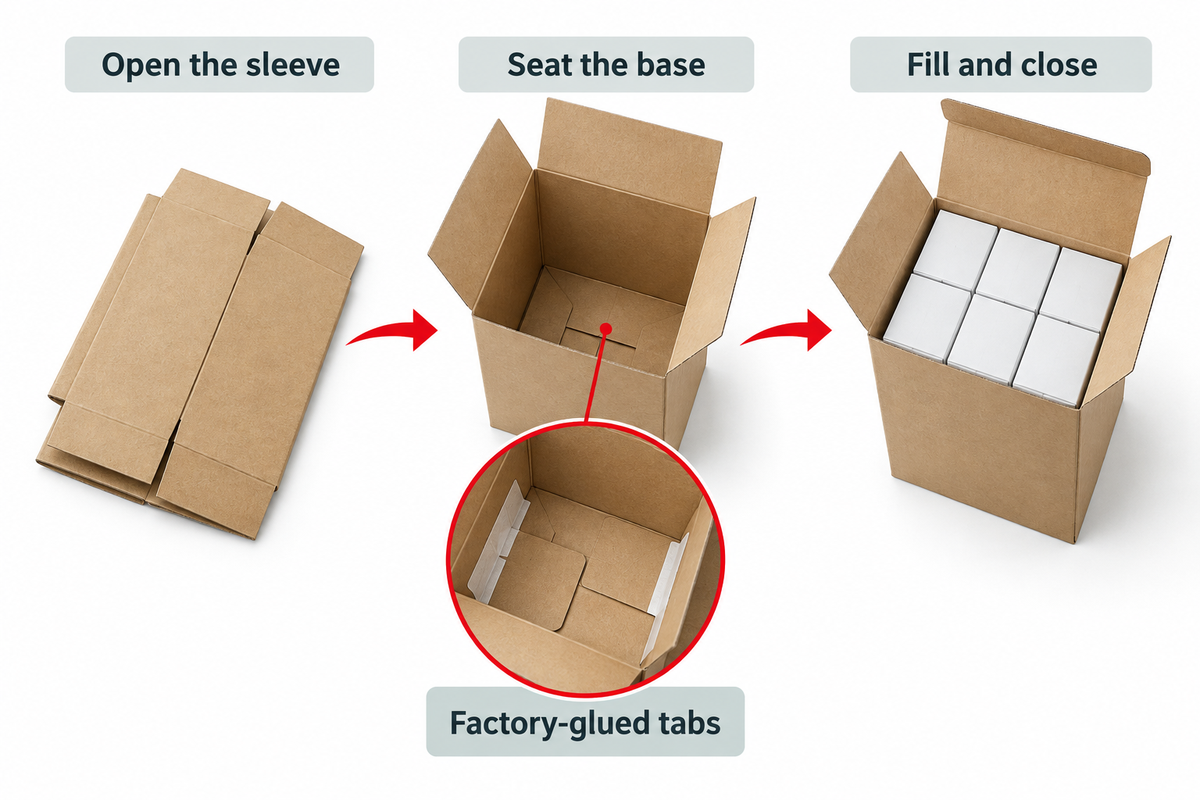
The crash lock base integrates bottom panels and glued tabs and crease lines. Panels are connected during manufacture, so opening the flat carton draws the bottom into its working position. The Paperboard Packaging Council’s automatic-bottom description identifies converter pre-gluing and hand erection as the defining production and packing steps.
How Does an Auto Lock Bottom Box Work?
An auto lock bottom box works by linking selected bottom flaps with adhesive before the carton reaches the packer. As the side walls open, the connections pull the base across the bottom of the box. The overlapping base locks into place, so the packer doesn’t need to individually tuck the bottom flaps to fill the carton.
The moving joints allow the box to travel flat, even with part of the base already glued. The side seam creates the carton sleeve. The bottom connections control how the base unfolds. Pressing on the base during packing is not the same as applying fresh glue or curing the original adhesive.
- Open the sleeve. Pull the opposing sides apart along the carton’s intended erection movement.
- Seat the base. Let the linked panels move into place and check that the bottom is fully formed.
- Fill and close. Place the product and its support inside, then close the separately specified lid.
A crash lock box can have a tuck top, a separate sealing arrangement, or some other type of lid. The top may require taping or some specified seal strip. A peel-and-seal strip of a postal box is a top closure feature.
Crash Lock vs Snap-Lock and Tuck-Bottom Boxes
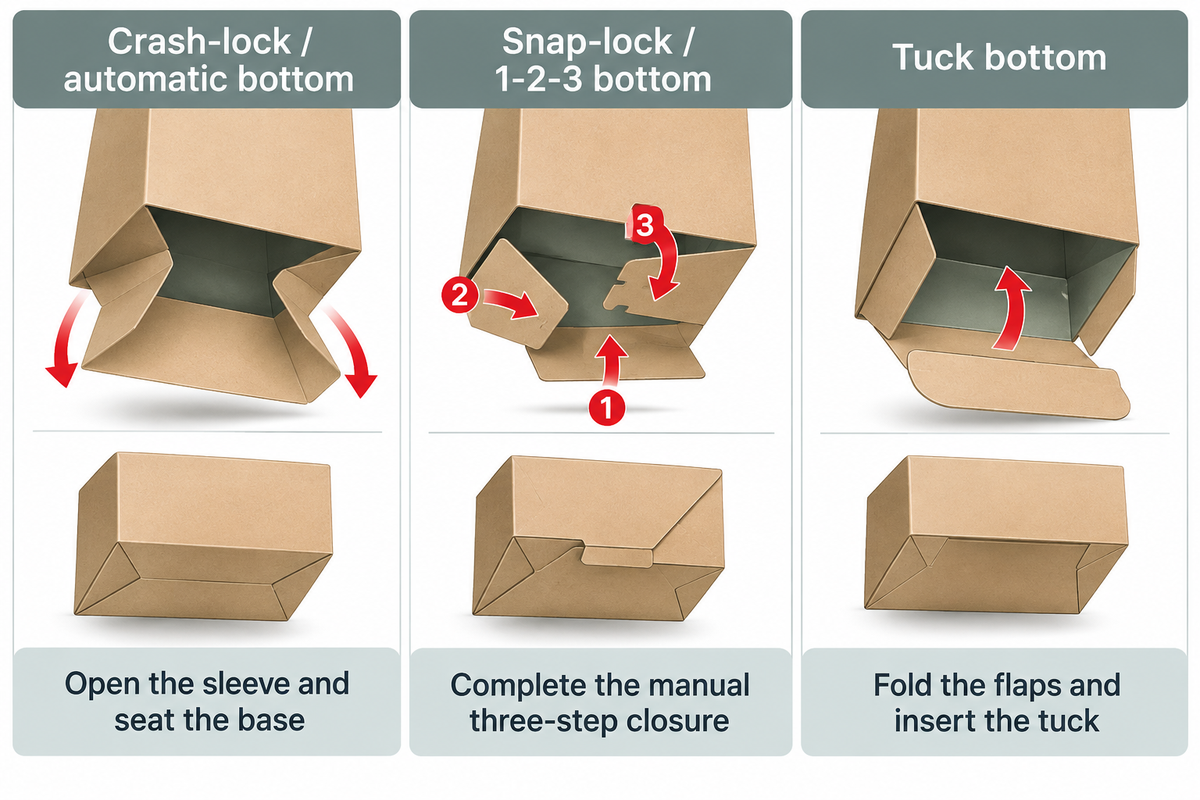
Choose an automatic bottom when pre-gluing and quick erection suit the packing task. Using a manual snap-lock bottom design is OK if an extra hand-folding sequence is acceptable. A tuck-bottom carton closes by inserting a flap. These carton styles differ in packer actions and converting work.
| Bottom style | Factory bottom preparation | Packer action | Useful buying distinction |
|---|---|---|---|
| Crash-lock / automatic bottom | Selected bottom tabs pre-glued | Open the sleeve and seat the base | Moves bottom preparation upstream to the converter |
| Snap-lock / 1-2-3 bottom | Die-cut interlocking bottom flaps | Complete the manual three-step closure | Retains more bottom assembly at the packing bench |
| Tuck bottom | Die-cut tuck flap and receiving opening | Fold the flaps and insert the tuck | Simple closure geometry with a separate tucking task |
MOD-PAC calls its manual three-step design a Snap Lock Bottom Carton. This is different from a pre-glued base. When a quotation uses “self-locking” or “interlocking base,” compare the drawing and erected sample with the actual assembly movement.
Automatic-bottom advantages
- Fewer separate base-folding actions during packing.
- Flat delivery for storage before use.
- A consistent assembly movement for repeated hand packing.
Automatic-bottom limitations
- Additional folding and gluing work during converting.
- A base that relies on correct glue placement and crease geometry.
- A product fit that still needs suitable material and support.
At the base, both a manual interlocking design and a pre-glued design can require no tape during packing. Compare their ease of use by assembling both samples with the intended insert. “No tape or glue needed” should describe the packer’s task: the automatic carton already contains factory-applied glue.
Paperboard or Corrugated: Match the Packaging to the Product
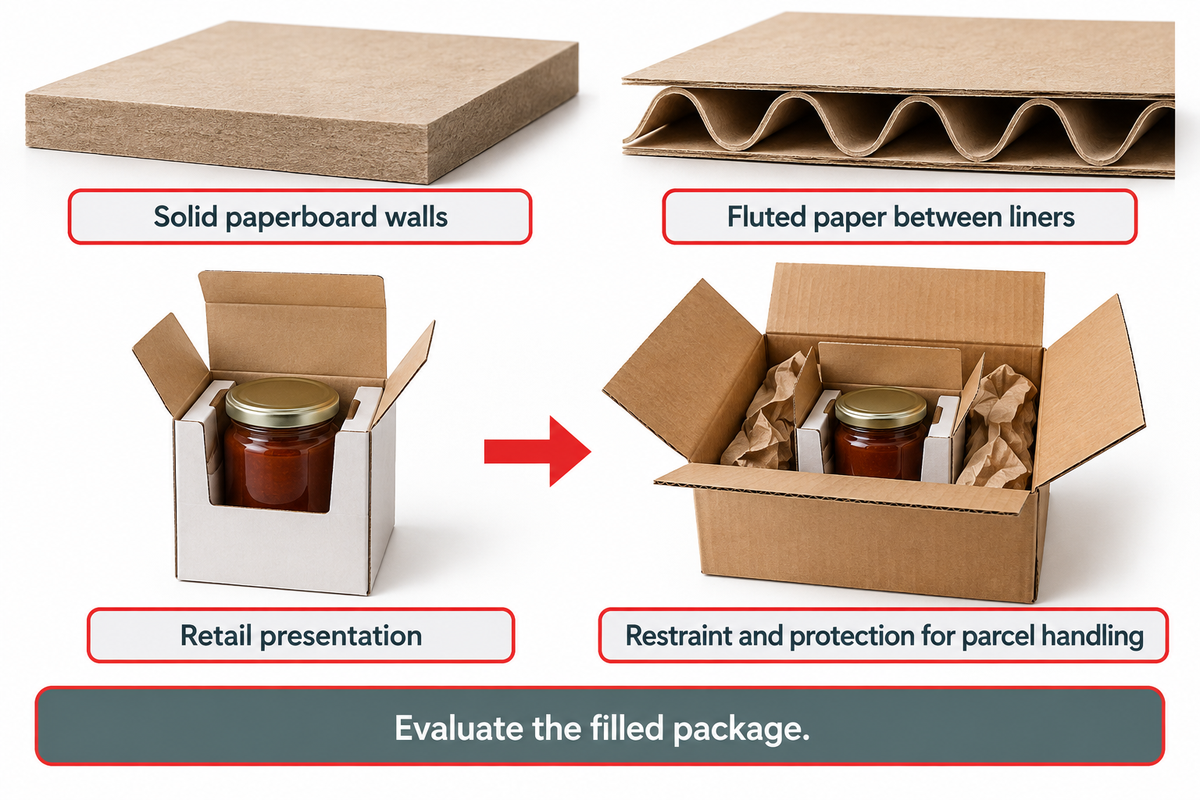
Use paperboard when the main function of the carton is product presentation and containment within the chosen distribution pack. Use corrugated board when the selected design needs fluted-wall protection for handling and transport. For a glass jar sent by parcel, start with a complete protective packaging solution, including restraint and cushioning of the jar.
What is the difference between carton and corrugated boxes?
A paperboard folding carton has solid board walls, while a corrugated box has fluted paper between liners. Corrugated construction creates a different wall structure from solid cartonboard. FEFCO describes three, five or seven sheets forming single-, double- or triple-wall board.
| Packaging task | Design starting point | What the sample must demonstrate |
|---|---|---|
| Retail shelf presentation | Printed paperboard carton fitted to the product | Clean folding, product fit and secure base seating |
| Parcel dispatch of a fragile product | Corrugated shipper or qualified protective pack with suitable inserts | Product restraint and protection through the intended route |
| Several units in one outer case | Unit cartons plus an outer case and dividers where needed | Stable arrangement without damaging contact between units |
FEFCO’s production guide explains the liners and fluting behind corrugated construction, sometimes shortened to “corrugate.” Wall rigidity and durability under the intended handling conditions matter as much as the bottom movement. The material distinction also matters in equipment selection: a corrugated folder gluer must suit that board, rather than being selected solely because a carton has an automatic bottom.
In this example, a candle brand is selling a glass jar in a cosmetic-style retail carton. A fitted insert can keep the jar centered and presentational surfaces protected in the unit pack. However, for e-commerce businesses sending the same item in individual orders, transit changes the handling conditions. A decorative crash-lock carton placed directly into the delivery network leaves a different protection task from that carton restrained inside a corrugated shipper. To keep products safe through parcel handling, develop the pack around the filled product rather than carrying the retail choice across unchanged.
The ISTA 3A overview treats the package and product together. ASTM D642-25 addresses external compression and includes loaded-container arrangements where contents share load. Filling can also create unfavorable deformation: a 2022 corrugated-box creep study found reduced lifetime for filled boxes in its tested storage conditions. Select a representative filled-pack evaluation for the product, route and storage exposure; bottom style alone does not provide a safe payload.
Where Crash Lock Boxes Help, and Where They Do Not
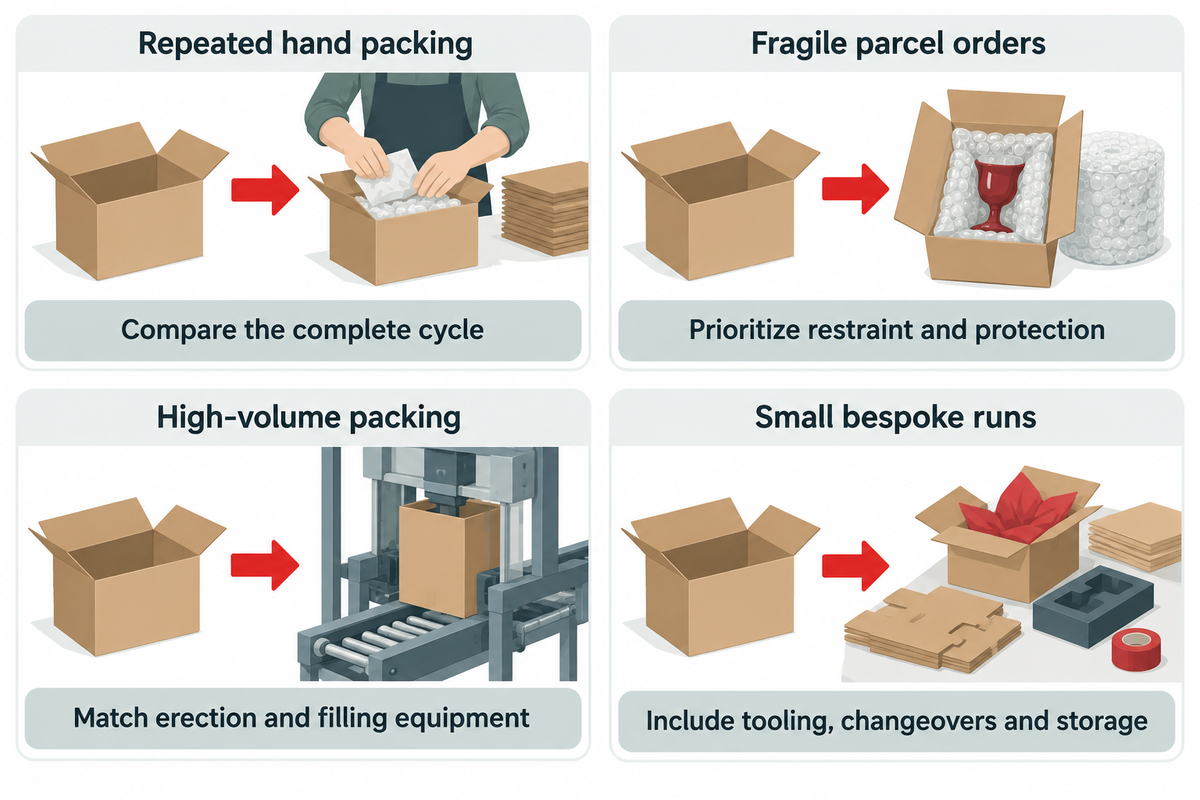
Crash lock boxes can be useful when a meaningful share of the manual work done in packing is taken up by repeated base assembly. Crash lock boxes are designed for quick erection from a flat state. They offer less practical benefit when product placement, protective wrapping or top sealing controls the packing line’s pace.
The Paperboard Packaging Council lists food, liquor and pharmaceutical applications for automatic bottoms. That defines carton use rather than confirming a specific board or finished package for direct contact with the contents.
In this example, the operator at a small jewellery business spends most of the packing time for each order arranging the item, adding a card, and protecting a polished surface. An easy-assembly base removes a handling step, but the remaining work still controls dispatch. For this slow, presentation-led packing operation, a manual carton may still be a sensible choice. For a repetitive replenishment kit, with an insert and contents already prepared, quicker erection has more opportunity to improve the complete cycle. The useful comparison is the finished, correctly packed order under each option.
- Repeated hand packing: compare complete-cycle times with the intended insert.
- Fragile parcel orders: prioritize product restraint and transport protection.
- High-volume packing: compare the carton with the actual erection and filling equipment.
- Small bespoke runs: include tooling, changeovers and flat-carton storage in the bespoke packaging choice.
Does Faster Packing Offset the Box Price?
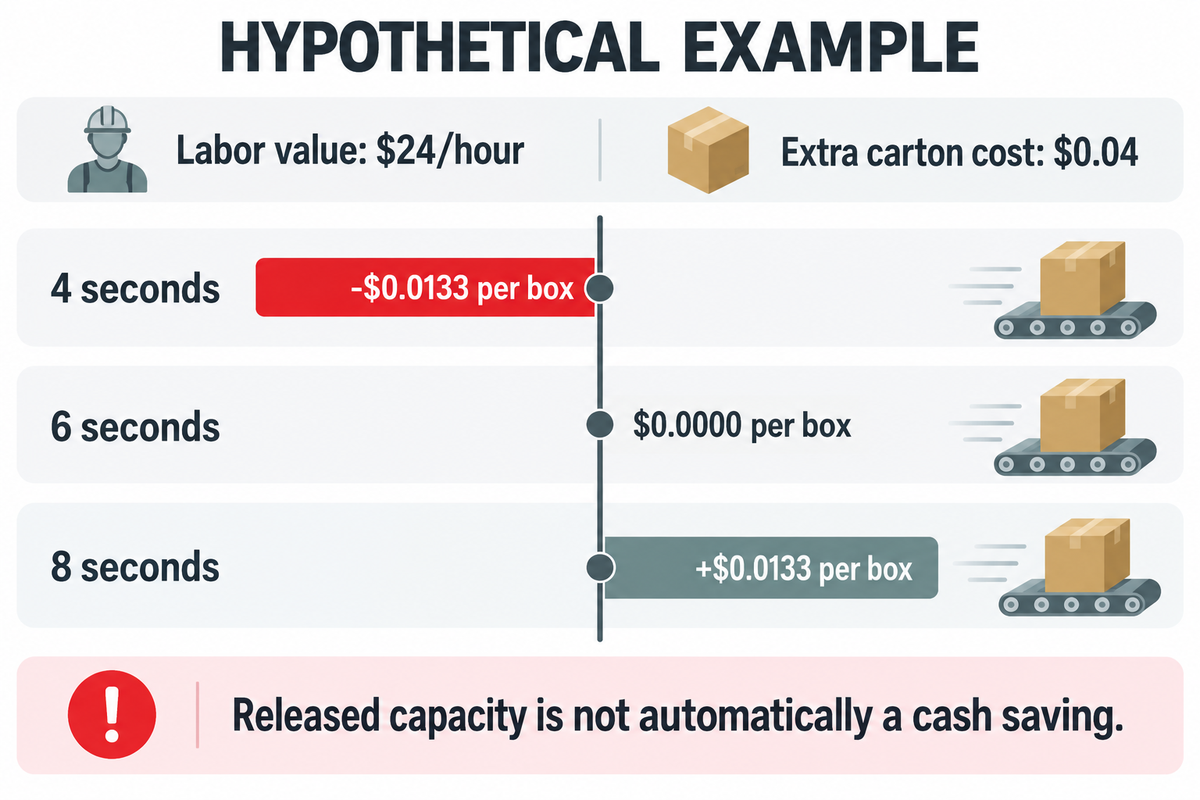
Automatic bottoms generally cost more to convert than simple tuck bottoms, because the factory adds bottom gluing. Packaging buyer Sara Greasley explains this cost direction in her folding-carton style guide. Faster packing offsets a higher delivered price when the realized value of the complete-cycle time saving exceeds the carton premium.
Crash lock boxes offer a simpler base-assembly task, so compare matched boxes and a timed finished pack. A labor-value calculation may show cost-effectiveness or available capacity; reduced payroll requires a real change in paid expenditure.
Packing-Time Price Ceiling
For an explicitly hypothetical example, assume labor is valued at $24 per hour and an automatic-bottom carton costs $0.04 more per box than the alternative. Each second is then worth $24 ÷ 3,600 = $0.006667. Multiply that value by the seconds removed from the complete cycle, then subtract the carton premium.
| Complete-cycle time saved | Labor value per box | Value less carton premium |
|---|---|---|
| 4 seconds | $0.0267 | −$0.0133 per box |
| 6 seconds | $0.0400 | $0.0000 per box |
| 8 seconds | $0.0533 | +$0.0133 per box |
Six seconds is the balance point for these assumptions only. Given no change in paid hours, the operator’s freed time is time to do something else. Distinguishing cash and non-cash benefits in the Government Efficiency Framework can help separate the impacts. Additional setup charges, rejected packs and differences in freight belong in the full comparison.
In this example, a packing supervisor wants faster erection to clear a late dispatch queue. The accountant wants a lower cost per finished order. The newly available operator time may help achieve both goals. If filling remains the slowest operation, faster erection may simply create a queue of empty cartons. The team should record how the released time will be used before calling its calculated value a cash saving.
| Observed constraint | Trial comparison | Decision consequence |
|---|---|---|
| Blanks run out at the bench | Include blank replenishment in the timed work | Allow for how flat stock reaches the operator |
| Insert preparation is slow | Compare the complete insert-and-carton assembly | Consider a preformed insert alongside the base choice |
| Product placement takes longer than erection | Time through product placement, not just box opening | Evaluate the insert and work arrangement alongside the base |
| Protective wrapping controls the cycle | Include the required wrapping and restraint | Preserve product protection in the faster-pack trial |
| Top sealing controls dispatch | Time through a correctly closed pack | Changing the bottom alone may not raise finished output |
| Labels or scans delay completion | Include order identification and labelling | Compare a dispatch-ready order rather than an unlabelled box |
| Malformed bases need rework | Count acceptable packs and reworked packs separately | Include quality losses in the price comparison |
| Completed packs queue at handoff | Observe the move to the next packing or dispatch station | Identify whether released operator time can be used |
| Frequent product changes interrupt packing | Include sample changes and restart work in the trial | Compare the intended job mix rather than one uninterrupted run |
Owning the machine can also be analyzed using Cenwan’s folder-gluer cost calculator. It shouldn’t be confused with the delivered cost of boxes.
How Crash Lock Cartons Are Made
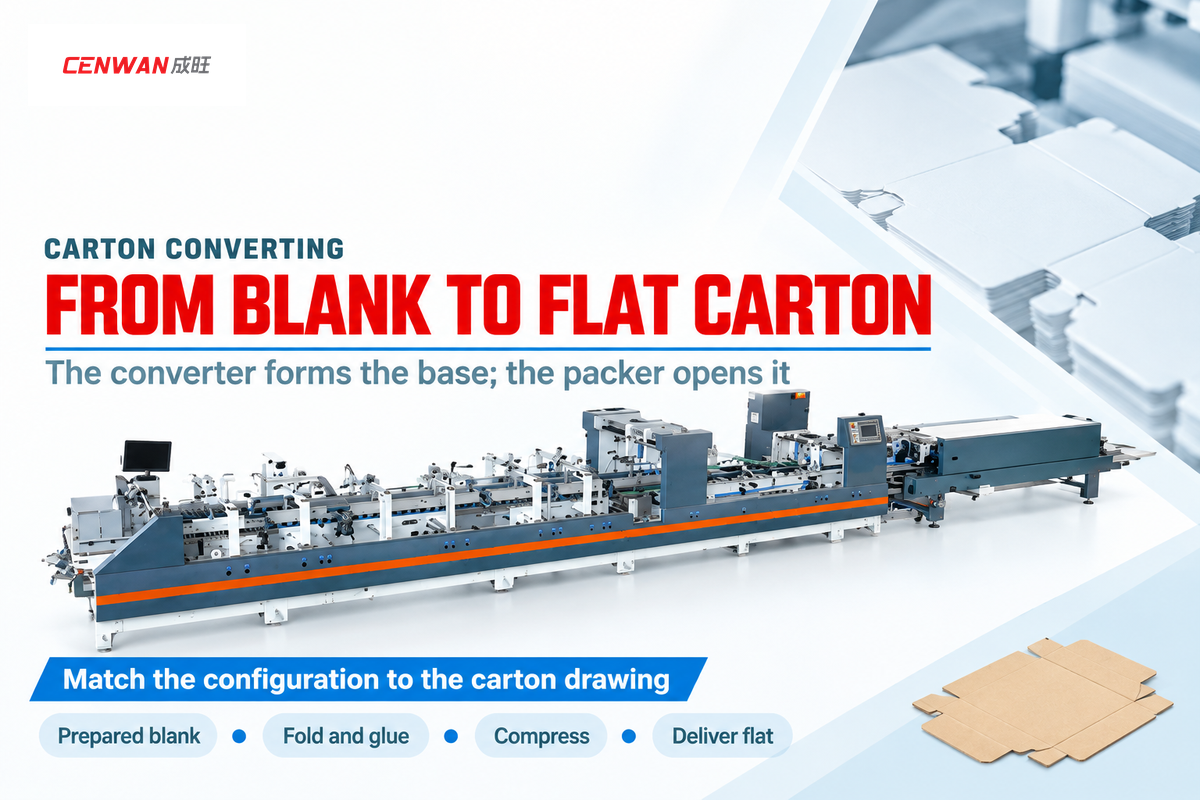
A converter prints, die-cuts and creases the board, then folds and glues the blank into a flat carton with an automatic base. Later, the packer erects and fills it. The BOBST expert contribution in Label and Narrow Web describes folder-gluer stages from feeding and pre-breaking through folding, gluing, transfer and delivery.
- Prepare the blank: printing and finishing options must align with the die-cut layout and crease positions.
- Pre-break and guide: prepare the folds while keeping the blank registered through the machine.
- Apply adhesive and form: place glue on the specified joints and fold the side seam and bottom connections.
- Compress and deliver: hold the glued joints appropriately and deliver cartons flat for packing.
For custom printed work, the areas of glue contact, coating and board direction belong in the converting specification. Decorative finishing can change a bonding surface. A high-quality printed face cannot compensate for glue in a moving fold or a base connection that prevents the carton from opening.
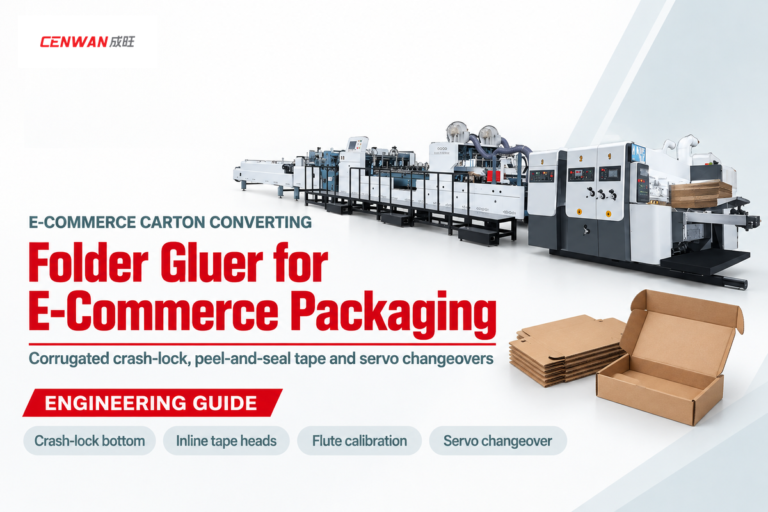
Cenwan’s cardboard crash lock bottom folder gluer family has two- and four-fold configurations. Kluge’s own application tip describes a Fold Hook Kit for automatic-bottom work. These are separate manufacturers’ arrangements, not interchangeable features.
Start by matching the machine to your carton drawing, then trial the intended blanks. Nominal belt speed doesn’t state the number of acceptable cartons delivered per hour. The crash-lock product page covers available equipment configurations in more detail.
Why a Crash Lock Bottom Fails to Open or Hold
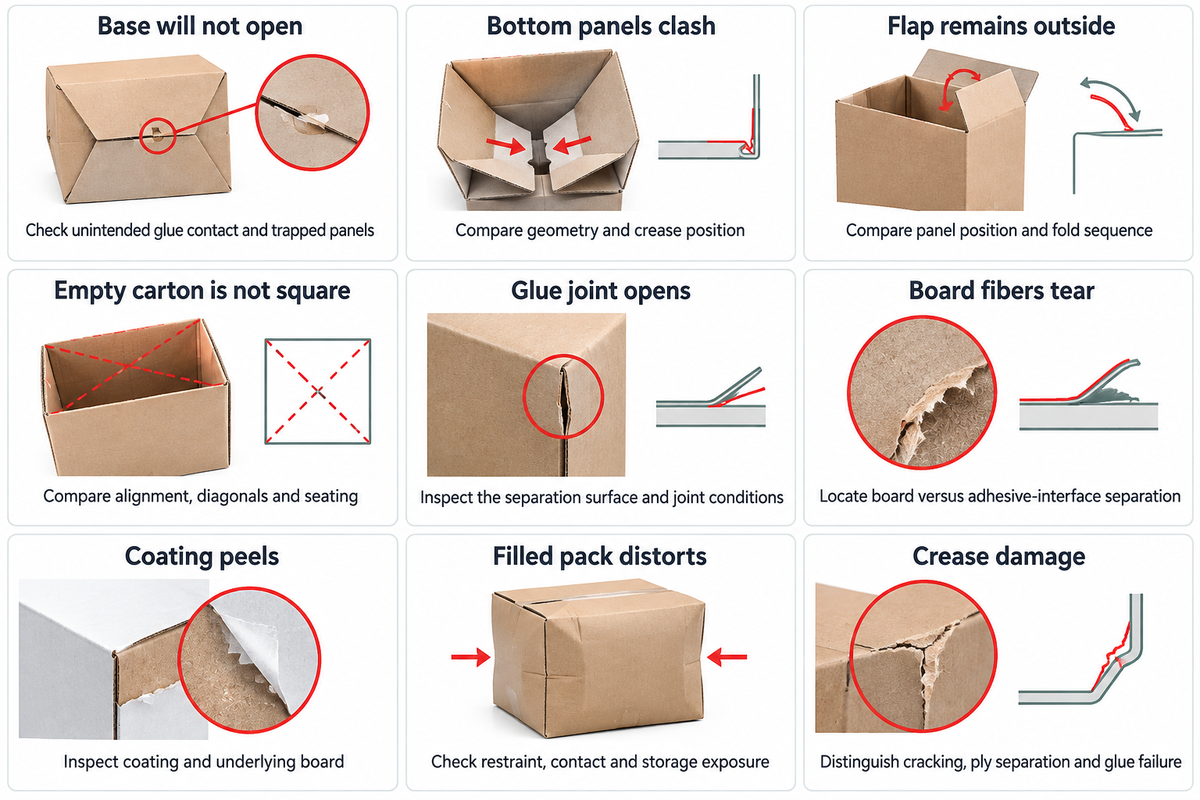
A crash lock bottom can fail to open because its moving panels clash or become glued together, and it can fail to hold when a joint or the board gives way. Separate the visible symptom from its possible causes. Compare the faulty carton with the approved drawing and a good reference sample before changing the process.
| Observed defect type | Checks to distinguish alternatives |
|---|---|
| Base will not open | Look for unintended glued contact, trapped panels and departure from the approved fold sequence |
| Bottom panels clash | Compare die-cut geometry, crease position and carton squareness with the reference blank |
| A bottom flap remains outside the base | Compare panel position and folding sequence with the approved erected sample |
| Empty carton does not sit square | Compare side-seam alignment, diagonals and bottom-panel seating with a good reference |
| Glue joint opens | Identify the separation surface; compare board/coating, adhesive placement and compression conditions |
| Board fibers tear beside a glued area | Record whether separation is within the board or at the adhesive interface before changing adhesive |
| Surface coating peels at a joint | Inspect the coating and underlying board on both separated surfaces |
| Base or walls distort after filling | Check product restraint, concentrated contact, filled-pack geometry and storage exposure |
| Damage appears at a crease | Distinguish surface cracking, excessive ply separation and an opening adhesive joint |
DGM’s short-crease carton example describes less opportunity for alignment correction during conveying and compression. Capital Adhesives’ packaging guidance identifies adhesive setup time and substrate change as practical bonding issues.
An adequate description of board delamination is also needed. Choi and colleagues’ paperboard-folding research distinguishes functional layer separation during creasing from excessive separation that weakens the fold. A failed glue interface and an internally creased board layer are two different sites for inspection.
Approved blanks and an assembled empty carton are needed for the trial. A filled representative pack is also needed. Only change one suspected variable at a time. Cenwan’s folder-gluer setup checks provide a related machine-preparation reference.
Before Ordering Crash Lock Box Packaging
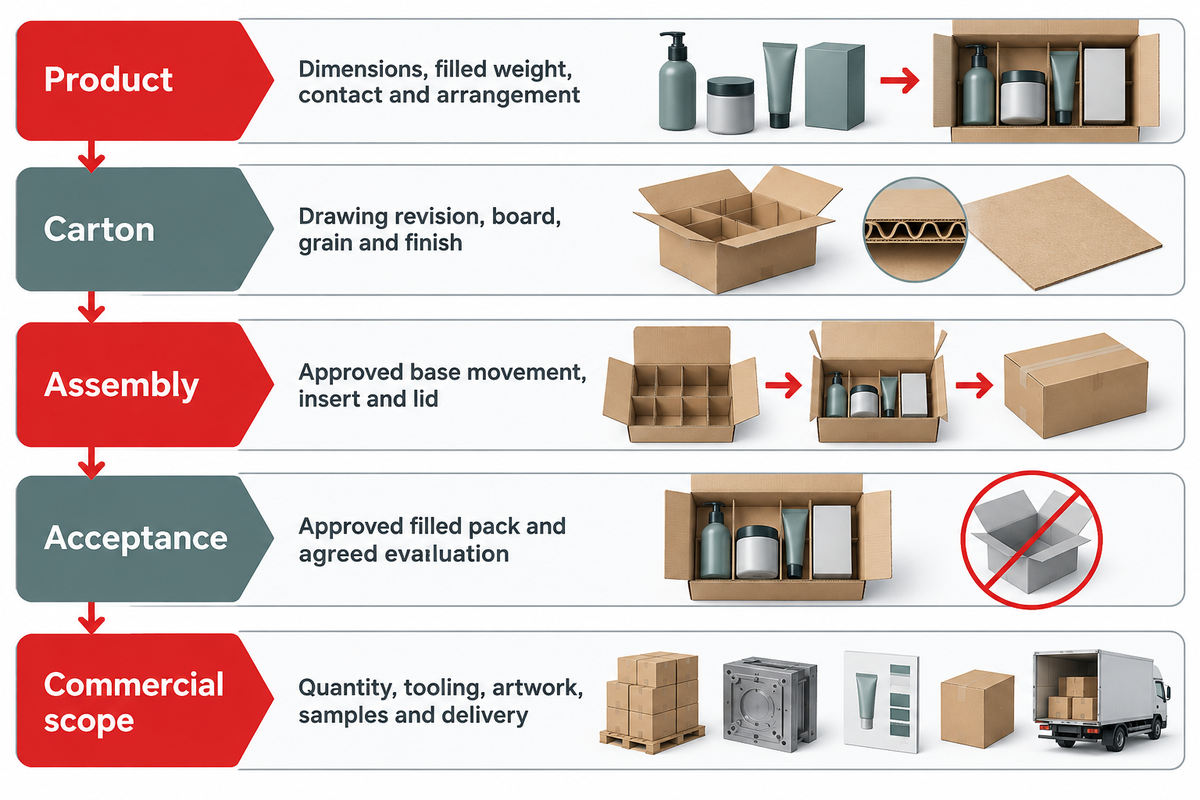
Give packaging manufacturers the product arrangement and distribution task, then compare quotations for the same board, print, finishing, insert and closure. For a carton, obtain a price for an empty carton and a price for a carton with protective components. This will reflect two different purchases.
Empty vs. loaded evaluation is important here: ASTM D642-25 allows containers to be tested with or without contents. Record the agreed sample condition alongside the result, so procurement and quality staff are comparing the same packaging system.
- Product: dimensions, filled weight, contact points and arrangement.
- Carton: drawing revision, board specification, grain direction and print finish.
- Assembly: approved bottom movement, insert placement and top closure.
- Acceptance: approved representative filled pack and the agreed handling/storage evaluation.
- Commercial scope: quantity, tooling, artwork, sampling, packing and delivery terms.
For machinery, send Cenwan the carton drawing and sample requirements, along with the board specification and required acceptable output. Finished-box procurement and folder-gluer procurement require different quotes.
Industry Outlook: Short Runs Favor Repeatable Carton Setup
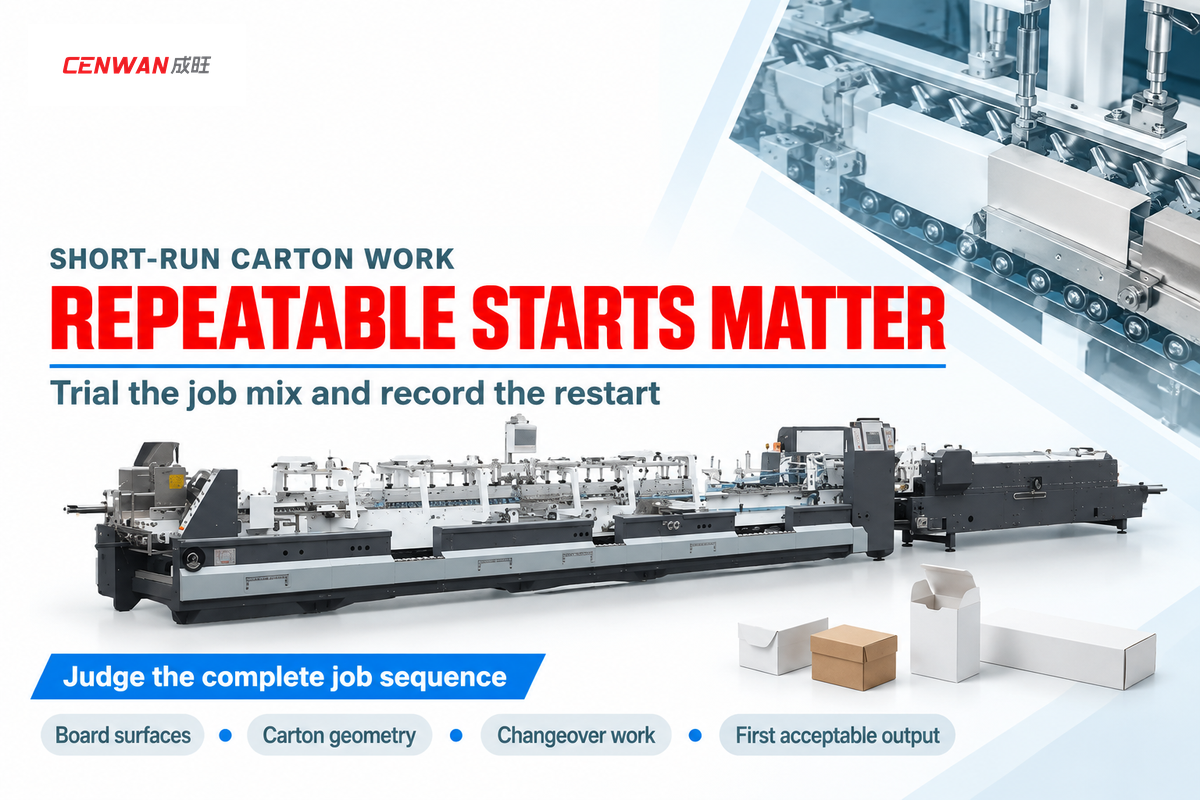
For short-run carton work, focus is on repeatable setups and changeovers throughout the converting process. In January 2026, BOBST’s Ludovico Frati discussed substrate behavior, die-cutting choices and connected converting in The essentials of carton converting. His process perspective points buyers toward a mixed-job trial rather than a single maximum-speed demonstration.
“Digital printing alone does not guarantee agility.”
Include representative board surfaces and carton geometries in a crash-lock trial. Record the setting, changeover work, first acceptable output and stability after restart. An integrated die-cutting and gluing line changes how those stages connect; thus, judge the whole job.
Frequently Asked Questions
What is the difference between an auto lock bottom box and a crash lock bottom box?
These terms typically describe the same automatic-bottom family of pre-glued construction. The practical distinction is between that method of construction and a manual snap-lock or 1-2-3 bottom. With suppliers using overlapping terms, differentiate a base by its drawing and the movement of its assembly. A pre-glued bottom locks automatically as the sleeve opens; a manual bottom needs its flaps interlocked by the packer.
Are Auto Lock Bottom Boxes Eco-Friendly?
They can be recyclable when the complete material construction is accepted by the local paper-recycling system. The bottom mechanism alone doesn’t determine sustainability. For an eco-conscious specification, consider coatings, windows, inserts, adhesive and product contamination alongside the board. Reusable packaging also needs to survive its intended reuse; an easy-opening carton is not automatically a reusable shipping pack.
How long does it take to produce custom auto lock bottom boxes?
Hannpack’s guide gives 10–20 business days after artwork approval as an example for a standard production run. Sampling and artwork development and transport can be outside the production period. Freight transit begins after shipment. Stipulate the approval milestone and delivery scope on the order; this is a finished-carton example, not Cenwan’s machinery delivery time.
What is the minimum order quantity for custom auto lock bottom boxes?
Hannpack lists a starting quantity of 500 sets for its custom printed auto lock bottom boxes. This is a named supplier’s minimum, not a requirement of the crash-lock structure or a Cenwan finished-box offer.
What Products Are Auto Bottom Boxes Best Suited For?
Hand-packed retail products and kits are suitable applications when quick, easy assembly matters. Cosmetics, jewellery and packaged consumer goods can use the automatic base while receiving different inserts, board grades and lids. The Paperboard Packaging Council cites applications for food, liquor and pharmaceuticals.
For a fragile or concentrated load, develop the product support along with the carton. A candle jar, for example, held in a fitted retail insert, presents a different task from several loose jars in one shipping carton. Choose the arrangement that keeps the product securely positioned, then evaluate that filled package for its route.
Planning crash-lock carton production?
Send the carton drawing, board specification and required acceptable output. Cenwan can discuss the folder-gluer configuration for your box family.
References & Sources
- Paperboard Packaging Council: Five Must-Know Folding Carton Designs
- FEFCO: Corrugated board production process
- ISTA: Procedure 3A overview
- ASTM D642-25: Compressive resistance of shipping containers, public scope
- Gray-Stuart and colleagues, 2022: Box preparation and corrugated-box creep performance
- Choi and colleagues, 2012: Delamination in the scoring and folding of paperboard
- UK Government: The Government Efficiency Framework
- Label and Narrow Web, January 2026: The essentials of carton converting