Get in touch with Cenwan Machine Company


Updated November 2026 · by CYH · Reviewed by the Zhejiang Chengwang Intelligent Packaging Equipment (Cenwan Machine) Technical Team
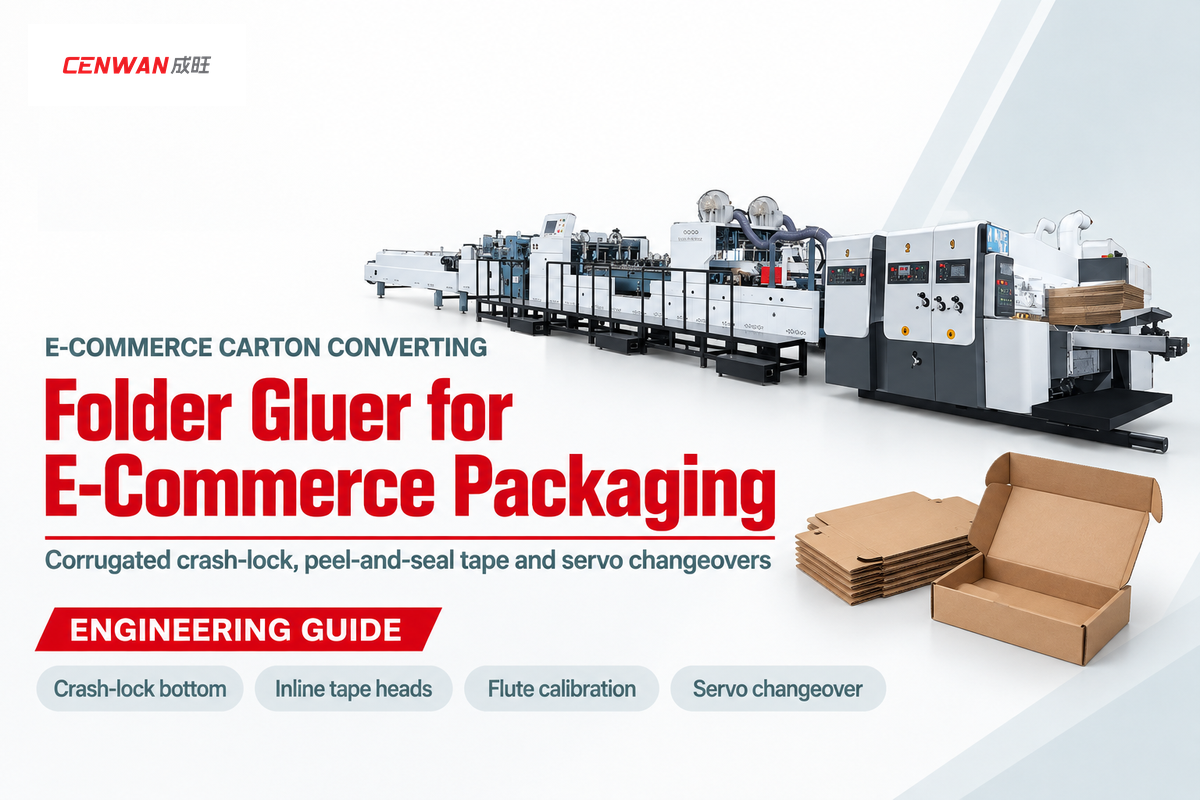
A folder gluer for e-commerce packaging is a converting machine that feeds flat die-cut corrugated or paperboard blanks at rated speeds from 70 to 450 m/min by model and engaged module. It pre-breaks creases at 180°, applies cold or hot-melt glue with release tape and folds crash-lock or return mailers. Specify your production line based on working width (650 to 1650 mm) & servo stations with regard to FEFCO 0201, 0701 & 0427 box styles. With these configurations, parcel void space will be within the EU Regulation 2025/40 50% empty-space limit by 2030.
Fulfillment centers that ship directly to consumers don’t consistently run a single shipping case size all week. Converters have to adapt quickly to order changes for auto-bottom mailers, double-tape returnable boxes, and multi-depth trays in the packaging industries. Assessing machinery on catalog belt speed is misleading, as mechanical cam straight-line changeovers take 120-240 minutes per order switch. Retrofit cut-and-place tape applicators also limit linear speed to 70-80 m/min. This document covers box specifications, flute nip settings, adhesive systems, shift productivity math, and Factory Acceptance Test (FAT) procedures.
Quick Specs: E-Commerce Folder Gluer Engineering Baseline
| Supported Substrate & Flute Range | 180–800 gsm cardboard (Cenwan CW-G series). E, F, C, B, and AB flute (3-layer and 5-layer corrugated board). |
| Unfolded Blank Width Classes | 130–650 mm (650PC), 140–880 mm (880PC/1100PC), 290–1250 mm (1250AC-S), and up to 1650 mm (1650PCW). |
| Governing Line Speeds by Module | 200–450 m/min straight-line rating. 180 m/min servo 4/6-corner rating. 70–80 m/min with KY-20T and KY-35T tape heads. |
| Pre-Folding & Guide Settings | 180° first fold and 165° third fold. 4.8 mm tapered guide gap on a 5.0 mm sheet example (US8512803B2). |
| Published Straight-Line Changeover Benchmarks | 5–15 min on Cenwan full-servo motor-and-rod straight-line gluers (<5 min dimensional) vs. 120–240 min on legacy mechanical cam straight-line gluers. |
What Does a Folder Gluer for E-Commerce Packaging Actually Do?
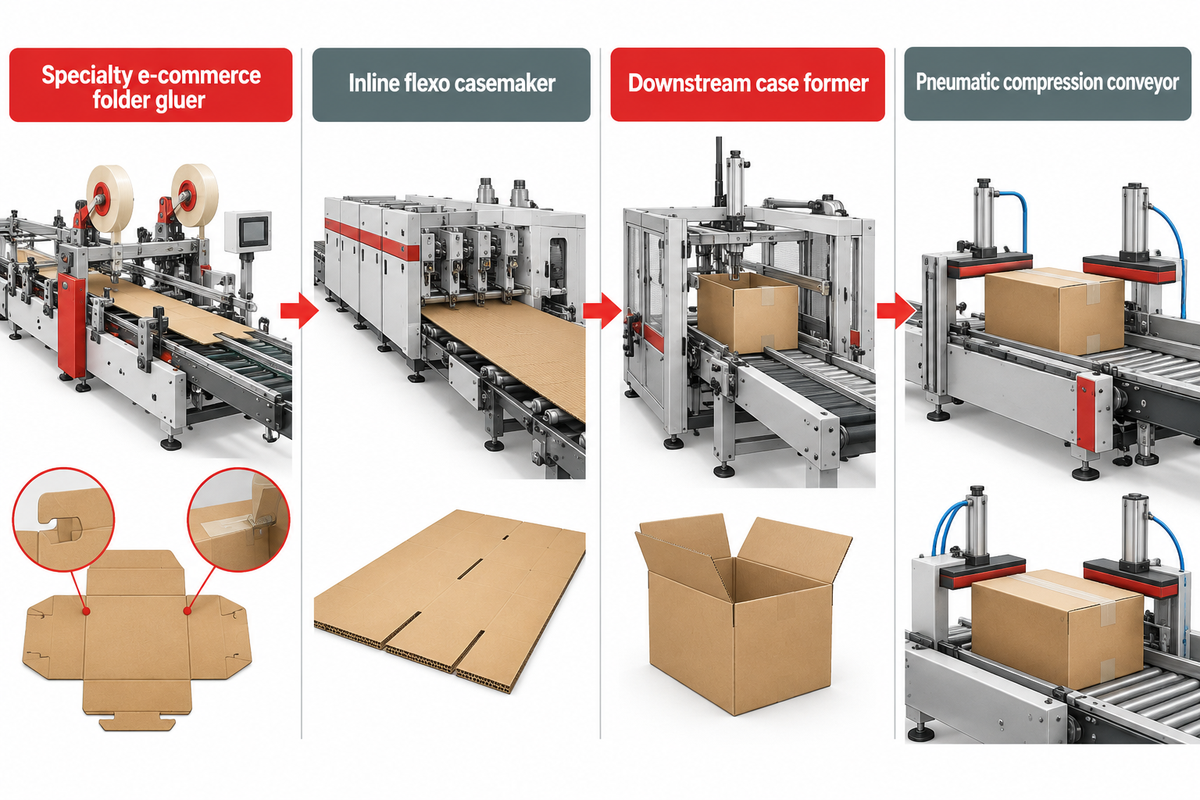
Specialty folder gluers convert flat, printed and die-cut cardboard or corrugated blanks into pre-glued, flat-bundled mailers at speeds of 70 to 450 m/min, depending on model and engaged module. They differ from inline flexo folder gluers (FFG) that print, slot, and glue FEFCO 0201 cases from raw board sheets. They also differ from downstream fulfillment equipment that erects cases before product loading and top sealing.
What Does a Folder Gluer for E-Commerce Packaging Actually Do?
Specialty e-commerce folder gluers use rotary or flatbed die-cut blanks and perform crease pre-breaking, crash-lock bottom folding, adhesive bonding and release-tape placement. Inline flexo folder-gluer casemakers instead manufacture standard FEFCO 0201 regular slotted containers (RSC) in one pass. Downstream fulfillment case formers erect boxes before separate loading and sealing, as seen on the 18 cases/min OCME Line 4 case former.
Buyers who visit corrugated box manufacturing often mix up these three machines located on the packaging line. As a core part of packaging production, a box folder gluer machine receives die-cut corrugated fiberboard blanks and runs multi-stage fold and glue operations. Like the specialty cartoners, its stations pre-break score lines, engage bottom lock hooks, and apply release-liner tape. A pneumatic compression conveyor then holds the joint while the glue sets and hot-melt adhesive cools.
Structural variety in parcel shipping has expanded rapidly. According to the FEFCO Code 12th Version Technical Standard, the latest corrugated classification added more than a hundred new designs, including a retail and e-commerce series. Regulatory rules are also shaping multi-SKU packaging solutions. Under EUR-Lex Regulation (EU) 2025/40 on Packaging and Packaging Waste, economic operators must keep empty space in grouped, transport, and e-commerce packaging at or below 50% by 2030.
Downstream fulfillment machinery handles a separate stage of production after cartons leave the converter. In beverage and parcel plants, a case former opens a flat carton and seals the bottom flaps. A loader then inserts the product, and a top sealer closes the top flaps. Tests reported by Packaging World on an OCME Line 4 case former document a speed of 18 cases/min (1,080 cases/hour). That line applies 4.95 to 9.9 g of hot-melt adhesive per 18-bottle case. Similarly, Packaging Digest’s Pack Expo machinery report describes a compact 10-ft L top case sealer with interchangeable hot-melt and tape modules.
| Parameter | Specialty E-Commerce Folder Gluer | Inline Flexo Folder Gluer (FFG) | Downstream Fulfillment Case Former |
|---|---|---|---|
| Primary Input Material | Printed and die-cut corrugated or paperboard blank. | Unprinted rectangular corrugated board sheet. | Pre-glued flat carton (products loaded downstream). |
| Target Box Structures | FEFCO 0701 crash-lock, 0427 mailer, 4/6-corner tray, and 0201 RSC. | FEFCO 0201 regular slotted containers (RSC). | Bottom-sealed shipping cases ready for downstream filling. |
| Core Stations Onboard | Feeder, 180° pre-folder, crash-lock hooks, tape head, squaring, and compression. | Lead-edge feeder, flexo print units, rotary slotter, folder, and counter-ejector. | Vacuum blank erector and bottom-flap hot-melt gluer (loading and 10-ft L top sealing are separate downstream units). |
| Typical Operating Speed | 70–450 m/min linear belt speed by model and module. | 300–400 m/min continuous straight-line RSC output. | 18 cases/min (1,080 cases/hour) on OCME Line 4 case former test. |
| Equipment Owner | Corrugated converter and folding carton production plant. | High-volume corrugated box sheet feeder plant. | 3PL warehouse, beverage plant, or D2C fulfillment center. |
Sources: FEFCO Code 12th Version, Packaging World’s article on OCME Line 4 case former, Packaging Digest article on Pack Expo, and Cenwan Machine technical catalogs.
Which E-Commerce Box Styles Require Crash-Lock or 4/6-Corner Modules?
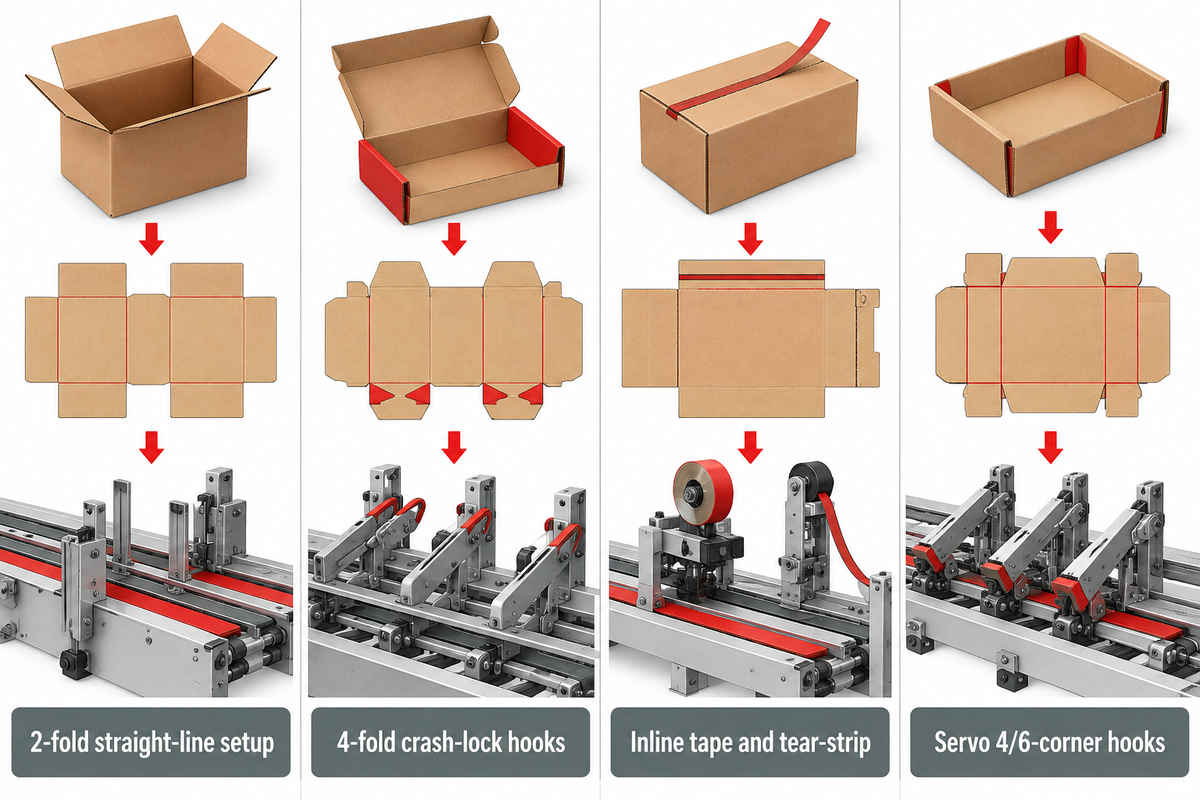
Standard FEFCO 0201 shipping cartons require only a 2-fold straight-line setup, whereas FEFCO 0701 auto-bottom mailers require 4-fold pre-breaking and bottom-lock hooks. When FEFCO 0427 die-cut mailers use self-seal closures, converters add inline release-tape and tear-strip heads rated at 70 to 80 m/min. Multi-panel 4/6 corner trays require back-folding hooks, servo-controlled, capped at 180 m/min.
Which E-Commerce Box Styles Require Crash-Lock or 4/6-Corner Modules?
FEFCO 0701 crash-lock bottom mailers require a 4-fold pre-folding section and spring-loaded bottom hooks. Returnable FEFCO 0427 mailers specified with peel-and-seal closures and tear strips use inline tape and tear-strip applicators (such as the 80 m/min KY-35T and 70 m/min KY-20T heads).
Specifying a basic twofold machine locks a converter out of auto-bottom e-commerce contracts. When fulfillment centers pack thousands of orders per hour, operators need self-locking bottom boxes that erect without manual folding or bottom taping. In our published straight-line corrugated folder gluer specifications, the Cenwan CW-W-1250AC-S handles unfolded box widths from 290 to 1250 mm. This machine uses a 22 kW servo drive and an 8.0 T frame to run E, F, C, B, and AB flute corrugated board at up to 200 m/min. Adding a crash-lock module lets the folding section fold diagonal bottom flaps over hooks before side panels close.
For packaging box processing and lighter micro-flute paperboard, converters group narrower width classes with higher belt speeds. Models within the high-speed fourfold folder gluer series and the CW-G crash-lock bottom folder gluer line process 180 to 800 gsm cardboard at speeds up to 400 m/min. The widths covered by the unfolded box are between 130 to 650 mm on the 13.5 kW, 650 PC. They’re between 140 to 880 mm on the 880 PC and 1100 PC in 2-Fold (15 m) and 4-Fold (17.5 m) frames, respectively. Hook geometry can be found in our crash-lock bottom box structure and packing guide.
Multi-corner trays and modular frames set a second mechanical boundary. On the Cenwan CW-W-1250/1450/1650 PCW 4/6-corner series (290 to 1650 mm width, 25 kW motor), 180 m/min is the honest servo-limited gluing speed on 4/6-corner work. Advertised speeds of 300 to 400 m/min reflect straight-line feeding capacity rather than 4/6-corner output. Recent new innovations in integrated crash-lock and 4/6-corner modules on the BOBST EXPERTFOLD 110 A3 (450 m/min max belt speed) also cut setup time during changeovers by four-fifths.
E-Commerce Box Style-to-Station Configuration Matrix
| Box Type & Application Category | Required Converting Stations | Machine Tier & Reference Model | Width & Substrate Class | Governing Speed Ceiling |
|---|---|---|---|---|
| 1. FEFCO 0201 Corrugated RSC (Straight-Line Class) | Vacuum feeder, 2-fold belts, cold/hot glue gun, and squaring unit. | Cenwan CW-W-1250AC-S (22 kW, 8.0 T). | 290–1250 mm; E/F/C/B/AB flute and up to 800 gsm board. | Up to 200 m/min servo straight-line speed. |
| 2. FEFCO 0201 Paperboard Carton (2-Fold High-Speed Tier) | Friction feeder, 2-Fold (15 m) carrier section, cold glue wheel or jet. | Cenwan CW-G-650PC / 880PC (2-Fold configuration). | 130–650 mm (650PC) or 140–880 mm (880PC); 180–800 gsm. | Up to 400 m/min straight-line belt speed. |
| 3. FEFCO 0701 Compact Auto-Bottom Mailer (650 Class) | 180°/165° 4-fold pre-folder, crash-lock bottom hooks, and dual glue guns. | Cenwan CW-G-650PC (13.5 kW, 17.5 m 4-Fold frame). | 130–650 mm unfolded width; 180–800 gsm cardboard and E/F flute. | 150–250 m/min typical crash-lock run (400 m/min max). |
| 4. FEFCO 0701 Mid-Format Crash-Lock Mailer (880/1100 Class) | 4-Fold (17.5 m) pre-breaking, multi-hook bottom lock, and compression belt. | Cenwan CW-G-880PC / CW-G-1100PC Flagship Tier. | 140–880 mm unfolded width; 180–800 gsm board and micro-flute. | 150–250 m/min crash-lock operating window. |
| 5. FEFCO 0701 Heavy Corrugated Auto-Bottom (1250 Class) | Heavy-duty vacuum feeder, crash-lock hook beam, and dual-stage squaring. | Cenwan CW-W-1250AC-S with crash-lock module (22 kW). | 290–1250 mm width; 3-layer and 5-layer B, C, and AB flute. | Up to 200 m/min frame rating (run at moderate speed for lock accuracy). |
| 6. FEFCO 0427 Self-Seal Mailer (Single Release-Tape Class) | Alignment bridge and inline KY-35T double-sided release tape applicator. | CW-G or CW-W frame + Kylin KY-35T head (15 W). | Tape width 5–35 mm applied to die-cut corrugated mailers. | Up to 80 m/min with ±2 mm front-to-back/lateral tolerance. |
| 7. FEFCO 0427 Returnable Mailer (Dual Tape + Tear-Strip Class) | Inline KY-35T release-tape head paired with KY-20T tear-strip head. | CW-G or CW-W frame + KY-35T (15 W) and KY-20T (15 W). | Tape 5–35 mm plus tear strip 3–20 mm on returnable mailers. | 70 m/min combined line ceiling (governed by KY-20T) at ±2 mm. |
| 8. 4-Corner Pop-Up E-Commerce Tray (Servo Corner Class) | 180°/165° pre-folder, electronic servo rotary back-folding hooks, and glue guns. | Cenwan CW-W-1250PCW / 1450PCW / 1650PCW (25 kW). | 290–1650 mm width; 400 mm feeder stack height. | 180 m/min honest servo-limited corner folding speed. |
| 9. 6-Corner Hinged-Lid Display Carton (Multi-Corner Tier) | Single-finger servo 4/6-corner fold, crash-lock, and double-wall modules. | Koenig & Bauer Duran Omega Allpro 90 or BOBST EXPERTFOLD 110 A3. | Solid paperboard and micro-flute multi-corner packaging. | 400–450 m/min max belt rating (servo corner arm governed). |
| 10. Single-Pass Rotated Complex Mailer (Dual-Channel Tier) | Inline blank turner/rotator (left-to-right or right-to-left) and two-pass folding. | BOBST EXPERTFOLD 165 GYROBOX or Cenwan Dual-Channel Line. | Complex multi-panel e-commerce mailers converted in one pass. | Up to 250 m/min (GYROBOX) or 240 m/min (Cenwan Dual-Channel). |
Sources: Cenwan Machine CW-W and CW-G product specifications, TLMI BOBST EXPERTFOLD 165 report, WhatTheyThink Omega Allpro 90 report, and Kylin KY-35T/KY-20T technical data.
How Do Flute Profiles and Recycled Liners Change Feeder and Carrier Settings?
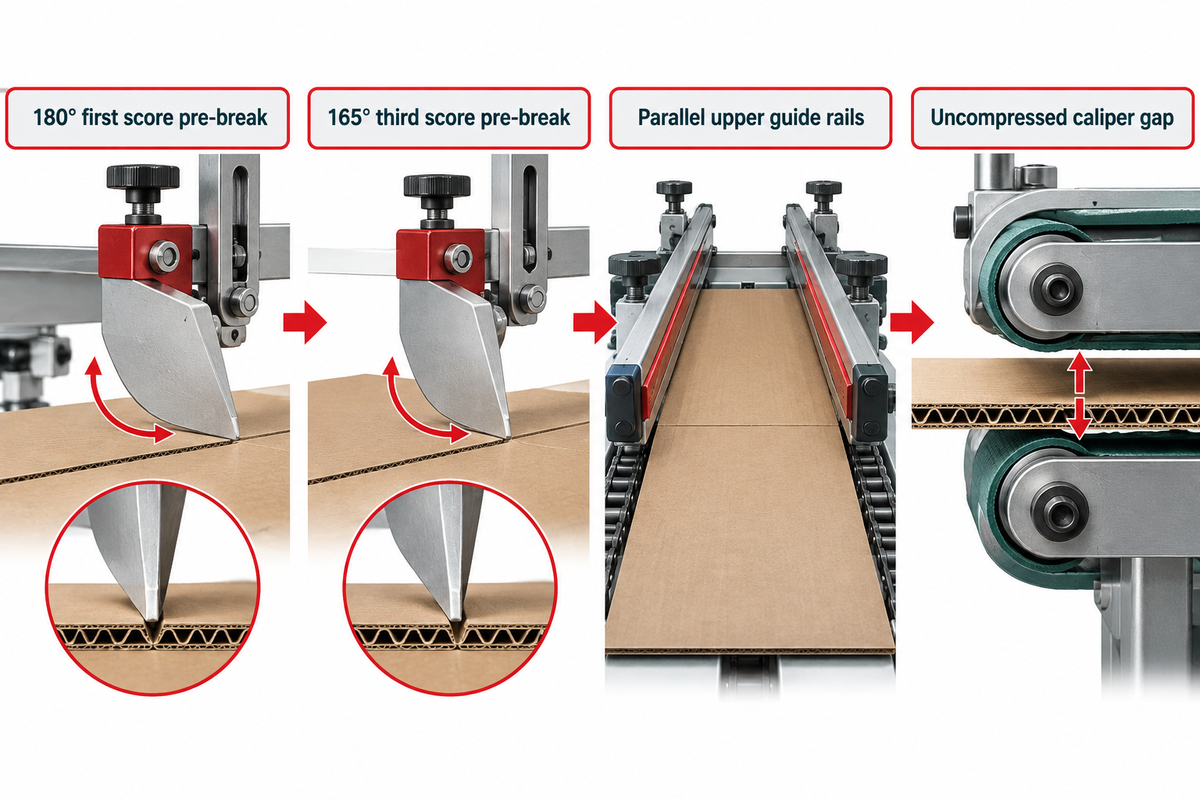
Running recycled E, B, C, or EB flute corrugated board requires pre-breaking the first score at 180° and the third score at 165° (Cenwan CW-W PCW 400 mm stack). Operators also align the upper belt guide rails parallel to the centerline and avoid over-tightening the carrier belts.
How Do Flute Profiles and Recycled Liners Change Feeder and Carrier Settings?
Micro-flute (E and F) and heavy corrugated (B, C, and AB) blanks require 180° first score and 165° third score pre-folding angles to reduce crease spring-back. Operators pair these angles with synchronized upper and lower carrier belt gaps set to uncompressed sheet caliper. Over-tightening upper carrier belts crushes flutes and accelerates belt wear.
E-commerce packaging production uses testliner and medium with high recycled content. Compared to virgin Kraft paperboard, recycled corrugated cardboard absorbs moisture unevenly, leading to S-warp in the stack and higher paper dust at the feeder gate. On a corrugated folder gluer like the Cenwan CW-W PCW series (400 mm feeder stack height), pre-folding happens in two stages. Pre-breaking the first score at 180° and the third score at 165°, reduces crease memory in thick corrugated boards. Properly die-cut cartons then open more reliably on automated fulfillment lines.
Carrier belt geometry and nip pressure govern box squareness and Edge Crush Test (ECT) retention in folding-gluing operations. According to FoldingGluing.com’s calibration guide, a non-parallel condition of just 0.3 mm over 1 meter of upper folding belt length produces out-of-square boxes and 3,000 boxes rejected per 100,000 boxes per shift. Technical guidance from American International Machinery also warns against over-tightening upper carrier belts to stop sheet slip. Excess belt pressure crushes corrugated flutes, requires frequent belt replacement, and prevents optimal performance.
Thickness changes between micro-flute and heavy double-wall blanks also shift the safe speed window. When converting heavy corrugated board between 600 and 800 gsm on a crash-lock gluer, plants moderate line speed below lighter paperboard settings. This controlled production flow prevents flap tearing and stops bottom lock spring-back. Springing back of the lock happens during a humidity change, which also effects the fibers of the board. This is why most operators verify final nip gaps on warped E, B or EB sheets rather than on the virgin kraft sheets.
| Substrate & Flute Profile | Pre-Folding Score Angles | Carrier Belt & Guide Setting | Operating Speed Window |
|---|---|---|---|
| Solid Paperboard (180–500 gsm) | 180° first fold and 135°–165° third fold. | Keep upper folding rails parallel to centerline and match belt tension. | Up to 400 m/min on straight-line CW-G series. |
| Micro-Flute E & F Corrugated | 180° first fold and 165° third fold pre-break. | Set gap to uncompressed caliper. Avoid over-tightening carriers. | 150–250 m/min on crash-lock bottom mailers. |
| Heavy B, C & AB Flute (600–800 gsm) | 180° first fold and 165° third fold (400 mm stack height). | In the USPTO US8512803B2 tapered-guide example, 4.8 mm narrowest gap on a 5.0 mm sheet. | Up to 200 m/min straight-line; moderate crash-lock speed against spring-back. |
Cold Glue vs. Hot-Melt Extrusion: Which Adhesive System Prevents E-Commerce Seam Pop-Opens?
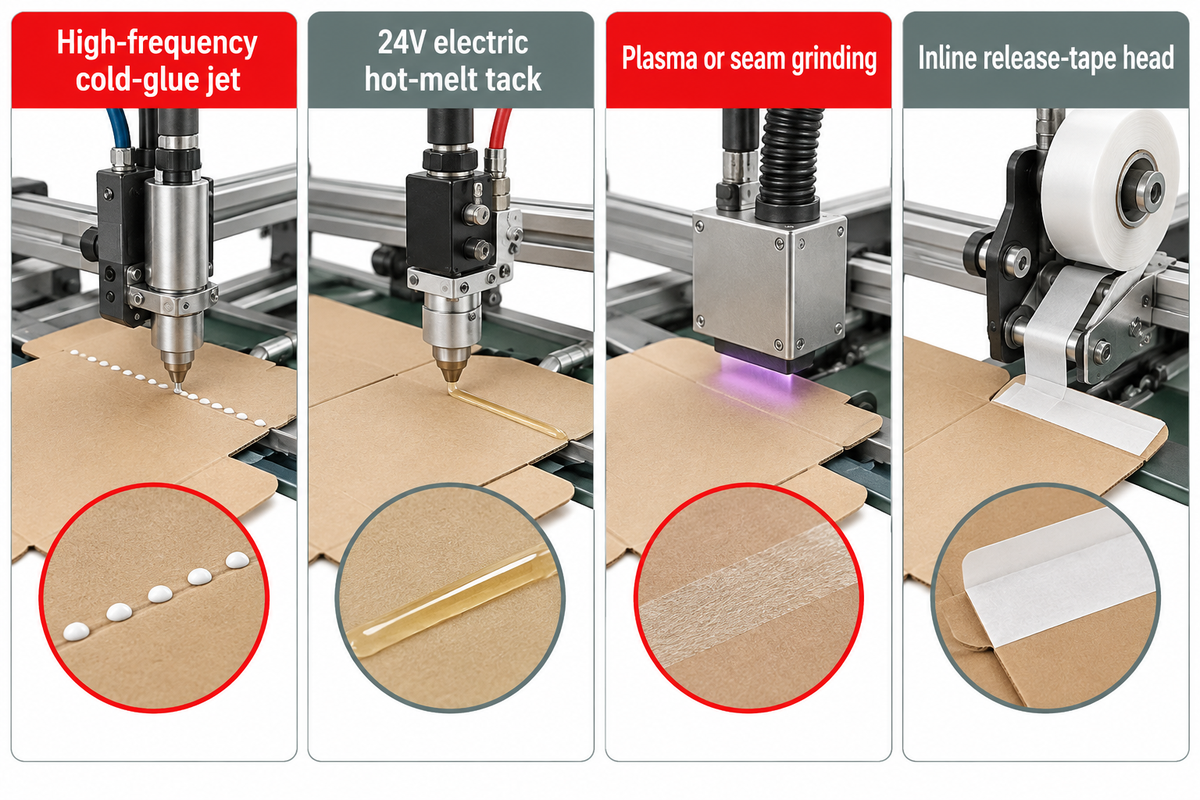
Dual cold-glue and electric hot melt systems provide pop-open seam prevention on corrugated mailers and D2C boxes. Hot-melt at compression exit provides instant tack, while the final bond is effected by the 500-1000 cps cold glue, which cures over time.
When Should You Combine Cold Glue and Hot-Melt on an E-Commerce Line?
Use an electric hot-melt gun along with a polyvinyl acetate (PVA) cold-glue system during frequent changeovers (5-15 min on Cenwan full-servo straight-line gluers vs. 120-240 min on cam units, or 10-15 min manual straight-line vs. 25-35 min manual crash-lock setup in Sinosun’s industry comparison) to combat spring-back on corrugated or coated D2C boards. On aqueous-coated or laminated blanks, dual gluing can be accomplished with an unvarnished glue reserve strip, inline plasma treatment and seam-grinding.
Using a cold glue system alone for crash-lock cartons can cause popped joints for thick B-flute boxes. Hot melting every seam can soften the adhesive and increase costs for delivery. Using both a cold glue system and a hot-melt gun solves this problem during the folding and gluing process. In this continuous process, a high-frequency cold-glue jet head works alongside an electric hot-melt tacking valve. You can see nozzle layout examples in our folder gluer adhesive and glue system selection guide.
More efficient use of adhesive is possible with precision jetting vs. the use of open wheels or pneumatic solenoid valves. Cold-glue heads like the Baumer hhs PX 1000 are able to run adhesives with viscosities up to 4500 mPaS at 750 Hz switching cycles. When glue is applied in stitched dots rather than a continuous wheel line (which runs at 500 to 1000 cps), plants reduce cold-glue volume significantly. In Packaging World’s Line 4 case-former study, the use of 24V electric valves reduced hot-melt use from 9.9 g/case to 4.95 g/case and paid for itself in less than 6 months.
“In tests carried out on the Line 4 OCME case former, which operates at a speed of 18 cases/min (1,080 cases/hour), the pneumatic valves consumed an average of 1.65 grams of adhesive per valve, totaling 9.9 grams per case with six valves.”
Packaging World, Coca-Cola’s Topo Chico Innovates in Case Gluing and Sealing
In that same six-valve Line 4 comparison, switching to Valco Melton EcoStitch 24V electric valves lowered reported case consumption to 4.95 g/case, a 50% reduction from the 9.9 g/case pneumatic baseline. If your plant uses pneumatic hot-melt solenoids, adhesive supplier H.B. Fuller specifies keeping incoming air pressure to the solenoid above 50 psi to prevent valve lag and pop-opens. For returnable mailers requiring inline tape, the KY-35T tape applicator (5 to 35 mm width) runs at up to 80 m/min. The KY-20T tear-strip head (3 to 20 mm width, 15 W) runs at up to 70 m/min with ±2 mm placement tolerance.
| Bonding / Sealing System | Operating Parameter & Rating | Documented Consumption & Accuracy | Best E-Commerce Box Application |
|---|---|---|---|
| High-Frequency Cold Glue Jet (Baumer hhs PX 1000) | Up to 4500 mPaS viscosity and 750 Hz switching cycles (standard wheel: 500–1000 cps). | Applies stitched cold-glue dots at high frequency across the glue lap. | Uncoated kraft RSCs, crash-lock glue flaps, and high-speed folding carton runs. |
| 24V Electric Hot-Melt Valve (Valco Melton EcoStitch) | 24V electric actuation (Line 4 test). Pneumatic solenoids require >50 psi air. | 4.95 g/case reported total vs. 9.9 g/case pneumatic baseline (1.65 g/valve across 6 valves; 50% reduction). | Instant tack on high-spring-back B/EB-flute crash-lock and dual-glue seams. |
| Inline Tape & Tear-Strip Heads (KY-35T / KY-20T) | KY-35T: 5–35 mm width, 80 m/min. KY-20T: 3–20 mm width, 70 m/min, 15 W. | ±2 mm front-to-back and lateral placement tolerance across full speed range. | FEFCO 0427 peel-and-seal returnable e-commerce mailers and pouches. |
How Do Feeder, Pre-Folding, and Squaring Stations Prevent Fishtailing?
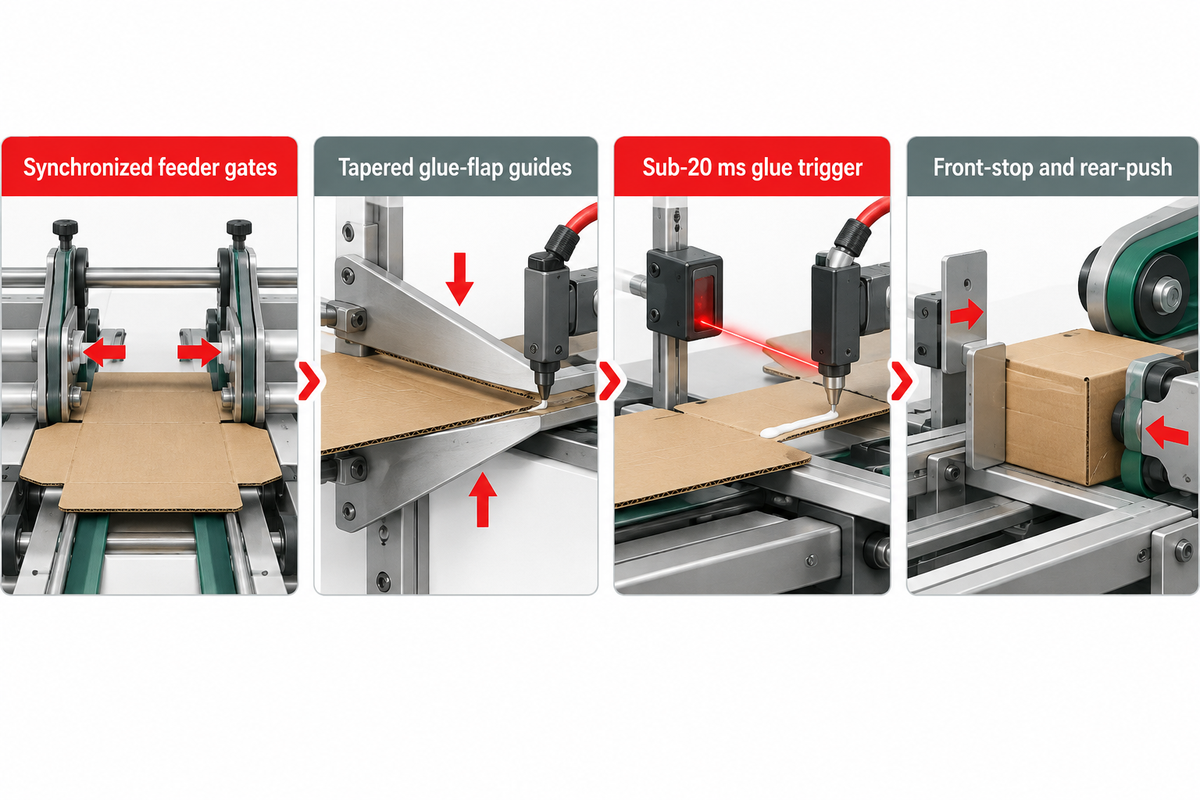
Tapered glue-flap guide plates (such as the 4.8 mm narrowest gap on a 5.0 mm corrugated sheet in USPTO Patent US8512803B2) eliminate fishtailing during glue application. Dual-action front-and-rear squaring stations keep ± 0.5 mm alignment, and sub-20 ms photoelectric glue triggers prevent out-of-square joints at 300 boxes/min.
How Do Feeder, Pre-Folding, and Squaring Stations Prevent Fishtailing?
Synchronized feeder gates, tapered glue-tab guides (such as the 4.8 mm gap for a 5.0 mm sheet in US8512803B2) and dual-action squaring stations eliminate blank twist before compression. Maintaining cold-glue viscosity at 500 to 1000 cps and sensor trigger delay below 20 ms prevents unglued seams at 300 boxes/min.
When e-commerce corrugated cartons show a wider gap at the top of the joint than at the bottom (“fishtailing”), operators often blame die-cutting. In practice, most skew starts inside the gluing machine between the feeder gate, the glue station, and the squaring unit. According to USPTO Patent US8512803B2 (Mitsubishi Heavy Industries), the lower contact of a glue gun creates a reaction force that deflects the corrugated sheet. To prevent twisting, an upper and lower guide plate are employed. In the patent’s configuration, when the corrugated sheet thickness is 5.0 mm, the narrowest gap between the upper and lower guide plates is set to 4.8 mm.
Electronic timing at the gluing station creates a second class of defective products. In the cited calibration case, a 20 ms photoelectric sensor delay at a 300 boxes/min rate corresponded to a 3 mm shift in the glue pattern at the glue head. That 3 mm shift causes weak seams or internal glue squeeze-out that sticks the carton interior together. Standard automatic folder gluer (cold glue) viscosity should be between 500 and 1000 cps to strike a balance between bond strength and wrinkling of the thinner liners.
At the end of the production process, corrugated board still has a lot of energy. A single squaring pass is often not enough to hold +- 0.5 mm through the compression zone. The best way to keep heavy mailers square is to combine front-stop and rear-push squaring with the pneumatic compression belt. Our Station-by-Station folder gluer verification and adjustment process can help operators synchronize the belt speed, inspection systems, and compression pressure for a consistent product.
| Observed Carton Defect | Originating Machine Station | Measured Failure Mechanism | Quantitative Calibration Target |
|---|---|---|---|
| Fishtailing (tapered manufacturer’s joint) | Upper folding belt rails and glue-tab guide plates. | Contact glue-gun reaction force tilts unconstrained corrugated glue flap. | Keep upper rails within 0.3 mm/m parallelism; in the US8512803B2 tapered-guide example, 4.8 mm gap on 5.0 mm sheet. |
| Glue squeeze-out or unglued leading edge | Photoelectric trigger sensor and glue wheel or gun. | In the published calibration guide example, a 20 ms trigger delay at 300 boxes/min shifts the glue pattern by 3 mm. | Compensate encoder lead time and maintain cold-glue viscosity at 500–1000 cps. |
| Out-of-square folded body on thick board | Squaring section and pneumatic compression entry. | Single squaring pass fails to hold ±0.5 mm under heavy corrugated spring-back. | Engage front-stop plus rear-push squaring before the pneumatic compression zone. |
Standalone Specialty Folder Gluer vs. Inline Flexo Folder Gluer: Which Fits Your Order Mix?
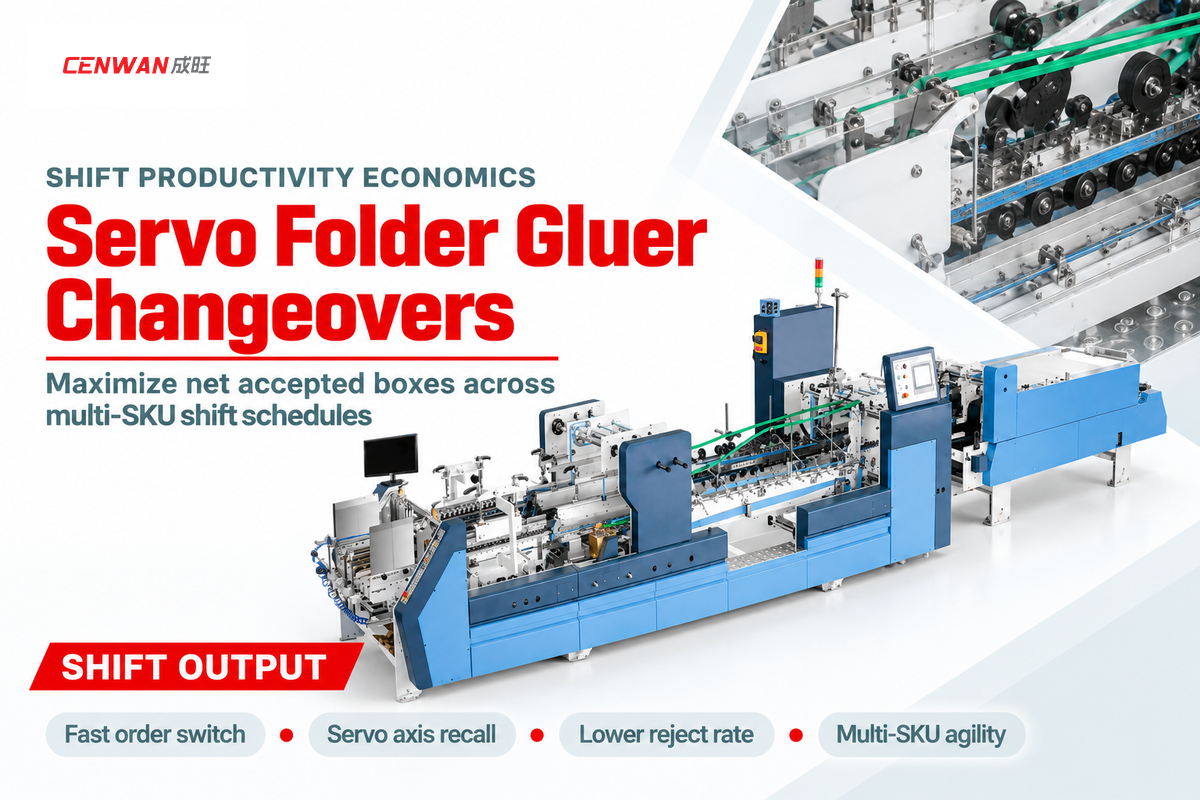
Inline flexo folder gluers fit single-size FEFCO 0201 runs above 100,000 boxes per shift, whereas standalone servo specialty folder gluers fit multi-SKU die-cut crash-lock and returnable mailers. Full-servo automation cuts straight-line changeover from 120–240 minutes on mechanical cam units to 5–15 minutes.
How Do Setup Time, Packing Limits, and Configuration Drive Cost and Shift Output?
Shorter changeovers and automated delivery strapping increase net accepted cartons per 480-minute shift and reduce unit labor costs. Blank width (650–1650 mm) and folding modules drive machine price from $45,000–$180,000 on standalone Cenwan lines to $350,000–$600,000 on Dual-Channel lines. Full-machine payback is calculated from shift minutes recovered and scrap avoided, whereas electric hot-melt valve retrofits paid back in under 6 months in Packaging World’s Line 4 test.
Plant managers evaluating an automatic folder gluer often focus too much on the catalog speed of the machine. In the real world, net accepted cartons per 480-minute shift follow three variables: changeover downtime for production runs, high-speed defect rates, and manual labor bottlenecks at delivery. Traditional manual wrench setups and slow hand-packing erase nameplate speed advantages. See our EU PPWR packaging compliance timeline for carton plants to learn how the 2030 50% empty-space cap will reshape box orders. As brands adopt more right-sized footprints, changeovers within a plant will increase.
According to Cenwan’s straight-line engineering data on production methods and production efficiency, mechanical cam-type straight-line folder gluers take between 120 and 240 minutes to complete a changeover. Full-servo motor-and-connecting-rod systems compress that window to 5 to 15 minutes and drop dimensional changes below 5 minutes. Standard straight-line gluers use 3 to 4 stations with 10 to 15 minute manual changeovers, 300 to 400 m/min belt speeds, and output above 100,000 cartons per shift. Crash-lock bottom gluers use 6 to 8 stations with 25 to 35 minute manual changeovers, 150 to 250 m/min belt speeds, and 40,000 to 80,000 cartons per shift.
Maximizing the catalog speed of a crash-lock gluer increases flap defects and rework in folding gluing operations. Crash-lock bottom gluers are run at sub-maximum speeds to allow operators to manage interlocks. When run at maximum speed, defects increase, requiring more rework sorting. Blank rotations in one pass can be an issue when boxes require e-commerce type integrated structures. The GYROBOX module, as noted in TLMI’s report on the BOBST EXPERTFOLD 165 e-commerce platform, can rotate blanks at up to 250 m/min. Cenwan’s Dual-Channel Integrated Line can run e-commerce boxes at up to 240 m/min.
480-Minute Shift Net-Accepted-Box Crossover Model (5-Job Crash-Lock Schedule)
compare manual wrench setup against full-servo memory recall across a 480-minute shift running 5 crash-lock jobs (4 order switches) at 150 cartons/min:
- Line A (Manual Crash-Lock Setup at 30 Min/Switch): 4 order switches x 30 min manual changeover (25-35 min benchmark midpoint) = 120 min setup downtime. This leaves 360 net running minutes. At 150 cartons/min (54,000 gross cartons) – 5,400 over-speed rejects, Line A yields 48,600 net accepted cartons per shift.
- Line B (Use of Fully Automatic Servo Memory Recall at 10 Min/Switch): 4 order switches x 10 min servo changeover (5-15 min full-servo midpoint) = 40 min setup downtime. This leaves 440 net running minutes (+80 extra production minutes). At 150 cartons/min (66,000 gross cartons) – 1,650 controlled-speed rejects, Line B yields 64,350 net accepted cartons per shift (+15,750 accepted cartons per shift).
| Shift Parameter | Standard Straight-Line Line | Line A: Manual Crash-Lock | Line B: Full-Servo Crash-Lock |
|---|---|---|---|
| Stations & Setup Architecture | 3–4 stations; manual or servo rail setup. | 6–8 stations; manual wrench adjustment. | 6–8 stations plus motorized servo axis recall. |
| Changeover Time per Order Switch | 10–15 min manual (120–240 min on legacy cam). | 25–35 min manual crash-lock adjustment (30 min model). | 5–15 min full-servo (10 min model; <5 min dimensional). |
| Net Running Time (4 Switches / 480-Min Shift) | 420–440 min (at 10–15 min per switch). | 360 min (120 min setup downtime across 4 switches). | 440 min (40 min setup downtime across 4 switches). |
| Gross Output at 150 Cartons/Min Reference | 300–400 m/min continuous straight-line run. | 54,000 gross cartons (360 min × 150 cartons/min). | 66,000 gross cartons (440 min × 150 cartons/min). |
| Net Accepted Output & Reject Volume | >100,000 cartons per shift. | 48,600 accepted cartons (after 5,400 over-speed rejects). | 64,350 accepted cartons (after 1,650 rejects; +15,750 net gain). |
Scope note: This 480-minute shift model uses published changeover benchmarks for a 5-job schedule at 150 cartons/min. Plant shift output varies with blank pitch, daily SKU count, and delivery end packing crew or auto-bundler capacity.
How Should Buyers Evaluate Manufacturers and Verify Performance at FAT?
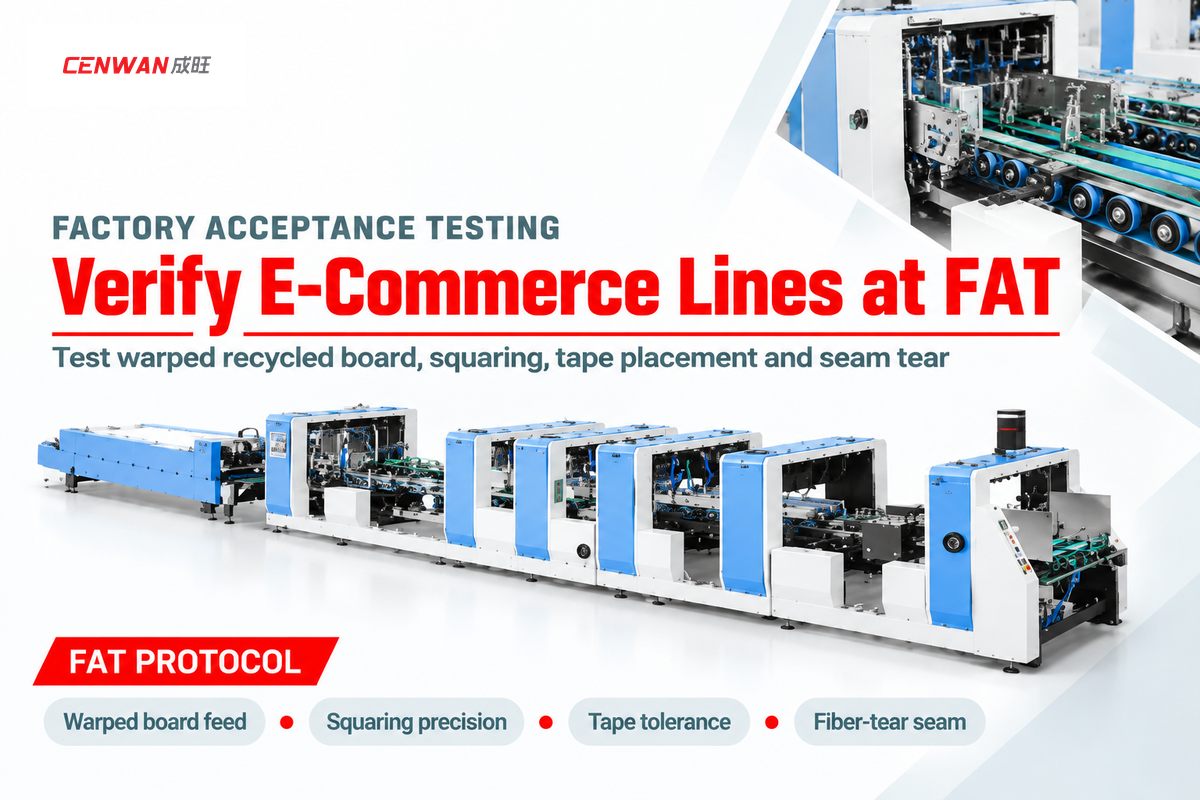
BOBST, Heidelberg, Koenig & Bauer Duran, American International Machinery, and Cenwan Machine supply e-commerce folder gluers. Published Cenwan FOB Ningbo/Shanghai price bands span $45,000 to $180,000 for standalone machines and $350,000 to $600,000 for Dual-Channel lines. Require a 5-gate Factory Acceptance Test (FAT) verifying warped blank feeding, ±0.5 mm squaring, ±2 mm tape placement, full fiber-tear glue bonds, and 5–15 minute full-servo straight-line changeover recall.
Which Manufacturers Fit E-Commerce Profiles and What Belongs on Your FAT Checklist?
Global tier-1 builders (BOBST, Heidelberg, Koenig & Bauer Duran, and AIM Signature) fit multi-shift plants seeking custom-quoted 400–450 m/min lines. Cenwan Machine ($45,000–$180,000 standalone; $350,000–$600,000 Dual-Channel) fits converters seeking documented FOB pricing. Our 5-gate FAT checklist tests warped blank feeding, ±0.5 mm squaring, ±2 mm tape placement, full fiber tear per TAPPI T 840 om-10 / T 813, and 5–15 minute full-servo straight-line recall.
When evaluating the best manufacturers for corrugated e-commerce converting, clients match capital tiers to volume and check each builder’s suggested products by width and module class. BOBST and Heidelberg/MK Diana, Koenig & Bauer Duran and American International Machinery (AIM) Signature folder gluers are the main European and North American suppliers. B & R Moll Inc. is the main supplier of specialty pocket/mailer gluers, while Alliance Machine Systems is the main supplier of pre-feeders and bundlers for high volume automated production. WhatTheyThink’s report on the Koenig & Bauer Duran Omega Allpro 90 mentions straight-line, double-wall, crash-lock, and single-finger servo 4/6-corner production at 400 m/min.
In the Chinese OEM tier, Cenwan Machine’s high-speed folder gluer catalog organizes stand-alone machines across the CW-M Entry tier, CW-G Flagship high-speed automatic tier, and CW-W Intelligent Servo tier. On that same Cenwan high-speed series specification page, custom-engineered Dual-Channel Integrated Lines serve single-pass multi-module converting. Published FOB price bands cover base configurations across working widths (650 to 1650 mm), servo axis counts, glue/tape heads and destination country’s electrical standard. The payback period for the full machine isn’t fixed by a single constant and is estimated from your plant’s daily changeover savings and labor rates.
You shouldn’t accept a factory video filmed on flat virgin kraft paperboard if your plant runs recycled corrugated e-commerce boxes. Send your own die-cut corrugated blanks to the builder’s floor and run the 5-Gate E-Commerce Carton FAT Verification Protocol below. The validation protocol involves the completion of TAPPI T 840 om-10 (for evaluating adhesives in glued lap joints) and TAPPI T 813 (tensile test for the finished manufacturer’s joint) . Completion of the trials prior to the EU PPWR general application date of 12 August 2026 (effective 11 February 2025) demonstrates your line’s capability for multi-SKU changeover.
5-Gate E-Commerce Carton FAT Verification Protocol
| FAT Verification Gate | Test Blank & Operating Condition | Measured Acceptance Target |
|---|---|---|
| Gate 1: Warped Recycled Board Feeding & Pre-Break | 400 mm feeder stack of buyer’s recycled E, B, and AB flute blanks. | Continuous feeding without jams. 180° first fold and 165° third fold with zero flute crush. |
| Gate 2: Crash-Lock & 4/6-Corner Squareness | FEFCO 0701 crash-lock run; 4/6-corner tray run at 180 m/min servo speed. | Hold ±0.5 mm squaring precision through the compression zone via dual-stage squaring. |
| Gate 3: Inline Peel-and-Seal Tape & Tear Strip | FEFCO 0427 returnable mailer with KY-35T (80 m/min) and KY-20T (70 m/min). | ±2 mm front-to-back and lateral placement tolerance. Intact release liner. |
| Gate 4: Cold/Hot Glue Seam & TAPPI Joint Integrity | 500–1000 cps cold glue plus electric hot-melt tack (>50 psi air if pneumatic). | Keep trigger delay <20 ms (avoiding the 3 mm pattern shift cited at 300 boxes/min); verify 100% fiber tear per TAPPI T 840 om-10 and TAPPI T 813. |
| Gate 5: Timed Multi-SKU Changeover Recall | Live straight-line order switch on full-servo motor-and-rod configuration. | 5–15 min full-servo straight-line changeover (<5 min dimensional recall) to first square carton. |
Validate Your E-Commerce Dielines on a Live Cenwan Folder Gluer
Send us your unfolded CAD drawings, flute profiles (E, F, B, C or EB), and daily SKU changeover goals. Our engineering team will configure the exact CW-G or CW-W station, and run a video-documented trial on your blanks.
Frequently Asked Questions
How do I verify whether a used folder gluer can run modern e-commerce crash-lock mailers before purchasing?
Test-run 500 warped recycled E-flute and B-flute crash-lock blanks on the used machine before buying.
During the live trial, verify upper folding rail alignment (within 0.3 mm per meter) and check the squaring section holds ±0.5 mm. Check the frame for mounting clearance to add 80 m/min release tape heads. Also, verify if legacy cam adjustments will take 120 to 240 minutes per changeover.
What limits net line speed when applying peel-and-seal adhesive tape and tear strips inline on a folder gluer?
Cut-and-place applicators like the KY-35T and KY-20T limit returnable e-commerce mailers to a speed of 70-80 m/min.
While a base folder-gluer frame runs 200 to 400 m/min on straight-line cartons, the KY-35T double-sided release-tape applicator (5 to 35 mm width) is rated up to 80 m/min. The KY-20T tear-strip applicator (3 to 20 mm width, 15 W) achieves 70 m/min. Both applicators hold a ± 2 mm front to back and left to right placement tolerance at that speed. Therefore, converters set shift output at 70 m/min based on the combined limit of the applicators rather than un-loaded belt speed.
How does the EU Packaging and Packaging Waste Regulation (PPWR) change folder gluer requirements for e-commerce box plants?
Regulation (EU) 2025/40 limits empty space in e-commerce, grouped, and transport packaging to 50% by 2030.
The regulation will take effect on February 11, 2025 and be enforced from August 12, 2026, after a transitional period of 18 months. When fulfillment brands order more right-sized box footprints to reduce void fill, 5 to 15 minute full-servo straight-line changeovers protect shift running time.
How many operators are needed at the delivery end of an automatic e-commerce folder gluer?
Manual hand-collecting, turning, and strapping at the delivery conveyor of an automatic folder gluer requires 2 to 3 packing personnel for a shift of 40,000 to 80,000 crash-lock cartons.
When a high-speed line runs straight-line boxes above 100,000 cartons per shift, manual packing becomes the primary bottleneck. Packing becomes the major constraint, so operators slow the belt speed to below the machine’s capability. Packing can be automated by using a combination of a fully automatic box turner, a counter-ejector, and an inline strapping bundler to bundle at the compression exit. Packing operators will then not need to hand turn and strap the bundles.
Can a folder gluer process aqueous-coated or laminated D2C subscription boxes without glue seam failure?
Yes, provided the glue flap uses a bare reserve strip or inline surface prep.
If dielines lack an unvarnished glue window, equip the pre-folding section with a mechanical seam grinder to abrade the coating or an atmospheric plasma treater to increase surface energy. Couple that prep with an electric hot-melt tack bead and a 500 to 1000 cps cold glue line tested under TAPPI T 840 om-10 and TAPPI T 813.
What information should be included in the Request for Quotation (RFQ) package sent to a folder gluer supplier?
Include 1:1 unfolded CAD dielines for your smallest, largest, and most complex FEFCO box styles along with flute calipers, board gsm range, and daily SKU changeover frequency. Specify whether your e-commerce mailers require crash-lock hooks or 4/6-corner servo arms (180 m/min servo ceiling).
State whether you need inline peel-and-seal tape and tear-strip heads (70 to 80 m/min ceiling on KY-20T and KY-35T units). Also provide plant voltage, compressed air (50 psi minimum for glue solenoids), desired delivery strapping layout, warped blanks, and your 5-gate FAT scope.
When should a converter add an inline stitcher to a corrugated e-commerce folder gluer line?
Add an inline stitcher for heavy double wall bulk containers or specifications requiring wire-stitched seams.
Standard D2C parcel mailers in E, F or B flute (180 to 800 gsm) use cold-glue or hot-melt adhesive bonding to avoid metal wire staples. An inline gluer-stitcher is used for heavy-duty automotive and bulk industrial shipping boxes, which require mechanical wire stitching.
Why We Write This
This specification guide integrates mechanical engineering data from our CW-G and CW-W folder gluer commissioning logs across corrugated e-commerce mailer plants. We compare those factory benchmarks with FEFCO structural standards, TAPPI joint test methods and EU PPWR laws. Our focus is to allow carton converters to evaluate machine widths, servo changeover times and inline tape speeds with respect to math that’s as transparent as possible. Edited and reviewed by Zhejiang Chengwang Intelligent Packaging Equipment (Cenwan Machine) technical team.
References & Sources
- FEFCO Code 12th Version: International Fibreboard Case Code for Retail and E-Commerce European Federation of Corrugated Board Manufacturers (FEFCO)
- Regulation (EU) 2025/40 on Packaging and Packaging Waste (50% Empty-Space Ratio Rule) EUR-Lex / Official Journal of the European Union
- Coca-Cola’s Topo Chico Innovates in Case Gluing and Sealing (Electric vs. Pneumatic Hot-Melt Valve Study) Packaging World
- Pack Expo Packaging Technologies Report: Compact Hot-Melt and Tape Case Sealers – Packaging Digest
- US Patent US8512803B2: Folder Gluer and Method for Manufacturing Corrugated Box – United States Patent and Trademark Office (USPTO) / Mitsubishi Heavy Industries
- BOBST Launches New E-Commerce Version of EXPERTFOLD 165 Folder-Gluer Tag and Label Manufacturers Institute (TLMI)
- Koenig & Bauer Duran Installs First North American Omega Allpro 90 Folder Gluer WhatTheyThink
- TAPPI T 840 om-10 & TAPPI T 813: Testing Adhesives and Tensile Strength in Glued Lap Joints of Corrugated Containers Technical Association of the Pulp and Paper Industry (TAPPI)
- EU Packaging and Packaging Waste Regulation: New Compliance Requirements for E-Commerce – Greenberg Traurig LLP